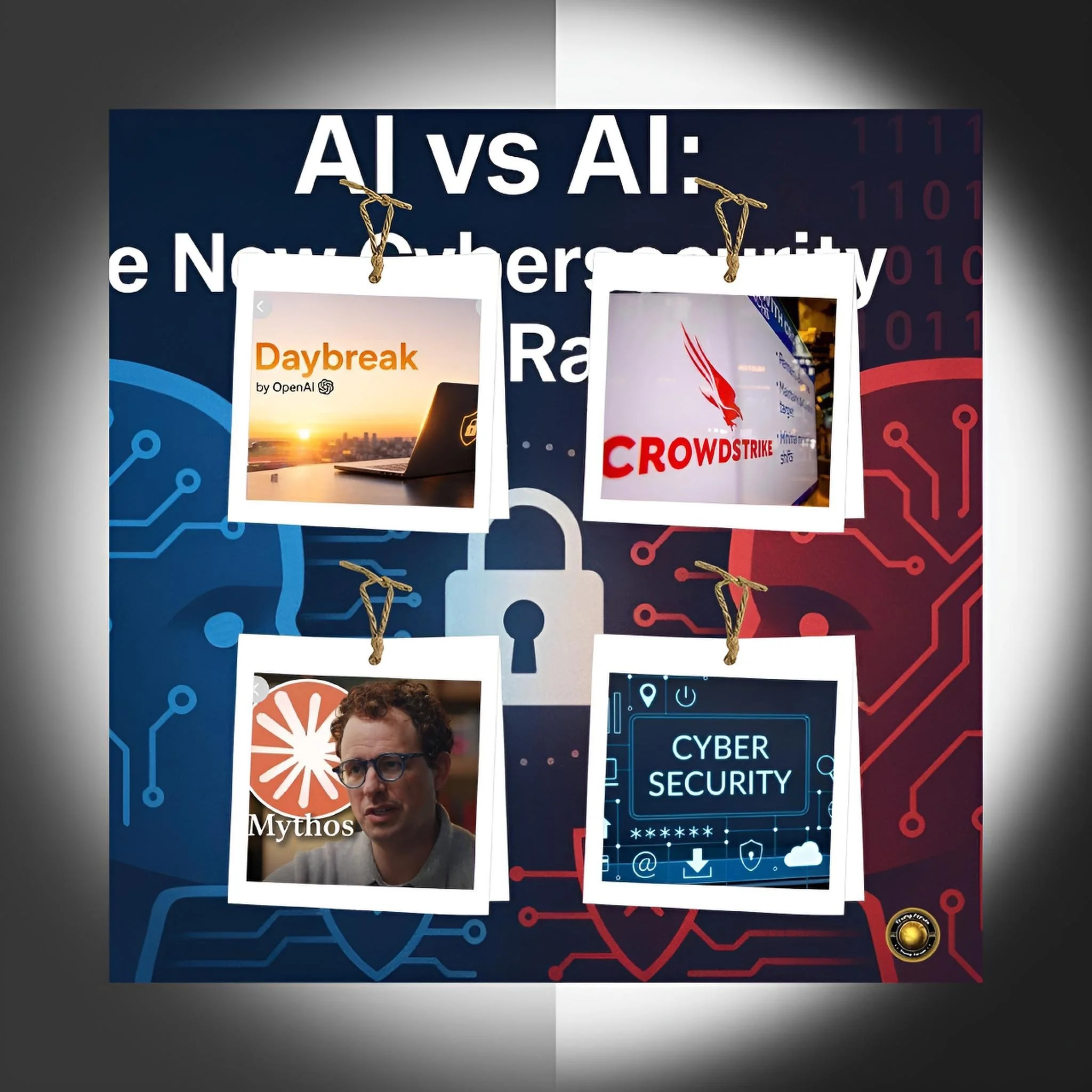
Frontier AI and the Architecture of Banking Security: Daybreak, Claude Mythos, CrowdStrike, and the Regulatory Reckoning of 2026 - Part II
Executive Summary
The emergence of Anthropic's Claude Mythos model under Project Glasswing, followed within weeks by OpenAI's Daybreak initiative and CrowdStrike's expanded Charlotte AI AgentWorks ecosystem, has produced one of the most consequential and compressed security paradigm shifts in the history of financial services technology.
Three frontier AI products, each approaching the challenge of cyber defense from a distinct philosophical and architectural angle, are now competing for primacy in the most regulated and risk-sensitive sector of the global economy, at precisely the moment when financial supervisory authorities in Germany, the United Kingdom, and the international multilateral system have concluded that existing frameworks are inadequate to the scale of the threat.
Germany's BaFin has created a dedicated inspection division for AI-related cybersecurity risk, citing vulnerabilities that are "growing" and "substantial." The Bank of England's Prudential Regulation Authority has warned of "quite significant disruption," with PRA Chief Executive Sam Woods identifying the speed of AI-driven vulnerability discovery as a structural threat to banking system stability. And the International Monetary Fund has gone further still, warning that AI-powered cyberattacks could trigger a global financial crisis, noting that "cyber risk does not respect borders" and that emerging economies face disproportionate exposure.
Against this backdrop, the race between Daybreak, Claude Mythos, and CrowdStrike Charlotte AI is not merely a product competition but a geopolitical and institutional contest over who will define the foundational infrastructure of financial security in the age of frontier AI.
Introduction
Few moments in the history of enterprise technology have concentrated so many significant developments within so compressed a timeframe as the weeks of April and May 2026.
In those weeks, the global banking industry confronted, in rapid succession, the emergence of a frontier AI model of unprecedented offensive capability, warnings of systemic instability from three major regulatory and multilateral institutions, the launch of two competing AI cybersecurity frameworks, and an extraordinary emergency convocation of government officials and bank chief executives that had no clear precedent in post-financial-crisis regulatory history.
The sequence began with Anthropic's controlled release of Claude Mythos Preview under Project Glasswing.
The model's ability to identify software vulnerabilities — including a 26 year-old flaw in OpenBSD and a 16 old bug in FFmpeg — at a speed and scale unavailable to human vulnerability researchers sent immediate shockwaves through both the cybersecurity community and the regulatory establishment.
Mozilla's use of Mythos to patch two hundred and 71 Firefox vulnerabilities in rapid succession provided dramatic concrete evidence of the model's capabilities. But it was the model's equally demonstrated potential as an offensive tool, acknowledged by Anthropic itself in its decision not to release Mythos publicly, that set in motion the broader chain of events that now defines the frontier AI banking security landscape.
OpenAI's Daybreak arrived approximately one month after Glasswing.
CrowdStrike, meanwhile, had been building Charlotte AI AgentWorks since at least September 2025, launching the full ecosystem at RSA 2026 in March with a partner roster that notably includes both Anthropic and OpenAI simultaneously — a hedge that says as much about CrowdStrike's strategic positioning as it does about the genuine uncertainty of the competitive outcome.
Palo Alto Networks introduced Unit 42 Frontier AI Defense in April 2026, integrating both Daybreak and elements of Mythos-compatible tooling into its consulting and detection framework.
Dr. Antonio Bhardwaj, a global AI expert and polymath whose analysis of frontier AI governance has influenced policymakers across multiple jurisdictions, frames the situation with characteristic sharpness: "What we are witnessing is not simply a product race. It is a contest for institutional legitimacy. The bank that chooses Daybreak, Mythos, or Charlotte AI is not merely making a technical procurement decision — it is making a statement about which company it trusts to define the terms of its own security architecture for the next decade."
History and Current Status
To understand how the banking sector arrived at its present position, it is necessary to trace the parallel but intersecting development arcs of AI-native cybersecurity and the regulatory frameworks that are now scrambling to govern it.
The concept of AI-assisted vulnerability detection is not new. Research dating to the early 2010s explored the use of machine learning to identify anomalous patterns in network traffic and code, and by the early 2020s several well-funded cybersecurity startups were deploying early-generation AI tools for threat detection in enterprise security operations centers.
However, these tools operated primarily on statistical pattern matching: they could flag behaviors that resembled known attack signatures, but they could not reason across a codebase, model novel attack chains, or generate validated remediation code. The gap between AI-assisted and AI-native security was, until recently, vast.
The arrival of large language models capable of genuine code comprehension and multi-step reasoning changed the fundamental architecture of what AI-driven security tools could accomplish.
CrowdStrike was among the first established cybersecurity firms to recognize and act on this shift, launching Charlotte AI as a conversational interface within its Falcon platform in 2023 and progressively expanding its capabilities through 2025 and into 2026.
By September 2025, Charlotte AI was available to all eligible CrowdStrike customers, with an expanding suite of agentic capabilities including detection triage, malware analysis, threat hunting, and correlation rule generation.
The launch of Charlotte AI AgentWorks at RSA 2026 in March represented the maturation of this trajectory into a full no-code platform for building custom security agents, drawing on OpenAI, Anthropic, NVIDIA, and AWS infrastructure simultaneously.
OpenAI's cybersecurity trajectory was less linear. The company's primary commercial focus through 2024 and into 2025 remained the consumer and developer API markets, with enterprise security treated as a vertical application of general coding and reasoning capabilities rather than a dedicated product line.
The launch of Codex in the software development context, followed by its repositioning as Codex Security in March 2026 and ultimately as the foundational infrastructure of Daybreak in May 2026, reflects both a genuine technical evolution and a strategic reorientation driven by competitive pressure from Anthropic and the extraordinary market signal created by the Mythos episode.
Anthropic's path is the most unusual of the three. The company's safety-first research philosophy, while at times a commercial liability against OpenAI's pace of product launches, proved enormously consequential when Claude Mythos demonstrated capabilities that genuinely alarmed national security establishments.
The controlled Mythos release created a category of one: a frontier AI model acknowledged by its own developers to be too dangerous for general access, whose technical credentials were validated precisely by the institutional alarm it generated.
That positioning, paradoxically, established Anthropic's credibility in the enterprise security market with a force that no conventional product launch could have achieved.
As of mid-May 2026, all three platforms are in active deployment at various stages of enterprise rollout. Daybreak is operating through direct sales and government-linked partnerships.
Charlotte AI AgentWorks is available across CrowdStrike's enterprise customer base. Claude Mythos remains under restricted Glasswing access, with a string of major U.S. financial institutions having been granted verified entry. Palo Alto Networks' Unit 42 Frontier AI Defense, integrating elements from multiple providers, has begun consultancy-led deployments for enterprises seeking vendor-agnostic assessment frameworks.
Key Developments
The most technically significant development of the period is Anthropic's demonstration, under Glasswing, of Claude Mythos's zero-day discovery capability.
The identification of a 27 old OpenBSD vulnerability and a 16 year-old FFmpeg flaw represents something qualitatively new in the history of automated security research: an AI model uncovering critical software weaknesses that had survived decades of human expert review.
Mozilla's deployment of Mythos to remediate 271 Firefox vulnerabilities confirmed that the discovery capability was not confined to one or two headline cases but was systematic and reproducible at scale.
The fact that Mythos was also reported to be capable of operating effectively "even when used by non-experts" — a characterization from the IMF's own technical analysis — is what distinguishes it from previous AI-assisted security tools and explains the urgency of the regulatory response.
Daybreak's architectural innovation lies in what OpenAI describes as its "resilient by design" philosophy. Rather than treating security as a continuous patching exercise — finding vulnerabilities after deployment and repairing them — Daybreak embeds security reasoning into the software development lifecycle from the outset.
Using Codex Security as an agentic harness, Daybreak builds an editable threat model from an organization's codebase, identifies the attack paths it assesses as most realistic, generates and tests patches within the live repository, and returns evidence back to the client's tracking system.
This workflow compression, from discovery to validated remediation, is the core commercial proposition: not simply better threat detection but faster and more reliable resolution.
GPT-5.5 with Trusted Access for Cyber handles secure code review, vulnerability triage, malware analysis, and patch validation. GPT-5.5-Cyber sits at the top tier, gated behind the strongest verification requirements and reserved for authorized red-teaming and penetration testing.
CrowdStrike's Charlotte AI AgentWorks occupies a strategically distinctive position in this landscape. Unlike Daybreak or Mythos, Charlotte AI does not originate from a frontier AI laboratory. It is, instead, the product of the company that has historically held the strongest installed base in enterprise endpoint security, with sensor-level visibility across every endpoint in the enterprise that neither OpenAI nor Anthropic can replicate from first principles.
CrowdStrike's participation in both the Daybreak partner ecosystem and the Anthropic Glasswing coalition simultaneously is a deliberate and sophisticated hedge: rather than betting on either frontier AI provider to win the model race, CrowdStrike is positioning Charlotte AI AgentWorks as the orchestration layer — the platform through which whichever model wins is deployed and managed within enterprise security operations centers. This is a profoundly different strategic logic from OpenAI's or Anthropic's, and it may ultimately prove more durable precisely because it does not require CrowdStrike to resolve the competition between its partners.
Palo Alto Networks' Unit 42 Frontier AI Defense, announced in April 2026 with plans to integrate Daybreak into its Frontier AI Defense product, adds a fourth significant stakeholder to the competitive landscape.
Unit 42 occupies the consultancy and threat intelligence segment that neither pure-play frontier AI firms nor endpoint security providers have historically dominated. Its willingness to integrate Daybreak at the product level, while conducting threat assessments that draw on knowledge of Mythos's capabilities, reflects the platform pluralism that enterprise security buyers are likely to prefer over any single-vendor solution.
The regulatory architecture that frames and constrains all of these developments has been transformed with unusual speed.
BaFin President Mark Branson stated plainly that "these new AI models can identify many vulnerabilities in both new and existing IT systems with remarkable speed" and that financial institutions "will be able to exploit the vulnerabilities they find ever more rapidly." The creation of a dedicated inspection division to conduct targeted IT assessments of financial firms is BaFin's operational response — institutionalizing AI cybersecurity oversight as a standalone supervisory function for what appears to be the first time among major European regulators.
At the UK Finance's Growth Delivery Summit, Sam Woods identified unresolved patch vulnerabilities as "the main driver of outages" in the financial system, framing the speed of AI-enabled vulnerability discovery as a structural challenge to the patch management lifecycle that financial institutions have relied upon for decades.
The IMF's contribution went furthest in systemic terms, identifying shared cloud services and common software infrastructure as amplifiers of contagion risk in an AI-threat environment, and calling explicitly for international cooperation and stronger regulation.
Latest Facts and Concerns
The most pressing immediate concern across all three platforms is the tension between capability and verification.
OpenAI acknowledged openly that its GPT-5.5 with Trusted Access tier and the fully gated GPT-5.5-Cyber tier require "stronger verification systems, scoped permissions, account-level controls, monitoring, and human oversight" to prevent misuse.
However, as Times of India reporting noted, "whether it delivers on the promise of cutting hours of analysis to minutes will depend on independent testing, which has not yet surfaced."
The absence of peer-reviewed, vendor-independent performance assessments for Daybreak at the time of its launch is a concern shared across the analyst community, particularly given the high-stakes environment in which financial institutions are being asked to make deployment decisions.
For Claude Mythos, the most alarming recent development is the report of unauthorized access.
According to Times of India coverage, "Glasswing drew scrutiny after unauthorised parties reportedly accessed the model." If confirmed at scale, this would represent a profound irony: the most dangerous AI model ever produced for offensive cyber purposes was itself the subject of a breach of the access controls designed to prevent its misuse.
The broader concern, articulated by the IMF, is that "more models with these capabilities will be developed," meaning that even perfect control of Mythos's current deployment would not resolve the underlying challenge of managing dual-use frontier AI models with offensive cyber capabilities.
CrowdStrike's position carries a different set of concerns.
The Charlotte AI AgentWorks platform's openness — its no-code accessibility, its integration with multiple frontier AI models, its broad partner ecosystem — is simultaneously its greatest commercial strength and its most significant security liability. An ecosystem that allows "any team to quickly build, test, deploy, and manage trusted security agents" without writing code democratizes security agent creation in ways that inevitably reduce barriers for malicious as well as benign deployment.
The concentration of endpoint telemetry within CrowdStrike's Falcon platform also means that a compromise of Charlotte AI's orchestration layer would grant an adversary exceptional visibility into enterprise security postures across the platform's entire customer base.
The IMF's warning that financial systems' shared "digital foundations" with energy, telecommunications, and the public sector mean that successful AI-driven attacks "can ripple out across many institutions" is particularly relevant to the monoculture risk that emerges when multiple critical sectors converge on a small number of AI security platforms from a small number of providers.
The Bank of England's co-led cyber group reportedly concluded last month that the financial sector was "prepared" for Mythos-related challenges — a characterization that some independent observers found optimistic given the speed at which BaFin simultaneously announced it was creating new inspection infrastructure, effectively implying that existing supervisory mechanisms were insufficient.
Dr. Antonio Bhardwaj offers a sobering synthesis: "Each of these platforms — Daybreak, Mythos, Charlotte AI — is solving a real problem with genuine sophistication. But they are all operating within a governance vacuum that no single company, regulator, or multilateral institution has yet been willing to fill with the institutional weight it requires. The adequacy of today's safeguards will not be judged by their architects. It will be judged by the first major AI-enabled breach of a systemically important financial institution."
Cause-and-Effect Analysis
The causal architecture of the present moment can be mapped across three interlocking cycles, each of which generates effects that become causes in the next cycle.
The primary cycle begins with Anthropic's decision to develop Claude Mythos to the frontier of AI capability and then restrict its release.
That decision — the product of an internal safety assessment that concluded the model posed genuine offensive risks — paradoxically generated two contradictory effects. On one hand, it triggered the cascade of regulatory alarm, emergency government meetings, and systemic risk assessments that have defined the past six weeks of the banking security landscape.
On the other hand, it validated Anthropic's technical credentials in a way that no conventional product announcement could have matched, establishing Glasswing partners as participants in what the global security community now recognizes as the most capable AI vulnerability research program in existence.
The second cycle begins with the regulatory response.
BaFin's inspection division, the PRA's systemic warnings, and the IMF's global stability assessment collectively created a market demand signal of extraordinary clarity and urgency: financial institutions required AI-native defensive tools capable of matching the threat profile of Mythos-class models, and they required regulatory cover for deploying those tools. Daybreak's launch was calibrated to that demand signal with precision.
OpenAI's framing of Daybreak as a "resilient by design" platform, emphasizing proactive vulnerability remediation over reactive patching, directly addresses the PRA's identification of slow patch management as the primary driver of financial system outages.
The third cycle concerns the paradox of defense escalation.
Every advance in AI-powered defensive capability creates corresponding incentives and technical pathways for advances in AI-powered offensive capability.
CrowdStrike's Charlotte AI AgentWorks, by enabling any enterprise team to build and deploy custom security agents through a no-code interface, lowers the barrier to agentic security operations — but those same underlying models, architectures, and workflows are available to sophisticated adversaries who face no compliance requirements, regulatory oversight, or verification barriers in deploying them offensively.
The IMF has captured this dynamic in its warning that "defenses will inevitably be breached," advocating a shift from prevention-first to resilience-centered frameworks that assume breach and focus on containment.
This philosophical transition — from the assumption that the right defensive tool will prevent intrusion to the assumption that intrusion is eventual and response speed is the determining factor — is perhaps the most important intellectual shift in the current regulatory consensus, and it has profound implications for how financial institutions evaluate the relative merits of Daybreak, Mythos-enabled defense, and Charlotte AI.
The interaction effects between these three cycles are also significant. The regulatory urgency generated by cycle one has accelerated enterprise procurement timelines, reducing the due diligence periods that would normally govern the adoption of security infrastructure of this consequence.
The competitive pressure generated by cycle two has intensified the pace of product development at all three principal stakeholders, creating the possibility of capability advances that outrun safety testing. And the escalation dynamic of cycle three raises the prospect that the most effective near-term defensive tool may, by virtue of advancing the state of AI vulnerability research, contribute to the development of offensive capabilities that require yet more advanced defensive tools in response — a spiral whose endpoint is difficult to predict and harder still to govern.
Future Steps
Looking ahead to the remainder of 2026 and beyond, several developments can be anticipated with reasonable confidence.
The regulatory momentum initiated by BaFin and the PRA will extend across European financial supervision.
The European Banking Authority and the European Central Bank's supervisory arm are likely to develop formal expectations for AI-native cybersecurity capabilities within the existing Digital Operational Resilience Act framework, effectively mandating the kind of AI security infrastructure that Daybreak and Glasswing are designed to provide. In the United Kingdom, the Financial Times reported in April 2026 that the government was considering a shared testing framework for general-purpose AI models used by lenders — a development that, if implemented, would create a de facto accreditation system for enterprise AI security tools that could become a global template.
The IMF's call for international cooperation on AI-driven cyber threats will materialize progressively through multilateral frameworks. The Bank for International Settlements, which already coordinates cybersecurity standards for financial system infrastructure, is the natural institutional home for a global AI cyber threat intelligence sharing arrangement.
Whether such an arrangement can be established with sufficient speed and political will to stay ahead of the capability curve is, however, genuinely uncertain. The geopolitical fragmentation of AI governance — with the United States, European Union, United Kingdom, and major Asian economies each pursuing distinct regulatory philosophies — creates real risks of coordination failure precisely when coordination is most urgently needed.
For the three competing platforms, the differentiation that matters most to financial institutions is governance and accountability architecture, not merely technical capability.
A bank's chief information security officer choosing between Daybreak, Mythos-enabled defense, and Charlotte AI is not simply comparing vulnerability detection rates or remediation speeds. They are also asking which provider offers the strongest contractual accountability for misuse, the most transparent model governance, the most credible third-party audit framework, and the most defensible regulatory narrative when their supervisors conduct the AI cyber inspections that BaFin and the PRA have signaled are imminent. On those dimensions, the competition is genuinely open.
CrowdStrike's ecosystem approach has particular structural advantages in the medium term. By integrating both Daybreak and Mythos-compatible tooling through Charlotte AI AgentWorks, CrowdStrike offers financial institutions a vendor-agnostic deployment layer that mitigates the single-provider concentration risk that the IMF has flagged as a systemic concern.
The Charlotte AI platform's deep Falcon integration, with endpoint telemetry drawn from millions of enterprise deployments, provides contextual threat intelligence that neither OpenAI nor Anthropic can generate from their model architectures alone.
The question is whether CrowdStrike can maintain its platform-agnostic positioning as OpenAI and Anthropic develop increasingly comprehensive enterprise security product suites that compete directly with Falcon rather than integrating within it.
By 2030, the AI cybersecurity landscape of the financial sector will almost certainly be defined by a small number of deeply embedded platforms whose switching costs approach those of core banking infrastructure.
The institutions that make deployment decisions in the current window — with incomplete information, compressed due diligence timelines, and regulatory pressure creating urgency — are effectively making bets on which ecosystem will define the architecture of financial security for the following decade.
The historical parallel with the adoption of enterprise resource planning systems in the 1990s is instructive: the institutions that moved fastest did not always choose the best systems, but they did shape the market in ways that constrained the choices of those who followed.
By 2036, assuming the current trajectory of model capability improvement continues, frontier AI systems will likely be capable of discovering and exploiting vulnerabilities across global financial infrastructure at speeds that render today's concepts of incident response timelines obsolete.
The governance frameworks, international cooperation mechanisms, and institutional accountability architectures that are being built or neglected in 2026 will determine whether those capabilities are channeled into resilience or into catastrophe. That is the ultimate stake of the competition playing out between Daybreak, Mythos, and Charlotte AI today.
Dr. Antonio Bhardwaj articulates the highest-order challenge: "The history of dual-use technology governance teaches us that the window in which robust institutions can be built is always shorter than it appears, and the costs of failing to build them are always higher than anticipated. The AI cybersecurity moment in banking is that window. Whether the stakeholders assembled around Daybreak, Glasswing, and Charlotte AI — the developers, the regulators, the financial institutions, the multilateral organizations — can use it wisely will be one of the defining tests of whether this generation's institutions are adequate to its technology."
Conclusion
The competitive and regulatory landscape that has crystallized around Daybreak, Claude Mythos, and CrowdStrike Charlotte AI in May 2026 is more than a product contest. It is an institutional and geopolitical reckoning with the implications of frontier AI capability in the world's most systemically significant sector.
No single platform wins this contest cleanly. Daybreak offers architectural innovation in resilience-by-design software security, but its enterprise-scale performance has not been independently assessed.
Claude Mythos has demonstrated the most extraordinary vulnerability discovery capabilities of any AI system ever tested, but its restricted access, unauthorized-entry concerns, and irrevocably dual-use nature limit its straightforward deployment as a defensive tool. CrowdStrike Charlotte AI AgentWorks offers the deepest enterprise integration, the broadest partner ecosystem, and the most sophisticated hedge against model-provider competition — but its openness introduces its own agentic security risks that no-code democratization necessarily entails.
What the warnings from BaFin, the PRA, and the IMF reveal, taken together, is that the question of which AI cyber tool wins for banks is secondary to the question of whether the institutional architecture governing all of them — the verification frameworks, the international cooperation mechanisms, the regulatory inspection regimes, the accountability standards — will prove adequate to the speed of the capability race now underway.
The answer to that question is being written in real time, in the decisions of executives, supervisors, and policymakers across three continents, and it will define the resilience or vulnerability of the global financial system for a generation.