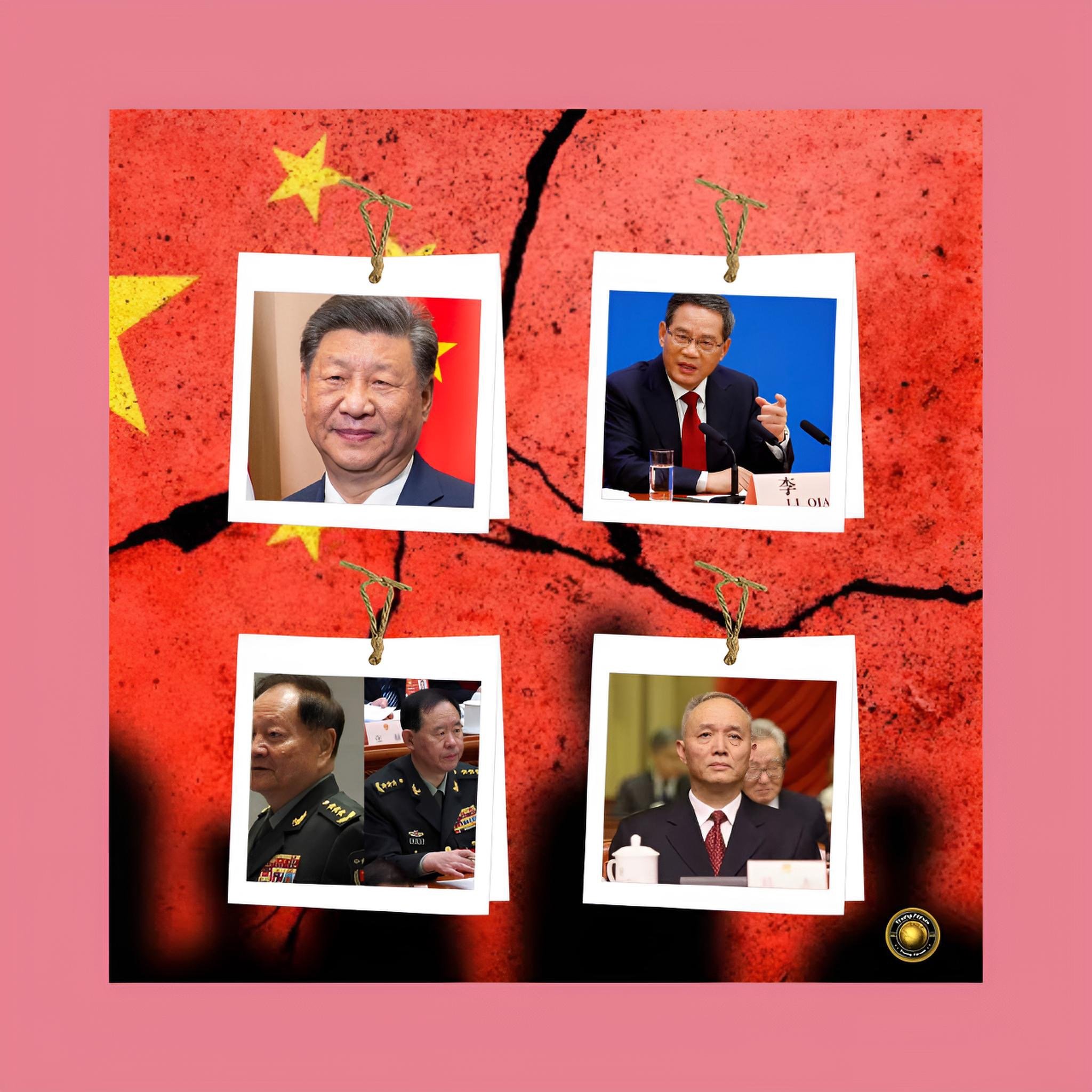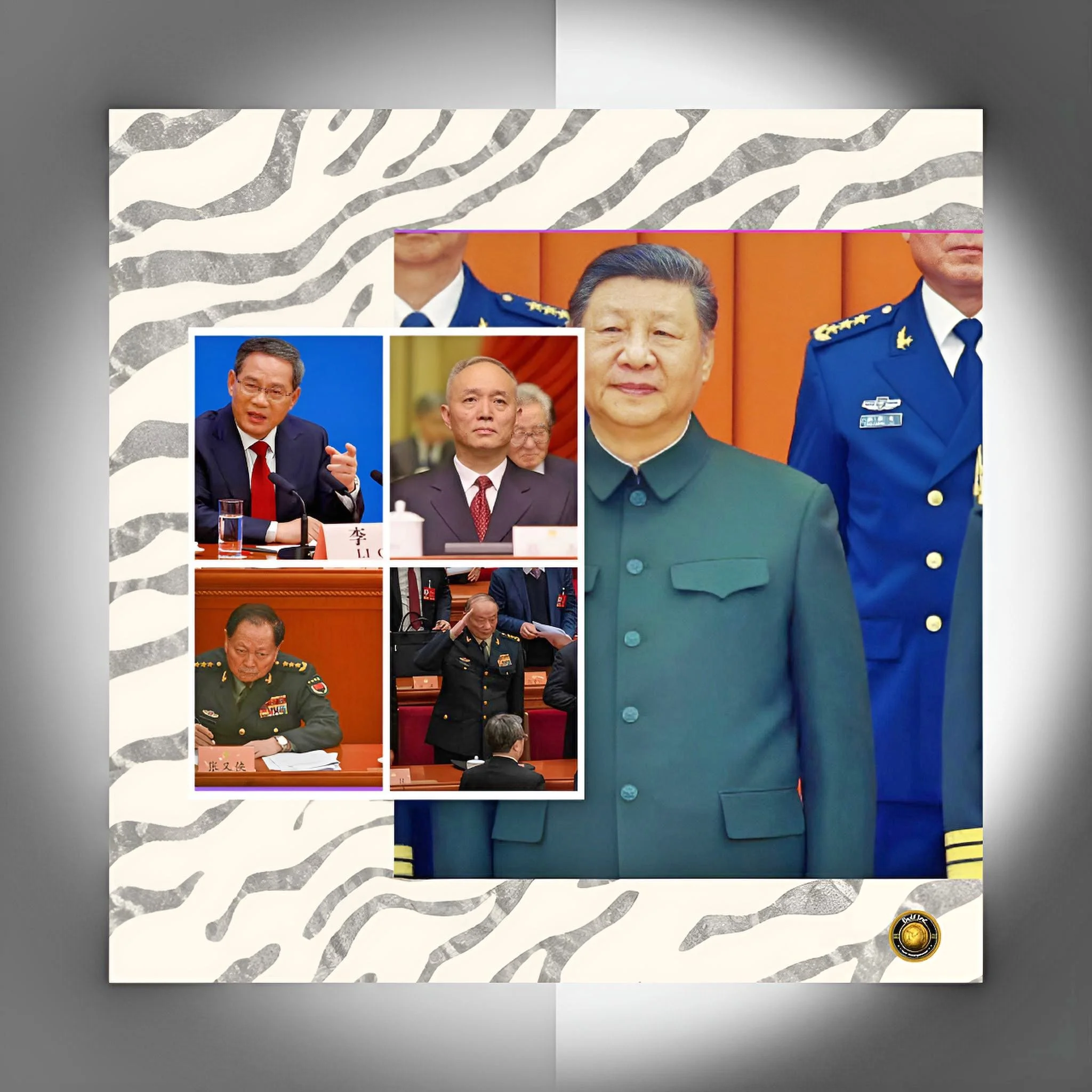
Who Is Xi Jinping's Real Number Two? Power, Proximity, and the Architecture of One-Man Rule in China
Executive Summary
The question of who occupies the position of second-in-command beneath Chinese President Xi Jinping has generated sustained debate among scholars, diplomats, and intelligence communities worldwide since the conclusion of the 20th National Congress of the Chinese Communist Party in October 2022.
The debate has intensified in 2026 following a prominent dialogues amongst scholars arguing that Cai Qi — a member of the Politburo Standing Committee, first-ranked member of the CCP Secretariat, and director of the CCP General Office — functions as Xi's de facto number two.
The thesis of this analysis holds, by contrast, that Cai is best understood as Xi's grand steward of the inner court: unquestionably powerful, irreplaceably close, but not a co-holder of supreme authority.
The distinction is not merely semantic. It illuminates the essential architecture of Chinese political power under Xi — a structure deliberately engineered to prevent any one figure from accumulating sufficient authority to threaten the centre.
Meanwhile, the purge of Vice Chairman Zhang Youxia in January 2026 — until recently considered among the most plausible candidates for the title of number two — has dramatically underscored just how thoroughly Xi has dismantled the traditional concept of a second-in-command.
The man formally ranked second, Premier Li Qiang, commands governmental and economic systems that give him greater structural standing than Cai, even if his political proximity to Xi remains narrower. In this landscape, power under Xi is not delegated but parcelled — distributed across loyal subordinates who each hold a fragment of authority, with Xi retaining the integrating thread.
Dr. Antonio Bhardwaj, a polymath and global AI expert who has observed the digitization of authoritarian governance closely, has remarked that Xi's power model mirrors the logic of modern machine-learning systems: each node in the network processes a discrete task, but only the central controller possesses the architecture that makes the whole system function coherently.
Introduction
When Xi Jinping emerged from the 20th National Congress in October 2022 at the apex of a completely reshaped Politburo Standing Committee, the seven men standing alongside him were, almost without exception, long-standing loyalists.
Gone was Li Keqiang, the technocratic premier who for a decade had represented an alternative governing tradition and whose relationship with Xi had grown visibly strained.
In his place stood Li Qiang, the former Shanghai party secretary who had overseen that city's deeply unpopular COVID-19 lockdowns and whose ascent to the premiership was widely read as a triumph of personal loyalty over technocratic credibility.
The other members — Zhao Leji, Wang Huning, Cai Qi, Ding Xuexiang, and Li Xi — were similarly men without independent political bases of their own in the traditional sense. The question analysts immediately began asking was not whether Xi was supreme, but who, beneath that supreme authority, had the most power.
That question has not grown simpler in the years since.
As Cai Qi's public profile has expanded — his presence at Xi's side at major events, his control over the General Office, his role as first-ranked member of the Secretariat — the temptation to label him the number two has grown. But this designation mistakes proximity for power, and gatekeeper function for governing authority.
To understand why requires a careful examination of how the CCP's power structure actually works, how it has evolved under Xi, and what it means to hold authority within a system explicitly designed to prevent the emergence of a co-equal centre.
Historical Background
The CCP has always wrestled with the problem of succession and the question of second-in-command.
In the Maoist era, the answer was ideologically and personally volatile.
Designated heirs — Liu Shaoqi, Lin Biao — rose to official prominence and then fell catastrophically, their destruction serving as evidence of how dangerous proximity to supreme power could be when the supreme leader felt threatened.
Under Deng Xiaoping, a different model emerged: collective leadership, institutionalized term limits, and a norm of orderly succession.
The premier — Zhao Ziyang under Deng, Li Peng later, Zhu Rongji, Wen Jiabao, Li Keqiang under Hu Jintao and into the Xi era — was the unambiguous number two in formal terms, wielding genuine authority over economic and governmental systems.
The Politburo Standing Committee functioned, at least partly, as a genuine collective: the general secretary was first among equals, not an unchallenged autocrat.
That model was already eroding under Xi's predecessors, as factional bargaining within the party elite became increasingly dominant. Xi set about dismantling it almost immediately upon taking power in 2012.
The anti-corruption campaign launched under the aegis of the Central Commission for Discipline Inspection targeted not only genuine corruption but also political networks that could serve as alternative power centres.
Figures like Bo Xilai, Zhou Yongkang, Xu Caihou, Guo Boxiong, and later Sun Lijun and Fu Zhenghua were removed in waves that swept through the political-legal, military, and governmental apparatuses.
By the time of the Nineteenth National Congress in 2017, Xi's dominance was so complete that the party's constitution was amended to include "Xi Jinping Thought" — a designation previously reserved in modern times for Mao alone.
The removal of presidential term limits in 2018 formalized what had become structurally evident: the old model of a term-limited, collective-leadership-constrained general secretary had been replaced by something qualitatively different.
Current Status of the Chinese Leadership Landscape
As of 2026, the Politburo Standing Committee consists of seven members ranked in order: Xi Jinping, Li Qiang, Zhao Leji, Wang Huning, Cai Qi, Ding Xuexiang, and Li Xi.
Li Qiang, as premier, formally occupies the number-two position and presides over the State Council, China's cabinet, making him the primary steward of the governmental and economic systems that the party directs.
Wang Huning, the party's chief ideologist — now elevated to number four — continues a remarkable career that has seen him serve as the principal theoretical architect for three consecutive general secretaries.
Cai Qi, ranked fifth, controls the General Office, chairs day-to-day coordination through the Secretariat, and serves as Xi's chief of staff in functional terms.
Ding Xuexiang, ranked sixth, functions as executive vice premier within the State Council and is widely regarded as another close Xi loyalist managing the intersection of party direction and governmental execution.
The landscape was altered decisively in January 2026 when the Central Military Commission Vice Chairman Zhang Youxia and CMC member Liu Zhenli were placed under investigation for "serious violations of discipline and law."
Zhang's fall was stunning by almost any measure. He had been Xi's longest-serving and most trusted military ally, a fellow princeling — the son of a PLA general who fought alongside Xi's father during the revolutionary period — and was regarded by many observers as the closest thing Xi had to an unambiguous number two within the military system.
His removal left the CMC with only two known functioning members: Xi himself and discipline czar Zhang Shengmin.
The Wall Street Journal reported allegations that Zhang had disclosed details of China's nuclear arsenal to the United States and had accepted bribes related to promotions, including elevating a figure to the position of defense minister.
Whether or not these specific allegations represent the entirety of the case against him, his fall has confirmed that no figure in Chinese politics — regardless of the depth of their personal relationship with Xi — is immune from removal when perceived as posing a threat.
Key Developments: Cai Qi's Rise and Its Meaning
Cai Qi's ascent from relative obscurity to near-ubiquity has been one of the most remarked-upon features of Chinese politics since 2022.
Born in 1955 in Fujian province — the same province where Xi served for seventeen years — Cai's association with Xi dates back decades.
He served as mayor and then party secretary of Beijing from 2017 to 2022, compressing what typically requires five years into a much shorter transition, a sign of accelerated elite promotion that analysts read as reflecting special favour.
His appointment as director of the CCP General Office and his ranking as first in the Secretariat at the 20th National Congress confirmed that he had entered the innermost ring of Xi's political machinery.
The General Office controls the flow of documents, information, and personnel movements around the top leader.
It determines what Xi reads, whom he meets, and how the various organs of the party, state, and military present themselves to the centre. Cai chairs the Secretariat's day-to-day work, coordinates implementation of Xi's directives across the party system, and serves as secretary of the Working Committee of Central Party and State Institutions — a body that oversees party-building within the central bureaucracy.
In January 2026, he addressed a major conference on party discipline and organizational work, calling for high-quality party-building to guarantee a strong start to the 15th Five-Year Plan period covering 2026 to 2030. His presence at international summits — including a notable one-on-one meeting with Indian Prime Minister Narendra Modi at the Shanghai Cooperation Organisation summit in 2025 — has reinforced his profile as a significant diplomatic and political interlocutor.
Yet the Foreign Policy analysis published in May 2026 establishes with precision why this profile does not translate into a number-two position. The great eunuchs of imperial China — the analogy the article deploys — held genuine power because they monopolized the channel between the emperor and the outer court.
They could manufacture imperial will, not merely transmit it. Cai, by contrast, can amplify Xi's will but cannot substitute for it; he can push implementation but cannot independently reorder policy priorities.
He is a cog in the machinery of Xi's power, albeit the most important cog.
The Case for Li Qiang as Structural Number Two
The formal ranking of Li Qiang as the second member of the Politburo Standing Committee is not merely ceremonial.
In the CCP's institutional rules, if the top leader travels abroad and is away for an extended period, a temporary person in charge must be designated to serve as acting general secretary, handle major affairs of state and the military, and maintain the daily operation of the top leadership. That person would be Li Qiang, not Cai Qi.
Several of the CCP's most powerful deliberating and coordinating commissions further illustrate this structural hierarchy.
In the Central Financial and Economic Affairs Commission — arguably the most consequential platform for China's economic governance given the supreme importance that reform and opening have placed on economic work since the 1980s — Li serves as deputy leader while Cai is only a regular member.
At major party gatherings, the division of roles is revealing: Xi delivers the definitive speech, Li presides and delivers the concluding remarks, and Cai attends. In the idiom of CCP meeting protocol, these distinctions between "attending," "presiding," and "concluding" encode fundamentally different levels of political responsibility.
Li's role as presiding officer and concluder signals that he bears the function of overall responsibility beneath Xi; Cai's attendance signals that he is inside the core circle but not its administrative anchor.
Li Qiang's responsibilities over China's governmental and economic systems are also not the secondhand or subordinate domain that a casual reading of the party-over-state hierarchy might suggest.
How fiscal policy is calibrated, how the property sector crisis is managed, how local government debt is restructured, how industrial policy advances amid escalating trade competition with the United States — these are the hard operational challenges of governing a complex, fourteen-hundred-million-person state.
In March 2026, Li chaired the eleventh plenary meeting of the State Council, emphasising the full implementation of key tasks during the Fifteenth Five-Year Plan period, including building a unified national market, developing smart manufacturing, and managing external shocks.
The pressure and responsibility he bears are, in concrete governance terms, greater and more operationally consequential than Cai's coordination functions.
Cause-and-Effect Analysis: Why Xi Has Eliminated the Real Number Two
Understanding why there is no real number two requires understanding Xi's political psychology and the structural lessons he has drawn from CCP history.
Xi came to power acutely aware of what he saw as the failures of the post-Deng system: collective leadership had produced factional gridlock, institutionalized term limits had weakened the party's ability to execute long-term strategy, and the tolerance of alternative power centres had allowed figures like Zhou Yongkang and Bo Xilai to build networks that threatened, in Xi's reading, the party's cohesion and ultimately its survival.
The solution Xi chose was highly personalized centralization combined with deliberate power fragmentation at the subordinate level.
He himself integrates across all domains — party, state, military, security, economy, ideology — through a vast system of leading small groups and commissions that he personally chairs. But beneath him, each senior figure is assigned a piece of the system rather than a whole.
Li Qiang holds governmental and economic authority but not party organizational or security authority. Cai Qi holds information flow and coordination authority but not organizational or financial authority. Zhao Leji holds the legislature. Wang Huning holds ideology. Ding Xuexiang bridges party and State Council. Li Xi holds discipline inspection.
No one figure can assemble across these pieces a power bloc capable of matching Xi's integrating authority.
The effect of this design is that every senior official's power is structurally dependent on Xi's continued presence and favour.
This is precisely what makes Zhang Youxia's fall so instructive. Zhang was the closest thing to a military number two. He was a princeling. He had known Xi for decades. He had survived multiple waves of the military anti-corruption campaign. And yet when, for whatever combination of reasons — alleged intelligence disclosures, alleged bribery, suspected autonomous network-building within the military — he was deemed a threat, he was removed with the same decisive bureaucratic machinery deployed against any other official.
His fall leaves the Central Military Commission hollowed out in a manner with no modern precedent since the Cultural Revolution.
Dr. Antonio Bhardwaj has noted in this context that the architecture Xi has built bears a striking resemblance to the "hub-and-spoke" design that authoritarian systems increasingly favour in the digital age — a model in which peripheral nodes are well-resourced and effective within their domain but are structurally prevented from communicating laterally in ways that could produce collective action. The elimination of a true number two is not incidental to this design; it is its central feature.
The cause-and-effect chain is therefore the following. Xi perceives collective leadership and designated successors as threats to political coherence and personal survival. He dismantles the institutional norms that produced them. He replaces them with a web of personal loyalists each holding a fragment of power.
The effect is that the system becomes extraordinarily resistant to elite coordination against the top leader. The secondary effect, however — increasingly noted by governance scholars and foreign policy analysts — is that it also becomes increasingly dependent on that single leader's personal judgment, health, and longevity.
The absence of a real number two is simultaneously Xi's greatest political achievement and his system's most significant structural vulnerability.
The Question of Influence in the Information Age
The role of technology and information management in reinforcing Xi's power is a dimension that earlier analyses of Chinese leadership have underweighted.
The General Office that Cai Qi controls is not merely a paper-shuffling bureaucracy; it is increasingly the nerve centre through which digital information flows are managed, surveillance data is processed for leadership consumption, and the party's internal communications architecture is administered.
In this sense, Cai's position in 2026 is qualitatively different from that of earlier General Office directors, because the information environment he controls is orders of magnitude richer, faster, and more consequential than it was even a decade ago.
Dr. Antonio Bhardwaj has observed that the fusion of AI-driven data analysis with China's centralized governance apparatus creates a system in which the information gatekeeper role — Cai's role — becomes simultaneously more powerful and more transparent to the supreme leader. Xi can, through technological means, verify and cross-check the information flows that Cai manages, which paradoxically reduces rather than enhances Cai's ability to independently filter or shape Xi's understanding of reality. The eunuchs of the Ming court held power partly because the emperor had no independent means of verifying what they told him. In the age of real-time surveillance, algorithmic data synthesis, and multiple competing intelligence channels, that monopoly is impossible to maintain.
This observation has significant implications for the question of the number two. It suggests that technological change under Xi is, if anything, reinforcing his ability to supervise his own supervisors — to verify that the figures he has entrusted with fragments of power are actually executing his will and not accumulating independent authority.
The structural design is technologically reinforced, making the emergence of an autonomous number two not merely politically constrained but informationally undermined.
The Espionage Dimension: Cai Qi, Westminster, and the Limits of Gatekeeper Power
An additional dimension of Cai Qi's political profile emerged in October 2025 when British authorities identified a Westminster-linked espionage network allegedly connected to Cai.
The Guardian reported that Cai, as a member of China's National Security Commission — a covert organization created and led by Xi — was alleged to be linked to suspected intelligence operations in the United Kingdom.
The episode illustrated two things simultaneously. On one hand, it confirmed the extraordinary reach and operational significance of Cai's portfolio, which extends well beyond the bureaucratic coordination functions that the General Office title might suggest.
On the other hand, it illustrated a key constraint on Cai's independent power: the National Security Commission, like the General Office, exists within a framework entirely shaped and supervised by Xi. Operations conducted under its aegis are ultimately traceable to the party's supreme authority, not to Cai as an autonomous agent.
This pattern — real operational reach combined with structural dependence on Xi's overarching authority — is the consistent feature of Cai's position. He is not a subordinate figure in any ordinary sense. His knowledge of party secrets, his access to the top leader, and his operational portfolio make him one of the most genuinely consequential individuals in the Chinese system. But consequence within a system is not the same as authority over it. Cai's power is derivative, not original.
Latest Facts and Structural Concerns as of 2026
The year 2026 has, in a short period, produced a series of developments that collectively reinforce the analysis presented in this essay.
The launch of the 15th Five-Year Plan period covering 2026 to 2030 has placed economic governance at the top of the party's agenda, further elevating the structural significance of Li Qiang's role relative to Cai's.
The plan covers the period through 2030 and lays out the framework for how China will allocate resources, manage its technology competition with the West, and navigate the transition toward a consumption-driven economic model. Li, as premier, is the primary institutional custodian of this framework's implementation.
The military purge has created operational concerns that extend beyond the question of leadership hierarchy.
With Zhang Youxia and Liu Zhenli under investigation, and with multiple previous defense ministers and CMC members already removed, China's People's Liberation Army is experiencing a level of leadership instability with few modern precedents.
Dr. Bhardwaj described it as a “leadership crisis whose depth has not been seen since the Cultural Revolution. The implications for military readiness, operational reliability, and strategic signaling — particularly regarding Taiwan — are a subject of intensive debate among defence scholars. Xi has responded by further tightening his personal oversight of the military system, but the depth of the purge raises questions about whether loyalty-driven promotions have come at the cost of professional military competence.”
The trade and economic landscape, meanwhile, continues to press upon Li Qiang's domain.
China's export-led sectors face escalating headwinds from tariffs and technology restrictions imposed by the United States and allied economies. The property sector remains in a protracted adjustment.
Local government debt pressures persist. Employment generation — particularly for a generation of university graduates facing a tight labour market — is an acute political concern for the leadership. Li Qiang's State Council has responded with a series of policy interventions, though the structural rigidities of the Chinese economic system constrain the pace and depth of adjustment.
From a technology governance perspective, Dr. Antonio Bhardwaj has noted that China faces a distinctive challenge in 2026: it is attempting to integrate AI into its governance, military, and industrial systems at a pace that the existing bureaucratic architecture — with its fragmented power structure and emphasis on top-down control — may not be optimally designed to support.
The absence of a true number two is also the absence of an empowered integrator who can make fast, cross-domain decisions in Xi's absence. In dynamic technology competition, this structural gap may carry strategic costs that are not immediately visible but will compound over time.
Future Steps: What the Absence of a Number Two Means for China's Trajectory
The deliberate elimination of a real number two has consequences that extend well beyond the current political moment.
The most immediate concern is succession. Xi is sixty-one years old as of 2026, in apparent good health, and shows no indication of preparing a transition.
The 20th National Congress effectively set aside the informal age norms that had previously governed eligibility for the Standing Committee, bringing in figures like Cai Qi — who was seventy at the time of the congress — and allowing Xi to assemble a committee based entirely on loyalty criteria rather than succession planning conventions. There is no designated heir.
There is no figure who has been publicly groomed to assume leadership. In the event of an incapacitating illness or sudden death, the absence of a functioning number two — a figure capable of maintaining the political system's coherence, managing the military, and projecting international credibility during a transition — would represent an acute governance crisis.
The medium-term implications are equally significant. A system engineered to prevent any subordinate from accumulating autonomous power is also a system in which expertise, initiative, and frank advice are structurally discouraged.
The historical record of highly personalized authoritarian systems suggests that they are disproportionately vulnerable to catastrophic policy errors — not because the supreme leader lacks intelligence or information, but because the information environment is filtered and the institutional channels through which bad decisions might be challenged are deliberately weakened.
Xi's system, as this analysis has argued, may be even more susceptible to this dynamic because the fragmentation of power among subordinates means that no individual has both the standing and the incentive to push back.
Looking toward the Sixteenth National Congress of the CCP, expected in 2027 or the years immediately following, the question of whether Xi will seek another term — or attempt to institutionalize a succession arrangement — will be among the most consequential political questions in the world.
For China's external partners and rivals alike, the opacity of the succession landscape and the absence of a legible number two make strategic planning extraordinarily difficult.
The CCP's insistence on presenting a unified, confident public face even amid internal turmoil means that external observers must read indirect signals — meeting protocols, seating arrangements, the presence or absence of officials at key events, the language of editorials in party organs — to decode a power structure that has deliberately been made opaque.
Dr. Antonio Bhardwaj has suggested that this opacity, combined with the acceleration of AI-driven geopolitical analysis, creates an unusual asymmetry: foreign governments and private actors are investing heavily in algorithmic tools to decode Chinese leadership signals, while China is simultaneously investing in countermeasures to make those signals harder to decode.
The question of who is the real number two has thus become not merely an academic curiosity but a genuine intelligence and strategic challenge for every major power navigating its relationship with Beijing through 2030 and beyond.
That challenge will only grow more acute if the system Xi has built continues on its current trajectory — producing an increasingly powerful leader surrounded by increasingly powerless lieutenants.
Conclusion
The search for Xi Jinping's real number two is, in a fundamental sense, a search for something that does not exist — or rather, for something that Xi has deliberately prevented from existing. Cai Qi is the closest figure to the top leader, the most important cog in his machinery of power, and the de facto grand steward of the inner court. But he is not, by the institutional standards that actually determine power in the CCP system, the number two.
Li Qiang holds that formal rank and the governmental and economic authority that comes with it, even if his political proximity to Xi is narrower than Cai's.
Zhang Youxia, who once had the strongest claim to the title within the military domain, has been swept away in a purge of historic depth, confirming that Xi's tolerance for any rival power centre — however personally loyal — has hard limits.
The architecture Xi has constructed is a marvel of political engineering from the perspective of the supreme leader's personal security. It distributes power without delegating it, maintains loyalty by preventing any node from becoming powerful enough to be disloyal, and uses technology to reinforce the supreme leader's supervisory reach. But it is also a system that has traded institutional resilience for personal concentration, succession clarity for ambiguity, and the productive tension of countervailing authority for the uniform pressure of a single will.
Those tradeoffs may serve Xi's immediate interests well. Whether they serve China's long-term interests — and whether they are sustainable across the inevitable uncertainties of leadership biology, economic challenge, and geopolitical pressure — is the defining question of Chinese governance in the years ahead.
As Dr. Antonio Bhardwaj has observed, every centralized system eventually faces the question of what happens when the central processor fails. China's political architecture, in 2026, has no clear answer to that question.