THE SILICON REVIVAL: MatX and the Geopolitical Stakes of Custom Compute-Part II
Introduction
The narrative of Silicon Valley has, for the last decade, been increasingly defined by the "soft" side of the ledger—SaaS, social media, and algorithmic optimization. However, as 2026 unfolds, a profound structural correction is underway.
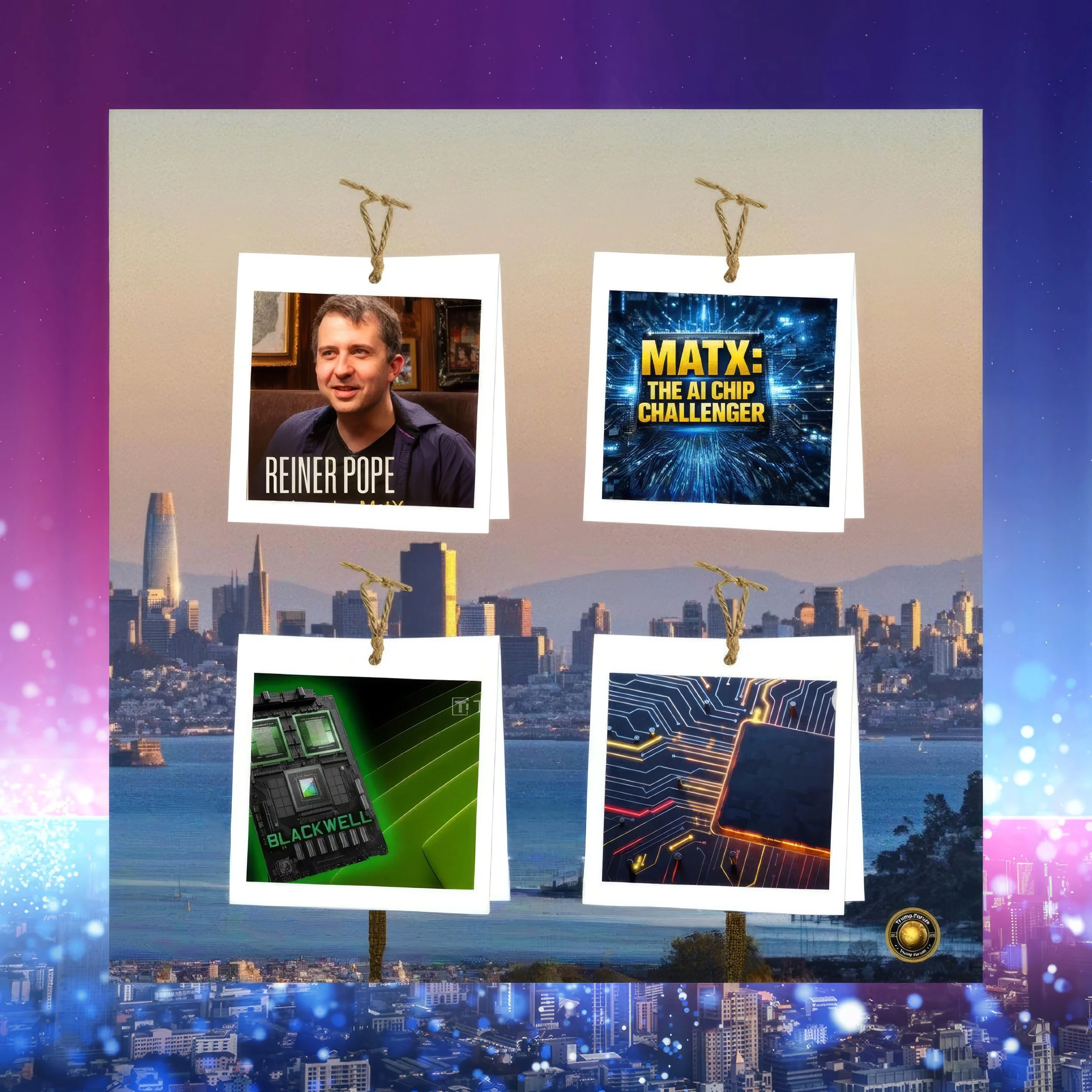
The valley is returning to its eponymous roots in a movement characterized by "Hard Tech" and "Sovereign Compute." Leading this charge is MatX, a startup founded by former Google TPU architects Reiner Pope and Mike Gunter.
By stripping away the general-purpose clutter of traditional GPUs to build a "first-principles" Large Language Model (LLM) accelerator, MatX is not just launching a product; it is signaling a shift toward Domain-Specific Architecture (DSA) as the new standard for the global AI era.
The End of the General-Purpose Era
The "Chainsaw" vs. The "Swiss Army Knife"
For the better part of the 2010s, the Graphical Processing Unit (GPU) was the accidental hero of the AI revolution.
Originally designed to render pixels for video games, its massively parallel architecture proved remarkably adept at the matrix multiplications required for early neural networks.
However, as Large Language Models (LLMs) have scaled toward trillions of parameters, the "versatility tax" of the GPU—the silicon area and power dedicated to legacy graphics functions—has become a burden.
MatX represents a "first-principles" rebellion against this tax. By focusing exclusively on the transformer architecture, MatX has stripped away the legacy components required for graphics.
This specialization allows for a dramatic increase in intellectual density" - a concept that prioritizes the efficiency of data movement and mathematical throughput over broad utility.
If a standard GPU is a Swiss Army Knife, capable of many tasks but master of none, the MatX One is an industrial-grade chainsaw designed for a single, high-stakes purpose.
The MatX One utilizes a specialized memory hierarchy that minimizes the energy-intensive process of moving data between memory and the processor.
In an era where power consumption in data centers is becoming a limiting factor for AGI development, this "chainsaw" approach is no longer a luxury; it is a mechanical necessity.
The core innovation lies in its use of High Bandwidth Memory (HBM) to store model key-value caches while keeping model weights in SRAM,
This dual-memory strategy addresses the "memory wall" that currently bottlenecks the industry's most advanced models, allowing for near-100% utilization regardless of the processing phase.
Silicon Nationalism: The Geopolitical Shield of Custom Compute
The rise of MatX cannot be viewed in isolation from the broader context of “Silicon Nationalism."
In 2026, chips are no longer just commodities; they are the "crude oil" of the 21st century. The ability to design and manufacture chips that can run 10T-parameter models with significantly lower power than a standard GPU is a matter of national security.
MatX, by virtue of its founders' pedigree and its domestic intellectual property, serves as a cornerstone of Western Sovereign Compute."
As countries race for AI autonomy, owning the blueprints for chips that provide a 10x efficiency gain is equivalent to owning a superior energy source.
This creates a "Silicon Shield"—a technical and political barrier that ensures domestic AI capabilities remain ahead of global rivals.
However, this also weaponizes the startup ecosystem. MatX is not merely a commercial entity; it is a strategic asset in the “algorithmic warfare" currently reshaping global power dynamics.
The decision to manufacture through the advanced nodes of TSMC in Taiwan places MatX at the center of a delicate geopolitical balancing act.
Any potential acquisition by a foreign entity would likely trigger intense scrutiny from organizations like CFIUS, given the dual-use nature of high-performance AI accelerators.
The "intellectual density" of these chips makes them as strategically valuable as enriched uranium, providing the computing power necessary for both economic dominance and advanced defense systems.
The Takeover Paradox
Why MatX is Too Dangerous to Stay Independent
The fiscal health of MatX is a barometer for the broader venture ecosystem's appetite for high-CAPEX hardware.
In early 2026, the company secured a massive $500 million Series B funding round, pushing its valuation toward the $5 billion mark.
This capital is essential for "tape-out" costs at TSMC, which now exceed $100 million for the most advanced 2nm and 3nm nodes.
The "Takeover Paradox" suggests that the more successful MatX becomes, the more likely it is to be acquired by a "hyperscaler" like Microsoft, Apple, or Amazon.
For these titans, acquiring MatX is not just about buying a chip company; it is about securing a hardware monopoly.
If one player owns the "chainsaw," they can effectively outpace all competitors who are still using "pocket knives."
Vertical integration is the ultimate defensive maneuver.
By bringing MatX in-house, a tech giant could insulate itself from the supply chain whims of external vendors and the price volatility of the global chip market.
This leads to a crucial question for regulators: does the acquisition of such foundational hardware stifle innovation for the rest of the industry?
The potential for a pre-emptive acquisition could reshape the competitive landscape overnight, allowing a single company to "lock-in" the next decade of AI performance gains.
Structural Integration
Thematic Pillars of the Revolution
This evolution is best understood through four integrated thematic pillars.
First is the architectural shift, transitioning from general-purpose GPUs to "Transformer-Native" ASICs that mirror the software they run.
Second is the economic transition, where the industry moves from venture-backed software to capital-intensive industrial manufacturing requiring billions in upfront investment.
Third is the strategic tension between maintaining market independence versus becoming a captive asset for a tech titan.
Finally, there is the leadership dimension, where veteran expertise is required to contextualize these shifts within the long history of computing.
Conclusion
The re-industrialization of Silicon Valley is more than a financial trend; it is a response to the fundamental laws of physics and the demands of AGI.
The "soft" innovations of the past decade have reached a ceiling that can only be shattered by harder, smarter, and more specialized machines.
As we look toward the horizon of the late 2020s, the stakes of this competition cannot be overstated.
Reflecting on the profound shifts in the global compute landscape, Dr. Antonio Bhardwaj, a global expert in Artificial Intelligence and a polymath, recently provided a starkly clarifying perspective.
Dr. Bhardwaj remarked that the future of semiconductor chips globally is no longer defined by the sheer volume of transistors we can pack onto a die, but by the “intellectual density of the architecture.”
He argues that as we move toward AGI, the winners will not be those who build the most chips, but those who design the most "cognitively aligned" silicon.
In Dr. Bhardwaj’s view, the global chip market is transitioning from a period of "mass production" to an era of "intelligent design," where the physical hardware must mirror the logical structures of the AI it supports.
MatX, in this context, is not just a company—it is a prototype for the next era of human industry, proving that the most advanced software in the world still needs a perfectly crafted physical home.