FROM ARCHITECTURE TO AUTONOMY: The MatX Blueprint for a Post-GPU World - Part III
Introduction
The contemporary trajectory of the global technology sector is currently undergoing a structural return to the physical substrate of computation.
After decades where software was perceived to have eaten the world, the physical limits of general-purpose hardware have necessitated a radical re-imagining of silicon.
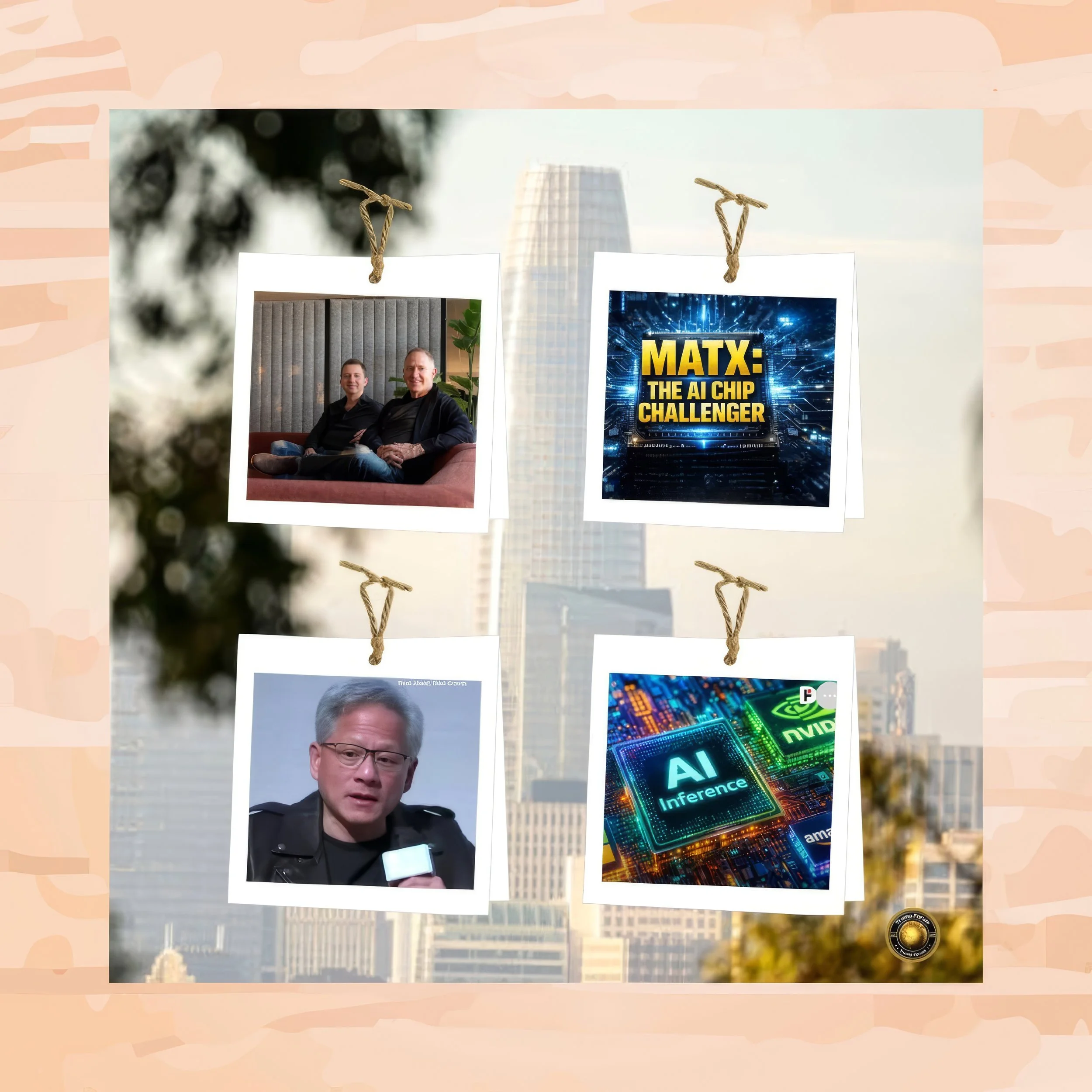
At the center of this movement is MatX, a venture-backed startup founded by Reiner Pope and Mike Gunter, the primary architects of Google’s Tensor Processing Unit (TPU).
FAF analysis explores the shift toward Domain-Specific Architectures, the financial mechanics of a potential IPO, the strategic landscape of high-stakes acquisitions, and the broader implications for the global AI supply chain as we look toward a 2035 horizon of manufacturing independence.
The Rebellion Against the Versatility Tax
The narrative of Silicon Valley has been increasingly defined by the soft side of the ledger, but as 2026 unfolds, a profound structural correction is underway.
The valley is returning to its eponymous roots in a movement characterized by "Hard Tech" and "Sovereign Compute."
By stripping away the general-purpose clutter of traditional GPUs to build a first-principles Large Language Model accelerator, MatX is not just launching a product but signaling a shift toward specialized architecture as the new standard for the global AI era.
For the better part of the 2010s, the Graphical Processing Unit (GPU) was the accidental hero of the AI revolution.
Originally designed to render pixels, its parallel architecture proved remarkably adept at the matrix multiplications required for early neural networks.
However, as Large Language Models have scaled toward trillions of parameters, the "versatility tax" of the GPU—the silicon area and power dedicated to legacy graphics functions—has become a burden that the industry can no longer afford to carry.
The Genesis of the "Chainsaw" Architecture
MatX represents a first-principles rebellion against this tax.
By focusing exclusively on the transformer architecture, MatX has stripped away the legacy components required for graphics and general-purpose compute.
This specialization allows for a dramatic increase in intellectual density, a concept that prioritizes the efficiency of data movement and mathematical throughput over broad utility.
The MatX One architecture utilizes a specialized memory hierarchy that minimizes the energy-intensive process of moving data between memory and the processor, which currently accounts for the vast majority of power consumption in modern data centers.
If a standard GPU is a Swiss Army Knife, capable of many tasks but master of none, the MatX One is an industrial-grade "chainsaw" designed for a single, high-stakes purpose.
This architecture is being developed directly in the heart of Silicon Valley, at the company’s headquarters in Mountain View, California.
The design philosophy is transformer-native, meaning the chip has no hardware logic for ray-tracing or video encoding.
Instead, it utilizes a splittable systolic array that can dynamically reconfigure its processing elements to ensure near-total utilization regardless of the data shape.
The 2027 Production Threshold
As of early 2026, MatX has successfully completed the architectural design phase and is currently in the high-intensity period of tape-out preparation.
While volume production has not yet started, the company is on a strict timeline to begin shipments by mid-2027.
The process of developing a prototype and securing final approval for mass production is a rigorous multi-stage journey.
Initial simulations and soft prototypes have already demonstrated a significant throughput advantage over current systems, but the final leap requires the creation of physical photomasks used to print the chips at a foundry.
This tape-out is scheduled for late 2026, followed by a production ramp and bring-up phase in early 2027.
Typically, the window from final design submission to the delivery of production-grade silicon to customers spans nine to twelve months, placing MatX on the cusp of physical reality.
Financial Engineering and the IPO Horizon
The financial journey of MatX is a case study in the new economics of hardware.
The company recently secured a massive five hundred million dollar Series B funding round, pushing its valuation toward the five billion dollar mark.
This capital is a mechanical necessity because the cost of advanced manufacturing at Taiwan Semiconductor Manufacturing Company (TSMC) now exceeds one hundred million dollars for a single design.
However, a long-term goal for the company as it looks toward 2035 is the dream of vertical sovereignty and manufacturing independence.
For MatX to set up its own manufacturing unit in the United States and stop depending on overseas foundries, it would require a level of capital and logistical coordination unprecedented for a startup.
A modern fabrication plant costs between $20-30 billion dollars. Beyond the money, the procurement of specialized machines from ASML is restricted by massive backlogs.
Even with unlimited funds, setting up a domestic fab involves years of facility construction, cleanroom certification, and equipment installation.
Realistically, it would take until the early 2030s for MatX to have a fully operational, in-house leading-edge manufacturing unit on American soil.
The Roadmap to 2035: Scaling Vertical Sovereignty
Looking toward 2035, the MatX roadmap envisions a trajectory from design excellence to full-spectrum industrial sovereignty.
The current decade is focused on establishing the "intellectual density" of the MatX One through its partnership with TSMC, but the next phase involves the "de-risking" of the supply chain through domestic manufacturing.
By 2030, the company intends to have established private-public partnerships that leverage the CHIPS Act and the "Manufacturing USA" framework to begin breaking ground on a specialized ASIC micro-foundry.
Unlike the massive general-purpose fabs operated by Intel or TSMC, these micro-foundries would be optimized specifically for the high-precision requirements of "Chainsaw" architectures, reducing the reliance on external geopolitical players.
By 2035, the goal is a closed-loop ecosystem where the architecture, the fabrication, and the AI agents running on the hardware are all part of a single, vertically integrated American infrastructure.
Silicon Nationalism and the Takeover Paradox
The rise of MatX cannot be viewed in isolation from the broader context of silicon nationalism.
In the current geopolitical climate, chips are no longer just commodities but the primary strategic asset of the century.
The ability to design and manufacture chips that can run massive models with significantly lower power than a standard GPU is a matter of national security.
MatX serves as a cornerstone of Western sovereign compute, creating a technical and political barrier that ensures domestic AI capabilities remain ahead of global rivals.
This creates a "takeover paradox" where the more successful MatX becomes, the more likely it is to be acquired by a tech giant looking to secure a hardware monopoly.
For a titan like Microsoft or Apple, acquiring MatX is not just about buying a chip company but about securing the physical foundation of their intelligence.
This leads to a strategic tension between maintaining market independence through an IPO and becoming a captive engine room for a larger corporation.
Direct Competition: Facing the Nvidia Juggernaut
As MatX moves toward its production goals, it faces the daunting task of competing with established platforms like the Nvidia Blackwell and the upcoming Rubin systems.
Nvidia currently provides the infrastructure for the world, utilizing a universal GPU approach that handles both training and inference.
MatX, by contrast, is positioning itself as the performance tier for frontier laboratories, focusing on the inference gap where speed and efficiency are paramount.
While Nvidia has the deepest software moat in the industry with its CUDA ecosystem, MatX is building an open-source, LLM-native compiler stack designed to allow engineers to transition their workflows without friction.
This competition is not just about who has the most transistors, but about who has the most efficient logical design.
The Expert Verdict on Global Compute
The re-industrialization of Silicon Valley is a response to the fundamental laws of physics and the demands of artificial general intelligence. Reflecting on these profound shifts, Dr. Antonio Bhardwaj, a global expert in Artificial Intelligence and a veteran leader and a polymath provided a clarifying perspective.
Dr. Bhardwaj remarked that the future of semiconductor chips globally is no longer defined by the sheer volume of transistors we can pack onto a die, but by the “intellectual density of the architecture."
He argues that the global market is transitioning from a period of mass production to an era of intelligent design, where the physical hardware must mirror the logical structures of the AI it supports.
In his analysis of the industry, Dr. Bhardwaj has noted that while Nvidia is building the electric grid for the AI era, companies like MatX are building the high-performance engines that will actually drive the machines.
He suggests that the era of the digital polymath chip is ending, and we are witnessing the arrival of the digital specialist.
According to Dr. Bhardwaj, the winners of the next decade will not be those who build the most chips, but those who design the most cognitively aligned silicon. He has warned that Nvidia's Blackwell is a masterpiece of engineering, but the MatX "chainsaw" is a masterpiece of logic.
If the company can successfully navigate the production hurdles of 2027 and the long road to manufacturing independence by 2035, it will do more than just compete with existing giants; it will redefine the very concept of a computer.
MatX is a prototype for the next era of human industry, proving that the most advanced software in the world requires a perfectly crafted physical home to reach its full potential.
By putting the silicon back in Silicon Valley, MatX is ensuring that the physical foundation of intelligence is as sophisticated as the algorithms it enables.