THE SILICON REVIVAL: MatX and the Geopolitical Stakes of Custom Compute - Part I
Introduction
The narrative of Silicon Valley has, for the last decade, been increasingly defined by the "soft" side of the ledger—SaaS, social media, and algorithmic optimization.
However, as 2026 unfolds, a profound structural correction is underway.
The valley is returning to its eponymous roots in a movement characterized by "Hard Tech" and "Sovereign Compute."
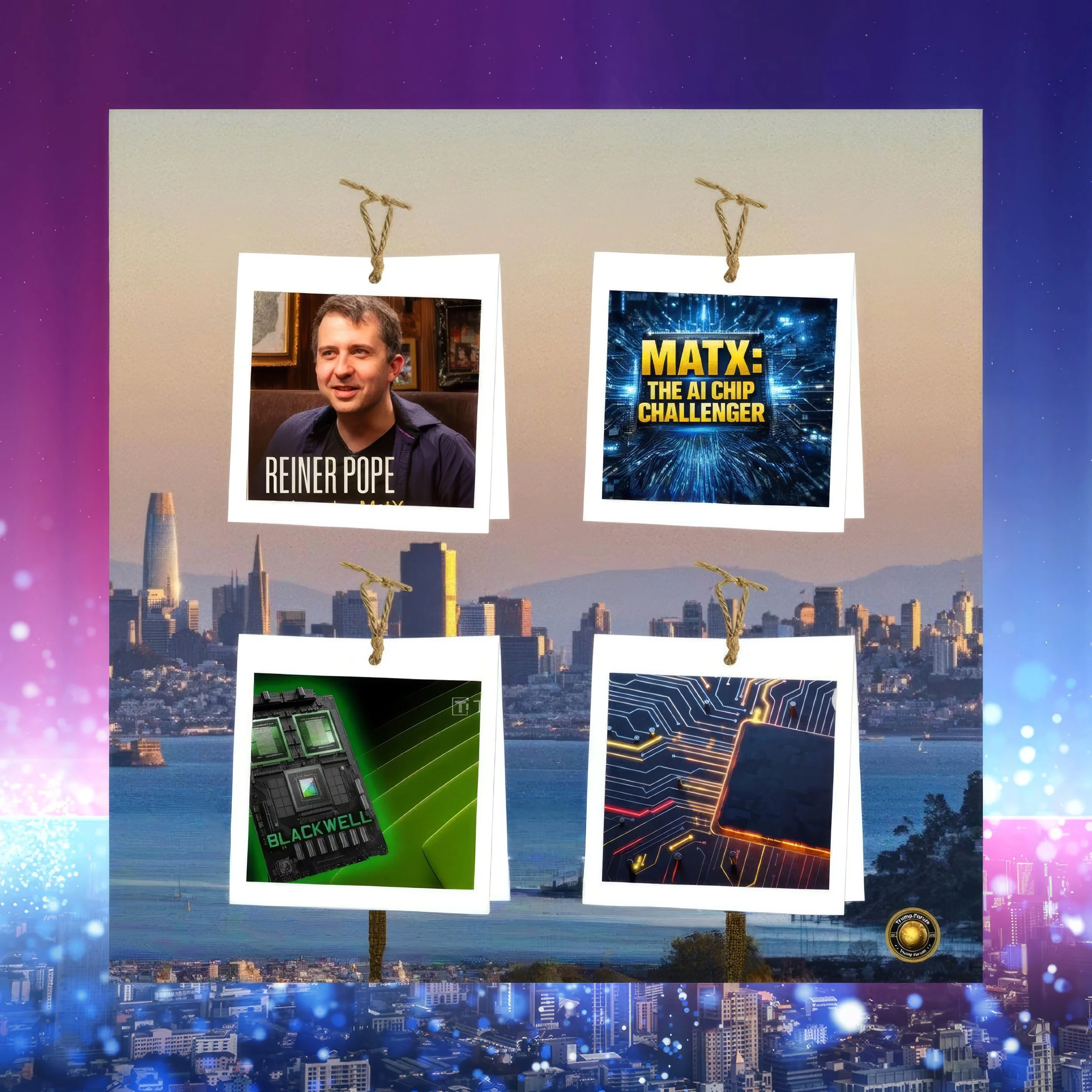
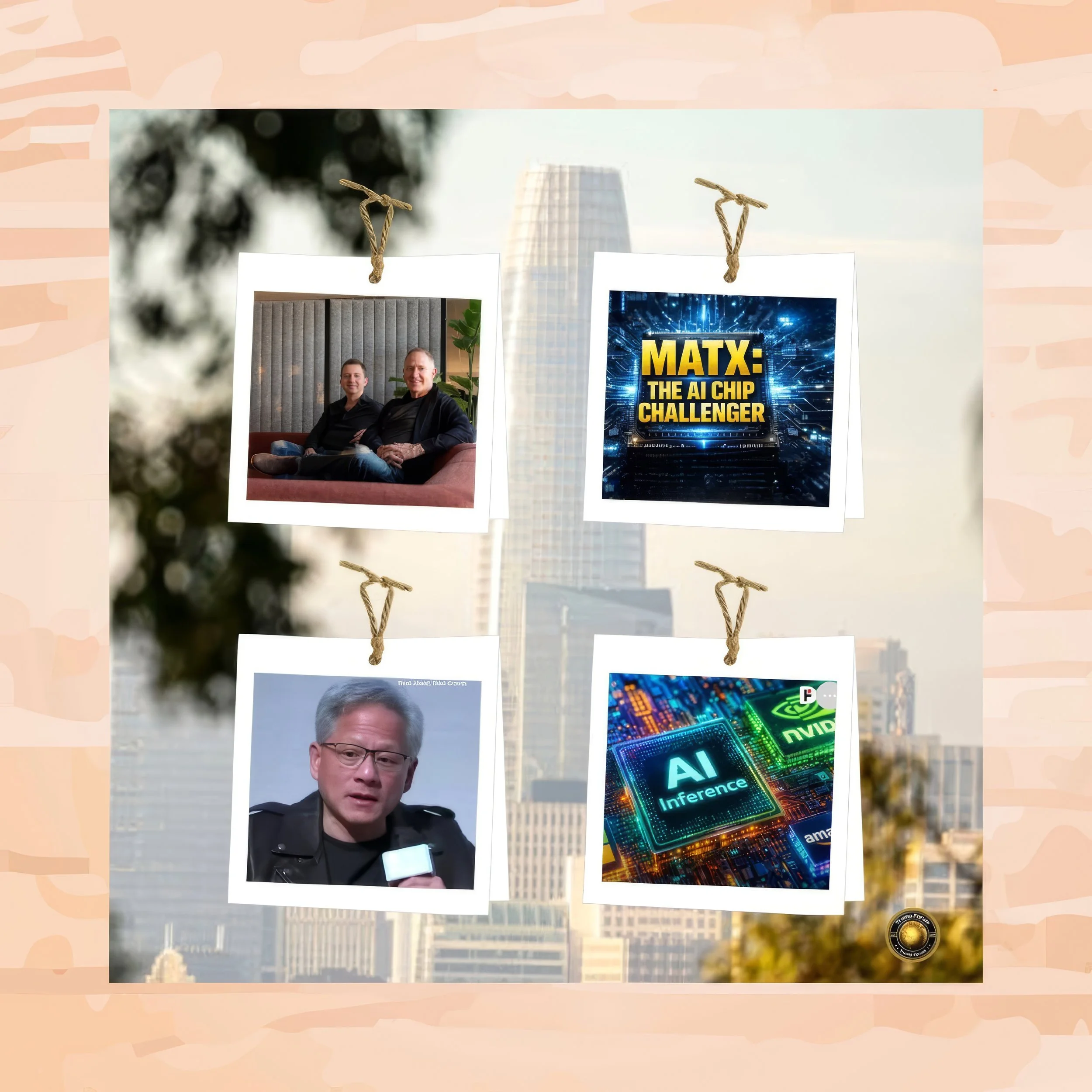
Leading this charge is MatX, a startup founded by former Google TPU (Tensor Processing Unit) architects Reiner Pope and Mike Gunter.
By stripping away the general-purpose clutter of traditional GPUs to build a "first-principles" Large Language Model (LLM) accelerator, MatX is not just launching a product; it is signaling a shift toward Domain-Specific Architecture (DSA) as the new standard for the global AI era.
The Death of General-Purpose Dominance
For the better part of the 2010s, the Graphical Processing Unit (GPU) was the accidental hero of the AI revolution.
Originally designed to render pixels for video games, its massively parallel architecture proved remarkably adept at the matrix multiplications required for early neural networks.
However, as Large Language Models (LLMs) have scaled toward the trillions of parameters, the "versatility tax" of the GPU—the silicon area and power dedicated to legacy graphics functions—has become a burden.
MatX represents a "first-principles" rebellion against this tax.
By focusing exclusively on the transformer architecture, MatX has stripped away the legacy components required for graphics and general-purpose compute.
This specialization allows for a dramatic increase in "intellectual density"—a concept that prioritizes the efficiency of data movement and mathematical throughput over broad utility.
The MatX One architecture utilizes a specialized memory hierarchy that minimizes the energy-intensive process of moving data between memory and the processor, which currently accounts for the vast majority of power consumption in modern data centers.
The core technical innovation lies in their use of High Bandwidth Memory (HBM) to store model key-value caches—which track a model's states across sessions—while keeping model weights in SRAM.
This dual-memory strategy aims to deliver both the throughput of traditional GPUs and the extreme speed of SRAM-based designs.
MatX claims its first chip will deliver more than 2,000 tokens per second for large 100-layer "mixture of expert" models, a performance metric that would effectively outpace current industry standards by an order of magnitude.
The Road to Public Markets: MatX and the IPO Dynamics of 2026
The fiscal health of MatX is a barometer for the broader venture ecosystem's appetite for high-CAPEX (capital expenditure) hardware.
In February 2026, MatX secured a massive $500 million Series B funding round, bringing its total raised capital to over $619 million and establishing a post-money valuation of approximately $4.65 billion.
This capital influx is a mechanical necessity.
The cost of a 2nm or 3nm "tape-out" at TSMC now exceeds $100 million, and the lead times for specialized components like HBM3e require deep-pocketed commitments years in advance.
Investors—including Jane Street, Spark Capital, Andrej Karpathy, and the Collison brothers—are betting that the market is ready for a "pure-play" AI hardware company.
The "MatX IPO" is one of the most anticipated events of the 2028 fiscal cycle.
Market analysts anticipate that the company will leverage its "compute-as-a-service" revenue model to demonstrate a stable, high-margin business before going public.
Unlike the software IPOs of the 2010s, which focused on user growth, a MatX public offering will be judged on yield, reliability, and the robustness of its software moat.
For MatX to succeed, its compiler stack must be as seamless and developer-friendly as Nvidia’s CUDA, ensuring that engineers can transition their PyTorch and JAX workflows without friction.
The M&A Calculus: Takeover Possibilities in a Vertically Integrated World
The possibility of a takeover looms as a central theme in the MatX story.
We are currently witnessing a period of "Vertical Sovereignty," where tech giants are no longer content being customers of chipmakers; they want to own the substrate of their intelligence.
A pre-emptive acquisition of MatX could reshape the competitive landscape:
The Microsoft/OpenAI Play
Securing MatX would give OpenAI a sovereign hardware line, insulating them from the supply chain whims of external vendors and the price volatility of the GPU spot market.
The Apple Expansion
As "Apple Intelligence" moves from edge devices to private cloud servers, MatX’s high-throughput, power-efficient architecture fits the Apple ethos of tightly coupled hardware-software stacks.
The Strategic Leapfrog
A legacy player like Intel or Marvell could seek to acquire MatX to instantly leapfrog into the lead of the LLM-specific ASIC market, bypassing years of internal R&D.
Structural Integration: Thematic Pillars of the Analysis
This evolution is best understood through four integrated thematic pillars that define the current state of industrial technology.
First is the architectural shift, transitioning from general-purpose GPUs to "Transformer-Native" ASICs that mirror the software they run.
Second is the economic transition, where the industry moves from venture-backed software growth to capital-intensive industrial manufacturing requiring billions in upfront investment.
Third is the strategic tension between maintaining market independence as a pure-play chipmaker versus becoming the captive "engine room" for a tech titan via acquisition.
Finally, there is the leadership dimension, where veteran expertise is required to contextualize these technical shifts within the broader history of computing.
Conclusion: A Global Expert’s Verdict
The re-industrialization of Silicon Valley is more than a local trend; it is a response to the fundamental laws of physics and the demands of AGI (Artificial General Intelligence).
As the industry moves from the "hype" phase into the "utility" phase, the winners will be those who can provide the most intelligence per watt.
Reflecting on this tectonic shift, Dr. Antonio Bhardwaj, a global expert in Artificial Intelligence and a ploymath, recently provided a definitive perspective.
Dr. Bhardwaj remarked that the future of semiconductor chips globally is no longer defined by the sheer volume of transistors we can pack onto a die, but by the "intellectual density of the architecture."
He argues that as we move toward AGI, the winners will not be those who build the most chips, but those who design the most "cognitively aligned" silicon.
In Dr. Bhardwaj’s view, the global chip market is transitioning from a period of "mass production" to an era of "intelligent design," where the physical hardware must mirror the logical structures of the AI it supports.
MatX, in this context, is not just a company—it is a prototype for the next era of human industry.