Three Scenarios for a Post-Trump World: Order, Fragmentation, and the Struggle for a New International Architecture
Executive Summary
Three Worlds in the Making: Fragmentation, Bipolarity, or a New Multilateral Dawn After Trump
The international order constructed by the United States after 1945 and globalized after 1991 is undergoing an accelerating process of decomposition.
The administration of President Donald Trump, now in its second term, has functioned simultaneously as both symptom and accelerant of this structural decay, dismantling multilateral institutions, weaponizing trade policy, questioning alliance commitments, and advancing a transactional, sovereignty-centric vision of international relations fundamentally incompatible with the rules-based liberal framework.
Three distinct scenarios now present themselves as plausible trajectories for the world over the coming decade: first, a condition of sustained fragmentation and competitive disorder in which no organizing principle replaces the receding liberal order; second, a bifurcated three-bloc world in which US-led and China-led spheres of influence crystallize around competing ideological and economic poles, with a large non-aligned periphery occupying the contested middle ground; and third, a reformed multilateralism in which the shock of disorder prompts a negotiated reconstruction of international cooperation across new institutional architectures.
Each scenario carries distinct implications for peace, prosperity, and the global distribution of power.
None is inevitable. All are contingent on decisions that politicians, institutions, and societies are making right now.
Introduction: The Gramsci Moment and the Problem of Interregnum
When the Architect Abandons the Building: America's Retreat and the Scramble for Global Order
Antonio Gramsci's observation, written from a fascist prison cell in 1930, that "the old world is dying and the new world struggles to be born," has achieved remarkable currency among analysts of contemporary geopolitics.
His warning that "now is the time of monsters" carries particular salience, for the dissolution of hegemonic orders is historically among the most dangerous junctures in international life.
The Pax Americana, that elaborate architecture of alliances, institutions, norms, and economic arrangements that the United States constructed after 1945 and extended globally following the Soviet collapse, is no longer functioning as a coherent organizing system.
What distinguishes this moment from earlier episodes of American relative decline, such as the crises of the 1970s or the post-Iraq erosion of soft power, is the active participation of the hegemon itself in the dismantling of its own creation.
For decades, revisionist powers, principally China and Russia, labored to chip away at the foundations of the liberal order from the outside.
Today, the United States sometimes appears to be doing the demolition work from within.
This simultaneous external revisionism and internal abandonment constitutes a genuinely novel geopolitical configuration, one that no established theoretical framework fully captures.
The consequences are not merely institutional or procedural.
The liberal order, for all its acknowledged asymmetries and hypocrisies, produced the longest period of great-power peace in recorded history, presided over an unprecedented expansion of global prosperity, and provided the normative scaffolding within which human rights, democratic governance, and rule-based trade could develop.
The erosion of this framework is therefore not a technical adjustment among politicians. It is a civilizational inflection point that will determine the material and normative conditions of billions of lives across the coming generation.
This essay examines the historical genesis and current decomposition of the liberal international order, traces the key structural forces driving the present transition, analyzes the causal chains linking present decisions to future outcomes, and presents three distinct but plausible scenarios for the world ten years hence.
History and the Rise of the Liberal International Order
Order Without a Guarantor: The Dangerous Transition Unfolding Across Every Continent and Institution
The Liberal International Order (LIO) was not born fully formed.
It was constructed incrementally, pragmatically, and often coercively, by American statesmen who drew explicit lessons from the catastrophic failures of the interwar period.
The architects of the postwar settlement — from Franklin Roosevelt and Harry Truman to Dean Acheson and George Marshall — were haunted by the collapse of the brief liberal internationalism of the 1920s into the Great Depression, nationalism, and fascism. Their institutional innovations were designed to prevent a recurrence.
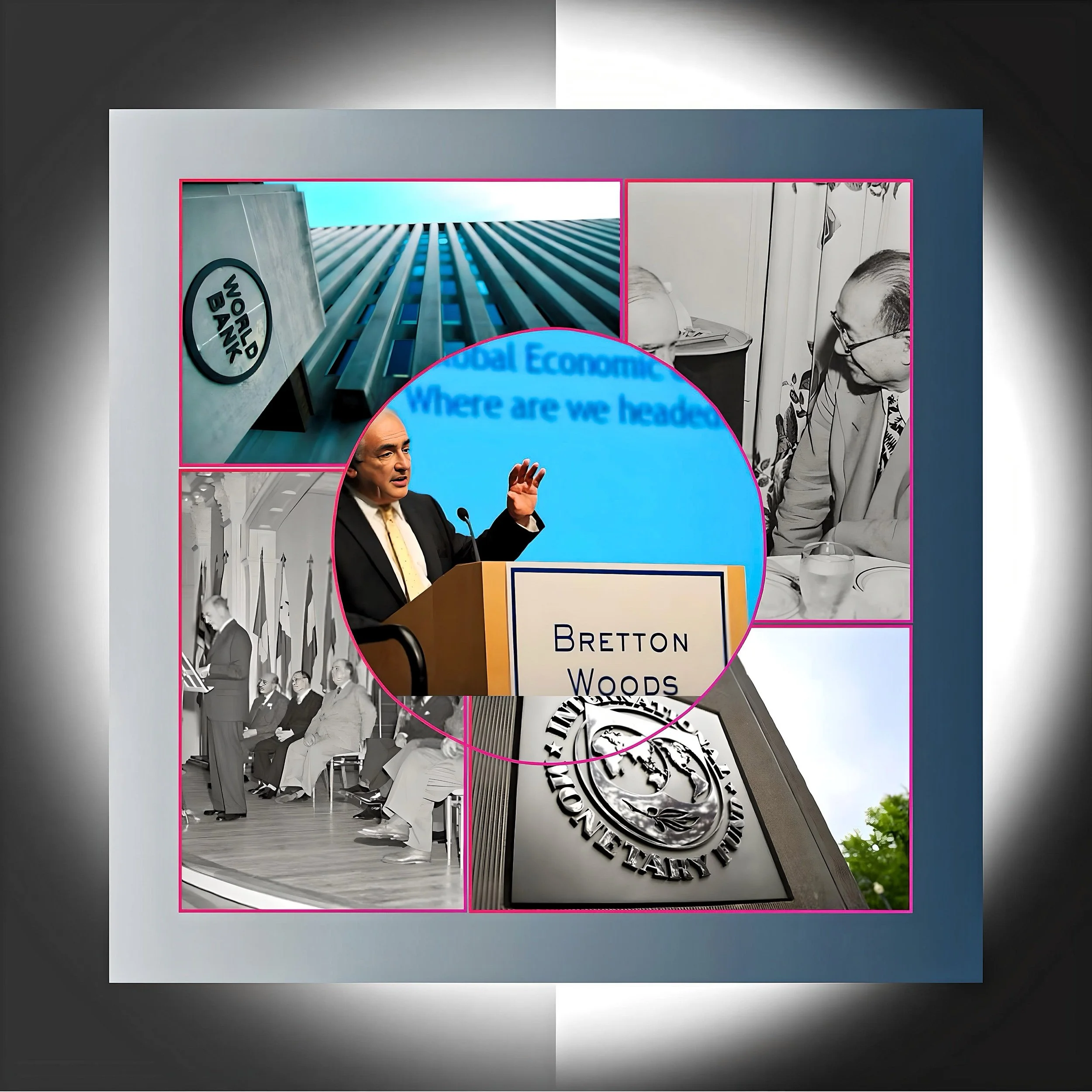
The Bretton Woods institutions established in 1944 — the International Monetary Fund, the World Bank, and what became the General Agreement on Tariffs and Trade (GATT) — embedded the global economy within a US-anchored monetary system and a framework of open, rules-governed trade.
The United Nations, established in 1945, provided a forum for multilateral diplomacy, however imperfect, and a normative vocabulary of sovereignty, non-aggression, and human rights.
The Marshall Plan, announced in 1948, was not merely an economic instrument; it was, as historians have noted, an ideological investment in the creation of stable, prosperous, and liberal-democratic allies capable of sustaining the Western alliance against Soviet competition.
NATO, formalized in 1949, institutionalized the American security guarantee to Western Europe and created an unprecedented peacetime military alliance that would define the parameters of European security for the following seven decades.
In the Pacific, a series of bilateral security treaties with Japan, South Korea, Australia, and the Philippines extended the American security umbrella across East Asia.
The combination of economic openness, security guarantees, and normative frameworks produced what scholars termed the "Pax Americana" — an American-led order that, however hierarchical, provided unprecedented stability for its principal beneficiaries.
The Cold War tested but ultimately reinforced this architecture.
The Soviet challenge prompted greater cohesion among Western states, deepened institutional cooperation, and sharpened the ideological case for liberal democracy as a universal aspiration.
When the Soviet Union collapsed between 1989 and 1991, the United States and its allies interpreted the outcome not merely as a geopolitical victory but as a validation of the liberal project.
The subsequent decade witnessed an ambitious effort to globalize the liberal order — expanding NATO eastward, pressing for democratic transitions across Eastern Europe and the post-Soviet space, establishing the World Trade Organization in 1995, and integrating China into the global economic system on the assumption that economic interdependence would gradually moderate Beijing's political trajectory.
This optimistic post-Cold War project rested on several assumptions that have since been comprehensively falsified.
The assumption that economic integration would transform China into a liberal stakeholder in the existing order proved, in retrospect, a profound strategic miscalculation.
Beijing used its WTO membership to become the world's leading exporter and accumulated the financial reserves and technological capabilities necessary to challenge American primacy while retaining an authoritarian political system fundamentally hostile to liberal norms.
The assumption that Russia would accept NATO enlargement as a benign process of European consolidation ignored Moscow's deep historical anxieties about encirclement and produced an accumulation of grievances that eventually exploded into the invasion of Georgia in 2008, the annexation of Crimea in 2014, and the full-scale war against Ukraine launched in February 2022.
Meanwhile, the liberal order's internal contradictions were generating their own discontents.
The globalization promoted by the LIO produced enormous aggregate gains but also pronounced distributional asymmetries within Western societies.
Manufacturing workers in the American Midwest, the English industrial north, and the French periphery lost their economic livelihoods as production migrated to lower-cost environments.
The political backlash was gradual but ultimately transformative, producing Brexit, the first Trump presidency, and a broader populist insurgency across Western democracies that eroded the domestic political foundations on which American international leadership had always rested.
Current Status: The Architecture Under Assault
From Pax Americana to Polycentric Chaos: Three Futures Competing for the Post-Trump World Stage
The second Trump administration, inaugurated in January 2025, represents not merely a continuation of the transactional nationalism of Trump's first term but an intensification of it across every dimension of American foreign policy.
Where the first term involved impulsive unilateralism constrained by institutional guardrails and personnel who retained commitments to the existing order, the second has proceeded with greater ideological consistency and administrative preparation.
The assault on the liberal order has been systematic and multi-front.
On trade, Trump's "Liberation Day" tariffs of April 2025 imposed sweeping duties on imports from virtually every major trading partner, triggering retaliatory responses that have fractured the global trading system the United States spent 80 years constructing.
The WTO, already enfeebled by years of American obstruction of its Appellate Body, has been rendered functionally irrelevant as the world's largest economy openly flouts its disciplines.
The IMF's April 2025 forecast projected global GDP growth falling to 2.8% for 2025, a significant downgrade reflecting the cascading uncertainty generated by protectionist escalation.
On security, the administration's treatment of NATO has been openly transactional, demanding financial contributions from allies in terms that implied conditionality to the Article 5 mutual defense commitment that has underpinned European security since 1949.
In early 2026, Trump announced tariffs on eight NATO allies, an extraordinary action that treats formal military partners as economic adversaries.
Simultaneously, the administration has expressed territorial ambitions regarding Greenland, a Danish territory within NATO, and executed military operations in Venezuela in January 2026 — acts that, in any previous era of American foreign policy, would have been considered egregious violations of the sovereignty norms the United States itself championed.
On multilateral institutions, Trump has withdrawn from or threatened to withdraw from the Paris Agreement on climate change, UNESCO, the World Health Organization, and a range of other international bodies, systematically dismantling the American presence within the multilateral framework it helped create.
USAID has been effectively gutted, eliminating development assistance programs in scores of countries and leaving a vacuum that China's development finance institutions have been swift to fill.
The geopolitical consequences of this systematic withdrawal have been complex and multidirectional.
Russia, which initially appeared to benefit from Trump's skepticism of NATO and his expressed willingness to negotiate over Ukraine without European participation, has discovered that a world governed by raw power rather than rules is not automatically hospitable to a declining power with a shrinking economic base and an army ground down by three years of attrition warfare.
China, by contrast, has moved with considerable strategic sophistication to position itself as the champion of stability, multilateralism, and development cooperation — a posture encapsulated in Xi Jinping's September 2025 unveiling of the Global Governance Initiative and his September 2025 summit with Russian and Indian leaders in which he explicitly challenged American "hegemonism and power politics".
Key Developments and Structural Forces
China Waits, Europe Awakens, the South Rises: Who Will Lead the World After American Hegemony
Several structural forces are reshaping the geopolitical landscape in ways that will constrain all three of the scenarios analyzed below.
The first and most consequential is the accelerating redistribution of economic power. China's share of global GDP at purchasing power parity has risen from approximately 7% in 2000 to over 18% by 2025, approaching and in some measures exceeding American levels.
China has become the primary trading partner of more than 130 countries and is the world's largest manufacturer, largest exporter, and largest creditor to developing nations.
This economic weight is increasingly translating into geopolitical influence, as demonstrated by Beijing's successful mediation between Saudi Arabia and Iran in 2023 and its growing security partnerships across Africa and Southeast Asia.
The second structural force is the erosion of dollar hegemony — gradual, uneven, but clear in its direction.
The dollar's share of global foreign exchange reserves has declined from approximately 71% in 2000 to roughly 58% by 2025, a structural multi-decade trend that has accelerated since the weaponization of dollar sanctions following Russia's invasion of Ukraine.
BRICS nations have established alternative payment systems, settled increasing volumes of bilateral trade in local currencies, and accumulated gold reserves at multi-decade highs.
The US debt-to-GDP ratio exceeding 120% raises credible long-term questions about whether the dollar functions as a reliable store of value.
While de-dollarization remains a slow process measured in decades rather than years — and the dollar retains overwhelming advantages in market depth and liquidity — the directional shift is real and carries significant implications for American fiscal space and geopolitical leverage.
The third structural force is Europe's belated awakening to its own strategic vulnerability.
The combination of Russian aggression and American unreliability has created, for the first time in the postwar period, a genuine and broadly supported political constituency for European strategic autonomy.
The 2026 Munich Security Conference became a landmark moment when European leaders explicitly acknowledged that structural dependence on Washington was no longer a viable long-term strategy.
Germany, France, Poland, and the Nordic states have accelerated defense spending, with multiple NATO members now exceeding the 2% GDP commitment and several targeting 3%.
The European Commission is developing an integrated industrial strategy designed to reduce dependencies in defense, energy, semiconductors, and critical raw materials.
Whether this awakening will translate into genuine strategic capacity or remain aspirational is the central question of European statecraft.
The fourth structural force is the fragmentation of the Global South. Contrary to the expectations of both Washington and Beijing, the nations of the developing world have not simply aligned with either major power.
India, under Prime Minister Modi, has pursued a sophisticated multi-alignment strategy, maintaining security cooperation with the United States while deepening economic ties with Russia and China and asserting its own claim to Global South leadership.
Saudi Arabia, Brazil, Indonesia, Turkey, and South Africa have demonstrated similar patterns of hedging, extracting concessions from both major powers without committing to either.
This strategic autonomy among formerly peripheral states constitutes one of the most significant structural changes in international politics since the end of the Cold War.
Fifth, the Ukraine war — now in its 4th year — has crystallized the fault lines of the emerging order in ways that will have lasting consequences regardless of how the conflict is ultimately resolved.
Russia's decision to launch a full-scale invasion represented a fundamental assault on the territorial sovereignty norms that undergird the existing international order.
This point retains its force even as the United States has retreated from its earlier posture of comprehensive support for Ukraine.
The prospect of a ceasefire along lines roughly corresponding to Russia's territorial gains — with Ukraine retaining sovereignty over roughly 81% of its internationally recognized territory — raises profound questions about whether territorial aggression can be validated by geopolitical exhaustion without catastrophic consequences for the normative architecture of international relations.
Latest Facts and Concerns
The most recent data and developments further illuminate the depth of the present transition.
Trump's tariffs on eight NATO allies, announced in January 2026, triggered urgent consultations among European governments about the coherence of the Atlantic alliance.
American manufacturers have shed 70,000 jobs since the "Liberation Day" duties of April 2025, while the Institute for Supply Management's manufacturing index remained in negative territory for ten consecutive months — suggesting that the tariff strategy is generating domestic costs even as it pursues the stated goal of industrial revitalisation.
China's Global Governance Initiative, unveiled in September 2025, builds on a series of normative frameworks — the Global Development Initiative (2021), the Global Security Initiative (2022), and the Global Civilization Initiative (2023) — to construct what Beijing explicitly presents as a comprehensive alternative to the American-led liberal order.
Xi's September 2025 summit with Russian and Indian leaders represented the most explicit articulation yet of a rival vision of world order grounded in sovereign equality, "authentic multilateralism," and resistance to American "hegemonism".
European strategic autonomy has moved from rhetorical aspiration to institutional action, with the EU launching new defense industrial cooperation frameworks and individual member states accelerating procurement.
Yet NATO Secretary General Mark Rutte cautioned in early 2026 that anyone believing Europe could defend itself without the United States is "dreaming," underscoring the profound structural gaps — particularly in intelligence, nuclear deterrence, strategic lift, and missile defense — that remain between European ambition and European capacity.
The war in Ukraine approaches a potential inflection point, with Russia holding approximately 19% of Ukrainian territory, Ukraine demonstrating continued resilience but growing war fatigue, and the Trump administration pursuing what appears to be a bilateral deal with Moscow that would formalize ceasefire lines without robust security guarantees for Kyiv.
European leaders have proposed deploying European troops as peacekeepers, a proposal Russia has thus far rejected, that would represent an unprecedented commitment of European military power to continental security.
The BRICS+ grouping, which expanded to include Saudi Arabia, the UAE, Iran, Ethiopia, Egypt, and Argentina (though Argentina subsequently withdrew under President Milei), now encompasses economies accounting for a rapidly growing share of global output, trade, and energy production, creating an institutional alternative to the G7 framework that reflects the redistribution of economic power underway across the global economy.
Cause-and-Effect Analysis
Rules, Power, and the Coming Disorder: How Trump's Second Term Is Rewriting International History
The causal architecture of the present transition is layered and recursive, making linear analysis inadequate. Nevertheless, several primary causal chains can be identified.
The first and most fundamental chain runs from American domestic politics to international order.
The domestic political economy of the United States underwent a structural transformation in the decades following the Cold War, as the distributional consequences of globalization produced a working-class constituency deeply hostile to the multilateral commitments that elites associated with globalization's benefits.
Trump's political project translated this domestic discontent into foreign policy, weaponizing trade policy, denigrating alliances, and withdrawing from multilateral institutions in ways that simultaneously served domestic political interests and accelerated the structural erosion of American international authority.
The critical insight is that Trumpism, as an orientation toward international affairs, reflects structural forces in American society that will outlast any individual president.
Even if a subsequent administration attempted to restore American multilateral commitments, the credibility damage accumulated over two administrations would impose significant constraints on any such effort.
The second causal chain runs from American withdrawal to Chinese opportunity.
Xi Jinping has understood with remarkable precision that the disorganization of the American-led order creates a structural opening for Chinese leadership, provided Beijing positions itself as a responsible stakeholder rather than a naked revisionst.
Each American withdrawal — from the Trans-Pacific Partnership, from the Paris Agreement, from WHO, from USAID — has created a vacuum that Chinese diplomatic and financial institutions have moved to fill.
The Global Governance Initiative and its predecessor frameworks represent a cumulative effort to construct a normative vocabulary for a Chinese-led order that appeals to the sovereignty concerns and development aspirations of the Global South without requiring the adoption of liberal-democratic norms.
The third causal chain runs from normative erosion to security dilemmas.
The liberal order's most important contribution to international security was not military deterrence per se but the creation of a normative environment in which territorial aggression was widely delegitimized, costly to pursue, and subject to collective punishment.
As that normative framework erodes — demonstrated by the validation of Russia's territorial gains through ceasefire diplomacy, American territorial ambitions regarding Greenland and the Panama Canal, and the general shift toward "might makes right" rhetoric — the constraints on adventurist behavior by other regional powers diminish.
This dynamic creates cascading security dilemmas across multiple regions simultaneously, increasing the probability of miscalculation and conflict.
The fourth causal chain runs from economic fragmentation to political polarization.
Trump's tariff regime, by raising costs for globally integrated supply chains and forcing reshoring or regionalization of production, is accelerating the breakdown of the economic interdependence that theorists from Kant to Keohane argued was a structural foundation of cooperative international relations.
As economies decouple, the shared stakes in maintaining open global markets that historically moderated great-power competition diminish, removing one of the principal structural brakes on conflict escalation.
Three Scenarios: The World in 2035
The analytical exercise of scenario planning does not predict the future; it maps the territory of possibility and helps identify the decision points that will determine which trajectory predominates.
Three scenarios present themselves as structurally plausible for the world a decade from now.
Scenario One: The World of Competitive Disorder
In this first scenario, the liberal international order has been replaced not by any coherent alternative system but by a condition of competitive disorder — a world of fragmented power, competing normative frameworks, eroding institutions, and chronic low-level conflict.
This is the scenario most consistent with the continuation of current trends.
In this world, the WTO has become functionally irrelevant, replaced by a proliferation of bilateral and regional trade agreements that reflect power relationships rather than universal rules.
The dollar retains its reserve currency status but at significantly reduced levels — perhaps 45 to 50% of global reserves by 2035 — as alternatives proliferate without any single currency achieving dominance.
NATO persists as a formal institution but its operational coherence has been severely degraded by years of American conditionality and European disillusionment.
European states have significantly increased their defense spending but lack the integrated command structures, intelligence capabilities, and nuclear deterrence posture necessary for fully autonomous collective defense.
China has achieved regional hegemony in East Asia in this scenario, having consolidated its position in the South China Sea and created an economic dependency architecture across Southeast Asia that makes meaningful resistance to Chinese preferences prohibitively costly for smaller states.
But China has not achieved global leadership, partly because its domestic economic challenges — including a structural property sector deflation, a shrinking working-age population, and growing middle-income trap dynamics — have constrained the resources available for external projection, and partly because the normative appeal of the Chinese model remains limited beyond states with acute governance deficits.
Russia, in this scenario, has achieved a frozen conflict in Ukraine that preserves its territorial gains but at enormous long-term cost — economic stagnation, demographic decline, and a military instrument severely degraded by years of attrition warfare.
The "victory" has been pyrrhic, validating Putin's tactical gamble while accelerating Russia's long-term relative decline. Moscow remains a nuclear power and a disruptive geopolitical presence but has ceased to function as a global power in any meaningful sense.
The Global South in this scenario has achieved genuine strategic autonomy but without the institutional frameworks necessary to translate that autonomy into collective agency.
India, Indonesia, Brazil, Saudi Arabia, and South Africa pursue independent foreign policies, extracting concessions from competing major powers without contributing to the reconstruction of international order.
The resulting environment is one of chronic instability, episodic conflict, and gradual erosion of the global commons — climate governance, pandemic preparedness, nuclear non-proliferation, financial regulation — that require multilateral cooperation to maintain.
This scenario is neither catastrophic nor stable. It resembles what scholars of 19th-century international relations recognize as a concert-of-powers arrangement, but without the shared normative framework and institutional habits of cooperation that made the Concert of Europe sporadically functional.
It is a world of managed competition, episodic crises, and gradual civilizational costs that accumulate too slowly to generate the systemic shock necessary to prompt reconstruction.
Scenario Two: A Three-Bloc World
In the second scenario, the diffuse competitive disorder of the first scenario gives way to a more structured bipolar arrangement, with the United States and China as the organizing poles of two competing blocs and a large but internally incoherent non-aligned grouping occupying the contested middle.
This scenario is consistent with the logic of great-power competition, the institutional habits of Cold War thinking still prevalent in American strategic culture, and China's demonstrated ability to construct institutional frameworks that aggregate the interests of development-seeking states.
The American-led bloc in this scenario is substantially smaller and less cohesive than the Western alliance system of the Cold War era.
It includes the core NATO states (with reduced American commitment to European members), Japan, South Korea, Australia, and a reduced cohort of Indo-Pacific partners.
The alliance is held together more by shared apprehension about Chinese power than by genuine ideological affinity, making it more reactive than proactive.
Within this bloc, the United States has significantly reduced its institutional commitments, preferring bilateral arrangements that maximize its leverage and minimize its obligations.
The Chinese-led bloc, by contrast, is organized around economic connectivity rather than security guarantees.
The Belt and Road Initiative, now in its third decade, has created physical and financial infrastructure dependencies across Central Asia, Southeast Asia, the Middle East, and Africa that give Beijing substantial leverage over member states' economic and political choices.
The Global Governance Initiative provides the normative framework, emphasizing sovereign equality, non-conditionality, and development partnership in terms explicitly contrasting with the human rights and democratic governance conditionality of Western aid frameworks.
The BRICS+ grouping has become the institutional nucleus of this arrangement, with its own reserve currency mechanisms, development banks, and dispute resolution frameworks gradually displacing Bretton Woods institutions within the Chinese sphere.
The non-aligned middle — encompassing India, Indonesia, Brazil, Saudi Arabia, Turkey, Mexico, South Africa, and dozens of smaller states — is the most dynamic and consequential zone of geopolitical contestation in this scenario.
These states do not submit to bloc alignment, maintaining economic relationships with both poles while preserving diplomatic autonomy.
Their collective economic weight, encompassing several of the world's ten largest economies, makes their alignment (or non-alignment) the decisive variable in great-power competition.
The United States and China compete intensively for their preferences, offering aid, trade access, security cooperation, and diplomatic backing in what amounts to a permanent auction for swing-state allegiance.
This scenario has the significant advantage of structural predictability.
The Cold War demonstrated that bipolar arrangements, for all their dangers, generate relatively stable deterrence relationships and reduce the probability of catastrophic miscalculation by creating clear lines of responsibility and commitment.
But the contemporary configuration differs from the Cold War in important ways that reduce this stabilizing effect.
The economic interdependence between the two poles — US-China trade still running in the hundreds of billions of dollar annually even amid tariff escalation — creates incentives for selective engagement that complicate clean bloc formation.
The absence of an ideological universalism comparable to liberalism or communism means that bloc membership is less sticky and more transactional.
And the nuclear proliferation that would likely accompany this scenario — with additional regional powers acquiring nuclear weapons in the absence of robust non-proliferation regimes — introduces new vectors of catastrophic risk.
Scenario Three: Reformed Multilateralism and a New International Architecture
The third scenario is the most demanding analytically because it requires positing conditions under which the current trajectory of disorder is reversed — not through the restoration of American hegemony, which is structurally implausible, but through the construction of a new multilateral architecture capable of managing the genuine collective challenges facing humanity.
This scenario corresponds to what analysts have called "multiplexity" — a world in which no single power dominates but in which shared institutional frameworks regulate the major dimensions of great-power interaction.
The precondition for this scenario is a form of collective shock therapy — a crisis severe enough to align the incentives of the major powers behind cooperative reconstruction.
The candidates for such a shock are not hard to identify: a pandemic more severe and economically disruptive than COVID-19; a financial crisis triggered by the simultaneous fragmentation of global supply chains, de-dollarization dynamics, and the accumulated fiscal vulnerabilities of major economies; a climate catastrophe of sufficient scale and immediacy to overcome the free-rider dynamics that have stymied climate governance; or a military confrontation in the Taiwan Strait or Korean Peninsula that brings the world close enough to great-power war to concentrate minds with Cold War intensity.
In this scenario, the institutions that emerge from such a shock differ from the Bretton Woods framework in important respects.
They are not American-designed and American-led; they reflect the distributed power of a genuinely multipolar world. China plays a central role, accepting institutional constraints on its behavior in exchange for a leadership position commensurate with its economic weight.
The United States retains significant influence, particularly in security, finance, and technology, but within a genuinely multilateral framework rather than as a hegemon setting rules unilaterally.
The European Union, having achieved a meaningful degree of strategic autonomy, functions as a third pole exercising normative leadership, particularly in trade, climate, and human rights governance.
The Global South, represented through reformed institutions and expanded voice in global governance frameworks, contributes to rather than merely receives the benefits of international cooperation.
The key analytical question is whether this scenario requires the prior experience of the competitive disorder of Scenario one as a condition of possibility — whether, in other words, the world must taste the "time of monsters" before it finds the collective will to build something better.
The historical precedent of the post-1945 settlement, itself constructed in the shadow of two catastrophic world wars, suggests that transformative institutional construction generally requires the catastrophic discrediting of the preceding arrangement.
This is a sobering observation for anyone hoping that the reformed multilateralism scenario can be achieved without passage through prolonged disorder.
Future Steps and Strategic Implications
The Gramsci Moment: How the Collapse of American Hegemony Is Reshaping the World Order
The transition now underway is not a passive process to which states and institutions can only react. It is a contested field in which decisions taken over the next 5 years will substantially determine which of the three scenarios materializes.
For Europe, the imperative is to transform the political consensus for strategic autonomy into genuine military capacity, industrial resilience, and institutional coherence.
The 2025-2026 surge in European defense spending is necessary but insufficient; the critical challenge is integration — developing the command structures, intelligence capabilities, and procurement systems that transform 27 national defense establishments into a coherent strategic instrument.
Simultaneously, Europe must develop an independent China policy that neither reflexively follows American confrontationalism nor naively accepts Chinese partnership on terms that create structural dependency.
The EU's regulatory power, its market size, and its normative authority in areas like data privacy, climate standards, and trade rules give it tools of influence that, if deployed strategically, can shape the emerging order.
For the United States, the critical variable is the durability of Trumpism as a foreign policy orientation.
If the structural domestic forces driving American retrenchment — manufacturing decline, fiscal constraint, the cultural backlash against globalization — remain powerful after the present administration, then the Scenario one trajectory will be difficult to reverse regardless of which party controls the White House.
The key question is whether any future American administration can reconstruct domestic political legitimacy for international engagement while simultaneously reforming the terms of that engagement to address the distributional grievances that generated the backlash.
This would require not merely a restoration of pre-Trump multilateralism but a genuine renegotiation of the terms on which the United States participates in international institutions — more genuinely reciprocal, more attentive to distributional consequences domestically, and more honest about the limits of American power.
For China, the strategic challenge is translating economic weight and diplomatic positioning into a form of leadership that can attract genuine international legitimacy rather than merely purchased compliance.
Xi Jinping's multilateralist rhetoric is strategically sophisticated, but it coexists with territorial assertiveness in the South China Sea and East China Sea, economic coercion of states that assert political independence, and a domestic governance model incompatible with the universal human rights norms that a genuine alternative international order would need to accommodate.
China can maximize its position in Scenarios one and two; achieving the Scenario three outcome would require a degree of normative flexibility that the current political system appears structurally unable to sustain.
For the Global South — that collective designation for the dozens of states whose preferences will prove decisive in any of the three scenarios — the present moment of strategic autonomy offers genuine opportunities but also genuine risks.
The ability to play major powers against each other can extract significant concessions in the short term.
But the erosion of the multilateral frameworks that have, however imperfectly, constrained great-power predation exposes smaller states to the classic vulnerabilities of multipolar international environments, in which the strong do what they can and the weak suffer what they must.
The long-term interests of the Global South lie decisively in the Scenario three trajectory, which requires these states to invest in multilateral institution-building rather than merely exploiting the current moment of disorder.
Conclusion: Building in the Time of Monsters
The Interregnum Is Now: Monsters, Power Voids, and the Coming Reordering of Global Politics
Antonio Gramsci's warning about the monsters that inhabit transitional moments in world history has proven prescient in ways he could not have fully anticipated.
The morbid symptoms he described — the rise of authoritarian nationalism, the weaponization of identity politics, the collapse of the normative frameworks that regulate political competition — are visible across the entire spectrum of contemporary international politics.
The question he could not answer from his prison cell, and that confronts contemporary statesmen, scholars, and citizens, is whether the monsters can be constrained long enough for the new world struggling to be born to take viable shape.
The historical evidence offers only qualified comfort. Major international order transitions have typically been violent, generating wars, depressions, and political catastrophes of the first magnitude before new stabilizing arrangements could be constructed.
The post-1945 settlement was achieved not through the wisdom of statesmen alone but through the traumatic and irreversible discrediting of the arrangements that preceded it. There is no guarantee that the present transition will prove less costly.
Yet there are also structural differences that create at least the possibility of a more managed transition.
The existence of nuclear weapons imposes constraints on great-power conflict that did not apply in 1914 or 1939, making direct military confrontation between major powers catastrophically costly in ways that create powerful incentives for managed competition.
The depth of global economic interdependence, even as it frays under the pressure of tariff wars and supply chain regionalization, retains sufficient weight to make comprehensive decoupling economically devastating for all parties.
The institutional infrastructure of multilateral cooperation, even in its degraded current state, preserves habits of engagement and frameworks of coordination that can be rebuilt more rapidly than they could be constructed from scratch.
The world ten years hence will be different — radically, structurally, irreversibly different — from the world of 2000 or even 2015.
The liberal international order as it was constituted cannot be restored; the domestic and international conditions that made it possible no longer obtain.
The question is whether what replaces it will be characterized by competitive disorder and episodic catastrophe, by a structured but unstable bipolar rivalry, or by a genuinely new multilateral architecture capable of addressing the collective challenges of the twenty-first century.
The answer depends, in no small measure, on choices that are being made right now — in Washington, Beijing, Brussels, New Delhi, and dozens of other capitals around the world.
Gramsci's monsters are present. Whether they prevail depends on the courage, vision, and strategic intelligence of those who choose to resist them.