When Strongmen Cannot Lose: Trump, the Iran War, and the Escalation Trap in an Age of Strategic Fragility
Executive Summary
When Strongmen Stumble: How Trump's Iran Gamble Risks Becoming His Greatest Strategic Catastrophe
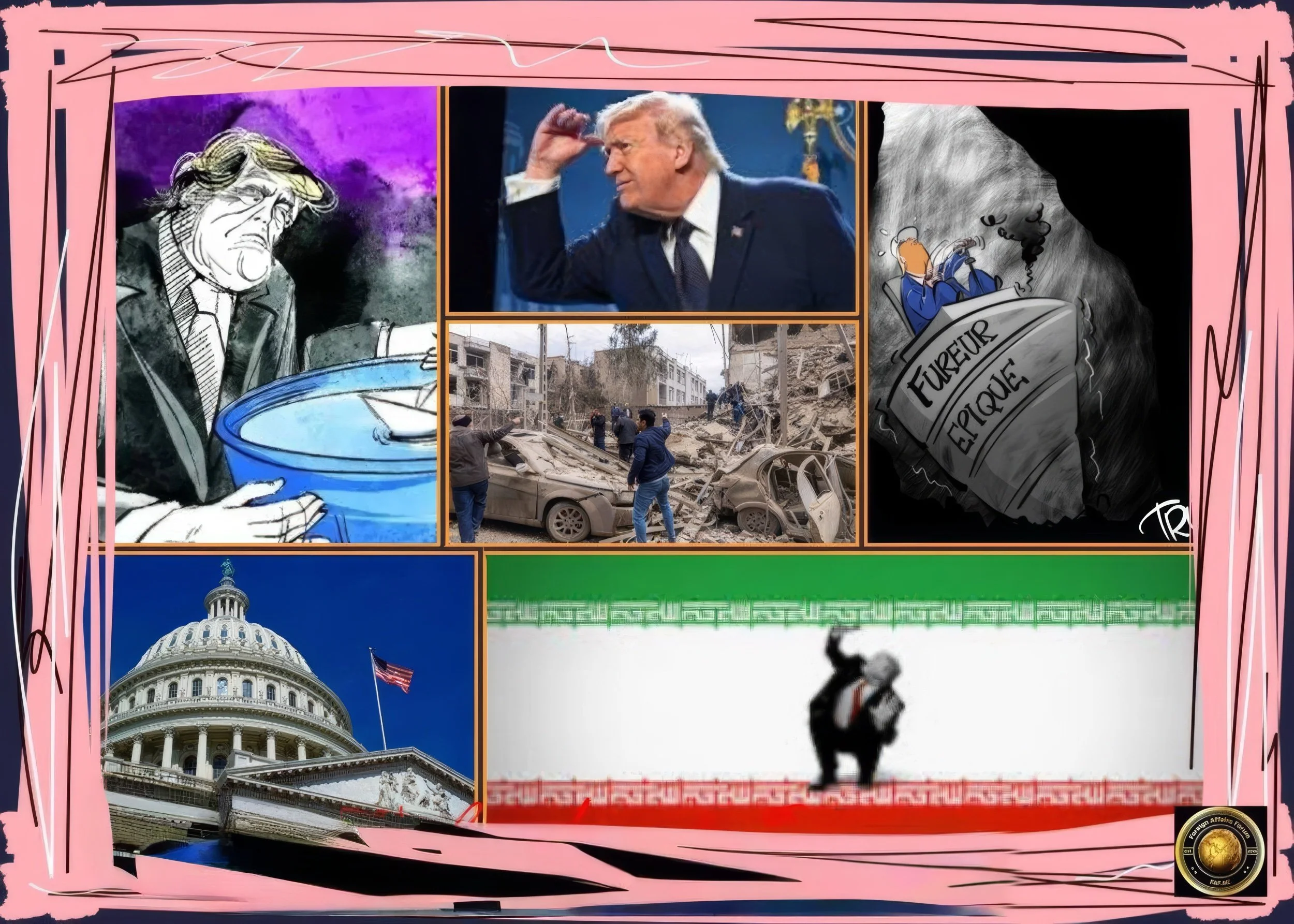
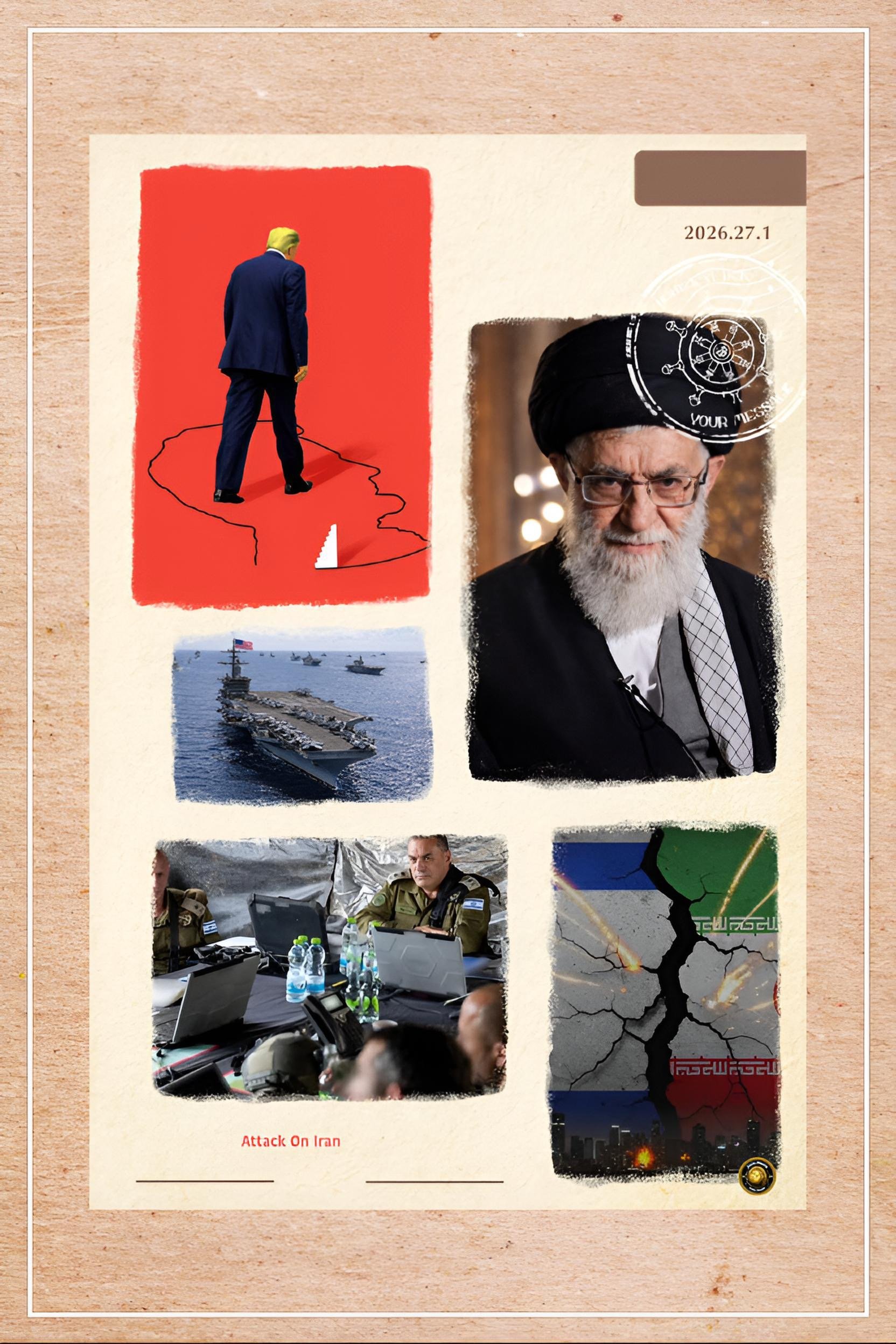
The United States-led war against Iran, launched on February 28, 2026, under the operational designation "Epic Fury," has entered its 3rd week as a conflict that has already defied the confident assumptions of its architects.
President Donald Trump, a leader who has built his political identity around the mythology of the deal, the win, and the decisive stroke, now confronts a war landscape that is beginning to close in on him.
The Islamic Republic, far from collapsing under the weight of American airpower and Israeli coordination, has responded with a resilience that has surprised the Pentagon and alarmed regional allies.
Iran has launched persistent waves of drone and missile attacks on Saudi Arabia and Israel, disrupted approximately 20% of global oil supplies through the effective closure of the Strait of Hormuz, and demonstrated that its political architecture, though grievously wounded, retains the capacity to function.
The central thesis of this analysis is straightforward but deeply uncomfortable for the architects of Operation Epic Fury: when a president who cannot psychologically or politically afford to lose confronts a war he cannot easily win, the resulting behavior is unlikely to be measured, strategic, or stabilizing.
FAF article examines the historical, psychological, and geopolitical dimensions of that premise.
Introduction: The President Who Cannot Afford Defeat
Operation Epic Fury and the Unraveling Dream: Trump's Iran War Heads Toward Dangerous Uncertainty
There is a particular kind of danger that emerges when a leader whose identity is fused with dominance encounters a situation he cannot control.
Donald Trump's entire political and psychological brand has been constructed on the premise of winning, of extracting concessions, of standing over adversaries as they capitulate.
From his business career through two terms in the White House, the narrative of Trump as a dealmaker who bends others to his will has served as the primary currency of his political legitimacy.
That narrative now confronts its most serious test, not in a boardroom or a trade negotiation, but in a war that has already consumed more than $36 billion in American resources, killed American service members, and disrupted the global economy in ways no administration official appears to have fully anticipated.
The question this analysis poses is not whether Trump will lose in Iran in any final military sense, but rather what he will do as the gap between his expectations and the reality on the ground widens.
The gap is already substantial.
The Trump administration entered Operation Epic Fury with a set of assumptions that have not survived contact with reality.
The administration anticipated a mostly seamless transition of power, akin to what officials described internally as a "Venezuela-style" outcome, in which the removal of the supreme leader would precipitate regime collapse and the emergence of a pliable successor.
It anticipated that Iran's population, galvanized by the 2025–2026 protest movements, would rise in sufficient numbers to accelerate that transition.
It anticipated that the destruction of Iran's air defenses, naval capacity, and ballistic missile infrastructure would leave Tehran with no meaningful tools of resistance.
Every one of those assumptions has proven, at least partially, wrong.
History and Context: The Long Road to Operation Epic Fury
Cornered and Combustible: What a Losing Trump Might Do to Salvage His Iran Legacy
Understanding what Trump may do in failure requires understanding how he arrived at this war in the first place, and what the historical precedents tell us about how American presidents have managed the psychological and political dimensions of strategic setback.
The origins of the current conflict lie in the wreckage of the 2015 Joint Comprehensive Plan of Action, which Trump unilaterally abandoned in 2018, describing it as a weak and insufficient agreement that had enriched Iran without adequately addressing its nuclear ambitions or its regional behavior.
That withdrawal set in motion a cycle of escalation that Iran matched step for step, expanding its enrichment activities, deepening its ties with regional proxy groups, and steadily approaching the threshold of nuclear weapons capability.
Trump's first term established the architecture of maximum pressure: sweeping economic sanctions designed to reduce Iran's oil exports to zero, financial isolation, and periodic military provocations including the January 2020 assassination of IRGC commander Qassem Soleimani.
None of these measures achieved their stated objective of compelling Iranian capitulation on the nuclear file.
By the time Trump returned to the White House in January 2025, Iran had enriched uranium to 60%, possessed sufficient fissile material to construct multiple nuclear devices within weeks, and retained a ballistic missile arsenal of approximately 2,000 projectiles capable of striking Israel.
The June 2025 12-Day War, conducted by Israel with American intelligence support, destroyed key Iranian nuclear facilities and degraded its missile capabilities, but as U.S. military analysts subsequently acknowledged, it set back Iran's nuclear timeline by only 2 years at most.
The war did not extinguish Iran's nuclear ambition. It did not dismantle the intellectual and technical infrastructure that underlies that program.
And it did not break the political will of the Islamic Revolutionary Guard Corps or the Supreme Leader's office to continue.
By February 2026, Iranian foreign minister Abbas Araghchi could still describe a negotiated agreement as "within reach," even as both sides understood the language of diplomacy was giving way to the language of military force.
When talks collapsed and Trump ordered the February 28 strikes — commencing Operation Epic Fury and killing Supreme Leader Ali Khamenei in the opening hours — the administration bet that decapitation would be the key that unlocked regime collapse.
The new Supreme Leader, Mojtaba Khamenei, moved quickly to assert authority.
Iran's institutional architecture proved more resilient than American planners had assumed.
Current Status: A War Without a Visible Exit
Beyond Shock and Awe: The Escalation Spiral Threatening to Pull the World Into Abyss
As of the 3rd week of Operation Epic Fury, the landscape of the conflict presents a picture of tactical American success and strategic American frustration.
The U.S. military has launched more than 7,800 strikes, destroyed more than 120 Iranian naval vessels, and substantially degraded Iran's integrated air defense system. American airpower has systematically targeted IRGC launch sites, missile storage facilities, and regime security infrastructure.
By any conventional military metric, the United States has achieved air and maritime dominance over the conflict zone.
And yet the war is not won. Iran continues to launch drone and missile attacks against Saudi Arabia and Israel.
The Strait of Hormuz, the narrow waterway through which approximately 20% of global oil supplies and significant volumes of liquefied natural gas transit, remains effectively closed, generating an energy shock that has driven Brent crude oil prices from approximately $70 per barrel before the conflict to over $110 per barrel within days.
Qatar, responsible for approximately 20% of global LNG supply, halted production on March 2nd following Iranian drone strikes on its energy infrastructure.
Asia's energy-dependent economies, which route 80% of their oil imports through the Strait of Hormuz, face acute supply disruptions with some nations holding oil reserves estimated to last fewer than 20 days.
The political objectives of the war remain unfulfilled.
Trump had articulated a vision that included regime change, the dismantling of Iran's nuclear and ballistic missile programs, the neutralization of Iran's proxy networks, and what he described as "unconditional surrender."
None of these has been achieved. The Pentagon has presented Trump with daily menus of options that include both escalatory pathways and de-escalation off-ramps, but no decision has been made that resolves the fundamental strategic dilemma.
The war is, by Trump's own shifting metrics, already $36 billion in the hole and producing a global economic disruption that is beginning to generate serious political blowback domestically and internationally.
Key Developments: Miscalculation, Escalation, and the Tightening Corner
Nuclear Shadows and Shattered Illusions: Why America's Iran War Is Already Rewriting Global Rules
The most consequential development in the current conflict has been the revelation of how profoundly Trump and his advisers miscalculated Iran's response. In the lead-up to the February 28th strikes,
Trump downplayed the risks to energy markets as a short-term concern that ought not to overshadow the mission to decapitate the Iranian regime.
He and his inner circle appear to have genuinely believed that Iran's response would be limited — constrained by the destruction of its military capabilities in June 2025 and demoralized by the killing of its supreme leader. That calculation was wrong in almost every significant dimension.
Iran's response has been far more forceful than its reaction during the 12-Day War of June 2025.
Tehran has leveraged its remaining proxy networks, launched sustained missile and drone offensives, and successfully closed the Strait of Hormuz — a strategic act that imposes asymmetric economic pain on the United States and its regional partners.
American forces have lost more than 12 MQ-9 Reaper drones, each valued at between $30 million and $32 million, representing losses exceeding $330 million in surveillance and strike capacity alone.
Iran's air defense capabilities, though degraded, have demonstrated the capacity to neutralize high-value American aerial assets in ways that have raised serious questions inside the Pentagon about the operational assumptions underlying the campaign.
A 2nd critical development is the deepening incoherence of the war's stated objectives. Trump's senior advisers have offered conflicting explanations for what America is fighting for in Iran.
Defense Secretary Pete Hegseth has insisted the war is not a regime change operation; the evidence of the campaign's targeting priorities suggests otherwise.
Trump himself has oscillated between calling for "unconditional surrender" and suggesting he is "considering winding down" operations, posting on Truth Social that the United States is "getting very close to meeting our objectives."
These contradictions are not merely rhetorical inconsistencies.
They reflect genuine confusion at the strategic level about what winning looks like, how it would be verified, and what terms could be described as acceptable without humiliating the president domestically.
The nuclear dimension adds a layer of danger that no amount of tactical success can fully address.
Military strikes can and have set back Iran's nuclear timeline, but as arms control analysts have consistently noted, they cannot eliminate Tehran's nuclear knowledge, its technical expertise, or the enriched uranium and fissile materials that survive the strikes.
Indeed, there is a profound irony embedded in the logic of the campaign: the more the United States and Israel punish Iran, the more Iran's leadership is likely to conclude that only a nuclear deterrent can provide genuine security.
Iran will emerge from this conflict, whatever its final shape, with a powerful institutional memory of having been attacked by the world's most capable military and having survived. That memory will shape Iranian strategic thinking for decades.
Latest Facts and Concerns: The Escalation Menu and Its Dangers
The President Who Cannot Lose: Trump's Fragile Ego and the Future of the Middle East
The strategic landscape of early March 2026 is one in which Trump faces a narrowing menu of choices, each carrying significant risks.
The military is presenting him with options that range from continued air and naval operations to the potential deployment of thousands of additional American ground troops, with the Pentagon reportedly seeking more than $200 billion in fresh war funding.
The deployment of Marines to secure Iranian islands and missile sites has been discussed as a possible option for expanding American leverage, though White House officials have stated that no decision to deploy ground troops has been made.
The most immediate concern among American allies and international observers is what Trump will do if and when he concludes that the current level of force is insufficient to achieve his stated objectives.
The administration's psychological and political architecture is not well-suited to absorbing strategic failure.
Trump's inner circle includes figures whose own political ambitions — several are reportedly already positioning for 2028 — are tied to the outcome of a war they helped design and advocate for.
The internal dynamics of a White House in which factions compete to serve Trump the biggest apparent win creates powerful incentives to escalate rather than accept a negotiated outcome that falls short of the proclaimed objectives.
The Chatham House analysis of March 2026 captures the essential strategic logic with precision: Iran's strategy is not to defeat the United States militarily but to exact a high enough political price on Trump to compel him to discontinue military operations.
Iran understands, as a weaker power always must, that it cannot win on the battlefield against American firepower. Its strategic aim is to impose costs — in treasure, in lives, in economic disruption, and in political humiliation — that make the continuation of the war politically untenable for a president who is already facing questions about its costs and direction.
The longer Iran can sustain this strategy, the more Trump will feel the need to escalate in order to prevent what he perceives as an unacceptable political outcome.
Cause-and-Effect Analysis: The Spiral Dynamics of a Cornered President
From Maximum Pressure to Maximum Peril: How Trump's Iran Miscalculation Endangers the Entire World
The causes of the current strategic impasse are layered and interconnected. At the most immediate level, the impasse reflects the fundamental error of beginning a war without a coherent theory of victory that accounts for the adversary's capacity and will to resist.
The Trump administration's optimistic assumptions about regime fragility, popular revolution, and the incapacitating effect of decapitation strikes were not products of careful intelligence analysis — they were products of wishful thinking shaped by ideological commitments and political timelines.
At a deeper level, the impasse reflects the structural consequences of Trump's governing style. By dismantling the interagency process that would normally subject military options to systematic scrutiny, skepticism, and red-teaming, the administration deprived itself of the institutional checks that might have surfaced more realistic assessments of Iran's resilience.
The court politics model of White House decision-making, in which factions compete to present the president with options that flatter his preferences, is catastrophically ill-suited to the management of a complex military conflict.
The effects of this impasse on Trump's behavior are predictable in broad outline, even if the specific manifestations remain uncertain.
Psychological research on narcissistic leadership patterns — patterns that multiple analysts have applied explicitly to Trump — identifies a characteristic response to perceived failure: the escalation of grandiosity, the construction of alternative narratives that redefine defeat as victory, and the search for a dramatic action that reasserts dominance and produces a headline-worthy demonstration of strength.
When outcomes fail to match promises, Trump's documented psychological pattern involves constructing post-hoc narratives that preserve his image as a dealmaker and global orchestrator, through misrepresentation, deflection, or redefining victory retroactively.
Applied to the Iran landscape, these dynamics suggest several possible trajectories.
The first is the declaration of premature victory: Trump concludes that the partial destruction of Iran's military infrastructure constitutes sufficient achievement and declares the war's objectives met, even as Iran's political system remains intact, its nuclear knowledge survives, and its proxy networks continue to operate.
This is the path of least immediate danger, but it creates a future in which Iran draws the lesson that endurance beats American airpower — a lesson with profound implications for deterrence.
The second trajectory is dramatic escalation: Trump, faced with the perception that the war is being lost or is producing insufficient results, orders a qualitative expansion of operations — whether through the introduction of ground forces, the targeting of Iranian civilian infrastructure such as power grids and water systems, strikes on Iranian diplomatic facilities, or pressure on allies to contribute to the campaign in ways that deepen the conflict's regional footprint.
This trajectory carries the most immediate dangers, both in terms of casualties and in terms of the risk of miscalculation that draws in other significant powers, most notably China and Russia, each of which has strategic interests in Iran's survival as a functioning state.
The third and most alarming trajectory is the nuclear dimension. As arms control experts have documented, Iran will retain, after this conflict, the knowledge, expertise, and — in some facilities — the materials necessary to pursue nuclear weapons on a compressed timeline.
A Trump administration that cannot claim a clean victory on the nuclear file faces an impossible political dilemma: admitting that military force failed to solve the nuclear problem would be an admission of defeat; but the alternative — accepting a negotiated outcome that permits Iran some level of enrichment capability — would require Trump to accept terms that his own maximalist rhetoric has made politically toxic.
The resolution of this dilemma through further military escalation, potentially including strikes on deeply buried enrichment facilities that have so far resisted American bunker-busting munitions, represents a path of continuing devastation with diminishing strategic returns.
Future Steps: What the World Should Anticipate and Prepare For
The international community, regional stakeholders, and American domestic institutions face an urgent imperative: to understand the range of Trump's possible responses to strategic frustration in Iran and to prepare accordingly. This imperative operates on several levels simultaneously.
At the diplomatic level, the most viable off-ramp from the current impasse remains a negotiated arrangement that permits Iran some symbolic preservation of face on the nuclear question while providing Trump with sufficiently tangible achievements to claim victory domestically.
The proposal floated in late February 2026 — a highly restricted enrichment program limited to medical research purposes — represents exactly the kind of face-saving formula that has historically allowed parties to exit intractable conflicts without either side openly acknowledging defeat.
The difficulty is that Trump's own maximalist rhetoric — "unconditional surrender," the complete dismantling of Iran's enrichment capacity, regime change — has raised the bar for acceptable terms to a level that Iran cannot meet without its own political collapse.
Backchannel diplomacy involving trusted intermediaries, most likely Omani or Qatari officials, represents the most practical avenue for creating sufficient ambiguity to allow both sides to accept a settlement that neither would publicly endorse.
At the military level, the continuation of Operation Epic Fury at its current intensity is not strategically sustainable.
The financial costs are accelerating — from $14 billion in the first week to total war costs approaching and exceeding $36 billion within three weeks. The above estimate is based on FAF analysis of $2 billion per day tangible and intangible war costs.
The global economic consequences of the Strait of Hormuz closure — including oil prices above $110 per barrel, LNG supply disruptions affecting an entire hemisphere, and the disruption of shipping that has driven freight rates to record levels — are generating inflationary pressures in economies that are already fragile.
Capital Economics has warned that if the conflict is prolonged, oil prices could reach $130 per barrel in the second quarter of 2026.
For an administration that came to power promising economic dynamism and lower energy costs, this trajectory is politically devastating.
At the Congressional level, the failure to consult Congress before launching Operation Epic Fury — a war of choice conducted without statutory authorization — represents a constitutional vulnerability that will grow more significant as the costs mount and the objectives remain elusive.
The historical precedent of the War Powers Resolution, consistently honored more in the breach than in observance by American presidents, will become an increasingly important arena of political contestation if the war extends into months rather than weeks.
At the level of regional strategic dynamics, the Iran war is reshaping the geopolitical landscape in ways that will outlast the conflict itself.
Saudi Arabia and the Gulf states, which have absorbed Iranian drone and missile attacks, face a dilemma between their security dependence on the United States and the devastating economic consequences of a prolonged regional conflict.
China's strategic positioning is especially significant: Tehran is reportedly considering allowing cargoes traded in Chinese yuan to transit through the Strait of Hormuz — a move that would accelerate the challenge to the U.S. dollar's dominance in global energy markets.
Russia, which has its own equities in Iranian survival, presents additional vectors of escalation that have not been adequately modeled by American strategic planners.
The nuclear question, finally, presents the most intractable long-term challenge.
If the war ends without a verifiable and durable arrangement that addresses Iran's enrichment capability, the United States and Israel will have attacked a sovereign nation, killed its supreme leader, disrupted the global economy, and spent tens of billions of dollars — only to face, within months or years, an Iran more determined than ever to acquire nuclear weapons as the only genuine guarantor of its security.
The perverse logic of the situation is that the war designed to prevent Iranian nuclearization may, in its failure to achieve that objective, make Iranian nuclearization more likely.
This is not a hypothetical risk. It is the assessed judgment of the American intelligence community and the arms control analytical community.
The Psychology of Defeat and the Danger of the Cornered Leader
No serious analysis of what Trump may do in Iran can avoid confronting the psychological dimension directly.
This is not a matter of reductive psychologizing but of taking seriously the substantial body of evidence about how Trump has consistently responded to situations he cannot control, cannot win by his own definition, or cannot narrate as triumph.
The patterns are remarkably consistent across multiple domains and years of documented behavior.
When faced with negative assessments about himself, when events portray him as inferior to his rivals, or when outcomes contradict his public commitments, Trump reacts immediately and with anger, without careful deliberation.
He constructs narratives that preserve his image regardless of the underlying facts. He seeks dramatic gestures that reassert dominance even at the cost of strategic coherence.
And when he confronts environments in which shared credit, compromise, or nuanced process is required — exactly the environment of serious diplomacy — his psychology makes productive engagement extraordinarily difficult.
The European Council on Foreign Relations analysis of February 2026 describes Trump's foreign policy style as prioritizing "headline-grabbing wins over the detail and substance of foreign policy," with White House factions competing to convince Trump that their preferred option will deliver the biggest visible win.
In a war context, this dynamic creates a systematic bias toward escalation over de-escalation, toward dramatic action over patient strategy, and toward the preservation of domestic narrative over the requirements of international stability.
The historical analogies are sobering. The United States has experience with presidents who, trapped in wars they could not win, chose escalation over admission of failure — with consequences that proved far more costly than the original conflict.
The Vietnam escalation under Lyndon Johnson, driven in substantial part by the political impossibility of accepting defeat, is the most cited example.
More recently, the expansion of American engagement in Afghanistan under multiple administrations, despite consistent intelligence assessments that the strategic objectives were unachievable, reflects a similar dynamic.
The difference in the Iran case is the compressed timeline, the nuclear dimension, and the specific psychological profile of the president making the decisions.
Implications for Allied and Regional Stakeholders
The implications of Trump's possible responses to strategic failure in Iran extend well beyond the bilateral relationship between Washington and Tehran.
The war has created a web of interconnected interests and vulnerabilities among regional and global stakeholders that must be carefully navigated.
Israel, the most intimately involved American partner in the conflict, faces its own strategic dilemma.
The killing of the supreme leader and the degradation of Iran's military capabilities serve Israeli security interests in the short and medium term.
But an Iran that emerges from this conflict humiliated, economically devastated, and convinced of the necessity of nuclear weapons represents a far more dangerous long-term adversary.
Israeli strategic planners are not uniform in their assessment of whether regime change or continued containment better serves Israeli security over a 10- to 20-year horizon.
Saudi Arabia has absorbed Iranian attacks, suffered disruptions to its energy infrastructure, and faces the prospect of an extended conflict that keeps oil markets in turmoil.
For Riyadh, the desire to see Iran's power permanently diminished must be weighed against the economic costs of a war that is disrupting the very energy revenues on which the Saudi state depends.
The Gulf Cooperation Council states are, individually and collectively, subject to Iranian retaliatory capability in ways that the United States, separated from Iran by a significant geographical buffer, is not.
China's posture is strategic and calculated. Beijing has significant trade and energy dependencies on Iranian oil, which has flowed at discounted prices under American sanctions.
A permanently weakened Iran would remove a significant lever of Chinese energy diversification and a significant source of strategic pressure on American allies in the Gulf.
China's response to the war — quiet support for Iranian financial transactions, the potential yuan-denominated energy trade through the Strait, and diplomatic signaling through multilateral forums — reflects a determination to prevent Iran's complete strategic defeat without directly challenging American military operations.
Russia's equities are similar in structure if different in detail. Moscow has supplied Iran with military technology including drone components and air defense systems.
An Iran that collapses under American pressure would remove a significant strategic buffer for Russian regional interests and demonstrate the vulnerability of American adversaries to overwhelming force — a demonstration that would not comfort the Kremlin in the context of its own conflicts.
Russia will use its influence in the United Nations Security Council and through back channels to complicate any American attempt to declare clean victory or to impose a post-conflict settlement that does not account for Iranian interests.
Conclusion: The Architecture of a Necessary Reckoning
When the Endgame Has No Exit: Trump, Tehran, and the Trap of Unwinnable Wars
The question "what will Trump do if he loses in Iran" is, in one sense, premature — the conflict remains in active evolution, and the range of possible outcomes has not yet been definitively narrowed.
But it is also a question that responsible strategic thinking cannot defer.
The evidence accumulated in the first three weeks of Operation Epic Fury — the miscalculation of Iranian resilience, the failure of the regime collapse scenario, the persistence of the nuclear threat, the global economic damage, and the psychological and political dynamics of a president who cannot afford to acknowledge failure — all point toward a period of significant danger as the gap between expectations and reality widens.
The architecture of a safe and responsible off-ramp requires several simultaneous elements. It requires a diplomatic process that creates sufficient ambiguity to allow both Washington and Tehran to claim partial victory.
It requires Congressional reassertion of its constitutional role in the authorization of war.
It requires allied pressure — from European capitals, from Gulf states, from the United Nations system — that creates political space for a negotiated settlement that Trump can narrative as a win without requiring Iranian humiliation.
And it requires an honest public reckoning in the United States with the costs, the miscalculations, and the strategic consequences of a war that was launched on contestable intelligence, without Congressional authorization, and without a coherent theory of victory.
None of these requirements is easily satisfied in the current environment. But the alternative — a president who, unable to accept failure, escalates a war with nuclear-adjacent dimensions into a deeper and more dangerous conflict — is a prospect that the international community cannot afford to treat as a low-probability contingency.
The history of great power conflicts gone wrong is largely a history of leaders who could not find the off-ramp.
The Iran war of 2026 is still, barely, at the stage where the off-ramp exists.
The question is whether the political will to take it can be assembled before the cost of not doing so becomes catastrophic.