The Petroyuan Ultimatum: Iran, the Strait of Hormuz, and the Structural Unraveling of Dollar Hegemony in Global Energy Markets
Executive Summary
Iran's Yuan Gambit at Hormuz Is Rewriting the Rules of Global Energy Finance
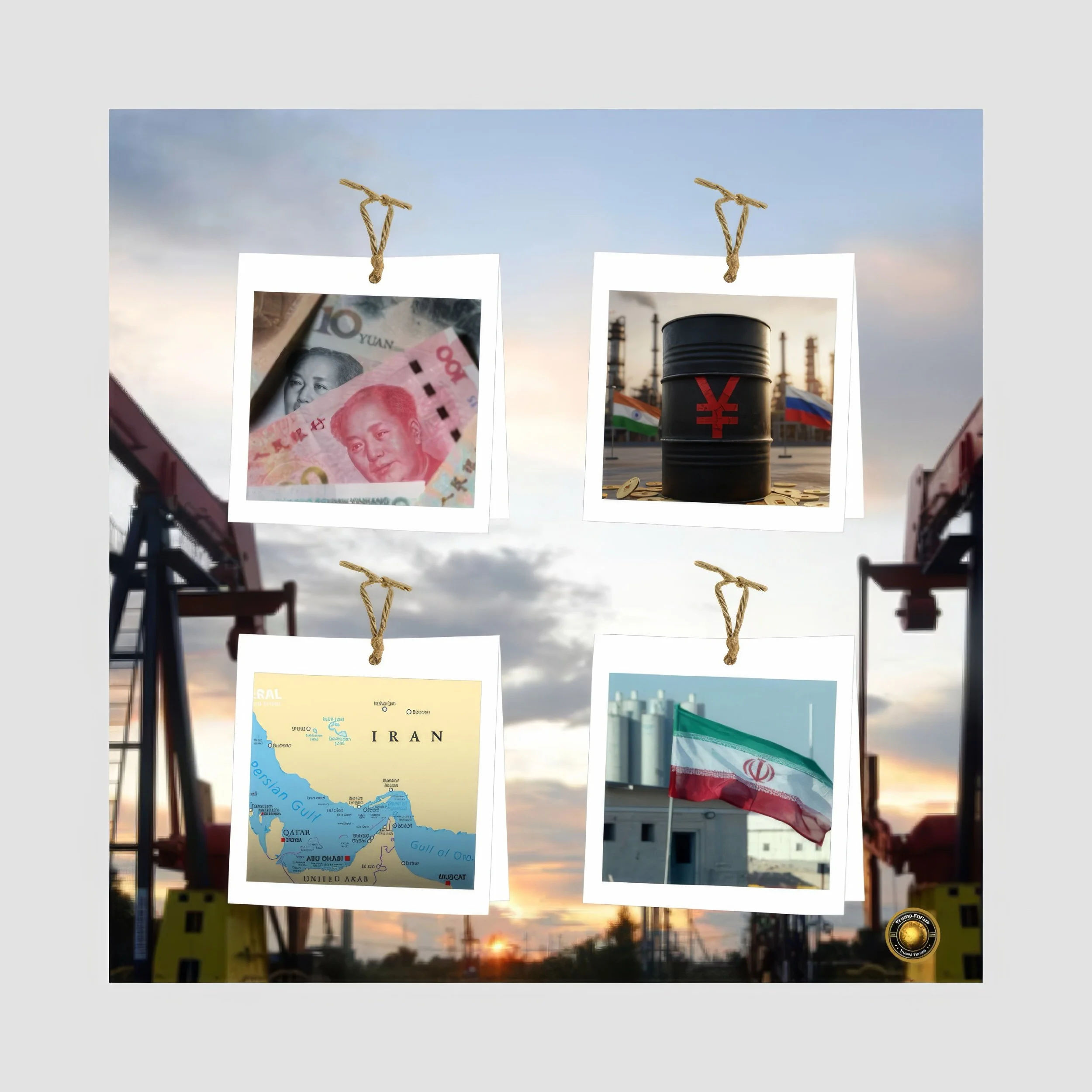
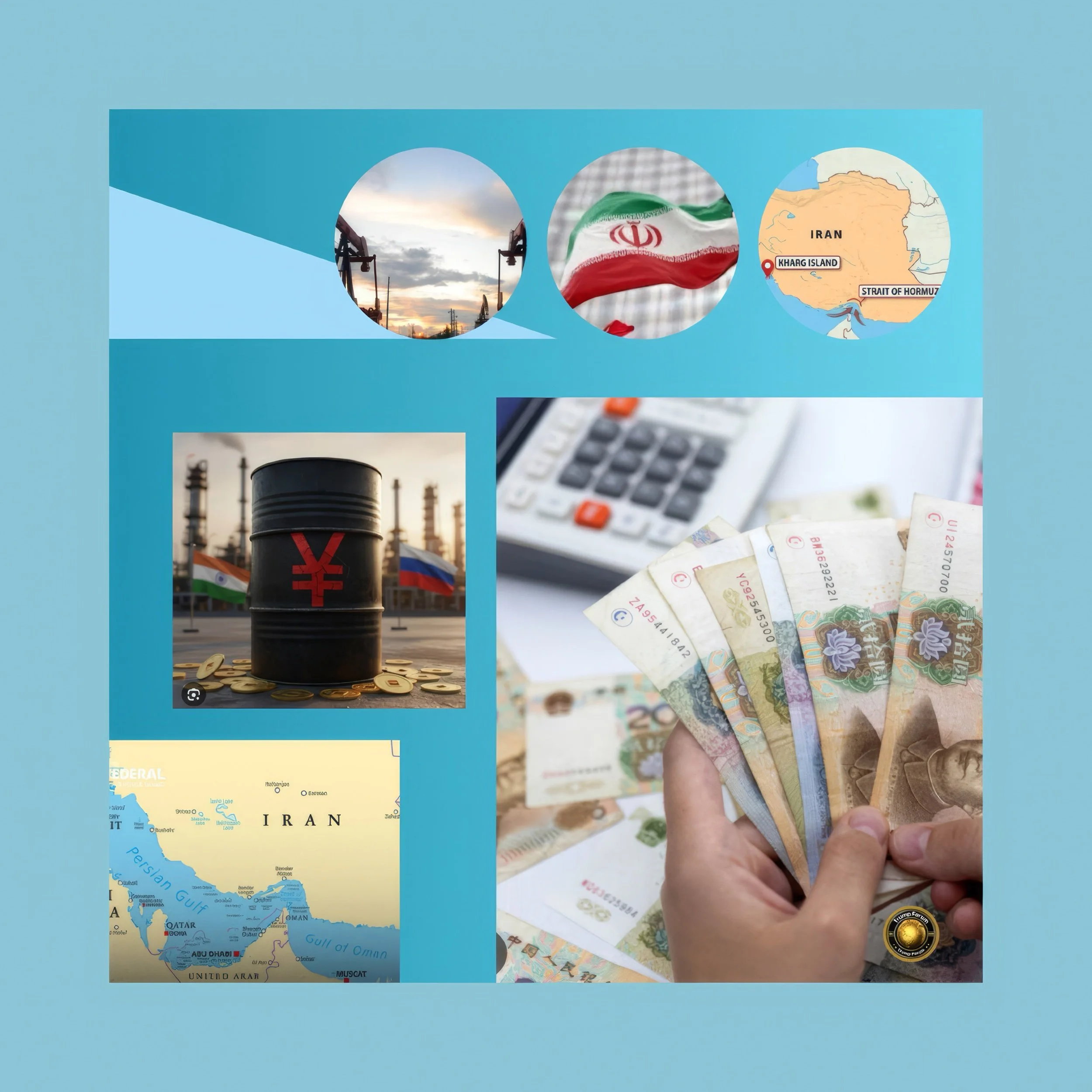
The March 2026 announcement that Iran was considering allowing a limited number of oil tankers to transit the Strait of Hormuz on the condition that their cargo be traded in Chinese yuan represents one of the most consequential and symbolically charged financial propositions in the post-Bretton Woods era.
This is not merely a tactical maneuver by a sanctions-besieged state seeking leverage over its adversaries.
It is the latest — and perhaps most operationally significant — manifestation of a structural realignment that has been gathering momentum for over a decade: the systematic erosion of the petrodollar system and the emergence of the petroyuan as a credible, institutionally embedded alternative framework for settling global energy transactions.
The Strait of Hormuz, through which approximately 20 million barrels of oil pass daily and which handles roughly 20% of all global liquefied natural gas trade, has been effectively restricted since the outbreak of hostilities involving Iran, Israel, and the United States.
This closure has already triggered a roughly 10% surge in oil prices on a single trading day, with analysts warning that a prolonged blockade could push Brent crude past $100 per barrel.
Against this backdrop, Tehran's yuan condition transforms a chokepoint of physical geography into a chokepoint of financial architecture — a deliberate, strategic instrument designed to hasten the displacement of the dollar from its role as the universal medium of oil exchange.
The implications for the United States, for global monetary order, and for the strategic balance between Washington and Beijing are profound and enduring.
Introduction: A Chokepoint Becomes a Currency Battleground
The Petrodollar's Long Twilight: How Iran Is Accelerating a 50-Year Reckoning
Throughout recorded history, the control of maritime choke points has conferred enormous strategic leverage on those who possess it.
The Strait of Hormuz — the narrow corridor connecting the Persian Gulf to the Gulf of Oman and thence to the broader Indian Ocean — represents perhaps the most consequential such corridor in the contemporary world.
At its narrowest point, it is barely 20.5 miles wide.
Yet, its significance dwarfs that of any canal, passage, or waterway on the planet by virtue of the sheer volume and strategic value of the hydrocarbons that transit it.
In the spring of 2026, this geography has been weaponized in an entirely new register.
Where previous crises around the strait have focused on the threat of physical blockade, mining, or military interdiction, Tehran's March 2026 proposal introduces a novel dimension: the financial architecture of the transaction itself as a condition of passage.
Iran's signal — that oil tankers may be permitted to transit the strait if their cargo is priced and settled in Chinese yuan rather than US dollar— is simultaneously a sanctions-evasion strategy, a geopolitical alliance signal to Beijing, and a calculated strike at the institutional foundations of American financial power.
To understand why this matters so profoundly, FAF has traced the history of the petrodollar system from its origins in the wreckage of Bretton Woods, through its consolidation as the backbone of American fiscal and monetary power, to its current state of accelerating institutional erosion.
History and Current Status: The Petrodollar — Architecture, Consolidation, and Fracture
From Riyadh to Beijing: The Seismic Shift That Could End Dollar Supremacy in Oil
The petrodollar system was born not from diplomatic idealism but from crisis management.
In August 1971, President Richard Nixon unilaterally suspended the convertibility of the US dollar into gold, effectively terminating the Bretton Woods fixed exchange rate regime that had governed the international monetary system since 1944.
The consequences were severe: floating exchange rates introduced volatility into international trade, the dollar depreciated, and oil-producing states found that their revenues — denominated in a currency no longer anchored to gold — were being eroded in real terms.
The 1973 Yom Kippur War provided the trigger for OPEC's oil embargo against the United States and its allies, quadrupling oil prices from approximately $3-$12 per barrel and plunging the industrialized world into recession.
From this crisis emerged one of the most consequential — and, until its declassification in 2016, one of the most secretive — bilateral economic arrangements of the 20th century.
In 1974, the Nixon administration negotiated a compact with Saudi Arabia under which Riyadh committed to pricing its oil exclusively in US dollar and to recycling its surplus petrodollar revenues into US Treasury bonds and American financial instruments.
In return, Washington pledged military protection, arms sales, and sustained security guarantees to the Saudi kingdom.
The arrangement was then extended, through a combination of coercion and inducement, across the broader OPEC membership, cementing the dollar as the sole global currency of oil settlement.
From that moment forward, every nation on Earth that needed oil — and virtually every nation needed oil — was obliged to maintain dollar reserves, creating an effectively inexhaustible global demand for American currency that underwrote US Treasury borrowing, suppressed American interest rates, and subsidized decades of US fiscal expansion.
The petrodollar system functioned as an invisible tax on the rest of the world.
Nations exported real goods and services, accumulated dollar, and then recycled those dollar back into US financial markets, effectively providing Washington with a structural subsidy that no other state in history has enjoyed.
The "exorbitant privilege," as French Finance Minister Valéry Giscard d'Estaing memorably described it in the 1960s, was not merely a matter of prestige — it was the material foundation of American geopolitical power, enabling the United States to run persistent current account deficits without triggering currency crises, to finance military expeditions without immediate fiscal constraint, and to wield sanctions as instruments of geopolitical coercion with devastating effectiveness.
For 50 years, this architecture held.
Then, in June 2024, Saudi Arabia allowed the original petrodollar agreement to quietly expire without renewal — a development that received remarkably little mainstream media coverage given its historical significance.
Riyadh announced that it would henceforth accept yuan, €, ¥, and digital currencies for oil transactions, a shift driven by the structural transformation of Saudi Arabia's customer base — China had by then displaced the United States as Saudi Arabia's single largest oil customer — and by a growing strategic unease with Washington's instrumentalization of the dollar as a sanctions weapon.
Saudi Arabia's accession to the BRICS framework and its deepening economic integration with Beijing had already signaled the direction of travel; the non-renewal of the petrodollar agreement confirmed it.
Iran's 2026 Hormuz yuan condition thus arrives not in isolation but as the latest and most dramatic episode in a sequence of structural shifts that have been progressively undermining the petrodollar architecture.
Where Saudi Arabia's move was gradual and diplomatically hedged, Iran's proposition is confrontational, immediate, and operationally concrete. It deploys control over a physical chokepoint to enforce a financial condition — a qualitatively new form of currency warfare.
Key Developments: From Sanctions Evasion to Financial Architecture Transformation
A Chokepoint, a Currency War, and the Quiet Collapse of America's Financial Architecture
To appreciate the full strategic depth of Iran's yuan gambit, it is necessary to examine the institutional scaffolding that China and Iran have jointly constructed over the preceding decade to make such a proposition operationally feasible.
Iran has faced comprehensive US sanctions since the Islamic Revolution of 1979, but the sanctions architecture dramatically intensified after the United States withdrew from the Joint Comprehensive Plan of Action in 2018, effectively severing Iran from the SWIFT international banking system and making dollar transactions legally treacherous for any financial institution worldwide.
The consequence was not the economic collapse that Washington intended but a forced restructuring of Iran's trade relationships toward non-dollar frameworks.
China, as Iran's largest trading partner and the buyer of approximately 80 to 90% of Iranian oil exports, became the anchor of Iran's alternative financial universe.
As reported by the Wall Street Journal in late 2025, China developed a covert financial mechanism — reportedly known internally as "Chuxin" — specifically designed to facilitate yuan-denominated payments to Iran for oil without routing transactions through the US banking system.
This infrastructure, operating outside the reach of US Treasury enforcement, effectively created a parallel settlement system for Iranian hydrocarbons.
By early 2026, China was purchasing approximately 90% of Iran's oil exports, representing over $8 billion annually, entirely within this non-dollar architecture.
Simultaneously, China has been constructing the institutional infrastructure for broader yuan internationalisation in energy markets.
The Cross-Border Interbank Payment System (CIPS), a Chinese-developed alternative to SWIFT, has steadily expanded its membership and transaction volumes.
The inclusion of China's e-CNY digital currency on the mBridge platform — a multilateral central bank digital currency project involving several Gulf states — has further advanced the technical feasibility of non-dollar oil settlement at scale.
The Asia Society Policy Institute has noted that these innovations "offer oil producers not only viable but potentially superior alternatives" to dollar-based settlement channels, particularly given the growing vulnerability of dollar-denominated systems to US sanctions enforcement.
The 25-year China-Iran Comprehensive Cooperation Agreement, signed in 2021, provided the strategic framework within which these financial innovations were deployed.
The agreement committed China to investing up to $400 billion in Iranian infrastructure, energy, and technology in exchange for guaranteed access to discounted Iranian oil — a structural fusion of Chinese capital requirements with Iranian hydrocarbon assets that bypassed the dollar entirely.
This agreement represented not merely a bilateral trade deal but the institutional embedding of the petroyuan within the Iran-China relationship.
By 2026, Tehran's proposal to condition Hormuz transit on yuan settlement was not a theoretical aspiration but the activation of an already-functional financial architecture.
Beyond Iran, the broader landscape of petroyuan adoption has been advancing on multiple fronts.
Russia, under comprehensive Western sanctions following its 2022 invasion of Ukraine, has progressively shifted its energy exports — particularly to China and India — into yuan and ruble settlements. Russia-China trade had reached approximately 55% yuan settlement by 2025.
India, despite its complex strategic relationship with the United States, has been settling Russian oil purchases in yuan, creating a triangular non-dollar energy trading network spanning the Eurasian landmass.
BRICS nations, which collectively account for approximately 37% of emerging market fuel trade, have been systematically building the financial infrastructure — payment systems, currency swap arrangements, and trade finance mechanisms — required to sustain a post-dollar energy economy.
Latest Facts and Concerns: The Hormuz Crisis and Its Financial Ramifications
De-Dollarization in Real Time: What Iran's Hormuz Condition Means for the World Order
The immediate context of Iran's March 2026 yuan proposal is an active military confrontation of alarming intensity.
The Strait of Hormuz has been effectively closed since the outbreak of hostilities involving Iran, Israel, and the United States, with tanker traffic reduced to a fraction of normal levels.
Oil prices surged approximately 20% in the initial days of the conflict, with analysts at Wood Mackenzie warning that a closure lasting two weeks could drive Brent crude to $100 per barrel, while more pessimistic scenarios involving prolonged disruption or damage to Gulf energy infrastructure have generated projections approaching $150.
The global economic implications are immediate and severe. Asia bears the most direct exposure: Japan, South Korea, India, and China collectively depend on Persian Gulf oil for the majority of their energy imports, and their refining industries have been scrambling for alternative sources in an already tight market.
India, which imports over 85% of its crude oil requirements, faces acute inflationary pressure across transportation, manufacturing, and consumer goods sectors.
The Indian rupee has come under significant pressure against the dollar, with MUFG analysts projecting that sustained oil at $100 per barrel could push the USD/INR exchange rate to 95.50.
European economies, heavily dependent on LNG from the Persian Gulf, face both energy security and inflationary risks that could reignite the cost-of-living crises that battered the continent in 2022.
For the United States, the economic exposure to a Hormuz closure is structurally more limited than it was a decade ago — domestic shale production has substantially reduced American import dependence — but the financial and geopolitical ramifications are far more consequential.
The Federal Reserve's inflation management framework would be challenged by an exogenous energy supply shock of this magnitude, potentially forcing a stark choice between tolerating higher inflation and tightening monetary conditions into a slowing economy.
More fundamentally, the Iranian yuan condition directly challenges the institutional architecture through which the United States exercises financial hegemony.
If the yuan becomes the currency of passage through the world's most important energy chokepoint, the normative case for dollar settlement in global oil markets weakens structurally.
Analysts at the South China Morning Post have noted that while Iran's yuan proposal could symbolically advance yuan internationalisation, it faces significant security and feasibility challenges in implementation.
The practical complications are real: yuan convertibility remains restricted by Chinese capital controls, the depth of yuan-denominated financial markets cannot yet match the liquidity of dollar markets, and many non-Chinese stakeholders in the Hormuz oil trade lack the institutional relationships with Chinese financial infrastructure required to operationalize yuan settlement at short notice.
Nevertheless, the very fact that the proposal is being seriously entertained — and that the technical infrastructure to partially implement it already exists — marks a qualitative threshold in the de-dollarization trajectory.
Cause-and-Effect Analysis: The Cascading Consequences of a Petroyuan Chokepoint
How Tehran's Yuan Ultimatum at Hormuz Threatens the Foundations of the Global Economy
The analytical core of Iran's Hormuz yuan condition lies in its cascading systemic effects, which operate simultaneously across the physical, financial, and geopolitical dimensions of the global energy economy.
At the most immediate level, the physical disruption of Hormuz flows has already administered a severe supply shock to global oil markets, driving price surges that function as a regressive tax on every oil-importing economy in the world.
This supply shock is not merely cyclical — it is revealing structural vulnerabilities in the global refining system, where the concentration of capacity in Asia and Europe has created geographic dependencies on Persian Gulf crude that cannot be rapidly diversified.
The consequence is sustained upward pressure on energy prices, inflation, and — through the mechanism of reduced real disposable income and elevated production costs — a drag on global GDP growth.
At the financial level, the yuan settlement condition introduces a mechanism that could, if adopted even partially, alter the flow of dollar through the global financial system.
The petrodollar system functions because the settlement of oil in dollar creates a structural global demand for American currency.
Every barrel of oil sold generates a dollar transaction that must be settled through US financial institutions, creating flow-through demand for dollar reserves and, by extension, for US Treasury securities.
If a meaningful fraction of global oil settlement migrates to yuan, this structural demand diminishes.
The dollar weakens, US Treasury yields must rise to attract buyers on market terms rather than structural necessity, and the cost of American fiscal deficits — currently running at levels that require continuous foreign recycling — increases.
The Federal Reserve's capacity to conduct monetary policy is correspondingly reduced, as the external demand floor for dollar that the petrodollar provides begins to erode.
At the geopolitical level, Iran's proposal is designed to demonstrate, concretely and publicly, that China's financial infrastructure can function as a viable alternative to the dollar system even under conditions of maximum geopolitical stress.
Beijing has enormous strategic incentives to support this demonstration: a successful yuan-denominated transit arrangement at Hormuz would signal to every oil-producing state in the Gulf — and to every oil-importing state in Asia — that the technical and institutional barriers to yuan settlement have been substantially overcome.
Saudi Arabia, the UAE, Qatar, and Kuwait, all of which have been quietly exploring yuan settlement options, would receive a powerful signal that the infrastructure is ready and the political cover is available.
The cause-and-effect chain extends into the realm of sanctions effectiveness.
The United States has wielded financial sanctions as its most potent geopolitical instrument for two decades, targeting Iran, Russia, Venezuela, Cuba, North Korea, and a growing list of Chinese entities and individuals.
The dollar's centrality to global finance is what makes sanctions devastating: cut an entity off from dollar settlement, and you cut it off from the global economy.
If the yuan provides a credible alternative settlement mechanism — embedded in a parallel financial infrastructure spanning CIPS, mBridge, bilateral currency swap arrangements, and commodity exchange platforms — the capacity of dollar sanctions to inflict decisive economic pain is fundamentally impaired.
Every successful yuan-denominated transaction that bypasses the dollar system is simultaneously a technical proof-of-concept for sanctions evasion and an institutional precedent that normalises non-dollar settlement in global trade.
The effect on American fiscal capacity is structural and long-term.
The United States has been able to sustain exceptionally high levels of government debt — approaching $39 trillion as of mid-2026 — partly because the petrodollar system generates a structural global demand for US Treasuries: oil-exporting states accumulate dollar, and those dollar are recycled into American sovereign debt, suppressing yields and enabling fiscal expansion at low cost.
The erosion of this recycling mechanism — even at the margins — will over time force American fiscal adjustment, raising the cost of government borrowing and constraining the latitude available for military spending, social programs, and economic stimulus.
This is not a short-term crisis but a long-term structural ratchet that tightens incrementally with each yuan transaction that displaces a dollar one.
China's position in this dynamic is one of asymmetric advantage. Beijing does not need to fully displace the dollar in the near term to achieve its strategic objectives — it needs only to demonstrate that viable alternatives exist, to expand the institutional infrastructure that makes those alternatives operational, and to patiently absorb the incremental gains in yuan internationalisation that each new crisis generates.
The Iran-Hormuz yuan proposal advances all three of these objectives simultaneously, at a moment when US geopolitical overextension and domestic fiscal constraints limit Washington's capacity to mount a decisive counter-response.
The implications for global energy-importing nations — particularly in the Global South — are complex.
On one hand, the availability of yuan-denominated financing for energy trade reduces dependence on the dollar and the exposure to US financial coercion that comes with it.
On the other hand, substituting yuan for dollar creates a new form of financial dependence on China, with its own associated vulnerabilities: restricted convertibility, exposure to Chinese capital controls, and the political risks that attend deep financial integration with a state that instrumentalises economic relationships for strategic purposes.
The Global South, in other words, is not escaping financial hegemony — it is potentially transitioning between its American and Chinese variants.
Future Steps: Trajectories, Scenarios, and Strategic Implications
The Strait of Hormuz as a Financial Weapon: Iran, China, and the Dollar's Existential Crisis
The analytical question is not whether the petrodollar system will be further eroded — the structural forces driving that erosion are too powerful, too institutionally embedded, and too geopolitically reinforced to reverse — but rather at what pace, through what mechanisms, and with what distributional consequences for the major stakeholders.
In the near term, the resolution of the Hormuz crisis will determine whether Iran's yuan proposal remains a negotiating signal or becomes an operational precedent.
If even a limited number of tanker transits are successfully completed under yuan settlement terms, the institutional and normative precedent would be substantial.
The first successful yuan-denominated Hormuz transit would function as a Rubicon moment — demonstrating that the most strategically critical energy corridor in the world can be transited outside the dollar framework, under conditions of maximum geopolitical pressure.
This demonstration effect would reverberate through every oil-producing capital in the Gulf and every oil-importing ministry in Asia.
Over the medium term — a horizon of three to seven years — the trajectory of yuan internationalisation in energy markets will be determined by the interplay of several structural variables.
The pace of CIPS expansion and the adoption of mBridge by Gulf central banks will be critical: if the technical infrastructure for yuan settlement becomes sufficiently liquid and accessible, the transaction cost advantages of the dollar will narrow.
The policy choices of Saudi Arabia — the single most consequential variable in global oil pricing — will be determinative: a full Saudi pivot to accepting yuan for oil would represent a structural endpoint for the petrodollar system in a way that Iranian and Russian yuan transactions have not.
The trajectory of US-China strategic competition will also matter: the more aggressively Washington deploys dollar-based sanctions against Chinese entities, the stronger Beijing's incentive to accelerate yuan internationalisation becomes.
The Asia Society Policy Institute's January 2026 analysis is characteristically measured but directionally unambiguous: "While complete de-dollarization of the oil trade is highly unlikely over the next five years, expect gradual erosion of the dollar's use in oil trade settlement and the global recycling of oil revenues."
This erosion, compounding over time, represents a structural transformation of the global monetary order even if it falls well short of the dramatic "dollar collapse" narratives that periodically surface in financial commentary.
For the United States, the strategic imperatives are clear even if the political will to pursue them is uncertain.
Washington must develop a response to de-dollarization that goes beyond the reactive deployment of sanctions — which, as argued above, paradoxically accelerates the very process it seeks to contain.
A constructive response would involve deepening US energy diplomacy with Gulf states to maintain their preference for dollar settlement, investing in the competitiveness of US financial infrastructure relative to Chinese alternatives, and developing a more sophisticated understanding of the conditions under which dollar-denominated settlement provides genuine value to trading partners rather than merely reflecting historical inertia.
The United States retains enormous structural advantages — the depth and liquidity of dollar-denominated financial markets, the rule of law protections of the US financial system, and the global network of financial institutions that have built their operations around dollar infrastructure, which gives the petrodollar system considerable residual resilience.
But these advantages are not permanent, and they are being systematically challenged.
For China, the strategic task is to continue building the institutional infrastructure of yuan internationalisation while managing the tensions between capital account openness and the political control that Chinese authorities prize.
The yuan's Achilles heel remains its limited convertibility: a currency that cannot be freely exchanged undermines the trust and liquidity that reserve currency status requires.
Beijing faces a structural dilemma — fully liberalizing the capital account would expose China's financial system to external shocks and potentially destabilizing capital flows, but maintaining capital controls places a ceiling on yuan internationalisation.
How Beijing navigates this dilemma will ultimately determine whether the petroyuan becomes a genuine global reserve currency or remains a strategically significant but regionally circumscribed alternative to the dollar.
The emerging economies of Asia, Africa, and Latin America face a landscape of constrained choices.
De-dollarization offers them reduced exposure to US sanctions coercion and potentially greater monetary sovereignty, but yuan adoption brings its own dependencies.
The most attractive outcome for these states — a genuinely multipolar currency system in which no single currency commands structural dominance — is also the most institutionally difficult to achieve, requiring levels of coordination and trust among competing powers that the current geopolitical environment does not favor.
The Role of Digital Currencies in Reshaping the Energy Settlement Landscape
No analysis of the petroyuan trajectory would be complete without a detailed examination of the role of digital currencies — and specifically of China's e-CNY and the mBridge platform — in transforming the technical feasibility of non-dollar oil settlement.
The petrodollar system's resilience has historically rested in part on the network effects of dollar-denominated financial infrastructure: SWIFT, correspondent banking, the deep liquidity pools of US financial markets, and the habit of institutions worldwide of denominating contracts, reserves, and transactions in dollar.
These network effects are powerful, but they are not immutable, and digital currency technology is specifically designed to circumvent the intermediary infrastructure through which the dollar exerts its gravitational pull.
China's Cross-Border Interbank Payment System, launched in 2015 and steadily expanded since, now operates as a parallel messaging and settlement infrastructure to SWIFT for yuan-denominated transactions.
By 2025, CIPS had significantly expanded its participant base among financial institutions in Asia, the Middle East, and Africa.
The mBridge platform, developed by the Bank for International Settlements in collaboration with the central banks of China, Hong Kong, Thailand, and the UAE, enables direct, real-time settlement between central banks in their respective digital currencies — eliminating the correspondent banking relationships through which the dollar has historically maintained its settlement dominance.
The inclusion of Saudi Arabia, the UAE, and other Gulf states in mBridge explorations represents a potential structural transformation of oil payment infrastructure: if Gulf producers can settle oil transactions directly with Chinese buyers through digital currency platforms without routing through US financial infrastructure, the dollar's role as the essential intermediary in energy finance is bypassed entirely.
The London-based macroeconomic forecasting firm Enodo Economics has argued that these innovations "offer oil producers not only viable but potentially superior alternatives" to dollar-based settlement, noting that rapid advances in financial technology are accelerating the timeline for petrodollar decline.
Diana Choyleva, chief economist at Enodo, has observed: "The petrodollar's decline in the Gulf isn't a question of if, but when — and 'when' is coming faster than most realise."
This assessment, from a mainstream analytical institution rather than a BRICS advocacy platform, reflects the degree to which the structural erosion of dollar hegemony in energy markets has become a baseline assumption among serious analysts.
Geopolitical Dimensions: Iran, China, and the Strategic Architecture of Financial Multipolarity
Iran's strategic calculus in advancing the yuan condition at Hormuz is multidimensional.
At the most immediate level, it is a sanctions-evasion measure: by routing oil transactions through yuan infrastructure, Iran further insulates its energy revenues from US Treasury enforcement.
But the strategic depth of the move extends far beyond sanctions evasion. Tehran is using its control of the world's most important energy corridor as geopolitical leverage to advance a broader structural agenda: the normalization of non-dollar energy settlement as a global standard.
This agenda aligns precisely with Beijing's long-term strategic objectives.
China has been the most determined and systematic advocate of yuan internationalisation precisely because of its structural vulnerability to dollar hegemony: as the world's largest oil importer, China pays for its energy in a currency it does not control, creating a dependency that US sanctions policy could potentially exploit to devastating effect.
The deepening of Sino-Iranian energy cooperation — formalized in the 2021 Comprehensive Cooperation Agreement and operationalized through the Chuxin financial mechanism — represents China's most advanced operational experiment in constructing a non-dollar energy trading system.
For Russia, currently operating under comprehensive Western financial sanctions, the normalization of yuan-denominated energy trade represents both an economic lifeline and a geopolitical demonstration that the dollar-centric sanctions architecture can be structurally circumvented.
Russia-China energy trade conducted in yuan has been growing rapidly, with pipeline gas and oil payments increasingly denominated in yuan, providing real-time evidence of the operational viability of petroyuan infrastructure at scale.
The triangulation of Iran, Russia, and China around yuan-denominated energy trade is creating the institutional precedents, technical systems, and normative frameworks that will govern a post-petrodollar energy economy.
Saudi Arabia's position remains the critical variable in this landscape.
Riyadh's decision in 2024 not to renew the petrodollar agreement was significant but carefully hedged: Saudi Arabia has not yet made a full commitment to yuan settlement, and it retains powerful incentives to maintain its relationship with the United States, including the security guarantees that have been central to Saudi strategic policy since 1974.
The question is whether the combination of Iran's Hormuz yuan gambit, China's advancing financial infrastructure, and the demonstration effects of successful non-dollar energy transactions will tip the Saudi calculus decisively toward yuan adoption.
If it does, the petrodollar system does not merely erode — it structurally collapses.
Institutional and Academic Perspectives on Dollar Resilience
A rigorous analysis requires engagement with the counterarguments that serious scholars and institutions advance in defense of dollar durability.
The Atlantic Council has noted that there is in fact no formal legal agreement requiring oil to be priced in dollar — the petrodollar system rests on commercial convention, network effects, and strategic relationships rather than binding contractual obligation.
This means its erosion, while structurally significant, does not have a fixed legal endpoint at which it definitively terminates.
Dollar-denominated financial markets remain vastly deeper, more liquid, and more institutionally sophisticated than yuan alternatives: the US Treasury market, at over $25 trillion in outstanding debt, provides a depth of safe asset provision that no Chinese financial instrument can currently match.
The Asia Society Policy Institute's January 2026 report reinforces this point, noting that while yuan settlements are advancing, "complete de-dollarization of the oil trade is highly unlikely over the next five years."
The yuan is not yet a freely convertible currency, Chinese capital controls impose friction on large-scale yuan accumulation by foreign central banks, and the institutional network effects of the dollar — accumulated over 80 years of global financial development — represent a structural inertia of enormous magnitude.
Nevertheless, the same report notes that "gradual erosion of the dollar's use in oil trade settlement" is now a baseline scenario rather than a tail risk.
The structural forces driving this erosion — China's energy import volumes, its financial technology development, the spreading adoption of yuan-denominated trade finance across the Global South, and the accelerating institutional development of CIPS and mBridge — are not going to reverse.
The question is not whether erosion occurs but how fast it proceeds and how consequential it becomes before the United States develops a strategic response adequate to the challenge.
Conclusion: The Long Unwinding of a Fifty-Year Order
Iran Weaponizes the Strait of Hormuz to Turbocharge China's Petroyuan Ambitions
Iran's March 2026 yuan condition at the Strait of Hormuz will be recorded by historians as a pivotal moment in the long unwinding of the dollar-centric international monetary order that was constructed in the aftermath of Bretton Woods.
It does not, in itself, end the petrodollar system — the structural resilience of dollar infrastructure, the depth of dollar-denominated financial markets, and the institutional inertia of a global financial system built around dollar settlement all ensure that the transition, if it comes, will be measured in decades rather than months.
But Iran's gambit is qualitatively different from previous episodes of de-dollarization in one critical respect: it is not a marginal adjustment in reserve composition or a bilateral trade finance arrangement between secondary powers. It is the deployment of control over the most strategically critical energy corridor in the world as a lever to enforce a financial condition — the replacement of the dollar with the yuan as the medium of oil settlement — that strikes at the heart of American financial hegemony.
The fact that the institutional infrastructure required to make this condition operational already exists — that China and Iran have, over the preceding decade, constructed a parallel financial architecture capable of supporting yuan-denominated oil settlement at scale — means that the proposal is not rhetorical but operational.
The petrodollar system was born from crisis — from the wreckage of Bretton Woods, the trauma of the 1973 oil embargo, and the diplomatic ingenuity of Henry Kissinger and William Simon.
It survived for 50 years as the invisible architecture of American financial power, underwriting US fiscal deficits, enabling dollar sanctions, and recycling global oil revenues into American sovereign debt markets.
Now, at the Strait of Hormuz in the spring of 2026, it faces the most operationally credible challenge in its history — not from a single adversary acting in isolation, but from a convergent alignment of Iranian geopolitical leverage, Chinese financial infrastructure, and a broader global momentum toward a multipolar monetary order that no single power has yet demonstrated the capacity to arrest.
The structural unraveling of a 50-year financial order does not happen suddenly. But it does happen. And the events of March 2026 suggest that it is happening now.