Executive Summary
In early March 2026, a narrow strip of water between Iran and Oman changed everything about how the world gets its energy.
After the United States and Israel attacked Iran, Iran fought back — not just with missiles, but by blocking the Strait of Hormuz, the single most important oil shipping route on the planet.
The result was that oil prices shot up dramatically, everyday people started paying more at the pump, and world leaders suddenly had to reckon with how dependent everyone still is on a waterway that could fit inside a small American county.
Think of the Strait of Hormuz as the world's most important garden hose. If someone puts their boot on it, the entire garden dries out — and that is exactly what happened.
Introduction
Why a Narrow Stretch of Water Rules the World
Most people have never heard of the Strait of Hormuz. But almost everyone has felt its power through their wallets and fuel bills.
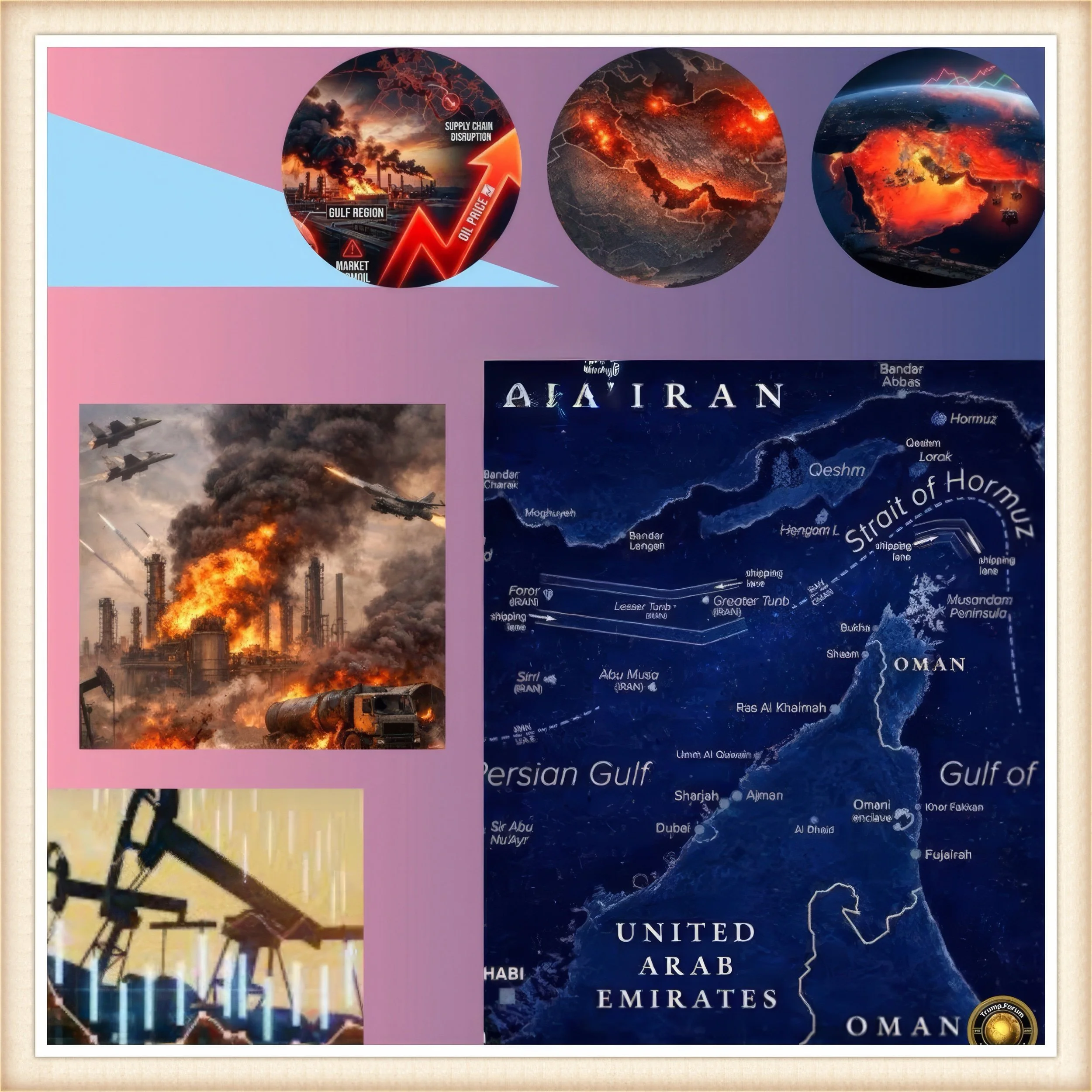
Every single day before the crisis of 2026, roughly 20 million barrels of oil moved through this 20.5 Mile-wide passage, connecting the Persian Gulf — home to the oil fields of Saudi Arabia, the UAE, Iraq, Kuwait, and Iran itself — to the open ocean and the rest of the world.
To understand the scale of this, imagine a conveyor belt carrying roughly 20% of all the oil the world uses every day, all of it squeezed through a gap roughly as wide as an average coastal city.
When that conveyor belt stopped in March 2026, the consequences rippled from the streets of Houston to the factories of Shanghai to the heating bills of European families.
History and Current Status
A Danger the World Always Knew About, but Ignored
The risk of the Strait of Hormuz being closed is not new.
During the Iran-Iraq War in the 1980s, both countries attacked oil tankers trying to pass through the Gulf, and the United States had to send its Navy to escort the ships safely through.
That moment — called the Tanker War — showed the world how dangerous it was to depend on a single narrow waterway.
Yet for the next four decades, the world continued to depend on it just as heavily, reassured by the belief that US military power would always keep the passage open.
That belief was shattered on February 28th, 2026, when the United States and Israel launched military strikes against Iran to destroy its nuclear capabilities.
Iran responded not by fighting a conventional military battle it could not win, but by sending drones to attack oil tankers in the Gulf and threatening to destroy any ship connected to the US, Israel, or their allies.
The maritime insurance companies that oil tanker operators depend on withdrew their coverage almost immediately.
Without insurance, no shipping company would risk sending its multi-million-dollar vessels into the corridor.
The result: by the first week of March, shipping traffic through the strait fell by 83%, and oil prices, which had been around $70 a barrel before the war began, shot up toward $120 in fewer than ten days.
Key Developments
Dominoes Falling Across the Global Economy
The closure of the strait was not just an oil problem. It was an everything problem.
Here is why: when ships cannot move Gulf oil, the producers of that oil — Saudi Arabia, the UAE, Iraq, and Kuwait — literally run out of places to put the crude they are still pumping out of the ground.
Their storage tanks fill up fast. Once storage is full, they have no choice but to stop pumping. Saudi Arabia cut its production by between 2 and 2.5 million barrels per day; the UAE cut by up to 800,000 barrels; Kuwait by 500,000; Iraq by roughly 2.9 million.
The collective loss from these countries alone wiped out an enormous share of global supply in a matter of days.
At the same time, Qatar — which supplies a huge share of the world's liquefied natural gas (LNG), the fuel that heats European homes and powers Asian factories — was forced to halt its LNG production due to missile attacks in the region.
For countries like Japan and South Korea, which import around 80% of their energy, this was an especially severe blow.
European gas prices jumped by 25%, adding to an already difficult cost-of-living situation for families across Germany, France, Italy, and beyond.
Iran even attacked energy infrastructure on land. Saudi Arabia's Ras Tanura refinery — the largest in the country — was damaged and shut down.
A fire broke out at Fujairah port in the UAE, a critical hub for oil storage.
The message from Tehran was clear: this is not just about blocking ships. It is about making the entire Gulf energy system unworkable for as long as the war continues.
Latest Facts and Concerns
The Numbers Tell the Story
By March 13, Brent crude oil — the global price reference for oil — was trading above $100 per barrel, having achieved its largest weekly gain since the start of the COVID-19 pandemic in 2020.
That single fact captures why the world was alarmed. In normal times, a sustained oil price above $100 triggers inflation, slows economic growth, hurts businesses, and squeezes ordinary families who need fuel to drive to work, heat their homes, and buy food that was transported in trucks powered by diesel.
In the United States, the national average gasoline price rose from $3 per gallon before the war to $3.48 per gallon by early March, a 17% increase in just 10 days.
For American families already stretched by years of inflation, this was a painful new burden.
For President Trump, it was a political nightmare. His presidency had been built in part on the promise of lower energy costs.
Gasoline price increases of this speed and scale, appearing just as his administration launched a military campaign, handed his political opponents a powerful weapon heading into the November 2026 midterm elections.
The International Energy Agency took the extraordinary step of releasing 400 million barrels from the world's emergency oil reserves — the largest such release in history — to try to bring prices down.
It helped a little. But 400 million barrels, while enormous in absolute terms, represents fewer than two weeks of global oil consumption at normal rates. It is a sticking plaster on a wound that requires surgery.
Cause-and-Effect Analysis
How One Decision Triggered a Global Cascade
To understand why the Hormuz crisis caused so much economic damage so quickly, it helps to trace the chain of cause and effect. The US and Israeli strikes on Iran caused Iran to activate its asymmetric maritime strategy.
That strategy — using cheap drones to attack expensive tankers and infrastructure — caused insurance companies to withdraw coverage. The withdrawal of insurance coverage caused commercial shipping to stop.
The halt in shipping caused Gulf producers to fill their storage to capacity. Full storage tanks caused production cuts. Production cuts removed millions of barrels of oil per day from global supply.
Reduced supply caused oil prices to rise sharply.
Rising oil prices caused gasoline and energy costs for households and businesses to jump. Rising energy costs caused concern about inflation returning and economic growth slowing — the combination economists call "stagflation," where prices rise and growth falls at the same time.
Goldman Sachs and UBS analysts estimated that if the disruption lasted through the second quarter of 2026, global inflation could increase by 0.7 to 0.8% points, and global economic growth could slow by as much as 0.4 % points.
To put that in plain terms: millions of people would end up poorer, thousands of businesses would struggle or fail, and governments around the world would face pressure they cannot easily manage.
The political cause-and-effect is equally striking.
Trump entered the conflict confident the economic costs would be short-lived.
When it became clear they were not, he pivoted — just as he had done during the tariff war of spring 2025, when market pressure forced him to step back from confrontation with trading partners.
His March 9 statement that the war was "very complete" and nearly over sent oil prices crashing toward $80.
But when he reversed course and suggested the US "has plenty of time" to fight, prices bounced back above $100.
Markets, in effect, became the most powerful constraint on his strategic choices.
Future Steps
What Comes Next for Energy and the World
Whether the military conflict ends quickly or drags on for months, the energy market will not simply return to its pre-war state. Analysts agree on this point.
Some of the damage is already permanent: infrastructure that has been attacked must be rebuilt, supply chains that have been severed take time to reconnect, and the confidence of shipping companies and insurance providers must be rebuilt through demonstrated stability before normal tanker traffic resumes.
Over the coming months, the world will need to tackle several urgent challenges.
Governments in Asia, Europe, and the Americas will accelerate their plans to diversify energy supplies away from total dependence on Gulf oil.
Countries like Japan and South Korea will invest more heavily in expanding their strategic reserves and in locking in alternative LNG contracts from suppliers in Australia, the United States, and elsewhere.
Europe will once again confront the question — still unresolved after the 2022 Russian gas crisis — of how to build a truly resilient energy system that is not vulnerable to distant conflicts it cannot control.
For the Gulf oil producers — Saudi Arabia, the UAE, Kuwait, and Iraq — the crisis demonstrates the enormous economic cost of depending on a single export route.
Saudi Arabia will face renewed pressure to expand its land-based pipeline capacity and to reduce its vulnerability to a corridor it shares with an adversary.
For Iran, the long-term consequences of using the strait as a weapon are double-edged: the country is itself a major oil exporter, and $67 billion in annual oil revenue depends on the same waterway it is now threatening to close permanently.
Conclusion
A Changed World, a Changed Market
The Strait of Hormuz crisis of 2026 is one of those rare events that divides time into before and after.
Before February 28th, the world ran on the assumption that Gulf oil would always flow, that American power would always keep the corridor open, and that the risks of a Hormuz closure were real but remote.
After March 2026, none of those assumptions can be taken for granted.
The crisis has shown that in the twenty-first century, a relatively small country can cause enormous global economic damage by targeting a single point of vulnerability in the world's supply network.
It has shown that oil markets, global growth, and the political fortunes of the most powerful leaders in the world can all hinge on what happens in a stretch of water 20.5 Mile wide.
And it has shown that the world is still, despite decades of warnings, far too dependent on a geography it cannot fully control.
The Hormuz crisis will be studied for years — as a lesson in strategic vulnerability, in economic interdependence, and in the very human tendency to ignore known risks until they become unavoidable catastrophes.