China’s High-Stakes Gold Gamble in Taliban-Controlled Northern Afghanistan
Executive Summary
The Taliban Government Cannot Shield Beijing’s Miners From Escalating Hostility
Since the Taliban’s return to power in 2021, Afghanistan’s mineral wealth has become one of the few economic levers available to the new regime.
Among external stakeholders, China has moved most aggressively to capitalize on this opportunity.
Drawn by record-high global gold prices and Afghanistan’s largely untapped deposits, Chinese firms, private investors, and informal operators have rushed into northern provinces bordering Tajikistan.
What began as an opportunistic economic expansion is now evolving into a volatile security crisis.
Chinese miners have increasingly become targets of militant groups operating in northern Afghanistan and across the porous Tajik frontier.
Recent cross-border attacks killing five Chinese workers have underscored the fragility of Taliban security guarantees. At the same time, resentment among local Afghan communities has deepened. Many perceive mining concessions as opaque, unfair, and extractive, benefiting foreign interests and Taliban elites while leaving little for local populations.
The convergence of high gold prices, weak governance, fragmented Taliban authority, and cross-border insurgency has transformed northern Afghanistan into a combustible zone.
Beijing faces a dilemma. Its strategic interests in Afghanistan extend beyond gold: regional stability affects China’s Belt and Road ambitions, Xinjiang security concerns, and broader Central Asian partnerships.
Yet deeper engagement risks entanglement in local rivalries and militant violence. The Taliban, meanwhile, lacks both institutional capacity and unified command structures to regulate mining or protect foreign workers effectively.
FAF analysis examines the historical context of Sino-Afghan resource engagement, the current surge in gold extraction, emerging security threats, and the broader geopolitical implications.
It argues that China’s Afghan gold rush reveals the structural limits of economic statecraft in fragile states and exposes the Taliban’s inability to translate territorial control into stable governance.
Introduction
Gold Fever in a Fractured State
Afghanistan’s mineral wealth has long been described as a dormant treasure chest.
Estimates of untapped resources have ranged into the trillions of dollars.
Yet decades of war, corruption, and institutional weakness prevented large-scale development.
After 2021, with Western aid evaporating and sanctions constraining financial flows, the Taliban urgently sought alternative sources of revenue. Mining emerged as an economic lifeline.
China’s entry into this space was neither accidental nor purely commercial. Beijing had maintained cautious engagement with the Taliban even before the U.S. withdrawal.
Its calculus was pragmatic: Afghanistan, while unstable, offered opportunities in copper, lithium, rare-earth elements, and gold.
As global gold prices surged to historic levels, small- and mid-sized Chinese investors—alongside larger state-linked firms—saw immediate potential returns.
However, northern Afghanistan is not a vacuum. The region has long been ethnically diverse, politically contested, and geographically porous.
Bordering Tajikistan, it has historically served as a corridor for smuggling, insurgency, and transnational militant networks, and into this complex environment stepped foreign miners seeking rapid extraction.
The result has been a convergence of economic opportunism and structural fragility. Violence against Chinese nationals is not merely criminal or isolated; it reflects deeper tensions about sovereignty, legitimacy, and the distribution of resources under Taliban rule.
History and Current Status
From Mes Aynak to Northern Goldfields
China’s involvement in Afghanistan’s resource sector predates the Taliban’s latest ascendancy. In 2007, a Chinese consortium secured rights to the Mes Aynak copper deposit, one of the world’s largest untapped reserves.
That project stalled due to security threats, corruption allegations, and infrastructure deficiencies. The experience demonstrated both the promise and peril of Afghan mining.
After 2021, the Taliban signaled openness to renewed Chinese investment. High-level meetings between Taliban officials and Chinese diplomats emphasized economic cooperation.
Beijing cautiously increased engagement, motivated in part by concerns about extremist groups operating near Xinjiang.
Gold, unlike large-scale copper or lithium projects, requires less infrastructure and offers faster returns.
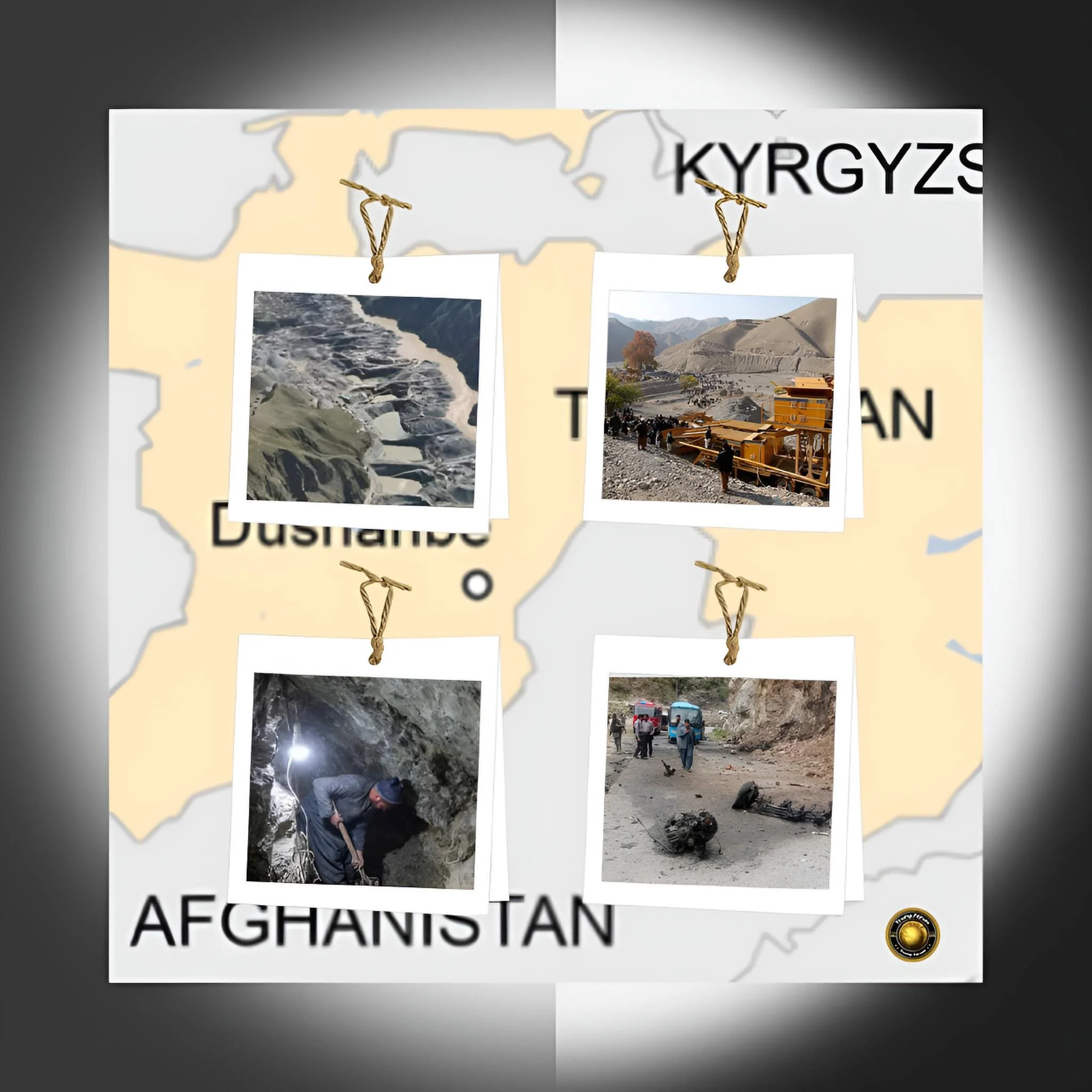
Northern provinces such as Badakhshan and Takhar became focal points. Both lie near the Afghanistan–Tajikistan border, a mountainous terrain with limited state oversight.
The mining landscape that emerged was fragmented. Some operations received formal approval from the Taliban central authorities.
Others were arranged informally with local commanders—the absence of clear regulatory frameworks created competition among factions. Revenue-sharing arrangements were opaque, fueling perceptions of corruption.
At the same time, Tajikistan’s border regions have witnessed periodic instability.
Militant groups, including anti-Taliban factions and transnational jihadist networks, operate across the frontier. Cross-border attacks targeting Chinese workers reflect both ideological hostility and tactical opportunism.
Currently, Chinese mining presence continues but under heightened security measures.
Private security arrangements have increased, and Taliban units have been deployed around major sites. Yet incidents persist, indicating systemic vulnerabilities.
Key Developments
Escalating Attacks and Diplomatic Recalibration
The killing of 5 Chinese miners in cross-border assaults marked a turning point.
These incidents were not isolated robberies but coordinated operations attributed to militants exploiting border terrain. Beijing publicly condemned the attacks and demanded stronger protections.
In remarks emphasizing security cooperation, President Xi Jinping stated that China “expects all partners to ensure the safety of Chinese citizens abroad.”
The language signaled concern without confrontation.
The Taliban leadership responded by pledging investigations and increased patrols.
However, internal divisions complicate enforcement. Northern commanders often exercise autonomy, and loyalty to central directives varies.
Tajikistan’s government has also entered the equation. President Emomali Rahmon has previously criticized the Taliban for insufficient inclusivity.
Following the attacks, Tajik officials emphasized border vigilance while implicitly questioning Taliban control over northern provinces.
U.S. President Joe Biden, commenting broadly on regional instability, noted that “economic engagement without security reform rarely produces durable stability.” While not directly addressing China, the implication was clear.
Russian President Vladimir Putin has underscored concerns about militant spillover into Central Asia, stressing the need for coordinated counterterrorism efforts.
European leaders, including German Chancellor Olaf Scholz, have framed the situation as a warning about the risks of operating in unrecognized regimes without institutional guarantees.
These reactions highlight the broader geopolitical lens through which Afghan mining is viewed.
Latest Facts and Concerns
Local Resentment and Structural Instability
Beyond militant attacks, local resentment constitutes a growing risk. Communities near mining sites often report limited economic benefits.
Employment opportunities frequently favor imported Chinese labor or external contractors. Environmental degradation compounds grievances.
Taliban governance remains centralized in rhetoric but decentralized in practice. Revenue from mining is critical for the regime’s fiscal survival.
Yet uneven distribution fuels tensions among factions and ethnic groups.
Gold’s global value amplifies incentives. At sustained high price levels, even small-scale operations generate substantial returns.
This profitability attracts speculative investors lacking experience in conflict environments. Informal arrangements bypass regulatory scrutiny, exacerbating lawlessness.
Security concerns extend to Xinjiang. Beijing fears that instability in northern Afghanistan could embolden extremist networks with transnational ambitions.
Thus, economic projects intertwine with domestic security calculations.
Limited training, equipment shortages, and factional rivalries constrain the Taliban’s capacity to protect foreign nationals. While the regime exercises coercive power, it lacks institutional depth.
Cause-and-Effect Analysis
Why the Gold Rush Is Turning Deadly
The violence surrounding Chinese mining operations arises from interacting structural factors.
First, economic asymmetry generates grievance. Foreign capital entering impoverished regions without transparent benefit-sharing fosters resentment. When communities perceive extraction without inclusion, hostility intensifies.
Second, fragmented authority undermines predictability. The Taliban’s centralized claims mask localized power dynamics. Competing commanders may view mining revenues as resources to capture, incentivizing conflict.
Third, border geography enables militant mobility. The Afghanistan–Tajikistan frontier is difficult to monitor. Insurgents exploit terrain to stage cross-border attacks, complicating attribution and retaliation.
Fourth, high gold prices elevate stakes. The higher the commodity value, the greater the incentive for both investment and predation. Criminal networks, militants, and rival factions all perceive opportunity.
Fifth, geopolitical signaling plays a role. Attacking Chinese nationals carries symbolic weight, drawing international attention. Militants may calculate that such operations amplify their relevance.
Together, these dynamics create a feedback loop. Violence prompts increased security deployments, which may alienate locals further.
Heightened tension discourages formal regulation, pushing more operations into informal channels. The cycle deepens instability.
Future Steps
Navigating Between Engagement and Entrapment
China faces strategic choices. It can scale back involvement, reducing exposure but forfeiting influence. Alternatively, it can deepen security cooperation with the Taliban, potentially entangling itself in internal Afghan politics.
Enhanced security protocols, including coordinated patrols and intelligence sharing, are likely. Beijing may also push for clearer contractual frameworks to reduce informal arrangements.
The Taliban must confront governance deficits. Transparent revenue-sharing mechanisms and local inclusion policies could mitigate resentment. However, ideological rigidity and resource constraints limit reform capacity.
Regional actors, including Tajikistan and Russia, will monitor developments closely. Multilateral coordination on border security may increase, albeit informally.
Ultimately, sustainable mining requires institutional stability. Without recognized governance structures and legal predictability, resource extraction remains precarious.
Conclusion
Gold Without Governance
China’s Afghan gold rush encapsulates the paradox of economic statecraft in fragile environments. Investment can generate opportunity, but without governance it amplifies volatility.
The Taliban’s territorial control has not translated into administrative coherence. Beijing’s pragmatic engagement encounters structural limits.
The deaths of Chinese miners underscore that commercial ambition cannot substitute for political settlement.
Northern Afghanistan’s goldfields are more than economic assets; they are arenas where local grievance, militant strategy, and geopolitical competition intersect.
Unless governance improves and inclusive frameworks emerge, the promise of Afghan mineral wealth will remain shadowed by violence.
Gold may glitter, but in the mountains along the Tajik border, it is increasingly stained by blood.