Executive summary
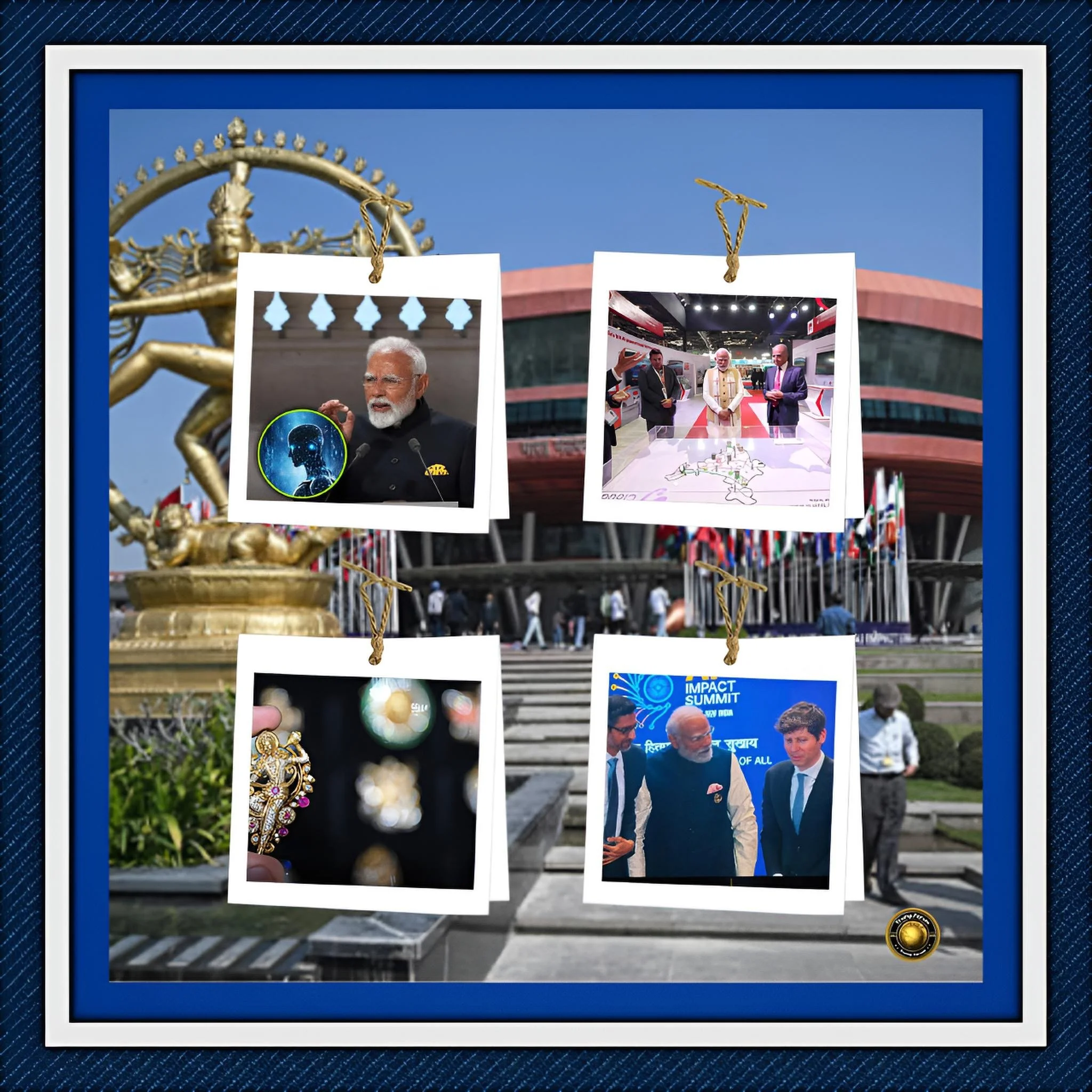
India is hosting a very large meeting on artificial intelligence in New Delhi.
It is called the India AI Impact Summit 2026. Leaders from many countries, and bosses of big technology companies, have come to talk about how AI should grow and how it should be controlled. It is the first global AI summit held in the Global South, not in Europe or North America.
This clear, simple article explains what five important speakers said.
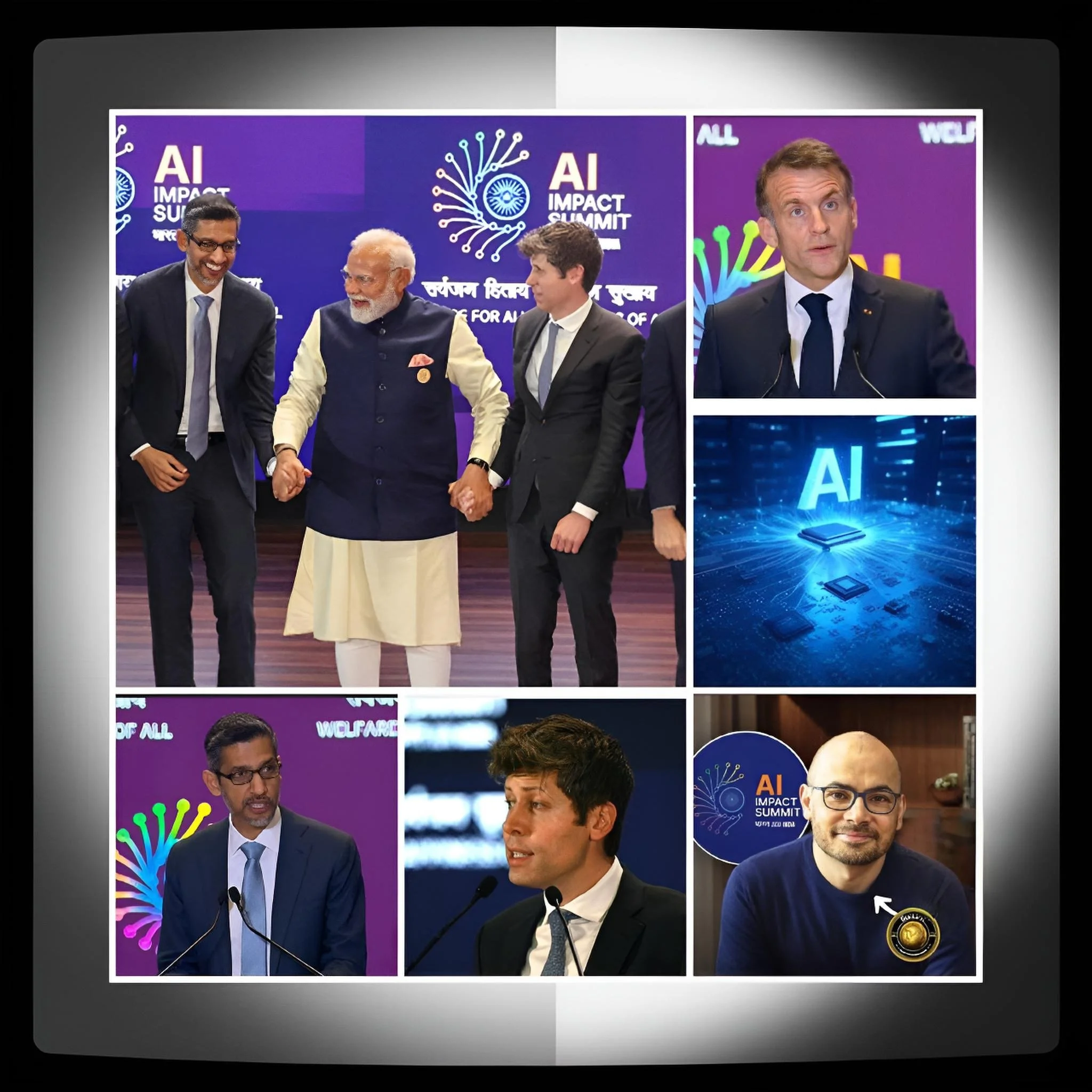
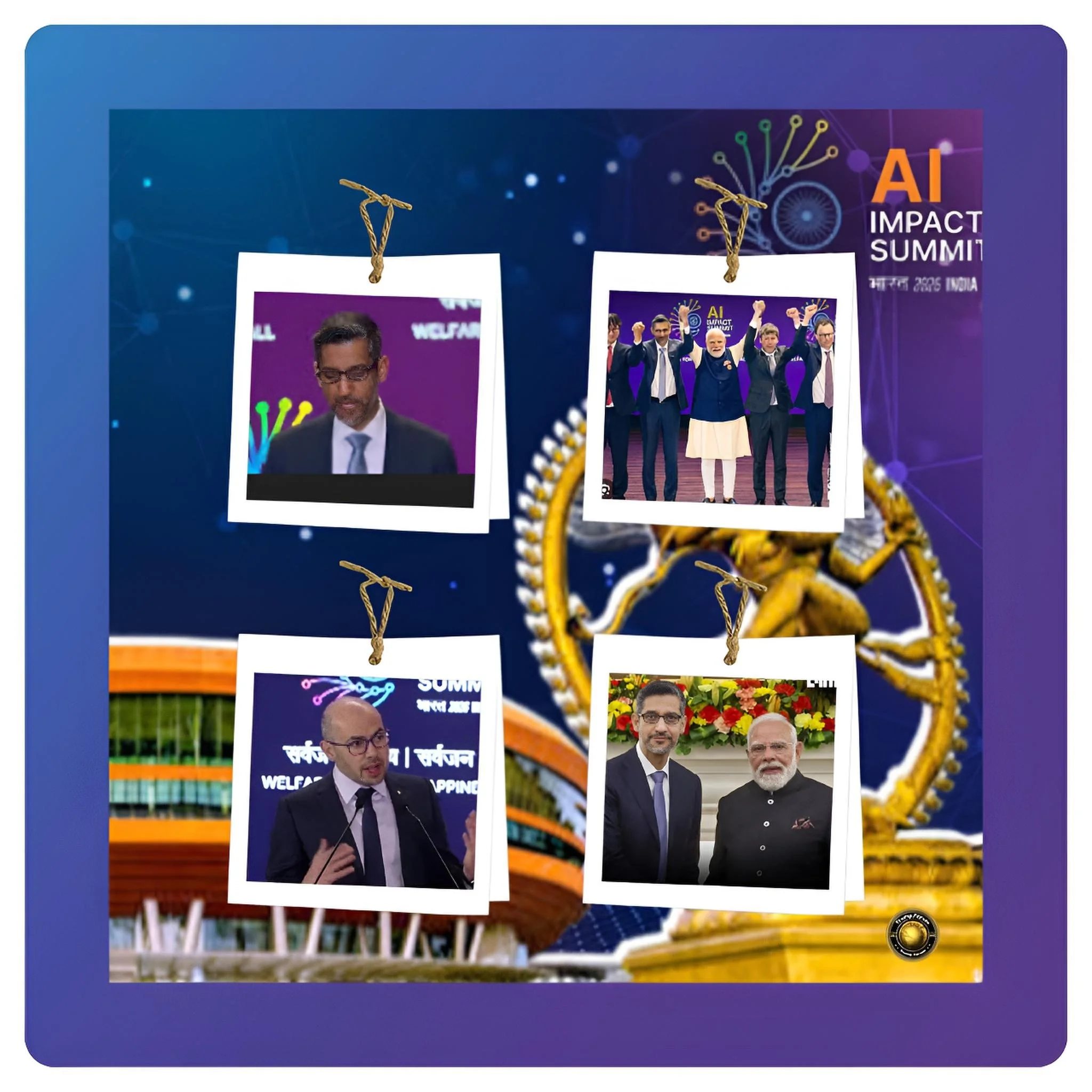
They are India’s Prime Minister Narendra Modi, Google chief executive Sundar Pichai, OpenAI chief executive Sam Altman, French President Emmanuel Macron and DeepMind chief executive Demis Hassabis.
Each of them spoke about chances and dangers in AI. Together they show how AI is now about politics, business and everyday life, not only about computers.
Introduction
Why this summit matters for ordinary people?
AI already touches the daily lives of many Indians. It helps apps translate between languages, powers chatbots for customer service, gives crop advice to farmers and supports doctors with early diagnosis tools.
In classrooms, students are using AI chat tools to ask questions about homework. In offices, workers use AI to draft emails and reports.
Until now, most big political talks about AI were held in rich countries. Rules, safety plans and big funding decisions mainly came from Europe and North America.
This summit is different. It takes place in India and invites many countries from Asia, Africa and Latin America to speak.
India wants to show that AI should not be controlled only by a few powerful governments and a few big firms. It should be used to help people in poorer countries as well, for example by improving health care in villages or giving better information to small farmers.
Narendra Modi
AI must serve humans, not control them
Prime Minister Modi opened the summit with a simple but strong idea: AI must serve people, not the other way around. He compared AI with atomic power.
Just as nuclear energy can give electricity but also make bombs, AI can either help society or damage it. The choice, he said, is up to humans, not the machines.
To guide that choice he offered what he called a MANAV vision.
In basic terms, he wants AI that follows moral rules, has clear responsibility, respects each country’s control, is easy for ordinary people to use and is honest in how it works.
For example, if a bank uses AI to decide who gets a loan, there should be a way to question and review that decision. If a police system uses AI for face recognition, there must be clear laws to prevent abuse.
Modi is very worried about deepfakes, which are fake videos or audio created by AI.
Imagine a video that seems to show a politician saying something ugly that he never said, released just before an election. This can mislead millions of voters.
To reduce this danger, Modi suggested that online pictures, videos and audio should carry clear marks or “labels” when they are made by AI, like food packets show what is inside. That way, people can better judge what to trust.
He also pointed to India’s strengths: many young people who learn fast, strong democracy and a history of building digital tools for everyone, such as UPI payments and digital identity.
In his view, if an AI system works well across India’s many languages and income levels, it can work almost anywhere. So he invited companies and countries to “design and develop in India, deliver to the world”.
Sundar Pichai
Building the cables, computers and skills for AI
Sundar Pichai, the head of Google, talked more about the “plumbing” of AI – the hidden cables, computers and training that make AI possible.
He called AI the biggest technology shift of this time, bigger than mobile phones, and said it will change every line of work, from doctors and teachers to truck drivers and factory workers.
Pichai announced a $15 billion AI hub in the city of Visakhapatnam. This hub will have very large computer centres where AI models can run, and a new undersea internet cable landing that connects India with other countries.
In simple words, this is like building a giant power station and highway system for data. It means faster, cheaper AI services for Indian users, and more business for Google.
He also warned that the world must avoid a new “AI divide”.
In the past, there was a gap between those who had access to the internet and those who did not. Now there is a risk of a fresh gap between those who can use modern AI tools and those who cannot.
As an example, think of two students. One has a laptop and fast internet and uses AI every day to learn.
The other has only an old phone and poor connectivity. Over time the first student may get much better results and jobs.
Pichai said companies and governments must invest in cheap access, local‑language tools and teacher training, so that more people can benefit.
He also launched a $30 million programme to support scientists who use AI for research on problems like climate change and disease.
His message was that AI should not only make ads smarter; it should also help science and society.
Sam Altman
How powerful AI could become, and how India fits in
Sam Altman, who leads OpenAI, spoke in very direct and sometimes alarming language. He said that, if progress continues at the current speed, the world may see early forms of “superintelligence” in just a few years.
That means AI systems that are better than humans at most mental tasks, from writing code to planning strategies.
He even suggested that by around 2028, more of the world’s total “thinking power” could sit inside data centres than in human brains.
To explain what this could mean, imagine a world where AI systems design most new drugs, write much of the software, suggest business plans and maybe even help design new machines.
This could make many things cheaper and faster. But it could also destroy certain jobs and give huge power to whoever controls the AI systems and the electricity they need.
Altman shared some numbers to show how fast India is adopting AI.
Over 100 million people in India use ChatGPT every week, and more than one third are students.
India is also the fastest‑growing market for OpenAI’s coding assistant, Codex.
For example, a student in Lucknow might now use Codex to learn Python and build a small app instead of waiting for a local training course. This makes learning more flexible, but it also means students depend on a foreign company’s tools.
Altman said India has “all the ingredients” to become a full‑stack AI leader: strong talent, big markets and a government AI plan. But he warned that three things must move together.
People must have access to AI tools and the internet.
Schools, companies and offices must actually adopt these tools in daily work.
And individuals must have the skills and confidence – the agency – to use AI to create, not just consume. If only some groups gain that agency, AI will increase inequality.
He also spoke about serious risks. One worry is that powerful AI models could help bad actors design new germs or chemicals more easily.
This is why, he argued, some AI systems should not be fully open‑sourced, and why countries need to cooperate on safety rules.
Emmanuel Macron
Rules, children and a middle road between superpowers
French President Emmanuel Macron used his talk to link India’s digital success to Europe’s style of strict rules.
He praised India’s digital identity, its payment system that handles around 20 billion transactions each month and its large digital health projects.
For him, these show that a big, diverse democracy can use digital tools for development, not just for control.
Macron then spoke about the European Union’s AI law.
This law bans certain uses of AI, such as some types of live face recognition in public places, and sets strong conditions for “high‑risk” uses, such as in hiring. He said such rules are needed if citizens are to trust AI and accept it in their daily lives.
He also said Europe plans to invest more than €58 billion in data centres and AI, powered mostly by low‑carbon energy, including nuclear.
In easy terms, he wants AI growth without big increases in pollution.
He suggested that Europe and India can work together as a “third path” between the United States, where big tech firms dominate, and China, where the state has very strong control.
A striking part of Macron’s speech was about children. He said France plans to block social‑media use for children under fifteen and asked India to join a group of countries that protect teenagers from digital harms.
He linked this to AI because recommendation engines and generative tools can push harmful content to young users.
Demis Hassabis
AI for science, and why the world must cooperate
Demis Hassabis, head of Google DeepMind, spoke as a scientist who has worked with AI for years.
He gave an example from his own lab.
A system called AlphaFold used AI to predict how proteins fold, a problem that had troubled scientists for decades.
This tool helped researchers around the world speed up work on new drugs and vaccines. It showed how AI can help science, not just chat or make images.
Hassabis said we are now moving toward more “agentic” AI. These are systems that can set sub‑goals, plan steps and call other tools.
For example, an AI scientist could read thousands of research papers, form a hypothesis, design a virtual experiment and suggest which real‑world test a lab should run next.
He believes that in about five to eight years we may reach artificial general intelligence that can match or beat humans at most thinking tasks.
He said India can play a big role in this future because it has many young engineers and big problems to solve in health, agriculture and climate. If India invests in research, computing power and open sharing of scientific data, it can become a centre for AI‑driven discovery.
But he also warned that the same technologies can be misused.
Agentic systems could write harmful code, carry out cyberattacks or spread targeted lies online.
No single company or country can foresee all such threats. That is why, he said, global cooperation is needed.
Summits like the one in Delhi bring more countries into the conversation, including those who were not present in earlier meetings in Europe.
Conclusion
What this all means for India and the world?
These five speeches together show that AI is no longer a narrow technical topic.
It is about jobs, security, children, democracy and power between countries.
Modi wants AI that fits India’s development story and protects democracy from deepfakes.
Pichai is placing big bets on India’s cables and computers and sees the country as a main partner. Altman believes very powerful AI is close and warns that the world must prepare fast, especially to protect jobs and prevent dangerous misuse.
Macron wants strong rules and a role for Europe and India in writing them. Hassabis wants AI to drive new scientific breakthroughs but only with shared responsibility and global rules.
For ordinary people, the choices made after this summit will shape daily life.
AI could mean quicker health advice in rural clinics, better weather warnings for farmers and more personal learning help for students. It could also mean job changes, new kinds of scams and more powerful tools in the hands of both good and bad actors. India now sits close to the centre of these debates.
How it uses that position – in its laws, investments and foreign policy – will decide whether this huge meeting in New Delhi becomes a turning point toward fairer AI, or just a big show before power returns to a small group of players.