Sam Altman’s AI speech in India: A 101 For Dummies
Summary
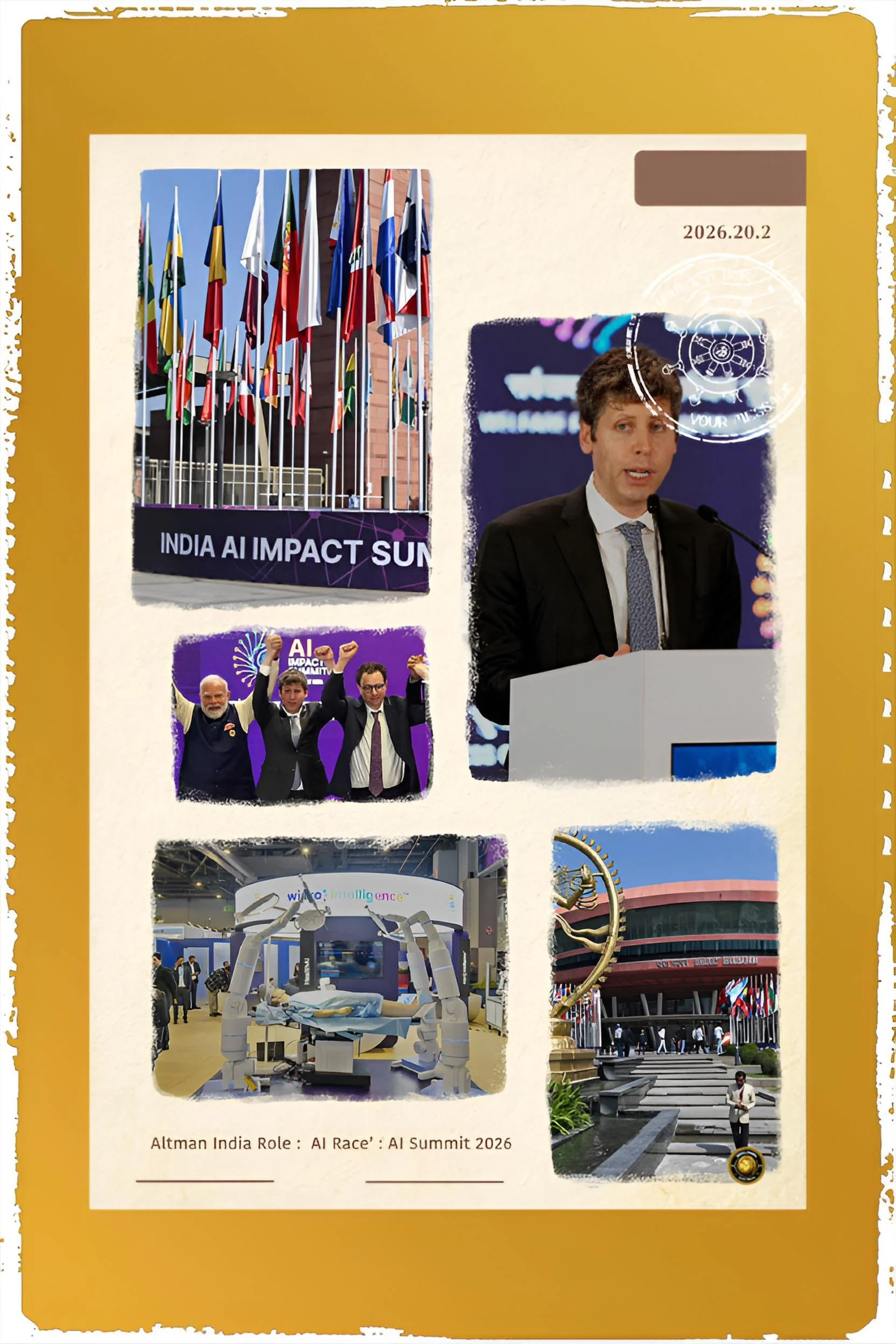
In February 2026, Sam Altman, the boss of OpenAI, came to New Delhi for the India AI Impact Summit.
The meeting took place at Bharat Mandapam, a large conference center where leaders from government and big tech firms gathered to talk about the future of artificial intelligence.
The Indian prime minister opened the event, and Altman gave one of the most watched talks of the summit.
In his speech, Altman said that India is “well positioned to lead” in AI.
He told the audience that compared with his last visit about one year earlier, he could already see big changes.
AI systems that once struggled with school‑level math were now able to help with serious research work.
For him, India had moved from just “joining” the AI race to helping “shape” it.
What Altman said about AI power?
Altman repeated a message he has given in other countries, but this time he tied it directly to India. He said that if very strong AI tools are controlled by only one company or one country, the results could be very bad for the world.
He used the word “ruin” to show how serious he thinks this danger is.
Instead, he argued that AI should be “democratized.” In simple terms, this means powerful AI tools should be available to many people and many countries, not just a small group.
As an example, he pointed out that India already has millions of users of ChatGPT, including students, teachers, and small businesses, and that this kind of wide use is what he wants to see.
Altman also said that AI is getting better very fast.
He warned that the world may be only a “couple of years” away from early “superintelligence,” which means AI systems that are much smarter than humans in many areas.
He even suggested that such systems might help us design new rules and institutions to keep AI safe and fair.
India’s own plan at the summit
The Indian government used the summit to show its own big plans for AI.
The prime minister talked about a new framework called MANAV, a Hindi word that means “human.”
MANAV stands for five ideas: moral and ethical systems, accountable governance, national sovereignty over data, accessible and inclusive AI, and valid and legitimate use of technology.
The government also shared numbers.
Under the IndiaAI Mission, it has set aside about Rs 10,372 crore to help build an AI ecosystem.
At the current rate—1 $ is about 91.07 Rs as of 19 February 2026—that is roughly $1.14 billion.
Officials said there is already a large shared computer facility with more than 38,000 GPUs so that startups and public bodies can access strong computing power without buying their own expensive hardware.
Another key point was language. India announced government‑backed and private models that can work in 22 Indian languages.
This matters because it means people who do not speak English can still use AI tools in their daily lives.
Deals between OpenAI and Tata
During the summit, Tata Group announced a major partnership with OpenAI.
Tata’s technology arm, TCS, will build a new AI‑ready data center with 100 megawatts of power that could grow to one gigawatt over time.
To picture this, think of a data center big enough to serve huge numbers of AI requests from across India and beyond. Industry experts say that a 1‑gigawatt campus can cost tens of billions of dollars, so this is not a small project.
Under this deal, Tata will roll out ChatGPT Enterprise to large parts of its workforce and use OpenAI’s coding tools in its software teams.
In practice, this means that hundreds of thousands of Indian workers may soon use AI every day to write emails, analyze documents, or generate code.
If used well, this could raise productivity.
If handled badly, it could also increase worries about job loss.
Why this matters for India?
There are several reasons why Altman’s talk and these deals matter for India.
One, they help confirm India’s status as a major AI market. Global tech firms are making very large bets on the country.
Apart from OpenAI and Tata, companies such as Google, Microsoft, and Amazon have announced many billions of dollars in planned data‑center and AI investments.
This wave of money and hardware could help India close the gap between the huge amount of data it produces and its still modest data‑center capacity.
Two, they support India’s attempt to act as a voice for the Global South.
By hosting the summit, setting out the MANAV vision, and speaking about AI for welfare and inclusion, India is trying to show other developing countries that there is a way to use AI that is not based only on profit or control. Altman’s friendly language about democratization fits with this story.
Three, the summit deepens India’s ties with the United States in technology. The U.S. government already sees India as a “highly strategic partner” in AI and semiconductors, and big private firms are now backing that view with real money and projects.
OpenAI’s work with Tata is one more link in this growing chain.
Risks and hard questions
There are also real risks.
Data centers for AI need huge amounts of power and water.
Studies suggest that India may need 45–50 million extra square feet of data‑center space and 40–45 terawatt hours of extra electricity by 2030 just to meet AI‑driven demand.
In plain terms, that is like adding the power use of several mid‑sized cities.
In a country already facing heatwaves and water stress, this raises tough questions about where all that energy and water will come from.
Another risk is new forms of dependence.
Even if the data centers are in India, much of the key technology—advanced chips, core models, and cloud software—will still come from a small set of foreign firms.
If those firms change their rules, raise prices, or face export limits from their home governments, India could find its AI plans slowed or reshaped by decisions made elsewhere.
Finally, there is the question of jobs.
Altman’s view is that AI will destroy some jobs but create better ones, as past technologies did. In practice, this shift can be painful.
A call‑center worker in an Indian city might see parts of their work automated by chatbots, while new jobs appear in AI model testing or prompt design.
A farmer using an AI tool in a local language might get better crop advice, but the same system could also be used by large firms to squeeze small suppliers.
How India manages education, retraining, and worker protection will matter as much as how many GPUs it hosts.
What comes next?
For India, the next steps are about balance. It will need to welcome foreign capital and know‑how while also building its own models, chips, and research strength.
That means putting real money into local AI research centers, supporting open‑source projects in Indian languages, and making sure public‑sector uses of AI are transparent and accountable.
For OpenAI, success in India will depend not only on the size of its projects but also on trust. Indian users and officials will watch to see how the company handles issues like data use, safety, and political content.
If “OpenAI for India” is seen as a one‑way street, where Indian data and talent flow out and control remains abroad, the political mood could shift quickly.
For other developing countries, the Delhi summit sends a mixed signal. It shows that it is possible to get big AI firms to invest heavily and to take local concerns seriously. It also shows that once large infrastructure is in place, it can be hard to change course.
Countries looking at India’s example will have to decide how far they want to copy its model and how far they want to design their own.
Simple Conclusion
Sam Altman’s talk at the India AI Impact Summit was more than a speech about technology. It was a moment when a leading AI company and a rising power in the Global South tried to define a shared future.
Altman praised India, warned about the dangers of centralization, and promised partnerships. India answered with its own vision of human‑centred AI, large investments, and a claim to global leadership.
Whether this story ends well will depend on the choices ahead.
If India can use these partnerships to build its own strength, protect its people, and keep AI open and fair, the summit may be remembered as the start of something new.
If not, it could be seen as the point at which a new kind of digital dependence was locked in, even as everyone spoke the language of freedom and inclusion.