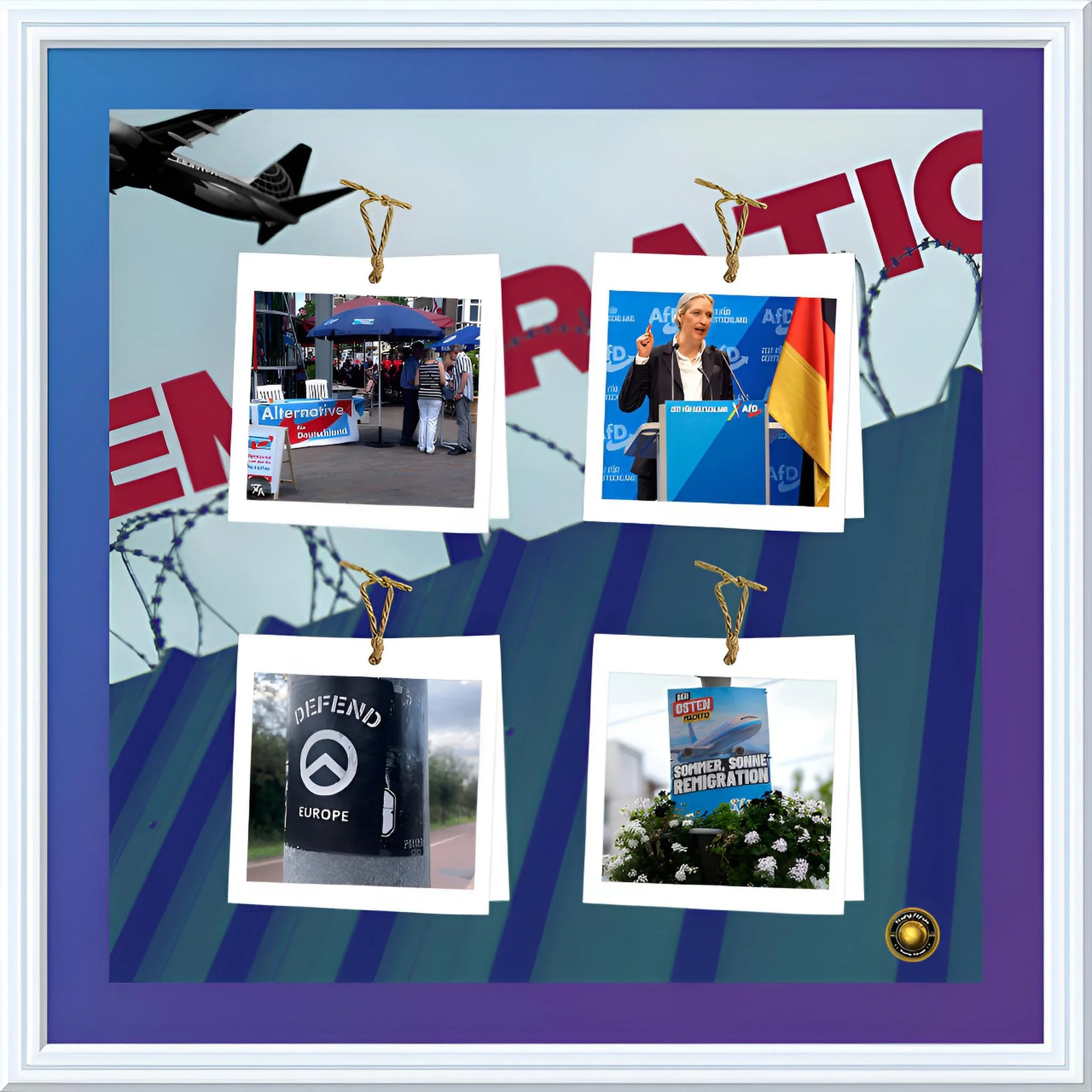
Remigration’s Insidious Ascent: Far-Right Ideology Permeates Europe’s Political Landscape Through AfD’s Bold Embrace
Executive Summary
Remigration Takes Over: How Far-Right Ideas Enter Europe’s Main Politics Via Germany’s AfD
The concept of remigration, once relegated to the shadowy precincts of far-right extremism, has inexorably insinuated itself into the discursive fabric of European politics, particularly through the auspices of Germany’s Alternative for Germany party.
This euphemistic term, connoting the coerced repatriation of immigrant populations irrespective of legal status, exemplifies the osmotic diffusion of radical ideologies into mainstream arenas.
As the AfD garners unprecedented electoral traction, surpassing 20% in national polls and securing second-place finishes in federal elections, the proliferation of remigration portends profound implications for democratic norms, constitutional integrity, and societal cohesion across the continent.
FAF analysis elucidates the historical genesis, contemporary manifestations, and prospective ramifications of this phenomenon, underscoring the imperative for vigilant countermeasures to safeguard pluralistic governance.
Introduction
In the labyrinthine corridors of European political evolution, few concepts have traversed the spectrum from marginal obscurity to central contention with the alacrity of remigration.
Coined within the intellectual redoubts of French ultranationalism and propagated by identitarian networks, this notion advocates the systematic expulsion of non-indigenous populations, ostensibly to preserve ethnocultural homogeneity.
Its permeation into the political mainstream, epitomized by the AfD’s overt adoption, signals a paradigmatic shift wherein extremist rhetoric accretes legitimacy through electoral validation.
Amidst Germany’s fractious political milieu, where the AfD’s ascendancy challenges the post-war consensus on multiculturalism, remigration emerges as a litmus test for the resilience of liberal democracies.
This exposition interrogates the multifaceted dimensions of this infiltration, probing its antecedents, dynamics, and trajectories to illuminate the broader geopolitical undercurrents reshaping Europe.
History and Current Status
The etymological and ideological provenance of remigration traces to the early 2010s, when French philosopher Renaud Camus articulated the grand remplacement theory, positing a conspiratorial substitution of indigenous Europeans by immigrant hordes.
This narrative, suffused with xenophobic pathos, was appropriated by the Identitäre Bewegung, a pan-European youth movement advocating ethno-pluralism and cultural segregation.
In Germany, the term gained traction through Austrian activist Martin Sellner, whose expositions framed remigration as a remedial inversion of mass immigration, encompassing not merely undocumented entrants but also naturalized citizens deemed insufficiently assimilated.
By the mid-2020s, remigration had transcended fringe discourse, embedding itself within the AfD’s programmatic lexicon.
Founded in 2013 as a Eurosceptic entity, the AfD radicalized amid the 2015 refugee influx, pivoting toward anti-immigrant fervor.
Currently, the party commands approximately 20% national support, eclipsing traditional formations like the Social Democrats in eastern states.
Its status as a monitored entity by the Bundesamt für Verfassungsschutz, classified as right-wing extremist, underscores the tension between its populist appeal and constitutional antipathy.
In broader Europe, analogs proliferate: Spain’s Vox echoes remigration in deportation pledges, while Britain’s Reform UK insinuates similar repatriation schemes, reflecting a continental contagion of nativist resurgence.
Key Developments
Pivotal milestones delineate remigration’s trajectory from esoteric meme to policy cornerstone.
The 2023 Potsdam conclave, clandestinely convened and exposed by investigative outlet Correctiv, marked a watershed: AfD luminaries, alongside Sellner and neo-Nazi affiliates, deliberated a master plan for expelling millions, including German passport holders of migrant descent.
This revelation precipitated nationwide protests, mobilizing over one million demonstrators in repudiation of ethnonationalist agendas.
Undeterred, AfD co-leader Alice Weidel embraced the term in a January 2025 party congress, proclaiming, “If it’s going to be called remigration, then that’s what it’s going to be: remigration,” amid rapturous acclaim.
This endorsement catalyzed electoral dividends, with the AfD securing 20.8% in the February 2025 federal ballot, its zenith.
Concurrently, judicial rebukes ensued; a 2025 Federal Administrative Court ruling deemed Sellner’s remigration schema antithetical to human dignity, potentially imperiling AfD’s legality.
Internationally, endorsements from figures like Elon Musk, who lauded the AfD as Germany’s “last spark of hope,” amplified its visibility, while intra-party schisms—between moderates wary of bans and radicals like Björn Höcke—intensified.
Latest Facts and Concerns
Recent empirics reveal remigration’s entrenched foothold: AfD’s 2025 manifesto advocates repatriating 1.2 million Syrians, framing it as a corrective to civil war’s cessation.
Polling indicates 43% of Germans now countenance stricter deportation protocols, a surge attributable to incidents like the 2024 Magdeburg market attack by a Saudi national.
Concerns proliferate regarding democratic erosion; the AfD’s dalliances with extremists risk normalizing unconstitutional doctrines, as evidenced by its expulsion from the European Parliament’s Identity and Democracy group.
Broader apprehensions encompass societal polarization: remigration’s rhetoric exacerbates xenophobic violence, with 217 anti-migrant assaults documented in 2025.
Economically, it deters foreign investment, potentially contracting GDP by 1.5% through labor shortages. Geopolitically, it strains EU cohesion, as Hungary’s Viktor Orbán hails the AfD as Europe’s “future,” portending a bloc-wide nativist realignment.
Cause-and-Effect Analysis
The causal matrix underpinning remigration’s mainstreaming intertwines socioeconomic dislocations with ideological opportunism.
Economic stagnation—Germany’s anemic 0.2% growth in 2024—fosters scapegoating of immigrants for resource scarcity, engendering receptivity to AfD’s narratives.
The 2015-2022 influx of two million refugees, coupled with integration failures, amplified perceptions of cultural dilution, catalyzing grand remplacement anxieties.
Effects manifest multifariously: electorally, AfD’s gains compel centrist parties like the CDU to adopt stringent migration stances, shifting the Overton window rightward.
Societally, it erodes trust in institutions, with 35% of eastern Germans viewing democracy as flawed. Internationally, it emboldens analogs—France’s Rassemblement National contemplates similar expulsions—fostering a cascade of populist insurgencies.
Conversely, backlash effects include fortified civil society resistance, as 2024 protests attest, potentially galvanizing progressive coalitions.
Future Steps
Mitigating remigration’s encroachment demands a polyvalent strategy.
Domestically, Germany should expedite constitutional proceedings to proscribe AfD if extremist ties substantiate, while enhancing integration programs to preempt nativist grievances.
EU-wide, harmonized asylum reforms—augmenting Frontex capabilities and equitable burden-sharing—could defuse migration pressures.
Diplomatically, countering disinformation through transnational alliances, including NATO’s hybrid threat centers, is paramount.
Economically, incentivizing skilled immigration via streamlined visas could underscore migrants’ contributions, countering AfD’s zero-sum framing.
Ultimately, pedagogical initiatives inculcating historical literacy—evoking Nazi-era deportations—may inoculate publics against ethnonationalist allure.
Conclusion
Remigration’s odyssey from fringe meme to mainstream precept, propelled by the AfD’s audacious integration, heralds a precarious epoch for European democracies.
As Radical ideologies permeate electoral discourse, imperiling the foundational tenets of inclusivity and the rule of law; the onus lies with vigilant polities to reaffirm humanistic values.
Absent resolute intervention, this insidious penetration risks unraveling the continent’s postwar edifice, consigning pluralism to obsolescence.