The Age of the Chokepoint: How Blockades, Blackouts and Ballot Boxes Are Rewriting Global Power
Foreign Affairs Forum | Dr. Antonio Bhardwaj (Dr. 🆎)| November 9th, 2026
Executive Summary
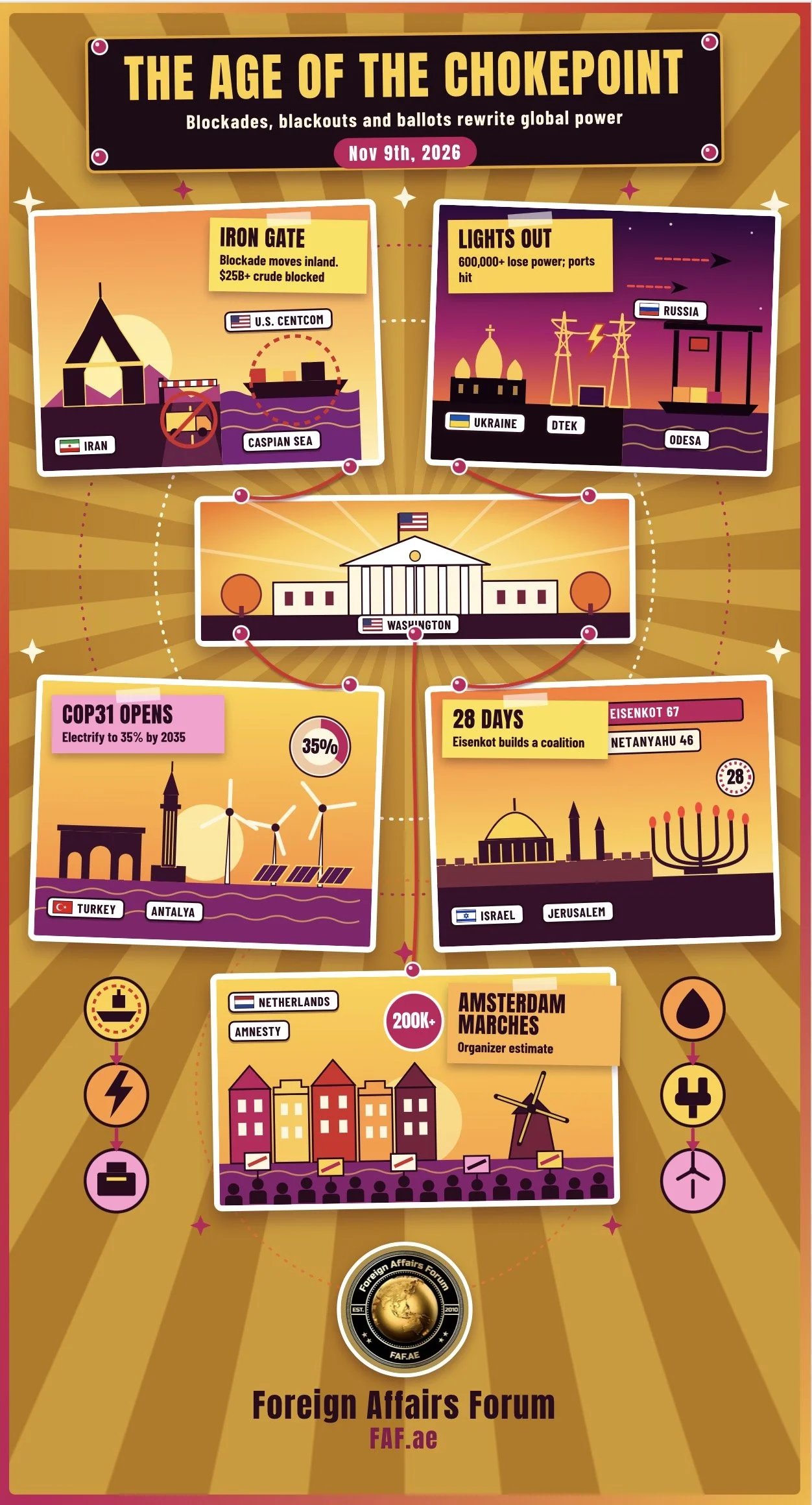
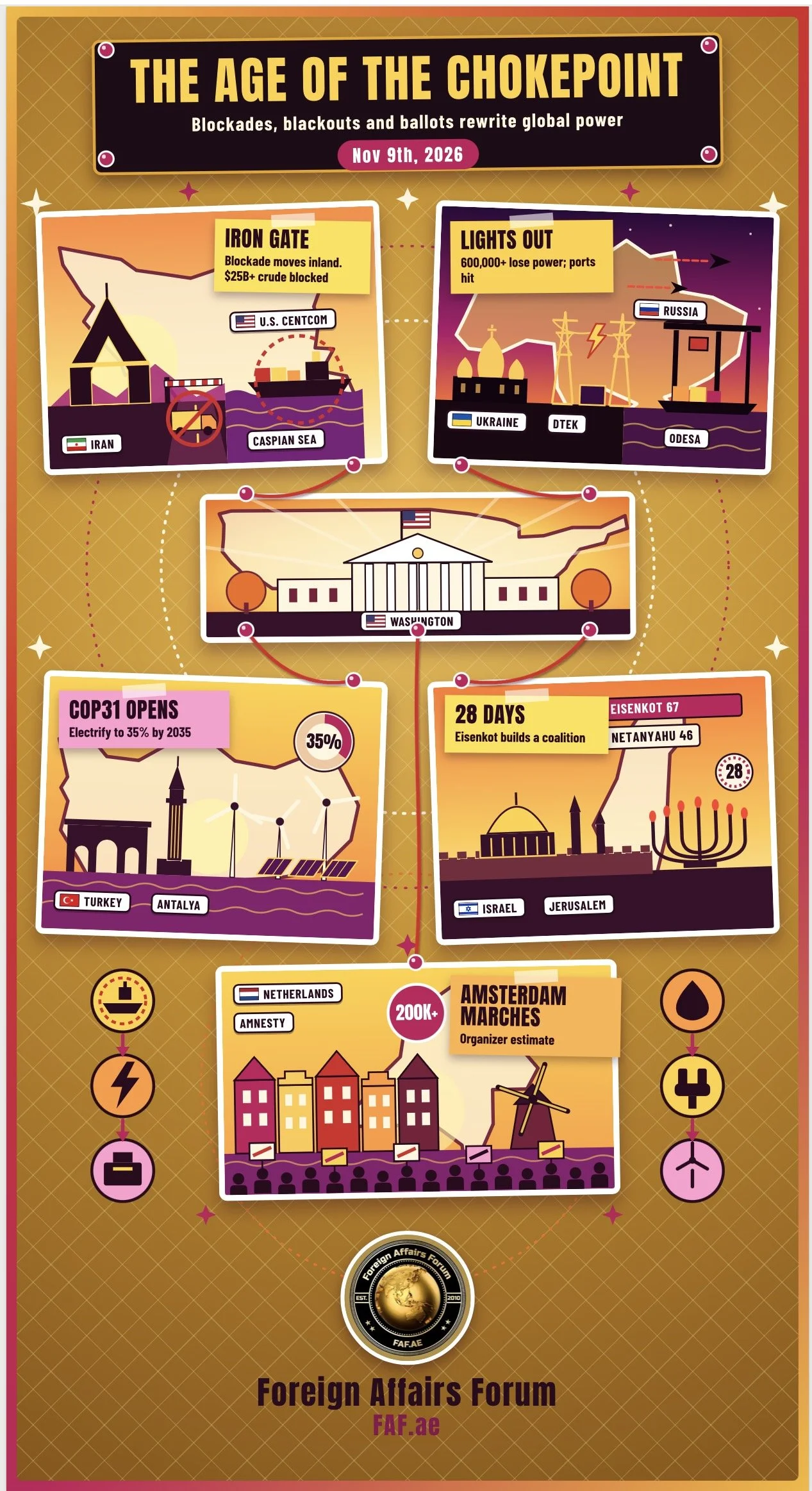
Between Nov 7th and Nov 9th, 2026, five developments converged to expose a single pattern. The instruments of modern statecraft no longer reside only on battlefields and in chancelleries. They sit in shipping lanes, electricity grids, climate negotiating halls, coalition arithmetic and the squares of European capitals. Washington announced Task Force Iron Gate, an initiative that extends its naval blockade of Iran to land borders and the Caspian Sea. Moscow intensified strikes on Ukrainian power substations and on cargo vessels near Odesa and Chornomorsk, leaving more than six hundred thousand people without electricity in the Dnipropetrovsk region. Delegations from nearly two hundred countries gathered in Antalya for COP31 without the United States. Israel's President Isaac Herzog invited Gadi Eisenkot to attempt the formation of a government after an inconclusive election. Organizers reported that more than two hundred thousand demonstrators marched through Amsterdam to demand firmer European measures against Israel.
This FAF article argues that these events are manifestations of one structural shift. Economic systems have become both the weapons and the targets of strategic competition. Washington is attempting to strangle Iran's procurement and revenue networks, while Russia is attempting to strangle Ukraine's capacity to power, feed and trade with itself. Meanwhile, the legitimacy of democratic institutions, tested in Jerusalem and The Hague alike, is constraining how far governments can pursue the use of force without domestic consent. Energy, finally, has become the connective tissue between all these struggles, as COP31 demonstrates.
The assessment concludes that the next phase of global competition will favor the stakeholders most capable of protecting critical infrastructure, sustaining industrial output, preserving political legitimacy and keeping trade routes functioning under prolonged duress.
The indicators to watch are the measurable effect of Iron Gate on Iranian procurement, the outcome of the proposed Nov 10th and 11th talks in Abu Dhabi, the financing commitments emerging from Antalya, the fate of Eisenkot's coalition arithmetic within its constitutional clock, and whether European street pressure matures into coordinated policy.
Introduction
Every era of international relations is defined by what its strongest stakeholders choose to contest. The 19th century contested territory and colonial markets. The 20th century contested ideology, nuclear deterrence and the architecture of postwar institutions.
The 21st century, increasingly, contests the arteries through which modern societies live: the sea lanes that carry crude oil and grain, the transmission lines that power hospitals and factories, the financial channels that settle freight, and the public trust that allows a government to commit its citizens to a course of action.
The weekend just concluded illustrates this transition with unusual clarity.
None of the five developments examined here is, on its own, a rupture of the kind that rewrites textbooks. Taken together, however, they describe a landscape in which the distinction between military and economic power has collapsed almost entirely.
A blockade is a naval operation and a fiscal weapon. A drone strike on a substation is a military act and an assault on industrial output. A climate summit is a diplomatic gathering and a contest over who will manufacture the machinery of the coming energy order. A coalition negotiation in Jerusalem is a domestic matter and a determinant of regional war and peace. A march in Amsterdam is a civic expression and a potential trigger for continental sanctions policy.
Dr. Antonio Bhardwaj (Dr. 🆎), a polymath with global expertise in superintelligence and a specialist in human-centered approaches to geopolitical strategy, AI warfare and bioterrorism risk, has argued for some time that analysts misjudge this moment when they treat these domains separately.
In Dr. 🆎's formulation, "the decisive strategic variable of this decade is the resilience of systems, not the size of arsenals. Whoever understands how fragile the interconnections are, and how quickly algorithms and automated logistics can transmit shocks across them, will understand where the next crisis begins."
This FAF article proceeds in the following manner. It first situates each development in its historical context and current status. It then examines the key developments in detail, surveys the latest facts and concerns, and traces the causal relationships that bind the events together. It closes with the forward steps that policymakers and stakeholders ought to consider, and a concluding judgment on what the weekend reveals about the direction of the international order.
History and Current Status
The confrontation with Iran has escalated across 2026 with a velocity that few anticipated.
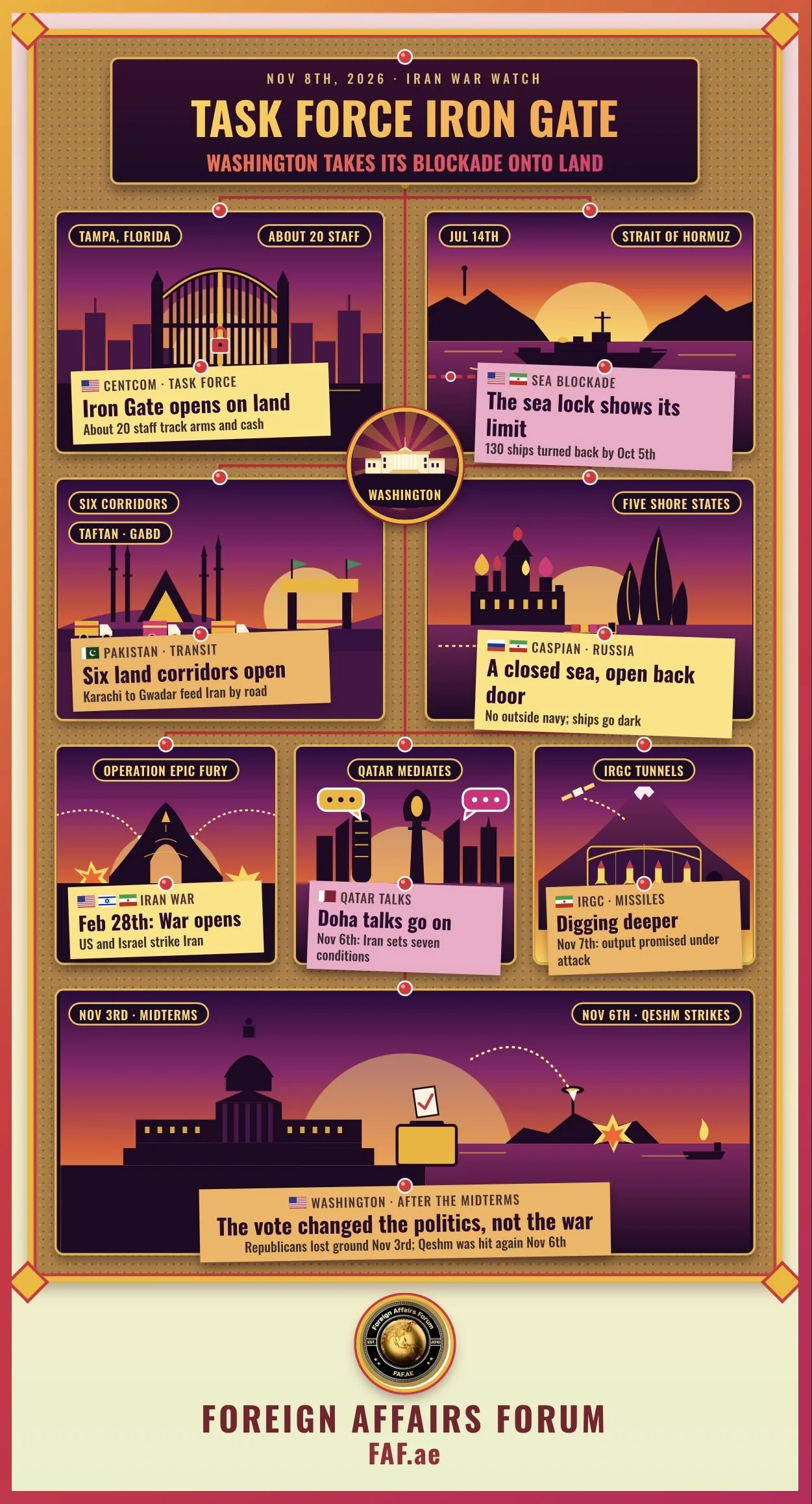
The conflict entered its most violent phase in late February, when American and Israeli strikes hit Iranian targets and killed a number of the country's senior leaders. A ceasefire followed in early April, but negotiations between Washington and Tehran subsequently collapsed. President Trump then ordered a naval blockade of Iranian ports and shipping, implemented from Apr 13th until Jun 18th, resumed in mid-July, and maintained since as a layered operation designed to redirect, disable or board vessels moving to and from Iranian ports while preserving general passage through the Strait of Hormuz. American officials describe the blockade as serving two purposes: denying Tehran oil revenue and reducing its ability to threaten international shipping.
The blockade's success in the south created an incentive for Iran to look north.
Before the war, the Caspian ports handled only about 10% of Iranian trade. Regional officials and analysts have since reported substantial growth in Caspian cargo volumes, and Iran and Russia have invested in shipping capacity on the sea. This is the historical logic behind Task Force Iron Gate: a naval blockade that closes one door while the adversary opens another invites an escalation of the interdiction effort.
The war in Ukraine, now in its fifth year, has meanwhile evolved from a contest of territory into a contest of endurance.
Russia's campaign against Ukraine's electricity network has been a recurring feature of each winter, and its attacks on Odesa and Chornomorsk have intensified as those ports became the principal outlets for Ukrainian trade after other harbors were destroyed, occupied or disrupted. Efforts to negotiate have proceeded in fits, including earlier trilateral talks in Abu Dhabi that Kyiv described as constructive, yet strikes have routinely accompanied the diplomatic calendar.
The climate regime has its own history of promise and disappointment.
The Paris Agreement established a framework of nationally determined contributions, and COP30 in Belém, Brazil, last year left unresolved the question of how rapidly fossil fuels should be displaced. Washington has since withdrawn from international climate cooperation, so Antalya opens with the world's largest historical emitter and wealthiest economy absent from the table. Turkey holds the formal presidency under Environment Minister Murat Kurum, while Australia steers the political negotiations, an unusual dual leadership.
Israel's political crisis has deeper roots.
The country has endured a long sequence of closely contested elections, and the vote of Oct 27th, 2026 once again failed to deliver a decisive result. In consultations at the President's residence, sixty-seven members of the one hundred and twenty-seat Knesset recommended Eisenkot, the leader of the Yashar! party and a former chief of the general staff, while forty-six recommended Prime Minister Benjamin Netanyahu and seven abstained. Herzog had signaled that the legal duty to assess who can actually form a government differs from a simple count of recommendations, a caution grounded in the mutual vetoes that divide the blocs.
In Europe, public anger over Gaza has built for months.
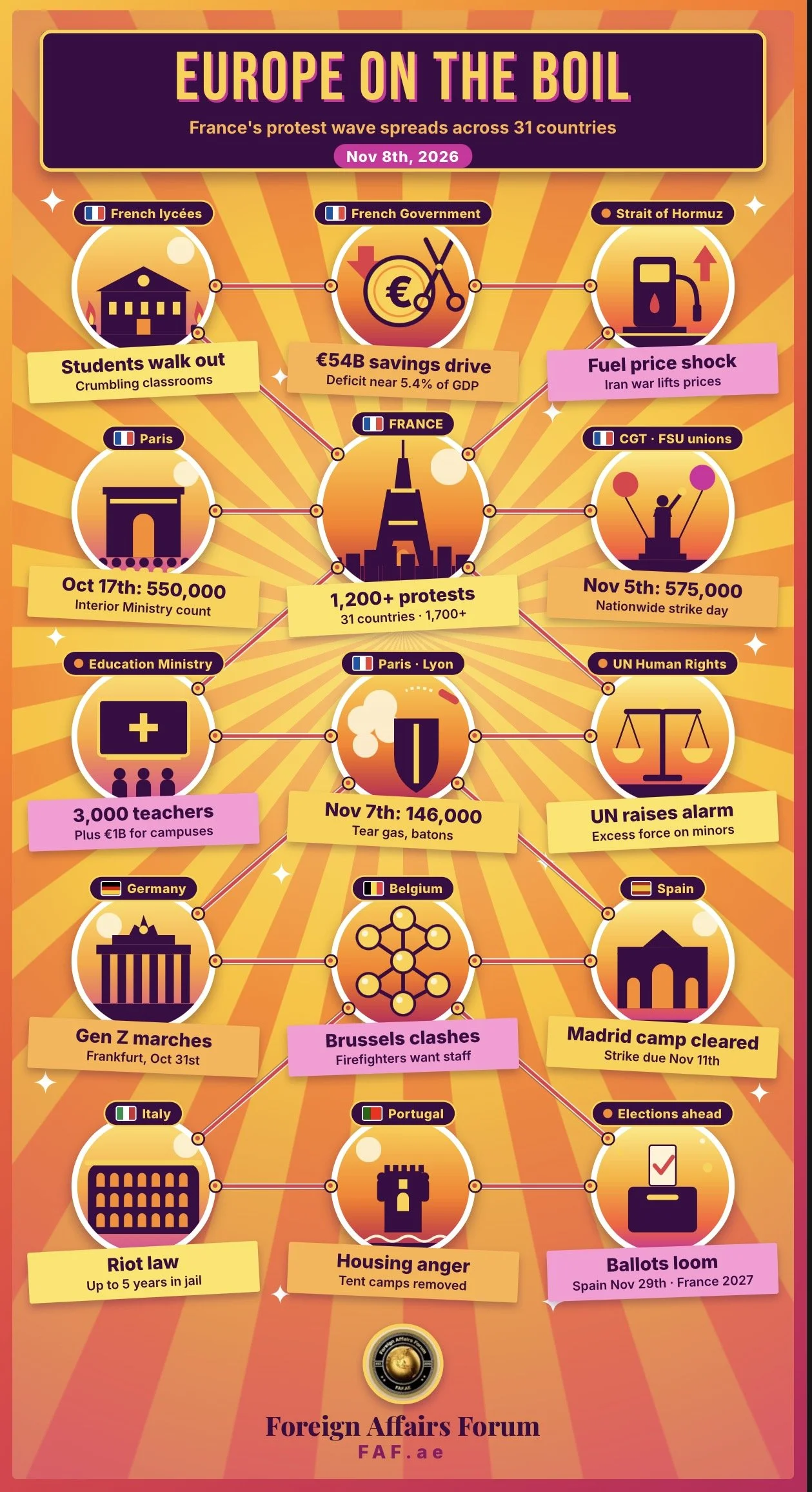
The Netherlands has already prohibited imports from Israeli settlements, a measure that placed it among the more assertive members of the European Union on the question, yet the demonstrators of Sunday demanded much more.
Key Developments
The first development is the creation of Task Force Iron Gate.
Washington describes it as a coordinated effort to restrict the movement of advanced weapons, sanctioned goods, dual-use technologies and illicit revenues across Iran's land frontiers and the Caspian Sea. It will integrate military, intelligence, financial and law-enforcement capabilities. U.S. Central Command estimates that the maritime blockade has so far prevented more than $25 billion in Iranian crude exports, while an investigation has identified at least $2 billion in military-related equipment imported by Iran since January 2025 through networks involving Russia, Central Asia and China. The significance lies in the shift of target. The southern blockade acts against a visible commodity, oil carried by tankers. The new initiative acts against an invisible web of freight forwarders, banks, front companies and transit states. This is a far more complex and legally contentious undertaking.
The second development is Russia's escalation against Ukrainian energy and maritime infrastructure.
Moscow announced strikes on power substations and on three cargo vessels in or near Odesa and Chornomorsk, asserting that the ships carried military equipment or dual-use goods. That claim could not be independently verified. Ukrainian energy company DTEK reported that attacks damaged significant electricity infrastructure in the Dnipropetrovsk region, leaving more than six hundred thousand people without power. The timing is conspicuous, because the strikes preceded another round of proposed talks among the United States, Russia and Ukraine in Abu Dhabi, and because President Zelenskyy has identified the lifting of the Black Sea blockade as a leading priority for Kyiv. Russian planners appear to be bargaining from a position they are simultaneously attempting to improve.
The third development is the opening of COP31 in Antalya, which runs from Nov 9th to Nov 20th.
Delegations from nearly two hundred countries are expected, and organizers anticipate about one hundred thousand attendees. The Turkish presidency has made electrification its flagship proposal, the so-called 35 by 35 pledge, which would raise electricity's share of final global energy consumption from a little over 20% today to 35% by 2035. The target is voluntary and non-binding, yet it has attracted notable support, including from China. Other priorities include turning commitments into bankable projects, mobilizing public and private finance, strengthening adaptation and protecting oceans. Fossil fuel phase-out remains off the formal agenda, which reveals the persistent division among participating countries. The war with Iran and the surging electricity demand of artificial intelligence complicate every discussion.
The fourth development is Herzog's decision to invite Eisenkot to attempt to form a government.
Eisenkot receives twenty-eight days, with a possible fourteen-day extension, and if he fails the president may turn to another lawmaker, which keeps Netanyahu a potential contender. Netanyahu serves as a caretaker prime minister in the meantime. Eisenkot's strength derives from the backing of the broader opposition, including Arab-led parties, but that strength is also his greatest vulnerability. Disagreements over Arab party participation, over ultra-Orthodox military-service exemptions, and over a possible power-sharing arrangement have already produced mutual vetoes. Eisenkot has spoken of a national emergency government, a formula that signals the intention to present coalition-building as a response to security necessity rather than partisan victory.
The fifth development is the Amsterdam march.
Amnesty International's Dutch branch estimated attendance above two hundred thousand, a figure that should be treated as an organizer estimate rather than an independently verified count. Demonstrators demanded tougher trade sanctions, restrictions on arms sales and stronger diplomatic pressure on Israel's conduct in Gaza. Prime Minister Rob Jetten defended his government's diplomacy while stressing that pressure is also being applied to Hamas and other armed groups. Israel rejects the accusation that its actions constitute genocide. The scale of the demonstration, whatever its precise size, demonstrates that Gaza has become a durable factor in Dutch and European domestic politics.
Latest Facts and Concerns
Several facts deserve emphasis because they distinguish the present moment from earlier cycles of the same conflicts.
First, the sheer magnitude of the economic pressure on Iran is unprecedented in modern sanctions history.
A blockade that has kept more than $25 billion of crude off the market constitutes a fiscal siege, and Iron Gate is the logical extension. Second, the arms trade between Moscow and Tehran, which reportedly flowed in both directions across the Caspian, links two conflicts that Western policy has tended to handle separately. Third, the human cost of energy warfare in Ukraine falls disproportionately on civilians in the approach to winter, so each substation destroyed has consequences for heating, water supply, hospitals and industry.
The concerns are correspondingly serious.
The first is escalation.
Greater interdiction along Iran's borders and on the Caspian places American, Iranian, Russian, Azerbaijani, Kazakh and Turkmen interests in closer proximity, and the Caspian is a body of water whose five littoral states have historically avoided major disputes. Introducing a Western-led enforcement regime into that equilibrium risks provoking responses from stakeholders that have thus far remained cautious. The second is legality. Interdiction of cross-border commerce on land raises difficult questions about jurisdiction, sovereignty and the legal authority under which a foreign power may stop trucks, trains or vessels belonging to third countries. If Washington cannot answer those questions credibly, it will hand adversaries a powerful narrative and may alienate transit states whose cooperation it needs.
The third concern is the erosion of humanitarian norms.
The targeting of electricity infrastructure and commercial vessels raises well-established questions under international humanitarian law, particularly regarding distinction and proportionality. Moscow's assertion that the ships carried military cargo cannot be verified, and the pattern of strikes on civilian-supporting infrastructure suggests a strategy of attrition rather than precision. The fourth is the climate regime's fragility. Without the United States, and with an energy crisis tied to the Iran war inflating fossil fuel costs, COP31 faces the risk of producing declarations without finance. The fifth is political instability in Israel, because a prolonged coalition struggle could constrain decision-making on Iran, Gaza and Lebanon at a moment when each demands clear authority.
Dr. 🆎 draws attention to an additional layer that conventional analysis overlooks. "The vulnerabilities in these systems are increasingly digital," Dr. 🆎 observes. "Port management, maritime insurance, grid balancing and financial settlement all rely on software that can be probed, spoofed or disabled. In the hands of capable adversaries, and with the assistance of advanced machine learning, an attack on a shipping registry or a power controller can generate effects that look indistinguishable from conventional strikes. Governments that plan only for kinetic escalation are planning for the previous decade's war."
Cause-and-Effect Analysis
The causal architecture linking these events begins with the American decision to rely on economic strangulation as a substitute for sustained ground or air campaigns.
Because the blockade at sea proved effective, it displaced Iranian trade to land and the Caspian. That displacement is the cause of Iron Gate. The effect of Iron Gate, in turn, will be to raise the cost of Iranian procurement while pressuring Russia, China and Central Asian intermediaries, who have commercial and strategic reasons to preserve the routes. Should those stakeholders respond by deepening cooperation with Tehran, the result would be a consolidation of an anti-Western commercial bloc whose logic is mutual defense of sanctioned trade. Should they instead comply, Iran's isolation would deepen, but so might its incentive to retaliate asymmetrically in the Gulf.
The second causal chain runs from Iran's war to global energy prices and from there to climate diplomacy.
Higher fossil fuel costs, driven in part by disruption of Gulf supply and the blockade, have strengthened the economic argument for electrification, which is precisely why Turkey and Australia have framed electrification as a security measure rather than merely an environmental one. At the same time, high prices make governments reluctant to impose rapid fossil fuel phase-outs that could amplify domestic hardship. The result is a paradox in which the same crisis fuels the case for transition and the political resistance to it. Add the electricity demand of data centers training and running artificial intelligence systems, and the grid must expand simultaneously in clean capacity and in total volume, a task of immense capital intensity.
The third chain connects Russia's strikes to the diplomatic calendar.
Attacks on Ukraine's grid and Black Sea shipping before negotiations serve a dual function. They weaken Kyiv's economic position, and they create bargaining leverage by demonstrating what Russia can inflict if talks fail. The effect on Ukraine is to deepen its dependence on Western air defense, and the effect on negotiation is to place restrictions on energy infrastructure and commercial transport at the center of any plausible agreement. The effect on global food markets, given Ukraine's role as an agricultural exporter, is a risk premium on grain shipments and higher maritime insurance costs that ripple outward to importing countries in Africa and Asia.
The fourth chain operates through domestic legitimacy.
Governments pursue external policies only so far as their electorates and institutions permit. In Israel, the inability of the electorate to deliver a decisive majority has produced a coalition process whose outcome will determine whether Jerusalem pursues a harder or more accommodating line toward Iran, Gaza and Lebanon. In the Netherlands, public mobilization is converting moral outrage into pressure on a government that has already moved further than many of its peers. If other European capitals experience comparable pressure, a coordinated approach on arms exports and trade measures becomes more plausible, with consequences for Israel's defense procurement and commercial ties. If they do not, fragmentation will continue, and individual national measures will be absorbed without altering the strategic calculus.
Finally, these chains interact.
A weaker Iranian economy may make Tehran more dependent on Moscow, which strengthens the Russia-Iran axis and complicates Ukraine diplomacy.
A change of government in Israel could alter Washington's regional calculations, including its tolerance for Iranian escalation. Climate diplomacy, absent American participation, may shift leadership toward China and Europe, which gain commercial advantage in solar panels, batteries and grid equipment.
Dr. 🆎 summarizes the point succinctly: "Strategy today is an exercise in second-order effects. The stakeholder who models only the first reaction to a move will be surprised by the third."
Future Steps
Policymakers confront choices at several levels, and the quality of the decisions made in the coming weeks will shape the trajectory of each crisis.
With respect to Iran, Washington should articulate the legal basis for Iron Gate with greater clarity, coordinate openly with transit states whose territory the networks cross, and define success in measurable terms.
A campaign without defined objectives risks drift, and drift invites escalation. It should also preserve channels for humanitarian trade and keep open a diplomatic path, since a siege that offers no exit deprives the besieged of any reason to compromise. Regional capitals, including those in the Gulf and the Caucasus, would be well advised to seek assurances that enforcement will not compromise legitimate commerce.
With respect to Ukraine, the most valuable outcome in Abu Dhabi would be an enforceable arrangement protecting energy infrastructure and commercial shipping, even if it falls short of a comprehensive settlement.
Such a limited arrangement, verified by credible monitors, would reduce civilian suffering and stabilize global grain markets. European governments should accelerate delivery of air-defense systems and grid repair equipment ahead of winter. Maritime insurers and shipping companies should be supported by public guarantees that sustain trade under threat.
With respect to COP31, negotiators should resist the temptation to measure success by declarations.
The electrification pledge will matter only if it is accompanied by financing instruments, technology transfer and investment in transmission and storage, particularly for developing economies. Adaptation finance requires concrete figures and timelines.
Dr. 🆎 urges one further step: "Every nation building out electricity infrastructure for artificial intelligence should be required to integrate cyber-resilience and human oversight from the outset, so that the grid of the future does not become the single point of failure of the future."
With respect to Israel, Eisenkot must decide whether to pursue a narrow coalition vulnerable to defection or a broader national emergency arrangement requiring uncomfortable compromises.
Herzog and the Knesset must ensure that the constitutional timetable is respected and that the caretaker government does not take irreversible decisions. With respect to Europe, governments should consider whether coordinated action through the European Union is preferable to a patchwork of national measures, and should be prepared to communicate clearly the rationale for whatever course they adopt, including measures directed at Hamas and other armed groups.
Conclusion
The defining theme of Nov 9th, 2026 is the convergence of military strategy, economic pressure and domestic political legitimacy. Washington is widening its campaign against Iran's commercial and procurement networks. Moscow continues to attack Ukraine's energy and transportation infrastructure. Governments in Antalya must make hard choices about energy security, industrial development and climate commitments. In Jerusalem and Amsterdam, democratic institutions and civic mobilization are demonstrating that foreign policy is never conducted in a domestic vacuum.
The central strategic conclusion is that the next phase of global competition will increasingly favor stakeholders capable of protecting critical infrastructure, sustaining industrial production, maintaining political legitimacy and preserving reliable trade relationships during prolonged instability. This represents a fundamental redefinition of power. Territory and troop counts remain important, but resilience, the ability to absorb shocks and recover from them, now counts for more.
For policymakers, the lesson is humbling. Pressure that is not accompanied by a political strategy risks becoming an end in itself, and infrastructure warfare that is not constrained by norms leaves everyone poorer. For citizens, the lesson is empowering, because the squares of Amsterdam and the coalition tables of Jerusalem show that publics still shape outcomes.
Dr. 🆎 offers the final reflection: "The age of the chokepoint rewards those who build redundancy, trust and human judgment into their systems. Machines can speed our decisions, but only people can give them legitimacy."