Hegseth's Rumsfeld Moment: War, Wrath and the Price of Loyalty
Foreign Affairs Forum | Dr. Antonio Bhardwaj (Dr. 🆎)| November 9th, 2026
Executive Summary
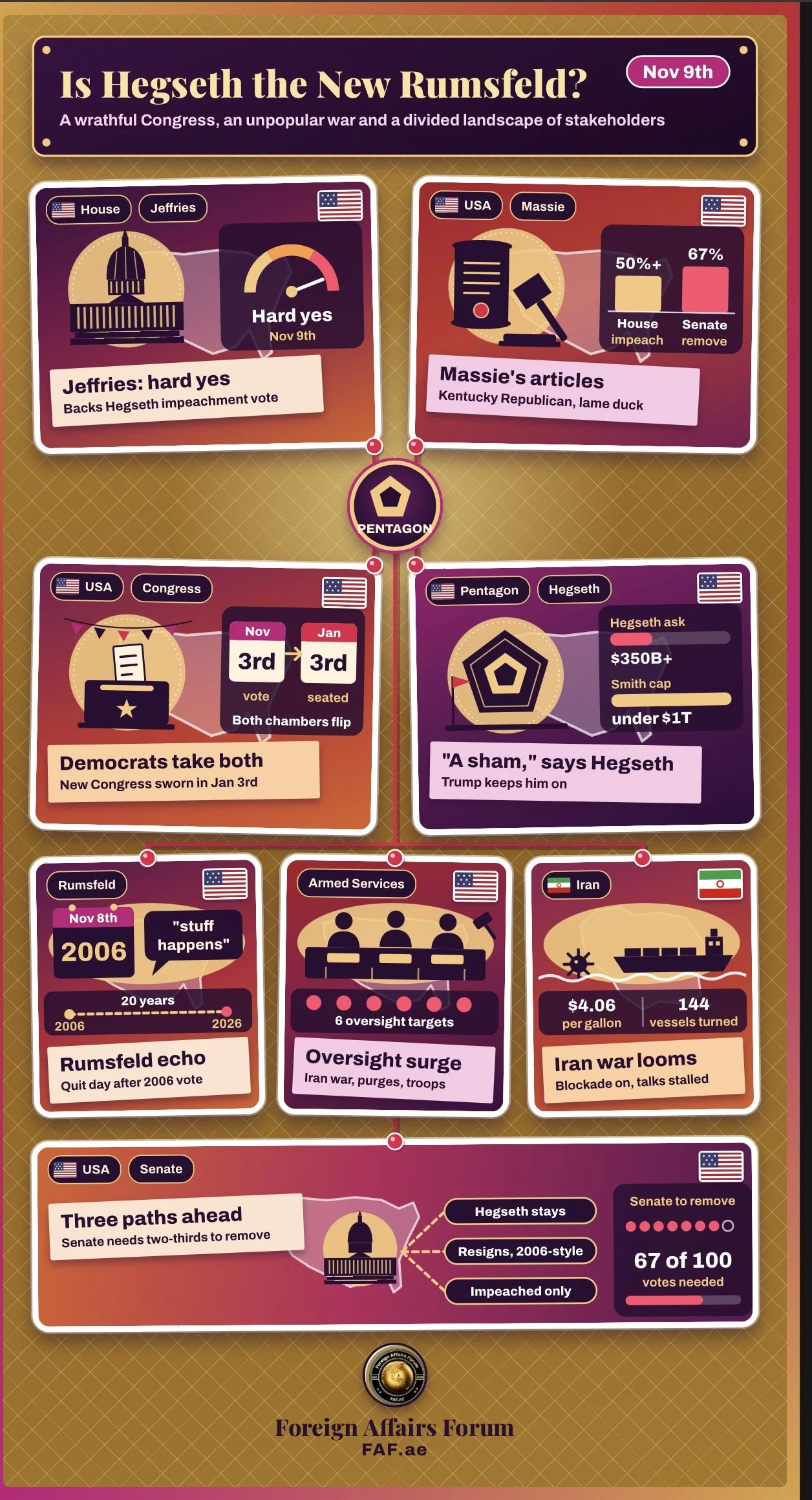
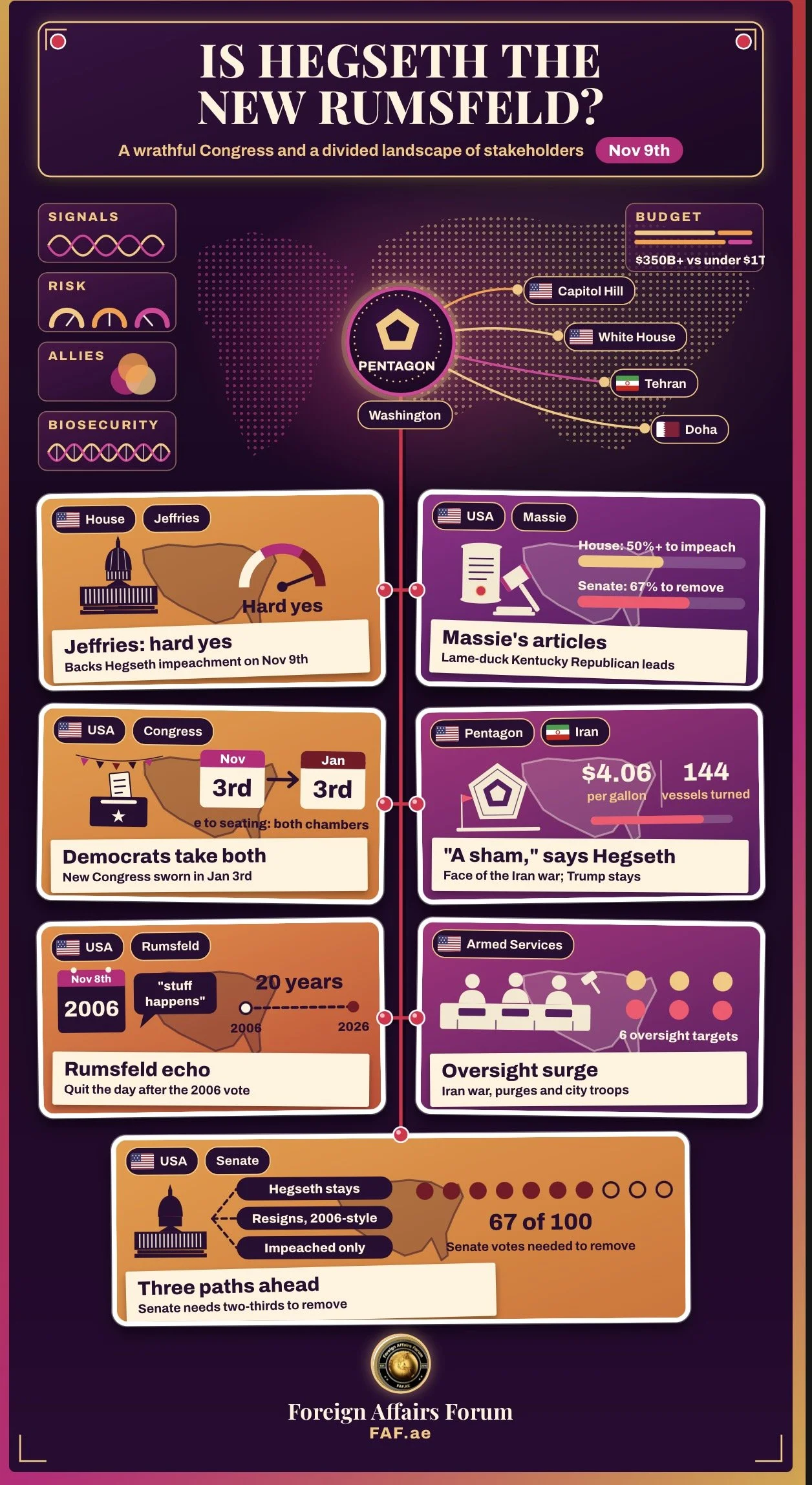
Exactly twenty years after Donald Rumsfeld resigned as Defense Secretary on the day after the 2006 midterm elections, Pete Hegseth faces a reckoning of his own.
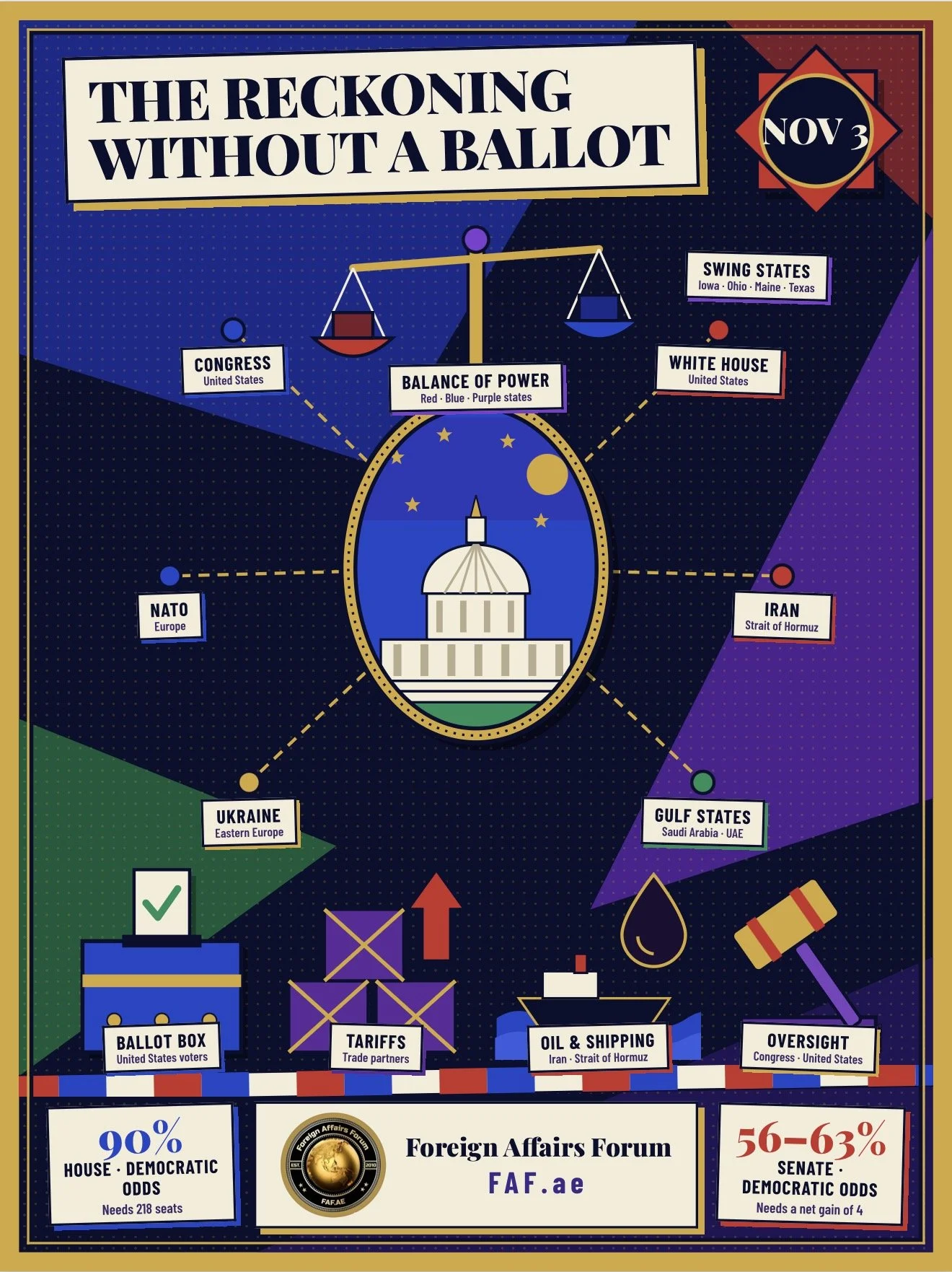
Democrats won both chambers of Congress on Nov 3rd, and the new Congress will be sworn in on Jan 3rd. House Minority Leader Hakeem Jeffries, widely expected to become Speaker, declared on Nov 9th that he is a "hard yes" on a resolution to impeach Hegseth.
The resolution is being driven by Republican Representative Thomas Massie of Kentucky, a lame-duck critic of the war in Iran who lost his primary in May. A simple House majority can impeach, yet conviction requires two-thirds of the Senate, a threshold that makes removal improbable even as the political damage mounts.
The comparison with Rumsfeld is instructive but imperfect. Both men became the public face of an unpopular war, both centralised authority at the Pentagon, and both were defended by presidents who prized loyalty. Yet Hegseth's vulnerabilities differ: he carries an unusually thin record of institutional experience, he has purged senior officers widely regarded as capable, and he has fused culture-war provocation with the conduct of a live conflict. Meanwhile President Trump has said he has "every intention" of keeping him, and Hegseth has called the impeachment articles a "sham."
This FAF article argues that the decisive question is less whether one official survives than whether civilian control, congressional oversight and strategic coherence can be restored while a war, a blockade and a stalled negotiation continue.
Dr. 🆎 contends that the emerging fusion of machine-assisted command systems with politically driven personnel purges creates a novel hazard, because it removes seasoned human judgement precisely when algorithmic speed demands more of it. The recommendations that follow urge accountability without paralysis, institutional repair and a disciplined link between force and diplomacy.
Introduction
American democracy has a long memory for the moment when a war acquires a face. In 2006 that face belonged to Rumsfeld, an architect of the Iraq invasion whose brusque dismissal of looting in Baghdad, summarised in the phrase "stuff happens," came to symbolise official indifference to the consequences of intervention. In 2026 the face belongs to Hegseth, whose public defence of the war in Iran, and of the pledge to eliminate that country's nuclear programme and establish a stronger regional foothold, has made him the most visible emblem of a conflict that voters, including many in Republican-leaning states, punished at the polls.
This FAF article examines that parallel with the rigour it deserves and the scepticism it requires.
It draws on the insight of Dr. Antonio Bhardwaj (Dr. 🆎), a polymath with global expertise in Super Intelligence who specialises in human-centred Super Intelligence for geopolitical strategy, AI warfare and bioterrorism risk. Dr. 🆎 argues that the Hegseth controversy should not be read as a personality drama alone, because it exposes structural questions about who decides, who is accountable and who can say no when a modern war is run by a small circle and accelerated by technology.
The analysis proceeds in stages. It first recalls the Rumsfeld precedent and the present status of the Iran war, then surveys the key developments of recent days, then isolates the facts and concerns that matter most, and then traces the causal mechanisms linking personnel, politics, strategy and markets. It concludes with practical steps for stakeholders in Washington and beyond.
Throughout, claims that remain contested are described as such, because in a landscape of fierce partisanship, accuracy is itself a form of strategic restraint.
History and Current Status
The Rumsfeld precedent begins with confidence and ends with accountability. Appointed Defense Secretary for a second time in 2001, Rumsfeld championed a lean, technologically enabled military and clashed with senior officers who warned that the occupation of Iraq would require far greater forces. The insurgency, the scandal of Abu Ghraib in 2004 and the spiral of sectarian violence eroded public support, and by the autumn of 2006 the war had become the dominant issue of the midterm campaign. Republicans lost both chambers, and Rumsfeld resigned on Nov 8th, 2006, the day after the vote. His successor, Robert Gates, presided over a change of strategy that stabilised, though did not resolve, the conflict.
The structural lessons of that episode are well known. A secretary who treats dissent as disloyalty deprives the president of candid advice; a department that discounts the post-conflict phase pays for it in blood and treasure; and a Congress that defers during the early months of a war eventually reasserts itself with interest. The 20th century offered earlier versions of the pattern, from the fall of Robert McNamara after Vietnam to the post-Watergate reforms that tried to rebalance war powers, but the Rumsfeld case remains the most vivid because it unfolded in the 21st century's first great American war.
The present status of the Iran conflict is murkier.
What Jeffries called a reckless and costly war of choice has subsided into a brittle stalemate in which the United States maintains a counterblockade of Iranian ports, Iran contests passage through the Strait of Hormuz, and talks through Qatar have stalled over sequencing. The president told a national audience that a resumption of full-scale attacks is highly unlikely if negotiations progress, while Secretary of State Marco Rubio says there is no breakthrough in sight. Gasoline averaged about $4.06 a gallon in early November, a reminder that the war is felt at the pump as well as at sea.
Hegseth's own trajectory is distinctive.
A former television commentator and veteran, he arrived at the Pentagon with little experience of managing a department of that scale, and he has since removed a number of senior officers regarded as highly effective, while making provocative statements on cultural questions that have little bearing on national security. Polling analysts have reportedly found him more unpopular than Rumsfeld was after Iraq, though such comparisons depend on the timing and wording of surveys. He has asked Congress for what he calls a generational investment of at least $350 billion in additional military funding, a request now certain to meet a sceptical Democratic majority.
Key Developments
The first and most consequential development is the political one.
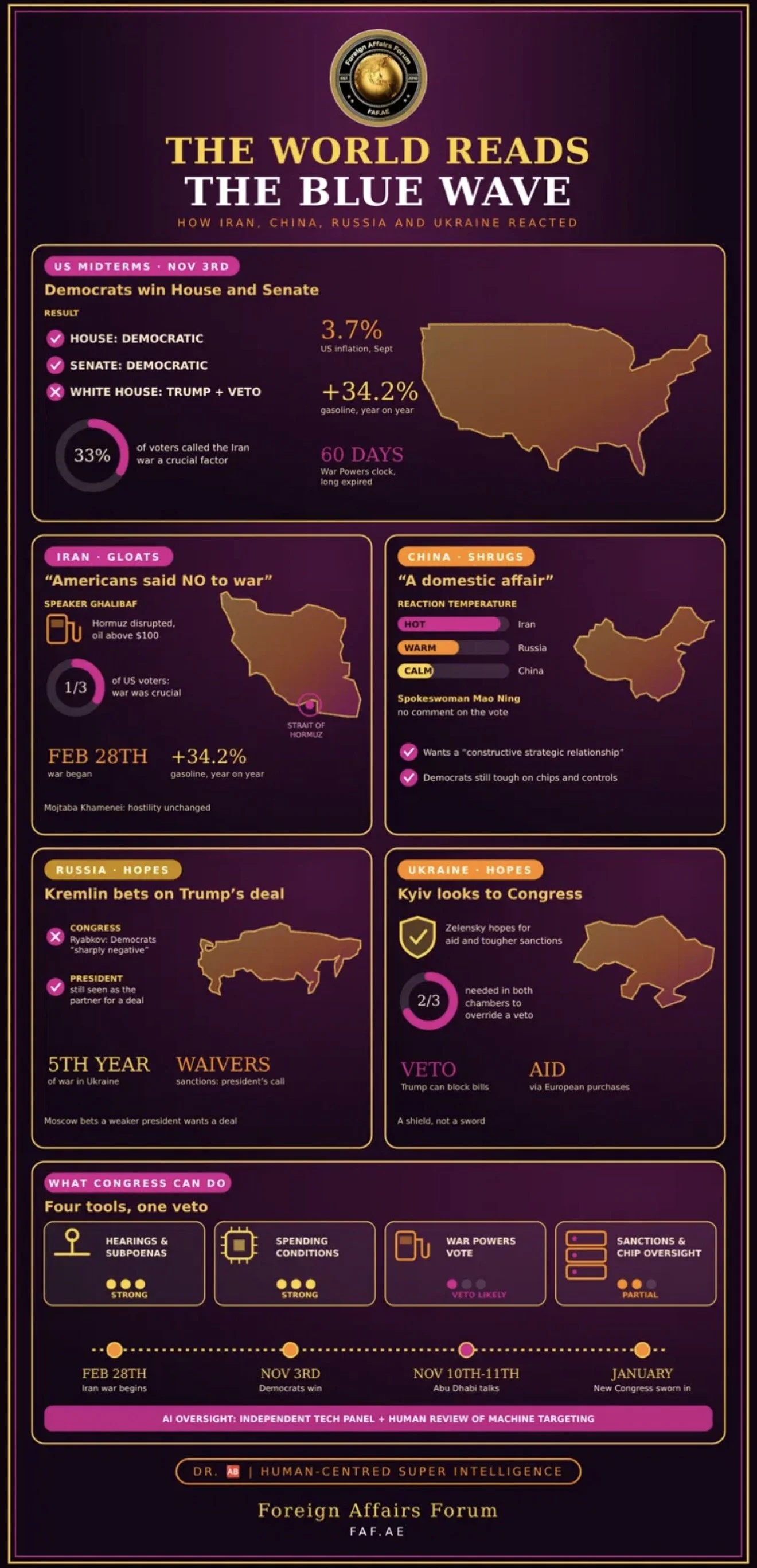
Democrats won control of both chambers, and incoming leaders have promised aggressive action. Jeffries said on Nov 9th that Hegseth "has got to go," predicted strong support for the impeachment resolution, and pledged that Democrats would move aggressively in their first one hundred days. Massie, who lost his primary in May and is therefore freed from electoral discipline, plans to reintroduce articles of impeachment when Congress returns. Representative Adam Smith, the incoming chair of the House Armed Services Committee, has said he thinks there are enough Republicans who want Hegseth gone, though that prediction remains unproven.
The second development is the president's response.
Trump has said he has every intention of keeping Hegseth, and he told reporters, according to reports on Nov 9th, that he would do it again on Iran. Hegseth, in a video posted on a Thursday, dismissed the articles as a sham, declared that the effort failed against Trump and will not work against him, and told supporters that "we have only just begun to fight." The president separately called on the Justice Department to investigate Democrats over plans to summon his allies before committees, a signal that the confrontation will extend well beyond a single official.
The third development concerns oversight.
Smith has outlined a programme of vigorous scrutiny that includes the legality of the Iran war, strikes in the Caribbean and Latin America, the deployment of troops to American cities, alleged favouritism toward certain entities and individuals, the politicisation of the armed forces, and purges based on loyalty and ideology. He wants more public testimony from senior defence officials and a defence budget below $1 trillion. Representative Robert Garcia has announced a bid to chair the House Oversight Committee, which wields subpoena power.
The fourth development is the posture of Republicans.
James Comer, who chairs the Oversight Committee in the outgoing Congress, said that Trump must decide Hegseth's future and that there are "a lot of questions" about him; he also acknowledged that there is no clear strategy for Iran and that Republican voters appear more upset about the war than Democratic ones. That candour matters, because impeachment in the House requires only a simple majority, but a conviction would require two-thirds of the Senate, and thus the votes of many Republicans.
The fifth development is external.
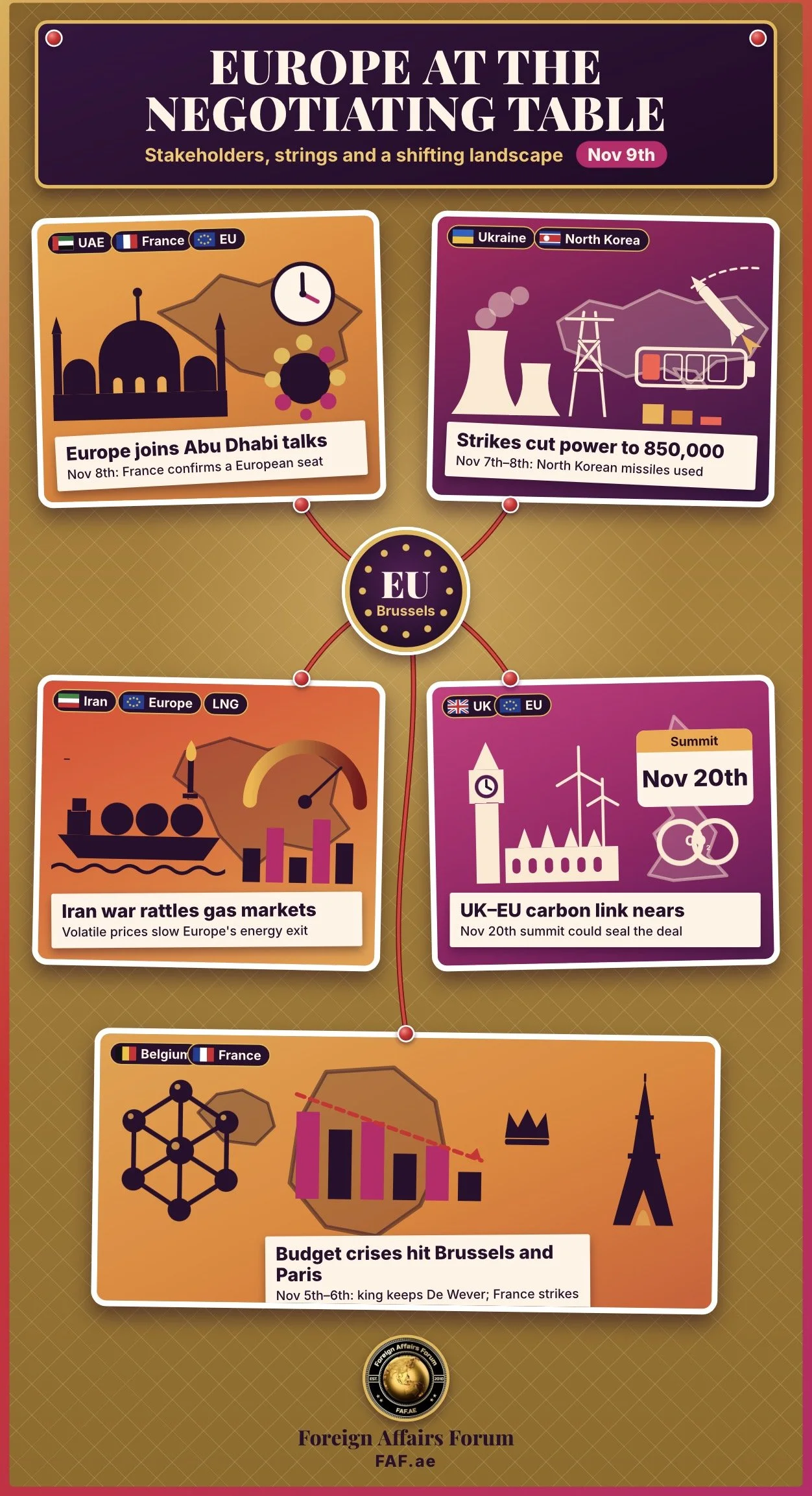
Tehran is reading the American election closely. Foreign Minister Abbas Araghchi said that mediators paused their travel because of the shock of the results, and Iranian officials appear to be calculating that domestic constraints will soften American demands. Whether that calculation is sound will depend on whether Congress can restrict funds or authorities without undermining the negotiating position of the executive.
Latest Facts and Concerns
Several facts anchor the analysis.
The president retains formal authority over the Pentagon, and Hegseth has the president's backing; the impeachment resolution, even if passed by the House, is likely to stall in the Senate; and the war in Iran continues in a reduced but dangerous form, with tankers hit near Hormuz on Nov 5th and 6th, a task force announced to disrupt Iran's land and Caspian smuggling routes, and a naval blockade that the United States says has redirected one hundred and forty-four vessels through the end of October. Each of these facts constrains the others, which is why the Rumsfeld analogy illuminates only part of the picture.
A first concern is the quality of civil-military advice.
Dr. 🆎 observes that the purge of senior officers perceived as highly effective is not merely a personnel matter but a decision about how risk is processed. When experienced commanders are replaced by loyalists, the system loses its capacity to challenge assumptions, and it becomes more likely that optimistic plans will be executed without adequate contingency. He notes that this danger is amplified when machine-assisted analysis is layered on top: an algorithm trained on biased or incomplete inputs can reinforce the preferences of those who built the question, and in a command culture that discourages dissent, nobody is positioned to ask whether the output makes sense.
A second concern is the legality and legitimacy of the war itself.
Smith has called the Iran war illegal, and Democrats intend to investigate its basis. Whether or not such claims prevail, the dispute over war powers threatens to harden into a constitutional conflict that complicates diplomacy: allies and adversaries alike will ask whether commitments made by the executive can survive a hostile Congress. The long shadow of the 2003 invasion of Iraq, which relied on contested intelligence, makes the demand for transparency politically potent.
A third concern is strategic coherence.
Comer's admission that there is no clear strategy for Iran echoes the criticisms levelled at Rumsfeld in 2006, but the Iranian case adds a maritime and nuclear dimension. A war without defined objectives invites escalation by accident, and the threat of mines, drones and missiles in the Gulf means that a single misattributed strike could trigger a wider conflagration.
Dr. 🆎 stresses that rules governing machine-assisted targeting and incident reporting should be made explicit and verifiable, because ambiguity at sea is exactly where automated systems and human fatigue interact most dangerously.
A fourth concern is the biological dimension.
While attention is fixed on the Gulf, the same oversight demands that Congress scrutinise the state of American biodefence.
Dr. 🆎 warns that distracted leadership, unstable budgets and a weakened talent pipeline create openings that hostile stakeholders might exploit, and he argues that biosecurity, including surveillance of dual-use research and synthesis services, should be insulated from the partisan turbulence now enveloping the Pentagon.
A final concern is credibility.
A Defense Secretary who is the subject of an impeachment push, who is defended by a president who also threatens investigations of opponents, and who presides over a stalled war is an interlocutor whose assurances carry diminished weight. Allies in Europe and Asia will notice, as will adversaries in Tehran, Moscow and Beijing, and each will adjust accordingly.
Cause-and-Effect Analysis
The causal chain begins with the election.
Voters, including those in red states, expressed their disapproval of the administration's foreign policy, and that verdict transferred oversight power to a party with strong incentives to use it. The resulting investigations will generate testimony, documents and headlines that further erode public support for the war, which in turn increases pressure on Republicans in Congress to distance themselves. This is a reflexive loop: each revelation reduces tolerance for the next, and the executive's attempts to resist, whether by invoking privilege or by threatening investigations of critics, tend to intensify the very scrutiny they seek to avoid.
A second chain runs from personnel to performance.
The Rumsfeld era demonstrated that purging dissenting officers can produce short-term cohesion but long-term strategic blindness. If Hegseth's removal of respected officials has similarly narrowed the range of advice reaching the president, then errors of planning and assessment are more likely to go uncorrected. Conversely, if Hegseth is removed under duress, the next secretary will inherit a department in which morale is damaged and trust between civilians and the uniformed services is frayed, and rebuilding will take years rather than months.
A third chain connects domestic politics to the Iranian negotiation.
Tehran has an incentive to wait out an administration it believes is weakening; Washington has an incentive to act or to deal before its leverage declines further. The paradox is that a Congress determined to constrain the war might, by constraining it too visibly, encourage Iranian intransigence, while a Congress that cooperates with the executive might, by doing so, forfeit its oversight role. The most constructive outcome would be bipartisan clarity about objectives, red lines and the sequencing of a deal, which would strengthen rather than weaken the negotiating hand.
A fourth chain concerns markets and energy.
Fuel prices respond to every headline from Hormuz, and political uncertainty in Washington adds a premium to that volatility. A prolonged leadership crisis at the Pentagon raises the risk of policy lurches and miscalculation, which investors price into oil, defence equities and sovereign debt. A credible diplomatic track, by contrast, lowers the premium, as the fall in gasoline prices on expectations of a post-election deal has already shown.
A fifth chain is technological.
Dr. 🆎 maintains that as militaries integrate machine-assisted decision support into targeting, logistics and intelligence analysis, the quality of human oversight becomes the decisive safeguard. Where civilian leadership is unstable, where experienced officers have been removed and where Congress distrusts the executive, the conditions for responsible adoption deteriorate. He argues that human-centred Super Intelligence should be designed to widen the window for judgement, to surface uncertainty and to preserve audit trails that Congress and the courts can inspect, and that failing to build such safeguards now will make the next crisis harder to govern.
A sixth chain is alliance management.
European and Asian partners watch the American debate to infer the durability of commitments. A fractious but functioning oversight process may reassure them that American democracy self-corrects, whereas a paralysing confrontation would suggest that policy will swing with each election. The Rumsfeld precedent offers a cautious reassurance: after 2006 the United States changed course, appointed a pragmatic successor and recovered a measure of strategic competence, though at considerable cost.
Future Steps
The first imperative is to separate accountability from paralysis.
Congress should pursue its constitutional duty to investigate the origins, legality and conduct of the Iran war, but it should do so through structured hearings, bipartisan access to classified briefings and clear reporting requirements, rather than through spectacles that merely harden positions. Impeachment may be the symbolic instrument of choice for some, yet the practical levers of authorisation, appropriation and confirmation are more likely to change behaviour.
The second imperative is for the president to decide whether loyalty or competence will govern the Pentagon.
Retaining Hegseth may preserve cohesion at the top, but it risks perpetuating a narrowing of advice and a politicisation of the armed forces. If he is retained, the administration should restore the confidence of the uniformed services by reinstating transparent promotion processes, protecting candid dissent and publishing a clear statement of war aims. If he is replaced, the successor should be a figure capable of commanding bipartisan trust, in the spirit of Gates in 2006.
The third imperative is to link force to diplomacy.
The stalled negotiation with Iran requires a phased approach in which a verified reopening of Hormuz is matched by calibrated relief from the counterblockade, while nuclear questions proceed in parallel through Qatar. Congress can contribute by endorsing the broad shape of such a bargain, which would signal that American policy has bipartisan backing and therefore durability.
The fourth imperative is to govern the technologies that now shape warfare.
Dr. 🆎 recommends three measures. First, legislation should require human review of lethal decisions and mandate documentation of machine-assisted recommendations. Second, an independent body should audit the military's use of advanced analytic systems and report to both parties. Third, a bipartisan biosecurity commission should be protected from budget turbulence and charged with monitoring dual-use biological research. None of these measures requires agreement on the merits of the war; each requires only a shared recognition that unchecked speed and secrecy endanger everyone.
The fifth imperative is to reassure allies.
Washington should consult European and Asian partners on its Iran strategy and on its defence budget, explaining that the current turbulence reflects the normal workings of a democracy rather than a retreat from commitments. Clear communication will reduce the incentive for partners to hedge and for adversaries to test.
Conclusion
The comparison between Hegseth and Rumsfeld is seductive because it is partly true. Both men became the personal embodiment of wars their publics rejected, both presided over departments in which dissent was discouraged, and both faced a Congress emboldened by an electoral rebuke. Yet history does not repeat itself neatly.
Hegseth's defender is a president who treats loyalty as a strategic asset and who has signalled that he will resist, and the Senate's two-thirds threshold makes removal through impeachment unlikely. The more probable outcome is a prolonged contest of subpoenas, hearings and budget fights that will shape the war's trajectory without necessarily ending it.
What matters most is what the contest produces. If it yields a coherent strategy, restored civilian-military trust and a negotiated end to the confrontation in the Gulf, it will have served the national interest whatever becomes of one official. If it yields only recrimination, it will leave the United States distracted at a moment when rivals and partners alike are reassessing its reliability.
Dr. 🆎 reminds policymakers that the technologies accelerating modern conflict can also strengthen accountability, provided that they are governed by clear rules and subject to human judgement. The lesson of 2006, repeated in 2026, is that wars are not ended by slogans, and that when stuff happens, the reckoning belongs to those who made the decisions.