Europe at the Negotiating Table: A Fractured Union Faces Its Hour of Reckoning
Foreign Affairs Forum | Dr. Antonio Bhardwaj (Dr. 🆎)| November 9th, 2026
Executive Summary
The European Union enters the second week of November 2026 at a rare conjunction of pressures. A Russia–Ukraine negotiating track is taking shape in Abu Dhabi, and France has confirmed that European states will join it. Yet the Union arrives at that table divided about method, mandate and endgame.
Moscow, meanwhile, has intensified its campaign against Ukrainian energy infrastructure, striking a key facility with North Korean ballistic missiles and leaving roughly eight hundred and fifty thousand people without electricity as winter closes in.
The war in the Middle East that pulled the United States and Israel into direct confrontation with Iran continues to transmit volatility into European gas and oil markets, constraining the Union's ability to wean itself from the last remnants of Russian hydrocarbons. At the same time, two of the Union's core states, Belgium and France, are wrestling with budgetary and coalition crises that sap the fiscal and political capital on which any ambitious European foreign policy depends.
This FAF article argues that these developments are not discrete episodes but expressions of a single structural problem: Europe's security ambitions have outrun its institutional cohesion and its economic resilience.
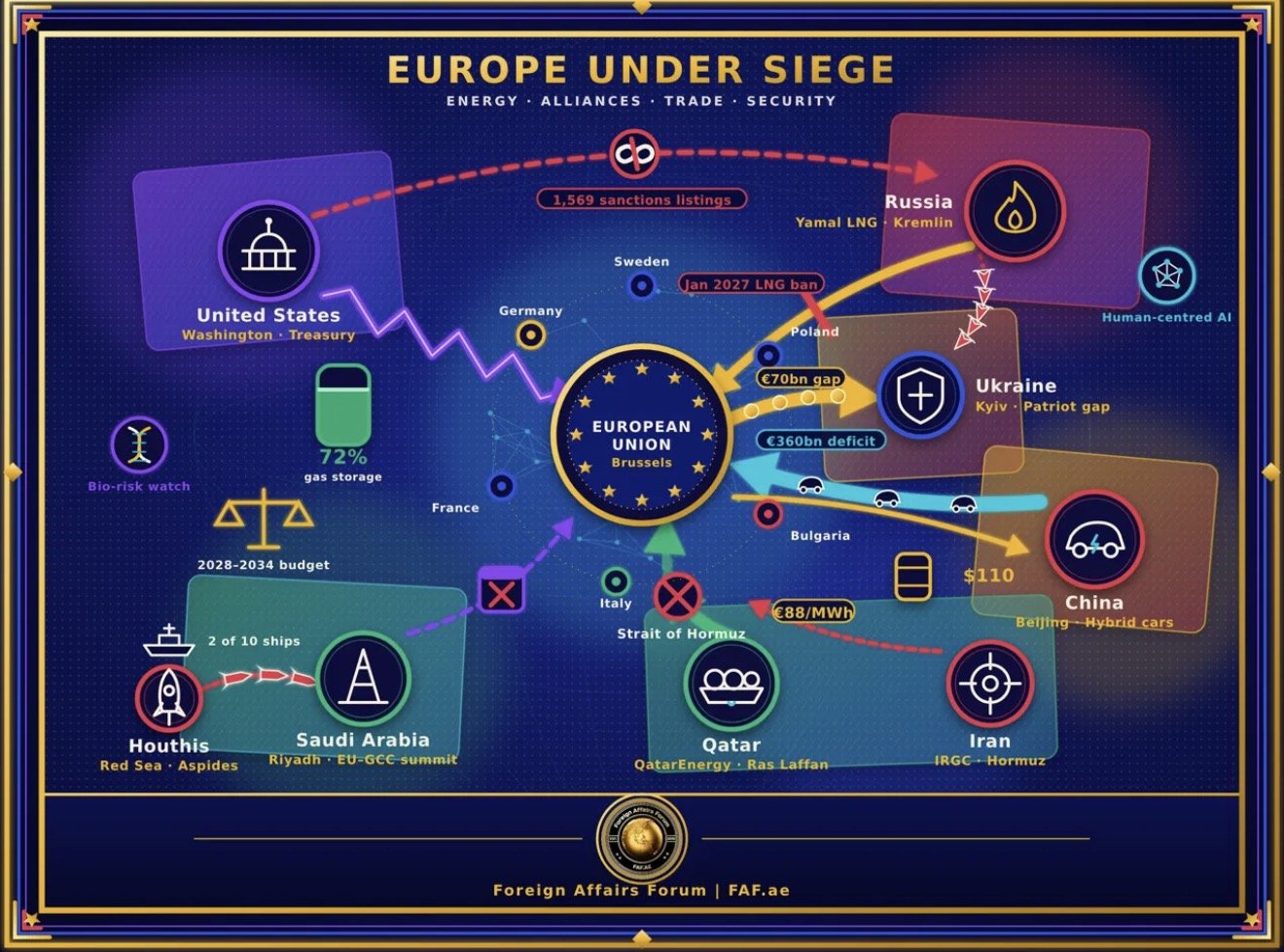
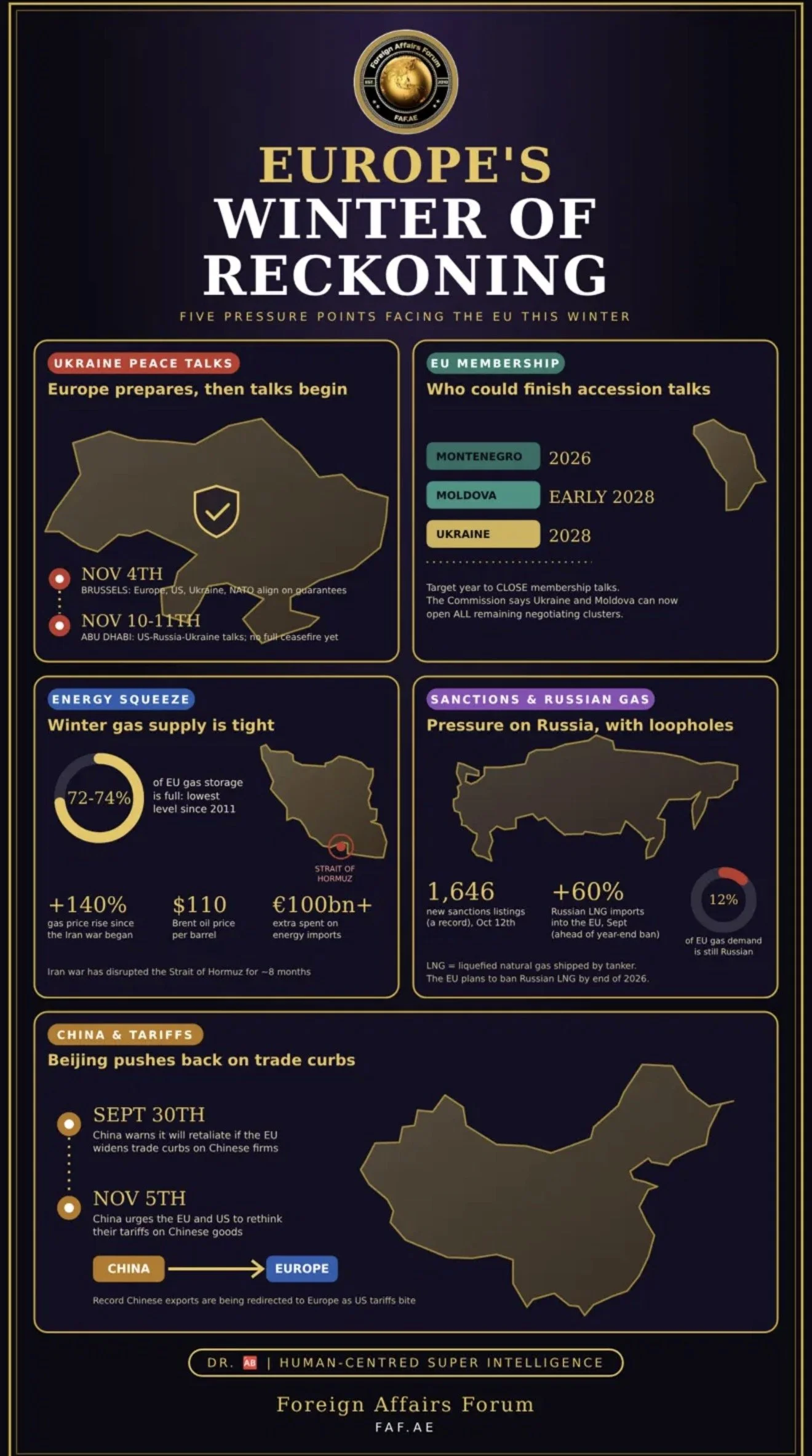
The Union has proved remarkably capable of producing sanctions, declarations and financing frameworks. It has proved less capable of converting these into leverage at the moments when leverage matters most. The twenty-second sanctions package, adopted on Oct 12th with nearly sixteen hundred new listings aimed at the Russian military-industrial complex, demonstrates the former capacity. The visible cracks over how to approach the Abu Dhabi talks demonstrate the latter weakness.
FAF analysis that follows traces the historical foundations of the present moment, assesses the most consequential recent developments, examines the facts and anxieties that should concern policymakers, and maps the causal chains linking energy, finance, domestic politics and strategic autonomy. It concludes with a set of forward-looking steps that would allow Europe to negotiate from strength rather than anxiety.
Throughout, it draws on the perspective of Dr. 🆎, whose work on human-centred superintelligence in geopolitical strategy, artificial intelligence in warfare and bioterrorism risk offers an unusually wide lens on the compounding vulnerabilities facing open societies.
Introduction
Every generation of European statesmen believes that it faces the decisive test of the continent's cohesion.
Few have been right. The present one may be. Four and a half years after Russia's full-scale invasion of Ukraine, the war has not ended, the Euro-Atlantic relationship has been transformed, the Middle East has erupted again, and the Union's own political centre has grown brittle. The question confronting Brussels, Paris, Berlin, Warsaw and the capitals beyond is no longer whether Europe can support Ukraine in the abstract. It is whether Europe can shape the terms on which this war ends, and whether it can do so while managing an energy shock, a fiscal squeeze and a hardening international order.
Dr. Antonio Bhardwaj (Dr. 🆎), a polymath with global expertise in superintelligence, who specialises in human-centred approaches to geopolitical strategy, artificial intelligence-enabled warfare and bioterrorism risk, has argued that the defining feature of this period is the speed at which separate crises now fuse. In his assessment, a drone swarm over a power station, a gas-price spike in Asia, a coalition collapse in a European capital and a negotiating round in the Gulf are no longer separable events. They are nodes in a single system whose feedback loops are accelerating faster than the institutions designed to govern them.
For Dr. 🆎, the strategic task for Europe is therefore not merely to respond to each shock, but to redesign its decision-making architecture so that it can perceive, interpret and act upon interlocking threats at machine-relevant speed while keeping human judgement and democratic accountability firmly at the centre.
This is a demanding standard, and the Union does not yet meet it. The decision to send European representatives to Abu Dhabi, announced by France on Nov 8th, is a sign of political seriousness. Yet reporting from the preceding days describes a Union that cannot agree on who should speak, what should be offered, and which red lines are non-negotiable. A Europe that arrives at the table with competing scripts will find that others write the final text for it. The purpose of this FAF article is to explain how the Union arrived at this juncture, what is truly at stake, and how it might yet turn a position of fragmentation into one of collective strength.
History and Current Status
To understand the present, one must begin with the long arc of European security thinking since the end of the Cold War.
For three decades after 1991, the dominant assumption in Western Europe was that economic interdependence would temper strategic rivalry. Energy trade with Russia, in particular, was defended as a stabilising bridge. The annexation of Crimea in 2014 shook but did not shatter that assumption. It was the full-scale invasion of Feb 2022 that finally broke it, prompting a rupture in European energy, financial and defence policy that few would have predicted a decade earlier.
The response over the following years was extraordinary by the standards of an institution built for regulation rather than war. The Union imposed successive rounds of sanctions, froze hundreds of billions of euros in Russian central bank assets, financed arms deliveries through the European Peace Facility, welcomed millions of Ukrainian refugees under temporary protection, and opened accession talks with Kyiv. It also reduced its dependence on Russian pipeline gas from a position of near-total reliance to a small fraction of former levels. These were genuine achievements. They were also achieved under the protective umbrella of American leadership, which supplied the bulk of high-end military assistance and intelligence.
That umbrella has since thinned. The return of an America-first posture in Washington, the friction over trade tariffs, and, more recently, tensions linked to Greenland have eroded the assumption that the United States will underwrite European security on the old terms. Brussels has responded with ambitious defence-readiness programmes and joint borrowing proposals, and in Dec 2025 European leaders agreed to fund Ukraine through the end of 2027 with joint borrowing of €90 billion, after Belgium resisted a scheme to use immobilised Russian assets as collateral. That decision illustrated both the Union's creativity and its limits: it found a workable financial solution, but only by routing around a disagreement rather than resolving it.
The current status of the Union can therefore be summarised in three propositions. First, it is more militarily and financially engaged in the defence of Ukraine than at any point since 2022. Second, it is less able to rely on its transatlantic partner as the guarantor of last resort. Third, it faces simultaneous energy and fiscal pressures that narrow its room for manoeuvre. The twenty-second sanctions package, which Kaja Kallas announced after foreign ministers approved it on Oct 12th, shows that the machinery of economic pressure still functions. Its scale, covering hundreds of entities and hundreds of individuals tied to Russia's war industry, is the largest expansion of listings since the first weeks of the war. But sanctions alone have never ended a war, and the Union now faces a negotiating process in which economic pressure must be translated into diplomatic outcomes.
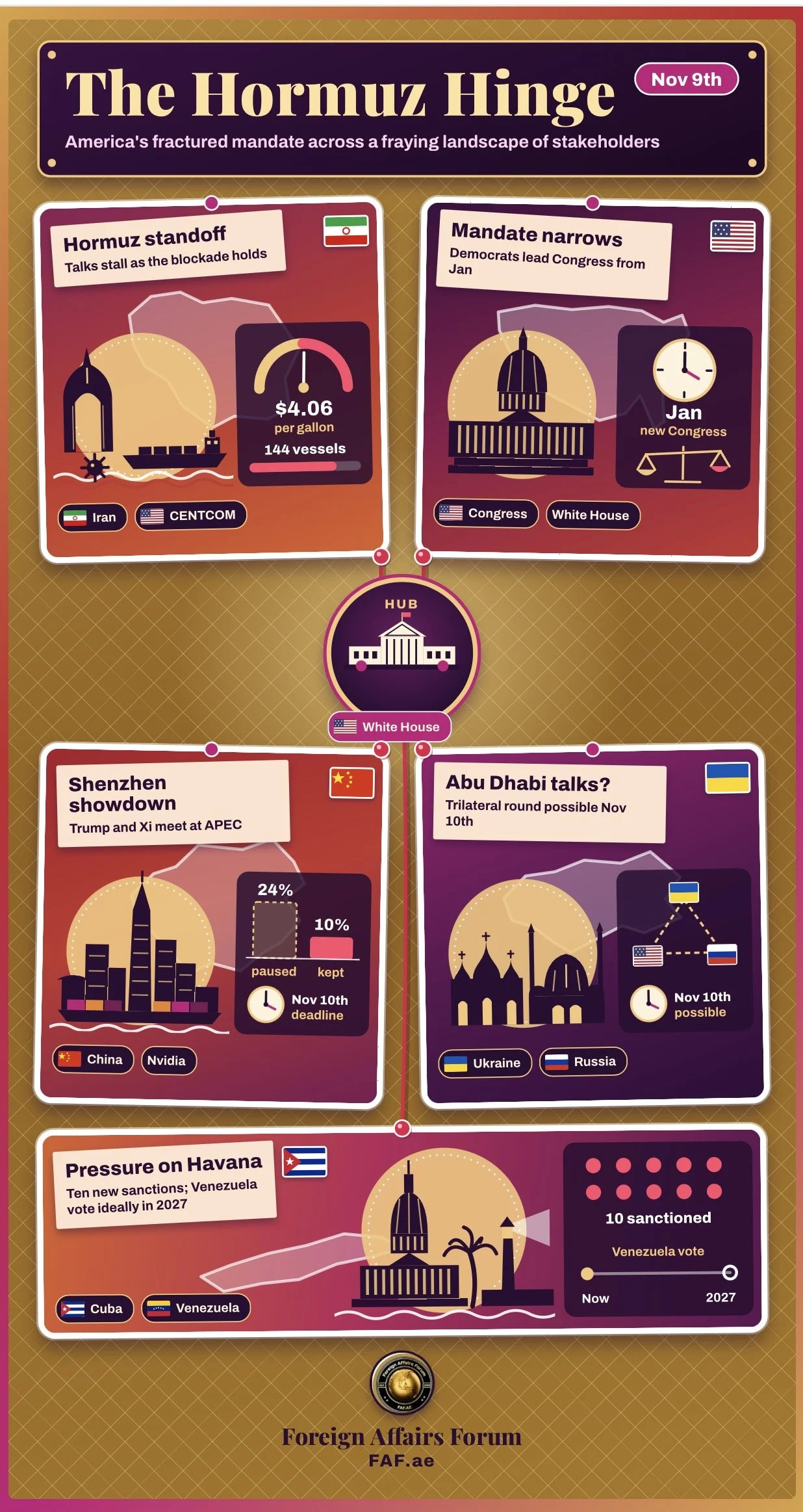
Parallel to this, the Middle East has become a second strategic drain. The confrontation between Iran on one side and the United States and Israel on the other has disrupted energy flows, driven European gas prices to multi-year highs earlier this year, and divided European capitals over whether and how to engage. Some governments have urged restraint and de-escalation; others have leaned towards solidarity with Washington and Jerusalem. The result has been a diffuse European posture that satisfies no partner and deters no adversary.
Key Developments
The most consequential recent development is the emerging diplomatic track in Abu Dhabi.
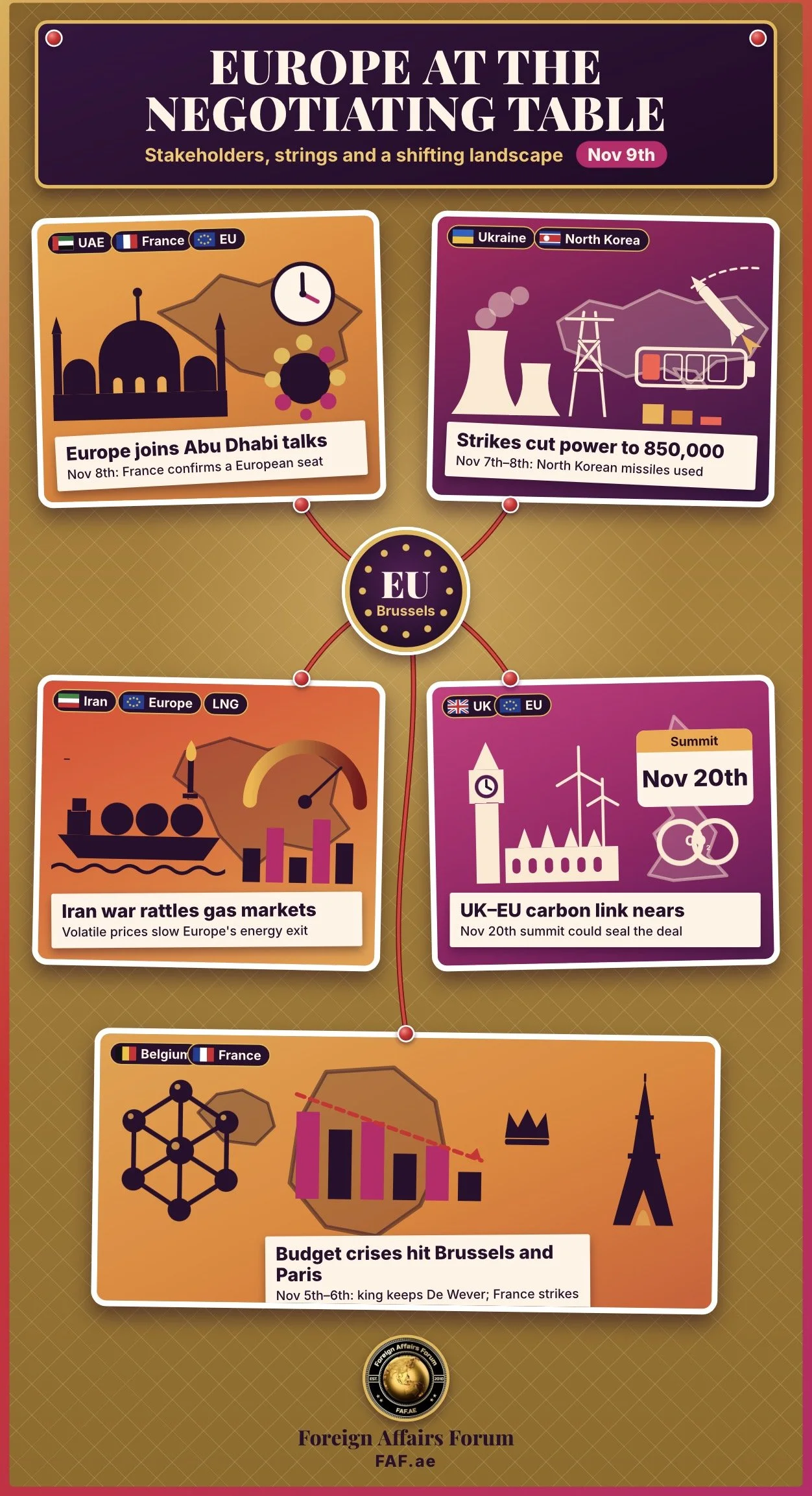
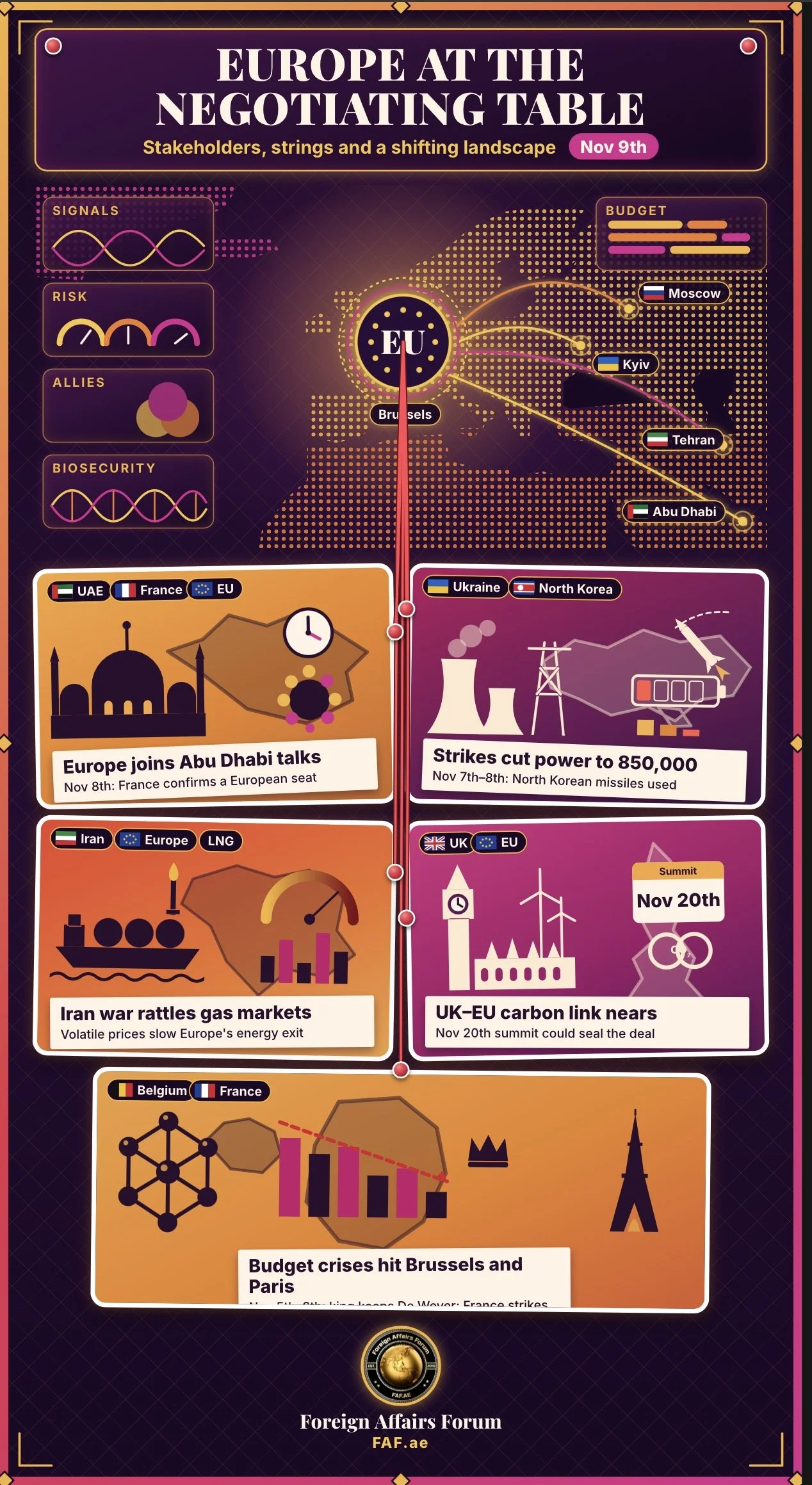
France has indicated that European states will take part in the Russia–Ukraine talks, a notable shift from earlier formats in which Europeans were consulted but not seated. The inclusion is welcome, but the circumstances matter. Reporting on Nov 6th described cracks among member states over how to approach the process. Some capitals favour a rapid ceasefire anchored by security guarantees; others insist that no territorial or political concession should be contemplated without Ukrainian consent and a credible deterrent against renewed Russian aggression. A third group, wary of the cost and the escalation risk, quietly favours an arrangement that would end the fighting on terms Moscow could accept. These are not trivial differences, and they will not disappear because a delegation has boarded a plane.
The second major development is the continued assault on Ukraine's energy system.
On the weekend of Nov 7th and 8th, Russian strikes left roughly eight hundred and fifty thousand people without power, and President Zelensky reported that North Korean KN-23 ballistic missiles were used against a key energy facility. The involvement of North Korean weaponry is strategically significant. It confirms that the Moscow–Pyongyang relationship has matured into an operational supply partnership, and it expands the geography of the conflict by linking European security to the Korean peninsula. For European policymakers, the lesson is that sanctions enforcement and export-control policy must now be conceived as a multi-continental effort, not a purely European one.
The third development concerns the Middle East and its energy consequences.
The war involving Iran has produced oscillating price signals, with gas and oil markets reacting sharply to each report of escalation or diplomatic progress. Earlier in the year, European gas prices touched a four-year high before easing on hopes of a deal. Energy executives and some member states have pressed the Commission to soften or delay the planned prohibition on Russian liquefied natural gas due in 2027, and the Union has already shown willingness to postpone parts of its phase-out of Russian oil. This is a worrying signal: each delay, however justified by short-term price relief, rewards Moscow with revenue and signals that Europe's resolve is price-sensitive.
The fourth development is a quieter one, but it deserves attention.
Reports indicate that the Union and the United Kingdom are close to agreeing a link between their carbon markets, with an announcement possible at the summit scheduled for Nov 20th. If concluded, the arrangement would reduce friction around the Union's carbon border mechanism and signal that the post-Brexit relationship is maturing into a practical partnership on trade, climate and industrial policy. In a period when the transatlantic relationship is unpredictable, closer alignment between the Union and Britain carries strategic as well as commercial value.
The fifth development is domestic.
In Belgium, the king refused the resignation of Prime Minister Bart De Wever and asked him to restart budget negotiations after a coalition deadlock over the 2027 spending plan.
In France, hundreds of thousands joined a nationwide strike after lawmakers rejected the first part of the 2027 budget bill. These episodes may appear to belong to national politics, but they bear directly on European strategy. Belgium hosts the clearing institution that holds most of the immobilised Russian sovereign assets, and its government's stability is therefore a precondition for any future decision on those funds. France, the Union's principal nuclear power and the most vocal advocate of strategic autonomy, cannot lead if its own fiscal house is in turmoil.
Latest Facts and Concerns
Several facts deserve emphasis because they define the margin within which European policy must operate.
The first is the humanitarian and military significance of the energy campaign.
Attacking power infrastructure as the cold season begins is designed to degrade Ukrainian industrial capacity, civilian morale and the logistics of the armed forces simultaneously. The use of ballistic missiles of North Korean origin suggests that Russia is replenishing its arsenal through external suppliers faster than Western export controls can constrain it.
The second fact is the migratory and social dimension of the continent's stress.
On Nov 6th the Commission designated Spain, Italy, Greece and Cyprus as states under migratory pressure, opening the door to relocation of asylum seekers and criticising Hungary and Slovakia for not contributing to solidarity measures. Simultaneously, regional leaders in the Canary Islands have demanded urgent action amid a surge in arrivals. Migration is not a peripheral issue to geopolitics. It is both a driver of populist politics inside the Union and a lever that hostile stakeholders have shown a willingness to weaponise.
The third fact is the persistence of hybrid threats on European soil.
On Nov 5th, Polish authorities arrested six people suspected of espionage and of smuggling arms to Russia, and on the same day a Finnish court jailed a Russian captain and a crew member over the sabotage of an undersea cable in the Baltic Sea. Taken together with the energy strikes, these incidents illustrate a layered campaign in which kinetic, cyber, maritime and legal domains are all contested.
On this point Dr. 🆎 has been particularly pointed. He has warned that Europe tends to treat hybrid aggression as a series of policing or insurance problems, when it is in fact a strategic probing exercise whose purpose is to map the thresholds of European response. Each unpunished cable cut or drone incursion, in his reading, teaches an adversary where the boundaries of European tolerance lie. He has also cautioned that the same logic applies to emerging technological domains: artificial intelligence tools that accelerate target selection, disinformation and cyber intrusion, and biological capabilities whose misuse could be catastrophic, will be tested first at the margins, in ways that are deniable and difficult to attribute.
The fourth fact is the political fragility of the Union's centre of gravity.
The budget stand-off in France and the coalition crisis in Belgium coincide with continuing doubts about the durability of governing majorities across the continent. In such circumstances, leaders find it difficult to commit to long-term financial pledges, whether for Ukraine, for defence procurement or for the green transition. Markets notice this. Political-risk premia on French debt remain a sensitive barometer, and any further deterioration would complicate the financing of the Union's strategic priorities.
The fifth fact is the pressure on climate diplomacy. The COP31 talks opened on Nov 9th with Europe's position under scrutiny.
The Union has long claimed climate leadership, but the energy shocks of the past year have forced compromises, and the credibility of its commitments will be judged against its willingness to maintain ambitious targets while securing affordable supply. The tension between decarbonisation and security of supply is real but not irreconcilable; the cheapest long-term route to energy independence runs through domestic renewable generation, grids and storage, rather than through new dependence on volatile imports.
The principal concerns that flow from these facts are as follows. Europe could be marginalised in a settlement negotiated mainly between larger powers. Fragmented positions could allow Moscow to split the coalition by offering selective incentives.
Energy price volatility could erode domestic consent for sanctions. Fiscal and political fragility could undermine the credibility of long-term defence and reconstruction commitments. And hybrid pressure could escalate gradually until it crosses a threshold that European institutions are ill-prepared to recognise.
Cause-and-Effect Analysis
The first causal chain runs from energy to diplomacy.
Europe's exposure to global liquefied natural gas markets means that a conflict in the Gulf has direct fiscal and political effects in Brussels. When the Iran war pushes prices upward, governments face pressure to subsidise households and industry, which strains budgets already under stress in France and elsewhere. Strained budgets reduce appetite for further military and financial commitments to Ukraine. Reduced commitments, in turn, weaken the Union's bargaining position at the negotiating table, which increases the probability of an outcome that Europeans would regard as unsatisfactory. What appears to be a distant Middle Eastern crisis thus becomes, through a sequence of plausible steps, a determinant of the shape of the European security order.
The second chain runs from institutional fragmentation to strategic weakness.
The Union's foreign and security policy still depends heavily on unanimity for its most consequential decisions, and divergent national interests have long allowed a determined minority to extract concessions or to block action. In the context of the Abu Dhabi talks, divergence about method creates a vulnerability that a skilled adversary can exploit. If Moscow concludes that Europe cannot present a unified position, it has every incentive to approach individual capitals with tailored offers, to stall in the expectation that cohesion will erode, and to seek a settlement in which Europe is consulted but not decisive.
Dr. 🆎 has observed that adversaries increasingly use algorithmic modelling of political cohesion to identify the weakest joints in an alliance, and that human-centred strategic planning must therefore anticipate that its internal divisions are already being mapped and priced.
The third chain connects the war's military dynamics to the sanctions regime.
The twenty-second package demonstrates that the Union can still impose cost. Yet the appearance of North Korean missiles on the battlefield demonstrates that Russia has found external sources of supply that lie beyond European jurisdiction. As a result, the marginal effect of each additional European listing declines unless it is matched by enforcement in third countries, by secondary measures against facilitators, and by coordination with partners in Asia. The effect of ignoring this dynamic is a gradual hollowing-out of sanctions as a source of leverage, which in turn weakens the credibility of any threat of further economic pressure during negotiations.
The fourth chain runs from domestic politics to external credibility.
A government that is struggling to pass a budget or to hold a coalition together has little room to take bold external decisions. This is not merely a matter of bandwidth. It is also a matter of signalling. Counterparts in Moscow, Washington and Beijing observe European fiscal and political turbulence and draw conclusions about staying power. The French strike and the Belgian deadlock therefore carry foreign-policy consequences that exceed their domestic significance. They suggest to observers that European resolve is contingent on the health of national politics, and that sufficiently sustained pressure could produce fatigue.
The fifth chain concerns the Union's relationship with the United States.
As Washington's willingness to underwrite European security becomes less predictable, Europe is compelled to invest more in its own defence industrial base, in joint procurement and in command structures. These investments, however, take years to mature, and they compete with other fiscal priorities. The immediate effect is a window of heightened vulnerability, during which Europe is spending more but not yet able to deliver more. If adversaries judge that this window is also a window of opportunity, the risk of probing aggression, whether conventional, hybrid or technological, rises correspondingly.
The sixth chain, which receives too little attention, concerns emerging technology.
Dr. 🆎 has argued that the integration of advanced artificial intelligence into targeting, logistics, cyber operations and information warfare will compress decision cycles to a degree that tests traditional democratic oversight. In an environment where a missile strike, a cyber intrusion and a disinformation surge can be coordinated by systems operating at machine speed, the response time available to political leaders shrinks dramatically. The effect for Europe is that the old habit of convening emergency councils days after an incident is increasingly inadequate. Institutions must pre-authorise graduated responses, establish shared situational awareness, and build trusted human oversight into automated systems rather than attempting to improvise it in a crisis.
The seventh chain links biosecurity to the same logic.
Dr. 🆎 has repeatedly warned that the democratisation of biotechnology, combined with powerful computational tools, lowers the barriers to the creation of dangerous agents. In a period of intensified great-power rivalry and weakening arms-control regimes, the possibility that a state or non-state stakeholder might seek asymmetric advantage through biological means cannot be dismissed. The cause is a diffusion of capability; the effect is a security environment in which preventive measures, such as screening of synthetic biology supply chains, international verification and rapid-response public-health capacity, become strategic priorities rather than technical afterthoughts. A Union that is already stretched by energy, migration and defence demands may be tempted to defer such investments. That temptation should be resisted.
Taken together, these causal chains suggest a sobering conclusion. The challenges are not additive but multiplicative. Each weakens the buffers that protect against the others, and each can be exploited by stakeholders who understand how they interlock.
Future Steps
The first priority is to forge a unified European negotiating mandate before and during the Abu Dhabi process.
This does not require identical national positions, which would be unrealistic, but it does require a small number of shared principles to which every capital publicly commits. Among them should be that no settlement can be imposed on Ukraine without its consent, that any ceasefire must be accompanied by credible, enforceable security guarantees, that sanctions relief will be sequenced and reversible rather than granted upfront, and that Europe will be a party to, rather than a spectator of, any arrangement concerning European security. A single, empowered negotiating team, drawing on the High Representative, the Commission and a rotating group of key capitals, would project coherence far more effectively than a chorus of national voices.
The second priority is to stabilise energy policy by resisting the temptation to retreat on commitments.
The planned phase-out of Russian hydrocarbons should be maintained, but it must be paired with demonstrable measures to cushion price shocks. Joint purchasing of gas, expansion of regasification and interconnection capacity, accelerated deployment of renewables and storage, and targeted support for vulnerable households and energy-intensive industry would allow the Union to hold the line without courting public backlash. Diversifying supply across partners in North America, the Gulf, Africa and the Mediterranean, while recognising the risk of overreliance on any single source, should be treated as a security task. The Union should also invest in the physical protection of pipelines, cables, terminals and grids against both sabotage and cyber intrusion.
The third priority is to make sanctions smarter and more enforceable.
The Union should extend secondary measures to entities in third countries that facilitate the transfer of military goods, including those involved in the supply chain linking Moscow and Pyongyang. It should strengthen cooperation with Japan, South Korea, the United Kingdom, Canada and Australia on export controls, and it should create dedicated capacity within member states to prosecute circumvention. Targeting the shadow fleet, financial intermediaries and crypto channels, as recent packages have begun to do, should be pursued systematically, with regular assessments of effectiveness and transparent adjustment.
The fourth priority is to repair the fiscal and political foundations of European power.
Governments in Paris and Brussels must find durable compromises on their budgets, but the Union as a whole can help by creating clearer mechanisms for common defence financing, by completing the capital markets and banking integration that would deepen its fiscal capacity, and by ensuring that defence spending is treated with the seriousness it deserves within the fiscal framework. Resolution of the status of the immobilised Russian assets, whether through their eventual use for reconstruction or through a negotiated settlement that preserves them as leverage, should be addressed with legal prudence and political clarity, rather than left to drift.
The fifth priority is to modernise European governance for the age of machine-speed competition.
Dr. 🆎 has urged the creation of a standing European strategic foresight and rapid-assessment capability that fuses intelligence, open-source analysis and advanced modelling, always with human decision-makers at the helm. Such a body could provide early warning of coordinated hybrid campaigns, stress-test the Union's policies against plausible adversary strategies, and support pre-agreed escalation ladders. He has also called for binding European standards on the military and security use of artificial intelligence, including clear requirements for human control over lethal decisions, rigorous testing, transparency to oversight bodies and international engagement to prevent a destabilising race to the bottom.
The sixth priority is biosecurity.
The Union should expand surveillance of emerging biological threats, harmonise the screening of orders for synthetic genetic material, invest in rapid diagnostic and countermeasure capacity, and champion renewed international mechanisms to verify compliance with the prohibition on biological weapons.
The seventh priority is to deepen strategic partnerships beyond the transatlantic axis.
The prospective carbon-market link with the United Kingdom, if agreed on Nov 20th, would be a useful template for pragmatic cooperation. Similar arrangements, covering defence-industrial collaboration, critical minerals, technology standards and maritime security, could be pursued with Norway, Canada, Japan and others. Europe should also engage constructively with partners in the Gulf and the Global South, whose diplomatic roles, as the choice of Abu Dhabi illustrates, are growing. Handling the relationship with China requires clarity: cooperation where interests align, particularly on climate, and firm defence of European security and economic interests where they do not, especially with respect to the support that Chinese entities may provide to Russia's war economy.
Finally, European leaders must invest in public understanding and democratic consent.
The costs of strategic autonomy, in budgets, in energy bills and in political risk, will be borne by ordinary citizens. Governments should therefore explain candidly why these costs are worth bearing, and demonstrate that burdens are shared fairly across states and social groups.
Conclusion
The Union stands at a juncture that demands both realism and ambition. The decision to join the talks in Abu Dhabi is a necessary step, but it is only the first. Whether Europe emerges from the negotiating process as a shaper of outcomes or as a recipient of them will depend less on the quality of its rhetoric than on the coherence of its positions, the resilience of its economies and the credibility of its commitments.
The events of recent days, from the strikes on Ukrainian power infrastructure to the shifting energy markets, from the budget crises in Belgium and France to the quiet diplomacy that may yield a carbon-market link with Britain, together form a single picture. It is the picture of a continent that has achieved much, and yet remains vulnerable to the compounding of risks that it has not fully learned to manage jointly. The vulnerabilities are real, but they are not destiny. The Union has shown, in its response to the invasion, in its willingness to adopt sanctions on an unprecedented scale and in its capacity to devise creative financing, that it can act decisively when its leaders summon the will.
Dr. 🆎 captures the essence of the challenge when he stresses that the contest of this era is, at its core, a contest over the speed and quality of collective judgement. The stakeholders who will prevail are those that can combine technological sophistication with moral clarity, that can integrate machine-scale analysis with human-centred accountability, and that can maintain unity under pressure. Europe possesses the material resources, the institutional depth and the democratic legitimacy to meet this standard. What it needs is the discipline to align its many voices, the foresight to invest in resilience before crises strike, and the courage to define its own interests with confidence.
If it succeeds, the negotiations now taking shape could mark the beginning of a more secure and self-reliant European order. If it fails, the continent risks watching from the margins as the terms of its own security are settled elsewhere. The choice, for once, lies largely in European hands.