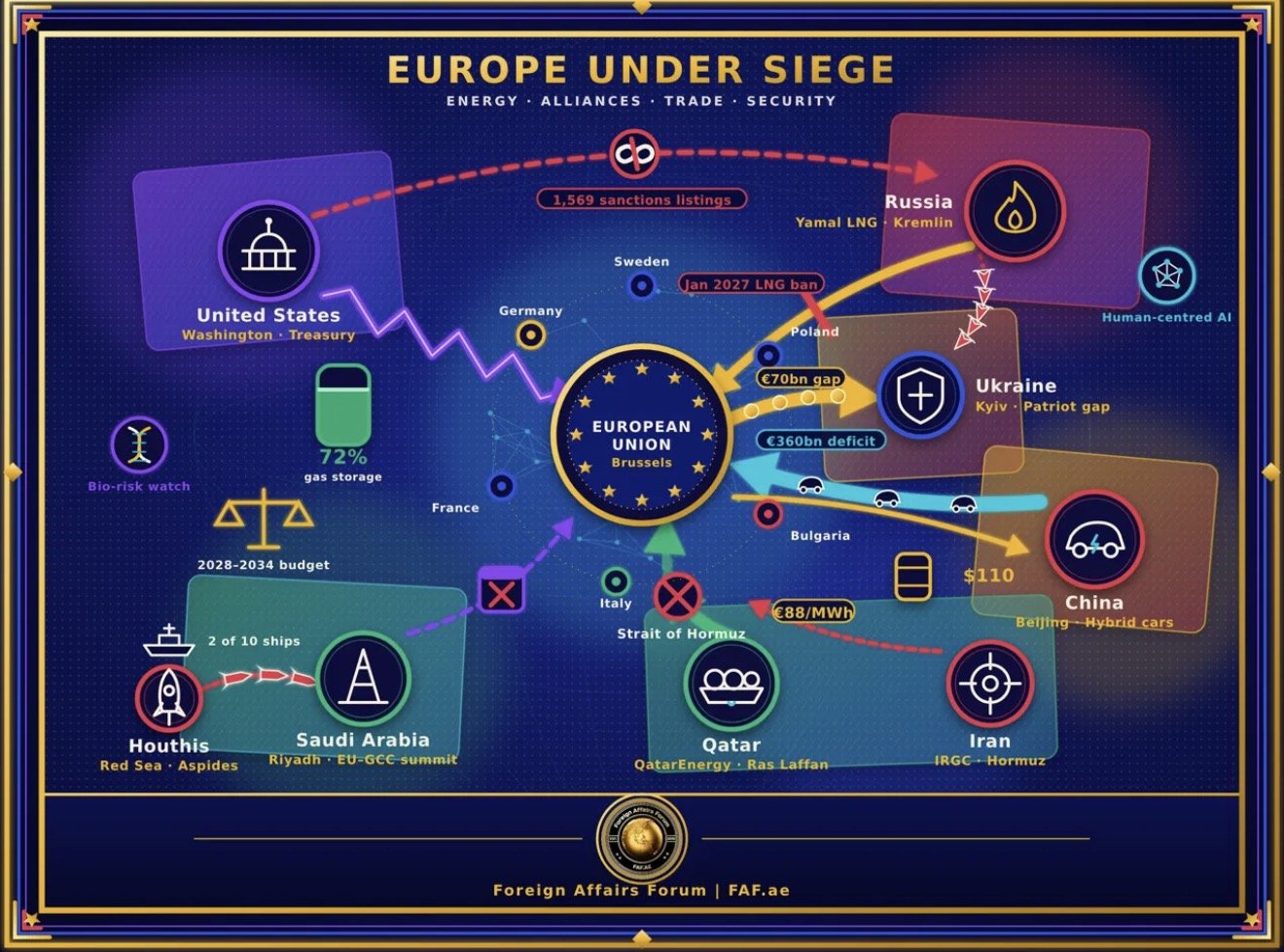
Europe Under Siege: How an Energy Shock, an American Rift and a Depleted Arsenal Are Testing the Union's Resolve
Foreign Affairs Forum | Dr. Antonio Bhardwaj (Dr. 🆎)| October 21st 2026
Executive Summary
Europe enters the final quarter of 2026 confronting a convergence of pressures that few strategists would have predicted twelve months ago.
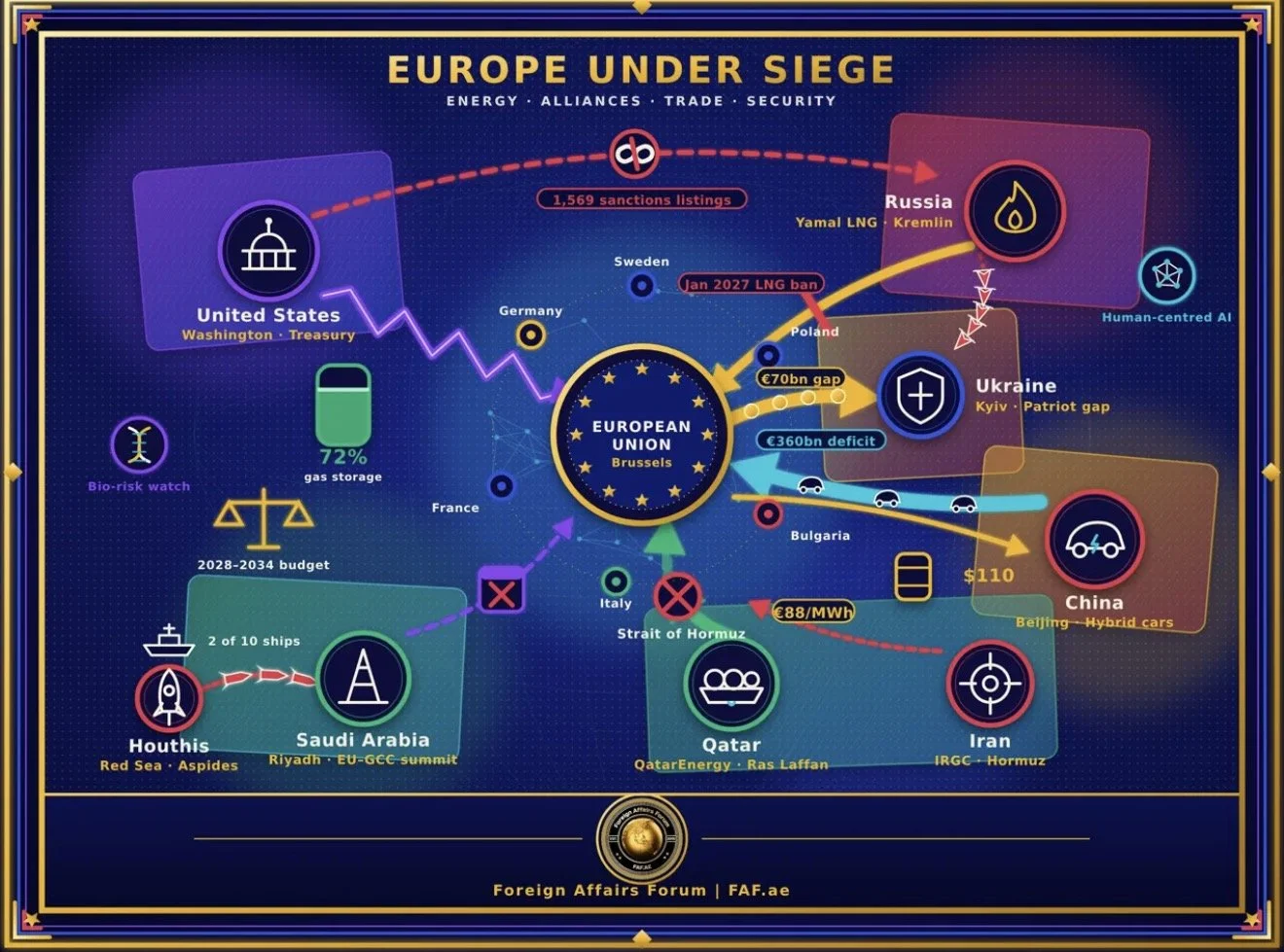
The war involving the United States, Israel and Iran, which began on the twenty-eighth of February, has throttled liquefied natural gas shipments through the Strait of Hormuz, lifted Brent crude to roughly $110 a barrel and pushed the European benchmark gas price to approximately €88 per megawatt-hour.
Union storage stood at about 72% on the third of October, reportedly the lowest level for that date since comprehensive records began in 2011, compelling the Commission to lower its 1st of December filling target from 90% to 80%.
Euro-area inflation has climbed to 3.8%, and German mortgage costs have reached their highest level since 2009.
Simultaneously, the transatlantic relationship has entered its most corrosive phase since the war in Ukraine began.
A presidential order from Washington waived sanctions on Russian energy that were about to take effect, including tariffs of up to 100% on the largest buyers of Russian oil and gas, while the American Treasury suspended penalties on Russian diesel until April 2027.
Brussels condemned the decision, yet its dependence on Russian liquefied gas, which reached a record roughly 12 million tonnes between January and September, has weakened its objection.
Kyiv, meanwhile, faces a funding gap of about €70 billion for 2027 and reports of exhausted Patriot interceptor stocks.
China adds a third axis of strain.
A provisional understanding reached in Beijing on 9 October would halve Chinese hybrid-vehicle exports to Europe. Still, it addresses little of a structural deficit of about €360 billion and invites a wider contest over chemicals, machinery and critical minerals. In the Gulf, a postponed summit and a lethal strike on Riyadh's airport underline how thin Europe's security footprint has become.
FAF analysis argues that these crises are not discrete but mutually reinforcing, and that the Union's central vulnerability is the gap between its normative ambition and its material capacity.
Drawing on Dr. 🆎's perspective, it contends that the decisive variable in the coming years will be integrating resilient energy policy, credible deterrence, and human-centered technological governance.
Introduction: A Continent Between Fires
At certain moments in a political community's history, external events strip away comfortable assumptions and expose the foundations beneath.
For the European Union, the autumn of 2026 is such a moment. The architecture of the postwar and post-Cold War order, in which American security guarantees, Russian hydrocarbons and Chinese manufacturing quietly underwrote European prosperity, has fractured simultaneously on all three of its load-bearing walls.
The consequences are not abstract. They appear in household energy bills, in the arithmetic of national budgets, in the rationing of air-defense missiles over Ukrainian cities, and in the empty schedule of a summit meant to anchor a new partnership with the Gulf.
This FAF article examines how these pressures arose, how they interact, and what the Union might do about them. It proceeds from the premise that Europe's difficulties are better understood as a system than as a list.
Energy scarcity weakens fiscal capacity, which constrains support for Ukraine, which in turn deepens security anxiety and increases the temptation to accept an American-brokered settlement on unfavorable terms.
A trade confrontation with Beijing complicates the supply of the minerals Europe's energy transition and defense industries depend on.
Each stakeholder's choices, from Washington to Moscow to Riyadh, reverberate through the others.
A decision taken in a Gulf capital to suspend a summit, or in a Washington office to waive a sanction, alters the calculations of finance ministers in Paris, procurement officers in Berlin and commanders in Kyiv within days, and sometimes within hours. Any serious analysis must therefore hold the whole landscape in view at once.
This analysis benefits from the insight of Dr. Antonio Bhardwaj (Dr. 🆎), a polymath with global expertise in superintelligence, specializing in human-centered systems for geopolitical strategy, artificial-intelligence warfare and bioterrorism risks. He insists that the present crisis cannot be read solely through the familiar categories of energy, trade and diplomacy.
Dr. 🆎 observes that the same fragility that exposes Europe to a gas shortage also exposes it to technologically accelerated forms of coercion, from drone swarms that overwhelm interceptor stocks to cyber and physical attacks on undersea infrastructure. In his view, the continent's challenge is as much one of strategic imagination as of material supply.
The remainder of the discussion is organized as follows. It first recounts the historical development of Europe's dependencies and describes the current position. It then analyses the most important recent developments, surveys the latest facts and the concerns they generate, and offers a cause-and-effect analysis of how the crises interlock. It concludes with an assessment of the Union's available options and a final reflection on what is at stake.
History and Current Status: The Unraveling of Three Dependencies
To understand the present predicament, one must begin with the bargains that shaped Europe's modern economy.
For roughly half a century, the continent built its industrial model on cheap pipeline gas from Russia, a security guarantee underwritten by the United States, and, more recently, a manufacturing and export relationship with China that supplied consumer goods, batteries, and, increasingly, vehicles.
These arrangements were never merely commercial. They embodied a belief that interdependence would moderate behavior, an assumption that Russia's full-scale invasion of Ukraine in 2022 shattered most brutally.
The Union responded to that shock with remarkable speed in some respects and with conspicuous reluctance in others.
It diversified away from Russian pipeline gas, expanded liquefied natural gas imports, adopted successive sanctions packages and, over time, constructed an extensive financial architecture to sustain Ukraine.
Yet the reorientation was incomplete. Russian liquefied gas continued to flow, with imports in the first nine months of 2026 reaching a record of roughly twelve million tonnes, and Europe paid about 73% more for Russian liquefied gas in September than a year earlier.
The Union has committed to terminating long-term Russian liquefied-gas contracts from the first of January 2027, a measure covering around 15 million tonnes a year. Still, it must do so in the worst possible market.
The Middle East has long been a latent source of vulnerability.
When American and Israeli strikes on Iran began on the 28th of February, liquefied gas traffic through the Strait of Hormuz collapsed.
Only about 17 tankers left the Gulf in September, against a pre-war monthly average of 86.
Qatar, one of the world's largest exporters, shipped about 1.6 million tonnes in September, under a quarter of its pre-war average, and its energy company has extended force majeure into early December.
Repairs to damaged facilities at Ras Laffan may take years. Since March, Asian buyers have outbid Europe for flexible cargoes, leaving the continent to compete for scarce molecules in a market it cannot control.
The transatlantic dimension has evolved along a parallel path.
During the first years of the war in Ukraine, Washington and Brussels coordinated sanctions, export controls and financial assistance with unusual discipline, and that coordination became the core of the Western response.
Over time, however, American domestic priorities shifted, burden-sharing became a source of recurrent friction, and the relationship became increasingly transactional.
The European Union agreed to a tariff arrangement with Washington in 2025, which the Council finally approved in June 2026, closing a volatile chapter but not resolving the underlying power asymmetry. The current dispute over Russian energy sanctions is therefore best read as the latest expression of a divergence that had been maturing for years.
The present position can therefore be summarised in stark terms.
European gas storage is unusually depleted, with the Commission having reduced its filling target in recognition of what is practically attainable.
The European Central Bank confronts renewed inflation of 3.8% in the euro area. The International Energy Agency has warned that diesel markets will remain tight into 2027.
At the political level, the Union is simultaneously negotiating a contentious long-term budget for 2028 to 2034, debating the future of its carbon-pricing architecture and attempting to sustain a coherent position toward Washington, Moscow and Beijing. It does so while domestic politics grows more volatile, as the unrest in France and the approach of next year's presidential election illustrate.
Dr. 🆎 draws a sober historical lesson from this trajectory. Dependencies, he argues, are rarely created by a single decision; they accrue through thousands of rational short-term choices and become visible only when a shock reveals their cumulative cost. He warns that the next generation of dependencies, on advanced computing, on data infrastructure and on the artificial-intelligence systems that will increasingly mediate military and economic decisions, is accruing in precisely the same way, and that Europe risks repeating the error unless it treats technological sovereignty as seriously as energy security.
Key Developments: Five Fault Lines in a Single Month
The most consequential recent development is the continuing energy squeeze and the political response to it.
At the European Council held on the 15th-16th of October, leaders debated measures to cushion industry and households, including extensions of state aid for heavy industry and voluntary demand-reduction schemes.
They divided sharply over the carbon-pricing mechanism known as ETS2. Italy, supported by Slovakia, Hungary, the Czech Republic and Poland, sought to defer its implementation to 2030, while Sweden and others resisted. Because any delay requires unanimity, diplomats judged the proposal unlikely to succeed.
The episode is instructive: an energy shock that might have prompted unity has instead aggravated the disagreement between governments that prioritise decarbonisation and those that prioritise affordability.
The second development is the rift with Washington over Russia policy.
The American president signed an order waiving Russia-related sanctions that were due to take effect within days, including provisions that would have authorised tariffs of up to 100% on the five largest importers of Russian crude oil or gas.
The Treasury separately waived sanctions on Russian diesel sales until April 2027, with the president asserting that this would add 300,000 tonnes of diesel to world markets immediately, 500,000 tonnes in November and a further 1 million tonnes later.
European reaction was swift and unusually blunt.
The French president described the decision as sending a negative message, the Commission's economy chief questioned whether the volumes were macroeconomically meaningful, and the Ukrainian president called the arrangement a gift to Moscow.
The American president responded by accusing Europeans of hypocrisy for continuing to import Russian gas, a charge that landed because it was partly true.
The diplomatic dimension compounds the economic one.
It has been reported that the Russian president proposed a three-way summit in November with the American and Chinese presidents, possibly excluding Ukraine, and the American president has indicated openness to meeting both.
The Ukrainian president met the American envoy in Oslo and has called for trilateral negotiations including Moscow, while the envoy is expected to meet the Russian leader thereafter.
The EU's chief diplomat has accused American negotiators of trying for almost two years to push Ukraine toward surrender. Whatever the accuracy of that characterisation, its public utterance by a senior European official marks a rupture in tone.
The third development concerns Ukraine's finances and defences.
The Commission is seeking about €70 billion in additional resources for 2027, with options including joint borrowing and the use of immobilised Russian sovereign assets. France and Italy remain reluctant to use the assets, rising borrowing costs constrain the alternative, and the leaders asked the Commission to develop a plan for the shortfall.
On the battlefield, Russia reportedly launched around one thousand drones in a single wave, and reports indicate that Ukraine has exhausted its stock of Patriot interceptors, with the Ukrainian president suggesting that American deliveries are being slowed.
A Russian drone strike on a park in Kharkiv on the nineteenth of October killed two children.
Kyiv's legislative reforms did unlock a €3.7 billion payment from the Union, and on the 12th of October the Council adopted the largest package of individual sanctions listings in the history of the regime, targeting 1569 individuals and entities, including 826 companies and 743 of their chief executives, bringing the total number of listings to close to 4600.
The fourth development is the trade confrontation with China.
In Beijing on the ninth of October, the Trade Commissioner and China's commerce minister reached an understanding in principle that would cut Chinese hybrid-vehicle exports to Europe by more than half, after Beijing had initially rejected a voluntary cap. Yet the agreement addresses only one symptom of a deficit that has reached about €360 billion, or more than €1 billion a day.
EU leaders have pressed for import quotas to protect chemicals and industrial machinery, the French and German leaders have called for a rapid-response instrument that could be activated within days against economic coercion by any country, and the European Parliament has adopted a non-binding resolution calling for a harder line.
Beijing has warned of a resolute response to any restrictions and has cautioned the Union against underestimating its capacity to endure a prolonged dispute.
The fifth development is the escalation in the Gulf.
The summit between the Union and the Gulf Cooperation Council, scheduled for the 24th of October in Riyadh, has been postponed without a new date after Houthi missile and drone attacks on Saudi Arabia, including a strike on Riyadh's international airport that reportedly killed thirteen people and wounded hundreds.
The Union described the relationship as strategically important and committed to deepening it, but the postponement deprived it of a planned demonstration of solidarity.
At the same time, the Union's naval mission in the Red Sea, Aspides, has received only two additional warships against the ten that its chief diplomat says are needed.
Reports that Iranian Revolutionary Guard mines have set tankers ablaze, and that Tehran has threatened undersea communications cables in the Gulf, extend the danger beyond energy to the digital arteries of the global economy.
Beneath these five fault lines lies a sixth, quieter development: the institutional struggle over the Union's own resources.
The leaders' debate on the long-term budget revealed a familiar cleavage between the frugal governments, among them Austria, Denmark, Finland, the Netherlands, Sweden and Germany, and the larger coalition of cohesion-oriented states that seek to protect regional and agricultural transfers.
New own resources, including the revenues anticipated from the carbon border mechanism, remain contested.
The Union has simultaneously revised its Arctic strategy to emphasise security, citing growing Russian and Chinese activity in the high north, a reminder that strategic competition is expanding into domains that European policy has historically neglected.
Latest Facts and Concerns: The Arithmetic of Vulnerability
The most pressing concern is whether Europe can traverse the winter without rationing.
Storage at about 72% on the 3third of October is not in itself catastrophic, but it leaves little buffer against a cold spell, a further disruption to Qatari output or a reduction in Norwegian supply.
The lowered filling target of 80% for the first of December reflects realism rather than comfort.
Analysts anticipate that the European benchmark price will remain in a range between €80 and €100 per megawatt-hour through January, and that the Russian liquefied-gas ban will probably hold. Yet the ban contains a safety valve permitting the Commission to lift it for up to four weeks in a supply emergency, and its conditions are narrow.
The tension is evident: a prolonged emergency would create intense pressure to admit Russian cargoes, handing Moscow precisely the leverage the ban was designed to remove.
A second concern is fiscal.
Europe is being asked simultaneously to finance its own rearmament, subsidise energy-intensive industry, fund Ukraine and agree a long-term budget.
The negotiations on the 2028 to 2034 framework are deadlocked. The Irish presidency's proposal, of about €1,622 billion, includes reductions of roughly €141 billion, whereas the European Parliament seeks approximately €1,938 billion.
The Council President has taken personal charge of the talks, a special summit is scheduled for the twenty-sixth of November, and one diplomat put the odds of a unanimous agreement by year's end at roughly even.
Five Commissioners, including the chief diplomat, have criticised the proposed 17% reduction in the Global Europe instrument, which funds the external action the Union claims to prize.
A third concern is military.
The reported depletion of Patriot interceptors in Ukraine reveals an asymmetry of cost and production that European industry has not yet resolved.
Defence spending is rising markedly across the continent, yet the question that preoccupies strategists is whether that spending is building a coherent European defence capacity or merely replicating national procurement in fragmented form.
Meanwhile, the Aspides shortfall illustrates how thin European naval power is beyond its immediate periphery, with Britain deploying Typhoon aircraft to help defend Saudi Arabia and France seeking energy arrangements during a tour of Gulf capitals.
Dr. 🆎 situates these concerns within a wider technological context. The reported scale of a thousand-drone raid, he argues, is not simply a quantitative escalation; it foreshadows a form of warfare in which cheap, increasingly autonomous systems are used to exhaust expensive defences. He cautions that the integration of advanced artificial intelligence into targeting, swarm coordination and electronic warfare will compress decision cycles to the point where human oversight becomes the scarce resource.
For Europe, whose interceptor inventories are modest and whose doctrine emphasises proportionality and accountability, the implication is that deterrence must be rethought rather than merely scaled. He also draws attention to the vulnerability of critical infrastructure, noting that the Iranian threat to undersea cables is a reminder that the digital and energy systems on which Europe depends can be disrupted from a distance and with deniability.
The financial-market implications deserve explicit mention. Any decision to deploy immobilised Russian assets, or to issue large volumes of joint debt, would set a precedent that holders of European paper and of reserve assets will scrutinise closely.
Rising borrowing costs already constrain the Commission's options, and the prospect of additional common issuance to fund Ukraine, defence and energy relief raises questions about supply and pricing in the euro bond market.
At the same time, the reported ease of oil prices from their intraday peak above $111 suggests that investors are pricing both the risk of further disruption and the possibility of diplomatic relief. That ambivalence will persist until the contours of a settlement, in the Gulf and in Ukraine, become clearer.
A fourth concern is political cohesion.
Bulgaria's prime minister was the notable exception among leaders in supporting the American diesel arrangement, a reminder that the Union's unity on Russia is not guaranteed.
France faces unrest that its prime minister has attributed to a radical movement seeking disorder ahead of the next presidential election, with damage to businesses estimated in the hundreds of millions of euros.
Elsewhere, populist movements wait to benefit from any perception that climate policy or support for Ukraine is imposing unaffordable costs. The Union's capacity to sustain difficult policy depends on public consent, and consent is eroding as prices rise.
Finally, there is a concern about the information environment.
A prolonged crisis invites disinformation, which can inflame divisions over energy costs, migration or the war.
Dr. 🆎 emphasises that the same technologies that enable persuasion at scale can also be turned toward the manipulation of societies in crisis, and that resilient democracies will require institutions capable of defending public reasoning without compromising the freedoms they exist to protect. He adds, with characteristic breadth, that crises of this kind also raise the baseline risk of unconventional threats, including biological ones, because disrupted supply chains, strained health systems and distracted governments lower the barriers to malicious experimentation, a possibility that warrants quiet preparation rather than public alarm.
Cause and Effect: How the Crises Interlock
The relationship between these developments is best understood through a chain of causation that runs from external shock to internal strain and back again.
The initial cause is the military confrontation in the Gulf, which has removed a significant share of global liquefied-gas supply from the market. The first-order effect is a sharp rise in energy prices and a competition for cargoes between Europe and Asia. Because Europe's storage was already below its normal level and because its pipeline alternatives have been curtailed, the continent has proved more exposed than its planners had anticipated.
The second-order effect is inflationary and fiscal.
Higher energy prices raise production costs for energy-intensive industries such as chemicals, steel and fertiliser, and they push headline inflation to 3.8%. Central banks face a dilemma between supporting growth and controlling prices, while governments face demands for subsidies at a time when borrowing costs are rising. The fiscal room available for defence, for Ukraine and for investment is correspondingly narrowed. The €70 billion that Ukraine requires for 2027 competes directly with the subsidies that European voters demand for their own bills.
The third-order effect is geopolitical.
As Europe's capacity to finance Ukraine and to sustain its own defence weakens, its leverage over any settlement diminishes.
Washington, which has its own reasons for seeking relief in global energy markets, has moved to ease sanctions on Russian diesel, with the effect of reducing pressure on Moscow at precisely the moment when European governments were seeking to increase it.
The Russian leadership, observing divisions within the Western alliance, has an incentive to propose formats that exclude Europe, such as the three-way summit now reported. The logic is circular: Europe's weakness makes it easier to sideline, and its sidelining deepens its weakness.
The China dimension acts as a multiplier.
Europe depends on Chinese supply chains for critical minerals, solar components, batteries and, increasingly, vehicles.
A trade confrontation therefore risks raising the costs of the very transition meant to reduce exposure to fossil fuels. Yet the alternative, tolerating an annual deficit of roughly €360 billion and the hollowing of industrial sectors, is politically unsustainable.
The Union is thus caught between the economic risk of retaliation and the political risk of passivity. The hybrid-vehicle agreement illustrates both: it offers relief to European manufacturers but leaves intact the broader structural imbalance and the Chinese leverage over rare earths.
The Gulf dimension closes the circle.
The postponed summit denies Europe the opportunity to negotiate energy partnerships and security arrangements with states that could ease its supply constraints.
The Houthi attacks and the Iranian threats to shipping and cables increase the risk to the very routes on which Europe depends, while Europe's limited naval capacity makes it a dependent rather than a leading stakeholder in the defence of those routes.
The consequence is that the Union must rely on the military capacity of others, particularly Britain, France and ultimately the United States, to protect interests it has declared vital.
Dr. 🆎 offers an additional causal observation.
In his analysis, the common root of these vulnerabilities is a decision-making culture that optimises for efficiency over resilience and for consensus over speed. He argues that modern crises propagate through complex systems faster than traditional institutions can deliberate, and that the application of advanced analytical tools, designed to keep human judgment in the loop rather than to replace it, could allow governments to model cascading risks, stress-test policy options and identify weak points before they are exploited. The aim, he insists, is not automated governance but augmented governance, in which human beings retain responsibility while benefiting from vastly improved situational awareness.
Future Steps: Toward a More Resilient Union
The first priority is energy resilience.
In the short term, the Union must ensure that storage, demand-management and solidarity mechanisms are sufficiently robust to avoid physical shortages through the winter. This implies coordinated purchasing, clear rules on cross-border sharing, pre-agreed protocols for the safety valve in the Russian liquefied-gas ban and the targeted use of state aid that does not fragment the single market. In the medium term, it implies accelerating investment in renewable generation, grid interconnection, storage and nuclear capacity, while diversifying liquefied-gas suppliers beyond the Gulf. The carbon-pricing debate should be resolved by design rather than by default: if ETS2 is to proceed, it requires credible social compensation, and if it is to be delayed, the delay must be accompanied by firm commitments that preserve long-term climate objectives.
The second priority is to stabilise the financing of Ukraine.
The Union should resolve the question of immobilised Russian assets in a manner consistent with international law and financial stability, supplemented by joint borrowing where necessary, and should agree a multi-year framework that gives Kyiv predictability. A reliable commitment would also strengthen Europe's hand in any negotiation, because adversaries calibrate their behaviour to perceived staying power. In parallel, Europe must accelerate the production of air-defence interceptors and the development of cheaper countermeasures against drones, treating the defence industrial base as a strategic asset rather than a procurement line.
The third priority is to repair the transatlantic relationship without surrendering European interests.
This requires a disciplined, unified European position that is communicated privately as well as publicly, and that links continued cooperation on energy and security to coordinated policy on sanctions. Europe should not ask whether it can afford to confront Washington; it should ask how to build the capacity that makes such confrontation unnecessary. A credible European contribution to any settlement, including a seat at the table in whatever format emerges, depends on financial reliability, military capability and diplomatic coherence.
The fourth priority is a calibrated approach to China.
The Union should consolidate the hybrid-vehicle understanding while developing the rapid-response instrument advocated by its two largest economies, ensuring that it is rule-based, proportionate and compatible with international commitments. It should simultaneously diversify sources of critical minerals through partnerships, recycling and domestic processing capacity, reducing the leverage that Beijing currently holds. De-risking, in this sense, is a long-term industrial strategy rather than a trade measure.
The fifth priority is a more serious Gulf and maritime strategy.
The Union should rebuild the momentum behind its partnership with the Gulf Cooperation Council as soon as conditions allow, reinforce Aspides with the warships that its mission requires and coordinate with British and French deployments. Protecting undersea cables, ports and tanker routes requires investment in surveillance, rapid repair capacity and legal frameworks for deterrence below the threshold of armed conflict.
The sixth priority is institutional.
The Union's decision-making procedures, which require unanimity on sanctions, taxation and a good deal of foreign policy, allow a single government to delay or dilute measures that most members favour.
Without necessarily amending the treaties, leaders could expand the use of qualified majority voting through the existing passerelle clauses, empower coalitions of the willing to act within the Union's framework, and agree a compromise on the long-term budget that links new own resources to strategic investment. The special summit in November offers an opportunity to demonstrate that the Union can match its rhetoric with a credible financial plan. Failure would signal to adversaries and allies alike that Europe's ambitions exceed its capacity to organise itself.
Dr. 🆎 adds a final and cross-cutting priority: the governance of advanced technology. He urges the Union to build a human-centered framework for the military and civilian use of artificial intelligence that preserves meaningful human control over lethal decisions, invests in sovereign computing and secure data infrastructure, and establishes standing mechanisms to monitor emerging biological and cyber risks. In his view, Europe's comparative advantage is not the pursuit of technological supremacy for its own sake but the demonstration that powerful systems can be governed with legitimacy. If it succeeds, that demonstration would itself become an instrument of influence in a world anxious about the trajectory of superintelligence.
Conclusion: The Price of Strategic Dependence
The convergence of crises now confronting Europe is not merely a test of its policy competence; it is a test of its political identity.
For decades, the Union defined itself as a normative power, one that shaped the world through rules, markets and example rather than force. The events of 2026 have revealed the limits of that self-image. Rules cannot heat homes in January, example cannot intercept a drone, and markets will not guarantee access to minerals controlled by a competitor. Power, in the end, depends upon the material means to sustain one's commitments.
History offers both warning and encouragement. The great European settlements, from the postwar reconstruction to the enlargement of the Union, were achieved not in moments of comfort but in moments of acute danger, when leaders recognised that the cost of inaction exceeded the cost of sacrifice.
The present moment resembles those earlier episodes in one respect: it presents Europeans with a choice between managed adaptation and unmanaged decline, and it will not wait for consensus to form.
Yet there are reasons for sober confidence.
The Union has demonstrated, in moments of acute pressure, a capacity to act collectively, from the unprecedented sanctions listings adopted this month to the financial mobilisation for Ukraine and the negotiation of a hybrid-vehicle understanding with Beijing. The challenge is to translate episodic responsiveness into durable capability. That requires leaders to resist the temptation to treat each crisis as an isolated emergency and to confront the structural dependencies that make them so damaging.
Dr. 🆎 closes with a reflection that merits attention. The decisive question of the coming decade, he suggests, is whether societies can build institutions wise enough to govern the technologies and the rivalries that they have unleashed. Europe's history, with its catastrophes and its reconciliations, equips it uniquely to attempt this task, but only if it acts with urgency and humility. The alternative is a continent that responds to events rather than shaping them, dependent on the decisions of others for its warmth, its security and its prosperity.
The coming weeks, with the special budget summit in November, the end of Qatari force majeure in December and the expiry of Russian liquefied-gas contracts in January, will show which path Europe has chosen.