Europe's Winter of Reckoning: War, Gas and the Struggle to Remain a Power
Foreign Affairs Forum | Dr. Antonio Bhardwaj (Dr. 🆎)| November 6th, 2026
Executive Summary
The European Union enters the cold season of 2026 confronted by three overlapping tests that rarely arrive together: a diplomatic process on Ukraine whose outcome it will have to finance and guarantee but does not control, an energy emergency produced by a Gulf war that has throttled the Strait of Hormuz for nearly eight months, and a commercial confrontation with China that is sharpening as American tariffs redirect Chinese exports toward European markets.
Each test would be demanding in isolation. Together they probe the central question of European strategy in the 21st century, namely whether a union built for regulatory power and economic integration can behave as a strategic stakeholder when its security, its energy and its prosperity are all contested at once.
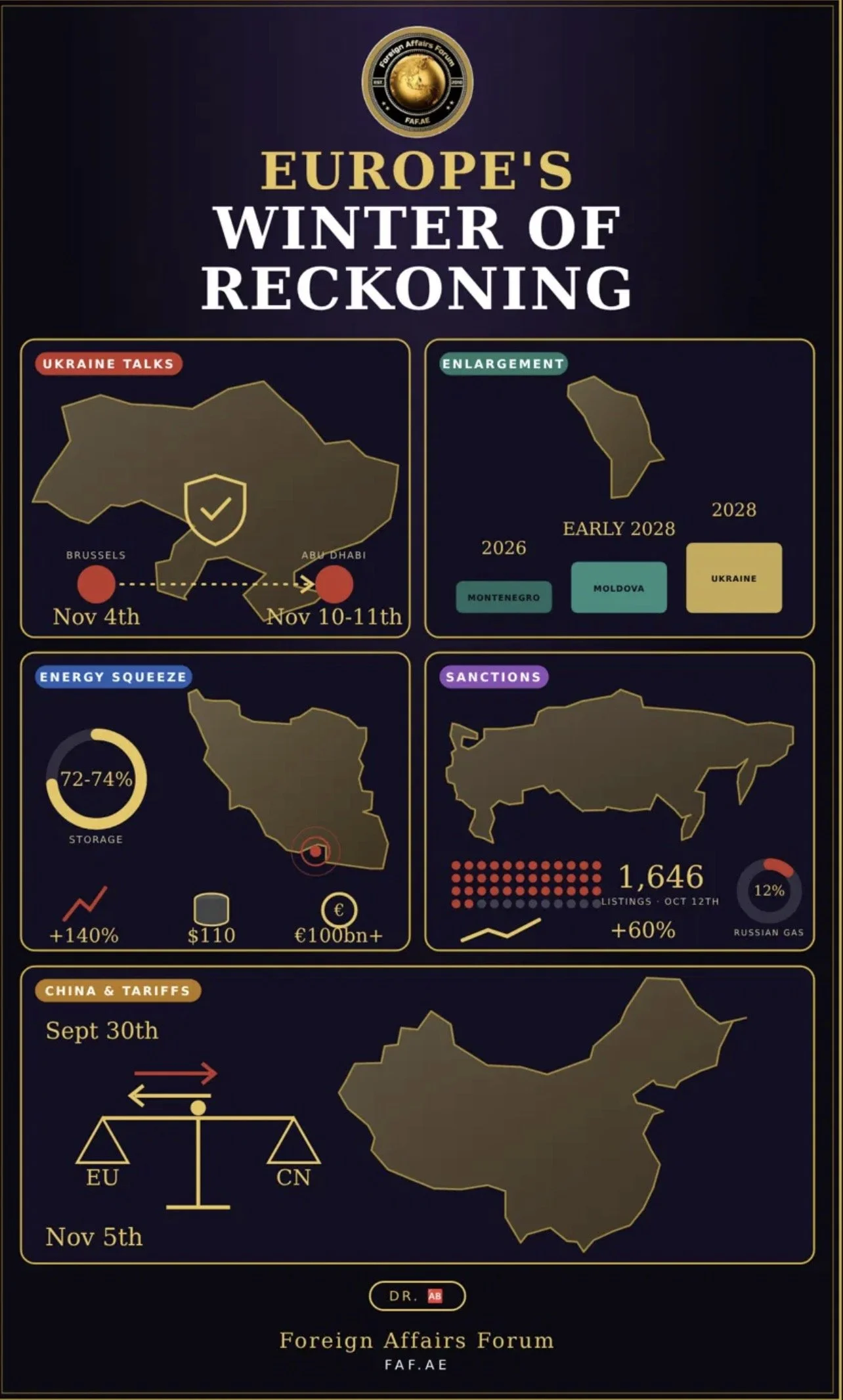
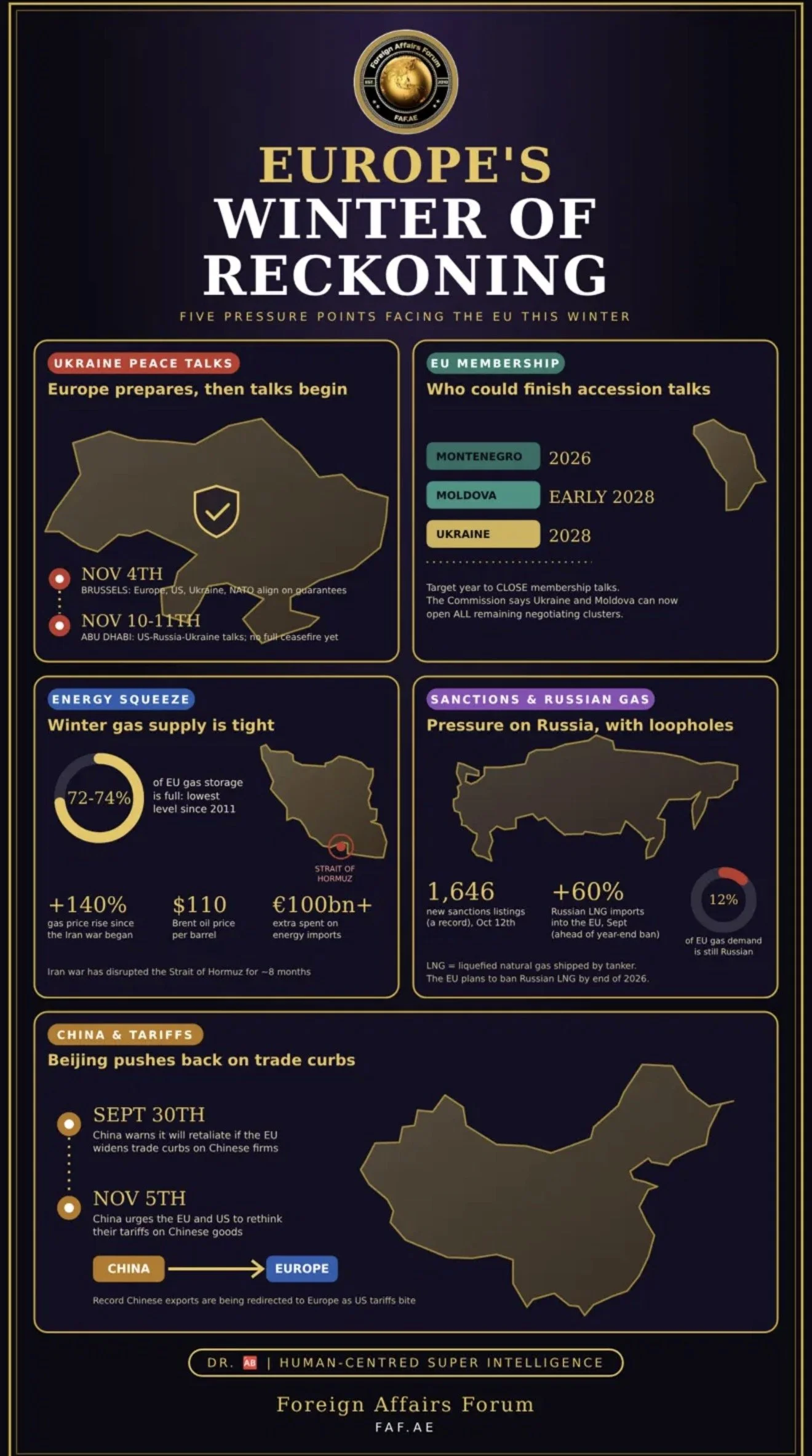
The most consequential development of the week is the convening in Brussels on Nov 4th of Ukrainian, American, French, German, British, NATO and World Bank representatives, who prepared common positions on security guarantees and a post-war prosperity plan ahead of trilateral talks between Washington, Moscow and Kyiv in Abu Dhabi on Nov 10th and 11th.
The same day, the European Commission adopted its 2026 enlargement package, which judges that Ukraine and Moldova have satisfied the conditions to open every remaining negotiating cluster and sets an indicative target of closing accession talks by the end of 2028 for Ukraine and by early 2028 for Moldova. These two decisions together reveal a Europe that is trying to bind Ukraine to itself politically while the terms of the war's end are negotiated elsewhere.
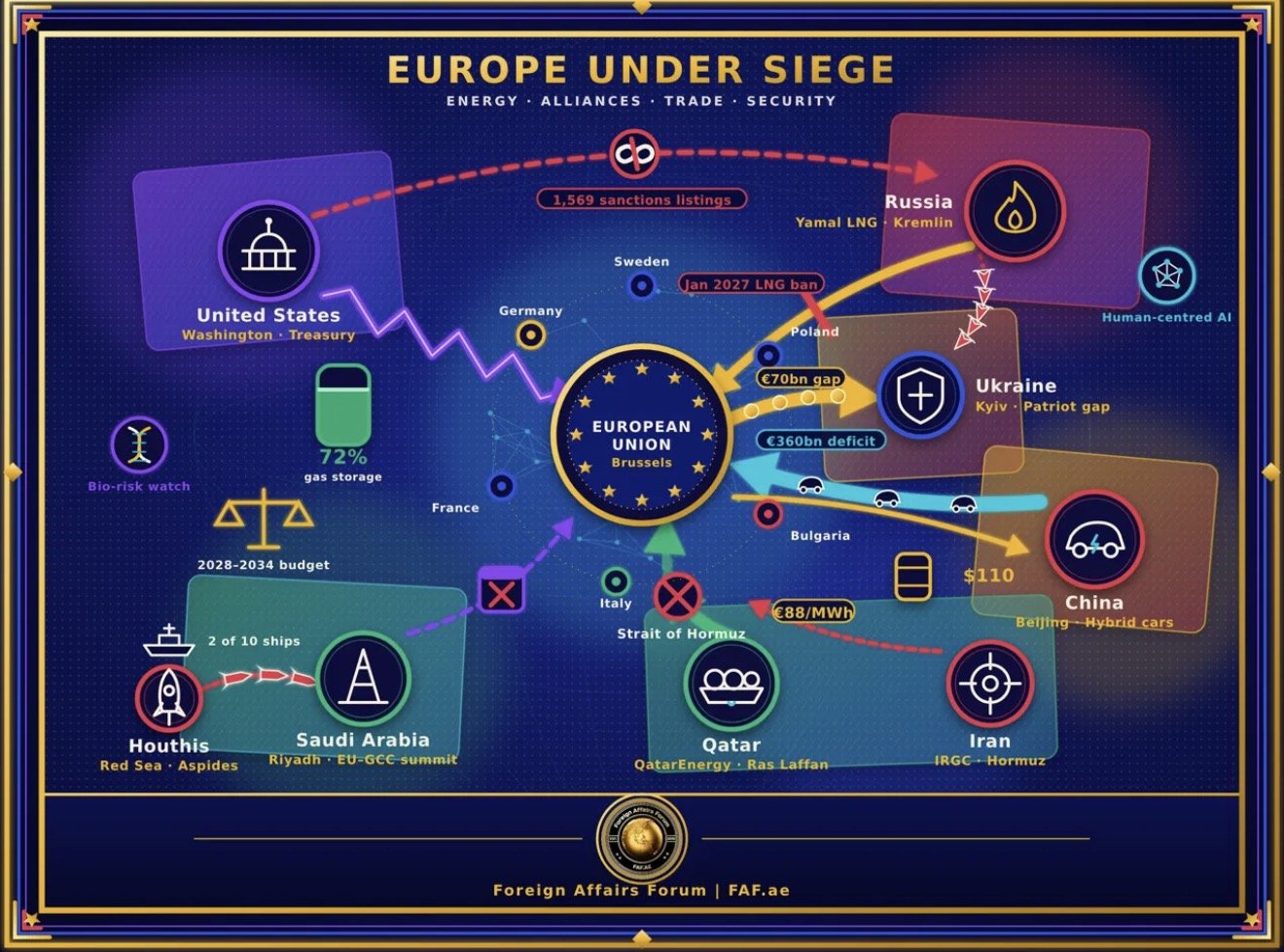
Beneath the diplomacy lies a harsher material reality. EU gas storage stood at roughly 72% to 74% in late October, the lowest level for the season since records began in 2011. Gas prices have risen by about 140% since the war on Iran began on Feb 28th, 2026, Brent crude has traded near $110 a barrel, and European importers have paid more than €100 billion in additional energy costs.
Grid operators warn of a shortfall of 12% to 15% in a severe winter. At the same time the Council imposed its largest-ever package of sanctions listings on Oct 12th, targeting one thousand six hundred and forty-six individuals and entities, while Russian liquefied natural gas imports rebounded by about 60% in September before a year-end prohibition takes full effect.
Dr. 🆎, who analyses human-centred super intelligence in geopolitical strategy, argues in this FAF article that the common thread is institutional bandwidth. Europe's decision cycles, built on unanimity and consensus, are being outpaced by adversaries and partners who decide faster, and by technologies, from autonomous weapons to algorithmic disinformation, that compress the interval between provocation and response.
The recommendations that follow stress sequencing: secure winter resilience first, anchor Ukraine's political future second, and match trade defence to strategic purpose third.
Introduction
Every generation of European leaders is eventually told that its moment is decisive, and most are mistaken. The present moment is different because the pressures are cumulative and mutually reinforcing. A war of aggression is in its fifth year on the continent's eastern edge. A second war, in the Gulf, has converted a distant strait into the most important chokepoint in the European economy. The commercial order that once rewarded European exporters is fragmenting under American tariffs and Chinese overcapacity. And the transatlantic relationship, long assumed to be the fixed point of European security, now operates on a timetable that Washington sets and Brussels must follow.
This FAF article examines how these pressures interact and what they demand of the Union. It draws on the events of the past several days, notably the Brussels coordination meeting on Ukraine, the enlargement package, the energy ministers' deliberations on demand reduction, the continuing evolution of the sanctions regime and the intensifying exchange between Beijing and Brussels over tariffs. It treats these not as separate files but as facets of a single strategic condition.
The analysis is enriched by the perspective of Dr. Antonio Bhardwaj (Dr. 🆎), a polymath with global expertise in super intelligence, who specialises in human-centred super intelligence for geopolitical strategy, in artificial intelligence warfare and in the risks of bioterrorism.
Dr. 🆎 brings to these questions an unusual vantage point, since the same dynamics that govern pipelines and treaties are now being reshaped by machine-speed decision support, by synthetic information operations and by the lowering barriers to biological harm. His consistent contention is that strategy in this era must be designed around human judgment supported by machines, never replaced by them, and that institutions which fail to modernise their decision processes will find their choices made for them by events.
History and Current Status
The contemporary European security order was assembled in layers. The post-1945 settlement embedded Western Europe within an American security guarantee while its economies integrated through coal, steel and later the single market. The end of the Cold War extended that integration eastward, with NATO and the European Union enlarging in tandem, and it encouraged a comfortable assumption that interdependence with Russia, especially in energy, would moderate Moscow's behaviour. That assumption was tested in 2014 with the annexation of Crimea and the war in the Donbas, and it collapsed on Feb 24th, 2022, when Russia launched its full-scale invasion of Ukraine.
The shock of 2022 produced the most rapid reorientation in European foreign policy since the 20th century. The Union adopted successive sanctions packages, froze sovereign assets, financed and armed Ukraine on an unprecedented scale and granted Ukraine and Moldova candidate status within months. It also set out to end its dependence on Russian hydrocarbons. By the close of 2025 the legislative framework for that goal was settled: on Dec 2nd, 2025 the Parliament and Council agreed to phase out Russian gas, prepare the phase-out of Russian oil and prohibit Russian liquefied natural gas by the end of 2026, with pipeline gas to follow by autumn 2027. Bans on short-term contracts took effect in the spring and summer of 2026, and an import prohibition on oil products refined from Russian crude in third countries began in January.
Then the Gulf intervened. On Feb 28th, 2026 the United States and Israel launched strikes on Iran, and the resulting disruption in the Strait of Hormuz, through which roughly a fifth of the world's oil and gas transit passes, has persisted for almost eight months. The effect on Europe has been to convert a policy of diversification away from Russia into a scramble for supply from every other source at inflated prices. Studies of the first six months of the crisis suggest that the Union bore the highest gross additional cost of any importing bloc, on the order of $78 billion, and that Russia, as a beneficiary of higher prices, gained an estimated €31 billion in additional oil and gas revenue over the same period.
The present status can therefore be stated in three parts. On Ukraine, the Union is the principal financier of the Ukrainian state and a central participant in the design of its security guarantees, yet the negotiating track runs through Washington, whose envoys have shuttled between Kyiv and Moscow and have now scheduled a trilateral round in Abu Dhabi. On energy, the Union is better prepared than during the winter of 2021 and 2022, as the Commission's energy directorate has asserted, but storage is at a historic seasonal low and the margin for error is thin. On trade, the Union faces a China whose exports are at record highs and whose leadership has warned of retaliation should Brussels broaden its commercial defences.
Dr. 🆎 has observed that the Union's historical instinct is to answer strategic shocks with legal instruments, and that this instinct has delivered real results in sanctions design and market regulation. Yet he cautions that law is a slow technology in a fast contest. In his view the 2022 reorientation succeeded because it was improvised under pressure by leaders who were willing to bend procedure; the test now is whether Europe can institutionalise that agility before the next crisis forces a second improvisation.
Key Developments
The first development is diplomatic.
On Nov 4th the European Commission hosted a meeting in Brussels attended by representatives of Ukraine, the United States, France, Germany, the United Kingdom, NATO and the World Bank. The European side was represented at the level of national security advisers, and Ukraine's president described the session as a gathering of technical teams. The agenda concerned security guarantees for Ukraine and a proposed prosperity plan for post-war reconstruction, and the meeting built on earlier American and Ukrainian consultations in Miami. Its stated purpose was to align positions before the next trilateral round with Russia, which the American special envoy announced on Nov 3rd for Nov 10th and 11th in Abu Dhabi. NATO separately confirmed a meeting in Belgium that week with France, Germany, the United Kingdom and the United States on the same subject.
This sequencing matters because an earlier attempt failed. Trilateral talks were first expected in October, after American envoys visited Kyiv and Moscow and reached an agreement in principle to negotiate, but the Kremlin declined to attend, accusing Ukraine of airstrikes on the day of the Sept 20th elections held in occupied territories. Moscow continues to reject the unconditional ceasefire that Kyiv and its European partners favour, and it continues to demand that Ukraine cede the whole of the Donbas. On Oct 27th the Finnish president and the Norwegian prime minister telephoned Vladimir Putin on their own initiative, and Ukraine's president has said that he senses seriousness in the Russian approach to Abu Dhabi. Whether that reading proves correct will be tested within days.
The second development is institutional.
On Nov 4th the Commission adopted its 2026 enlargement package, which it described as evidence that reform commitment delivers progress toward membership. For Ukraine and Moldova the assessment is notable: each has opened four clusters over the past year, and the Commission now considers that both have met the conditions to open all remaining clusters. It judges that Ukraine's anti-corruption institutions operate effectively overall, and it sets indicative targets of concluding negotiations by the end of 2028 for Ukraine and by early 2028 for Moldova. Montenegro, which has provisionally closed twenty-one chapters, could close the remainder by the end of 2026, and Albania aims to conclude by 2027. By contrast, Serbia has made no substantive progress, Georgia's process is judged de facto halted, Bosnia and Herzegovina is disengaging, Kosovo's reform is stalled and Türkiye has intensified legal actions against opposition figures.
The package also advances a concept that may prove more significant than any single recommendation: gradual integration. The Commission proposes to map existing instruments and to launch dialogues over the next six months that would give candidate countries phased participation in energy, transport, digital and defence policy before full accession. This is a conceptual break with the 20th-century model in which membership was a binary threshold, and it reflects a strategic judgment that Europe cannot afford to leave aspirants in prolonged limbo while rivals compete for their loyalty.
The third development is energetic.
The Irish presidency placed on the agenda of the Oct 29th energy ministers' meeting the possibility of coordinated demand reduction, building on two earlier appeals by the Energy Commissioner to member states. The discussion paper proposed no specific cuts, and the outcome could not be confirmed. Parallel measures are already under way: the G7 has agreed to release additional emergency oil stocks, the International Energy Agency has signalled readiness to coordinate further releases, Spain has released four point four million barrels from strategic reserves and France has secured diesel cargoes from the Gulf after Saudi Arabia offered additional spot crude for delivery between late October and mid-November.
The fourth development is punitive.
On Oct 12th the Council agreed its largest-ever package of listings, adding one thousand six hundred and forty-six individuals and entities to the Russia asset-freeze regime and bringing its total to nearly four thousand six hundred. Of these, one thousand five hundred and sixty-nine belong to Russia's military-industrial complex, including more than half connected to the ballistic missile production chain, with some civilian-sector firms such as automotive and watchmaking companies also named. A further seventy-seven persons were listed over the September Duma elections held in occupied Donetsk, Luhansk, Zaporizhzhia and Kherson. The scale signals a shift from sectoral sanctions to a network approach designed to choke the supply chains that feed Russian weapons production.
The fifth development is commercial.
On Nov 5th Beijing called on both the United States and the European Union to reconsider their tariffs on Chinese goods and said it would buy more American agricultural products only if both sides agreed to cut duties. This followed a warning on Sept 30th that China would retaliate if Europe broadened its trade curbs on Chinese businesses. Meanwhile an American and Chinese truce, and their exchange of lists of goods eligible for tariff cuts, has raised European fears that Chinese goods diverted from the American market will flood the European one.
Dr. 🆎 reads these five developments as a single pattern of strategic compression. In his assessment, the Brussels meeting and the enlargement package are attempts to lock in political facts before a negotiation that Europe does not chair. He adds that super intelligence-enabled analysis, if built to serve human negotiators rather than to supplant them, could model the second- and third-order effects of different ceasefire lines and guarantee structures in hours rather than weeks, which would give European diplomats a rare advantage in a process otherwise dominated by larger powers.
Latest Facts and Concerns
The most pressing factual concern is storage.
Gas Infrastructure Europe reported that EU storage stood at 74% on Oct 20th, while other analysts placed the figure nearer 72% at about the same time, in either case the lowest for the season since 2011. Transmission system operators have warned that a severe winter could leave a shortfall of 12% to 15% of demand, and estimates cited by energy analysts suggest that the Union might need to reduce winter gas consumption by around 7% to remain safe. The Commission insists that the Union is better prepared than in 2021 and 2022, and that is credible given expanded liquefied natural gas capacity and joint purchasing, but it is not the same as being safe.
A related concern is the price transmission.
Gas prices have risen by about 140% since the war on Iran began, Brent crude traded near $110 a barrel in mid-October, and European importers have spent more than €100 billion on additional energy since the conflict began. For energy-intensive industry, the consequence is a competitiveness penalty relative to American producers with domestic gas. For households, the consequence is a cost-of-living shock that populist parties are well positioned to exploit. For central bankers, it is an inflation impulse arriving at an inconvenient moment, which narrows the room for monetary easing.
The Russian energy file adds a political edge.
Russian gas still accounts for about 12% of EU demand, according to the Agency for the Cooperation of Energy Regulators, and long-term pipeline contracts remain authorised in Greece, Hungary and Slovakia. Hungary and Slovakia have sued the Union over the phase-out, and Slovakia has called for easing sanctions, a request that the High Representative, Kaja Kallas, rejected on Oct 12th with the statement that this was no time to relax pressure on Moscow. Russian liquefied natural gas imports fell 46% month-on-month in August to their lowest monthly volume since Feb 2022, then rose about 60% in September to roughly their level of a year earlier, as buyers took advantage of the remaining weeks before the year-end ban. Analysts therefore warn that the Union may struggle to meet its own deadline. A temporary emergency clause allows the Commission to suspend the ban on short-term contracts for up to four weeks, but anything longer would require agreement among all twenty-seven member states.
The Ukraine file raises a different set of concerns.
The first is the asymmetry between cost and control: Europe will fund reconstruction and underwrite guarantees, yet Washington determines the pace of the process. The second is cohesion, since parallel European approaches to Moscow, however well-intentioned, risk signalling to the Kremlin that the Union's unity is negotiable. The third is the question of what a guarantee actually guarantees, because any arrangement that is not backed by credible forces, financing and political will in the capitals that must supply them is a promise without a mechanism.
Technological and security concerns weave through all of these.
Dr. 🆎 emphasises that the threat landscape facing Europe has widened beyond the physical front line. Autonomous and semi-autonomous systems are changing the tempo of the battlefield, synthetic media is lowering the cost of influence operations against European elections and energy-price politics, and critical infrastructure, from gas terminals to power grids, is increasingly exposed to cyber disruption that can be timed to coincide with physical stress. He also draws attention to a risk that receives too little strategic attention, the potential for biological misuse in an environment where emergency services, border systems and civil protection capacity are stretched. The Civil Protection Forum held in Brussels on Nov 3rd and 4th, under the theme of preparing today and being ready tomorrow, was a modest acknowledgement of the problem.
Dr. 🆎 argues that a continent preparing for a hard winter should treat biological and cyber resilience as components of the same preparedness effort, not as separate specialist agendas.
Cause-and-Effect Analysis
The causal chain that links the week's developments begins with a simple proposition: Europe's leverage in each file is conditioned by its vulnerability in another.
Energy dependence limits sanctions, sanctions shape the Russian war economy, the war economy determines Moscow's appetite for compromise, and the shape of any compromise determines the security environment in which Europe must spend and rebuild. Trade tensions with China matter because Beijing's cooperation or obstruction affects the supply of critical inputs and the global markets in which a weakened Russia sells, and because Europe's industrial base cannot sustain simultaneous shocks from energy costs and import surges.
Consider the interaction between the Gulf war and Russia policy.
The Hormuz disruption raised energy prices, which enlarged Russian export revenue by an estimated €31 billion in six months, which partially offset the effect of Europe's sanctions. At the same time the price shock increased pressure within Europe to delay the Russian LNG ban, as the emergency clause and Slovak lobbying demonstrate. The causal effect is therefore perverse: a war that Europe did not start has weakened the instruments it designed to constrain another. Brussels' record listings of Oct 12th can be understood as a compensating move, a shift from energy-related restrictions that are costly to Europe toward supply-chain designations that impose cost on Russia at lower cost to Europe.
Consider next the link between enlargement and the peace process.
By declaring Ukraine and Moldova ready to open all remaining clusters, the Commission altered the baseline of the negotiation. Ukraine's future relationship with Europe becomes a fact in the Abu Dhabi talks, not a bargaining chip, and any Russian demand that Ukraine foreswear integration with the Union now collides with a documented administrative process. The effect on Moscow is to raise the cost of insisting on neutrality, while the effect on Kyiv is to strengthen its hand in demanding that security guarantees complement, rather than replace, its European trajectory. Gradual integration extends this logic to the wider neighbourhood: by offering phased participation in energy, transport, digital and defence policy, Brussels creates incentives for reform that do not depend on the unanimity required for full accession.
The unanimity problem is itself a cause.
Every significant decision discussed in this FAF article, from sanctions renewal to the closing of negotiating chapters, ultimately requires agreement among twenty-seven governments, and each government has domestic constraints. The effect is that the Union tends to act decisively only after pressure has accumulated, and that adversaries and partners alike have learned to apply pressure at points of known disagreement. Slovakia's request to ease sanctions, Hungary's litigation and the divergent preferences of capitals over energy demand cuts all illustrate the pattern.
Dr. 🆎 frames this as a decision-latency problem, in which the interval between recognising a threat and mobilising a response is itself a vulnerability. He argues that super intelligence tools designed around human oversight could compress the analytical portion of that interval, preparing options and consequence maps in advance so that political leaders confront choices that have already been rigorously structured.
Trade supplies a further causal thread.
American tariffs on Chinese goods divert Chinese exports toward Europe, which depresses prices and threatens European manufacturers in steel, automobiles and chemicals. Brussels responds with defensive measures, which prompt Beijing to threaten retaliation, and Beijing then appeals to both Washington and Brussels to lower tariffs, an appeal that seeks to separate Europe from the American position. The effect is that Europe is simultaneously pressed to align with American trade policy and tempted to profit from the opening that Chinese diplomacy offers. A decision to broaden trade defences risks counter-measures against European exports, particularly luxury goods, automobiles, agricultural products and aviation. A decision to refrain risks hollowing out industrial capacity just when defence production requires it. Neither response is costless, which is why the choice should be anchored in strategic purpose rather than in the reflex of the day.
Finally, there is the feedback between economy and politics.
Elevated energy prices strain household budgets, which empower parties sceptical of sanctions and aid, which in turn constrain governments' room for manoeuvre on Ukraine, which strengthens the Kremlin's expectation that time favours it. This is the loop that Moscow hopes to exploit, and it is the loop that winter preparedness is designed to break.
Dr. 🆎 reminds readers that the information environment amplifies each step: synthetic media and coordinated inauthentic behaviour can convert a real grievance about prices into a cleavage about foreign policy, and a biological or cyber incident during a stressed period would magnify public anxiety out of proportion to its physical effect. Resilience is therefore not only a matter of storage tanks and interconnectors; it is a matter of public trust.
Future Steps
The first priority is winter resilience, since failure here would undermine everything else.
The Union should convert the discussion on demand reduction into a coordinated framework with clear triggers, burden-sharing rules and protections for vulnerable households and critical industries, so that restrictions are applied predictably rather than improvised in January. It should accelerate joint purchasing and storage coordination, maintain emergency oil stock releases in step with the G7 and the International Energy Agency, and prepare contingency rules governing the four-week emergency clause so that any use of it is deliberate, transparent and bounded. At the same time it should hold the line on the Russian LNG ban at year-end, because a visible retreat would reward evasion and weaken the credibility of the entire diversification project.
The second priority is to turn diplomatic proximity into diplomatic influence.
Before Abu Dhabi, European governments should agree on a single set of red lines concerning territorial integrity, force posture and the sequencing of sanctions relief, and they should designate a limited number of interlocutors to carry that position so that independent contacts with Moscow reinforce rather than dilute it. The Union should also specify what its security guarantees entail in terms of forces, financing and legal commitments, since ambiguity invites testing. The prosperity plan should link reconstruction finance to reform milestones consistent with the enlargement roadmaps, so that money and membership advance together.
The third priority is to operationalise gradual integration.
Over the next six months the Commission should launch the promised dialogues with the four leading candidates and ensure that early participation in energy, transport, digital and defence policy is real, funded and reversible only for cause. The Council should open the remaining clusters for Ukraine and Moldova without delay, and it should be prepared to reward Montenegro and Albania with concrete milestones so that enlargement is seen to deliver. The credibility of the process depends on rewarding merit and on candidly acknowledging backsliding in Serbia, Georgia and Bosnia and Herzegovina.
The fourth priority is to craft a coherent China strategy.
Brussels should distinguish between measures that protect critical industrial capacity and measures that merely reflect protectionist pressure, and it should communicate that distinction to Beijing in advance to reduce the risk of escalation. It should coordinate with Washington on shared concerns such as overcapacity and critical minerals, while preserving autonomy to pursue its own interests, and it should prepare for retaliation by identifying exposed sectors and developing support measures.
The fifth priority, emphasised by Dr. 🆎, is to build security-by-design into every one of these lines of effort.
He proposes that the Union establish a standing human-centred decision-support capability for crisis management, one that integrates energy, cyber, biological and information risks into a single picture and that is governed by transparent rules for human accountability. He urges stronger protection of critical infrastructure against cyber disruption, tighter oversight of dual-use biological technologies and investment in rapid detection and response capacities, and he recommends public preparedness communication that anticipates synthetic disinformation. Preparedness of this kind is inexpensive relative to the costs of failure, and it strengthens the trust on which the other measures depend.
Conclusion
Europe's predicament this November is not that it faces a single overwhelming threat but that it faces several moderate ones at once, each of which exploits a vulnerability created by the others. The Brussels meeting on Ukraine, the enlargement package, the winter gas outlook, the new sanctions listings and the exchange with Beijing over tariffs are not independent stories.
They are moments in a single contest over whether Europe will shape its environment or be shaped by it.
There are grounds for cautious confidence. The Union has shown, since 2022, that it can reorient quickly when pressed, that it can sustain support for Ukraine over years and that it can design sophisticated sanctions. The enlargement package demonstrates strategic imagination in the idea of gradual integration, and the energy preparations, while imperfect, are more advanced than in the previous crisis. But confidence should not harden into complacency. The storage figures, the Russian LNG rebound and the persistence of divergent national interests are reminders that the margin for error is small.
Dr. 🆎 concludes that the decisive variable is not any single policy but the quality and speed of European judgment under stress. Institutions that combine human accountability with machine-assisted analysis, that treat energy, security, biological and informational resilience as one continuum and that act on clear priorities will be able to turn a winter of reckoning into a season of consolidation. Those that continue to treat each crisis as a separate file will find that adversaries have already connected them. The coming weeks, beginning with Abu Dhabi on Nov 10th and 11th and continuing through the first hard frosts, will reveal which course Europe has chosen.