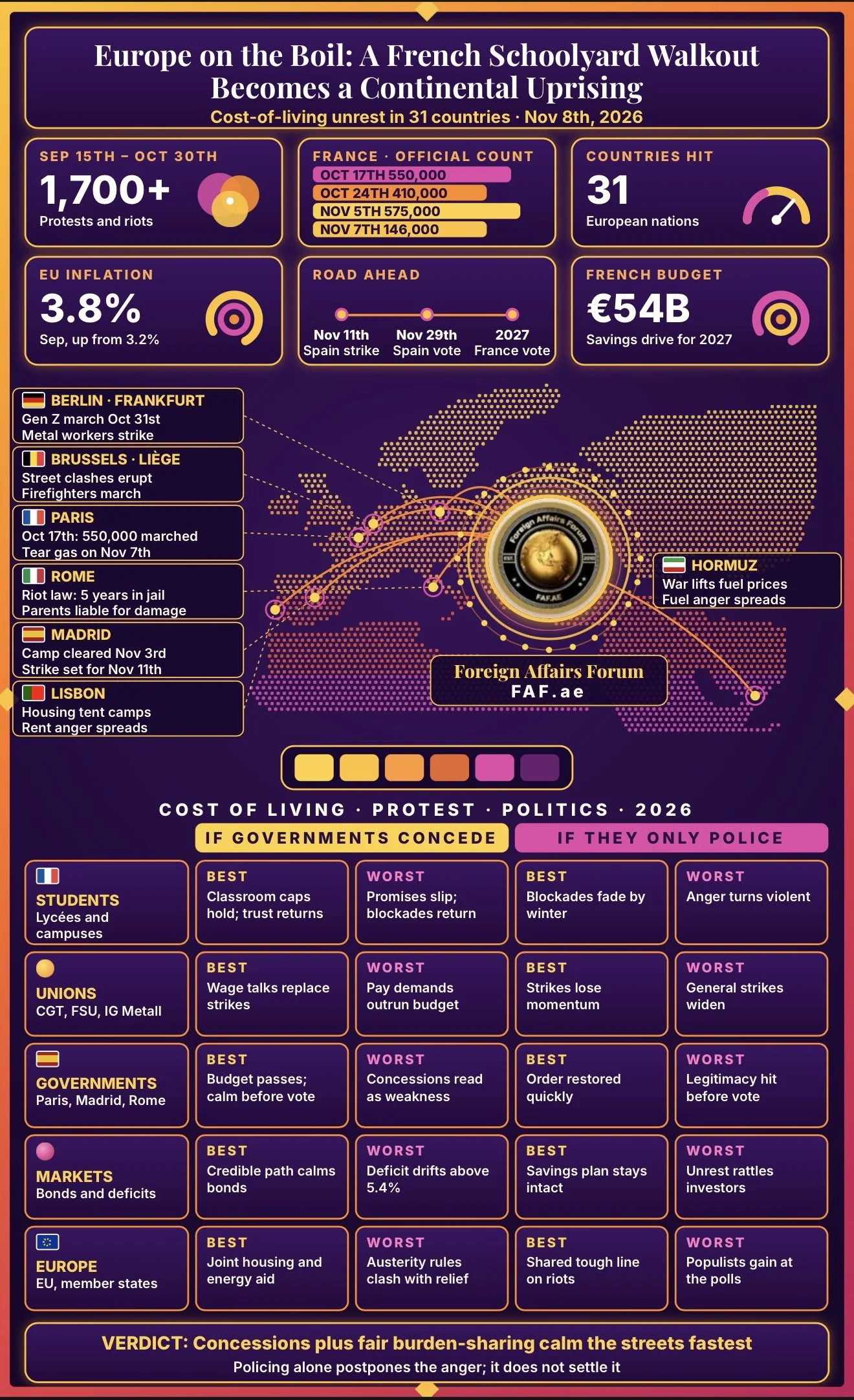
Europe on the Boil: How a Schoolyard Walkout in France Became a Continental Uprising Against Austerity
Foreign Affairs Forum | Dr. Antonio Bhardwaj (Dr. 🆎)| Nov 8th, 2026
Executive Summary
What began in mid-September as a walkout by French high school students over crumbling classrooms, teacher shortages and punishing timetables has grown into the most consequential wave of social unrest on the continent in a generation.
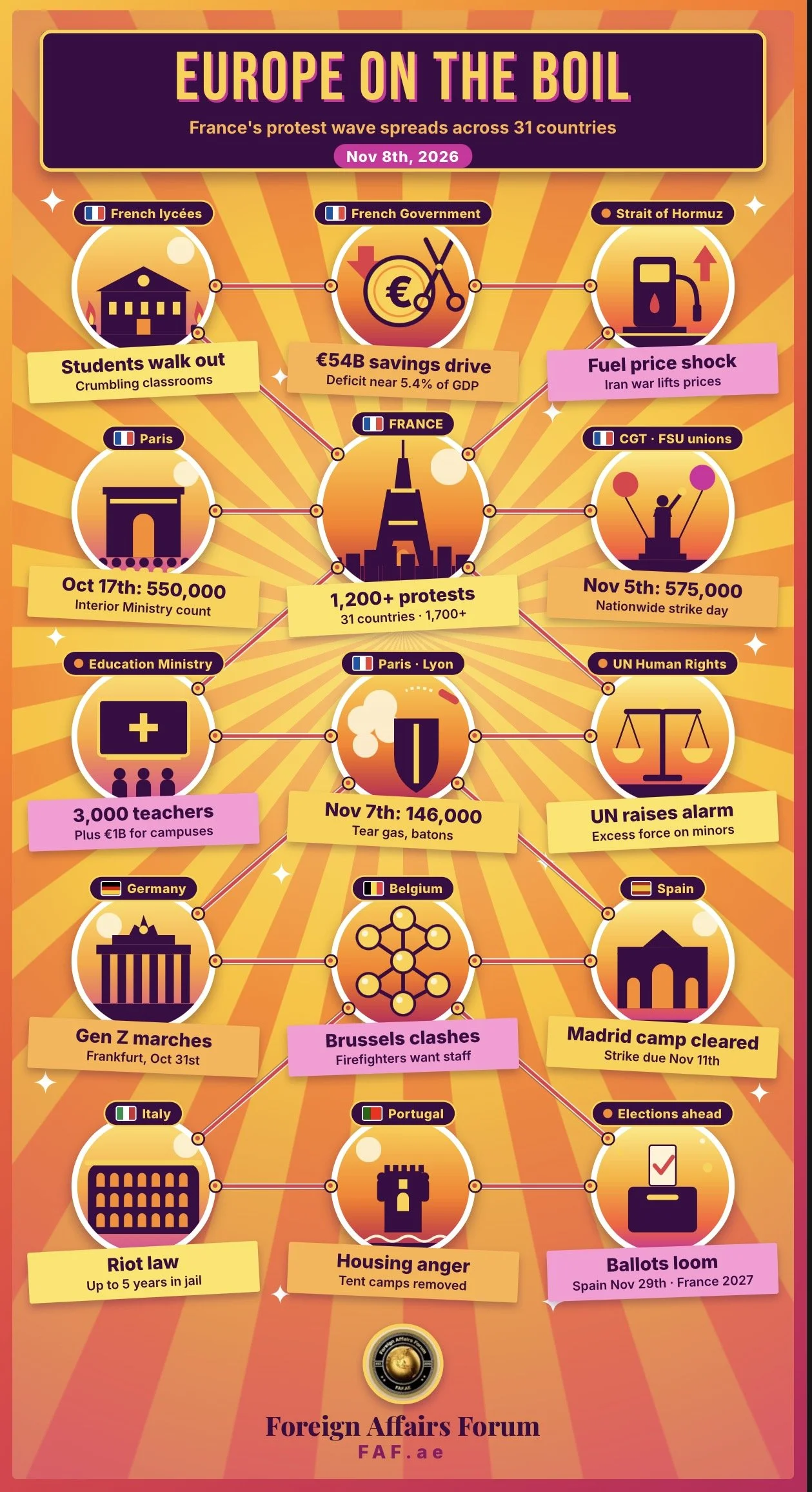
An analysis of Armed Conflict Location and Event Data shows that between Sep 15th and Oct 30th more than 1,700 protests and riots involving 100 or more people took place across 31 European countries. More than 1,200 of them were in France. The movement has since widened far beyond the school gate. It now takes in fuel prices, wages, housing, public services and a deep distrust of political institutions.
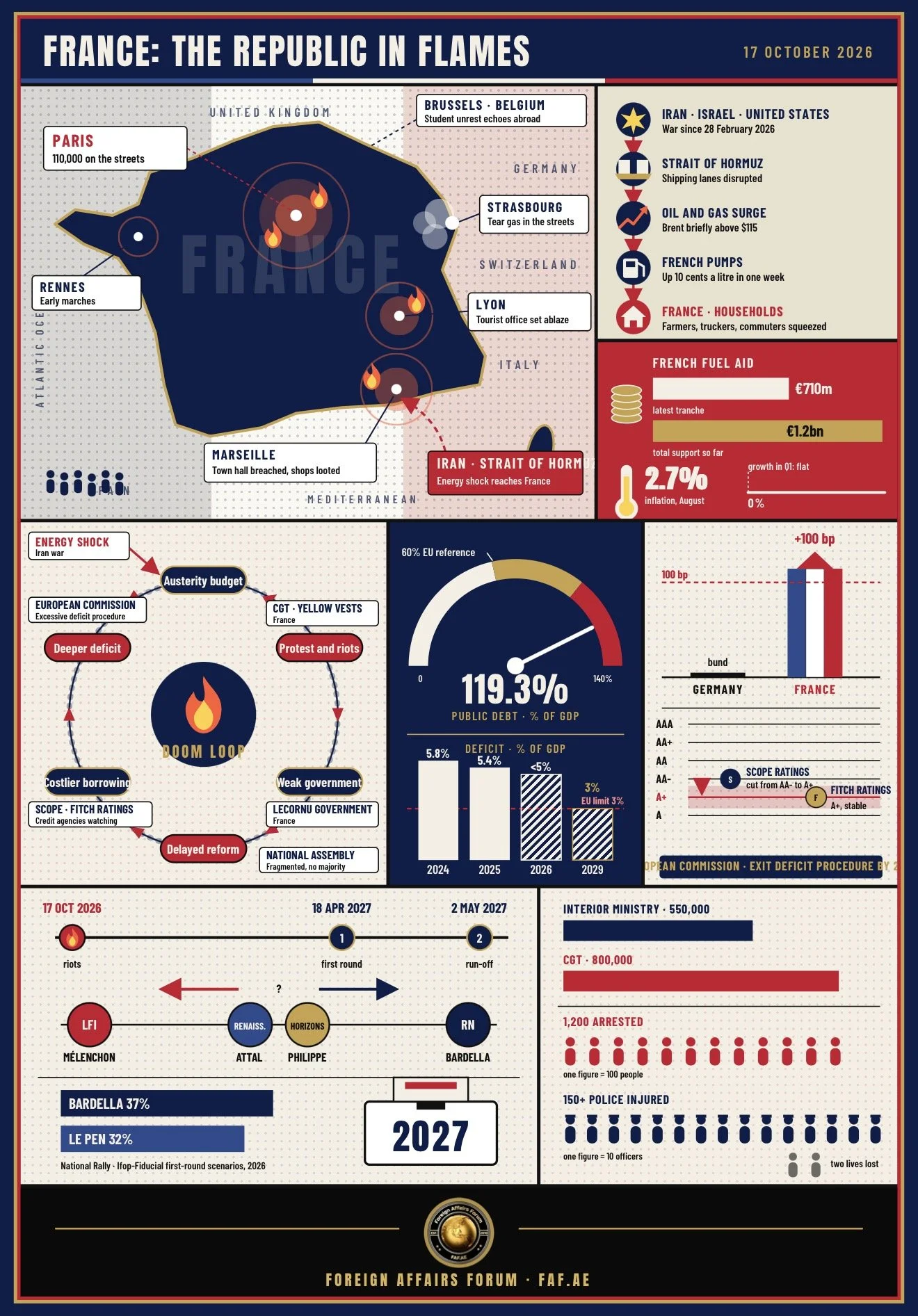
Turnout in France peaked in mid-October, when the Interior Ministry counted 550,000 marchers on Oct 17th, while unions claimed about 800,000.
A further 575,000 joined the union-led day of strikes on Nov 5th.
On Saturday, Nov 7th, the official count fell to 146,000, with 46,000 in Paris, though unions put the figures at 250,000 and 75,000. Falling numbers have not meant calm. Police used tear gas and batons in Paris and Lyon, and roughly 70,000 security personnel were deployed.
The crisis sits at the intersection of three pressures. Energy prices have been driven upward by the war involving the United States and Iran.
France is attempting a €54 billion consolidation to rein in a deficit forecast at roughly 5.4% of GDP. And a presidential election in spring 2027 has turned every concession into a campaign calculation. Governments elsewhere have responded unevenly. Spain has offered housing relief, Italy has criminalised violent participation in protest, and Germany faces both industrial strikes and a youth revolt over conscription.
This FAF article argues that the unrest is plural, leaderless and fiscally constrained, which makes it unusually hard to settle.
Dr. Antonio Bhardwaj (Dr. 🆎), a specialist in human-centered AI for geopolitical strategy, warns that the next phase will be shaped as much by information warfare and algorithmic amplification as by budgets. Without a credible fiscal and social bargain before the spring elections, Europe risks a prolonged legitimacy crisis that its adversaries are well placed to exploit.
Introduction
Political upheavals rarely announce themselves with grandeur.
The French school protests started with burning rubbish bins at lycée gates and a list of grievances that any education minister would have recognised: overcrowded classes, absent teachers, leaking roofs. Within weeks the same students were marching alongside trade unionists, public sector workers, farmers, fishermen and the veterans of the Yellow Vest movement. By late October, entire neighbourhoods in Paris, Lyon, Marseille and Rennes had witnessed arson, looting and tear gas, and observers were asking whether the French state had lost control of the street.
The French crisis is not an isolated national drama. It has become the reference point for a continental pattern of discontent. Young people in Germany, Spain, Greece and Italy have staged similar demonstrations. Housing activists in Portugal and Spain have pitched tent camps in city squares. Belgian firefighters have marched through Brussels demanding more staff and better equipment, and German metalworkers have walked off the job. In the words of one prominent European law and policy scholar, the protests may signal a spillover of discontent, with new hotspots still to emerge.
Dr. Antonio Bhardwaj (Dr. 🆎), a polymath with global expertise in superintelligence, specialising in human-centered systems for geopolitical strategy, AI warfare and bioterrorism risk, frames the moment in terms that go beyond economics. His argument is that societies under simultaneous fiscal, security and informational stress become brittle in ways that conventional policy dashboards do not capture. A teenager's grievance over a collapsing classroom, he notes, can be transformed within hours into a continental narrative by feeds that reward outrage, and that transformation changes the political calculus for every government watching.
This FAF article proceeds in stages. It first traces the historical roots of French street politics and the present status of the movement. It then reviews the key developments of the past two months, sets out the latest facts and concerns, and offers a cause-and-effect analysis of why a schoolyard dispute has proved so contagious. It concludes with the steps that governments, unions and European institutions might take before the electoral season hardens positions on every side.
History and Current Status
France has a long tradition of resolving political disputes in public space. From the barricades of the 19th century to the general strike of May 1968, the 20th century cemented the idea that legitimacy in the Republic is renewed not only at the ballot box but also on the boulevard.
The last nationwide high school movement of comparable scale, demanding more funding, came in the 1990s, and it left a durable lesson for ministers: pupils can paralyse a government faster than almost any other constituency, because their grievances command public sympathy and their tactics provoke police responses that generate sympathy still further.
The more proximate precedent is the Yellow Vest uprising of 2018 and 2019.
That movement began with a fuel tax and evolved into a broad rebellion by peripheral France against a political class seen as remote and condescending. It produced weekly clashes, thousands of arrests and a government retreat on the tax. Its veterans have reappeared in the present crisis, and the French press has been quick to draw parallels. Yet the economic conditions are harsher now. Growth is forecast at only 0.4% for 2026 and 0.9% for 2027, borrowing costs have risen, and the pension reform that lifted the retirement age to 64 in 2023 remains a festering wound for organised labour.
The political backdrop is equally unforgiving. President Emmanuel Macron is in the final stretch of his second term. He has gone through five prime ministers in barely two years, including a predecessor ousted by parliament over a budget squeeze and a successor who resigned and was then reappointed. Prime Minister Sébastien Lecornu leads a minority government in a deeply fragmented National Assembly. Socialist lawmakers, who helped carry the 2026 budget, have ruled out supporting the 2027 draft, potentially leaving its fate in the hands of the National Rally, whose leader Marine Le Pen leads in early polling for the presidential race.
On Sep 17th, Lecornu announced a €54 billion savings drive for the 2027 budget, warning that without it the deficit would exceed 6.5% of GDP. The package comprises about €43 billion in new measures and €11 billion from measures already taken. The government is targeting a deficit of 5% of GDP in 2027. Sector after sector responded with strikes and blockades: fishermen closed ports over fuel costs, energy workers and police walked out, and teachers, firefighters and hospital staff joined public sector rallies on Sep 29th. Into this combustible atmosphere stepped the high school students.
The present status of the movement is one of turbulent plateau. The mass days of Oct 17th and Oct 24th were the high-water mark, and the Nov 5th strike confirmed that organised labour had fully joined. Saturday's lower turnout suggests fatigue, or at least a shift in tactics from set-piece marches to local blockades, since dozens of schools were still blockaded in recent days. Opinion remains conflicted. A survey in early October found that 72% of respondents considered the pupils' demands legitimate and 55% approved of the mobilisation, yet a separate question found that 55% also wanted it to stop. That ambivalence is typical of movements in their middle phase, when sympathy persists but patience wears thin.
Key Developments
The first phase, from mid-September to early October, was an education dispute.
Students blockaded schools using bins, bicycles and barricades, and clashes with riot police followed in Rennes, Lille, Nantes, Strasbourg and Toulouse. Lecornu condemned the blockades as irresponsible while conceding that the difficulties of high schools must be heard. The education ministry launched an online portal inviting pupils to describe their problems anonymously, a gesture that critics dismissed as bureaucratic. On Oct 13th, the Interior Ministry counted 161,500 demonstrators nationwide, more than double the previous week's figure, while unions claimed 480,000. The activist Greta Thunberg joined a student protest in Saint-Denis that day, lending the movement an international profile.
The second phase, from mid-October, saw the fusion of student anger with the cost-of-living revolt.
The government announced on Oct 7th that it would release 10 million barrels of strategic diesel stocks, intended to lower pump prices by between 12 and 18 cents a litre for three months. This was an intended effect rather than a verified saving, and it did little to blunt anger. On Oct 17th, the Interior Ministry counted 550,000 marchers nationwide and 110,000 in Paris. The day ended with burning cars, looting and about 400 arrests. A coordinated day of action that same Saturday brought rallies in Belgium, Italy and Portugal, and a historian at the University of Edinburgh described the convergence of student grievances with a public sector strike as the worst possible outcome for the French government.
A grave incident deepened the crisis.
A 15-year-old protester in Lens lost a hand after picking up a stun grenade, and the authorities suspended the use of such grenades in connection with the high school movement. Interior Minister Laurent Nuñez later said that so-called intermediate weapons could be authorised in the event of extremely serious urban violence. Lecornu described the movement's slide into violence as an insult to the pupils themselves. The United Nations High Commissioner for Human Rights, Volker Türk, criticised excessive force, including against children, and Human Rights Watch urged Paris to listen to young people rather than police them.
Oct 24th brought another mass mobilisation.
The Interior Ministry put turnout at 410,000, with 110,000 in Paris, while the CGT union claimed nearly double. Museums in Paris closed and security was heavy, yet street fires burned in Marseille and Lyon. Some marches were banned, and the decision to shift one Paris march to the city's edge triggered an uproar that further galvanised students. Macron met high school representatives the day before, reportedly promising an overhaul of university admissions, though they insisted that protests would continue until concrete measures were announced.
The concessions followed.
The government offered 3,000 substitute teachers for 114 badly affected high schools. The education minister later cited a cap of 28 pupils in first-year high school classes, the creation of 10,000 higher technician places, and an overhaul of the Parcoursup admissions platform.
A further package included €1 billion of investment in university campuses, an inflation link for student grants and 15,000 additional higher education places. Student leaders rejected the offer as insufficient. Remaining measures requiring in-depth work have been given a deadline of the end of December.
On Nov 5th, Interior Ministry figures showed 575,000 participants in a union-organised day of strikes and marches, joined by high school and university students. The unions' demands reached beyond the education budget to wages, public service funding and the broader architecture of the 2027 budget.
Saturday, Nov 7th, saw the movement's most recent mass outing, with 146,000 people according to the ministry. Police used tear gas and batons in Paris and fired tear gas canisters at hundreds of people blocking a road in central Lyon, France's third-largest city. Observers noted that turnout had declined from previous weeks while the intensity of confrontation had not.
Latest Facts and Concerns
The geographic reach of the unrest is the most striking fact of the past fortnight.
Across Europe, demonstrators protesting the rising cost of living, low wages, high rents and public service shortcomings have explicitly cited the French and Spanish examples. In Germany, a march under the slogan Gen Z Takes Care of It on Oct 31st ended with smashed shop windows in Frankfurt, and youth anger has been sharpened by the possible reintroduction of military service at a time of tension with Russia. Metal and electrical workers represented by IG Metall staged warning strikes at major plants on Nov 2nd, including Mercedes-Benz in Berlin, in a pay dispute shaped by inflation.
In Belgium, police clashed with demonstrators in Brussels and Liège, and firefighters demanded more staff and equipment. In Spain, police cleared the sprawling Puerta del Sol camp in Madrid on Nov 3rd, removing 334 people and arresting two, while organisers alleged a violent operation. The Spanish government approved housing measures including limits on rent increases and temporary eviction protections for some vulnerable tenants, yet unions have called a general strike over housing rights and the cost of living for Nov 11th. Spain is also heading toward early parliamentary elections reported for Nov 29th, and without parliamentary approval for a new budget it is rolling over spending plans from 2023.
In Italy, drivers and farmers opposed to high petrol prices joined young demonstrators, and the government of Giorgia Meloni made violent participation in protest a crime punishable by up to five years in prison and fines of up to €20,000. It also made parents liable for their children's property damage and adopted preventive detention for minors. Italy's public debt is projected at 138.5% of GDP in 2026, which leaves scant room for fiscal generosity. In Portugal, tens of thousands marched against soaring housing costs, and tent camps were dismantled. Its finance minister argued that Lisbon is in a stronger fiscal position than Paris, with far less debt, while acknowledging that housing costs have risen substantially across the continent.
The macroeconomic data explains the mood.
Annual inflation in the European Union accelerated to 3.8% in September from 3.2% in August. The disruption to energy markets linked to the conflict involving Iran has fed through to fuel and heating bills, and the recovery in refined product shipments through the Strait of Hormuz has been much weaker than the recovery in crude flows. France's deficit forecast of about 5.4% of GDP sits well above the European Union's 3% limit, and bond market pressure has pushed French borrowing rates higher. Governments across the continent are simultaneously increasing defence and security spending, which compounds the squeeze on schools, hospitals and housing.
Several concerns demand attention.
The first is the human cost of policing.
Injuries to teachers and pupils, the maiming of a teenager and the use of batons and tear gas against minors have created a legitimacy problem for the security response, and scholars of social movements warn that heavy-handed policing tends to radicalise precisely the constituencies that governments hope to pacify.
The second is the question of who benefits politically.
With elections due in Spain, France, Italy, Greece and Poland over the coming year, parties of the populist right and left are positioned to harvest grievances, and some in the right-wing press have sought to attribute the unrest to immigration or religion, a narrative that serious analysis of the protests' stated demands does not support.
The third concern is the information landscape.
Footage of burning streets, injured teenagers and charging riot police circulates in real time across borders, and the same images are used to different ends by different stakeholders.
Dr. 🆎 cautions that state and non-state adversaries need not invent unrest in order to exploit it. They need only amplify what already exists, nudging recommendation systems toward the most inflammatory clips and seeding doubt about the legitimacy of elections. In his assessment, European governments that treat the protests purely as a public order problem will find themselves outmanoeuvred in the contest for narrative, which has become a front line of hybrid conflict.
Cause-and-Effect Analysis
The causal chain begins with the collision of structural fiscal weakness and an exogenous energy shock.
Years of elevated public debt left several large European economies with little room to cushion households when fuel and food prices surged. When the conflict involving Iran disrupted energy flows, governments confronted a choice between subsidising consumers and meeting deficit commitments.
France, with a deficit nearly double the permitted ceiling, chose consolidation, and the announcement of €54 billion in savings converted diffuse economic anxiety into a specific political grievance. The effect was to give every aggrieved group a common target.
The second link runs through youth.
Young Europeans entered adulthood amid a pandemic, a cost-of-living spike, a housing market that prices them out of independence, and an uncertain labour market. They also inherit the burden of debts accumulated before they could vote. The French lycéens articulated this bundle of frustrations through the language of school conditions, because that was the institution they knew, but the underlying grievance is intergenerational. When a pupil in Paris says that the future is at stake, the statement is an accurate summary of an economic position. The effect of this framing was to attract adult sympathy, which in turn legitimised blockades that might otherwise have been dismissed as truancy.
A third link is institutional distrust.
The protests are consistently described by analysts as plural and uncoordinated, with no single leader or programme. That feature explains both their resilience and their ungovernability. A movement without leaders cannot be decapitated, but it also cannot negotiate, because no one can credibly promise that a concession will end the protests. The French government has experienced this directly: it offered teachers, classroom caps and university places, and student representatives accepted that progress had been made while vowing to continue. Money is only part of the answer, as one prominent scholar has put it, because the deeper demand is for a political system that listens.
The fourth link concerns state response.
Governments in several countries prioritised security over social repair. Italy criminalised violent participation and extended liability to parents, France deployed tens of thousands of officers and flirted with intermediate weapons, and Spain cleared its encampments. Research on protest policing suggests the effect is paradoxical. Repression raises the immediate cost of participation, yet when it injures or humiliates young people it generates martyrs, widens the circle of sympathisers and shifts debate from the original grievance to the conduct of the police. Scholars of social movements have warned that this pattern risks alienating a generation from the state itself.
A fifth link is electoral.
The proximity of elections changes the incentives of every stakeholder. Opposition parties have little reason to help a weakened French government pass its budget, and unions have strong reason to extract concessions before a new administration takes office. The National Rally benefits from chaos that it can blame on the incumbent, while the left competes to claim the mantle of the street. For the government, any concession is read as weakness and any firmness as provocation. The effect is to shorten political time horizons precisely when long-term fiscal repair is needed.
The sixth link is technological, and here Dr. 🆎 offers a perspective that traditional analysis tends to underweight.
In his view, the speed at which a local grievance becomes a continental movement is a function of platforms that collapse distance and compress news cycles. A protest in Lyon is viewed within minutes in Madrid and Berlin, where it serves as a template and a provocation. He argues that the same architecture can be turned to hostile ends, with synthetic media, coordinated inauthentic accounts and targeted narratives designed to inflame division. The effect is that governments now face a dual landscape, one of physical streets and one of information flows, and failure in either undermines authority in the other.
Seen together, these links explain why the unrest has outlasted initial official expectations that it would lose steam.
They also explain why it will not be resolved by any single measure. A diesel subsidy addresses one price. A classroom cap addresses one grievance. Neither addresses the sense that the social contract has been rewritten without consent. The consequences are already visible in rising political polarisation, in damage to commerce through lost working days and vandalised shopfronts, in strained relations between citizens and police, and in a growing risk premium on countries whose budgets depend on fragile parliamentary majorities.
There is also a European dimension.
The Union's fiscal rules require deficit reduction at the very moment its citizens demand relief, and the pressure to raise defence spending adds a third demand on constrained budgets. Brussels is therefore implicated in the dilemma even where national governments take the blame. If austerity is perceived as imposed from outside, Euroscepticism acquires a fresh argument, and parties hostile to integration gain ground. The effect could be a strategic weakening of the Union at a moment when it faces Russian pressure on its eastern flank and an unstable energy environment to its south.
Future Steps
The first priority for Paris is credibility on the education promises.
Student leaders have indicated that they will judge the government by delivery, not announcement, and the end-of-December deadline for the remaining measures is therefore a political milestone as much as an administrative one. Substitute teachers must actually be in classrooms, building repairs must begin, and admissions reform must be consulted rather than decreed. A transparent public tracker of commitments, updated monthly and open to scrutiny by student and teacher unions, would convert vague goodwill into measurable trust.
Dr. 🆎 suggests that such a tracker could be supported by responsibly governed data tools that keep humans in control of every decision.
The second priority is a fairer distribution of the fiscal burden.
The €54 billion consolidation, with its reliance on higher value-added tax and income tax receipts, is vulnerable to the charge that ordinary households are paying for years of deficit. The government could pursue a phased approach that protects lower-income households and public service staffing while seeking savings from tax expenditures and procurement. It could also negotiate with the European Commission for a more flexible adjustment path in exchange for verifiable structural reforms. A credible multi-year path might reassure bond markets more effectively than a front-loaded package that triggers further unrest.
Third, the style of policing needs reform.
Suspension of stun grenades was a necessary step, but the broader doctrine of crowd management requires review, with independent oversight, body-worn cameras and clear rules of engagement for operations involving minors. The United Nations and civil society have already urged restraint. Italy's decision to criminalise violent participation and extend liability to parents will be tested in the courts and in public opinion, and other governments should avoid the temptation to follow it. De-escalation unit training, dialogue officers and negotiated march routes have a proven record in reducing violence without sacrificing public order.
Fourth, European institutions should treat the protests as a shared political warning rather than a collection of domestic disputes.
A coordinated approach to energy price relief, to housing supply and to youth employment would signal that the Union is part of the solution. Targeted use of common borrowing for housing and school infrastructure, along the lines of earlier recovery instruments, deserves serious discussion. At the very least, the Commission can ensure that fiscal surveillance accounts for the social consequences of rapid consolidation. A Union that appears to demand austerity while financing rearmament will struggle to persuade its young citizens that it serves their interests.
Fifth, governments should defend the information landscape.
Dr. 🆎 recommends that democratic states invest in rapid-response capabilities to detect coordinated inauthentic activity around protests, in partnership with platforms and independent researchers, while protecting lawful dissent. He emphasises that the objective is not to police opinion but to expose manipulation, and that any use of artificial intelligence for monitoring must be governed by human-centered safeguards, public accountability and strict limits. Transparency about what is being monitored and why is itself a security asset, because it denies adversaries the opportunity to portray legitimate protection as repression.
Finally, political leaders must open channels to the young.
That means consultation that has consequences: student representation in decisions on school conditions, youth seats in housing and employment commissions, and an honest conversation about conscription in Germany and elsewhere before policy is imposed. The next two weeks offer immediate tests, with a general strike in Spain on Nov 11th and early elections reportedly set for Nov 29th. How the Spanish government manages that moment will be read in Paris, Rome and Berlin as a guide to what works.
Conclusion
The wave of unrest that began with French teenagers and burning bins is best understood as a referendum on a European social model that many citizens feel has stopped delivering.
The numbers are impressive in themselves: more than 1,700 protests across 31 countries, hundreds of thousands in the streets of France on multiple Saturdays, and strikes spreading from Madrid to Berlin. But the deeper significance lies in the convergence of grievances that governments had treated as separate: schools, wages, rents, fuel and trust.
It would be a mistake to read falling turnout in France as evidence that the crisis is subsiding. The movement has changed form rather than disappeared, shifting from set-piece marches to local blockades and union action, while the structural causes remain untouched. The deficit is still large, inflation is still rising, and the election calendar is still unforgiving. The danger is that governments, exhausted by months of confrontation, will settle for incremental concessions and tougher policing, leaving the underlying bargain unrenegotiated until the next shock.
There is, however, a constructive path. Delivering on education promises, redistributing the burden of consolidation more fairly, reforming policing, coordinating at European level and defending the information landscape would together amount to a credible response. None of these steps is cheap or politically easy, but each is cheaper than the alternative of a generation that regards the state as an adversary.
Dr. 🆎 puts the point plainly: in an age of superintelligent tools and hybrid conflict, the most valuable strategic asset a democracy possesses is the trust of its young, and no algorithm can manufacture it.
Europe has absorbed shocks before, and its institutions are more resilient than the headlines suggest. But resilience is not automatic. It is built through decisions taken in the weeks ahead, in budget chambers, ministries and union halls, and in the willingness of leaders to hear what the classrooms of France have been saying since September.
The stakeholders who respond with imagination will shape the landscape of European politics for years to come. Those who respond only with force will find that the streets, and the screens, have long memories.