France : The Republic in Flames: Why France Will Burn Again
Foreign Affairs Forum | Dr. Antonio Bhardwaj (Dr. 🆎)| October 19th 2026
Executive Summary
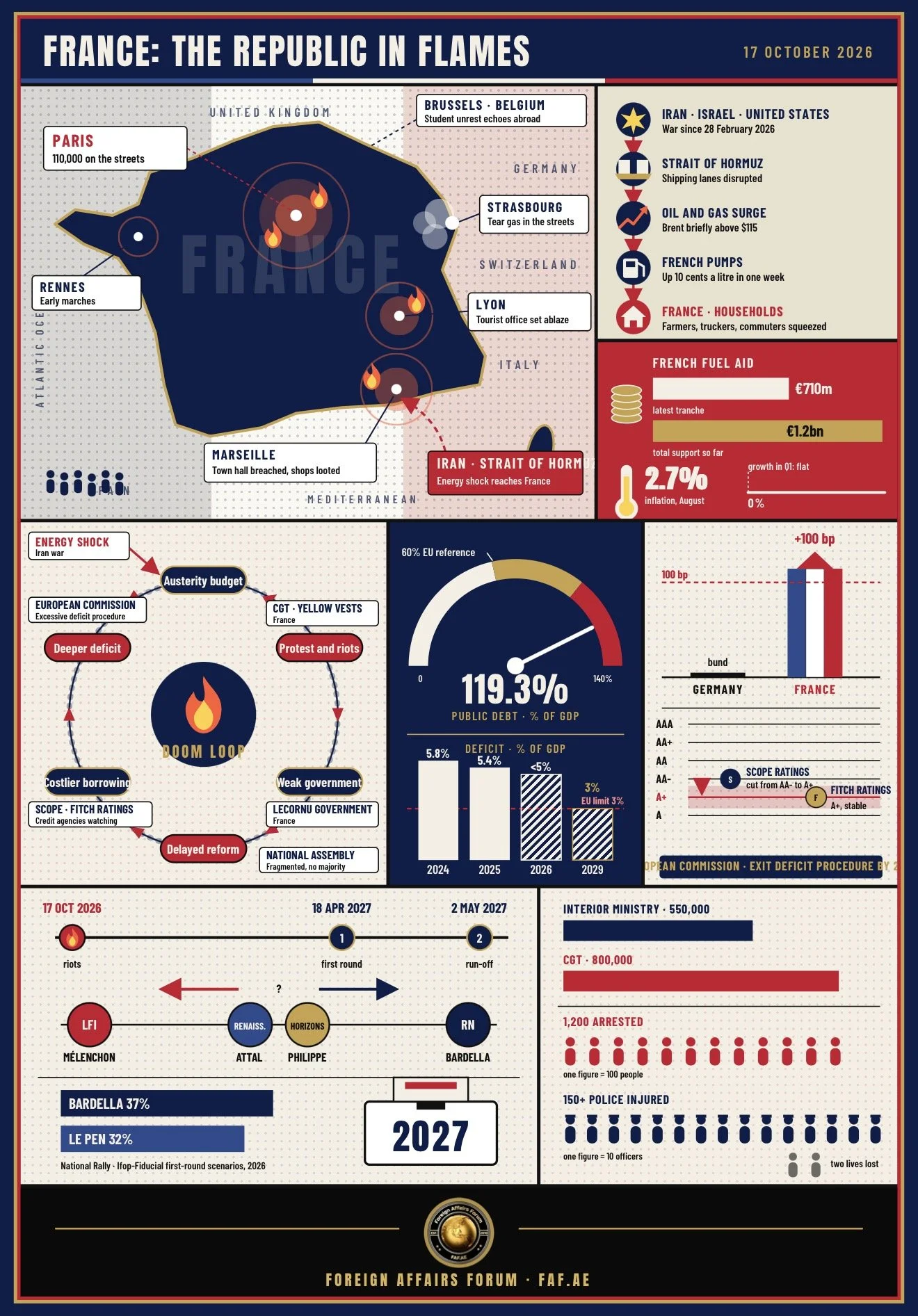
On October 17th, 2026, France endured some of the most destructive civil disorder in its modern history.
What began as a vast and largely peaceful mobilization against the rising cost of living, the erosion of public services and fuel prices inflated by the war on Iran was overtaken, in several cities, by organized and opportunistic violence.
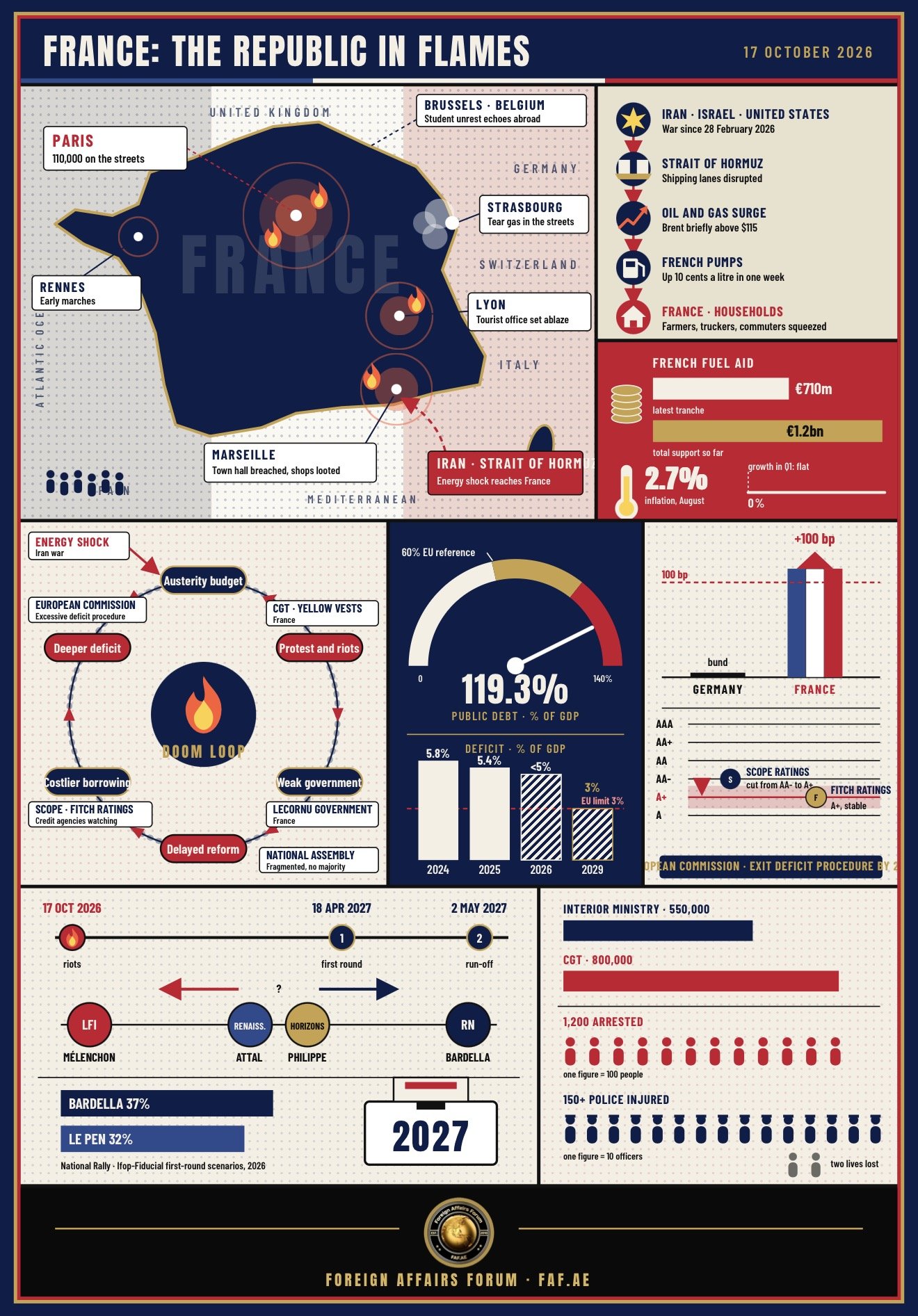
The interior ministry counted roughly five hundred and fifty thousand marchers nationwide, including about 110,000 in Paris, while the CGT trade union put the figure at eight hundred thousand.
Town halls were breached, a tourist office in Lyon was set ablaze, luxury boutiques and supermarkets were looted, and Prime Minister Sébastien Lecornu reported one thousand two hundred arrests and more than one hundred and fifty injured police officers.
This article contends that the disorder is a symptom of deeper institutional exhaustion rather than a passing eruption of anger.
France carries public debt approaching 119.3% of gross domestic product, a deficit that has stayed far above the European ceiling of 3%, a fragmented National Assembly incapable of producing durable majorities, and a presidency that has lost much of its capacity to persuade. Each of these pathologies feeds the others.
Austerity provokes protest, protest weakens governments, weak governments postpone reform, and postponed reform deepens the fiscal strain that made austerity unavoidable in the first place. The energy shock produced by the conflict in the Gulf has simply removed the last cushion of public tolerance.
The political consequences are already visible.
With the presidential election scheduled for April 18th and May 2nd 2027, the unrest hands a ready narrative to both the nationalist right and the radical left, and it risks reducing the contest to a choice between two forms of rupture.
FAF article concludes that only a credible national bargain on fiscal fairness, public services, policing doctrine and democratic participation can arrest the cycle, and that the window for such a bargain is narrowing quickly. Without it, further waves of violent protest are not a possibility but an expectation.
Introduction
France has always processed its deepest quarrels in the street. The Republic founded by Charles de Gaulle in 1958 was shaken a decade later by the student revolt and general strike of May 1968, and the general himself was gone within a year.
Emmanuel Macron confronted months of weekly confrontation with the gilets jaunes in 2018 and 2019, and in the summer of 2023 the death of a teenager at a police checkpoint in Nanterre ignited the worst urban disorder since 2005. Disorder, in other words, is not an aberration in French public life but one of its recurrent grammars. What distinguishes October 17th, 2026 is not that France burned but the condition of the political order into which the fire fell.
The scenes were extraordinary even by French standards.
Hundreds of thousands marched peacefully in scores of cities, brought together by an unusual coalition of former yellow vests, secondary school pupils, university students, teachers, trade unionists, farmers, retirees and climate campaigners.
By afternoon, however, masked groups had rammed the doors of the town hall in Marseille, entered a municipal building in the tenth arrondissement of Paris where about one hundred people attending a breast cancer awareness event were trapped, burned bins, bicycles and vehicles, and plundered shops. An elderly couple was reportedly robbed and stripped in the centre of the capital. A protester lost a hand to a police grenade. The word apocalyptic, used by observers in the aftermath, was not wholly rhetorical.
This article examines the disorder through the lens of cause and consequence rather than spectacle. It asks why a society with one of the most generous welfare systems in the world and one of the most sophisticated state apparatuses should prove so brittle, why no stakeholder in the political landscape appears willing or able to address the structural problems, and what the next phase of French politics is likely to look like as the presidential election approaches. It draws on the latest available facts while resisting the temptation to treat a single day as destiny.
Dr. Antonio Bhardwaj (Dr. 🆎), a polymath whose work on human-centred superintelligence for geopolitical strategy, artificial intelligence in warfare and bioterrorism risk has made him a sought-after voice on complex global challenges, offers a framing that runs through this analysis. "The French crisis is a failure of institutional bandwidth," Dr. 🆎 observes. "Modern states are now expected to absorb cost shocks, security threats, information warfare and democratic grievance at the same moment, and a state that cannot do so is driven to govern through emergency." That diagnosis, as the following sections show, fits the evidence uncomfortably well.
Two cautions are in order at the outset.
First, the peaceful majority of demonstrators and the violent minority must be analysed separately, because conflating them serves only those who wish to delegitimise the grievances or to romanticise the destruction.
Second, the sums involved in France's fiscal predicament are large but not beyond management.
The deeper deficit is one of trust, and trust cannot be restored by arithmetic alone.
History and Current Status
The Fifth Republic was designed to end instability.
The parliamentary chaos of the Fourth Republic, with its revolving governments and its inability to resolve the Algerian crisis, convinced de Gaulle that France required a strong executive insulated from the shifting arithmetic of the legislature.
The constitution of 1958 therefore concentrated authority in the presidency and equipped governments with instruments, most notably the power to force legislation through without a vote, that were meant to guarantee decisiveness.
For several decades the design worked, because the system produced presidents with parliamentary majorities and majorities with a sense of shared purpose. It is one of the ironies of French history that the very tools created to prevent paralysis have become, in an age of fragmentation, accelerants of public resentment.
The street has always served as the Republic's second parliament.
The general strikes of December 1995 forced the retreat of a major pension and welfare reform. The riots of 2005 exposed the alienation of the peripheral estates. Student protests defeated a youth employment contract in 2006, and the movement against labour law reform in 2016 produced weeks of occupation of public squares. In each episode a government proposed, society resisted, and the state negotiated or withdrew. What changed under Macron was the readiness of the executive to push through reform against sustained opposition, and the readiness of protesters to answer with ever greater intensity.
The yellow vest uprising of 2018 and 2019 began as a revolt against a fuel tax and broadened into a rejection of the entire social contract as experienced by the provincial and peri-urban middle class.
The pension reform of 2023, which raised the retirement age from 62 to 64 and was adopted using constitutional powers rather than a parliamentary vote, mobilised millions and left a lasting residue of illegitimacy. The killing of Nahel in Nanterre the same year brought a different grievance, the relationship between the police and young citizens of immigrant background, into the open. By the end of that year, France had endured three distinct episodes of mass unrest in five years, each with different participants and a common thread of distrust.
The political system then fractured.
After a poor result in the European elections of 2024, Macron dissolved the National Assembly, producing a hung chamber divided between a left alliance, the presidential camp and the National Rally. Michel Barnier's government fell in December 2024 over the budget for 2025. François Bayrou lost a confidence vote in September 2025 after proposing savings of around €44 billion, and a grassroots movement calling itself Bloquons tout had already staged mass blockades and strikes. Lecornu was named prime minister, resigned briefly in October 2025 and was reappointed. The budget for 2026 was finally adopted in February only through constitutional powers and after surviving no-confidence motions, a sequence that confirmed to many citizens that government was something done to them rather than for them.
The economic position is correspondingly fragile.
The deficit reached 5.8% of gross domestic product in 2024 and 5.4% in 2025, and the government aims to bring it below 5% this year and to 3% by 2029 under the European Union's excessive deficit procedure. Public debt, already above €3.3 trillion, is expected by the finance ministry to reach 119.3% of output in 2026 and 121.7% in 2027. Interest payments now rival the largest items of the state budget. In September the premium that investors demand to hold French ten-year bonds over German equivalents rose above one hundred basis points, its highest level since the euro area debt crisis, and one rating agency had already lowered France to A+ from AA-. Growth stagnated in the first quarter, and inflation, measured by the harmonised index, stood at 2.7% in August.
Into this brittle setting came the war on Iran.
The strikes of February 28th, 2026 and the resulting disruption around the Strait of Hormuz pushed oil and gas prices sharply higher, raised the cost of fertiliser and plastics, and sent pump prices climbing within days. The government responded with targeted support, the latest tranche worth €710 million and bringing total fuel assistance to nearly €1.2 billion, but the sums were modest against the scale of household anxiety. Meanwhile the political calendar is closing in. Macron cannot seek a third term, the election will be held on April 18th and May 2nd 2027, and the leading candidates, including the National Rally's Jordan Bardella, who has polled as high as 37% in first-round scenarios, are positioning themselves to harvest the discontent.
Key Developments
The first development of consequence was the energy shock itself.
In the weeks following the outbreak of war in the Gulf, fuel prices rose by roughly ten cents a litre in a single week, and by spring truckers and farmers were threatening blockades. Farmers reported that refilling a single tank cost twice what it had before the conflict. The French experience mirrored that of other European economies, but it landed on a society in which real incomes had already been squeezed for several years. The conflict thus converted a diffuse sense of declining prosperity into a concrete, daily and visible grievance at the petrol station and the supermarket till.
The second development was the fiscal stalemate in Paris.
The government had little room to compensate households without breaching the targets it had promised Brussels and the markets, and the opposition had little incentive to help.
The National Rally and the radical left alike calculated that obstruction would be rewarded at the ballot box. The budget passed in February with the aid of extraordinary constitutional mechanisms, which meant that the measures that followed lacked a genuine parliamentary mandate.
Dr. 🆎 describes this condition as legitimacy debt. "A government that governs by procedural exception accumulates a liability that is every bit as real as its financial debt," Dr. 🆎 notes, "and the repayment, when it comes, tends to arrive in the streets."
The third development was the coalescence of an unusual protest alliance.
For months the student movement had been demanding improved classrooms, better facilities and adequate resources in French schools and universities.
The yellow vests, dormant since 2019, reappeared over fuel and living costs and announced that they would back the students. The CGT, the largest of the traditional unions, joined with demands for higher wages and pensions and lower prices. Teachers, parents, farmers and climate campaigners added their own claims. This breadth was the source of the movement's size, but it also made it difficult for any organiser to control, and it created a vast, anonymous perimeter within which violent groups could operate.
The fourth development was the tactical preparation of the state.
Ahead of the day, the interior minister, Laurent Nuñez, indicated that stun grenades, whose use had been suspended after a serious injury in an earlier case, could be employed if serious violence occurred. The authorities anticipated several hundred actions and dozens of marches. They had reason for caution, yet the visible deployment of crowd-control weapons became a flashpoint when a protester's hand was blown off. Policing doctrine, never far from the centre of French controversy, thus entered the story within hours, and it will remain there as investigations proceed.
The fifth development was the violence itself, which was geographically wide and tactically varied.
In Paris, the Place de la République and the districts around the Gare du Nord saw running confrontations, burning barricades and attacks on police vehicles. In Marseille, demonstrators broke into the town hall and looted shops. In Lyon, a tourist office was set alight. Tear gas was used in Strasbourg, and protests in other cities saw bins and cars burned. Disturbing sympathy demonstrations by students elsewhere in Europe, including in Brussels where cars were overturned, suggested that the grievances of a generation were not confined to French borders.
The sixth development was the reaction of the political class.
Macron's address on Sunday evening condemned what he called the sowers of chaos, promised that those who attacked prefectures, businesses and town halls would be prosecuted, and acknowledged the death of a police officer and a protester. Lecornu toured damaged sites and reported the arrests and injuries.
Opposition leaders divided along predictable lines, with the radical left stressing that the great majority of marchers had been peaceful and blaming heavy-handed policing, and the nationalist right stressing disorder, impunity and the failure of the state to protect citizens. Neither response contained a programme for addressing the grievances that had filled the streets.
Latest Facts and Concerns
The most recent facts are stark.
According to the interior ministry, about five hundred and fifty thousand people took part in the protests, a figure disputed by organisers who spoke of eight hundred thousand. The prime minister reported one thousand two hundred arrests, a number far higher than the several hundred recorded during the day itself, which indicates that police continued to detain suspects through the evening and night. More than one hundred and fifty police officers were injured. Two deaths have been acknowledged, a police officer and a protester, and the circumstances of both will be subject to judicial scrutiny. Further arrests were promised in the coming days as video evidence is analysed.
The first concern is the character of the violence.
A distinction must be drawn between the committed insurrectionary groups who attack symbols of the state, the opportunistic looters who exploit the chaos for gain, and the angry but non-violent majority. The attack on a municipal building where a charitable health event was taking place, and the reported robbery and stripping of an elderly couple, suggest that a considerable portion of the violence had no political content whatsoever. Yet the targeting of town halls and prefectures, institutions that embody the daily reality of the Republic for ordinary citizens, was plainly political. The danger lies in the fusion of the two, in which criminal opportunism comes to shelter beneath political grievance.
The second concern is the condition of the police.
Officers who endure months of continuous mobilisation, who are condemned alternately for excess and for passivity, and who are injured in large numbers, form a profession under severe strain. The debate over stun grenades and other crowd-control weapons will recur, since injuries inflicted by the state on its own citizens are among the most potent accelerants of unrest.
Dr. 🆎 argues that the future of crowd management lies in human-centred technology. "Surveillance systems and predictive tools can help police separate violent minorities from peaceful crowds," Dr. 🆎 says, "but only if their use is transparent, proportionate and subject to independent oversight. Otherwise they simply add a new layer of grievance."
The third concern is financial.
The disorder will impose direct costs through destroyed property, damaged public buildings, lost retail revenue and disrupted tourism, and indirect costs through its effect on investor sentiment. Markets are already pricing French political risk, with the spread over German bonds at multi-year highs, and images of looted boutiques and burning civic buildings do nothing to calm them. Any further downgrade or widening of spreads raises the cost of servicing the debt, which in turn narrows the space for the very social spending that protesters demand. The fiscal and political crises are therefore bound together in a single loop.
The fourth concern is the information landscape.
Mass mobilisations in the age of social platforms are organised, amplified and distorted by algorithmic systems that reward outrage. Footage of violence, whether genuine, decontextualised or fabricated, circulates faster than any official statement can answer it. Hostile foreign stakeholders have repeatedly shown interest in exploiting European social tensions, and France, which is a nuclear power and a leading European voice on the Gulf conflict, is an obvious target.
Dr. 🆎 warns that "the next phase of civil unrest will be fought as much in the cognitive domain as on the pavement, and a state that lacks the capacity to defend the integrity of its public information will find its streets governed by rumour."
The fifth concern is electoral.
With the presidential contest only months away, the question is whether the disorder will push voters toward the parties of order or the parties of upheaval, and whether either side will be tempted to encourage further unrest for tactical gain.
Polls have for some time shown the National Rally comfortably leading the first round, and the radical left leader Jean-Luc Mélenchon, now seeking the presidency for a fourth time, retains a committed base.
The centre, weighed down by the unpopularity of the outgoing president, has not yet produced a convincing standard-bearer. The danger of a final round between two extremes, long considered a remote scenario, now appears plausible.
Cause-and-Effect Analysis
The first causal chain runs from the external energy shock to domestic purchasing power.
When oil and gas prices rise sharply, the effect on households is immediate, regressive and visible. Rural and peri-urban families who depend on cars, farmers who depend on diesel and fertiliser, and lower-income urban households whose budgets are dominated by food and energy suffer most. France has historically been more protective of household energy costs than many neighbours, which makes the shock more politically combustible, since citizens have been taught to regard stable prices as a matter of entitlement. The yellow vest movement had already demonstrated in 2018 that a fuel price rise could rupture the social contract. The war on Iran has repeated the experiment under worse fiscal conditions.
The second chain runs from fiscal constraint to political paralysis.
The state cannot spend its way out of the grievance because debt is already high, the deficit exceeds European limits, and bond markets are watching. Yet it cannot cut spending without inflaming the very citizens whose anger is already at the surface. A government in this position is condemned to offer small, targeted, grudging concessions, which satisfy no one, while simultaneously promising future austerity, which alarms everyone. The result is a politics of permanent disappointment, in which each budget cycle becomes a referendum on the government's right to exist and each concession is perceived as proof that protest works.
The third chain runs from fragmentation to illegitimacy.
The dissolution of 2024 destroyed the parliamentary majority on which the Fifth Republic depends, and no government since has been able to command a stable coalition. Prime ministers have therefore had to rely on procedural shortcuts to pass budgets, and each shortcut has deepened the perception that decisions are made without genuine consent. Voters who feel that their representatives cannot deliver, and that their executive will not listen, have little reason to channel their grievances through institutions.
Dr. 🆎 captures the dynamic succinctly: "When institutions lose the capacity to respond, citizens do not stop demanding responses. They simply look for other venues."
The fourth chain runs from presidential exhaustion to strategic drift.
Macron is a lame duck, constitutionally barred from running again and politically weakened by years of crisis. He retains formidable powers, especially in foreign and security policy, and has used them. But the domestic authority needed to persuade citizens to accept sacrifice has evaporated. Every stakeholder in the political landscape is already calculating for 2027. Ministers hedge, parties distance themselves, and potential successors avoid tying themselves to unpopular measures. The consequence is a vacuum in which nobody owns the problem and everybody assigns blame to everyone else.
The fifth chain runs from generational frustration to street mobilisation.
The students who joined the protests are demanding what any society should provide, namely functioning classrooms and adequate resources. Their grievance is intertwined with a wider sense, common to young Europeans, that the economy offers them little prospect of stable housing, secure work or meaningful influence. When an energy shock hits a generation that already feels excluded, the combination is potent. The use of protest as a first rather than last resort is a rational response from those who judge that formal channels have failed. Its spread across borders, visible in the unrest in Brussels, suggests a continental pattern.
The sixth chain runs from policing to escalation.
Every violent confrontation produces its own grievances, and every grievance feeds the next mobilisation. A protester maimed by a grenade, an officer killed in the line of duty, an elderly couple humiliated by looters: each of these events generates a constituency of anger, and each constituency demands retribution or reform. The political cost of a heavy security response is real, as is the political cost of a perceived failure to maintain order. Governments caught between these risks tend to oscillate, which in turn signals weakness to those who seek confrontation.
The seventh chain runs from disorder to electoral polarisation.
Scenes of destruction tend to benefit parties that promise order, and the nationalist right is well placed to claim that mantle. At the same time, the radical left presents itself as the defender of legitimate grievance against an unresponsive state. Both can credibly claim that the system has failed, and both will gain if the centre cannot offer a convincing alternative. The risk, as the opening observation suggested, is that voters will be offered a choice between two extremes.
Dr. 🆎 cautions that this outcome would carry consequences well beyond France: "A France locked in rupture politics weakens European defence, European fiscal discipline and European resolve on the Gulf and on Ukraine, all at a moment when adversaries are probing the continent for division."
The eighth chain runs from all of the above back to the markets, completing the circle.
Political risk raises borrowing costs, higher borrowing costs narrow fiscal room, narrower fiscal room demands more austerity or less social protection, and both provoke further protest. This is the doom loop that economists describe in the abstract and that France is now experiencing in practice. Breaking it requires intervention at some point in the chain, and the most promising points are those where credible political leadership can still make a difference, namely the design of the next budget, the treatment of the police and protest, and the pre-election bargain.
Future Steps
The first priority is to restore a sense of fairness in the distribution of burdens.
The unrest has been fuelled not merely by prices but by the perception that sacrifice is asked of ordinary citizens while the powerful are spared. A credible package would pair targeted energy support for the households and sectors most affected with visible contributions from those best able to pay, and it would be presented as a single, coherent bargain rather than a series of grudging concessions. The €710 million announced for fuel is a beginning, but it must be embedded in a longer-term framework that explains who pays, for how long and for what purpose.
The second priority is the reinvestment in public services that matter most to the generation now in the streets.
Schools and universities are the clearest example. Students who are asking for functioning classrooms are making a modest demand, and the government can meet at least part of it without breaching its fiscal targets by reallocating spending and phasing improvements over several years. The point is less the scale of the money than the signal that the state can respond to a legitimate claim. A visible early success in education would shift the narrative and would deprive violent minorities of the cover provided by popular sympathy.
The third priority is a doctrine of policing that is firm against violence and strict about proportionality.
The perpetrators of arson, looting and assault must be prosecuted swiftly and visibly, since impunity is itself an incitement. At the same time, the use of crowd-control weapons must be subject to clear rules, transparent investigation and independent review, particularly in cases of serious injury.
Dr. 🆎 recommends that any deployment of data-driven tools for public order be governed by what he calls the three tests of human-centred security. "They must be necessary, they must be auditable, and they must be reversible," Dr. 🆎 says. "A society that adopts powerful technologies without those safeguards will find that it has traded one form of insecurity for another."
The fourth priority is the protection of the information landscape ahead of the election.
The authorities should prepare for coordinated attempts, domestic or foreign, to inflame tensions through fabricated images, impersonation and amplification of extremist content. This requires cooperation with platforms, rapid public attribution of manipulation, and investment in public media literacy. Dr. 🆎 also draws attention to a wider resilience question. "The same stress that exposes a state to unrest also exposes its civil protection and public health systems to exploitation by hostile stakeholders," he warns. "Preparedness against biological and other unconventional threats should never be treated as a luxury during a fiscal squeeze."
The fifth priority is a political compact on the fiscal path.
The parties of government and responsible opposition should agree, before the campaign hardens, on a set of non-negotiable fiscal parameters, including the deficit trajectory towards 3% by 2029, and on a mechanism for adopting budgets without recourse to procedural exceptions. Such a compact would not eliminate disagreement over priorities, but it would reduce the scope for the budget to become a weapon in the presidential contest. It would also reassure markets that the French state can deliver continuity regardless of the electoral outcome. The European Union has an interest in helping, through flexibility on energy costs and support for investment in defence and the green transition.
The sixth priority is democratic renewal at the local level.
Town halls were among the targets of the violence, yet mayors remain the most trusted figures in French public life. Empowering them with resources and responsibility, and creating deliberative forums in which citizens can shape local budgets and priorities, would strengthen the institutions closest to the grievances. Citizen assemblies on energy transition and school reform could provide legitimacy for hard choices that national politicians are unwilling to make alone. None of this is a substitute for national leadership, but it can create the habit of participation that national politics currently lacks.
Conclusion
The title of this article is a prediction, and predictions deserve humility.
France is a resilient country with enormous assets, a diversified economy, deep capital markets, a skilled population and a strong tradition of civic engagement. It is not on the verge of collapse, and the lazy comparison with Greece, which lacked market access and a monetary sovereign, does not fit. Yet resilience can be consumed when it is taken for granted. The events of October 17th show that a society can retain its wealth and lose its patience at the same time.
What makes the prediction of further violence credible is not the intensity of any single grievance but the absence of any mechanism for resolving them. The fiscal position leaves little room for generosity, the parliamentary landscape leaves little room for compromise, the presidential calendar leaves little room for courage, and the economic environment leaves little room for error. Under such conditions, protest becomes the principal channel of political communication and violence its most dramatic form.
Dr. 🆎 puts it plainly: "A state that cannot listen will eventually be forced to count the cost of what it refused to hear."
The responsibility now falls on every stakeholder in the French landscape, from the president to the opposition, from the unions to the mayors, from the police to the platforms.
A fair distribution of burdens, a credible investment in the young, a disciplined and accountable policing doctrine, a protected information environment and a fiscal compact that survives the election are not luxuries.
They are the minimum conditions for preventing the next conflagration. If they are not met, the Republic that de Gaulle built to end instability will find that instability has returned as its permanent condition.