Why Republicans Are Blaming Israel : A Comprehensive Review
Executive Summary
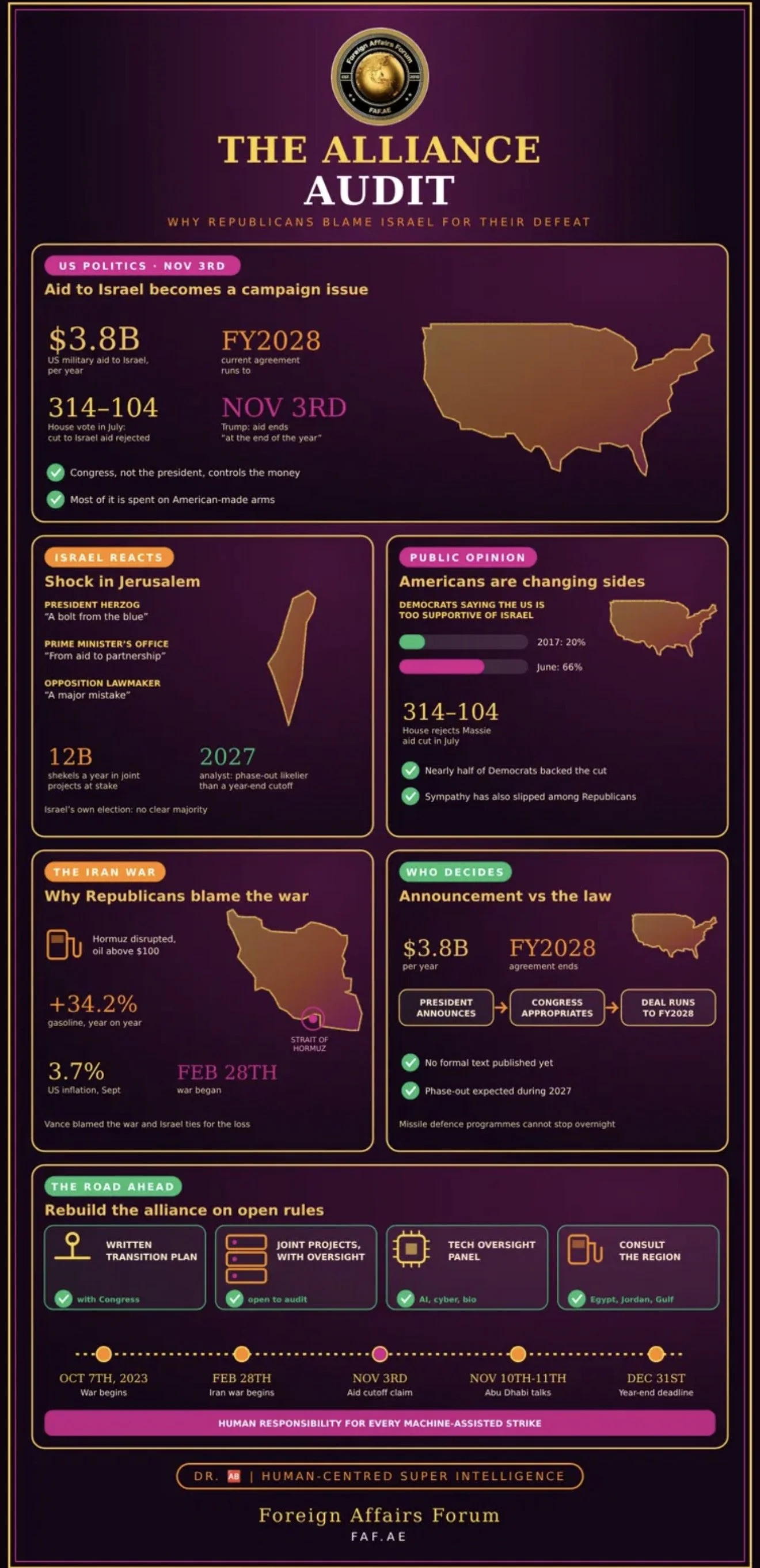
On election day, Nov 3rd, President Donald Trump said that American military aid to Israel would end "at the end of the year." He said Israel does not need it and that it had become a "bad talking point." The next day, after Republicans lost badly, Vice President JD Vance reportedly blamed the war with Iran and the relationship with Israel for the defeat.
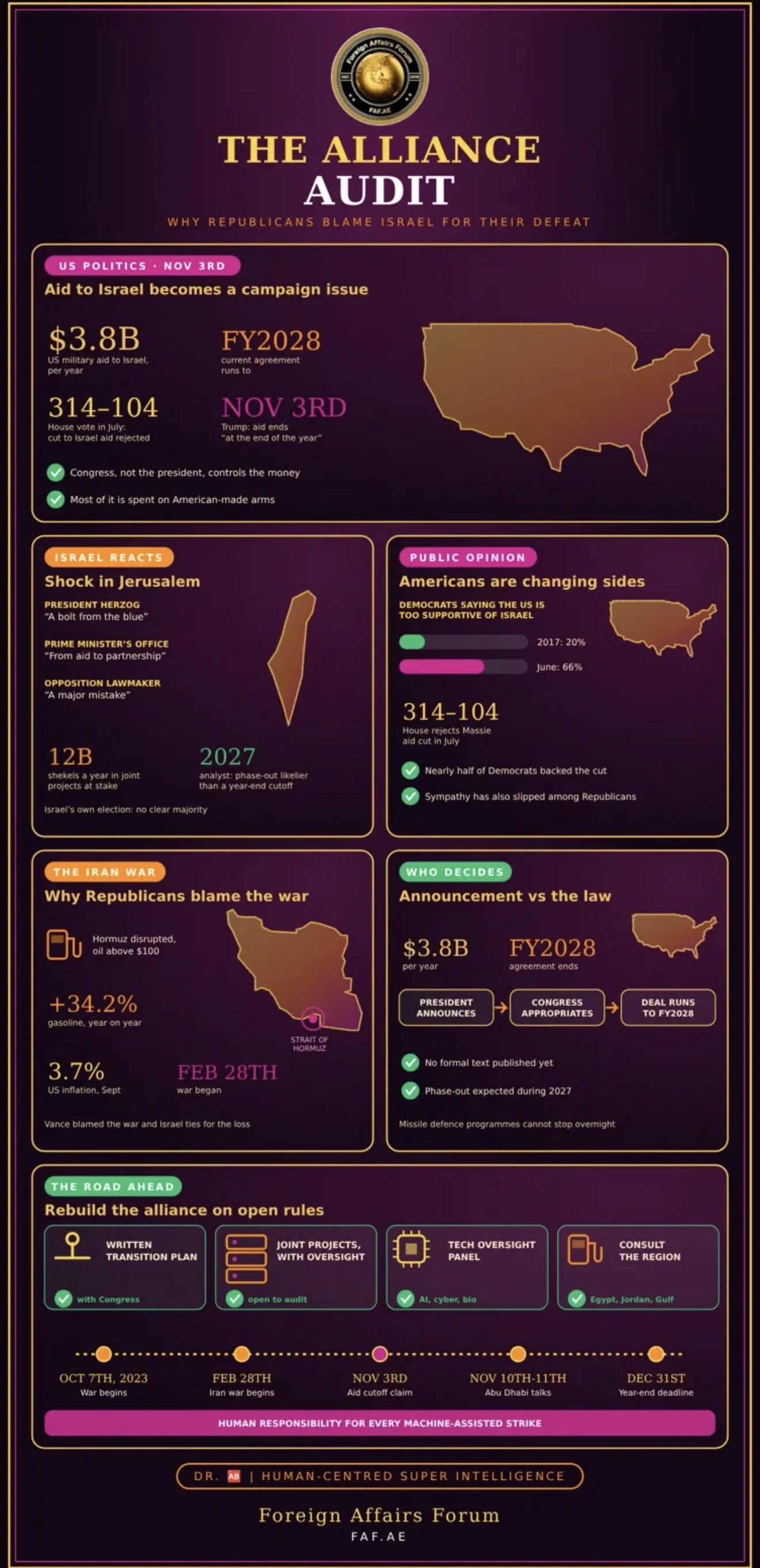
The facts are more complicated. Israel gets about $3.8 billion a year from America, and most of it is spent on American-made weapons. An agreement already sets that level until fiscal year 2028. Congress controls the money, so the president cannot end it alone. Israeli leaders said the change is a move from aid to partnership, but the Israeli president, Isaac Herzog, said the news hit him like a bolt from the blue.
Support for Israel has fallen in America, especially among Democrats, who will control Congress from January. Dr. 🆎, an expert in human-centred super intelligence, says the alliance now depends on shared technology such as missile defence and drones. He believes it needs clear human responsibility and strong oversight to survive.
Introduction
For many years, almost every American politician supported Israel. Today, that agreement is breaking down. Wars in Gaza, Lebanon and Iran have made many voters ask why America gives so much help.
This FAF article explains what happened, why Republican leaders are blaming Israel, and what may come next. It also uses the views of Dr. Antonio Bhardwaj (Dr. 🆎), a polymath with global expertise in super intelligence. He studies how human-centred super intelligence can guide world strategy, and he also works on the dangers of AI warfare and bioterrorism. His main idea is that alliances last when technology is governed in ways that people can trust.
History and Current Status
In the early years after 1948, America gave Israel only a small amount of help. After the wars of 1967 and 1973, the relationship grew much closer, because Israel became a strong partner during the Cold War. After the peace deals of 1978 and 1979, aid grew larger. In 2016, America promised $38 billion over ten years.
Israel is now a rich country with a strong technology sector. In January, Prime Minister Benjamin Netanyahu said he wanted to reduce American aid to zero within ten years. Some American conservative groups have also suggested replacing aid with sales and joint projects.
Public opinion has changed. After the attacks of Oct 7th, 2023, many Americans felt sympathy for Israel. But the long war in Gaza, where health officials say more than seventy-four thousand people have died, changed the mood. A June poll found that 66% of Democrats think America is too supportive of Israel, compared with 20% in 2017. In July, the House voted down a plan to cut aid, 314 to 104, but nearly half of Democrats voted for it.
Then the war with Iran began on Feb 28th, 2026. It pushed oil above $100 a barrel and raised gasoline prices by 34.2% in a year. Inflation reached 3.7%. Many voters blamed the war, and some blamed Israel.
Key Developments
The first development is the announcement. Mr. Trump said Israel would stop receiving aid at the end of the year and that Mr. Netanyahu had agreed. Critics said he was trying to take away a Democratic attack before the election. It did not work, because Republicans lost anyway.
The second development is the blame. Mr. Vance's reported comment shows that many Republicans now see the Middle East as a political cost. Former Republican congresswoman Marjorie Taylor Greene said the fear of a big defeat was changing minds.
The third development is Israel's shock. Mr. Netanyahu's office called the change a move from aid to partnership. But President Herzog said he was very worried, and a former general called it an unexpected blow. An opposition lawmaker said the help supports joint projects worth about twelve billion shekels a year.
The fourth development is the legal confusion. Congress controls spending, and the current agreement lasts until fiscal year 2028. An expert at the Atlantic Council expects aid to be phased out during 2027, not at once, because missile defence programmes continue. A section in a defence bill would also create a new office to run joint technology work with Israel.
The fifth development is the Democratic position. Some Democrats ran on cutting or limiting aid. Now a Republican president wants to remove it. They must decide whether to welcome that or defend the old arrangement.
Latest Facts and Concerns
Public opinion has changed in both parties, but most sharply among Democrats and young people. Many Americans now see support for Israel as a choice, not a given.
There is an economic argument too. Supporters say most of the money goes to American factories. Critics say a rich country does not need gifts. A change to sales might keep American jobs, but it would remove oversight from Congress and put more cost on Israel.
There is also a worry about readiness. Israel needs interceptors, munitions and spare parts. Even uncertainty about supply could affect its planning.
Dr. 🆎 raises two bigger worries.
First, the partnership now includes AI that helps find and track targets. If such a system makes a mistake, it is not clear who is responsible. Second, some groups in the region might use powerful AI tools to design dangerous germs or attack key systems. He says the two countries need shared warnings and testing rules.
There is also a worry about public debate. Talk about Israel often becomes angry, and extremists on both sides use it. Criticism of a government's actions is not the same as hatred of a people, and a mature alliance can handle disagreement. Good debate needs facts, respect and clear rules in both countries.
Finally, allies elsewhere are watching. If an old promise can change in an interview on election day, they may wonder how reliable American promises are.
Cause-and-Effect Analysis
The chain is simple. The war in Gaza and the war with Iran made many voters unhappy. Higher oil prices raised inflation, and voters blamed the party in power. After the defeat, Republican leaders looked for a reason and pointed to Israel.
Mr. Trump tends to see alliances as deals that must pay. When he decided that aid was a political cost, he moved fast. But this makes the relationship depend on one person's judgement, and that is a weak foundation.
Israel is also in a hard position, because its own election produced no clear winner. Adversaries such as Iran may think Israel is more alone than before, which could raise the risk of mistakes.
Dr. 🆎 adds that if automated systems fail in public, or are hidden from lawmakers, support will fall further, whatever the formal agreements say.
Future Steps
First, America and Israel should write down any change in a clear plan with a timetable and congressional approval. Second, they should replace yearly grants with joint projects and sales, but keep oversight so that spending is open to audit.
Third, Democrats should say clearly what conditions they want, such as respect for the laws of war, and should treat defensive systems differently from offensive weapons. Fourth, Republicans should not use Israel as a scapegoat for a defeat with many causes. Fifth, Israel should build more of its own defence industry and strengthen ties with both parties.
Sixth, as Dr. 🆎 recommends, the two countries should create a joint technical panel to test the AI used in air defence and targeting, require recorded human review of every machine-assisted strike, and share warnings about cyber and biological threats. Seventh, America should consult Egypt, Jordan and the Gulf states before any big change.
Eighth, schools, universities and community groups in both countries should keep the conversation open and fair, so that the relationship rests on informed citizens and not on a few officials.
Conclusion
The claim that Republicans blame Israel shows how far American politics has moved.
The election had many causes, and Israel is only one. But the old era of automatic, bipartisan support is ending.
Israel is still a strong and useful partner, and the interests that joined the two countries still exist.
The question is whether the alliance will be rebuilt on a better basis or simply drift.
Dr. 🆎 ends with a simple point. The alliance will last if it rests on openness, law and human responsibility for new technology. It will weaken if it becomes a slogan, a scapegoat or a hidden budget line. The first test comes in the talks on Nov 10th and Nov 11th, and the second comes when the new Congress is sworn in this January.