The Great Exception: How the AI Boom Is Turning Protectionists into Free Traders
Foreign Affairs Forum | Dr. Antonio Bhardwaj (Dr. 🆎)| Nov 6th, 2026
Executive Summary
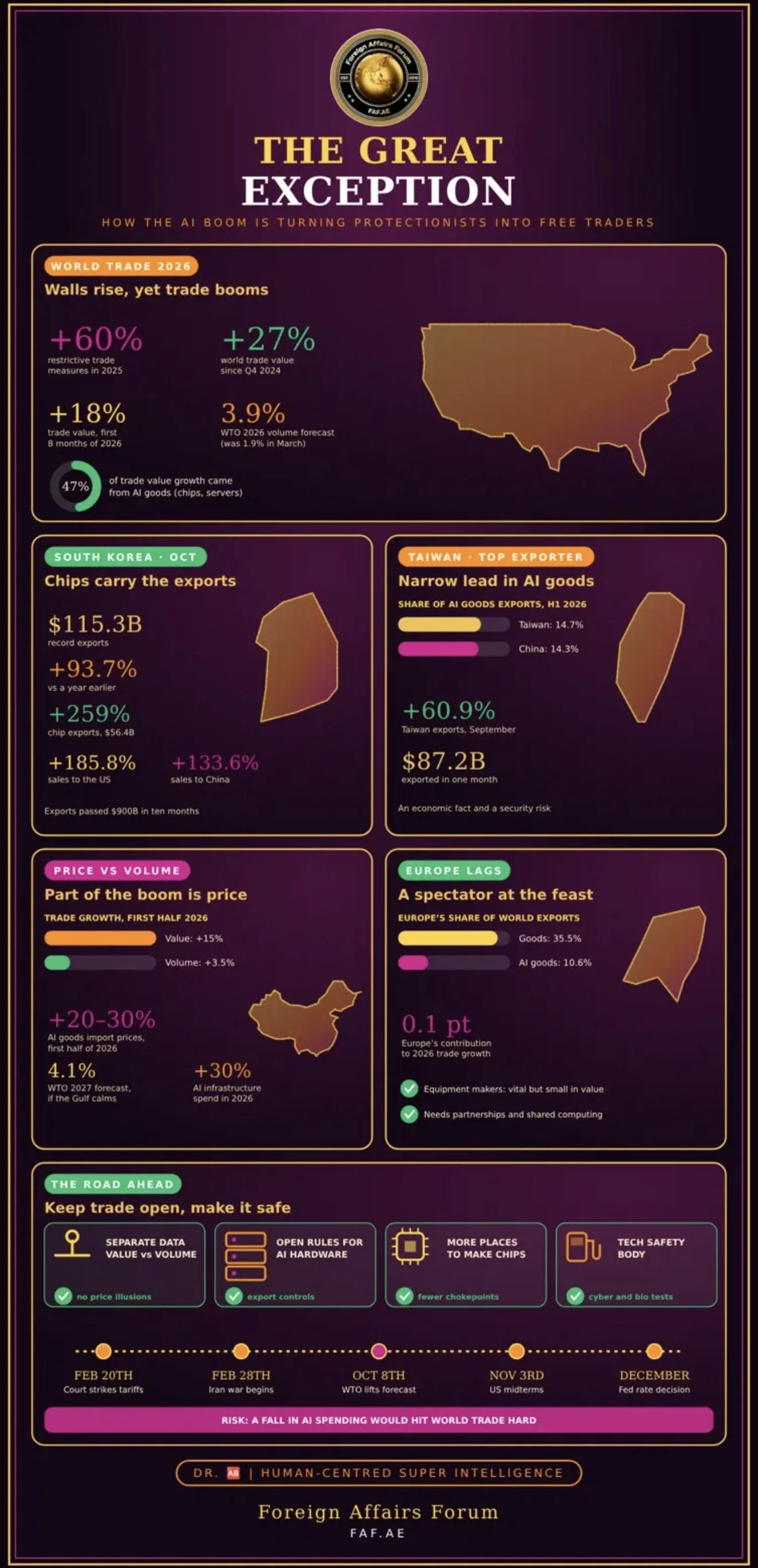
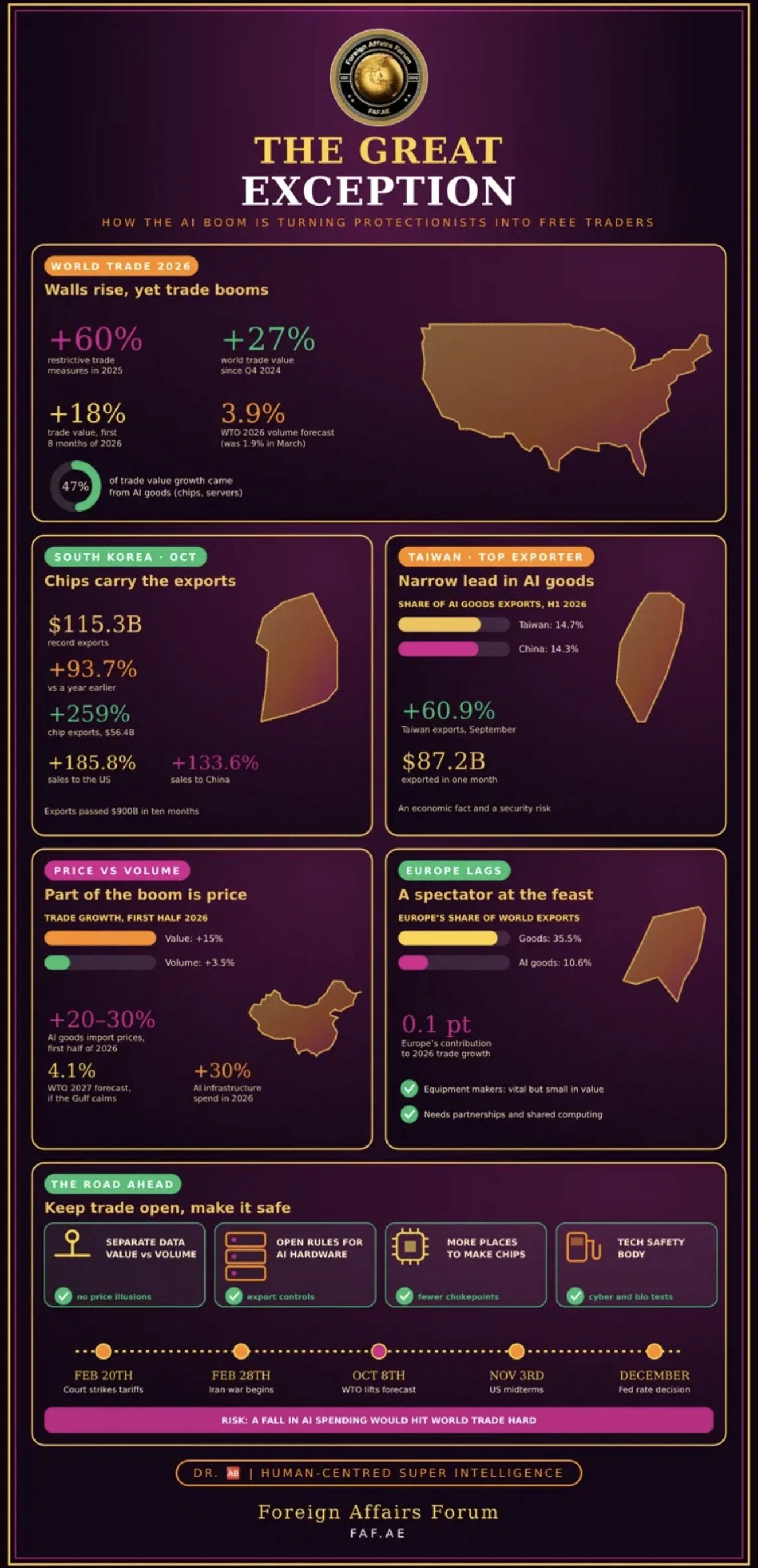
A year and a half ago, President Donald Trump set out to reverse globalisation. He declared chronic trade deficits a national emergency, imposed heavy tariffs and inspired imitators from New Delhi to Brussels to Mexico City. An index compiled by economists at the World Trade Organisation and the International Monetary Fund showed that restrictive trade measures rose by more than 60% in 2025 alone. By any ordinary reckoning, the world should now be experiencing a retreat from trade.
It is experiencing the opposite. Since the final quarter of 2024, the $ value of world trade has risen by more than 27%, and in the first eight months of 2026 it was up by 18% on the same period last year. The World Trade Organisation raised its forecast for 2026 merchandise trade volume growth to 3.9% in its update of Oct 8th, more than double the 1.9% it projected in March.
The explanation is artificial intelligence. Goods linked to the technology, such as advanced semiconductors, servers and networking equipment, account for 14.8% of world merchandise trade but supplied 47% of its growth in value in the first half of the year. South Korea's exports reached a record $115.3 billion in October, up 93.7% from a year earlier, with chip sales alone rising 259% to $56.4 billion.
The consequence is a remarkable inversion. The same governments that erect barriers to steel, cars, textiles and farm goods are removing them, or leaving them unbuilt, for the hardware of the AI economy. Protectionists have become free traders in one sector, because they believe that the race for computing power is the race that matters most. This is not a conversion to liberal principle. It is a hierarchy of fear, in which dependence on foreign steel is tolerable but dependence on foreign intelligence is not.
Dr. 🆎, an expert in human-centred super intelligence, argues that this exception deserves careful scrutiny. The trade boom is concentrated in a few places and a few products, it partly reflects rising prices rather than rising volumes, and it depends on an investment cycle that could reverse. He contends that the governance of AI hardware trade, including export controls, supply security and dual-use risks, has become the central question of world economic strategy.
Introduction
The standard story of the past two years is one of rising walls. Tariffs climbed in the United States. India urged its citizens to embrace self-sufficiency. The European Union moved to double tariffs on steel imports, and Mexico approved steep levies on goods from China and other Asian economies. Supply chains were rerouted, alliances were strained and economists warned that the era of open trade was ending.
That story is true but incomplete. Beneath the surface of the tariff wars, a different flow has been growing at extraordinary speed. Containers of servers, accelerators, memory chips and networking gear are crossing oceans in quantities that dwarf anything seen in previous technology cycles. The walls are rising everywhere except around the technology that governments most want.
This FAF article examines that paradox. It asks why protectionist governments are making an exception for AI, what the exception reveals about the real priorities of economic nationalism, and what risks it creates.
It also draws on the views of Dr. Antonio Bhardwaj (Dr. 🆎), a polymath with global expertise in super intelligence. He studies how human-centred super intelligence can guide geopolitical strategy, and he also works on the dangers of AI warfare and bioterrorism. His central argument is that the world is building a new trade system around compute, and that systems built without rules for safety and security will eventually fail.
The analysis begins with the history of globalisation and its recent reversal. It then describes the boom and its distribution, considers the concerns it raises, traces the causal links and ends with recommendations.
History and Current Status
Trade policy has swung between openness and closure for centuries. In the 19th century, Britain's repeal of its grain tariffs symbolised a liberal order built on cheap food and industrial exports, while other powers, including the United States and Germany, protected their young industries.
The Great Depression of the early 20th century saw a wave of tariffs that deepened the collapse. After 1945, a succession of agreements lowered barriers, and the creation of the World Trade Organisation in 1995 seemed to lock in the gains. Trade grew faster than output for decades, a pattern that economists identify as the hallmark of globalisation.
The financial crisis of 2007-09 broke that pattern. Trade recovered but slowly, and the pandemic then exposed the fragility of long supply chains. A sense grew in many countries that openness had hurt industrial workers and left nations dependent on rivals for critical goods. Mr. Trump, in his first term and especially in his second, gave the sentiment its most forceful voice. He imposed tariffs on allies and rivals alike and described the trade deficit as a national emergency.
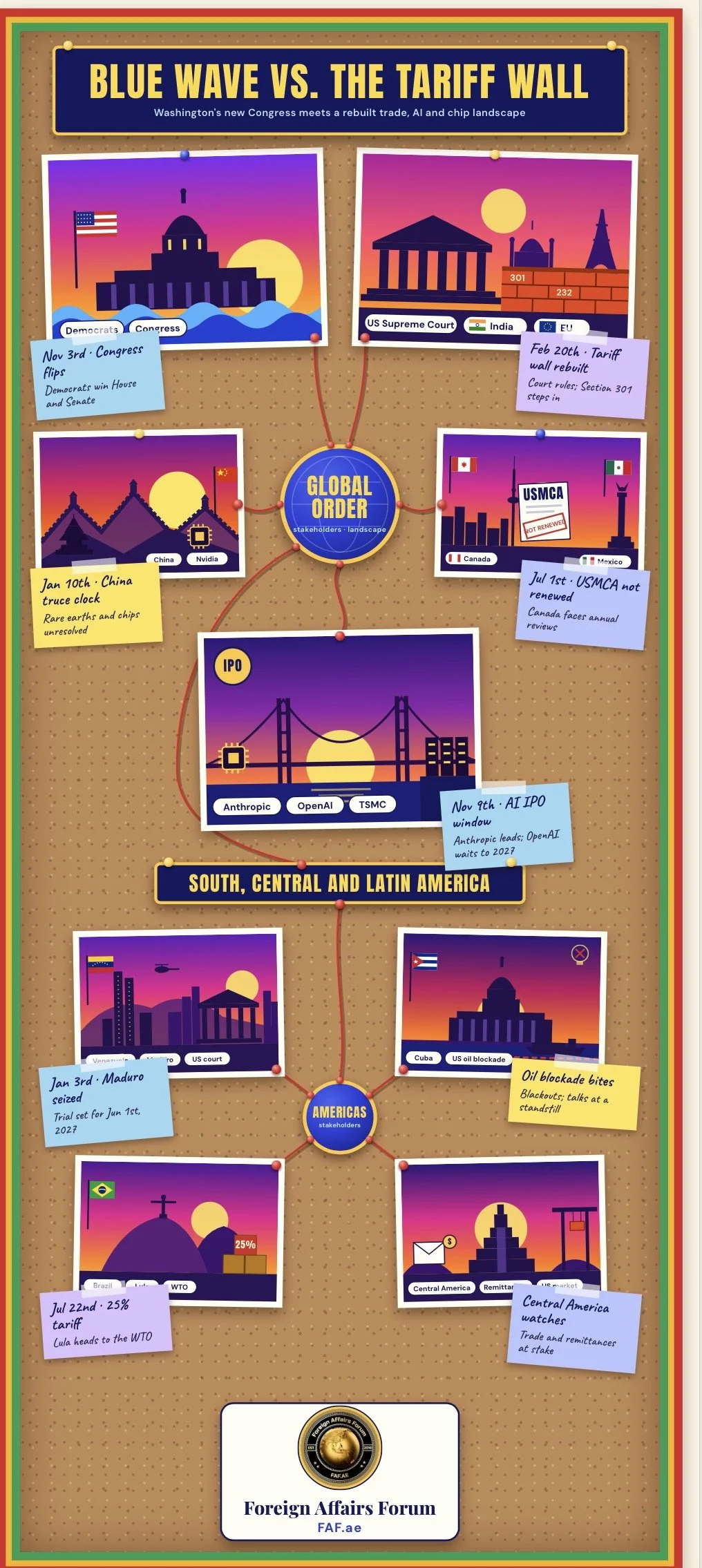
The legal foundation of that approach was shaken on Feb 20th, 2026, when the Supreme Court ruled that the president could not use an emergency law to impose sweeping tariffs, because taxation belongs to Congress. The administration responded with a temporary 10% tariff under another law that lasts only one hundred and fifty days, and with a search for other tools. The result is a tariff structure that is in flux, with uncertainty about refunds and about what will replace the struck-down duties.
The war with Iran, which began on Feb 28th, 2026, added another shock. The conflict disrupted the Strait of Hormuz, and crude oil export volumes from the Middle East fell by about 24% in the first half of the year, while liquefied natural gas volumes fell by nearly half. Oil rose above $100 a barrel, gasoline prices rose by 34.2% over twelve months and United States inflation reached 3.7% in September. Conditions that would once have predicted a collapse in trade instead coincided with a boom.
The reason is that a new category of goods has risen to dominate the margins of global commerce. Before 2023, goods related to artificial intelligence represented roughly 7% to 8% of world merchandise trade. Their value fell by 10% in 2023, then rose by 16% in 2024 and 31% in 2025. In the first half of 2026 it rose by 67% year on year, while total merchandise trade rose by 15% in value. Their share has therefore nearly doubled, to 14.8%, and they supplied 47% of the growth in the value of world trade in that period.
The geography of the boom is concentrated. East Asia outside China supplied about 40% of AI goods exports in 2025, and Southeast Asia supplied about 23%. Taiwan was the largest exporter in the first half of 2026, with a share of 14.7%, just ahead of China at 14.3%. Taiwan's exports rose by 60.9% in September alone, to $87.22 billion. North America drives the demand, as American technology companies purchase enormous quantities of hardware for data centres. Europe, by contrast, holds 35.5% of world merchandise exports but only 10.6% of AI goods exports, and its contribution to trade growth this year is close to zero.
The current status, then, is a world of two trade systems. One is the old system of steel, cars, clothing and food, where barriers are rising and growth is modest. The other is the new system of compute, where barriers are low, volumes are surging and governments compete to attract investment. The first system generates headlines, but the second generates the growth.
Key Developments
The first development is the revision of the official outlook.
In its update of Oct 8th, the World Trade Organisation raised its forecast for the growth in the volume of world merchandise trade in 2026 from 1.9% to 3.9%, and projected 4.1% for 2027 on the assumption that the conflict in the Middle East eases. It credited two forces: the resilience of supply chains, which absorbed the shock from the Gulf, and investment in AI infrastructure, which lifted trade. Global spending on AI infrastructure is expected to rise by at least 30% this year, and by a further 10% to 20% next year, with the United States accounting for roughly two-thirds to three-quarters of the total. Trade volume is therefore set to grow faster than the world economy for a second consecutive year, as it did in globalisation's heyday.
The second development is the extraordinary performance of Asian exporters.
South Korea's exports reached a record $115.3 billion in October, an increase of 93.7% on a year earlier, and its trade surplus for the month was $42.5 billion. Semiconductor exports rose by 259% to $56.4 billion, accounting for more than a quarter of the month's total. Shipments to the United States rose by 185.8% to $24.9 billion, and shipments to China rose by 133.6% to $26.98 billion. Total exports for the first ten months passed $900 billion for the first time, and the government says that annual exports could reach $1 trillion as early as November. Taiwan's exports have grown at a comparable pace, with shipments to the United States soaring as American purchasers rush to build capacity.
The third development is the tariff exemption that has made the boom possible.
Semiconductors and many items of computing equipment have been excluded or exempted from the broad tariffs imposed on imports, because American officials recognise that taxing the hardware of the AI buildout would raise the cost of the very investment that they wish to encourage. Other governments have behaved similarly. Countries that have raised barriers on steel, cars and consumer goods have simultaneously offered incentives, land, power and tax breaks to attract data centres and chip plants. The pattern is consistent across ideologies, which suggests that it reflects a shared strategic belief and not a passing political calculation.
The fourth development is the divergence among regions.
North America is the engine of import demand, contributing a large share of the growth in AI goods imports. East and Southeast Asia, including China, supplied nearly two-thirds of world exports of computing and infrastructure equipment. Europe is the laggard. Its exports of AI goods are small, its overall exports fell slightly this year and its contribution to world trade growth is close to zero. European industry occupies critical nodes, including the lithography machines that make advanced chips possible, but these are small in value compared with the servers and accelerators that dominate trade. The continent is therefore a spectator at the feast, and its leaders are aware of it.
The fifth development is the policy contradiction in the major capitals.
Mr. Trump's administration has used tariffs as a weapon, yet it has welcomed a surge of imported hardware. The Democratic majority that won the midterm elections on Nov 3rd campaigned against high prices and tariffs but also against the expansion of data centres, which means that it will inherit a trade system in which the most dynamic sector is also the most politically contested. Voters rejected data centre projects in forty of forty-one local ballot measures on election night. The trade boom and the political backlash are therefore two sides of the same phenomenon, and neither can be understood without the other.
The sixth development is the influence of the energy shock.
The Middle East conflict reduced the volume of oil and gas exports, and prices soared. Yet other suppliers limited the decline in global volumes to about 6% for crude and about 1% for gas. This resilience shows that the world trading system, whatever its political troubles, retains a capacity to adapt that few expected.
Dr. 🆎 observes that the adaptation of energy markets and the boom in compute are linked, because the computers consume vast amounts of electricity, and the competition for power is now a trade issue as well as a domestic one.
Latest Facts and Concerns
The most important qualification is that part of the boom is a price effect.
The World Trade Organisation notes that in the first half of the year the value of world merchandise trade grew by about 15%, while the volume grew by only about 3.5%. Estimates by European central bankers suggest that import prices for AI goods rose by about 10% in 2025 and by 20% to 30% in the first half of 2026. The scarcity of advanced chips, the concentration of production in a few firms and the intense demand from a small number of buyers have all pushed prices upward. A boom measured in $ terms is not the same as a boom measured in tonnes, and policymakers who treat the first as the second may draw false conclusions.
A second concern is concentration.
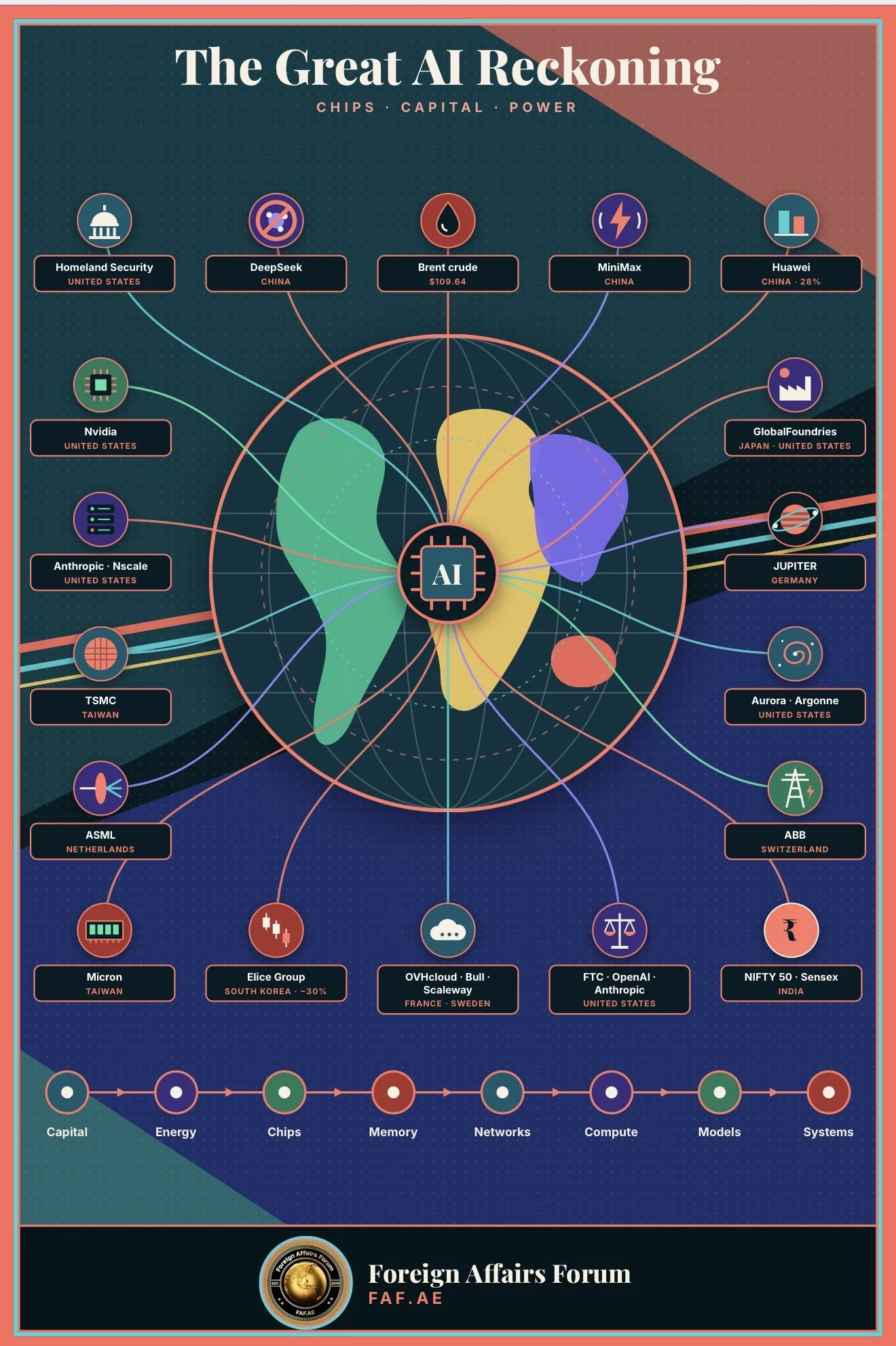
A few companies in the United States buy a vast share of the hardware, and a few firms in Taiwan, South Korea and the Netherlands make or enable its production. If any of these links is disrupted, whether by earthquake, blockade, cyberattack or political crisis, the consequences for the world economy would be severe.
Dr. 🆎 emphasises that Taiwan's position is both an economic fact and a security vulnerability, and that the trade boom has deepened the world's exposure to a single strait.
A third concern is the reversibility of the investment cycle.
The World Trade Organisation warns that a slowdown or reversal in AI investment could have a significant impact on trade because of the high import content of the hardware. It identifies a second channel, which is the wealth effect, because households hold exposure to AI companies through index funds and pension plans. Markets have already shown nervousness. The Nasdaq has fallen to about 11% below its record, and analysts at UBS have warned that about 30% of expected data centre additions in 2028 could be at risk. If the boom turned, world trade could slow abruptly, and economies that depend on chip exports would feel it first.
A fourth concern is the political backlash against data centres.
The same electorates that benefit from the investment object to its local costs, including higher electricity prices, water use and noise. An exit poll in the midterm elections found that 56% of voters regarded AI and data centres as a crucial or major factor in their congressional vote. If local resistance grows, projects may be delayed or relocated, and the trade flows that supply them would shift. The boom therefore depends on social consent as well as on capital.
A fifth concern is the security of dual-use goods.
Dr. 🆎 stresses that the hardware now flowing across borders is not neutral. The same accelerators that train commercial models can support military planning, cyber operations, autonomous weapons and the design of dangerous biological agents. Export controls attempt to manage the risk, but they are contested, leaky and politically volatile. A trade system that celebrates the free movement of such hardware while ignoring its military uses is storing up trouble.
A sixth concern is inequality among nations.
Countries that make chips and assemble servers are prospering. Countries that supply energy, minerals or labour to the chain are benefiting unevenly. Countries that merely consume the services, or that are shut out of access to the most advanced hardware, risk falling behind. Europe's weakness is the most visible example, but developing countries face a larger version of the same problem. The new trade system may widen, not narrow, the gap between those with compute and those without.
A seventh concern is the effect on the old trade system.
While the AI boom lifts the headline numbers, trade in other goods remains weak and fragile. The index of restrictive measures is rising, tariffs are in legal flux and supply chains are being rebuilt along political lines. A statistical boom can hide a structural decline. If policymakers conclude from the headline that protectionism has failed to damage trade, they may be encouraged to extend it, with real costs for industries and consumers that do not benefit from the AI surge.
An eighth concern is the strain on energy and materials.
The boom requires vast quantities of copper, rare earths, high-purity chemicals and electricity, and the Middle East conflict has already disturbed energy markets. If the demand for these inputs outruns supply, bottlenecks will appear, prices will rise and governments will be tempted to impose export restrictions of their own.
Dr. 🆎 warns that the competition for the inputs of compute may become the next arena of trade conflict, and that the world has no institution well suited to manage it.
Cause-and-Effect Analysis
The causal chain begins with a strategic belief.
Governments have concluded that artificial intelligence will determine economic power and military advantage in the coming decades, and that the country that leads in computing capacity will hold a decisive edge. This belief overrides the instinct for protection. A government that taxes imported steel to protect a factory will not tax imported accelerators if doing so delays a data centre that it believes is vital to national power. The effect is a selective liberalisation in which openness is reserved for the goods that matter most to the strategic competition.
The second link is the structure of supply.
Advanced chips are made by a very small number of firms, using equipment from an even smaller number, in a few locations. No country can produce the full stack alone. This means that a country that wishes to build computing capacity must import, and that its imports must come from the few places that can supply them. Nationalists who wanted self-sufficiency have found that in the most important sector, self-sufficiency is impossible. The consequence is that trade in AI hardware has become a form of interdependence that no protectionist programme can easily break.
The third link is the scale of investment.
American technology companies are spending hundreds of billions on data centres, and they buy hardware from abroad. Every $1 of investment generates imports, and every import generates exports for a supplier in East Asia. This chain explains why the value of trade has surged in a year of tariffs and conflict. It also explains why the surge is concentrated and why it is vulnerable to any change in the investment cycle. The trade boom is, in effect, a derivative of American capital spending.
The fourth link is price.
Because supply is constrained and demand is intense, prices have risen, and part of the apparent boom is inflation. This has a double effect. It inflates the statistics, making the boom look larger than it is, and it increases the cost of building computing capacity, which affects every buyer. Countries and companies with less purchasing power are priced out. The result is that the market allocates scarce hardware to the richest buyers, which reinforces the concentration of capability.
The fifth link is political.
Voters in the importing countries experience the boom through its local consequences, which are higher power bills, strained water supplies and the arrival of large industrial buildings in their communities. Their anger fed directly into the midterm elections, in which Democrats won both chambers of Congress. This link shows that a trade boom can generate a political reaction that eventually constrains it. The same investment that drives imports may be slowed by zoning boards, state legislatures and ballot measures, which would reduce trade flows even without any change in national tariff policy.
The sixth link is financial.
Interest rates matter. Markets expect the Federal Reserve to consider raising rates in December, and higher rates raise the cost of financing data centres. Inflation of 3.7% and rising borrowing costs may slow the investment cycle, and a slowdown in investment would quickly be felt in the exports of Korea, Taiwan and others. The irony is that decisions made for reasons unrelated to technology may do more to alter trade than any deliberate trade policy.
The seventh link is geopolitical.
The surge in trade with China, shown in the sharp rise of Korean exports to that country, coexists with intense American efforts to restrict China's access to advanced chips. This contradiction illustrates how trade and security are entangled. The more the world depends on a shared supply chain, the more powerful are the tools of exclusion, and the more tempting it becomes to use them.
Dr. 🆎 argues that this entanglement creates a perverse incentive. States will seek to control chokepoints, and rivals will seek to bypass them, and the resulting competition may damage the trade flows on which both depend.
Taken together, these links reveal that the AI trade boom is not evidence that protectionism has failed or that globalisation has returned in its old form. It is a new kind of globalisation, narrower, more strategic and more politically fragile. It is driven by a belief about power, sustained by a cycle of investment, concentrated in a few places and exposed to shocks from finance, politics and security. Understanding that structure is essential to judging what comes next.
Future Steps
First, governments should be honest about what the boom is and is not.
Statistical agencies and international organisations should publish separate figures for the value and volume of AI-related trade, so that the contribution of price increases can be distinguished from real growth. Policymakers who see only the headline will misjudge both the strength of the economy and the effectiveness of their policies.
Second, the major economies should negotiate a framework for trade in AI hardware that combines openness with security.
Such a framework would set clear rules for export controls, define categories of dual-use equipment, provide for verification and create channels for resolving disputes. At present, controls are imposed unilaterally, change frequently and are enforced unevenly, which creates uncertainty for companies and incentives for smuggling. A transparent system, negotiated among the main producers and consumers, would be more durable.
Third, countries should reduce their exposure to chokepoints.
This means diversifying the production of chips and equipment across more locations, building strategic reserves of critical components, investing in redundant capacity and developing alternative suppliers. It also means defence planning that recognises the vulnerability of Taiwan and the Taiwan Strait, and diplomacy that reduces the risk of conflict. The cost of diversification is real, but the cost of a disruption would be far greater.
Fourth, the United States and its partners should coordinate their trade policy with their industrial and energy policy.
A country that imports vast quantities of computing hardware must also supply the electricity to run it. Faster approval of transmission lines, support for clean generation and fair rules for allocating costs would reduce the backlash that threatens the investment. Tariff policy should be stabilised through legislation, now that the Supreme Court has returned the power over tariffs to Congress, so that firms can plan with confidence.
Fifth, Europe should decide what role it wishes to play.
It cannot match the scale of American or East Asian investment in the short term, but it can build on its strengths in advanced equipment, research and regulation. It should pursue partnerships, invest in computing capacity for science and public services, and use its market power to promote standards for safety and transparency. A continent that is merely a customer for foreign hardware will have little voice in setting the rules.
Sixth, the international community should help developing countries gain access to computing capacity.
Without such help, the new trade system will deepen inequality. Shared regional facilities, open scientific infrastructure, training programmes and financing mechanisms could widen participation and reduce the risk that large parts of the world are excluded from the technology that will shape their economies.
Seventh, as Dr. 🆎 recommends, the governance of AI hardware trade should be linked to safety and security.
He proposes an independent technical body, supported by the major producers and consumers, to track the flow of the most capable hardware, to test advanced models for dangerous cyber and biological abilities and to advise on controls. He also urges recorded human review for every military use of machine-assisted targeting, and stronger biosecurity rules for access to biological design tools. These measures would not slow legitimate trade. They would protect the legitimacy of an open system by showing that it can manage its own risks.
Eighth, policymakers should prepare for a downturn.
If the investment cycle reverses, economies that depend on AI exports will need buffers, including fiscal space, flexible labour markets and support for retraining. Central banks and finance ministries should run stress tests that include a sharp fall in AI-related trade, and international institutions should be ready to provide liquidity if needed.
Ninth, trading partners should coordinate their approach to the tariffs that remain.
The temporary 10% tariff that replaced the struck-down duties will expire after one hundred and fifty days, and Congress will have to decide what, if anything, replaces it. A predictable, legislated structure, with narrow protection for genuinely strategic industries and no broad taxes that merely raise consumer prices, would reassure investors and reduce the incentive for retaliation. The refund question should also be settled quickly, since uncertainty itself is a cost to firms that must plan years ahead.
Tenth, public understanding must keep pace.
Citizens who are asked to host data centres, to pay for grid upgrades and to accept the risks of dual-use technology deserve clear information about costs, benefits and safeguards. Governments and companies that explain these openly will find consent easier to win, and trade in the hardware that powers the new economy will rest on firmer ground.
Conclusion
The paradox with which this FAF article began has a clear resolution. Protectionism has not failed to bite, but it has bitten selectively. In steel, cars, clothing and food, barriers are rising and the effects are felt in prices and in lost opportunities. In the hardware of artificial intelligence, barriers are low, because governments fear dependence on rivals for intelligence more than they fear dependence for goods. The result is a boom that is real but narrow, large but concentrated, and strong but fragile.
The deeper lesson is that economic nationalism is a hierarchy of priorities. It protects what leaders regard as expendable and opens what they regard as essential. By observing what they choose to open, we learn what they truly value, and in 2026 they value computing power above almost everything else. That choice will shape the next decade of world politics, because the trade in compute is also a competition over military capability, scientific leadership and economic influence.
Dr. 🆎 ends with a simple point. A trade system is only as strong as the trust that sustains it. If the AI economy is seen as concentrating wealth, raising bills and increasing the risk of catastrophe, it will provoke the same backlash that earlier forms of globalisation did. If it is governed by rules that are open, verifiable and centred on human responsibility, it can bring prosperity and strength to many nations. The next twelve months, as the investment cycle meets the ballot box and the central bank, will show which path the world takes.