The Alliance Audit: Republicans Blame Israel for Defeat as Washington Rethinks the Relationship
Foreign Affairs Forum | Dr. Antonio Bhardwaj (Dr. 🆎)| Nov 6th, 2026
Executive Summary
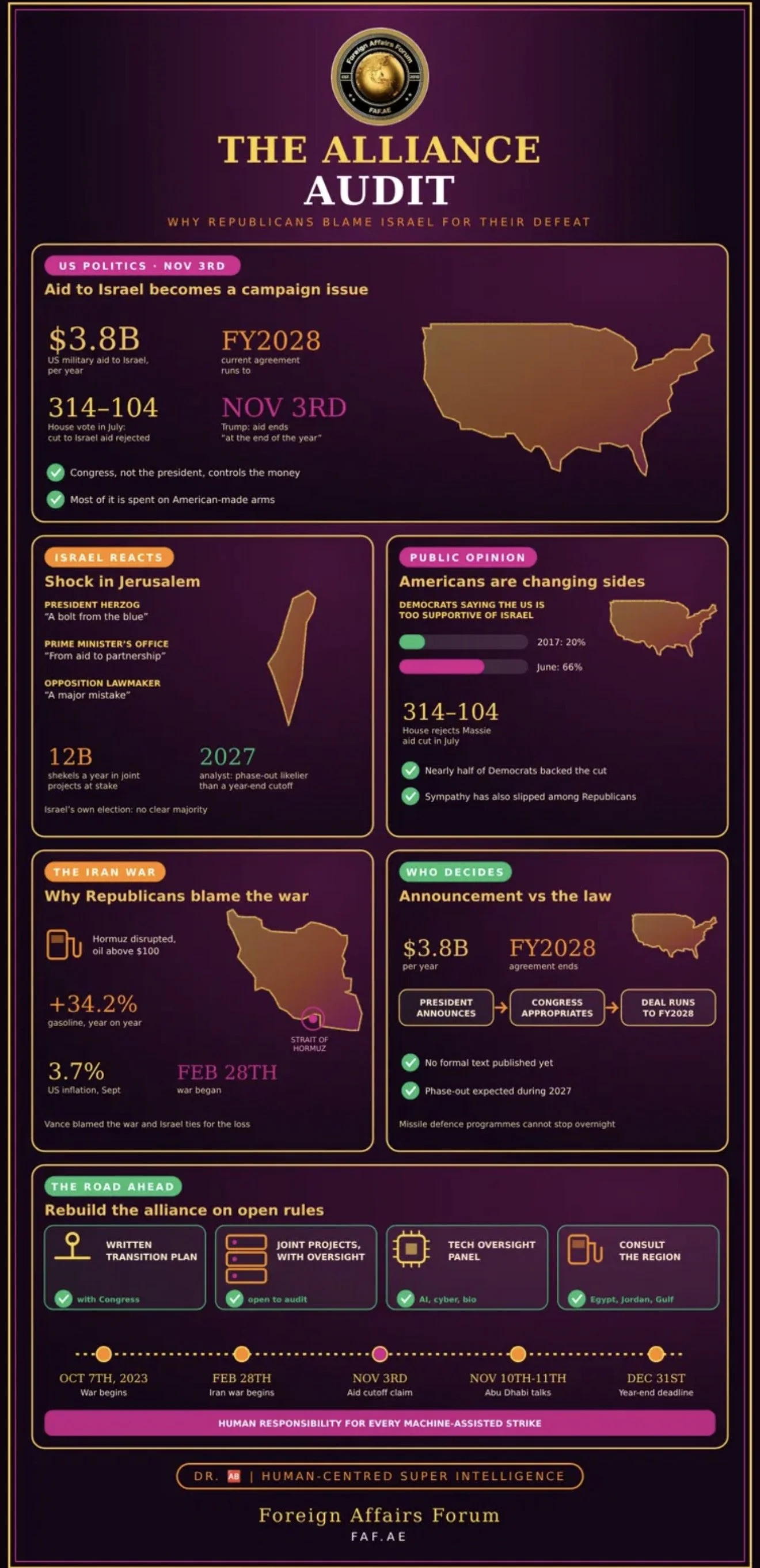
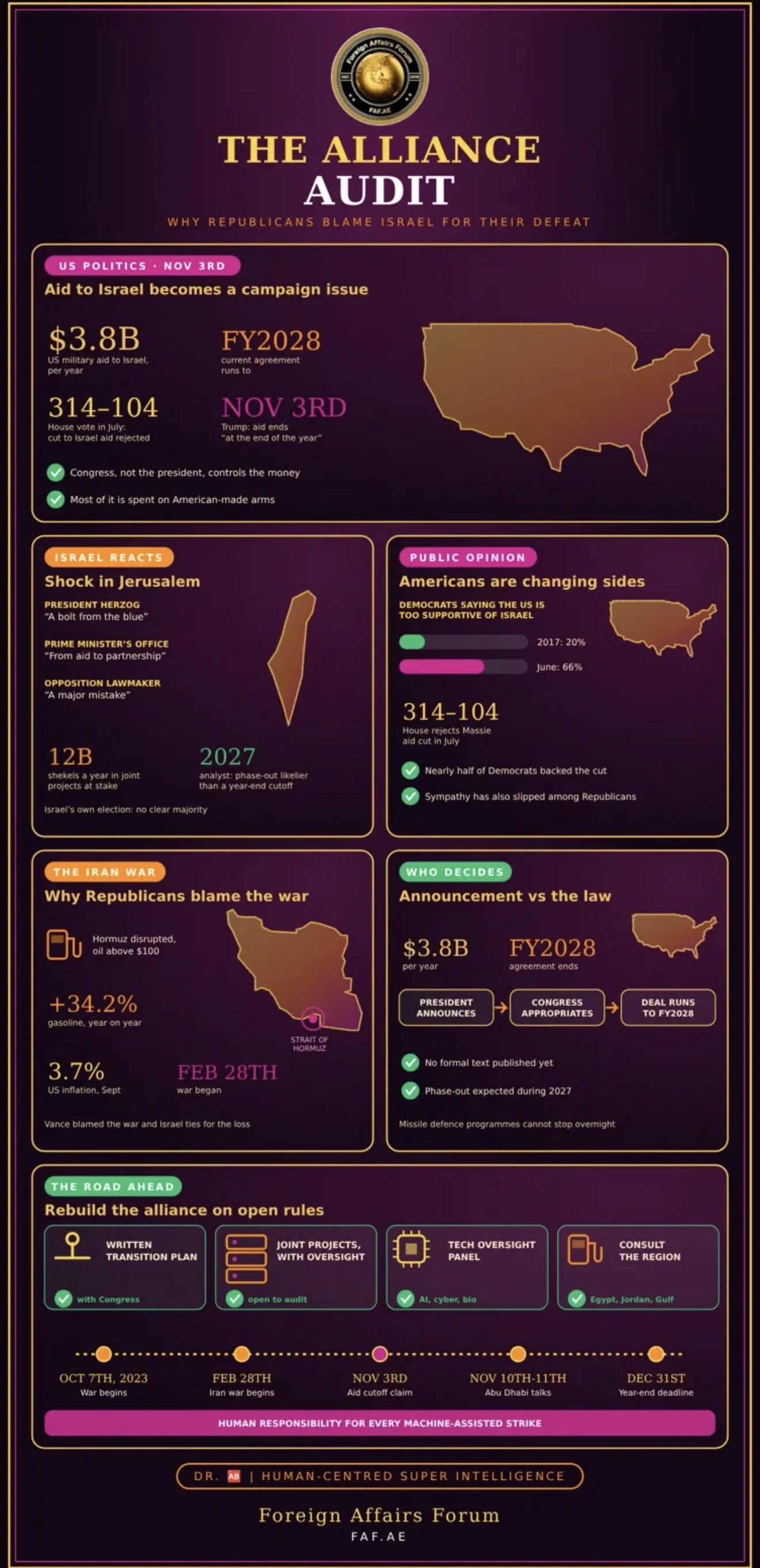
The blame began before the polls closed. On Nov 3rd, in a television interview on election day, President Donald Trump said that American military aid to Israel would end "at the end of the year," explaining that Israel no longer needs it and adding that it had become a "bad talking point."
The following day, after the Republican Party suffered a defeat of historic scale, Vice President JD Vance reportedly attributed the loss to the war with Iran and to the American relationship with Israel. Within hours, a question that had been whispered in Washington for years was being argued in public: whether the alliance that has defined American policy in the Middle East since the 20th century is now a political burden.
The facts are more complicated than the rhetoric. Israel receives about $3.8 billion a year in American military assistance under a memorandum of understanding that runs through fiscal year 2028, and most of that money is spent in the United States on American weapons. Congress, not the president, appropriates the funds, and no formal text announcing a cutoff has been published. Israeli officials have described the change as a move from aid to partnership, while President Isaac Herzog said that the news struck him like a bolt from the blue. Analysts expect any real change to come gradually in 2027 and beyond, partly because missile defence and counter-drone programmes cannot be switched off without risk.
Nonetheless, the political direction is clear. Support for Israel has fallen across the American political spectrum, and especially among Democrats, whose new majority will take its seats in January. Gaza, Lebanon and the unpopular war with Iran have eroded the bipartisan consensus that once protected the relationship. The Democratic victory therefore threatens to accelerate a decline that began under a Republican president.
Dr. 🆎, an expert in human-centred super intelligence, argues that the debate is too narrow. The deeper issue is that the alliance is becoming a technological partnership in which missile defence, drones, surveillance and machine-assisted targeting are developed jointly. He contends that such cooperation requires stronger democratic oversight and clearer human responsibility, and that a relationship governed only by money and slogans will be fragile.
Introduction
Alliances rest on interests, but they survive on legitimacy. For decades, the bond between the United States and Israel drew strength from a shared political culture, a strong domestic constituency and the strategic logic of the Cold War and its aftermath. Each of these supports has weakened. The Cold War is over, the constituency has fragmented and the strategic logic has been complicated by wars that many Americans no longer understand or wish to fund.
This FAF article examines what the midterm elections reveal about the future of the relationship, why Republican leaders have begun to blame Israel for their defeat, and what the Democratic majority may do. It also draws on the views of Dr. Antonio Bhardwaj (Dr. 🆎), a polymath with global expertise in super intelligence. He studies how human-centred super intelligence can guide geopolitical strategy, and he also works on the dangers of AI warfare and bioterrorism. His central argument is that the alliance will be judged less by the size of the cheque than by whether the technologies it produces are governed in ways that citizens in both countries can trust.
The article proceeds from history to the present. It recalls how the American commitment grew, describes the events of the past week, assesses the political and strategic consequences, and concludes with proposals for managing a transition that is already under way.
History and Current Status
The American relationship with Israel was not always as close as it later became.
In the first two decades after 1948, Washington provided modest assistance and withheld advanced arms. The turning point came after the wars of 1967 and 1973, when Israel proved itself a capable regional power and the Cold War logic of containing Soviet influence made it a valuable partner. Aid rose steeply after the Camp David agreements of 1978 and 1979, when Israel and Egypt each received large assistance packages as the price of peace. From that period onward, American support became a structural feature of regional policy.
The modern framework is built on ten-year memoranda of understanding.
The agreement signed in 2016 committed the United States to $38 billion over a decade, and the current arrangement continues the annual level of about $3.8 billion through fiscal year 2028. Almost all of it is spent on American-made arms and military supplies, which means that the assistance also supports American factories and jobs. This detail matters, because it explains why many officials in Washington describe the money as an investment in the defence industrial base as much as a gift to a foreign government.
Israel is no longer a poor country.
Its economy is advanced, its technology sector is world-class and it has become one of the largest arms exporters in the world. In January, Prime Minister Benjamin Netanyahu told a British magazine that he wished to taper American aid to zero within a decade. Conservative policy institutions in Washington have for some time proposed replacing grants with joint programmes or direct sales. A paper from one such institution in 2025 suggested a transition to military sales between 2029 and 2047. The idea that aid should evolve is therefore not new, and it is not confined to critics of Israel.
What changed in recent years is the political context.
After the attacks of Oct 7th, 2023, American sympathy for Israel was strong. But the long war in Gaza, in which the territory's health authorities report that more than seventy-four thousand people have died, and the campaign in Lebanon, altered the mood. A ceasefire was agreed in October 2025, but strikes have continued. Polling reflects the shift. A Quinnipiac survey in June found that 66% of Democrats said the United States was too supportive of Israel, compared with 20% in 2017. In July, the House of Representatives rejected an amendment by Republican Representative Thomas Massie to cut aid to Israel by 314 votes to 104, but nearly half of Democrats supported the measure. The vote showed that the party's position had moved far from its old consensus, while also showing that the institutional majority for continued support remained intact.
Then came the war with Iran, which began on Feb 28th, 2026. It disrupted the Strait of Hormuz, pushed oil above $100 a barrel, and raised gasoline prices by 34.2% over twelve months. Inflation reached 3.7% in September.
Many Americans linked the war, correctly or not, to Israeli pressure, and Democratic candidates seized the point. In Michigan, the Senate candidate Abdul El-Sayed, a vocal critic of American support for Israel, made the issue part of his campaign. Reports suggest that the president's decision to announce an end to aid was meant partly to deprive such candidates of a talking point.
The current status is therefore one of uncertainty.
The president has said that aid will end at the close of 2026. Ambassador Mike Huckabee has said that the goal is a shift from an aid relationship to a trade relationship and that he is seeking clarification on the timing. The Israeli prime minister's office has described the change as a move from aid to partnership. The State Department has not published details. Congress, which controls appropriations, has not acted. An Atlantic Council analyst has predicted that military aid will be phased out during 2027 rather than abruptly, because of continuing missile defence and counter-drone programmes. The only certainty is that the old arrangement can no longer be taken for granted.
Key Developments
The first development is the announcement itself.
In an election-day interview, Mr. Trump said that the United States had been giving Israel about $4 billion a year, that the arrangement would be cut off at the end of the year, and that Israel could still receive help if it needed it. He said that Mr. Netanyahu had agreed months earlier and had himself proposed the change, since aid was one of the points of contention. He also remarked that the aid had become a bad talking point. The comment was extraordinary, because it treated a pillar of American strategy as a campaign liability. Critics argued that the president was seeking to disarm Democratic attacks on the eve of the vote, and the tactic failed, since the Republican Party lost heavily regardless.
The second development is the blame.
Mr. Vance's reported remark, that the reason the party lost was the war and the relationship with Israel, signalled that a significant part of the Republican leadership now regards the Middle East as a source of electoral damage. Marjorie Taylor Greene, a former Republican congresswoman, observed that the prospect of a wipeout was changing minds within the party. The shift is important because it separates two arguments that had long been joined. One is the argument that Israel's policies are mistaken. The other is the argument that Israel is a political liability. Both now have supporters on the right as well as the left.
The third development is the Israeli reaction, which was one of alarm.
The prime minister's office presented the change as a step from aid to partnership. Others were less restrained. President Herzog said it had hit him like a bolt from the blue and that he was very worried. The former general Giora Eiland called it an unexpected blow. An opposition lawmaker, Moshe Tur-Paz, warned that the assistance supports collaborations worth about twelve billion shekels a year, which would have to be covered by cuts elsewhere in the budget. Another analyst described the political fallout as a five-alarm fire. The reaction was complicated by the fact that Israel's own election has produced no clear majority for either Mr. Netanyahu or his rivals, and that the largest opposition party, led by Gadi Eisenkot, has made repairing relations with American Democrats a priority.
The fourth development is the legal and institutional uncertainty.
Congress appropriates the funds, and the present memorandum of understanding commits the United States through fiscal year 2028. It is unclear how the White House could stop funding this year without congressional action. Some critics suggest that the real intention is to reclassify assistance as joint projects, with less oversight and fewer votes. A provision in the defence authorisation bill for 2027 would create a coordinating office for defence technology cooperation with Israel, and it passed the House largely along party lines in July. Its fate in the lame-duck Senate is uncertain. If it becomes law, it could provide the legal basis for a new kind of relationship in which funding is hidden inside research and development programmes.
The fifth development is the political realignment among Democrats.
The new majority includes members who campaigned on conditioning or ending military support, and others who warned against abandoning an ally. The party's leadership will have to reconcile these positions at the same time as it confronts a president who has himself moved. Mr. Trump's announcement has put Democrats in an unusual position. Having demanded restrictions on aid, they now face a Republican president who proposes to remove it, and they must decide whether to welcome the outcome or to defend the old commitments.
The sixth development concerns the wider region.
Gulf states, which have deepened their ties with Israel and have also been hurt by the Iran war, are watching closely. Talks with Iran are expected in Abu Dhabi on Nov 10th and Nov 11th, and an agreement that limits Iranian ambitions would change the strategic calculus. If Washington is seen as stepping back from Israel, Tehran may calculate that it can wait. If Israel is seen as isolated, hardliners in Jerusalem may conclude that they must act more independently, with unpredictable consequences.
Latest Facts and Concerns
The most important fact is that American public opinion has changed, and the change is not confined to one party.
Surveys show a steep decline in sympathy among Democrats and independents and a more gradual decline among Republicans, especially younger ones. The war in Gaza and the war with Iran have both contributed. Many Americans who once regarded support for Israel as a settled matter now regard it as a choice that deserves debate. Politicians have noticed.
A second concern is the economic argument.
Supporters of the aid point out that most of the money returns to American manufacturers, and that cutting it could harm defence jobs. Critics respond that a wealthy country does not need subsidies and that the funds could be spent at home. Both positions contain truth. A change from grants to sales would not necessarily reduce American arms exports, and it could increase them. But it would remove the political leverage and the congressional oversight that grants provide, and it would shift costs onto the Israeli budget at a time when Israel is dealing with the costs of several wars.
A third concern is military readiness.
Israel's reliance on American supplies grew after Oct 7th, 2023, and the conflicts that followed. Interceptors for missile defence, precision munitions and spare parts for aircraft are in heavy demand. A sudden reduction of funds, or even uncertainty about future supply, could affect planning. Israeli analysts have said that the country would need to rethink its military strategy if cuts occurred. The point is not merely financial. Israel's deterrence depends on confidence, on the part of both friends and enemies, that its supply lines are secure.
A fourth concern is the technological dimension that Dr. 🆎 emphasises.
The partnership between the two countries is increasingly built on advanced technology, including missile defence, drones, cyber tools, intelligence analysis and systems that use artificial intelligence to identify and track targets. He warns that as the relationship shifts from donation to joint development, the line between the two governments' responsibilities will blur. If an automated system contributes to an error that kills civilians, who is accountable, the developer, the operator or the government that paid for the research? He argues that neither Congress nor the Knesset currently has the technical capacity to answer that question.
A fifth concern is biological and non-conventional security.
Dr. 🆎 notes that the region contains states and non-state groups with the motive and, increasingly, the means to pursue unconventional weapons, and that advanced AI tools can lower the barrier to designing dangerous pathogens or to attacking critical infrastructure. Allies need shared early-warning systems and joint testing standards. A narrow debate about the size of a financial transfer risks neglecting these shared security tasks.
A sixth concern is the effect on American credibility.
Allies around the world observe how Washington treats its closest partners. If a long-standing commitment can be altered in an interview on election day, other governments will draw conclusions about the reliability of American promises. Partners in Europe and Asia have already begun to hedge, and a relationship with Israel treated as an electoral liability sends a message that all commitments are conditional on domestic politics.
A seventh concern is the risk that the debate will become a matter of identity rather than policy.
Discussions of Israel in the United States often generate heat, and extremes on both sides exploit the issue. Hostility to Jewish citizens has no place in the argument, and it would be a grave mistake to conflate criticism of a government's actions with prejudice against a people. Equally, a refusal to discuss policy on the ground that criticism is itself hostile would damage both countries. Mature alliances can sustain disagreement.
An eighth concern is the effect on the Israeli economy and budget.
Israel has a strong economy, but it has also borne the costs of multiple wars, mobilisation of reservists and the repair of damaged communities.
Replacing even part of American support would require either higher taxes, deeper cuts to civilian programmes or increased borrowing. Israeli officials have noted that the interplay between defence spending and social spending is already politically explosive, and a new fiscal burden would sharpen the conflict. The prospect of a government that lacks a clear majority making such choices adds to the uncertainty.
A ninth concern is the regional response.
Egypt, which receives its own American assistance, and Jordan, which depends on American support, will ask whether the change signals a broader review of aid to the region. Gulf governments that have invested in new relations with Israel may fear that an unsettled Washington will weaken the structure of cooperation that they have begun to build.
Turkey, Iran and other rivals will search the decision for signs of opportunity. A regional order that has relied on American predictability for decades now faces a period of doubt.
Cause-and-Effect Analysis
The chain begins with the war in Gaza and its consequences.
Images of devastation, a death toll above seventy-four thousand and the extension of fighting into Lebanon eroded sympathy among American voters, particularly young ones, who do not share the memories that anchored the alliance for their parents. The effect was to turn a once-secure bipartisan position into a contested one. Democratic candidates, facing a base that demanded change, began to promise conditions on aid. Some Republicans, sensing the mood, began to question the cost.
The second link is the Iran war.
Because the conflict began after sustained Israeli lobbying for action against Tehran, many Americans see it as a war undertaken for another country's interests. Whether or not that perception is fair, it has political force. The war raised oil prices, which raised gasoline prices, which pushed inflation to 3.7%. Voters who were angry about prices connected the dots and blamed the party in power. The electoral defeat then fed back into the argument about Israel, as Mr. Vance's reported remark shows. The Republican leadership, searching for an explanation, found one in the Middle East.
The third link is the logic of presidential politics.
Mr. Trump is a transactional leader who tends to regard alliances as arrangements that must pay. When he concluded that aid to Israel was a political cost, he moved quickly to remove it. The announcement reflects both his instinct and his reading of the electorate. It also reflects a calculation that the Israeli government is strong enough to survive the change and that a shift to sales will preserve American industrial benefits. The effect, however, is to make the relationship even more dependent on one man's judgment, which is precisely the kind of personalisation that harms long-term trust.
The fourth link is the structure of power in Washington.
The president announced a policy, but the Constitution gives the power of the purse to Congress. The new Democratic majority will inherit the budget process, the hearing rooms and the subpoena power, and it will decide whether to treat the change as a vindication or an abuse. If Democrats cooperate, the shift to a new relationship could occur with legislative approval. If they refuse, they may preserve the existing arrangement through the very mechanism that some of their own members have attacked. The paradox is that the institution most likely to restrain the end of aid may be one whose members campaigned for conditions on aid.
The fifth link is Israel's own politics.
A country without a clear governing majority, facing a shock from its most important partner, will find it difficult to decide quickly. Parties that favour closer ties with Democrats will argue that the government has neglected half of American politics. Parties that favour self-reliance will argue that the moment has come to reduce dependence. The announcement may therefore reshape the Israeli debate about its own strategy, including the balance between military self-sufficiency and diplomatic engagement with the region.
The sixth link concerns deterrence.
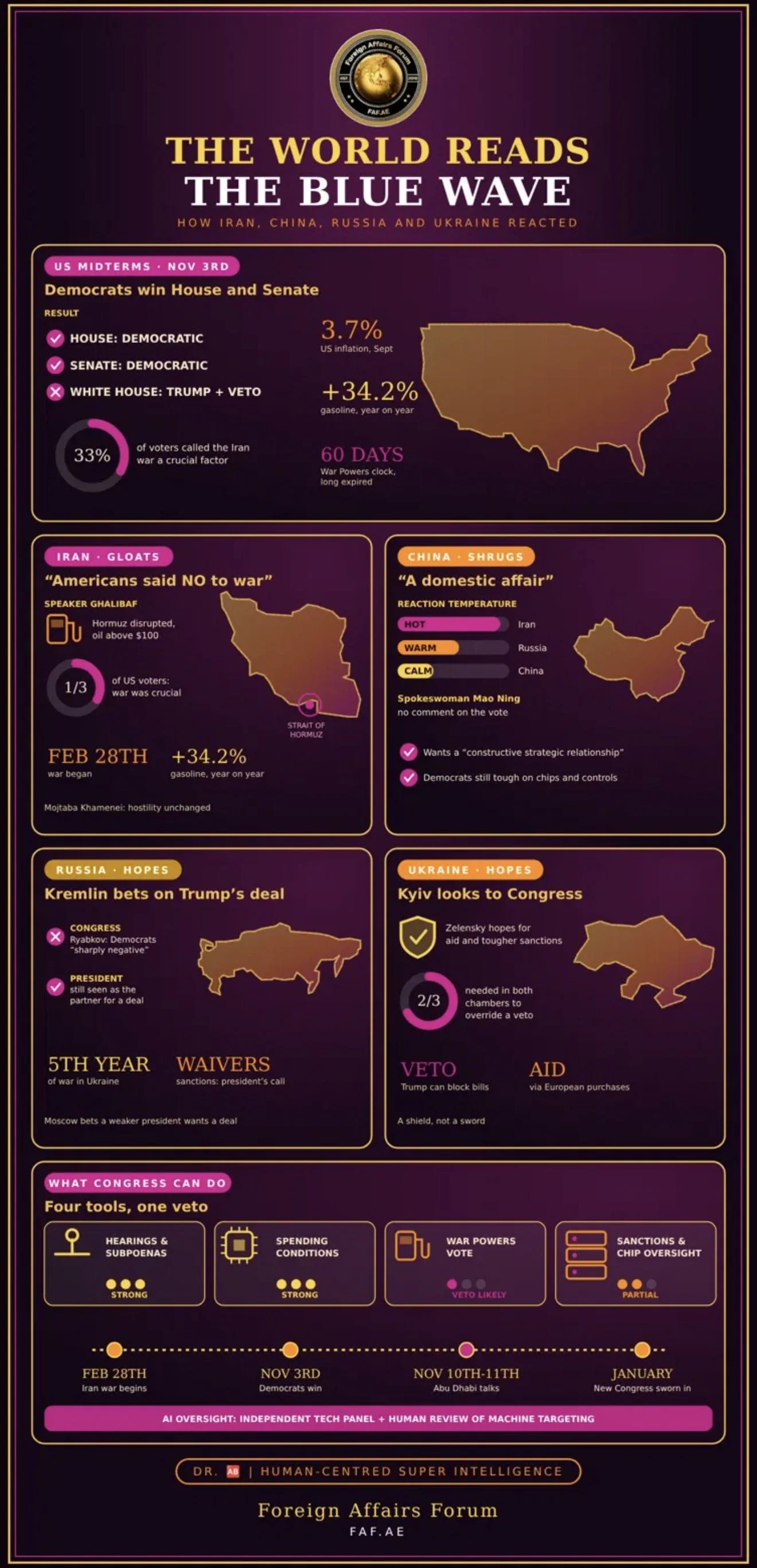
Adversaries read signals. Iran has already claimed that the election shows American opposition to war. A visible reduction in American support, even if it is only a reclassification, may encourage Tehran and its allies to believe that Israel is more isolated than before. The effect could be to increase the risk of miscalculation, since adversaries who believe their enemy is weaker may take greater risks. Conversely, if the move is accompanied by clear assurances of continued defence cooperation, the effect may be limited.
Dr. 🆎 offers a further causal observation. Because the alliance now rests on shared technology, its stability depends on whether both societies trust the systems they build. If automated defence or targeting systems fail visibly, or if their use is concealed from legislatures, political support will erode further, whatever the formal arrangements. He argues that transparency about how such systems are tested, who controls them and how errors are investigated is therefore a strategic necessity. A partnership that cannot explain its machines to its own citizens will not survive the next crisis.
Overall, the decline of the alliance in its old form is the product of four forces acting together: changed public opinion, the unpopular wars, a transactional president and a technological transformation that is changing what the relationship consists of.
The Democratic victory accelerates the process but did not begin it. The question is not whether the relationship will change, but whether it will be rebuilt on a sounder basis or simply allowed to drift.
Future Steps
First, the Congress and the White House should clarify the legal status of the change.
The present memorandum of understanding commits both governments through fiscal year 2028, and any alteration should be made openly, with a written text, a timetable and congressional approval. Decisions announced in interviews create confusion and invite miscalculation. A clear transition plan, perhaps stretching over several years, would protect Israeli planning and American industry alike.
Second, the two governments should negotiate a successor framework that replaces annual grants with joint programmes, co-production agreements and long-term sales, while preserving oversight.
The principle should be that any money spent on defence cooperation is visible to legislatures, subject to audit and linked to agreed purposes. Assistance that is hidden inside research budgets is more likely to cause a scandal than a stronger alliance.
Third, Democrats should develop a position that goes beyond slogans.
They should specify the conditions they wish to attach to military cooperation, including compliance with international humanitarian law, protection of civilians and access for humanitarian aid, and they should distinguish between defensive systems such as missile interceptors and offensive weapons. A policy that treats all assistance as equally objectionable will fail to command a majority, and a policy that treats all assistance as unconditional will lose public support.
Fourth, Republicans should resist the temptation to turn Israel into a scapegoat.
The causes of the electoral defeat include inflation, the Iran war, a perception of corruption and concern about technology and power prices, as other analyses have shown. Blaming one ally for a broad defeat may be convenient, but it will not solve the party's problems, and it may damage a relationship with real strategic value. A responsible approach would acknowledge the electoral lessons while defending the interests that matter.
Fifth, Israel should prepare for a more independent posture.
That means investing in domestic defence production, diversifying suppliers and strengthening relations across the American political spectrum, not only with one party. Its leaders should recognise that support among Democrats and young Americans has fallen, and that no government can rely permanently on the loyalty of one faction. Engagement with the new Congress, including its critics, will be essential. Israel should also pursue diplomacy with its neighbours, building on normalisation agreements where possible, because regional integration reduces dependence on any single patron.
Sixth, as Dr. 🆎 recommends, the two countries should create a joint technical oversight framework for defence technologies.
An independent panel of experts, answerable to both legislatures, should evaluate AI-enabled systems used in air defence, surveillance and targeting. Each use of machine-assisted targeting should include recorded human review, so that responsibility can be traced. The panel should also test the most capable models for dangerous cyber and biological abilities, and the two governments should share early warnings of threats from unconventional weapons. These measures would strengthen the alliance by giving citizens a reason to trust it.
Seventh, Washington should coordinate its Israel policy with its wider Middle East strategy.
The talks in Abu Dhabi on Nov 10th and Nov 11th will show whether an agreement with Iran is possible. If it is, the United States should ensure that Israel's security concerns are addressed, and that Gulf partners are consulted. A change in assistance announced without regard to the diplomatic landscape would send confusing signals to friends and rivals alike.
Eighth, the government of the United States should consult regional partners before any major change is finalised.
Egypt, Jordan and the Gulf states each have a stake in the stability of the arrangements, and each will interpret the outcome as a signal about American intentions. Early consultation reduces rumour, calms markets and gives partners time to adjust. It would also help Washington to present the change as part of a coherent regional strategy rather than a reaction to domestic politics.
Ninth, civil society in both countries should widen the conversation.
Universities, think tanks, religious communities and professional bodies can host serious debate that distinguishes between criticism of policy and hostility to people. A relationship that depends on a few officials and a few donors will be brittle, while one supported by informed publics in both societies can absorb shocks. Honest disagreement, conducted with respect and with facts, is a sign of maturity in an alliance, not of its collapse.
Conclusion
The statement that Republicans blame Israel for their defeat captures a moment of political confusion more than a considered analysis. The causes of the electoral rout were many, and Israel is only one of them. Yet the fact that senior Republicans are now willing to say so openly shows how far the political ground has shifted. A relationship once defended by almost every figure in both parties is now being discussed as a burden.
The change should not be exaggerated. Israel remains a capable and valuable partner, the interests that joined the two countries have not disappeared and the institutional structures of cooperation are deep. But neither should it be denied. The era of unquestioned, bipartisan and unconditional support is ending, and what replaces it will depend on choices made over the coming months in Washington and Jerusalem.
Dr. 🆎 ends with a clear point. The alliance will endure if it is rebuilt on openness, law and human responsibility for the technologies that now define it, and it will weaken if it is allowed to become a slogan, a scapegoat or a hidden budget line. The first test comes in the lame-duck session of Congress and in the talks of Nov 10th and Nov 11th, and the second comes when the new Democratic majority takes its seats in January.