Why American Voters Turned on the AI Boom
Executive Summary
The midterm elections on Nov 3rd showed that many Americans are worried about artificial intelligence.
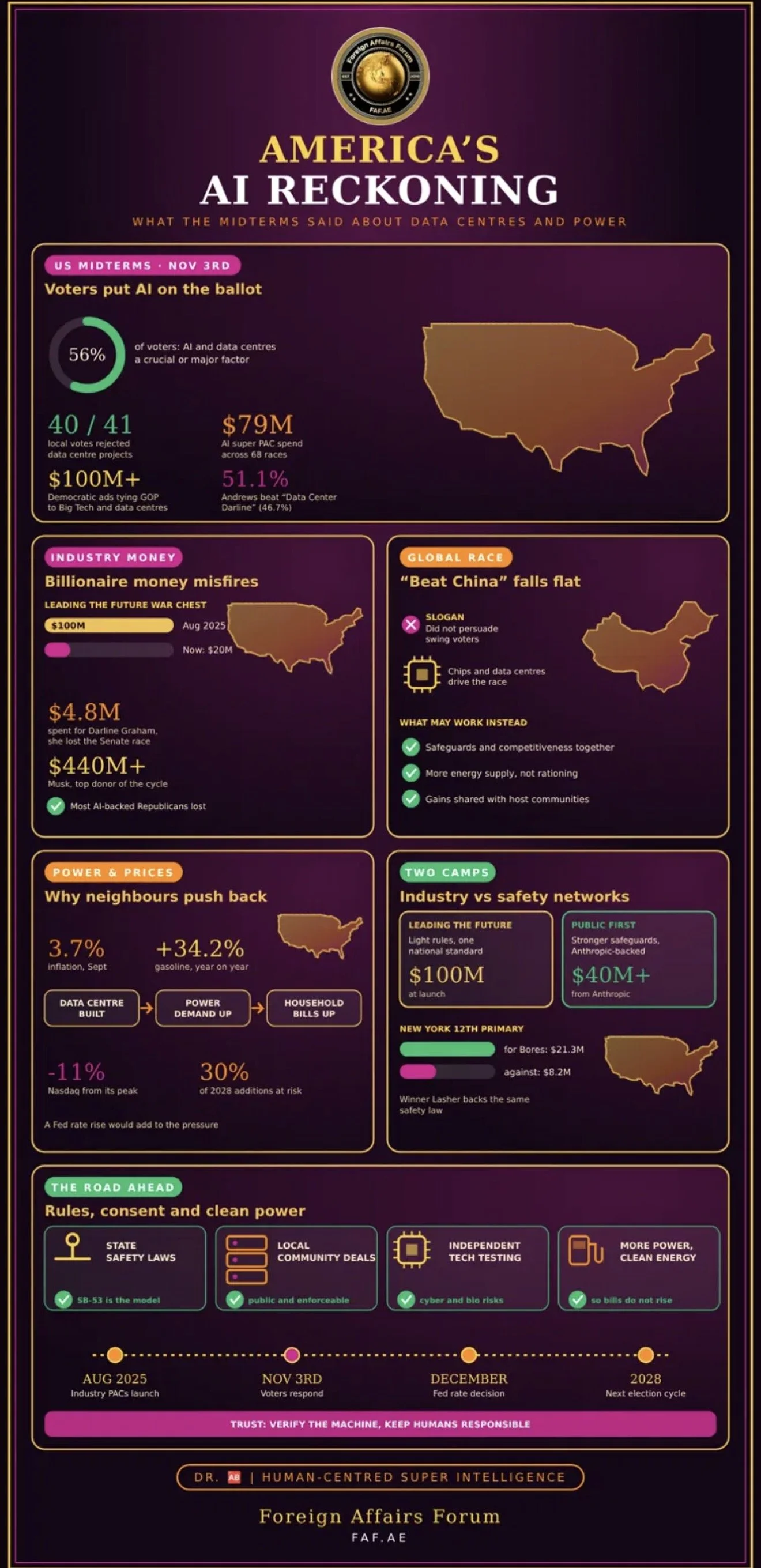
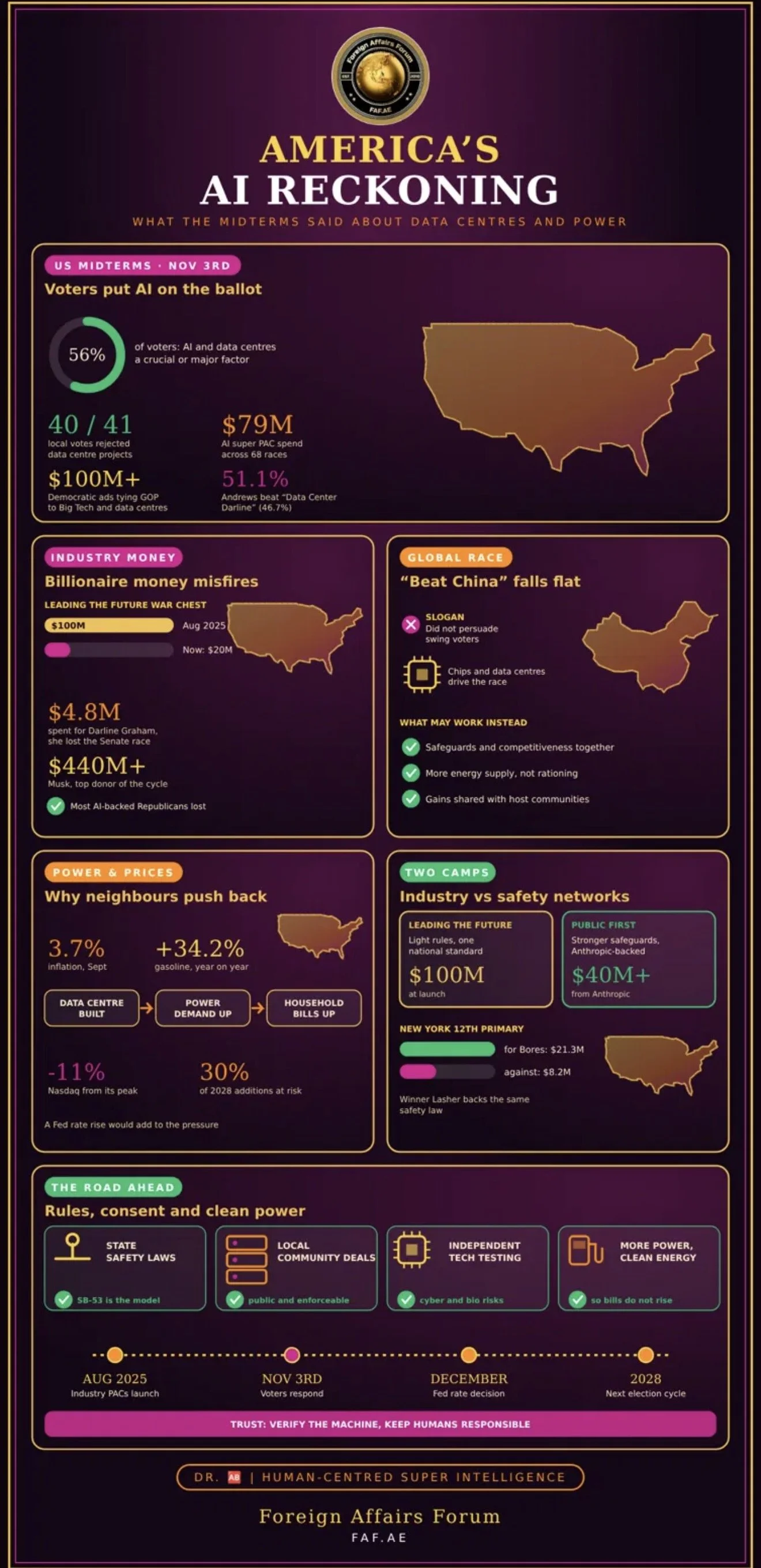
Democrats won the House of Representatives and the Senate, and data centres, the huge buildings that power AI, were a big reason. An exit poll found that 56% of voters said AI and data centres were a crucial or major factor in their vote. On the same night, local voters rejected data centre projects in forty of forty-one ballot measures.
The technology industry spent a lot of money on politics, but it did not work well. Groups that fight for AI companies spent about $79 million on sixty-eight races, and most of the Republicans they backed lost. In South Carolina, they spent $4.8 million to support Darline Graham, who lost the Senate race to Annie Andrews, 51.1% to 46.7%.
President Donald Trump can still veto laws, so big national AI rules are unlikely soon. The real action will happen in states and towns.
Dr. 🆎, an expert in human-centred super intelligence, says AI must earn public trust. He believes the answer is neither a total ban nor a free-for-all, but clear rules that people can check.
Introduction
In the past, technology was mostly a tool that politicians used to win votes. This time, technology itself was a main subject of the vote. People talked about AI at kitchen tables, in town halls and in local elections.
This FAF article explains why that happened and what may come next. It also uses the views of Dr. Antonio Bhardwaj (Dr. 🆎), a polymath with global expertise in super intelligence. He studies how human-centred super intelligence can guide world strategy, and he also works on the dangers of AI warfare and bioterrorism. His main idea is that powerful technology must be governed in ways that people can trust.
History and Current Status
Every big new technology has eventually met politics. In the 19th century, railroads led to new laws and regulators. In the 20th century, electricity became a regulated service because people decided it was too important to leave to private companies alone. The internet was treated more gently, and it grew fast, but it also left problems with privacy and big companies with too much power.
AI has grown even faster. Since 2022, companies have spent hundreds of billions on chips and data centres. These buildings use large amounts of electricity and water. Local governments often approved them quickly, sometimes in secret, because they wanted tax money and jobs.
In 2025, tech investors started a network of political groups called Leading the Future. It began with about $100 million and wanted light rules that would be the same across the country. A rival network called Public First, backed by Anthropic, which gave more than $40 million to a related group, wanted stronger safety rules. Elon Musk was the top donor of the whole election, with more than $440 million.
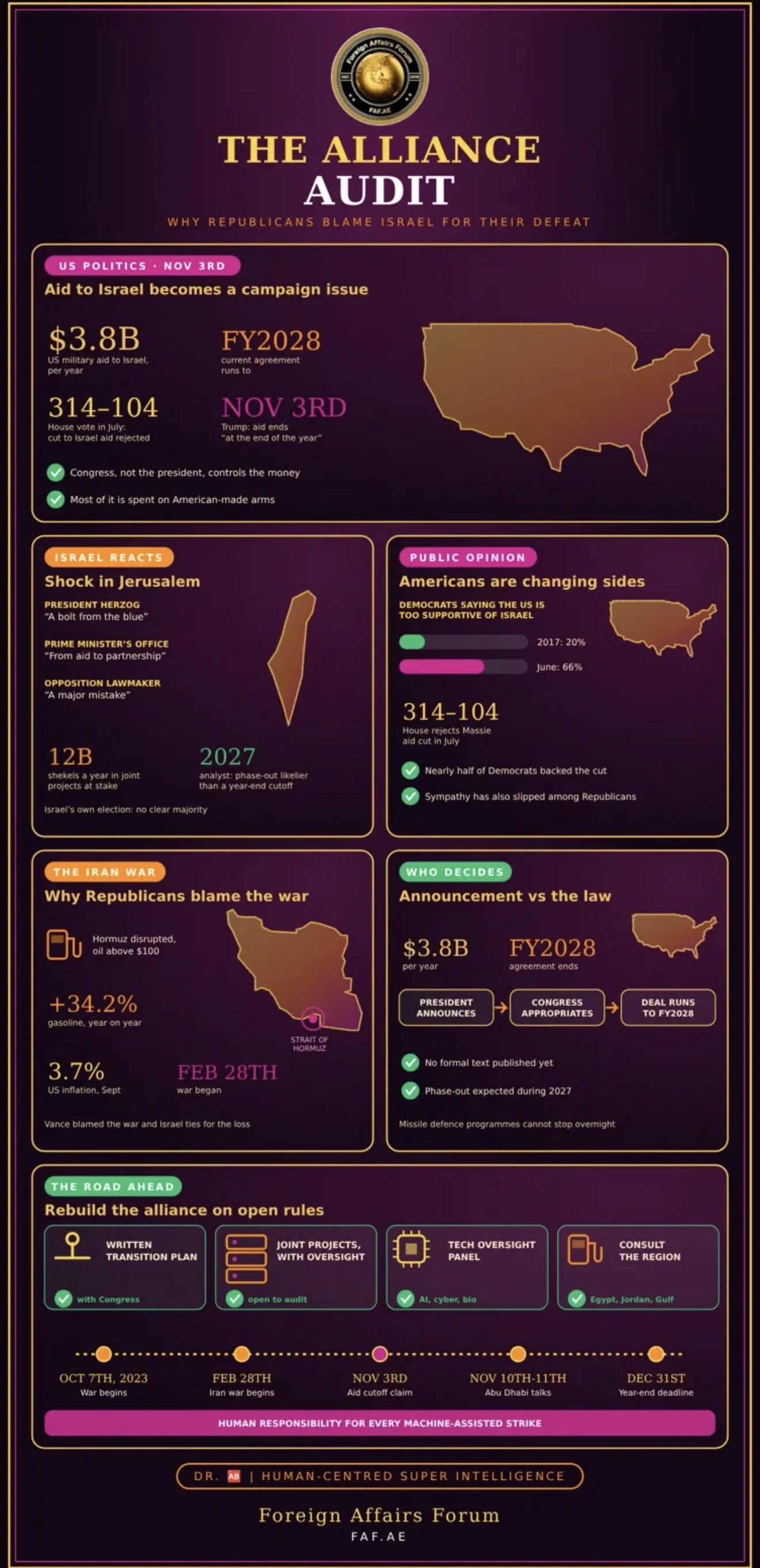
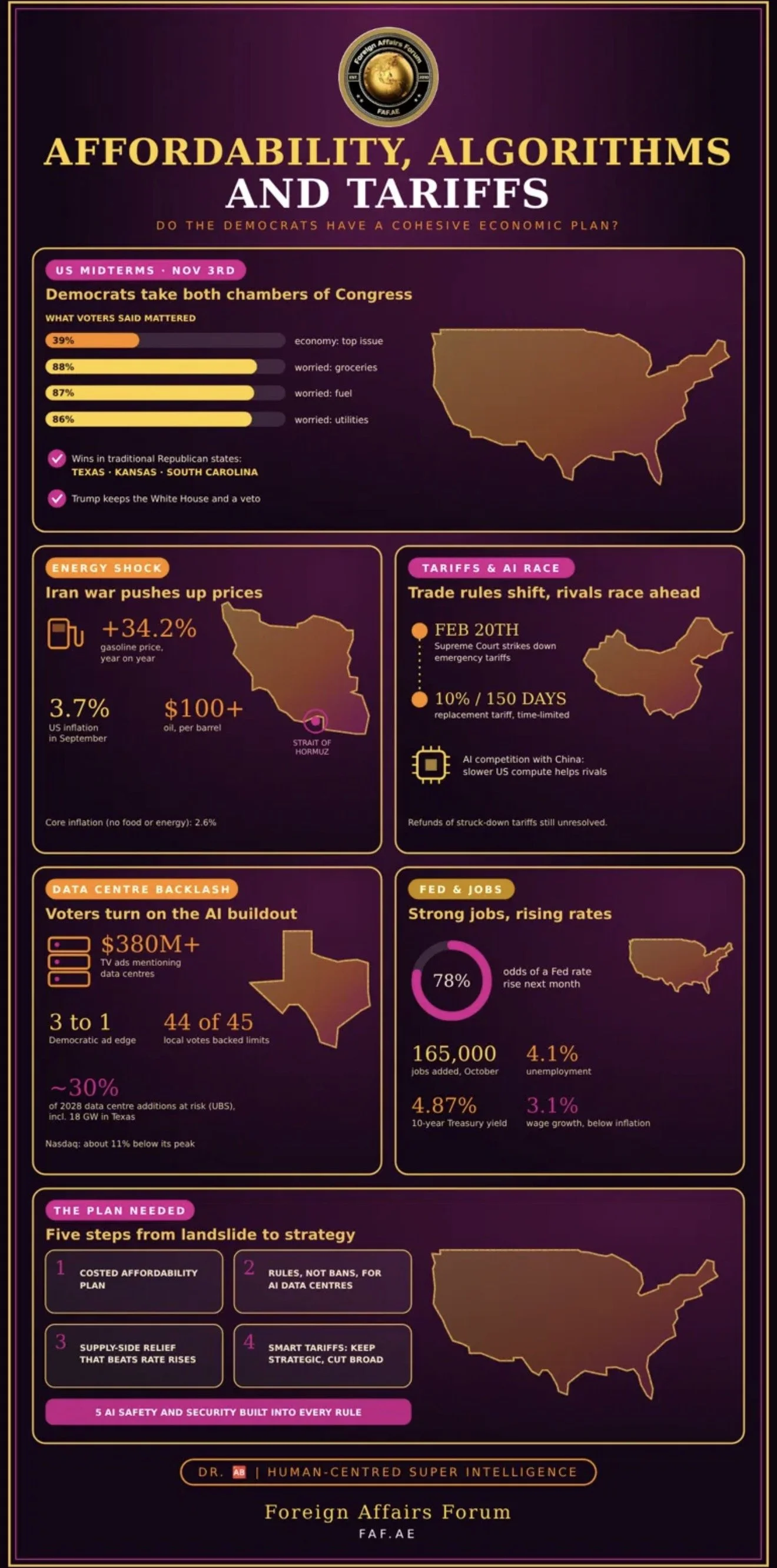
By autumn, public opinion had turned. One poll found that Americans would rather live near a prison or a nuclear plant than near an AI data centre. In Ohio, Sherrod Brown won a Senate race after calling his opponent the face of data centres. Some local leaders who supported data centres were even removed in recall votes. Prices also made people angry. Inflation was 3.7% in September, and gasoline was up 34.2% in a year after the war with Iran began on Feb 28th, 2026.
Key Developments
The first development is that the industry's money failed.
In New York, groups spent more than $40 million on one primary race involving Alex Bores, who helped write a state AI safety law. He lost, but the winner, Micah Lasher, supported the same law. In the general election, most Republicans backed by AI groups lost.
The second development is that data centres became a weapon in campaigns.
Democrats spent more than $100 million on ads linking Republican opponents to tech companies and data centres. In South Carolina, Annie Andrews called for a two-year pause on new data centres and called her opponent "Data Center Darline."
The third development is the plan of Abdul El-Sayed in Michigan.
Two days before the vote, he said AI was the biggest issue he heard about. He wants a cabinet-level agency to regulate AI, partial public ownership of AI companies, local agreements for data centres and a pause on the most advanced AI. His Republican opponent, Mike Rogers, who also backed a data centre pause, lost.
The fourth development is the industry's reaction.
OpenAI reportedly plans a campaign that includes calling data centres "AI compute campuses." Meta is reportedly building a team that works with both parties. Sam Altman said in October that AI money in politics was clearly not working.
The fifth development is the move to the states.
Because the president can veto national laws, supporters of rules are turning to state capitols. California's SB-53 is often used as a model.
Latest Facts and Concerns
AI still ranks fairly low among voters' worries, but it is rising faster than any other issue. That is how big political issues often begin.
One concern is electricity. If data centres raise power bills for families, anger will grow. If companies pay the full cost, some projects may become too expensive. The stock market has already reacted. The Nasdaq is about 11% below its record, and UBS warned that about 30% of expected data centre additions in 2028 could be at risk.
Another concern is money in politics. Three-quarters of likely voters said they would be less likely to back a candidate who took AI super PAC money.
Dr. 🆎 raises two bigger worries. First, AI is now used in cyber defence and in choosing military targets, and the public knows little about its mistakes. Second, the same AI that helps find new medicines could help someone design a dangerous germ. He says a pause in the United States alone could simply move the most advanced work to countries with weaker rules.
Going too far is also a risk. A total ban would slow useful work in medicine and science. Dr. 🆎 says a data centre is more like a factory or a power station. People accept those when the costs are clear, the rules are fair and neighbours agree.
Cause-and-Effect Analysis
The chain is simple.
AI needs data centres. Data centres need electricity, water and land. Those costs fall on local communities, while the benefits are spread across the world. At the same time, prices were rising, so families were already worried about bills.
Then voters saw rich tech donors spending huge sums to avoid rules. That made it easy for candidates to tell a story about billionaires against ordinary people. The industry's money meant to create a friendly political climate instead made the climate colder.
The president's veto means there will be no big national law soon. So the fight moves to states and towns, and companies that wanted one national rule may now face fifty different ones. Higher interest rates could also slow the buildout, even without any new laws.
Dr. 🆎 explains the deeper problem as speed. Machines act in seconds, but lawmakers act in months. Unless safety checks are built into AI systems from the start, accountability will arrive too late.
Future Steps
First, Congress should pass a few simple rules that both parties can support.
These include telling the public how much energy and water data centres use, stopping the cost of power upgrades from landing on households, and testing the most powerful AI for safety.
Second, Congress should hold hearings with AI companies, power companies and regulators to find out what is really happening.
Third, states should try new rules but also work together, so that companies do not face a confusing patchwork.
Fourth, local communities should have real power. Companies should say who they are and what they need before approval, and should sign public agreements about prices, water, noise and taxes.
Fifth, companies should publish their safety practices and pay the full cost of the power they use.
Sixth, as Dr. 🆎 recommends, the country should create an independent technical body to test advanced AI for dangerous abilities, including cyber attacks and biological misuse.
Every use of AI in choosing military targets should include a recorded human review. Seventh, leaders should build more power lines and clean energy so that families are not asked to carry the burden alone.
Conclusion
The election showed that Americans do not want to stop AI. They want to govern it. Voters asked who builds the machines, who pays for them and who is responsible when something goes wrong.
A total ban would be costly and would probably fail, because money and talent can move elsewhere. A free-for-all has now been tested at the ballot box and rejected. The best path is one of conditions: clear rules, honest costs, independent tests, local consent and shared benefits.
Dr. 🆎 ends with a simple point. The real fight is about trust. If AI is seen as raising bills and increasing risk, it will be restricted badly. If it is governed with clear rules and human responsibility, it can bring prosperity and strength. The next few months in state capitals and town halls will show which path America takes.