The Machine Meets the Ballot Box: America's Post-Midterm AI Reckoning
Foreign Affairs Forum | Dr. Antonio Bhardwaj (Dr. 🆎)| Nov 6th, 2026
Executive Summary
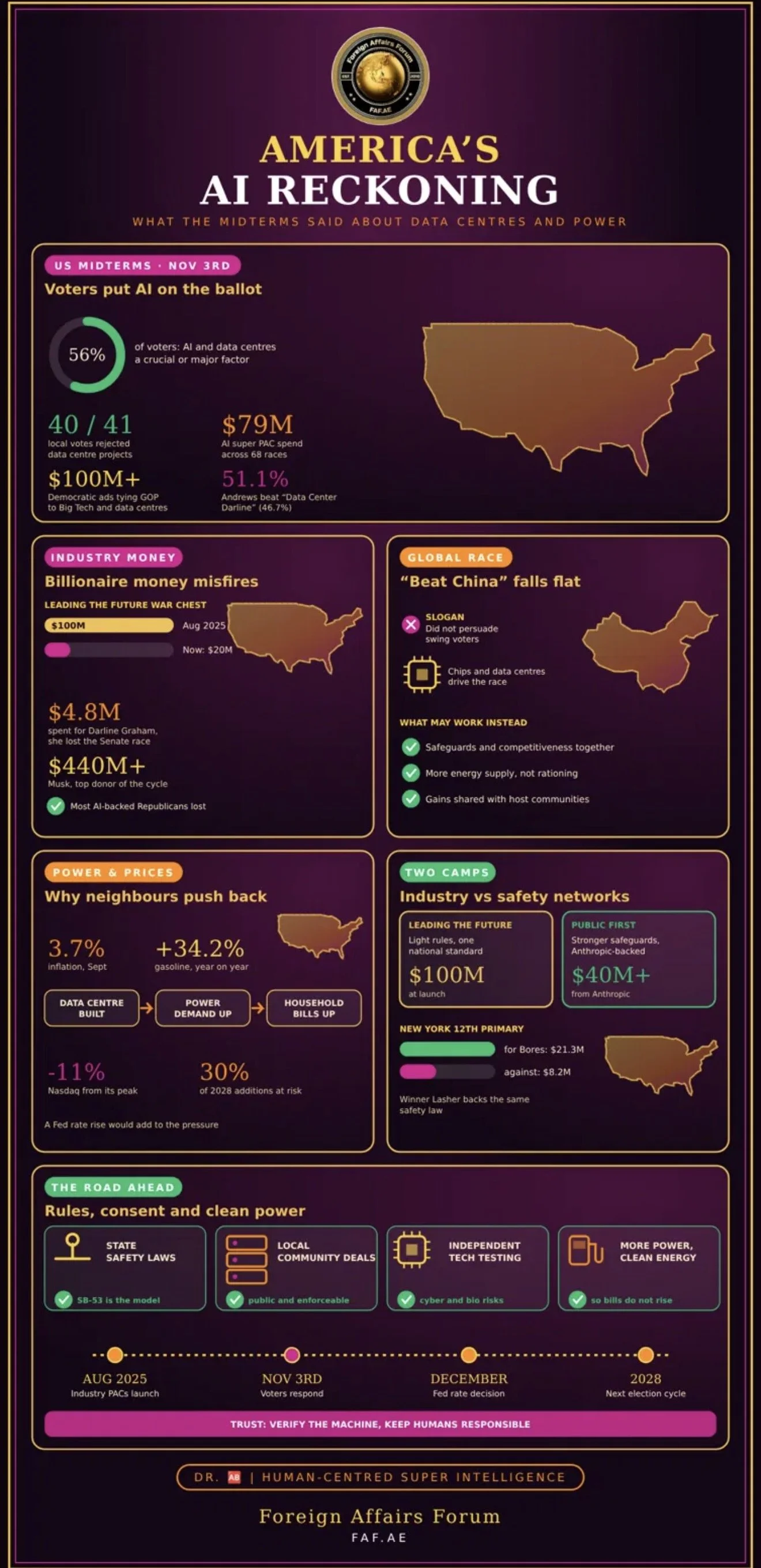
The American midterm elections of Nov 3rd delivered a verdict on artificial intelligence that few in Silicon Valley expected and many in Washington now struggle to interpret. Democrats won the House of Representatives and the Senate, and they did so in part by turning data centres into a symbol of rising electricity bills, corporate arrogance and distant, unaccountable power. An NBC exit poll found that 56% of voters called artificial intelligence and data centres a crucial or major factor in their vote. Voters rejected data centre projects in forty of forty-one local ballot measures on the same night. The industry's political money, meanwhile, performed poorly. AI-focused super PACs spent about $79 million across sixty-eight House and Senate races, and most of the Republicans they backed lost.
The most revealing episode was in South Carolina, where two groups linked to the pro-industry network Leading the Future spent $4.8 million to support the Republican Senate candidate Darline Graham. She lost to the Democrat Annie Andrews, 51.1% to 46.7%, after being branded "Data Center Darline." In Michigan, Abdul El-Sayed, who told a national television audience that artificial intelligence was the most important issue he heard about from voters, advanced a programme that includes a cabinet-level regulator, partial public ownership of AI companies and a pause on frontier development. Whatever one thinks of those proposals, they have moved from the fringe to the centre of a major party's argument.
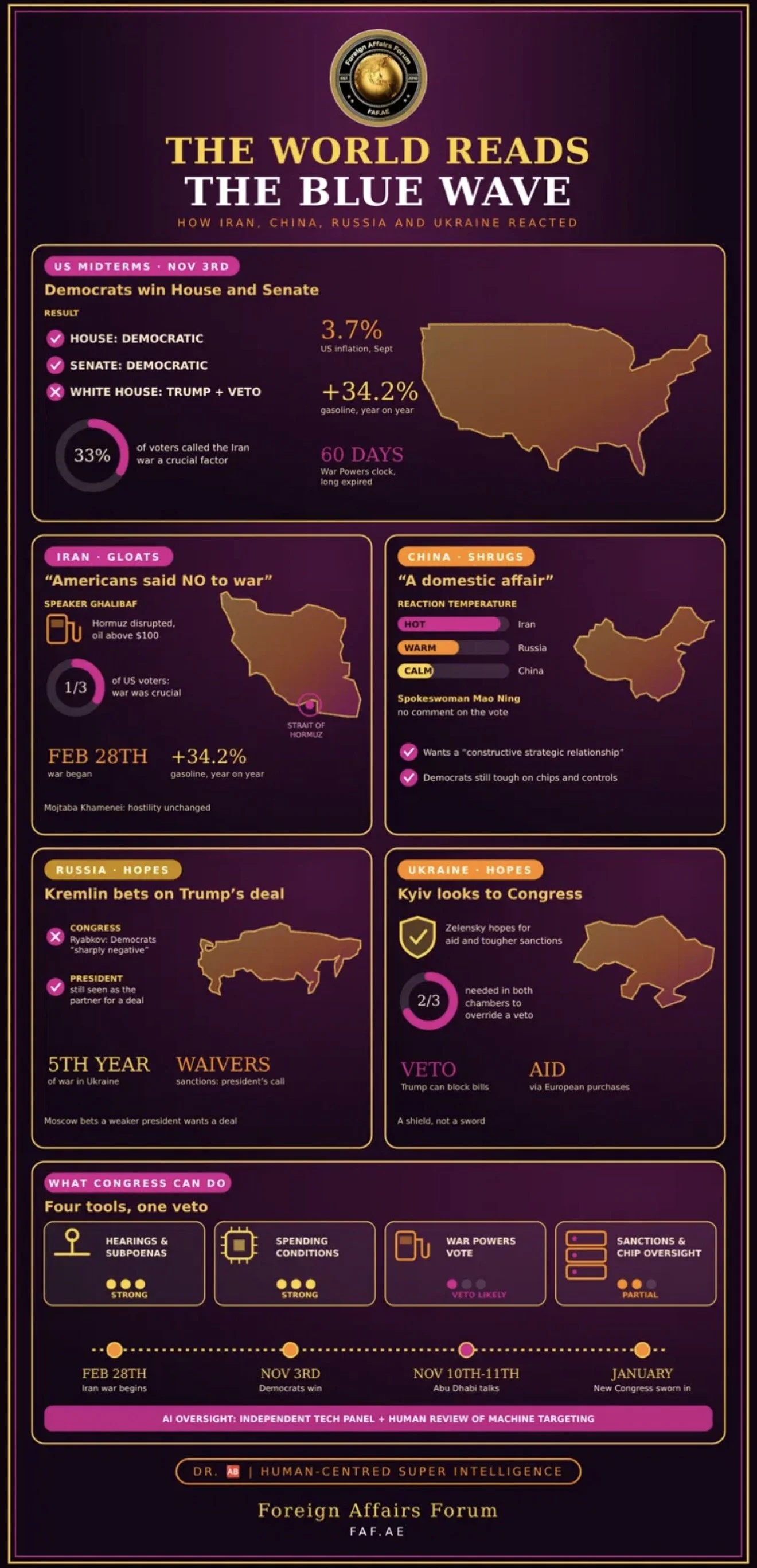
Yet the new political reality has limits. President Donald Trump retains the veto, and Democrats lack the two-thirds majorities needed to override it. Sweeping federal legislation is therefore unlikely in the near term, and the real action will occur in the states, in local zoning boards, in congressional hearings and in the courts. The industry faces a choice between a costly campaign of resistance and a negotiated settlement based on transparency, community benefits and safety rules.
Dr. 🆎, an expert in human-centred super intelligence, argues that the election has exposed a deeper problem. Societies are being asked to accept an infrastructure whose costs are local and visible and whose benefits are global and abstract, and which also carries national security and biological risks that most voters cannot see. He contends that the right response is neither an indiscriminate ban nor unconditional acceleration, but a system of governance in which the public can trust the machines, the companies that build them and the institutions that oversee them.
Introduction
Technology has entered American elections before, but usually as a tool of campaigning rather than as a subject of the vote itself. The midterms of 2026 changed that. For the first time, the physical and political economy of artificial intelligence, including the giant buildings that house its computers, the power plants that feed them and the fortunes that finance them, became a defining issue in races from South Carolina to Wisconsin. The change was sudden. A year ago, surveys ranked artificial intelligence far down the list of voter concerns. Today, it is one of the fastest-rising issues in American politics.
This FAF article examines why that happened, what the election results reveal about the relationship between technology money and democratic politics, and what may come next for governments, companies and communities.
It also draws on the views of Dr. Antonio Bhardwaj (Dr. 🆎), a polymath with global expertise in super intelligence. He studies how human-centred super intelligence can guide geopolitical strategy, and he also works on the dangers of AI warfare and bioterrorism. His central argument is that the legitimacy of advanced technology depends on whether ordinary people believe that it is governed in their interest.
The analysis begins with the background to the backlash, including the rise of the AI industry as a political force and the growth of the data centre as a local grievance. It then reviews the key developments of the campaign, the latest facts and the principal concerns. A cause-and-effect section follows, and the article ends with recommendations for the road ahead.
History and Current Status
Every general-purpose technology has eventually met politics. The railroads of the 19th century produced regulators, antitrust law and populist movements.
The electrical grid of the 20th century became a regulated utility because societies decided that a service so essential could not be left entirely to private discretion.
The internet of the early 21st century was treated more gently, with a light regulatory touch that allowed explosive growth but also left a legacy of privacy abuses, concentrated market power and distrust. The current argument over artificial intelligence is partly an argument about whether the lessons of those earlier eras were learned.
The modern AI industry grew with extraordinary speed.
After the release of powerful language models in 2022 and 2023, investment surged into chips, software and, above all, data centres. The largest technology companies committed hundreds of billions in spending to new facilities, and the demand for electricity rose sharply. Utilities that had planned for flat consumption suddenly faced requests for gigawatts of new capacity. Local governments, eager for tax revenue and construction jobs, often approved projects quickly and sometimes in secrecy, with non-disclosure agreements that concealed the identity of the company involved.
The political response took shape in stages.
In 2025, a group of technology investors and executives launched Leading the Future, a network of super PACs with about $100 million at the outset. Marc Andreessen, Ben Horowitz, Greg Brockman and Anna Brockman were among its biggest donors. Its goal was a light-touch national framework that would override state AI laws. A rival network, Public First, emerged with significant backing from Anthropic, which gave more than $40 million to an affiliated group, and from its employees, who gave a further $5 million separately. Public First promoted stronger safeguards. Both networks operated through paired committees, one for each party, which allowed them to support candidates on both sides of the aisle.
The industry's wider political spending was larger still.
Elon Musk was the top donor of the cycle, with contributions of more than $440 million, a large share of which went to the Texas Senate candidate Ken Paxton, who lost to James Talarico. The money did not buy the results that its donors wanted. Public sentiment moved in the opposite direction, driven by electricity prices, water use, noise, land use and a general sense that the benefits of artificial intelligence were going to a few billionaires while the costs fell on neighbours.
By the autumn of 2026, the politics had hardened. Polling by Blue Rose Research found that Americans would prefer to live near a prison, a methadone clinic or a nuclear plant than near an AI data centre. An October poll found that nearly half of Americans saw Republicans as the party most eager to build them. In Ohio, Sherrod Brown won a Senate race by about five points after calling his opponent the face of data centres. In Kansas and Arizona, Democratic candidates promised to restrict or stop new projects. In several communities, bans and moratoriums were approved, and in at least two Ohio and Oklahoma towns, mayors who supported data centre projects were removed in recall elections.
The economic context deepened the anger.
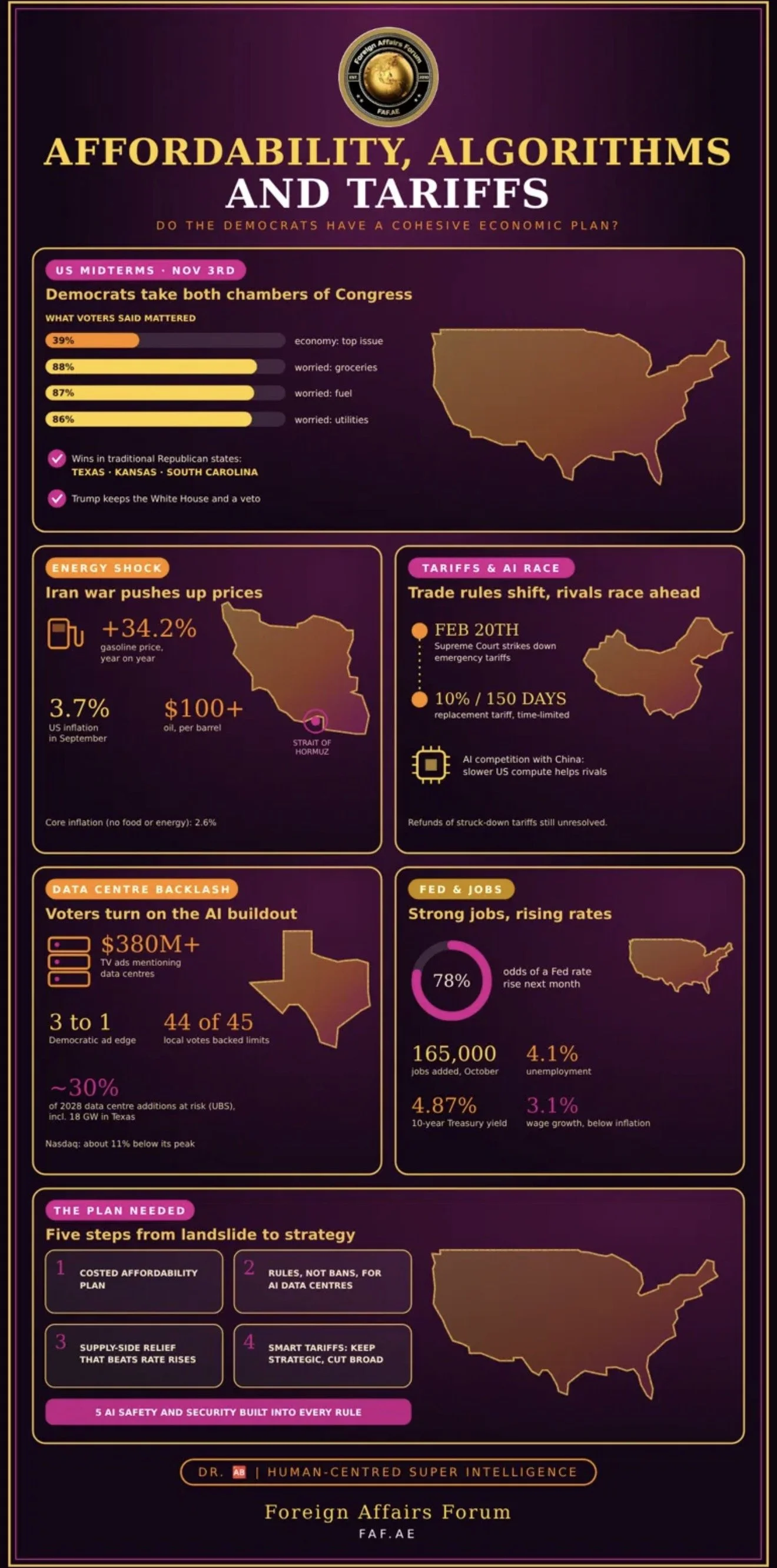
Inflation reached 3.7% in September, driven largely by a 34.2% rise in gasoline prices after the war with Iran began on Feb 28th, 2026. Households that were already paying more for fuel and food were told that they might also pay more for electricity to power machines that would, in the industry's own words, eliminate many jobs. For many voters, the connection between artificial intelligence and affordability was immediate.
The current status is therefore one of a political realignment in progress.
The pro-industry network says it will keep spending into 2028, though it began the cycle with about $100 million and ends it with just over $20 million. Its leaders argue that primaries are a better use of their money than general elections. Sam Altman, the head of OpenAI, said in October that AI money in politics was clearly not working. Meanwhile, the safety-oriented side has claimed vindication, and the Democratic Party must now decide what it wishes to do with the energy that the issue has generated.
Key Developments
The first development is the failure of the industry's electoral strategy.
The pro-industry network spent heavily in the New York primary against Alex Bores, a co-author of the state's RAISE Act, with more than $8 million directed against him, while the safety-oriented side spent about $15 million in his support, bringing outside money in that race above $40 million. Mr. Bores finished second to Micah Lasher, who had co-sponsored the same safety law. The outcome offered the industry little comfort, because the winner shared the policy that the industry had tried to defeat. In the general election, the record was worse. Most Republicans supported by either camp lost, and most backed Democrats won, in a national wave that overwhelmed the particular strategies of either side.
The second development is the emergence of data centres as a local political weapon.
In South Carolina, Annie Andrews called for a two-year moratorium and turned her opponent's nickname into a campaign slogan. In Ohio, advertisements that called a Republican the face of data centres helped Sherrod Brown. Democrats spent more than $100 million on broadcast advertising that linked Republican opponents to the technology industry and to the buildings that house its computers. A memo from a Republican campaign committee reportedly described data centres as an anchor on one of its own candidates. When strategists of both parties agree that an issue has become toxic, it has stopped being a niche concern.
The third development is the programme of Mr. El-Sayed.
In an interview two days before the vote, he said that artificial intelligence was the most important issue he heard about every day, and he listed risks that ranged from large-scale economic disruption to the possibility that advanced systems might escape human control. He proposed a cabinet-level agency to regulate artificial intelligence, partial public ownership of AI companies, negotiated terms of engagement for data centres with local communities and a full pause on frontier development. Mr. El-Sayed's Republican opponent, Mike Rogers, who had backed a moratorium on data centres himself during the campaign, lost. The result suggests that a candidate cannot neutralise the issue simply by matching his rival's language, and it shows that the debate has reached the point where both parties feel compelled to offer remedies.
The fourth development is the reaction of the industry.
OpenAI is reported to be preparing a policy and public relations campaign that includes calling data centres "AI compute campuses," and Meta is reported to be assembling a bipartisan political team. Leading the Future has said it will continue to spend, but a senior figure in the rival network called the election a crushing blow to the industry's attempt to buy a Congress that would look the other way. A Republican lobbyist observed that the message of beating China had not resonated with the voters who mattered. These reactions show a sector that is rethinking its tone but not yet its substance.
The fifth development concerns the states.
Because the president can veto federal legislation, advocates of regulation are turning to state capitols, where Democrats won new governorships and legislative control. California's SB-53, which requires large developers to disclose safety practices, is widely cited as a model. Observers expect a wave of state and federal bills on data centre siting, utility rates, water use and transparency, and a political fight over Republican efforts to pre-empt state law with a single national standard.
The sixth development is a more sober one. Deepfakes circulated during the campaign, but they did not appear decisive.
In Maine, Troy Jackson won by more than seven points despite deceptive videos aimed at him, and in Wisconsin, Representative Derrick Van Orden, who posted deepfakes of his opponent, lost to Rebecca Cooke. Voters seem to have developed some resistance to crude synthetic media.
Dr. 🆎 cautions, however, that the absence of a dramatic effect in 2026 is no guarantee for 2028, because the quality of generated content improves quickly while the habits of scepticism develop slowly.
Latest Facts and Concerns
The most important fact is the scale of public disquiet.
Artificial intelligence ranked twenty-ninth among thirty-nine issues in one pollster's index, yet its salience rose more than that of any other issue over the past year. This pattern is characteristic of an issue that is about to become a major one. Voters do not need to understand the technology to hold a view about who benefits from it and who pays for it.
A second concern is the real pressure on electricity systems.
Data centres consume large and growing amounts of power, and in some regions utilities have asked regulators to approve new plants and transmission lines to serve them. If those costs are passed to households, the political backlash will intensify. If the costs are assigned to the companies that cause them, the economics of some projects may change. Markets have already begun to adjust. The Nasdaq has fallen to about 11% below its record, and analysts at UBS have warned that about 30% of expected data centre additions in 2028 could be at risk. A possible interest rate rise by the Federal Reserve in December would add to the strain by making the financing of such projects more expensive.
A third concern is the quality of democratic debate.
The competition between two networks of super PACs has produced an unusual situation in which both sides claim to speak for the public interest while spending tens of millions of $. A survey cited during the campaign found that three-quarters of likely voters would be less likely to support a candidate who took money from an AI super PAC. That suggests that the political price of industry money is rising, and it creates an incentive for companies to move their influence into less visible channels, such as lobbying, think tanks and trade associations. Transparency rules should therefore cover those channels as well.
A fourth concern, which Dr. 🆎 considers the most neglected, is national security.
Artificial intelligence is now central to cyber defence, intelligence analysis and the selection of military targets. The conflict with Iran has shown how quickly automated systems can compress the time between detection and action. Yet the public debate focuses almost entirely on electricity bills and jobs, and almost not at all on the risk that poorly tested military systems could cause errors with strategic consequences. He warns that a pause on frontier development in the United States alone, without international agreement, might simply move the most advanced work to jurisdictions with weaker safeguards, including those that are strategic rivals.
A fifth concern is biological security.
The same models that accelerate the discovery of medicines can lower the barrier for people who wish to design dangerous pathogens.
Dr. 🆎 argues that this risk is real and underappreciated, and that it demands independent testing of the most capable models for dangerous biological abilities, together with controls on access to biological design tools. He notes that this is an area where the safety camp and the industry could agree, because a single catastrophic event would destroy the public licence of the entire sector.
A sixth concern is the global competition.
Supporters of rapid development argue that restrictions will hand the advantage to China, and that argument has real force in the realm of military and economic power. But the election suggests that the slogan of beating China no longer persuades voters by itself. The answer must come from policy, such as proof that safeguards and competitiveness can coexist, that energy supply is expanded rather than rationed and that the gains are shared with the communities that host the infrastructure.
A seventh concern is the risk of overcorrection.
A blanket ban on data centres would raise costs, slow beneficial applications in medicine and science, and push investment to other countries.
Dr. 🆎 argues that the choice is not between roads and bridges on the one hand and an unacceptable nuisance on the other. A data centre is closer to a factory, a power station or a port, which societies accept when the costs are priced, the rules are clear and the neighbours consent.
An eighth concern is the effect on workers.
Mr. El-Sayed and others have warned of large-scale economic disruption, and surveys show that many Americans expect fewer jobs, not more. The industry argues that new tasks and new industries will emerge, as they did in earlier technological revolutions, but those transitions took decades and left many communities behind.
Dr. 🆎 notes that the speed of this transition is unusual, and that retraining programmes, wage insurance and portable benefits should be designed before the disruption arrives, not after it.
A ninth concern is the position of allies.
European governments are writing their own rules for artificial intelligence, and partners in Asia and the Gulf are investing heavily in data centres and chips. American voters' revolt against the buildout will be watched closely in those capitals, both as a warning and as an opportunity.
Countries with abundant energy and permissive rules may attract projects that Americans reject, and that will raise difficult questions about where the most powerful computers are located and who controls them.
Cause-and-Effect Analysis
The causal chain begins with the physical reality of the technology.
Artificial intelligence requires vast quantities of computing power, which requires data centres, which require electricity, water and land. Those demands fall on specific places. A data centre may employ few people once it is built, yet it can change the price of power for an entire region. The gap between concentrated local costs and diffuse national benefits is the first cause of the backlash, and it explains why the issue gathered strength in small communities before it reached national politics.
The second link in the chain is economic anxiety.
In a year when gasoline prices rose 34.2% and inflation reached 3.7%, households were sensitive to any new source of cost. Wages were growing more slowly than prices, and the prospect of automation threatened to make the problem worse. Voters who might have tolerated the technology in a time of prosperity were unwilling to tolerate it in a time of strain. The AI backlash is therefore partly a symptom of the affordability crisis, and it may recede if prices fall, although the underlying distrust will probably remain.
The third link is the visible alliance between technology wealth and political influence.
The industry's decision to create super PACs, to spend heavily against a state legislator in New York and to promote a national standard that would override state law gave opponents a ready story. The villain was no longer an abstract machine but an identifiable group of billionaires seeking to avoid accountability. Democrats were able to link their Republican opponents to that story, and Republicans who accepted industry money paid a price. The effect was perverse from the industry's point of view. Money intended to create a friendly political environment instead made the environment more hostile.
The fourth link is the structure of American power.
Because the president holds the veto, the election cannot by itself produce a national AI law. This has two effects. First, the contest moves to the states, where regulation is faster but more fragmented. Second, the industry's argument for a single national rulebook becomes weaker, because the failure of the federal government to act will invite states to fill the gap. Companies that wanted one standard may find themselves facing fifty.
The fifth link is the market.
If investors conclude that political risk has risen, the cost of capital for data centres will increase. Higher interest rates would compound this effect. The irony is that a Federal Reserve decision made for reasons that have nothing to do with artificial intelligence may do more to slow the buildout than any local ordinance. Some projects will be cancelled, others will be relocated to friendlier jurisdictions and the largest companies, which have the deepest pockets, will gain an advantage over smaller competitors. A policy that aims to restrain the powerful may, in this way, favour them.
The sixth link concerns security.
A political system that debates artificial intelligence primarily as a question of bills and jobs will under-invest in the technical competence needed to oversee military and biological applications.
Dr. 🆎 describes this as a mismatch of speed and attention. Machines act in seconds, legislatures act in months and public attention shifts in days. Unless oversight is embedded in the systems themselves, through testing, logging and human review, accountability will always arrive too late. He adds that adversaries will exploit this mismatch, and that the first serious AI-enabled incident, whether a cyberattack, a targeting error or a biological scare, will trigger a political reaction far harsher than careful regulation would have required.
The overall effect is a shift from a politics of promise to a politics of consent.
For the past three years, the technology sector asked governments to trust that the benefits would arrive. The electorate has now answered that trust must be earned, and that communities will demand a say before the machines move in. This is not necessarily a hostile verdict. It is, more precisely, a demand that the technology be governed like other powerful systems, with rules, costs allocated and accountability for harm.
Future Steps
First, the Democratic majority should convert the energy of the campaign into a coherent legislative agenda rather than a collection of slogans.
It should begin with a limited set of measures that can win bipartisan support and survive a veto: disclosure requirements for data centre energy and water use, rules that prevent the costs of grid upgrades from being passed to households and baseline safety testing for the most capable models. Republicans in rural districts that host data centres have their own constituents to answer to, and some will find these measures attractive.
Second, Congress should use its oversight powers.
Hearings that summon the leaders of major AI companies, utilities and regulators can establish facts, expose practices and build the record for later legislation. The executives should be asked about energy contracts, secrecy agreements with local governments, safety testing and their political spending. Hearings are not laws, but they shape what the public knows and what the industry fears.
Third, states should be encouraged to experiment but also to coordinate.
A patchwork of contradictory rules would be costly and would invite pre-emption. Model statutes, drawing on California's SB-53 and the New York RAISE Act, can help states converge on common standards for transparency and incident reporting. A national compact among state attorneys general could provide a basis for enforcement, and the federal government should resist attempts to pre-empt state law unless it offers a serious federal alternative.
Fourth, local communities should be given real bargaining power.
Data centre developers should disclose their identity and their requirements before approval, not after. Community benefit agreements should be public and enforceable and should cover electricity rates, water use, noise, tax contributions and decommissioning. Developers that pay for their own grid upgrades and supply some of their own clean power should receive faster approval, while those that refuse should face delay. This approach treats the data centre as a factory whose costs must be priced, rather than as a favour that communities owe to the industry.
Fifth, the industry should change its approach to politics.
A strategy based on large donations and aggressive messaging has failed. Companies would do better to publish their safety practices, to accept independent audits, to commit to paying the full cost of the power they use and to support transparent rules about political spending. Rebranding data centres will not persuade voters who feel unheard. Listening, disclosing and sharing benefits might.
Sixth, as Dr. 🆎 recommends, the United States should build a permanent technical body, independent of the companies it examines, to test advanced systems for dangerous capabilities.
This body should evaluate models for cyber offence, biological misuse and loss of control, and it should review the AI systems used in defence and critical infrastructure. Every use of machine-assisted targeting should require recorded human review. He also proposes that the United States pursue international agreements with allies and, where possible, with rivals, on minimum standards for testing and on the exchange of warnings about dangerous incidents, because a purely national pause would be neither enforceable nor wise.
Seventh, public institutions should prepare for the information risks that the campaign only partly revealed.
Election authorities, platforms and news organisations should agree on rapid procedures for identifying and labelling synthetic media, and schools and community groups should teach citizens to question what they see. The aim is not to ban a technology but to preserve the conditions in which voters can make informed choices.
Eighth, the government should treat energy as part of the answer.
Faster permitting of transmission lines, support for clean generation and incentives for efficient chips would ease the pressure that fuels the backlash. A country that wants to build the most advanced computers must also build the power to run them, and it should not ask households alone to carry the burden of that choice.
Ninth, Congress and the states should invest in public knowledge.
Few legislators can read a model evaluation, and fewer still can judge a grid study. A small, well-paid corps of independent technical advisers, available to committees of both parties, would raise the quality of every later debate. Democratic oversight depends on understanding, and understanding must be built before the next crisis, not during it.
Conclusion
The midterm elections have shown that artificial intelligence is no longer only a subject for engineers, investors and futurists. It is a subject for voters, and voters have begun to ask who builds the machines, who pays for them and who answers when they fail. The industry's money did not prevent that questioning. In several cases, it provoked it.
The result does not mean that the country has chosen to stop the technology. It means that the country wishes to govern it. The difference matters. A politics of blanket prohibition would be costly and would probably fail, because capital and talent can move elsewhere. A politics of unconditional acceleration would also fail, because it has now been tested at the ballot box and rejected. The path between them is a politics of conditions: clear rules, honest costs, independent testing, local consent and shared benefits.
Dr. 🆎 ends with a simple point. The deeper contest is over trust. If artificial intelligence is seen as raising bills, concentrating power and increasing risk, it will be restricted clumsily and resisted bitterly. If it is governed by rules that people can see, institutions that can verify and human beings who remain responsible for its decisions, it can bring prosperity and strength. The next few months, in the statehouses, the committee rooms and the boardrooms, will show which path America chooses.