The Trillion-Dollar Bet: America's AI Build-Out Meets Bubble Risk, Political Reset and Crash Odds
Foreign Affairs Forum | Dr. Antonio Bhardwaj (Dr. 🆎)| Nov 6th, 2026
Executive Summary
This FAF article examines the largest private infrastructure cycle in modern American history and the growing question of whether it can sustain itself. Since Jan 20th, 2025, spending on AI data centers, chips, power and networking has reached roughly $700 billion to more than $1 trillion in actual outlays.
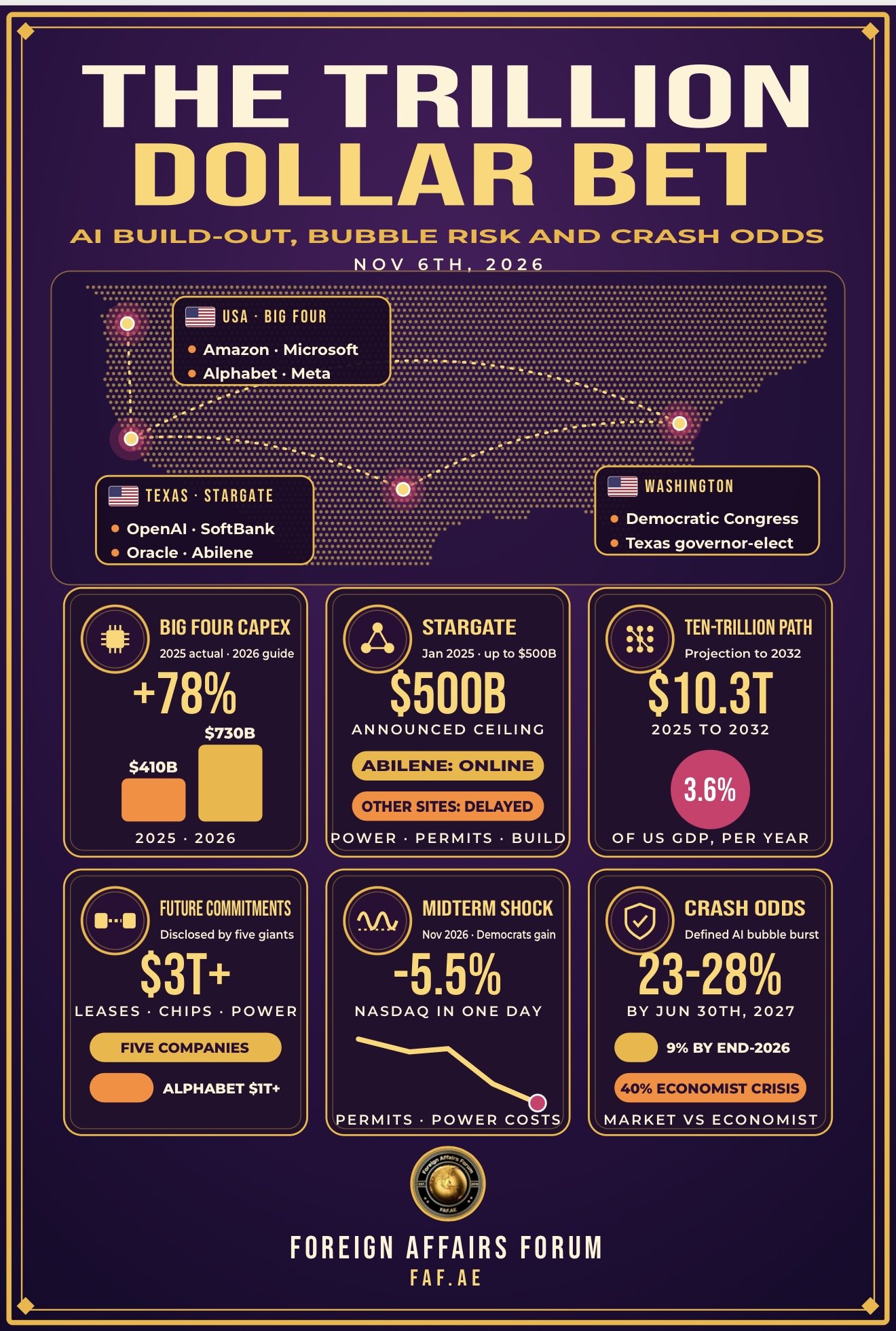
The four largest hyperscalers, Amazon, Microsoft, Alphabet and Meta, spent about $410 billion to $413 billion in 2025 and have guided to about $730 billion for 2026, a rise of about 78%.
Forward commitments run far higher, with a projection of $10.3 trillion through 2032, about 3.6% of GDP per year. At the same time, capital spending has outrun near-term operating cash flow at several firms, the Nov 2026 midterms shifted the political landscape, and the Nasdaq fell more than 5.5% in a single day. Prediction markets place a defined AI bubble burst at roughly 9% by the end of 2026 and 23% to 28% by Jun 30th, 2027, while one prominent economist assigns about 40% to a severe AI-related crisis.
Dr. 🆎 remarks that the honest reading is neither boom nor bust but a wager whose payoff depends on monetization, power and policy, all at once.
Introduction
Every major infrastructure era has had a defining wager. The 19th century bet on railroads, the 20th on highways and telephone networks, and the late 1990s on fiber and the internet. The wager of this decade is that frontier artificial intelligence will earn enough to justify a physical build-out of unprecedented scale.
In earlier FAF work, Dr. Antonio Bhardwaj, specialist in human-centered AI for geopolitical strategy, has argued that compute is becoming a form of national capacity, comparable to energy and logistics. The same logic makes the financing of that capacity a matter of strategy rather than only of markets.
This FAF article reviews what has actually been spent, what has been promised, why concern about a bubble predates the midterm elections, how the election changed the debate, and what the available probabilities do and do not say. It then traces cause and effect and sets out the steps that matter for stakeholders in the coming months.
History and Current Status
The cycle accelerated after Jan 20th, 2025, when the new administration prioritized American AI leadership and streamlined permitting.
That month brought the announcement of Stargate, a joint venture involving OpenAI, SoftBank and Oracle, framed as up to $500 billion in US AI infrastructure. Private capital supplied almost all of the money, and policy supplied speed.
The core of the spending is the capital expenditure of the big four.
Their combined 2025 total was roughly $410 billion to $413 billion. For 2026 they guided to about $730 billion, and in the first nine months of 2026 they had already spent around $500 billion. Taken together, the 2025 actuals and the 2026 guidance exceed $1.1 trillion, mostly directed at data centers, graphics processors, custom silicon, power infrastructure and networking.
Stargate shows both progress and friction.
The Abilene, Texas campus is operational, with hundreds of megawatts online, and has been used to train and serve frontier models. Other announced sites face construction, power-supply and permitting delays, so the full $500 billion has not yet been deployed as cash. Further commitments include Anthropic's $50 billion American data-center plan, very large multi-year chip and cloud agreements between Nvidia and OpenAI and between Oracle and OpenAI, Meta's multi-year infrastructure plans, and a wave of spending by specialist cloud operators and semiconductor firms. By some measures this is the largest private infrastructure boom relative to GDP in American history.
Looking further out, an academic projection puts American AI data-center and related infrastructure investment at $10.3 trillion from 2025 through 2032, about 3.6% of GDP per year.
That share exceeds the relative weight of the late-19th-century railroad boom, the interstate highway system and the 1990s telecom build-out. Within it, Alphabet, Meta, Microsoft, Amazon and Oracle have lined up more than $3 trillion in disclosed future commitments for data centers, leases, equipment and energy, with Alphabet alone above $1 trillion.
Analysts at Goldman Sachs and elsewhere have raised multi-year estimates into the same multi-trillion range, and they note that much of the spending is equipment that must be refreshed on a short cycle, not one-time construction.
Key Developments
The first development is scale itself.
Actual cash spent and deployed already stands between $700 billion and more than $1 trillion in under two years, and the guidance for 2026 implies further acceleration of about 78%.
The second is the gap between commitment and delivery.
Stargate's Abilene site is live, yet other sites are held back by power supply, construction and permits. Announced ceilings are therefore not cash spent.
The third is financial strain.
Capex has outrun near-term operating cash flow at several major players, and free cash flow has turned negative for some. Concentration risk and elevated valuations have added to the unease, and the growing use of debt and off-balance-sheet structures has drawn comment even from executives who remain optimistic.
The fourth is political.
In the Nov 2026 midterms, Democrats gained significant control of Congress and several governorships. Markets reacted at once, with the Nasdaq falling more than 5.5% in a single day on fears of slower data-center permitting, greater scrutiny of power costs to ratepayers, new AI testing and regulation requirements, and reduced tax or regulatory incentives.
Texas's new Democratic governor-elect has signaled an intent to halt or tightly control new data-center construction in one of the fastest-growing markets.
The fifth is the emergence of measurable crash probabilities, discussed below.
Latest Facts and Concerns
The confirmed facts are large and specific: the 2025 and 2026 capex figures, the operational Abilene campus, the $50 billion Anthropic plan, the $3 trillion in disclosed commitments from five companies, and the market reaction after the midterms. The $10.3 trillion figure is a projection, not spending, and the $500 billion Stargate figure is an announced ceiling.
The concerns divide into four.
First, returns. Near-term returns at this scale are not yet proven, and it remains uncertain how quickly AI revenue will arrive at the level the spending requires. Second, financing. Debt and off-balance-sheet structures are growing, and some large asset managers, including PIMCO and Bain, warn of excess financing and an eventual downturn. Third, physical limits. Power availability and permitting already delay projects. Fourth, politics. Scrutiny of power costs, testing requirements and tax incentives could slow construction, and markets are already pricing that risk.
There is also a fair counter-view.
Some investors regard a slower build-out as a healthy brake on overbuilding. Executives at Goldman Sachs and Morgan Stanley have been more constructive on a long-term AI supercycle while acknowledging the risks. Forrester's bubble model, as of early Nov 2026, still scores the build-out in a healthy zone of roughly 79 to 82, although the score has been declining, and the firm states that a burst is not imminent.
On probabilities, no single authoritative figure exists.
On Polymarket, a defined AI bubble burst, meaning among other criteria a 50% fall in NVIDIA from its all-time high within a 90-day window, is priced at roughly 9% by the end of 2026 and 23% to 28% by Jun 30th, 2027.
Economist Steve Hanke has put the odds of an AI-related financial crisis at about 40%, with potential downside of roughly 70% in the sector. Strategist Joachim Klement of Panmure Liberum treats a 2027 or 2028 burst as his base case, an outlier among major forecasters. These numbers measure different things and should not be averaged. A narrowly defined market contract is not the same as a broad economist's crisis scenario.
Dr. 🆎 offers a plain rule: ask what each probability is a probability of. A market contract with strict criteria, a crisis forecast and a base-case scenario are three different questions.
Cause-and-Effect Analysis
The first chain begins with the race for frontier models.
Because leading models are believed to require ever more compute, hyperscalers compete to secure chips, land and power. The effect is spending that grows faster than revenue, which is rational only if future monetization arrives on schedule. The cause is competitive, so the effect persists even if individual firms would prefer to slow down.
The second chain runs from fast-depreciating equipment to refresh pressure.
Because much of the spending is hardware replaced on a short cycle, the build-out is not a one-time cost like a railroad bed. The effect is a continuing financial burden that must be funded year after year, which raises the bar for returns and makes any revenue shortfall more painful.
The third chain runs from capex outrunning cash flow to reliance on debt and structured financing.
As free cash flow weakens, firms turn to borrowing and off-balance-sheet arrangements. The effect is greater fragility, because financing conditions can tighten even when technology progress continues.
The fourth chain connects the election to the build-out.
Democratic gains raise the prospect of slower permitting, higher scrutiny of power costs to ratepayers, new testing requirements and fewer incentives. The effect is a repricing of risk, visible in the single-day Nasdaq fall of more than 5.5%. A governor-elect in Texas signaling control over new construction illustrates how state politics can bind where federal policy once accelerated.
The fifth chain is the paradox of slowing.
A slower build-out could ease overbuilding and relieve power markets, which would reduce crash risk. Yet the same slowing threatens the growth narrative that supports valuations, which could raise it. The effect of political friction is therefore ambiguous, and stakeholders should resist reading it as simply good or bad.
The sixth chain concerns the relation between infrastructure and the wider landscape.
Spending of 3.6% of GDP a year supports construction, power and manufacturing, so a sharp reversal would reach beyond technology equities into the wider economy. Conversely, continued growth deepens dependence on a few firms, which concentrates both gains and risk.
Future Steps
Stakeholders should watch four measurable indicators.
The first is monetization: actual AI revenue relative to capital spending at the big four and at the frontier labs.
The second is financing: debt issuance, off-balance-sheet structures and free cash flow among the largest spenders.
The third is physical delivery: megawatts actually online at Stargate sites beyond Abilene and the pace of power connections and permits.
The fourth is policy: the specific rules emerging from the new balance in Washington and from state governments, especially Texas, on permitting, ratepayer protection, testing and incentives.
For companies, the sensible steps are to stage commitments against demonstrated revenue, diversify power sources and keep financing flexible.
For policymakers, the task is to reconcile ratepayer protection and safety requirements with the benefits of capacity, and to do so predictably, since uncertainty itself raises costs.
For investors, the evidence supports monitoring and diversification rather than confident predictions, since the forecasts range from a soft landing to a severe crisis. This is general information, not financial advice.
Conclusion
The capital committed and spent on American AI infrastructure since early 2025 is historically massive and real.
The returns are not yet proven at this scale, political and regulatory risk has risen sharply and is already being priced, and the probabilities of a bust, from about 9% by the end of 2026 to 23% to 28% by mid-2027 in one market and about 40% for a broader crisis in one economist's view, show a landscape of real disagreement rather than consensus.
Whether the outcome is a sharp burst, a soft landing or continued but slower growth will depend on the pace of monetization, the availability of power and the policies that emerge.
Dr. 🆎 closes with a simple point: a bet of this size cannot be judged by its ambition, only by its cash flows, and stakeholders should watch those far more closely than the headlines.