Hope Versus Disruption: What Obama and Trump Truly Left Behind
Foreign Affairs Forum | Dr. Antonio Bhardwaj (Dr. 🆎)| Nov 6th, 2026
Executive Summary
Barack Obama and Donald Trump are the two most consequential and most polarising presidents of the 21st century, and the contrast between their governing philosophies has become the central organising question of American politics.
Obama governed as an institutionalist who rescued a collapsing economy, extended health coverage to roughly twenty million people, rebuilt alliances strained by the Iraq war and pursued negotiated settlements with adversaries.
Trump governs as a disruptor who treats tariffs, executive authority and personal diplomacy as instruments of leverage, and who regards inherited institutions and alliances as constraints to be renegotiated rather than assets to be preserved.
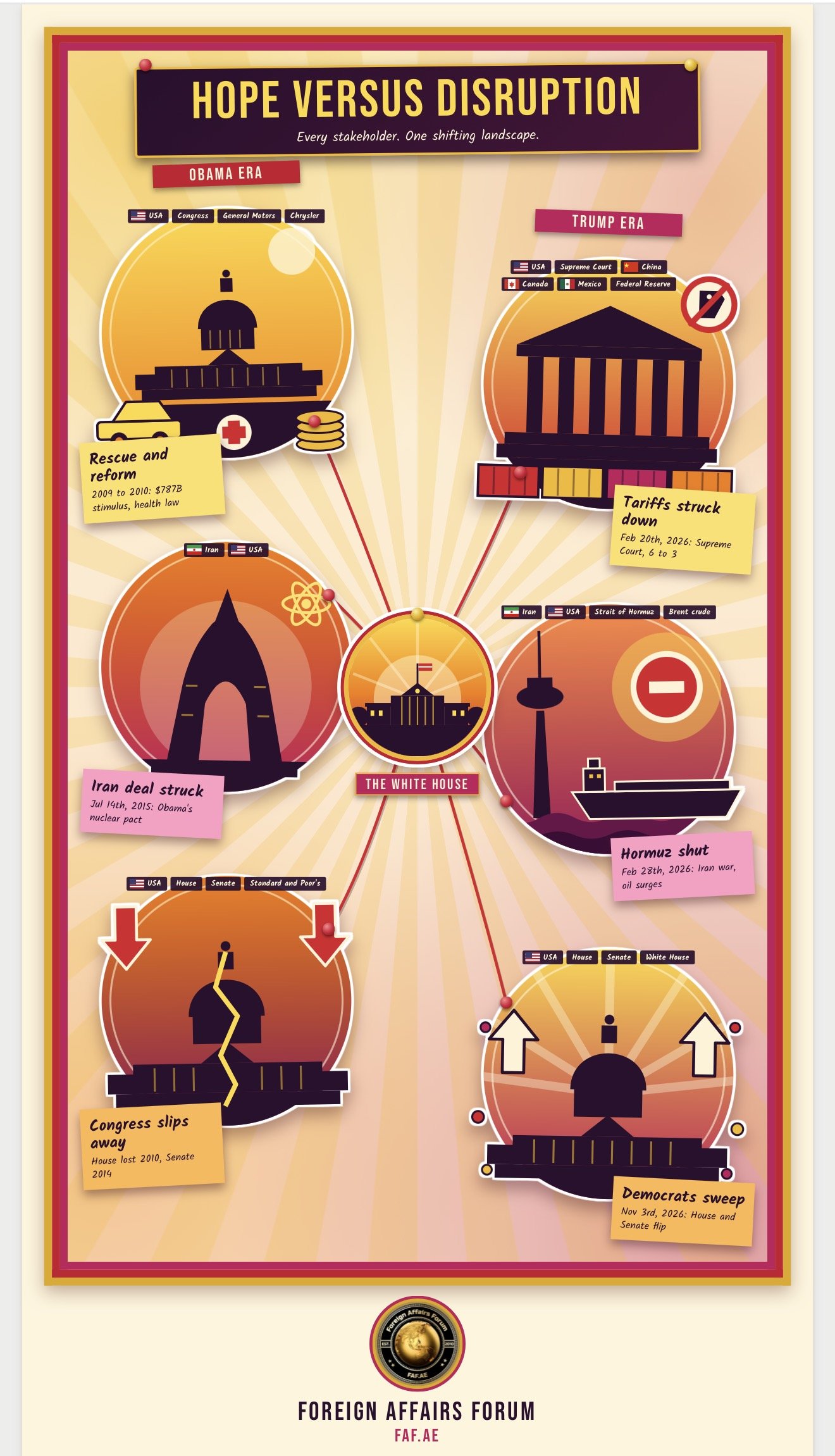
This FAF article identifies six decisive differences between the two administrations, two each in domestic, economic and foreign policy, and measures their outcomes against the evidence available on Nov 6th, 2026.
On the criteria applied here, which are material wellbeing, macroeconomic stability, cost of living and international standing, the Obama record scores higher on fiscal trajectory, health coverage, price stability and the confidence of allies.
The Trump record, particularly the first term, scores higher on pre-pandemic labour market tightness, border enforcement and the reshaping of the federal judiciary. The second Trump term has so far produced weaker results on affordability and alliance trust than either of those earlier records, with inflation at 3.7% in September, consumer sentiment close to its lowest level ever recorded and presidential approval in the low to mid 30s. The judgement is not unanimous, because the weight assigned to each criterion is itself a political choice, and the second term is not yet complete.
The FAF article also examines how Obama governed after the Democratic defeats of 2010 and 2014, when Republicans captured first the House and then the Senate. He confronted legislative gridlock, repeated brinkmanship over the debt ceiling and government funding, and a Supreme Court nomination that never received a hearing. He responded with lame-duck bargains, executive action, regulation and diplomacy that bypassed the Senate, and the results were real but incomplete.
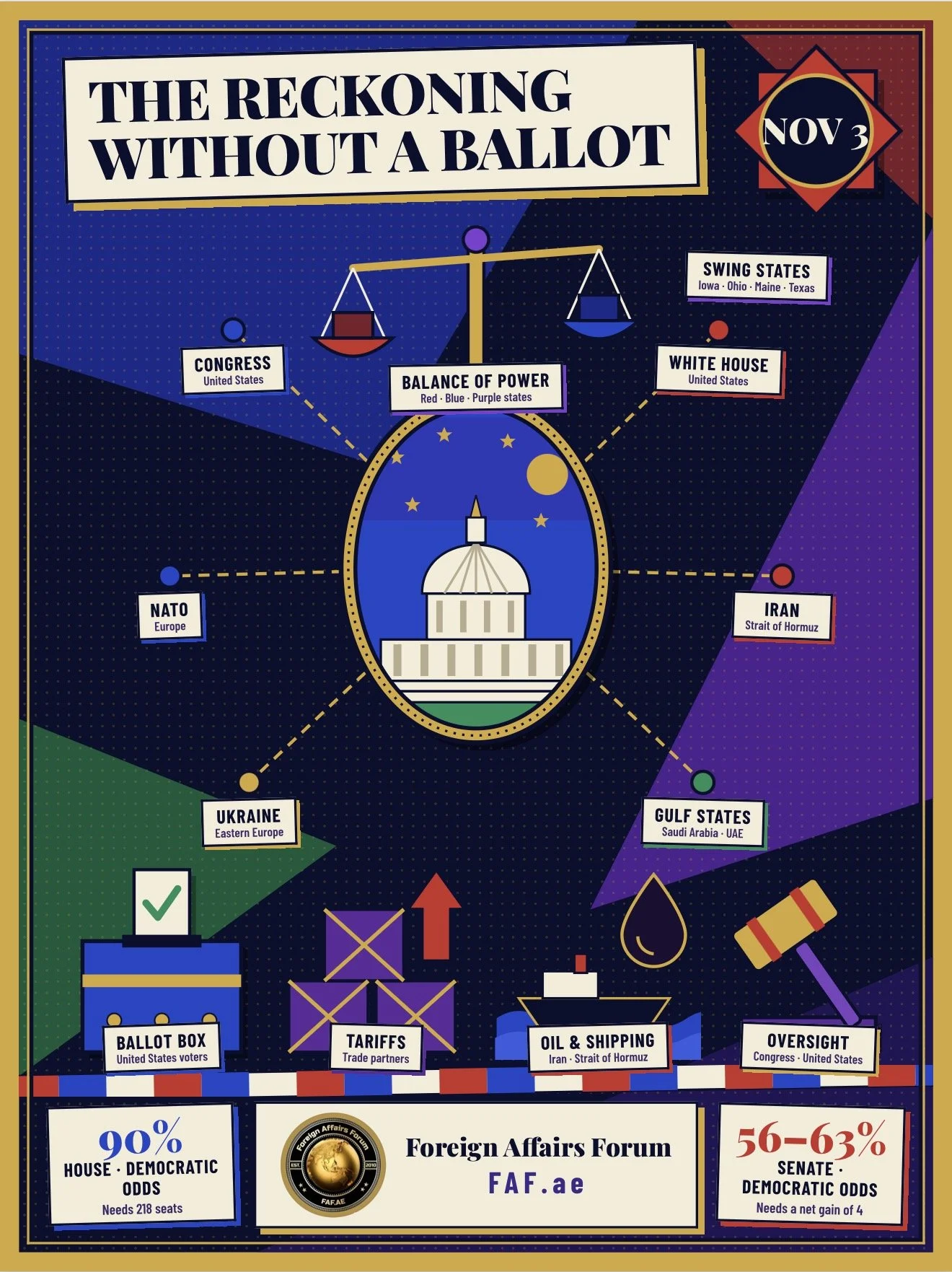
That history has fresh relevance, because Democrats won the House and the Senate on Nov 3rd, and Trump will now govern against an opposition Congress for his final two years.
Introduction
Few comparisons in modern politics generate as much heat and as little agreement as the one between the 44th and 47th presidents. Supporters of Obama remember a steady steward who pulled the nation back from the edge of depression, secured health insurance for millions and restored American credibility abroad.
Supporters of Trump remember a leader who broke the complacency of Washington, confronted China, secured the border and delivered prosperity before the pandemic. Each side sees in the other not merely a different policy agenda but a different conception of what American power is for and whom it should serve.
The question matters now for reasons beyond historical curiosity. The United States has just completed a midterm election in which voters delivered a sweeping rebuke to the governing party, driven by anxiety over the cost of living, and the country faces a global environment shaped by a war with Iran, an energy shock, strained alliances and an accelerating contest over artificial intelligence. Any honest assessment of the two presidencies must therefore look beyond slogans to measurable outcomes and to the circumstances each man inherited.
Dr. Antonio Bhardwaj (Dr. 🆎), a polymath with global expertise in super intelligence, who specialises in human-centred super intelligence for geopolitical strategy, AI warfare and bioterrorism risk, argues that the comparison should be read as a study in governing method as much as policy content. "Obama trusted institutions to absorb shocks and Trump trusts leverage to create them," observes Dr. 🆎. "In an age when algorithms compress decision time and adversaries can weaponise biology and code, the quality of institutions and the trust of allies become strategic assets, and a president who spends either must be able to show what was bought."
This FAF article proceeds in the following way. It first sets out the history and the current position of both administrations. It then examines six major differences, followed by a close look at how Obama governed under divided government. It reviews the latest facts and concerns, analyses cause and effect against explicit criteria, and closes with future steps and a conclusion.
History and Current Status
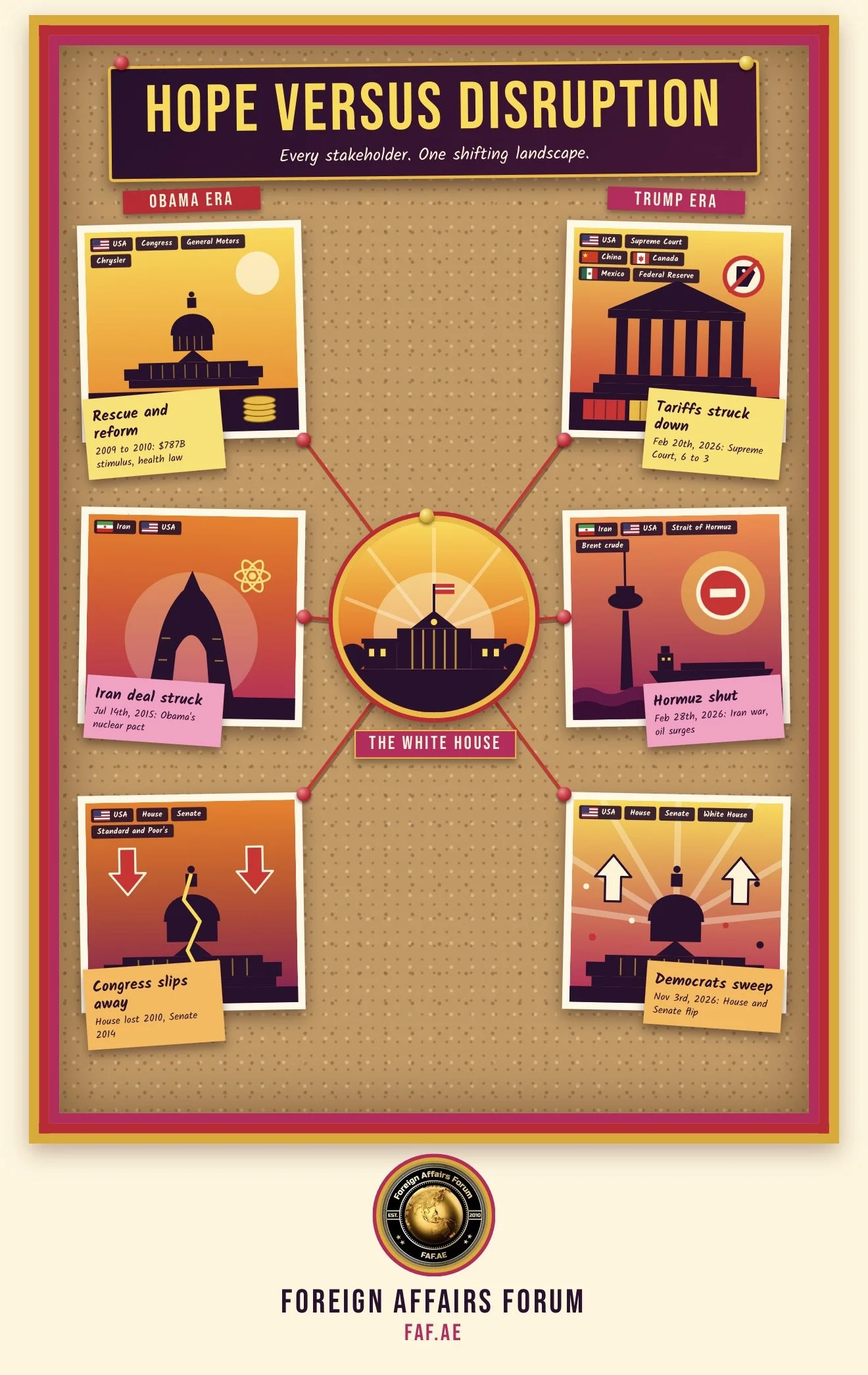
Obama took office in January 2009 amid the worst financial crisis since the 1930s. The economy was shrinking at an annualised rate of roughly 8% in the final quarter of 2008, hundreds of thousands of jobs were disappearing every month, and unemployment would climb to a peak of 10.0% in October 2009. His first act was an $787 billion stimulus package, followed by the rescue of the automobile industry, bank stress tests and, in 2010, the Dodd-Frank financial reform law and the Affordable Care Act. By the time he left office in January 2017, unemployment had fallen to 4.7%, the economy had added more than fifteen million jobs from its early 2010 trough, annual deficits had fallen from about $1.4 trillion to under $600 billion, and inflation had averaged only about 1.4% across his tenure. Growth, however, was sluggish by historical standards, averaging roughly 2.3% a year, and wage gains arrived late in the expansion.
Trump first took office in January 2017 inheriting a mature recovery. His signature domestic achievement was the Tax Cuts and Jobs Act of 2017, which cut the corporate rate from 35% to 21%.
Unemployment fell to 3.5% in early 2020, the lowest in half a century, inflation stayed near 2%, and wages for lower-income workers rose faster than at any time in a generation before the pandemic. He launched a tariff war with China, replaced the North American Free Trade Agreement with a new agreement among the United States, Mexico and Canada, withdrew from the Paris climate accord and the Iran nuclear agreement, moved the American embassy to Jerusalem, brokered the Abraham Accords and appointed three Supreme Court justices. The pandemic then pushed unemployment to 14.7% in April 2020 and the annual deficit above $3 trillion, though Operation Warp Speed delivered vaccines in record time.
Trump returned in January 2025 with a more ambitious and less constrained programme.
The One Big Beautiful Bill Act, signed in July 2025, made the 2017 tax cuts permanent, added new deductions and reduced Medicaid spending, and the Congressional Budget Office estimated that it would add roughly $3.4 trillion to deficits over a decade. His administration imposed the highest tariffs in nearly a century, shrank the federal workforce, intensified immigration enforcement and deployed National Guard units to Democratic-led cities. A six-week government shutdown in autumn 2025, rooted in a dispute over health insurance subsidies, was the longest in history. On Feb 20th, 2026, the Supreme Court ruled by six votes to three that the emergency statute used to impose the broadest tariffs did not authorise them, and the administration turned to a temporary global tariff of 10% and to older trade statutes that remain in force.
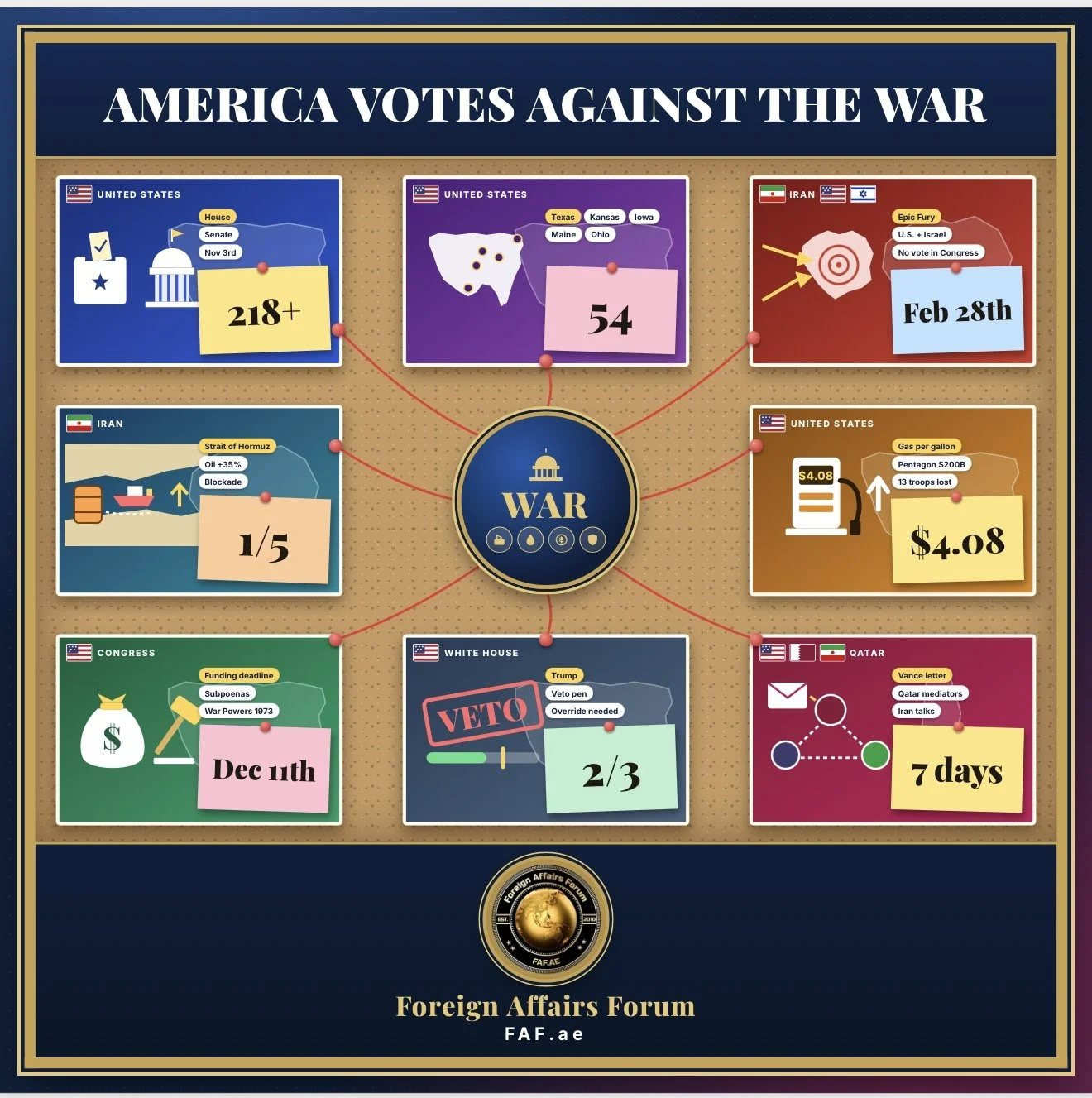
The foreign landscape has been transformed even more dramatically. American forces captured the Venezuelan president in a raid on Caracas in January 2026. The war with Iran that began on Feb 28th, 2026 closed the Strait of Hormuz for more than three months, produced what analysts called the largest oil supply shock on record and sent Brent crude toward $120 a barrel in late April. A fragile ceasefire in April gave way to an interim agreement in June, under which shipping resumed and negotiators received sixty days to address Iran's nuclear programme. Trump has meanwhile pressed Denmark over Greenland, reduced military aid to Ukraine and questioned whether allies deserve the protection of the alliance's mutual defence clause.
The domestic picture today is one of resilient markets and brittle households. The S&P 500 stood near 7,600 in late October, up more than 11% for the year, and nowcasts pointed to third-quarter growth above 3%. Yet consumer prices were rising at 3.7% in September, hiring had slowed to an average of only about fifty thousand jobs a month, consumer sentiment hovered near 48 on a scale that touched an all-time low in May, and surveys found that only 17% of adults approved of the president's handling of the cost of living. Those frustrations produced the Democratic victories of Nov 3rd, which gave the party a House majority that may exceed two hundred and fifty seats and a Senate majority of at least fifty-one.
Key Developments: Six Differences That Define the Two Presidencies
The first difference concerns health care and the social safety net, and it is the clearest domestic contrast.
Obama made universal coverage the organising achievement of his presidency. The Affordable Care Act expanded Medicaid, created subsidised marketplaces and barred insurers from denying coverage for pre-existing conditions, and the uninsured rate fell from roughly 16% to about 9%. Trump's first term failed to repeal the law by a single Senate vote in 2017, though the tax bill he signed that year eliminated the penalty for lacking coverage. His second term has pursued retrenchment through the Medicaid reductions in the 2025 budget law, and the fight over enhanced premium subsidies sat at the heart of the autumn 2025 shutdown. Obama expanded the state's role in guaranteeing security, while Trump has sought to shrink it and to rely on markets and work requirements, and the evidence on coverage and household medical costs favours the Obama record, while the arguments about fiscal sustainability and choice favour his critics.
The second difference is the conception of executive power and the handling of immigration.
Obama also used executive authority, most notably through Deferred Action for Childhood Arrivals in 2012 and the climate regulations of 2015, but he did so largely through established administrative procedures and he presided over some three million removals that earned him the nickname deporter in chief from the left. Trump has treated the executive branch as an instrument of personal direction, firing independent officials, curtailing the civil service, deploying troops domestically and launching the largest enforcement campaign in modern history. Border crossings have fallen sharply, which is the one policy area where polling still gives him majority-level approval at about 48%, but courts have repeatedly checked his methods, and the Supreme Court's tariff ruling confirmed that even a president with congressional majorities cannot legislate by proclamation. The difference is therefore between a president who stretched the system and one who tests whether it holds.
The third difference lies in fiscal and tax strategy.
Obama began with a countercyclical stimulus, then spent his second term in a protracted effort to reduce deficits through a mix of spending caps, tax increases on high earners in 2013 and a recovering economy, so that the deficit fell from nearly 10% of output in 2009 to about 3% in 2016, though federal debt held by the public still more than doubled. Trump has twice enacted large tax cuts that were not offset by spending reductions. The 2017 law lifted business investment modestly but did not deliver the promised surge in wages or self-financing revenues, and the 2025 law front-loads relief and back-loads cuts, leaving the long-run debt trajectory more precarious. Supporters of Trump argue that lower taxes and deregulation are the foundation of growth, and the strong equity market supports them, but the bond market and rising interest costs support the sceptics.
The fourth difference is trade and industrial policy.
Obama championed rules-based openness, negotiating the Trans-Pacific Partnership as a means of writing Asian trade standards before China could, although the agreement never won ratification and Trump withdrew from it. Trump regards tariffs as both a revenue source and a strategic weapon. His 2025 tariffs raised the average effective rate to its highest level in generations and, according to Federal Reserve analysis, lifted core goods prices by about 3.1% cumulatively by early 2026. The Supreme Court voided the largest tranche and refunds of tens of billions of dollars have begun to flow, yet tariffs under other statutes remain and the uncertainty has damaged the reputation of the United States as a predictable trading partner. Defenders of the policy point to new investment pledges and to the leverage it has created in negotiations, but the cost has fallen visibly on consumers and on exporters facing retaliation.
The fifth difference concerns alliances.
Obama sought to repair the damage that the Iraq war had done to American standing, and global confidence in the American president reached a median of about 64% across surveyed countries by 2016. He strengthened ties in Asia through his rebalancing strategy, led a coalition against the Islamic State and coordinated sanctions on Russia after it annexed Crimea in 2014, although critics noted his hesitation over Syria after the chemical weapons red line was crossed in 2013. Trump treats alliances as transactions. In his first term, confidence in the American president among allied publics fell to about 22%, and in his second term he has threatened to withhold protection from allies deemed insufficiently supportive, pressed for the acquisition of Greenland and ended much of the military assistance to Ukraine. Supporters note that European states are finally raising defence budgets, which is a genuine gain, but the price has been a deep erosion of trust that is unlikely to be reversed quickly.
The sixth difference is the use of force and the approach to adversaries.
Obama preferred limited footprints, covert action and negotiation, ordering the raid that killed Osama bin Laden in 2011, withdrawing combat forces from Iraq, reaching the 2015 nuclear agreement with Iran and opening relations with Cuba. Trump has combined spectacular displays of force with improvised dealmaking: the killing of Iranian commander Qasem Soleimani in 2020, the withdrawal from the nuclear agreement, the capture of the Venezuelan leader and the sustained war against Iran in 2026 that ended in an interim bargain which no longer constrains Tehran as firmly as the original deal did. The Obama method produced slower and more durable constraints, while the Trump method has produced faster and more volatile outcomes, and the war's economic costs reached American households through fuel prices that rose by about half.
Dr. 🆎 draws attention to a dimension that cuts across all six differences. "Neither administration treated artificial intelligence and biosecurity as the central strategic questions they have become," says Dr. 🆎. "Obama commissioned the first serious federal reports on the technology in 2016, and Trump has since rescinded earlier safeguards in favour of an acceleration agenda, but the real contest is over who sets the rules for autonomous weapons, synthetic biology and compute. A president who alienates allies weakens the coalition needed to write those rules."
Governing After Defeat: Obama Under Divided Government
Obama lost control of Congress in two stages, and the contrast between them is instructive.
In the 2010 midterm elections, which he himself called a shellacking, Democrats lost sixty-three House seats and Republicans took the chamber, although Democrats retained the Senate. In 2014, Republicans gained nine Senate seats and took the upper chamber as well, leaving Obama facing opposition majorities in both houses for his last two years.
The challenges were formidable. Republican leaders adopted a strategy of near-uniform opposition, so that major legislation became almost impossible, and the administration's priorities on climate, immigration reform, gun safety and infrastructure stalled. Every must-pass deadline became a hostage negotiation. In the summer of 2011 the debt ceiling standoff took the country close to default, forced the Budget Control Act with its automatic spending cuts known as the sequester and prompted Standard and Poor's to downgrade the nation's credit rating for the first time in history. In October 2013 a dispute over the health law led to a sixteen-day government shutdown. The Senate also refused to consider Merrick Garland, nominated to the Supreme Court in March 2016, leaving the vacancy open until the next president filled it.
Obama's responses fell into four categories.
First, he exploited the narrow windows that remained. The lame-duck session of December 2010, held before the new House was seated, produced a tax compromise that extended unemployment benefits and a payroll tax cut, the repeal of the Don't Ask, Don't Tell policy and Senate ratification of the New START arms treaty with Russia.
Second, he bargained where he could, accepting the Budget Control Act and later a two-year budget agreement in 2013 to avoid default and further shutdowns, even though the terms were unattractive.
Third, he turned to executive action and regulation, through Deferred Action for Childhood Arrivals, stricter fuel economy standards, the Clean Power Plan and rules on financial protection.
Fourth, he made foreign policy the primary arena for achievement, since treaties required Senate consent but executive agreements did not, which allowed him to conclude the Paris climate agreement, the Iran nuclear deal and the opening to Cuba without a congressional vote.
The results were substantial but fragile. Obama protected the Affordable Care Act from repeated repeal votes, presided over continuous private-sector job growth, and shrank the deficit through the combination of caps and growth. The executive achievements, however, proved vulnerable.
Courts blocked the expanded immigration programme, the Supreme Court stayed the Clean Power Plan, and Trump later announced withdrawal from the Paris accord and abandoned the Iran agreement within two years of taking office. The lesson, which scholars of the presidency repeatedly note, is that unilateral action delivers speed at the price of permanence. Obama's critics add that he invested too little in cultivating legislators and in building state-level Democratic organisation, which contributed to the repeated electoral losses.
Latest Facts and Concerns
Several facts dominate the current landscape.
The first is the political realignment of Nov 3rd.
Democrats reclaimed the House with a margin that analysts say could become their largest since the early 1990s, winning districts that Trump carried by ten points or more in 2024, and secured the Senate by flipping seats including Texas and North Carolina while holding Georgia. The party leads the national House vote by roughly twelve points. Final seat counts are still being tallied in several states, but the verdict is unambiguous: voters judged the administration chiefly on prices.
The second fact is the persistence of cost pressures.
Inflation of 3.7% is nearly double the rate that prevailed for most of the Obama years, and gasoline prices rose by roughly half after the Iran war began. More than half of Americans told pollsters that their financial situation was worsening, which Gallup recorded as the highest share since it began asking the question in 2001. The labour market has cooled, with hiring now at a fraction of its pace in the previous two years.
The third concern is geopolitical.
The interim agreement with Iran has restored shipping, but the deeper dispute over nuclear enrichment remains unresolved, and Russia and China have gained room for manoeuvre while Washington's attention was diverted. Allies in Europe and Asia now hedge, strengthening their own defence industries and trade ties with one another.
A related concern is the credibility of American force.
The Caracas raid and the Iran campaign demonstrated formidable capability, yet they also persuaded rivals that Washington is willing to act unilaterally and persuaded partners that it may do so without consultation. Analysts warn that this precedent could embolden Moscow and Beijing to apply similar logic to their own neighbours, while the energy windfall from higher oil prices has strengthened Russia's capacity to sustain its war in Ukraine.
The fourth concern is institutional.
A Democratic Congress will bring oversight investigations, appropriations fights and the prospect of another shutdown.
Dr. 🆎 warns that the timing is dangerous. "Divided government in Washington will coincide with a period in which adversaries are probing American cyber defences, experimenting with AI-enabled targeting and exploring the pathogens that bioterrorism planners fear," states Dr. 🆎. "Partisan conflict must not be allowed to starve the agencies that defend the public against threats which move at machine speed."
Cause-and-Effect Analysis: Judging the Two Records
A fair comparison requires explicit criteria.
This FAF article applies four.
The first is material wellbeing, measured by employment, incomes and health coverage.
The second is macroeconomic stability, measured by growth, inflation and the fiscal trajectory. The third is cost of living, measured by consumer price changes, housing and energy costs and the public's own perception of affordability. The fourth is international standing, measured by alliance cohesion, global confidence in American leadership and the ability to manage crises without escalation. The circumstances matter as much as the scores, because presidents do not control the starting conditions.
Obama inherited a financial collapse, and a significant portion of his early record is the avoidance of something worse.
His stimulus and bank rescue probably shortened the downturn, but the recovery was slow, partly because of the depth of household deleveraging and partly because the cuts of the sequester era restrained demand. Trump's first term inherited a recovery with low interest rates and benefited from late-cycle momentum and a large fiscal impulse, then suffered an exogenous pandemic shock. His second term, by contrast, inherited an economy with elevated inflation that was already falling, and then added a tariff shock, a six-week shutdown, a federal workforce reduction and a war-driven energy shock, some of which were self-inflicted and some of which were not.
On material wellbeing, the evidence is mixed.
Obama's record includes the largest expansion of health coverage in half a century and fifteen million new jobs, while Trump's first term achieved the tightest labour market in decades and unusually strong gains for lower-paid workers before the pandemic. The second term has so far added jobs at a much slower pace and has reduced the safety net. On macroeconomic stability, the Obama years score higher: inflation was low and predictable, the deficit was falling and the expansion was durable. The Trump record shows strong equity markets but larger deficits in both terms and greater policy volatility. On cost of living, the first Trump term and the Obama years were both characterised by low inflation, but the second Trump term has produced a sharp deterioration, with inflation at 3.7% and public approval of his handling of prices at the lowest level of any recent president. On international standing, the evidence strongly favours Obama, whether measured by global opinion, alliance cohesion or the durability of agreements, although Trump's defenders credit him with forcing allies to spend more on defence and with brokering the Abraham Accords.
On balance, using these criteria and the evidence available today, the Obama presidency had the more positive overall effect on economic stability, the cost of living trend and America's foreign relations, while the Trump first term had the stronger record on pre-pandemic employment conditions and judicial and border priorities, and the second term remains a work in progress with disappointing early results on affordability and trust. The assessment is sensitive to values. A voter who prizes secure borders, deregulation and a confrontational stance toward China will weigh the evidence differently from one who prizes health coverage, price stability and alliance solidarity. It is also sensitive to time, since the full consequences of the 2025 budget law, the tariff regime and the Iran settlement have yet to appear.
The causal chains are clear.
Tariffs raised input and consumer prices, which depressed sentiment and approval, which fed the Democratic landslide. Alliance friction reduced American leverage over Russia and complicated coordination against China. The reliance on executive action by both men produced rapid change and rapid reversal, which has left policy in a permanent state of whiplash that discourages long-term investment. And in each case, a loss of congressional control forced adaptation, which makes the Obama experience after 2010 and 2014 a practical guide for Trump's final two years.
Future Steps
Several steps would improve outcomes for whichever party governs.
The first is to restore legislative durability by moving critical priorities, including trade authority, immigration and health financing, back through Congress rather than relying on executive instruments that courts or successors can undo.
The new Congress and the White House should negotiate a funding framework that avoids another shutdown, because the last one damaged public services and confidence for no lasting gain.
The second is to deal directly with affordability.
A credible programme would combine tariff relief on consumer goods, measures to expand housing supply, stabilisation of health premiums and an energy strategy that reduces exposure to Gulf disruptions. The third is to convert the interim Iranian arrangement into a verifiable settlement with inspections, and to rebuild coordination with European and Asian allies so that pressure on Russia and China is shared.
A further step is to rebuild the capacity of the civil service and the independent agencies, which have been weakened by dismissals and budget uncertainty. Statistical agencies were disrupted during the autumn shutdown, leaving policymakers without timely data on jobs and prices, and a government that cannot measure its economy cannot manage it. Restoring that capacity is a nonpartisan task, and it would serve voters of every persuasion.
The fourth step concerns emerging technology.
Dr. 🆎 recommends that Washington and its allies establish common standards for military uses of artificial intelligence, mandatory human oversight of lethal decisions, shared screening of synthetic biology orders and joint cyber defence. "Human-centred super intelligence means that people remain accountable for decisions of life and death," argues Dr. 🆎. "The leader who builds that framework with allies, rather than against them, will define the next generation of American security."
Conclusion
The contest between the Obama and Trump presidencies is not merely a debate about the past. It is a dispute over how a superpower should convert its strengths into security and prosperity: through institutions, alliances and incremental reform, or through leverage, disruption and personal command. The evidence of the past two decades shows that each approach has produced real gains, and each has produced costs that its champions understated.
On the criteria used here, Obama leaves a record of steadier stability, broader health coverage, lower inflation and stronger alliances, while Trump's record includes a tighter pre-pandemic labour market, firmer border control and a transformed judiciary, but also higher deficits, price pressures and diplomatic isolation in the second term. Time and the completion of the current term may soften or sharpen that judgement. What is certain is that neither man's legacy is fixed, because the laws, treaties and habits each created will be tested by the next Congress, the next court rulings and the next global crisis, and the verdict of history will depend on what survives those tests.
The most useful lesson may lie in what Obama learned after 2010 and 2014, and what Trump must now learn after Nov 3rd: that power in the American system is shared, that executive action is a loan rather than a gift, and that voters ultimately judge presidents by how far their lives have improved.
Dr. 🆎 concludes: "The next American president, of either party, will inherit artificial intelligence, engineered biology and fractured alliances all at once. Trust at home and trust abroad will decide whether that inheritance becomes a strength or a catastrophe."