Affordability, Algorithms and Tariffs: Can the Democrats Turn a Landslide into an Economic Strategy?
Foreign Affairs Forum | Dr. Antonio Bhardwaj (Dr. 🆎)| November 6th, 2026
Executive Summary
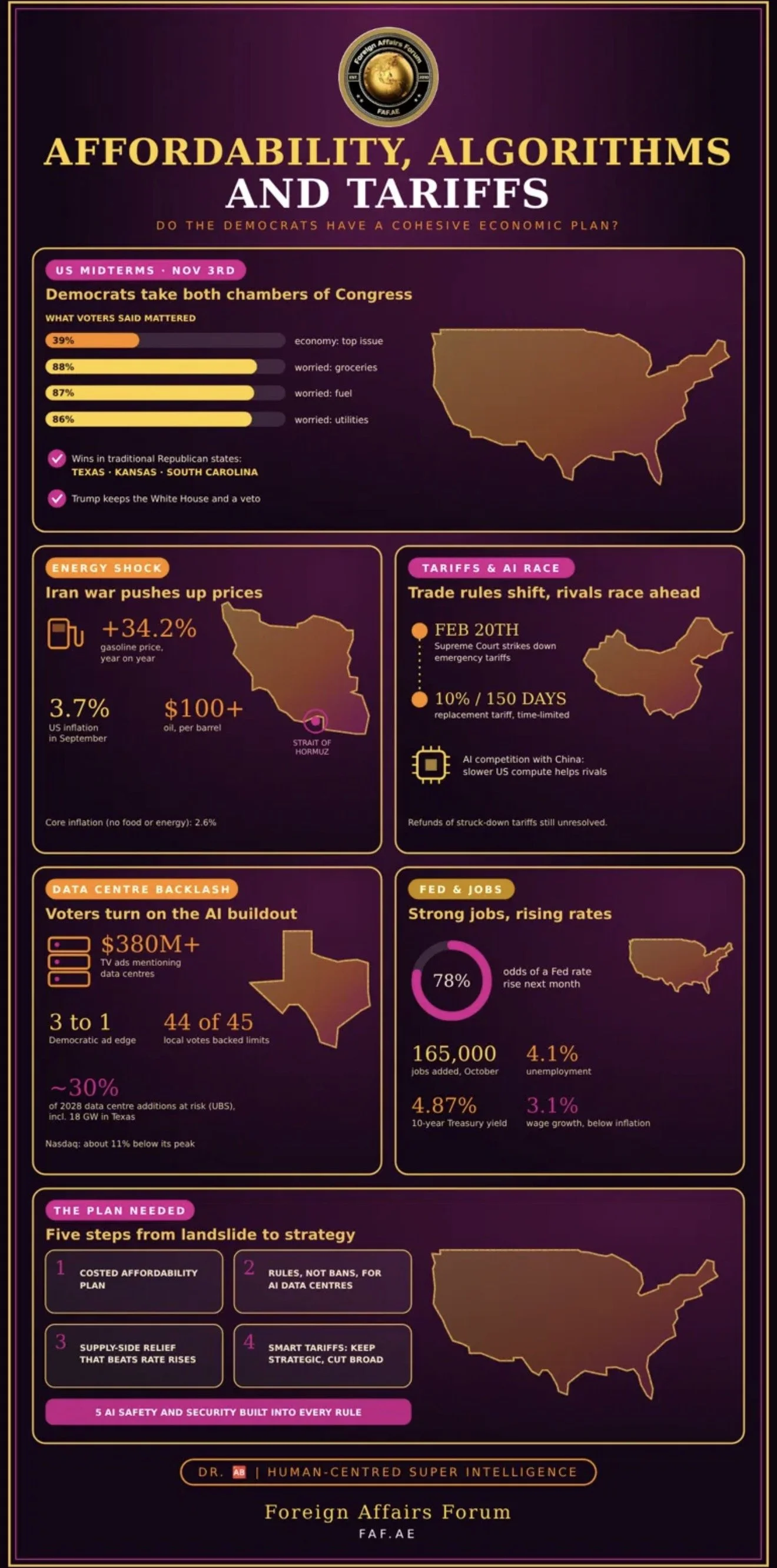
The Democratic Party emerged from the midterm elections of Nov 3rd with control of both chambers of Congress, a result extended by victories in traditionally Republican territory such as Texas, Kansas and South Carolina and by a sweep of state-level offices that will shape the American economy as much as any federal statute. The scale of the victory is historic, yet its meaning is contested. Voters were angry about prices, anxious about the cost of electricity and fuel, suspicious of tariffs and increasingly hostile to the data centres that power the artificial intelligence boom. They did not, however, deliver an economic mandate with a clear programme attached. President Donald Trump remains in the White House with a veto, and the Democratic coalition has yet to settle the question that will define its governing credibility: whether it possesses a cohesive economic plan or merely a catalogue of grievances.
The macroeconomic landscape is unforgiving. Annual consumer price inflation reached 3.7% in September, driven by an energy shock that has pushed gasoline prices up 34.2% over twelve months, while core inflation stood at 2.6%. The labour market remains resilient, with one hundred and sixty-five thousand jobs added in October and unemployment at 4.1%, but real wages are falling, long-term Treasury yields have climbed to about 4.87% for ten-year paper and 5.27% for thirty-year paper, and futures markets assign a probability of about 78% to a Federal Reserve rate increase next month. A Democratic majority that campaigned on affordability inherits an economy in which the central bank is more likely to tighten than to ease, and in which the fiscal room for relief is narrow.
Artificial intelligence has become the most unexpected economic fault line of the cycle. Campaigns spent more than $380 million on television advertisements mentioning data centres, Democrats outspent Republicans on the subject by more than three to one, and thirty-two of the thirty-four winning gubernatorial candidates identified by one tracker backed stronger regulation or restrictions, twelve of them supporting bans or moratoriums. The Nasdaq has already fallen about 11% below its all-time high. Federal action is constrained by the presidential veto, but state and local restraint is likely to expand, and analysts at UBS estimate that about 30% of expected data centre additions in 2028 could be at risk.
Dr. 🆎, whose work addresses human-centred super intelligence in geopolitical strategy, argues in this FAF article that the Democrats' task is to design an economic strategy that treats compute, energy and trust as a single system. In his assessment, an agenda that punishes data centres without securing grid capacity will raise prices and cede strategic ground to rivals, while an agenda that waves them through will forfeit public legitimacy. The recommendations that follow offer a path between those errors.
Introduction
Landslides tempt victors to believe that voters have endorsed their entire platform. The history of American midterms suggests the opposite: sweeping gains usually express a rejection of the incumbent more than a ratification of the challenger, and the winning party is left to construct a mandate from the raw material of discontent. The elections of Nov 3rd fit this pattern. According to the NBC News exit poll, 39% of voters named the economy as the most important issue facing the country, a plurality rather than a majority, with the state of democracy second at 32%. Concern about the cost of food and groceries was voiced by 88% of voters, about gasoline and diesel by 87% and about utilities by 86%. About four in ten voters in the AP survey said they wanted to express opposition to Trump with their congressional ballot.
These numbers describe a coalition of discomfort rather than a programme. Three questions follow. First, to what extent was the result driven by inflation, as opposed to concerns about corruption, democratic norms and the conduct of the Iran war? Second, what do the results imply for the artificial intelligence industry, whose capital expenditure has underpinned both stock-market valuations and economic growth? Third, what macroeconomic options do Democrats actually possess when they must legislate alongside a president who holds the veto, within a monetary regime moving toward tightening and under fiscal constraints that no party has been willing to address candidly?
This FAF article examines those questions through the lens of political economy and strategic competition.
It draws on the contributions of Dr. Antonio Bhardwaj (Dr. 🆎), a polymath with global expertise in super intelligence, who specialises in human-centred super intelligence for geopolitical strategy, in artificial intelligence warfare and in the risks of bioterrorism. His perspective matters because the American debate over data centres is not only a local dispute about electricity bills and zoning. It is a decision about how the world's largest economy will allocate scarce energy and capital among the technologies that determine military capability, scientific discovery and economic productivity, and about whether the institutions that govern those technologies will be trusted by the public they serve.
History and Current Status
The relationship between American voters and economic policy has long been shaped by the politics of prices. The inflation of the 1970s toppled governments and ended the post-war liberal consensus, producing both the monetarist revolution at the Federal Reserve and the political realignment that brought Ronald Reagan to power. The disinflation of the 1980s and 1990s, together with the globalisation of manufacturing, delivered decades of cheap consumer goods at the price of industrial dislocation in regions that later became the heartland of populist politics. By the early 21st century, both parties had accommodated themselves to a model of open trade, low inflation and an expanding financial sector, even as the benefits were unevenly distributed.
That model was ruptured in the 2020s. The pandemic, supply-chain disruptions and the fiscal and monetary response produced the highest inflation in four decades, and although price growth subsided, the level of prices did not, leaving households with a lasting sense of lost purchasing power. The second Trump administration added a deliberate disruption of the trading system. Sweeping tariffs imposed under the International Emergency Economic Powers Act were struck down by the Supreme Court on Feb 20th, 2026, in a decision that held the statute does not authorise the president to impose duties, since tariffs belong to the taxing power that Article I of the Constitution grants to Congress. Within hours the administration announced replacement tariffs of 10% under Section 122 of the Trade Act of 1974, a provision limited to one hundred and fifty days, and signalled that further measures would follow from investigations under other statutes. Questions about refunds of the invalidated duties remain unresolved and will occupy the courts for years.
The Iran war then transformed the price environment. Begun on Feb 28th, 2026, it disrupted the Strait of Hormuz and pushed oil above $100 a barrel. Gasoline rose above $4 a gallon for the first time in more than three years, and by September annual inflation had reached 3.7%, with a monthly gain of 0.6% in which gasoline alone rose 9.1%. Fuel oil is up 74.2% over the year. Core inflation, which excludes food and energy, has remained comparatively tame at 2.6%, which suggests that the shock is concentrated in energy but is leaking into the broader cost of living through transport, utilities and tariffs.
Alongside these pressures, artificial intelligence has become the principal engine of private investment. Technology companies have committed hundreds of billions of dollars to data centres, chips and power contracts, and AI-related spending has supported equity valuations and growth in a period when other sectors have faltered. The same buildout has driven up demand for electricity in ways that voters notice on their monthly bills. About three-quarters of voters in the AP survey said they oppose a data centre in their own community, even though only about one quarter considered data centres crucial to their congressional vote, which implies a latent grievance that campaigns were able to amplify but not yet one that dominates decision-making.
The present status can be summarised in three observations. Democrats now control Congress but not the executive, so their capacity to legislate is limited to measures that can survive a veto or be attached to must-pass bills. The Federal Reserve, facing a labour market that added one hundred and sixty-five thousand jobs in October and a rate of unemployment of 4.1%, is more concerned with inflation than growth, and markets are pricing the possibility of a rate rise in December. And the AI sector is at a moment of political vulnerability, with the Nasdaq off about 11% from its peak and the prospect of tougher state and local regulation clouding its cost of capital.
Dr. 🆎 observes that technological transitions repeatedly generate political backlash when their costs are local and visible while their benefits are diffuse and delayed. The railway mania of the 19th century produced both a financial bubble and a public demand for regulation, and the eventual settlement strengthened rather than weakened the industry by establishing public trust. He argues that the AI sector now stands at a similar juncture, and that the question is whether the settlement will be negotiated or imposed.
Key Developments
The first development is the breadth of the Democratic victory.
Control of the House and Senate was accompanied by gubernatorial wins in Texas, Ohio, Georgia, Nevada and Iowa, several of them in regions where data centre construction is concentrated, and by unified Democratic control of state government in Wisconsin, Minnesota, Pennsylvania, Nevada and Michigan. The geography matters for economic policy because the levers that most directly shape the cost of living, including utility regulation, zoning, tax incentives and permitting, sit largely at state level. A party that holds statehouses across the industrial Midwest and the Sun Belt can alter the economics of the AI buildout without passing a single federal law.
The second development is the emergence of affordability as the organising theme of the Democratic message.
Exit polling shows near-universal concern about groceries, fuel and utilities, and Democratic candidates framed the contest as a defence of household budgets against tariffs, energy shocks and corporate power. This framing has strategic virtues, since it unites urban progressives and suburban moderates and it avoids the cultural disputes that divided earlier coalitions. Its weakness is that it is easier to campaign on than to govern on. Many of the drivers of price pressure, from the Iran war to global energy markets, lie beyond the control of any Congress, and promises to reduce costs may collide with the realities of a central bank that is more likely to raise rates than to lower them.
The third development is the explosion of data centres as a political issue.
Campaigns spent more than $380 million on television advertisements mentioning data centres, with Democrats outspending Republicans by more than three to one. Restrictions passed in forty-four of the forty-five local referendums tracked by one consultancy. Thirty-two of the thirty-four winning gubernatorial candidates for whom a tracker could identify positions backed stronger regulation or limits, and twelve supported bans or moratoriums. Wisconsin's governor-elect, who had initially opposed a moratorium, now supports one and intends to end the state's sales-tax exemption for data centre operators. Prominent Democrats have called for a national moratorium. Policy ideas under discussion include mandatory disclosure of water and energy use, community consent requirements and protections that would shield ratepayers from the costs of connecting large facilities.
The fourth development is the market reaction.
The Nasdaq fell to about 11% below its all-time high on Nov 5th amid concern that costlier borrowing and tighter regulation could slow construction. Morgan Stanley warned of greater expectations for data centre restrictions that could divide the country into areas open and closed to new facilities, and UBS estimated that about 30% of expected data centre additions in 2028, including eighteen gigawatts in Texas, could be at risk. State Street judged that congressional control alone would not halt construction, given the presidential veto and the administration's command of regulatory agencies, and it expects AI investment to remain robust in 2027. OpenAI responded by publishing a framework of community commitments and calling for clear rules at federal, state and local levels, which suggests that the industry is preparing to negotiate rather than resist.
The fifth development concerns trade.
The Supreme Court's invalidation of the emergency tariffs on Feb 20th shifted authority back toward Congress, and the temporary replacement duties under Section 122 were limited by statute to one hundred and fifty days, leaving the administration reliant on sectoral and investigative measures that require more process. For Democrats, the legal landscape creates an opening. A Congress that controls the power of the purse and the tariff authority that the Constitution assigns to it can shape the next phase of trade policy, but it must decide whether to defend tariffs selectively, as instruments of industrial strategy, or to repudiate them wholesale in the name of consumer prices. The party's trade tradition is divided, and the electoral lessons are ambiguous.
The sixth development is the macroeconomic data released this week.
The October employment report showed payrolls rising by one hundred and sixty-five thousand against expectations of about sixty-five thousand, unemployment falling to 4.1% and wages up 3.1% over the year, which implies a decline in real earnings. Yields rose, with the two-year Treasury at about 4.52%, the ten-year at about 4.87% and the thirty-year at about 5.27%, and markets raised the probability of a December rate increase to about 78%. The report undermines the case for monetary relief and increases the political cost of a policy mix that depends on lower borrowing costs.
Dr. 🆎 reads these developments as the opening of a contest between two theories of the AI economy. In the first, data centres are infrastructure that must be built as rapidly as possible, with the costs socialised and the benefits assumed. In the second, they are industrial facilities whose externalities must be priced and whose social licence must be earned. He believes the Democratic victory moves the debate decisively toward the second theory, and that the industry's willingness to propose community commitments shows that it understands the shift. The risk, in his view, is that the second theory hardens into a blanket prohibition that disrupts the very capabilities the country will need for economic growth and national security.
Latest Facts and Concerns
The most immediate concern is inflation.
Annual consumer price inflation of 3.7% in September exceeded the consensus forecast and represented an acceleration from 3.4% in the two preceding months. Gasoline prices were up 34.2% from a year earlier, and the monthly rise of 0.6% was driven mainly by energy. Because the energy shock is tied to the Iran war and the disruption of the Strait of Hormuz, the path of inflation depends on geopolitical developments that the Federal Reserve cannot influence. Core inflation of 2.6% offers some reassurance, but the combination of high energy prices, tariff pass-through and a tight labour market could push underlying inflation higher if households and firms begin to expect persistent price increases.
The second concern is monetary policy.
A rate increase in December, which markets now price at about 78%, would raise the cost of mortgages, car loans and business credit at the very moment when Democrats have promised relief. It would also weigh on technology valuations and on the financing of data centres, which depend on long-term capital. The yield on thirty-year Treasury bonds above 5% adds a fiscal dimension, since higher interest costs consume a growing share of federal revenue and limit the space for new spending. A Democratic majority that proposes ambitious affordability measures will be asked how they will be paid for, and the answer must account for the interest burden.
The third concern is the labour market and real wages.
Although unemployment is low and hiring is strong, wage growth of 3.1% is below inflation, so living standards are eroding for many households. This helps explain the intensity of voter discontent despite headline indicators that would ordinarily support the incumbent. It also illustrates why a purely macroeconomic reading of the election is inadequate: voters judge the economy by the prices they pay, not by aggregate employment.
The fourth concern is the energy and technology collision.
Data centres are among the fastest-growing sources of electricity demand, and the strain on the grid is felt in capacity charges and retail rates. Public opposition is strong, with about three-quarters of voters opposed to a facility in their own community. At the same time, restraint could carry costs: communities host data centres in part because they generate tax revenue and community payments, and the Data Center Coalition has warned that restrictions could deprive them of those benefits. UBS notes that if data centres must pay for grid upgrades, the result could be higher costs for developers, which would have consequences for semiconductor and infrastructure suppliers.
The fifth concern is strategic.
Artificial intelligence is a field of intense competition with China, and any slowdown in American compute capacity carries implications for military and commercial advantage.
Dr. 🆎 emphasises that the debate is occurring at a moment when AI capabilities are advancing rapidly, with growing relevance for autonomous weapons, cyber operations, intelligence analysis and, more troublingly, biological research. He warns that the same models that accelerate drug discovery can lower the barriers to engineering dangerous pathogens, and that a political debate fixated on electricity prices could neglect the safety, security and biosecurity standards that should accompany any expansion of frontier compute.
In his view, a serious Democratic agenda should link the licensing of large facilities to security requirements, independent testing and incident reporting, not only to environmental and ratepayer protections.
Cause-and-Effect Analysis
The first question, whether inflation primarily fuelled the result, can be answered through a careful causal reading. Inflation was a necessary condition of the Democratic wave but not a sufficient explanation.
Price pressure created the permissive environment in which anti-incumbent sentiment could crystallise, since nearly nine in ten voters reported concern about groceries, fuel and utilities. Yet the exit data also show that democracy and corruption weighed heavily, that four in ten voters wanted to register opposition to the president, and that the Iran war and its costs shaped perceptions of competence. The reasonable inference is that inflation supplied the intensity and the other factors supplied the direction. This matters for governance, because a party that interprets its mandate narrowly as an inflation fix will be judged by a variable it cannot control.
Consider next the chain linking energy, the Iran war and household finances.
A military conflict disrupted a global chokepoint, which raised crude oil and gasoline prices, which lifted headline inflation, which eroded real wages, which intensified discontent, which was expressed at the ballot box against the party in power. Because the causal origin lies abroad, the remedy is partly geopolitical. De-escalation, strategic reserve releases and diversified supply would reduce price pressure more than any domestic subsidy, and Democrats who campaign on cost of living therefore acquire an interest in foreign policy outcomes, including the diplomacy that Republicans have defined as their own.
Consider the monetary channel. Inflation above target and a resilient labour market push the Federal Reserve toward tightening, which raises yields, which increases the cost of borrowing for households, firms and the federal government.
The effect of a December increase would be to compress valuations in interest-sensitive sectors, including technology, and to slow the financing of capital-intensive projects such as data centres. This produces an irony for the new majority: the monetary conditions most likely to prevail will themselves slow the AI buildout that Democrats are simultaneously considering restricting, so that policy and market forces may compound one another. The practical implication is that the marginal effect of any federal restriction may be smaller than expected, since higher capital costs are already doing part of the work, while state restrictions could deliver a decisive additional blow in particular regions.
Consider the AI-electricity-politics loop.
Rapid growth in compute demand raises electricity consumption, which tightens regional grids, which raises prices and capacity charges, which increases public hostility, which empowers candidates who promise restrictions, which raises regulatory risk for developers, which raises their cost of capital and delays projects, which may in turn constrain the supply of power-hungry computation and reduce the economic gains. The loop can also run in a more constructive direction. If developers are required to fund grid upgrades, procure new generation and share the benefits with host communities, the buildout could accelerate the modernisation of the electricity system, lowering long-term costs for all consumers. The direction depends on policy design, and that is the opportunity that a cohesive Democratic plan could seize.
Consider the trade channel.
The Supreme Court's ruling removed a broad instrument of executive discretion and returned the tariff question to Congress and to narrower statutes. The effect is to raise the legislative and legal cost of imposing sweeping duties, which reduces policy volatility but also leaves the economy exposed to piecemeal measures. Because tariffs act as a tax on consumption, their continuation contributes to inflation, particularly when combined with an energy shock. Democrats thus face a dilemma between the consumer-price logic of reducing tariffs and the industrial-policy logic of protecting strategic sectors such as semiconductors, batteries and critical minerals. The causal consequence of failing to resolve the dilemma is incoherence, with the party criticising tariffs in general while supporting them in particular.
Consider finally the federal-state interplay.
Presidential veto power and the administration's control of executive agencies limit what the new Congress can enact, so the most consequential regulatory effects will flow through the states. The result may be a patchwork in which some jurisdictions welcome data centres and others restrict them, which would shift investment toward permissive states, raise compliance costs for companies and complicate national security planning. PwC has noted that scrutiny does not guarantee clarity, and the absence of clarity itself imposes a cost on firms that cannot pause investment while rules take shape.
Dr. 🆎 offers a systems interpretation of these linkages. In his analysis, the American economy is being asked to absorb three simultaneous shocks, an energy shock, a monetary shock and a technological shock, each of which affects the others through the price of power and the price of capital. He cautions that political strategies built on a single lever, whether a moratorium, a tariff cut or a subsidy, will produce unintended effects elsewhere in the system, and that the discipline required is the same as that demanded by complex security problems: model the interactions before acting, and keep humans accountable for the choices the models inform.
Future Steps
The first priority for Democrats is to convert the affordability message into a prioritised, costed programme.
The party should select a small number of measures with measurable effects on household budgets, such as protections for ratepayers from the costs of large industrial loads, expanded supply of housing and transmission capacity, and targeted relief for fuel and utility costs, and should present them with transparent estimates of fiscal cost and distributional impact. A plan that can be explained in a paragraph and scored by independent analysts will carry greater credibility than a long list of aspirations.
The second priority is a coherent approach to the AI buildout.
Rather than a national moratorium, which would invite a veto and could damage the country's competitive position, Democrats should pursue a licensing and conditions framework that ties approval of large facilities to commitments on grid contribution, water use, disclosure, community benefit and security. Developers should be required to fund the transmission and generation that their loads necessitate, and to demonstrate that new capacity does not raise residential rates. The framework should be designed with state governments, which hold most of the practical authority, so that a patchwork becomes a set of compatible standards.
The third priority is to align macroeconomic policy with the realities of the monetary cycle.
Because the Federal Reserve is independent and likely to tighten, fiscal policy should avoid adding to demand pressure and should concentrate on supply-side measures that lower costs without stoking inflation. Energy supply, permitting reform for transmission and housing construction are the most direct examples. A credible medium-term plan for the deficit, which accounts for the rising interest bill implied by yields above 5% on thirty-year bonds, would reassure markets and strengthen the case for targeted spending.
The fourth priority is a deliberate trade strategy.
Congress should use its restored authority to legislate a framework distinguishing between tariffs that serve strategic aims, such as protecting semiconductor, battery and critical-minerals supply chains, and tariffs that function mainly as broad consumption taxes. Reducing the latter while retaining the former would address affordability without surrendering industrial policy. The question of refunds for the invalidated duties should be resolved through legislation or negotiated settlement in a way that does not leave businesses and consumers in prolonged uncertainty.
The fifth priority, emphasised by Dr. 🆎, is to embed security and safety requirements in the governance of artificial intelligence.
He proposes that licensing conditions for large compute clusters include independent evaluation of frontier models for dangerous capabilities, mandatory reporting of security incidents and strict controls on access to biological design tools. He urges the creation of a national technical body with the expertise to audit systems used in critical infrastructure and defence, and he recommends that the new Congress treat the energy and the security dimensions of AI as a single policy problem. In his view, a framework that safeguards ratepayers while leaving the country exposed to catastrophic misuse would fail on its own terms.
Conclusion
The midterm elections delivered a loud signal but an incomplete instruction. Americans told their leaders that prices are too high, that tariffs and energy shocks have hurt household budgets and that the physical footprint of the AI boom is no longer a purely private matter. They did not specify how those grievances should be resolved, and the Democrats who now hold the gavels must supply the answer. Their credibility will depend on whether they can transform an electoral coalition of discomfort into a governing coalition of purpose.
The central argument of this FAF article is that cohesion is possible but not automatic. It requires recognising that inflation, interest rates, energy supply, trade policy and technological competition form an interlocking system. A party that treats data centres as villains while demanding cheaper electricity, that attacks tariffs while defending selected industries, or that promises relief while ignoring the bond market will find the system pushing back. A party that designs policies with attention to interactions, that is candid about trade-offs and that anchors its agenda in a small number of measurable goals can build a durable mandate.
Dr. 🆎 concludes that the real contest is for the legitimacy of the technologies and institutions that will shape the next quarter-century. If the public perceives artificial intelligence as a force that raises bills, concentrates power and endangers security, it will be restricted clumsily. If it is governed through transparent standards, shared benefits and human accountability, it can become a source of prosperity and strength.
The coming months, as new legislatures convene and the Federal Reserve decides its course, will show whether the Democratic victory becomes a platform for that second outcome.