The Blue Wave Meets the Tariff Wall: How a Democratic Congress Will Rewire America's Trade, AI and Chip Ambitions
Foreign Affairs Forum | Dr. Antonio Bhardwaj (Dr. 🆎)| November 4th, 2026
Executive Summary
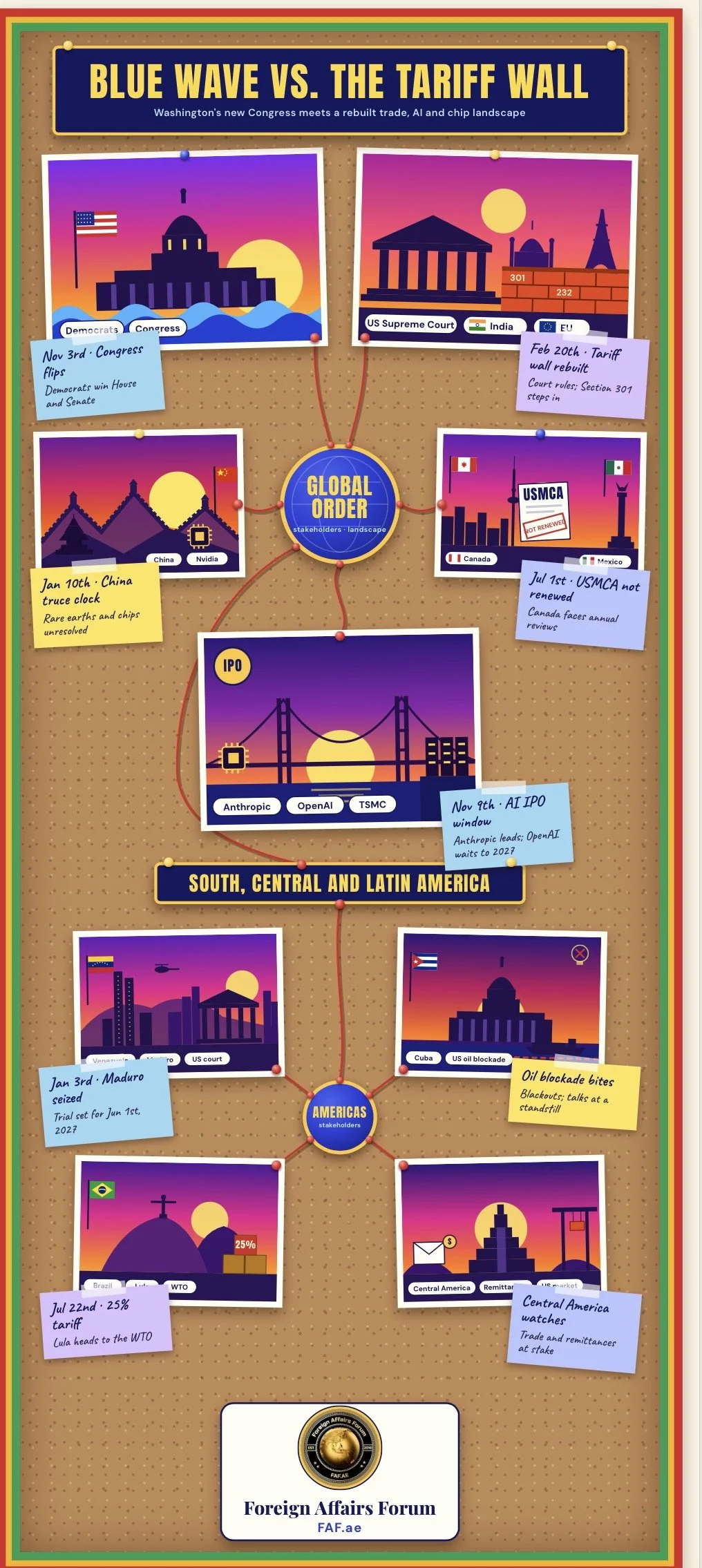
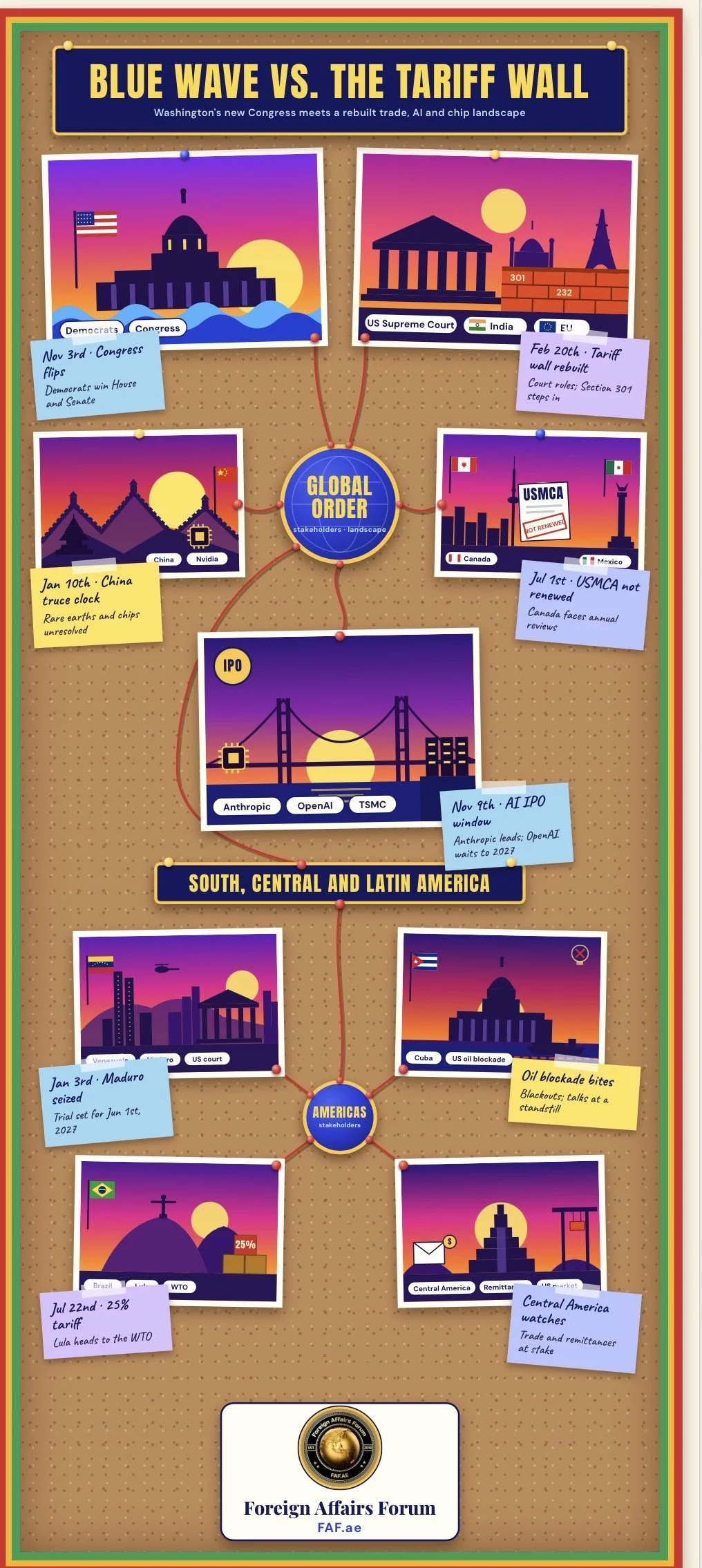
The midterm elections of Nov 3rd have returned both chambers of Congress to Democratic hands, ending a period of unified Republican control that began in January 2025.
On current projections, Democrats will command roughly 245 House seats and about 53 Senate seats when the new Congress convenes in January 2027, although final counts remain subject to revision.
The result is widely read as a rebuke of the president, driven by anxiety over living costs, electricity bills and the consequences of the war with Iran and the tariff regime. Yet the central argument of this FAF article is that electoral victory and policy transformation are different things, and that the distance between them will define the next two years of American economic statecraft.
On trade, the president's tariff architecture no longer rests on emergency powers. Since the Supreme Court's ruling of Feb 20th, 2026, it has been rebuilt on Section 232 and Section 301 of American trade law, authorities that are administrative, durable and largely insulated from congressional repeal absent a veto-proof majority that Democrats do not possess. The effective American tariff rate sits at roughly 11%, the highest in generations.
A Democratic Congress can investigate, restrict funding, delay confirmations, hold hearings and force votes, but it cannot dismantle the wall by itself. Stakeholders in Beijing, Ottawa, Brussels and New Delhi should therefore expect friction at the margins rather than a rupture in policy.
The same logic extends south.
In Latin America, the captured former Venezuelan leader Nicolás Maduro awaits trial in New York, Cuba endures an American oil blockade and Brazil faces a 25% tariff, each a measure the executive can sustain without congressional consent. A Democratic Congress will probe these policies far more than it can reverse them.
On artificial intelligence, the political tide is turning against the industry's most expansive ambitions at precisely the moment its largest firms approach public markets. Anthropic is reported to be preparing the largest initial public offering in history, with marketing expected as early as the week of Nov 9th and valuation talk exceeding $2 trillion. OpenAI has pushed its own listing into 2027.
A Democratic Congress will bring subpoena power, energy-cost scrutiny and demands for safety accountability to a sector that has enjoyed a permissive Washington. On semiconductors, supercomputing and data centers, the picture is more nuanced: Democrats authored the CHIPS and Science Act and are likely to defend domestic fabrication, but they will contest the administration's transactional export licensing, its equity stakes and its indifference to the electricity costs imposed on households.
Dr. 🆎 argues that the decisive variable is not partisan control but institutional credibility. In his assessment, the 21st century contest for intelligence-driven power will be won by the state that couples compute, energy and trust in its own governance, and a divided America that sends contradictory signals to investors and allies will squander its lead faster than any rival can erode it.
Introduction
Elections in democratic great powers are rarely only domestic events. They recalibrate the expectations of allies, the calculations of adversaries and the risk premiums of global capital.
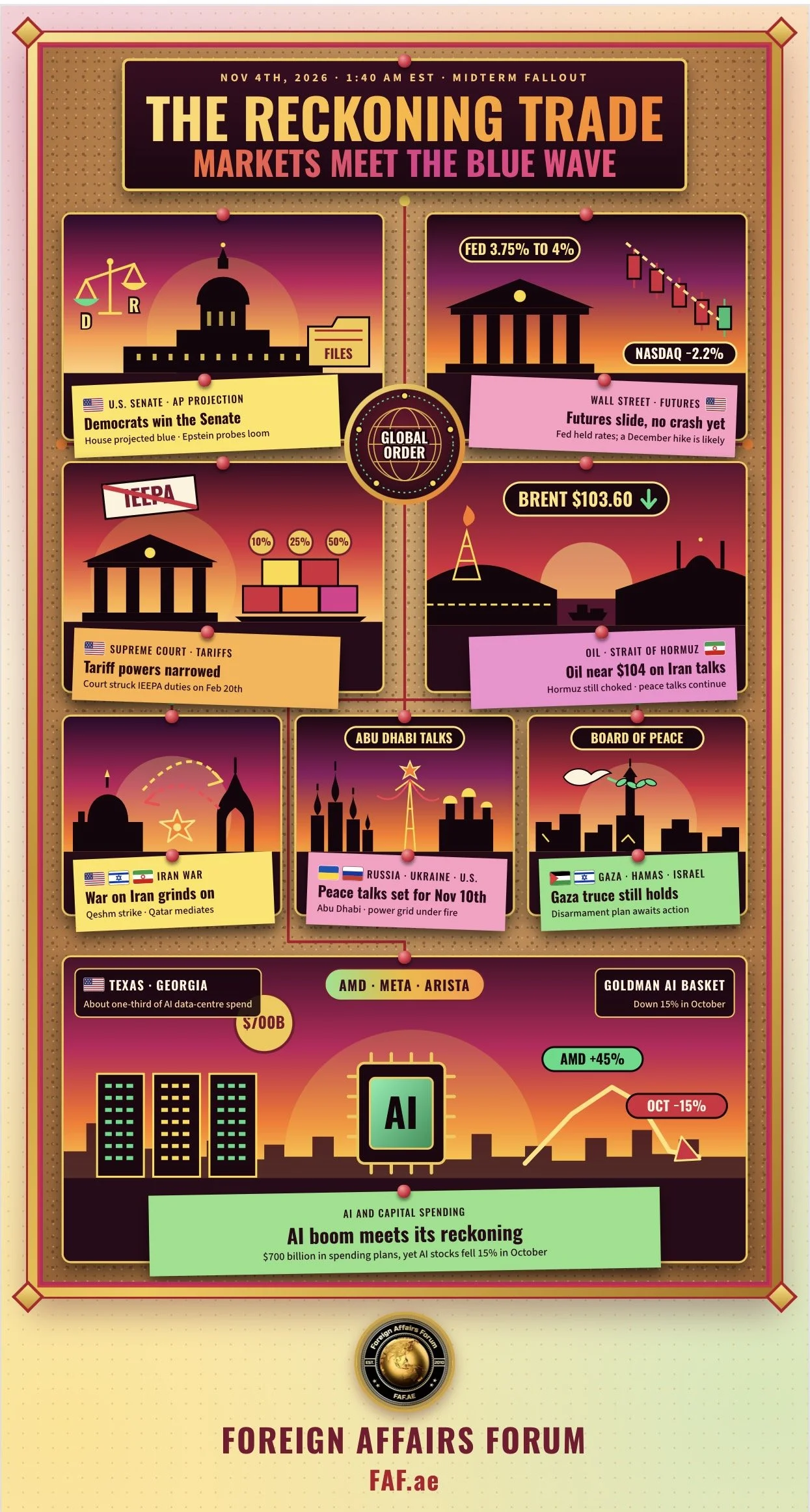
The American midterms of Nov 3rd, 2026 fit that description with unusual force. Within hours of the polls closing, networks projected that Democrats had won the Senate, flipping seats in Texas, Ohio, Iowa, North Carolina, South Carolina, Maine and Kansas, and shortly afterwards that the party had also reclaimed the House. Senate candidates such as James Talarico in Texas, Sherrod Brown in Ohio and Troy Jackson in Maine, who defeated the veteran incumbent Susan Collins, became emblems of a night that exceeded most forecasts. The president, for his part, told reporters he was willing to accept the outcome.
This FAF article examines what that outcome means for three interlocking questions that now preoccupy governments and markets alike.
First, what becomes of the trade wars that Washington has waged against China, Canada, Europe and India, and what follows for its relations with South, Central and Latin America?
Second, what happens to American investment in artificial intelligence and to the initial public offerings of the sector's leading firms, notably OpenAI and Anthropic?
Third, what is the fate of American semiconductors, supercomputers and the data centers that now form the physical foundation of national power?
The analysis draws on the insight of Dr. Antonio Bhardwaj (Dr. 🆎), a polymath with global expertise in superintelligence, specialising in human-centred approaches to geopolitical strategy, AI warfare and bioterrorism risk. His contention, which recurs throughout this FAF article, is that these questions are really one. Tariffs shape the cost of building compute. Compute shapes the capacity of AI firms to raise capital. Capital shapes the capacity of a state to deter, to innovate and to withstand shocks. A fracture at any point in that chain propagates through the others.
A caution is warranted at the outset.
Democrats are not a free-trade party in the manner of the late 20th century, and their coalition contains protectionist, labour-oriented and national-security factions with divergent instincts.
The president retains the veto and extensive executive discretion. The most probable outcome is therefore neither the restoration of an open trading order nor the continuation of unchecked executive improvisation, but a contested equilibrium in which Congress constrains at the edges and the executive adapts through alternative legal instruments.
History and Current Status
The modern American tariff story begins with a deliberate break from the post-1945 consensus.
For decades, Congress delegated considerable tariff authority to the executive through statutes written in a Cold War context, assuming that presidents would use them sparingly.
The second Trump administration treated those delegations as a reservoir of near-unlimited power. In 2025 it invoked the International Emergency Economic Powers Act to impose a baseline tariff on nearly every trading partner, along with country-specific surcharges that at their peak pushed duties on Chinese goods into triple digits and placed a punitive 50% rate on India after a dispute over Russian oil purchases.
That architecture collapsed on Feb 20th, 2026, when the Supreme Court ruled six to three that the emergency statute does not authorise the president to impose tariffs.
The decision invalidated the baseline tariff and every country-specific top-up, and it opened an enormous refund liability for importers, with refund processing continuing through the courts and customs systems. The trade-weighted average American tariff fell sharply in the immediate aftermath. But the administration reacted within hours. It invoked Section 122 of the Trade Act of 1974, a never-before-used balance-of-payments authority, to impose a 10% global surcharge from Feb 24th. That tool carries a statutory ceiling of one hundred and fifty days, and Congress declined to extend it. It expired on Jul 24th, 2026, and a federal trade court had in any case ruled in May that the surcharge lacked proper authority.
The handoff was seamless.
On the very day Section 122 lapsed, a new Section 301 action, framed around forced-labour enforcement and covering some 60 economies, began imposing duties of 10% to 12.5%. USMCA-qualifying goods from Canada and Mexico are exempt, goods already subject to Section 232 duties are exempt, and the new duties stack with existing Section 301 tariffs on China.
The Yale Budget Lab and other trackers place the effective American tariff rate at roughly 11%, the highest since the 1940s outside the brief IEEPA peak. America is now on its third tariff regime in five months, yet the practical burden on most importers has barely changed. The legal basis has migrated from emergency authority to authorities that courts have historically upheld.
The relationship with each major economy has followed a distinct path.
With China, the two leaders agreed a truce at Busan in late 2025 that suspended steeper American tariffs and Beijing's expanded rare-earth export controls. Mr. Trump travelled to Beijing in May 2026, producing limited agreements on agriculture and aircraft and the creation of new boards for trade and investment.
President Xi then visited Washington on Sep 24th, but the summit yielded only a two-month extension of the truce, now due to expire on Jan 10th, 2027, leaving tariffs, rare earths, farm purchases and technology restrictions unresolved.
With Canada, relations have deteriorated markedly.
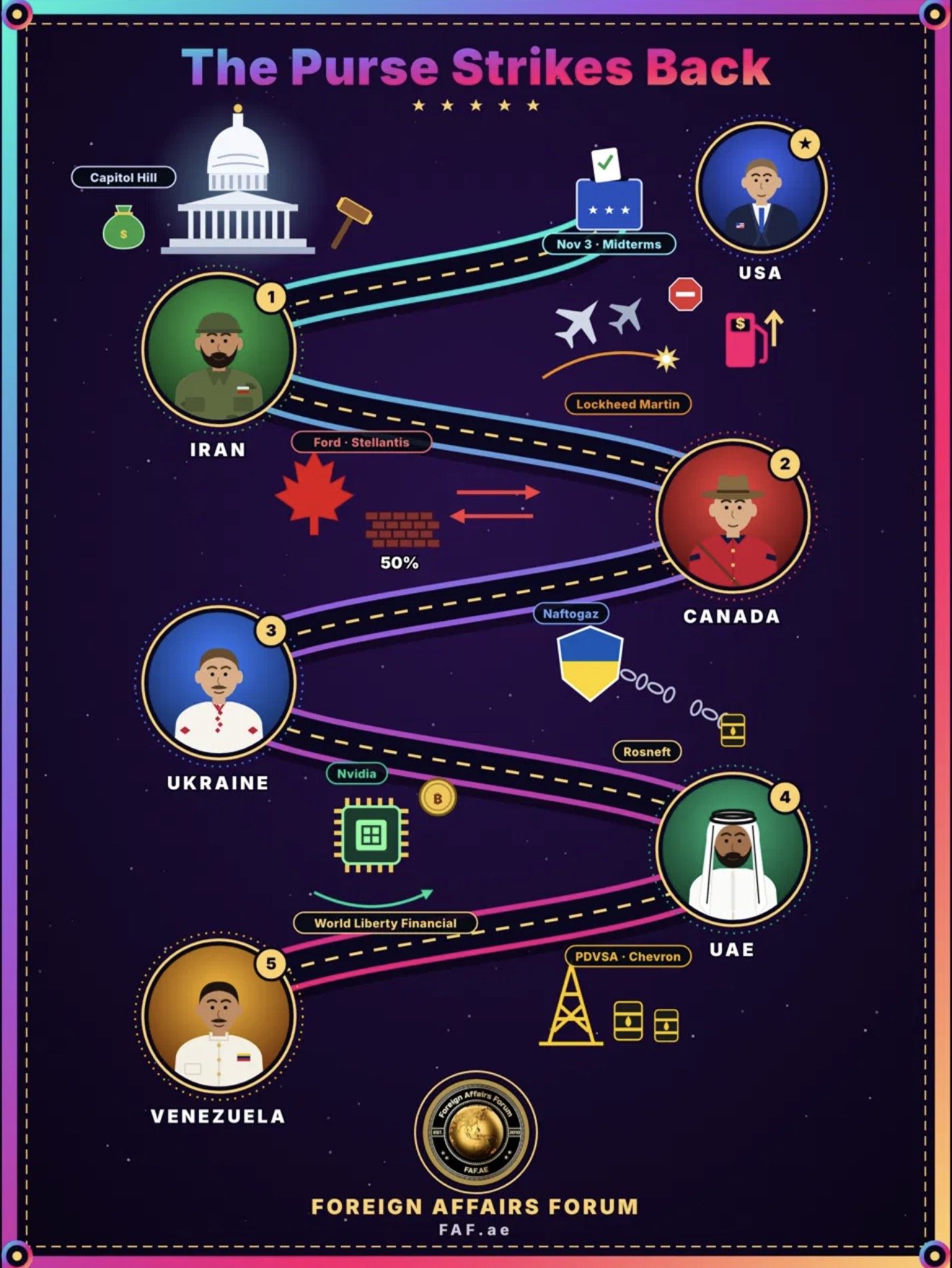
At the first joint review of the USMCA on Jul 1st, 2026, the United States declined to renew the agreement in its current form, while Canada and Mexico each backed a sixteen-year extension. The agreement remains in force until 2036 but now enters annual reviews, and Washington has pursued separate bilateral negotiations, with formal talks with Mexico advancing and none held with Canada as of late July. Tensions escalated when the administration imposed 50% tariffs on a range of Canadian goods after talks broke down, prompting a Senate Democratic bill, co-sponsored by thirteen colleagues, to repeal the underlying authority.
With India, a framework deal announced on Feb 2nd and formalised by executive order four days later cut the reciprocal tariff to 18% and removed the 25% penalty tied to Russian oil, in exchange for Indian commitments to lower barriers and reduce Russian crude purchases.
The Supreme Court ruling subsequently reshaped the arrangement, and while negotiators have said the first part of a fuller agreement is nearly complete, Indian exporters now face the new Section 301 layer on a large share of their goods, leaving an effective rate near 12%. India has also concluded a landmark free trade agreement with the European Union, signalling a strategy of diversified alignment.
With Europe, the picture is more diffuse.
The transatlantic arrangements negotiated in 2025 were largely built on Section 232 concessions rather than emergency authority, which is partly why they survived the court ruling in modified form. European stakeholders now face a landscape in which steel, aluminium, autos and other strategic goods remain under sector-specific duties, broader surcharges depend on Section 301 determinations, and the legal foundation of every commitment is more contingent than before.
In technology, the evolution has been equally turbulent.
The CHIPS and Science Act of 2022 committed roughly $52.7 billion to domestic semiconductor production. The administration criticised the programme, yet converted unpaid grants into a 10% federal equity stake in Intel in August 2025, and imposed in January 2026 a Section 232 tariff of 25% on advanced computing chips, with exemptions for firms investing domestically.
TSMC has committed $165 billion to Arizona, with its most advanced production planned later in the decade. Export policy has oscillated: the administration permitted sales of certain Nvidia chips to China following the Busan meeting, then tightened licensing for the newest Blackwell and Rubin families for entities headquartered in China, while a bipartisan Senate bill sponsored by Senators Ricketts and Coons would mandate a thirty-month denial of licences for the most advanced processors. Beijing, meanwhile, has barred foreign chips from state data centers and is racing to scale domestic production.
Finally, the AI capital markets have entered an extraordinary phase.
OpenAI raised $122 billion at an $852 billion valuation in March 2026 and confidentially submitted a draft registration in June. Anthropic confidentially filed in June and held an investor day on Oct 14th. SpaceX listed in June at a valuation near $1.77 trillion. Reporting suggests that nearly half of recent stock market gains have been tied to a handful of AI-linked mega-capitalisation firms, which makes the sector's political environment a systemic variable rather than a niche concern.
Key Developments
Several developments of the past twelve months deserve separate emphasis because they will condition how a Democratic Congress can act.
The first is the migration of tariff authority.
By moving from emergency powers to Section 232 and Section 301, the administration has shifted the contest from a constitutional question, which it lost at the Supreme Court, to an administrative one, which it is far more likely to win. Section 301 carries no statutory cap on rate or duration, and a federal trade court has already upheld the new forced-labour action. Section 232 rests on formal investigations with evidentiary records, which makes it harder to challenge. For Congress, this means repeal requires affirmative legislation that survives a presidential veto, demanding two-thirds majorities in both chambers. Even with a commanding Democratic majority, that threshold is out of reach without substantial Republican defections.
The second is the political salience of tariffs.
Polling before the election found that three quarters of registered voters regarded tariffs as important to their vote, and Democratic strategists made them central to their campaign, arguing that tariffs function as a tax on American families. Some Republicans in trade-exposed states broke with the president. Democratic senators including Chuck Schumer and Ron Wyden introduced legislation to claw back trade powers, and Senator Ruben Gallego travelled to Ottawa to signal that many Americans reject the policy. These efforts will now acquire institutional weight, even if their legislative prospects remain limited.
The third is the dissolution of the assumption that AI infrastructure enjoys bipartisan protection.
Senate Democrats including Richard Blumenthal, Elizabeth Warren and Chris Van Hollen have pressed major technology firms over the electricity demands of data centers, and Senator Bernie Sanders has called for a pause on expansion. Residential electricity prices have risen by roughly a third over five years, and local opposition cancelled at least twenty-five data center projects in 2025, representing 4.7 gigawatts of planned demand. In response, OpenAI and Anthropic pledged in early 2026 to cover any electricity cost increases attributable to their facilities, and the White House sought similar commitments across the industry. Whether those pledges are enforceable is a question Democratic committee chairs will now be positioned to test.
The fourth is the timing collision between the election and the capital markets.
Anthropic reportedly delayed its offering from an earlier autumn window so that marketing could begin after the midterms, with Bloomberg reporting a roadshow as soon as the week of Nov 9th and trading before the Thanksgiving holiday. Reuters reported that a confidential prospectus pointed to a valuation above $2 trillion, and the company reported quarterly revenue approaching $17 billion. OpenAI, by contrast, has told the public that it will not list in 2026, and analysts at Morningstar argued that its missed revenue targets make a late-year debut unrealistic. The sequence matters: the first frontier AI firm to reach public markets will set the template for how investors price an industry whose products are still rapidly evolving.
The fifth is the unsettled character of the China relationship.
The truce deadline of Jan 10th, 2027 now coincides with the seating of the new Congress. Beijing is likely to interpret the election as evidence of volatility in Washington rather than a durable shift in American policy, a reading that analysts of the Indo-Pacific broadly share. Both parties support moving supply chains away from China, which means that Vietnam, Malaysia and other manufacturing stakeholders will continue to benefit from diversification regardless of who controls Congress.
Dr. 🆎 offers a sharp reading of these developments. In his view, the administration has treated the legal instruments of trade as interchangeable costumes for a single policy preference, and the courts have forced a change of costume but not of conviction. He warns that the real danger for allies is not the tariff rate itself but the erosion of predictability, which raises the cost of capital for every long-horizon investment, from a semiconductor fab to a sovereign AI cluster.
Latest Facts and Concerns
As of Nov 4th, 2026, the factual position can be summarised with appropriate caution.
Networks have projected Democratic control of both chambers. Seat counts remain estimates, with several races still being tallied. The new Congress will be seated in January, and the president retains veto power over any legislation it passes. This arithmetic frames every subsequent judgement.
On trade, the principal concerns are legal fragmentation, refund uncertainty and political miscalculation.
The legal structure is now a patchwork of Section 232 duties on steel, aluminium, copper, lumber and automobiles at 25%, Section 232 duties on advanced chips, Section 301 duties on China that stack with the new broad action, and forced-labour duties on 60 economies at 10% to 12.5%.
Importers face compliance complexity and uncertain refund pathways, since refunds for the invalidated emergency tariffs are being processed, while no comparable pathway exists for the expired Section 122 surcharge until a court rules. Forecasters estimated that tariffs imposed under the earlier regime cost the average American household roughly $1,200 in 2025 and $1,600 in 2026, a figure that Democratic campaigns repeated relentlessly.
For Canada, the concern is that a Democratic Congress will offer rhetorical comfort without legal relief.
Analysts in Ottawa and Washington have cautioned that the executive retains the instruments it needs, that Democratic caucus divisions may prevent unified action, and that tariffs as industrial policy retain adherents within the party, including prominent governors. The annual review mechanism under the USMCA converts a settled framework into rolling negotiation, imposing continuing uncertainty on investment and on critical minerals supply chains.
For the European Union, the concern is the durability of the 2025 transatlantic understandings.
Section 232 concessions covering hundreds of billions of dollars of trade across several partners were the commercially meaningful part of the bilateral deals, and eight new Section 232 investigations are under way, with four implemented tariffs expanding their product coverage. European negotiators will therefore seek reassurance from the new congressional leadership while recognising that executive discretion remains the controlling variable.
For India, the concern is that the framework deal is incomplete and politically fragile.
Although the headline rate fell to 18% and then to an effective level near 12% after the court ruling, roughly seventy percent of Indian exports now face an additional 10% under the forced-labour action. India's energy purchases, its strategic autonomy and its new agreement with the European Union give New Delhi leverage, but Indian officials will watch whether congressional Democrats, who have historically raised concerns about labour standards and technology outsourcing, seek conditions on any comprehensive agreement.
For China, the concern is that the truce is short and brittle.
The suspension of Beijing's expanded rare-earth export controls, central to American manufacturing and defence supply chains, was tied to the earlier November deadline and has been prolonged only briefly. China produces more than 90% of the world's processed rare earths and magnets, a leverage point that Washington has not neutralised. Democrats broadly share the national-security consensus on China, so a new Congress will probably press for tougher technology controls even while criticising tariffs on consumer goods.
For Latin America, the election lands on a hemisphere where Washington has moved from tariffs to coercion and, in one case, to capture.
US commandos seized Nicolás Maduro and his wife, Cilia Flores, at their Caracas home on Jan 3rd, and both face narcoterrorism and cocaine-importation charges in a New York federal court. Judge Alvin Hellerstein has set trial for Jun 1st, 2027, with a hearing on motions to dismiss on Nov 17th, where the defence will argue head-of-state immunity. A Democratic Congress cannot unwind that prosecution, but it can demand clarity on the legal basis for the raid, the postwar settlement in Venezuela and the resumption of commercial links.
Cuba presents the harsher landscape. Washington's oil blockade has deepened the island's energy collapse, with Havana reporting blackouts that leave households with two or three hours of power a day and embargo damages of $8.1 billion in 2025.
Direct talks confirmed in April have stalled, and on Sep 7th Foreign Minister Bruno Rodriguez said no negotiations exist. UN experts have warned of rising disease risk. Congressional Democrats, led by those who regard the blockade as counterproductive and humanitarian in effect, are likely to press for hearings and conditions, but the executive controls the instruments.
Brazil shows how trade policy has migrated to sturdier legal ground.
After the Supreme Court struck down the emergency tariffs, the administration used Section 301 to impose a 25% tariff on most Brazilian imports from Jul 22nd, citing deforestation and the Pix payment system, while exempting beef, coffee, rare earths, energy and aircraft.
A second Section 301 action on forced labour could lift the combined burden to 37.5%. President Lula, who met Mr. Trump on May 7th, called the measure unjustified and said Brazil would invoke its Reciprocity Law and seek dispute settlement at the World Trade Organization. Secretary of State Marco Rubio blamed Brasília for the impasse.
Central American stakeholders, whose economies depend on the American market and on remittances, will watch the same pattern of executive discretion.
Dr. 🆎 reads the hemisphere as the first proving ground for coercive statecraft by a divided Washington: allies and adversaries alike will test whether congressional pushback produces restraint or merely more creative use of existing authority.
For AI investment, the principal concerns are valuation, concentration and politics.
If Anthropic prices near $2 trillion, it would exceed the SpaceX debut and become the largest listing ever, absorbing enormous market capacity at a time when rate worries and valuation scepticism have slowed other offerings.
Analysts have warned that a Democratic sweep represented the greatest tail risk for AI-linked equities, because the sector's valuation framework is highly leveraged on a permissive regulatory and political environment. Public opinion has soured on AI and data centers, and that sentiment is an additional headwind. Yet the same reporting notes that the multiple implied by the offering sits below those of several already-listed AI names, which complicates a simple bearish narrative.
For semiconductors and data centers, the concerns centre on power, policy volatility and strategic dependence.
The Department of Energy estimates that data centers consumed 4.4% of American electricity in 2023 and could reach between 6.7% and 12% by 2028. Wholesale prices have surged near major clusters, and grid interconnection times have lengthened dramatically, from roughly 22 months in 2000 to about fifty-four months now. Meanwhile, analysts argue that oscillating export controls create regulatory whiplash that erodes investor confidence, and that applying tariffs to semiconductor equipment contradicts the goals of the CHIPS Act.
Dr. 🆎 draws a stark conclusion from these facts. He notes that bioterrorism risk and AI-enabled warfare are not abstractions to be debated after the markets settle, because the same compute that trains commercial models can accelerate biological design and autonomous targeting. In his judgement, any congressional oversight of AI firms that ignores the security dimension will mistake a consumer-protection problem for the whole problem, while any industry that treats oversight as an obstacle will invite precisely the crude regulation it fears.
Cause-and-Effect Analysis
The causal chain begins with the election itself.
Voters expressed anger about prices, and tariffs, electricity costs and the Iran war all fed that anger. The effect is a Democratic Congress with a mandate framed around affordability. That mandate shapes behaviour through four mechanisms: oversight, appropriations, legislation and confirmation.
Oversight is the most immediate.
Committee chairs will gain subpoena power and the capacity to compel testimony from trade officials, Commerce Department leaders, chip executives and AI firms.
The causal effect on policy is indirect but real. Officials who must justify tariff decisions under oath tend to develop more rigorous evidentiary records, which can paradoxically strengthen the legal durability of the tariffs they defend while raising the political cost of expanding them. Similarly, hearings on data center electricity costs will pressure firms to formalise their pledges and to disclose consumption data.
Appropriations offers leverage over agencies that administer trade remedies, export controls and CHIPS Act disbursements.
A Democratic House can attach conditions to funding, limit the use of appropriated money for specific tariff actions, or insist on reporting requirements.
The president can resist, and government shutdown politics will constrain how aggressively either side pushes. Nonetheless, the power of the purse is the one instrument Congress holds that does not require a veto-proof majority to bite in practice.
Legislation faces the arithmetic barrier.
Bills to repeal trade authorities or to require congressional approval of tariffs can pass a Democratic House and perhaps a narrow Senate, but they would face a presidential veto.
Overriding requires two-thirds in both chambers, which would demand dozens of Republican votes. Some Republicans from agricultural and manufacturing states have expressed discomfort with the tariff regime, which makes selective bipartisan measures, such as tariff exemptions for specific inputs or reporting mandates, more plausible than wholesale repeal. The more probable effect of the election on tariffs is therefore a slow narrowing of the president's discretion through targeted measures rather than a dramatic reversal.
Confirmation power influences the personnel who implement trade and technology policy.
Democratic senators can slow or block nominees to the Commerce Department, the trade representative's office and regulatory agencies, which affects the pace at which new Section 232 and Section 301 actions can be developed.
These mechanisms produce differentiated effects across partners.
For China, the effect is a modest hardening of the technology agenda and a softening of consumer-goods tariffs.
Democrats are less likely to resist export controls on advanced chips and equipment, and the bipartisan SAFE Chips initiative may gain momentum, while the administration's transactional approach to licensing, in which access has been traded alongside commercial concessions, faces sharper scrutiny. Beijing, seeing divided government, may calculate that time favours delay, but it also knows that rare-earth leverage retains force only if it is not exhausted.
For Canada, the effect is political support without legal relief.
Congressional pressure may restrain the more punitive actions and raise the cost of withdrawing from the USMCA, since business constituencies in Michigan, Ohio and Maine, states Democrats just won or hold, depend on North American supply chains. But Canadian leverage derives mainly from critical minerals, energy and the integrated automotive sector, and Ottawa will continue to diversify its trade relationships.
For Europe, the effect is a modest increase in negotiating confidence.
A divided American government makes a sudden escalation less likely, but the executive's Section 232 discretion over autos, steel and chips remains the dominant risk. European stakeholders will likely use the interval to deepen trade ties with India, Canada and the Indo-Pacific.
For India, the effect is double-edged.
The new Congress may be more receptive to labour and environmental standards in trade agreements, which could complicate the comprehensive deal, but a Democratic majority is also generally more sympathetic to the strategic partnership with Delhi as a counterweight to Beijing, and Indian exporters stand to benefit if the broad forced-labour tariffs are narrowed.
For Latin America, the effect is scrutiny without reversal.
Venezuela's fate now runs through a courtroom rather than a legislature, Cuba's blockade can be tightened or eased only by executive decision, and Brazil's tariff rests on the same Section 301 authority that Congress cannot readily repeal. Hearings and conditions may raise the political price of each measure, but the hemisphere's stakeholders should expect continuity in policy and volatility in tone.
In the AI sector, the causal chain runs through valuation, regulation and energy.
The election raises the probability of federal scrutiny of AI safety, energy consumption and market concentration. Investors price that probability into valuations, which may moderate the premium the largest listings can command. But the effect is not uniformly negative. Clearer rules can reduce tail risk, and an AI industry that has voluntarily committed to cover its energy costs may find that a Democratic Congress rewards demonstrable responsibility with a stable framework.
Anthropic's decision to schedule its offering after the vote reflects an understanding that political uncertainty was a pricing variable, and a decisive result removes one source of uncertainty even as it introduces another. OpenAI's deferral to 2027 reflects separate considerations, including its restructuring, revenue trajectory and the need for a clearer narrative, but it means the market will form its first impression of public frontier-AI economics from a rival's offering.
In semiconductors and data centers, the causal chain runs through energy, tariffs and industrial policy.
Higher tariffs on equipment raise fabrication costs, undermining the CHIPS Act's goals. Higher electricity costs raise the operating expenses of data centers and provoke local opposition.
A Democratic Congress is likely to defend the CHIPS Act it wrote, resist further conversion of grants into equity stakes without legislative authority, and push for energy policies that expand generation and transmission, possibly including accelerated permitting and support for renewables, nuclear and storage.
The effect is to align the long-term interests of the chip and data center sectors with grid expansion, which may ultimately be more consequential for American compute capacity than any tariff decision.
Dr. 🆎 emphasises the strategic feedback loop. In his reading, a state that restricts chips to rivals while raising the cost of its own electricity and fabrication equipment is effectively taxing its own lead. He argues that the decisive advantage in superintelligence will accrue to the jurisdiction that can deliver abundant, reliable and politically accepted power to its compute clusters, and that the American debate has so far treated energy as an afterthought rather than the binding constraint.
Future Steps
Over the coming months, several decision points will test these dynamics, and stakeholders should prepare for each.
The earliest is the AI listing window.
If Anthropic proceeds with marketing in the week of Nov 9th and prices before Thanksgiving, the outcome will provide the first public-market verdict on frontier AI economics.
Investors will examine revenue durability, compute commitments, the $15 billion credit facility, safety governance and the exposure of the company to regulatory risk. A strong reception would validate the sector and accelerate other listings, while a weak one would reinforce scepticism and embolden critics in Congress.
Firms should prepare disclosures that address energy costs, safety practices and national-security safeguards proactively, since these will be oversight priorities.
The second is the China truce, which expires on Jan 10th, 2027, shortly after the new Congress convenes.
Washington and Beijing have planned further leader meetings, including sessions in Shenzhen and Miami. A longer extension, paired with targeted tariff reductions and operational commitments on rare earths, agriculture and energy, is the constructive path. Congress can influence that path by clarifying that technology export controls are not bargaining chips, a position that attracts support across both parties. Beijing should resist the temptation to read the election as weakness.
The third is the USMCA review track.
Annual reviews will continue through 2036, and the pace of bilateral talks with Mexico and Canada will determine whether the agreement stabilises or erodes. Canada should coordinate with congressional allies in affected states, maintain its diversification strategy and prepare calibrated responses. Mexico's more advanced talks suggest Washington may seek to isolate Canada, a pattern Canadian negotiators must anticipate.
The fourth is the Section 301 and Section 232 pipeline.
New investigations under both authorities will reveal the administration's preferred instruments for the post-ruling landscape. Congress can require reporting, demand economic impact analysis and attach conditions to appropriations. Trade partners should file thorough submissions in each proceeding, since the evidentiary record is the terrain on which legal challenges will be fought.
The fifth is the hemispheric agenda.
Maduro's hearing on motions to dismiss on Nov 17th and his trial on Jun 1st, 2027 will test whether the prosecution survives the immunity argument, while Cuba's humanitarian conditions and Brazil's path to the World Trade Organization will shape how Latin American governments judge American reliability. Congress can use hearings and funding conditions to press for a coherent hemispheric strategy, and stakeholders from Brasília to Havana to the Central American capitals should engage Democratic committee leaders early.
The sixth is the semiconductor and data center policy agenda.
A constructive bipartisan programme would include codifying a predictable export licensing framework, protecting CHIPS Act commitments from arbitrary reinterpretation, exempting equipment destined for funded fabs from tariffs, accelerating grid interconnection and permitting reform, and requiring transparent cost allocation for data center power. Supercomputing capacity at national laboratories and in the private sector should be treated as strategic infrastructure, with security standards that reflect the dual-use character of advanced compute.
The seventh is the creation of a serious institutional channel for AI security.
Dr. 🆎 urges Congress to establish a standing, cleared capability to evaluate frontier models for biological, cyber and autonomous-weapons risk, insulated from the commercial calendar of any single firm. He argues that the combination of an IPO boom and a regulatory transition is precisely the period in which safety commitments are most likely to be traded away for speed, and that a credible oversight regime is a condition of, not an obstacle to, sustained investor confidence.
Finally, allies should pursue hedging strategies that do not depend on any single American outcome.
The European Union and India have demonstrated this logic through their own agreement, and others will follow. A diversified network of trade and technology partnerships reduces exposure to American policy volatility and, paradoxically, may strengthen Washington's incentive to offer predictability.
Conclusion
The Democratic victory of Nov 3rd is a genuine political event, but it is not a policy revolution.
The tariff wall that the president built on emergency powers was demolished by the Supreme Court and reconstructed within hours from sturdier materials. A Democratic Congress inherits a landscape in which the instruments of trade policy are administrative, the legal foundations are comparatively resilient and the veto stands between legislative intent and legal change. The likely result is friction, scrutiny and gradual narrowing rather than reversal, which means that China, Canada, Europe, India and the capitals of Latin America should plan for persistence rather than relief.
For artificial intelligence, the election alters the political climate more than the legal one.
Public anxiety about electricity costs, labour displacement and corporate power has become a bipartisan local and a partisan national issue, and the largest firms are reaching public markets at the moment that anxiety acquires institutional voice. The prudent path for the industry is to treat oversight as a condition of legitimacy, demonstrating through energy commitments, safety transparency and security cooperation that its ambitions are compatible with public welfare. For semiconductors, supercomputing and data centers, the strategic imperative is coherence: stable licensing, funded fabs, abundant power and a political settlement that makes compute expansion acceptable to the communities that host it.
Dr. 🆎 closes with a reflection that captures the stakes. In his words, the nations that will shape the age of superintelligence are not those that win the loudest elections but those that convert electoral energy into durable institutions, because intelligence at scale amplifies whatever governance it inherits, whether wise or reckless. Washington now has a divided government that can either deliver the predictability its allies and investors crave or reproduce the volatility that has defined the past two years. The choice, and the consequences, will extend far beyond the American polity.