Wine Dregs and Ballot Boxes: How France's Forgotten Countryside Is Handing the Republic to the Populist Right
Foreign Affairs Forum | Dr. Antonio Bhardwaj (Dr. 🆎)| Nov 3rd, 2026
Executive Summary
This FAF article examines a quiet political transformation unfolding in the vineyards, villages and small market towns of south-western France.
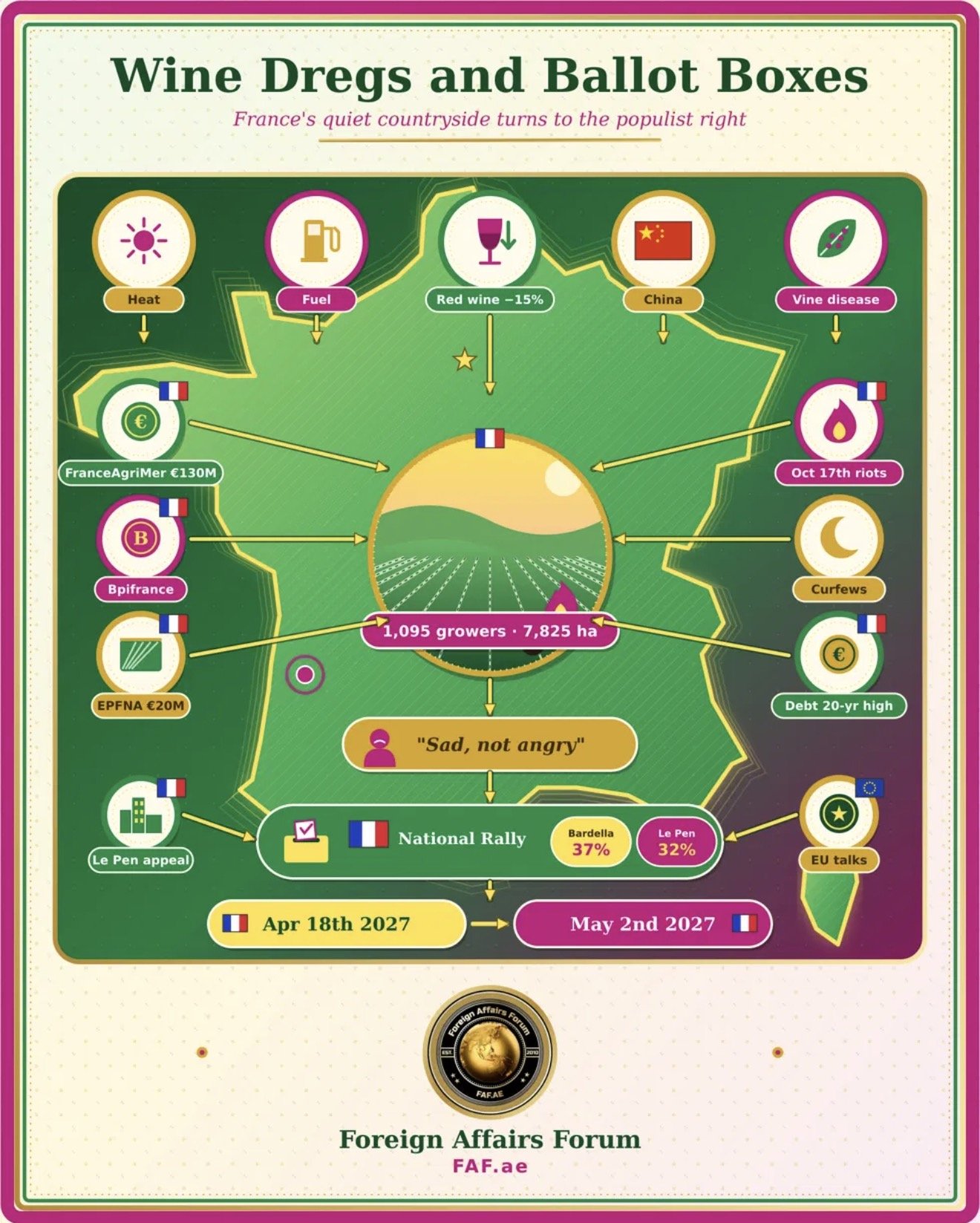
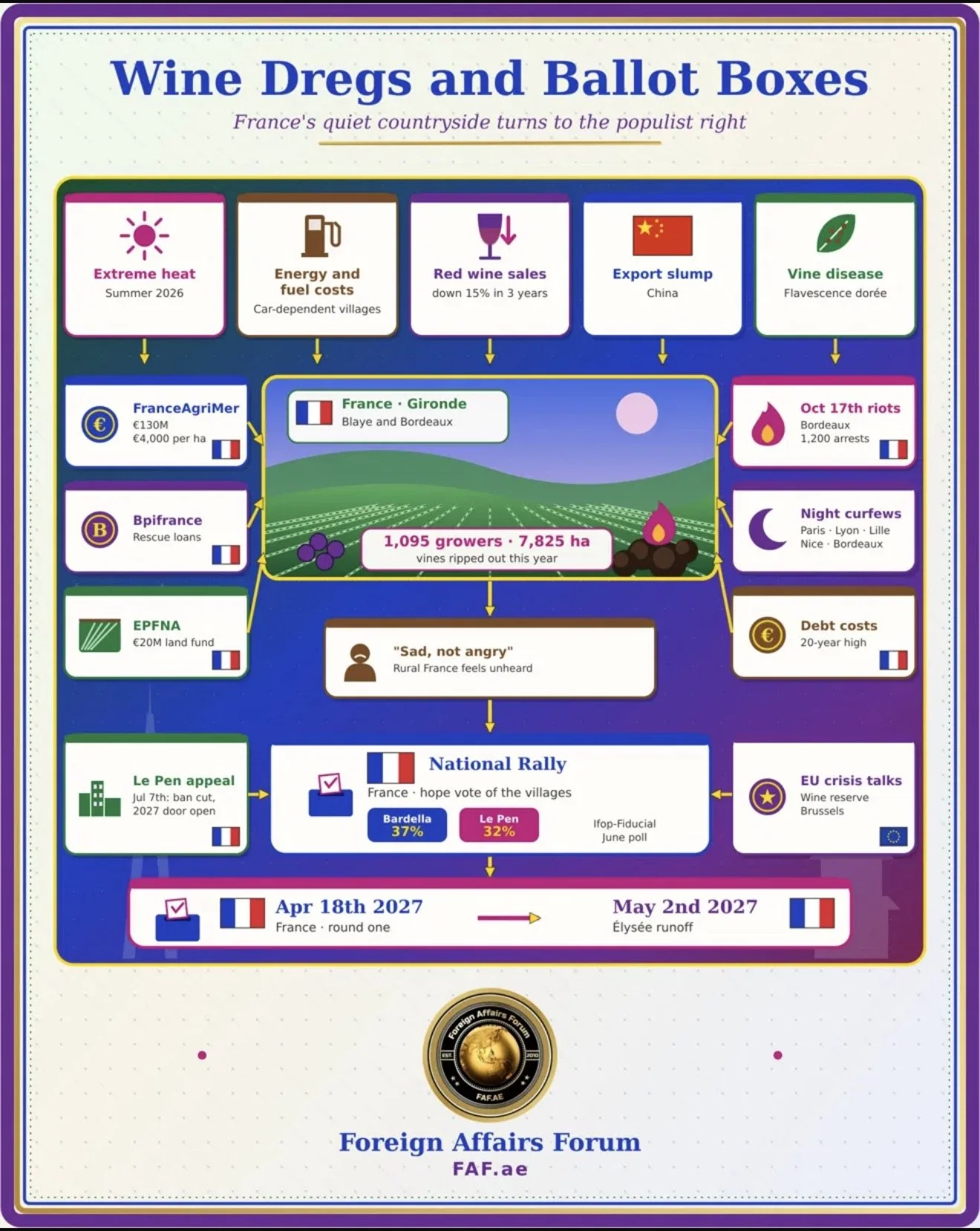
Across the Gironde estuary from the celebrated châteaux of the Haut-Médoc lie the humbler farmlands of the Blaye and Bourg country, where growers have been battered by extreme summer heat, higher energy costs and a global decline in the consumption of everyday wine. In the Gironde this year, 1,095 winegrowers have ripped out 7,825 hectares of vines, and more than a quarter of the department's vineyards have disappeared since 2023. Blackened piles of uprooted vines lie in fields awaiting the bonfire.
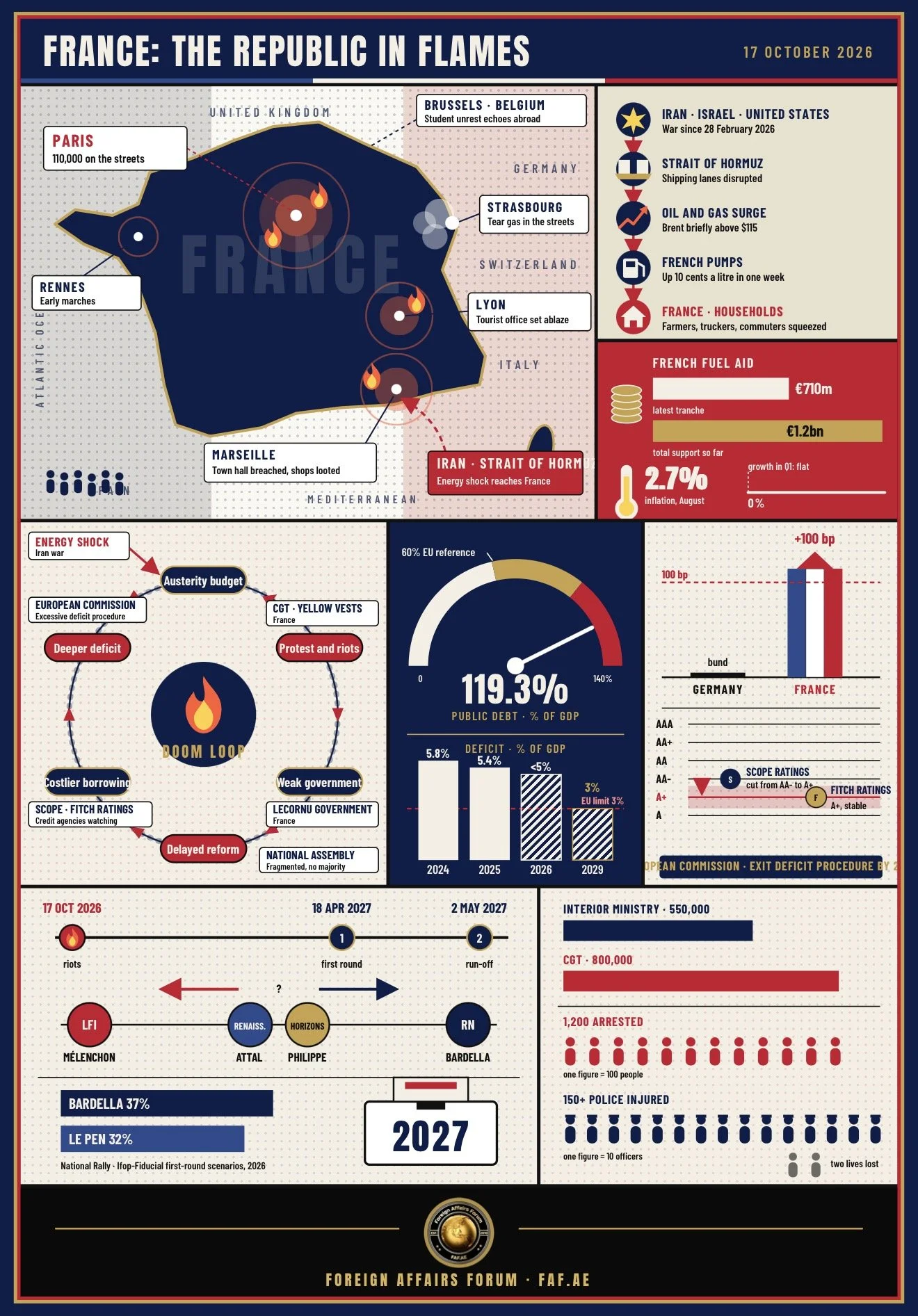
The distress of this landscape is not theatrical. It is the quiet, resigned sorrow of people who feel abandoned, and it differs sharply from the fury seen in the cities. Barricades burned in Bordeaux on Oct 17th, when the largest wave of rioting in years swept France, with roughly 1,200 arrests nationwide, curfews in five cities and damage to thousands of shops. Yet the countryside's mood is arguably more consequential for the coming presidential contest, because it is steady, cumulative and electorally decisive.
The central argument is that rural France has come to see the National Rally and its leaders, Marine Le Pen and her protégé Jordan Bardella, as the only stakeholders who acknowledge its suffering. The movement offers not a detailed programme but recognition, which in places that feel invisible is a potent political currency.
FAF analysis traces the history of the wine economy and of French rural alienation, surveys the key developments of 2025 and 2026, weighs the latest facts and concerns, and sets out a cause-and-effect analysis of how economic decline becomes populist loyalty. It then proposes steps that could rebuild trust before the first round on Apr 18th, 2027.
Dr. 🆎 argues that the lesson extends well beyond wine: whenever institutions meet structural decline with procedural indifference, they surrender moral authority to those who merely promise to listen.
Introduction
There is a particular silence in a vineyard that has been abandoned. It is not the silence of winter dormancy, when the vines are bare but the owner is merely waiting. It is the silence of a place from which the future has been withdrawn. Visitors to the lower Gironde in this autumn of 2026 encounter that silence repeatedly: rows of posts without wire, parcels where the earth has been turned and left bare, piles of blackened trunks waiting for fire. Behind them stand houses whose owners have worked the land for three decades or more and who now describe themselves, with striking consistency, as sad rather than angry.
That distinction matters more than it might appear. French politics in recent weeks has been dominated by images of anger: burning barricades in Bordeaux, looted shops in Paris, police vehicles attacked in Lyon and Marseille, and curfews imposed on minors in five cities. The government has blamed the ultra-left and criminal opportunists, and the Prime Minister, Sébastien Lecornu, has promised that the state will not be intimidated. But the more durable political phenomenon is the one that makes no noise. In towns such as Blaye, pupils blockaded their secondary school and the episode passed off calmly. Locals worry about the price of filling the tank in a place where a car is indispensable, doubt that the future will be better, and believe the government is doing nothing to help. One vineyard owner, closing his business after thirty years because of the collapse of exports to China and of wine drinking at home, remarked simply that France has a president who does not listen.
Dr. Antonio Bhardwaj (Dr. 🆎), a specialist in human-centred superintelligence for geopolitical strategy, AI warfare and bioterrorism risk, has long argued that the legitimacy of democratic states is eroded less by dramatic shocks than by the slow accumulation of unanswered grievances.
Dr. 🆎 observes that complex systems fail where feedback loops break, and that a republic whose rural citizens conclude that no signal they send reaches the centre has suffered precisely such a break. The National Rally, in this reading, is less a cause than a symptom, and also a beneficiary.
This FAF article proceeds in stages. It first situates the Bordeaux wine crisis within the longer history of French rural politics and of the wine trade. It then examines the policy responses of the past two years, the latest data and the principal concerns, before offering a causal analysis of the bridge between agricultural distress and populist voting. It concludes with recommendations. The timing is deliberate: the first round of the presidential election is fixed for Apr 18th, 2027, with a runoff on May 2nd, and the outgoing president, Emmanuel Macron, cannot seek another term. The countryside's verdict will help determine who succeeds him.
History and Current Status
To understand the present anguish, one must begin with the extraordinary prestige that Bordeaux accumulated over the 19th and 20th centuries. The 1855 classification of the great Médoc estates fixed a hierarchy of reputation that endures to this day, and it created the image of Bordeaux as a global luxury brand. But that image concealed a second, far larger economy. For every celebrated château, there were scores of modest family growers producing everyday red wine for the domestic market and for bulk export. The Haut-Médoc and Saint-Émilion enjoyed the glamour, while the right bank of the estuary, with its appellations of Blaye and Bourg, supplied volume. This was an honourable, productive and generally prosperous agricultural world through much of the 20th century, sustained by a French culture in which wine was a daily companion of the table.
That culture has been eroding for decades.
French consumption of wine per head has fallen steadily since the 1960s, and the fall has accelerated among younger drinkers, who drink less alcohol overall and favour lighter, whiter and cheaper alternatives. Red wine, the signature product of Bordeaux, has been hit hardest. Red wine sales have dropped by about 15% across the past three years. At the same time, the export market that once absorbed surplus has contracted. China, which in the first decade of the 21st century became the glamorous destination for Bordeaux, has retreated sharply, as its own economy has slowed and its consumers have turned elsewhere. Tariff threats and trade frictions with the United States have deepened the uncertainty.
The political history is equally important.
Rural France has never been uniformly conservative. The south-west was for generations a stronghold of the radical and socialist left, and the Gironde itself has swung between currents. But the closing decades of the 20th century and the opening decades of the 21st saw a steady hollowing of public services in the countryside: post offices, maternity wards, railway stations and local schools disappeared, while the car became an existential necessity. The Yellow Vest uprising of 2018, triggered by a fuel tax, was the first great political eruption of this resentment, and it revealed a France périphérique whose concerns the metropolitan elite had underestimated. The National Rally, under Marine Le Pen's leadership, then spent the better part of a decade methodically colonising this terrain, replacing the old party's stridency with a language of protection, purchasing power and dignity.
The current status is stark.
Between 2023 and 2025 the Gironde lost around 20,000 hectares of vines, and the process has continued through 2026. Nationally, the government has financed an uprooting plan covering roughly 28,000 hectares, about 4% of French vineyards, with a budget of €130 million and a payment of €4,000 per hectare removed.
Nearly 6,000 growers applied, and the Gironde accounts for about 28% of the national area targeted. Total uprooting accounts for roughly 37% of the area involved, which means that a substantial number of growers are not trimming their holdings but ending their livelihoods altogether. The deadline for completing the work is Dec 31st, 2026, and replanting is forbidden for years afterwards. For those who take the subsidy, it is a one-way door.
Key Developments
Several developments across 2025 and 2026 have shaped the present moment, and they must be read together rather than separately.
The first is the agricultural policy response.
After years of piecemeal distillation schemes and debt-restructuring loans, the state moved in 2026 to a large-scale, publicly funded uprooting programme. Farmers' representatives have described it as both necessary and painful, and critics point out that the compensation of €4,000 per hectare barely covers the cost of removal, estimated by some growers at about €2,000 per hectare, once taxes, social charges and supplier debts are paid. Others argue that the programme is too small, and that at least 15,000 hectares must disappear from Bordeaux alone before supply and demand can be rebalanced.
The second development is the creation of a land-conversion mechanism.
In the spring of 2026 the authorities in the Gironde launched a fund of €20 million to buy fallow land and vineyards scheduled for uprooting, with the aim of encouraging diversification into other crops, renaturing or new uses. The response was immediate: 430 submissions covering 4,400 hectares, spread across more than 6,500 parcels. The first sales are expected in the final quarter of this year. This reveals both the depth of the demand for exit and the thinness of the alternative: many former winegrowers lack the capital, the training or the markets to turn to something else, and transitions of this kind take years.
The third development is plant health.
Flavescence dorée,a serious vine disease, is spreading, and prefectural decrees now permit the compulsory uprooting of uncultivated vines in affected zones. Abandoned parcels are therefore not merely an eyesore but an epidemiological risk, and the law obliges proprietors to sell or uproot. For growers already in financial distress, this adds a coercive dimension to the crisis that is easily felt as persecution.
The fourth development is political and judicial.
On Mar 31st, 2025, a Paris court convicted Marine Le Pen of embezzling European Parliament funds and imposed an immediate ban on public office. On Jul 7th, 2026, the appeal court upheld the conviction but reduced the ineligibility to forty-five months, thirty of them suspended, a ruling widely read as opening the door to a 2027 candidacy while leaving legal uncertainty. The National Rally must now decide whether to field Le Pen, a three-time presidential candidate, or Bardella, aged thirty, who has led the party since 2021. Polling this year has shown both comfortably reaching the runoff. An Ifop-Fiducial survey in June gave Bardella up to 37% of first-round voting intentions against 32% for Le Pen, and an Odoxa poll in May suggested he could defeat former Prime Minister Édouard Philippe in a second round with 52%.
The fifth development is the wave of social unrest.
On Oct 17th, nationwide demonstrations against the rising cost of living and declining public services turned violent. Interior ministry figures put marchers at about 550,000, with roughly 1,200 arrests, looting of supermarkets, arson against public buildings and, in Bordeaux, serious damage near the city hall and the deployment of elite police units. Curfews for minors followed in Paris, Lille, Lyon, Nice and Bordeaux. A week later, on Oct 24th, between 410,000 and 800,000 people marched again, depending on whether one believes the government or the unions, with nearly 1,000 arrests and about 70,000 police deployed.
Together, these developments create a landscape in which rural despair and urban fury are converging against a government that appears unable to respond to either.
Latest Facts and Concerns
The latest facts present a picture of fiscal, social and political strain that goes well beyond the vineyards.
France's efforts to reduce its public debt have not reassured investors, and government borrowing costs have climbed to their highest levels in over two decades. This matters for the countryside because it narrows the room for generous rescue packages. A state that must convince bond markets of its discipline cannot easily promise a rural Marshall Plan, and every euro spent on uprooting compensation is a euro subject to scrutiny. The tension between fiscal credibility and territorial solidarity is therefore sharper than at any time since the euro crisis.
The wine data itself continues to deteriorate.
The 7,825 hectares removed in the Gironde this year, by 1,095 growers, come on top of the roughly 20,000 hectares lost between 2023 and 2025. Local unions have warned that a large proportion of wine businesses in the region are close to insolvency, and that the combination of low prices, high costs and heat-damaged harvests is eliminating the thinnest-margin producers first. This summer's extreme heat reduced yields and compounded the burden on estates that had little financial cushion. Energy costs, driven by the militarisation of European economies and by continuing instability in energy markets, have added to the pressure, and the cost of fuel is an everyday anxiety in a region where public transport barely exists.
There are several concerns that deserve particular attention.
The first is demographic.
Many of the growers who are leaving are elderly and have no successors, which means that the countryside is not merely losing an industry but losing the generation that held its social fabric together. When a vineyard closes in a small commune, the effects ripple outward to the cooperative, the mechanic, the café and the primary school.
The second concern is the sociology of resentment.
The sadness that locals express is not, strictly speaking, a rejection of the state; it is a complaint that the state has stopped listening. This is politically more dangerous than rage, because rage dissipates while resignation hardens into a settled belief that institutions are irrelevant. Voters who hold that belief are open to any movement that appears to take them seriously.
The third concern is the interaction with national instability.
The government has attributed the October violence to far-left agitators and criminals, but the protests drew together students, teachers, parents, trade unionists, farmers and retirees, and they carried echoes of the Yellow Vest movement. Observers note that the spectacle of disorder tends to benefit parties that promise order, and the National Rally has been careful to present itself as the guarantor of calm.
The fourth concern is the information environment.
The government has convened talks with major social media platforms about the amplification of unrest, an acknowledgement that the contest for narrative is as important as the contest for the streets.
Dr. 🆎 cautions that algorithmic systems optimised for engagement systematically reward grievance, and that a political class which neglects this dynamic will find its own legitimacy eroded by tools it did not design.
Cause-and-Effect Analysis
The causal chain linking collapsing vineyards to populist voting is not mechanical, and it is worth setting out carefully.
The first link is economic: a fall in demand, a rise in costs and a shock from climate produce a collapse in income.
This is the proximate cause, and it is real. But economic hardship alone does not explain political realignment. Plenty of struggling regions have remained loyal to mainstream parties, and plenty of prosperous ones have drifted rightward.
What matters is the second link, the perception of cause and responsibility.
In the Gironde, the perception is that the decline is not a natural misfortune but the consequence of policy choices made elsewhere: trade decisions that cost export markets, energy policy that raised bills, regulation that burdens small producers, and a general indifference in Paris. Whether or not each of these claims is fully accurate, they are believable because they match lived experience. The growers saw their markets vanish, saw the price of fuel climb, and received in response a compensation scheme that many consider inadequate. A person who has been told to destroy his own vines for €4,000 per hectare, and who is forbidden to replant for years, is inclined to interpret the state as an adversary rather than a partner.
The third link is symbolic recognition.
Here the National Rally has proved remarkably skilled. Its leaders speak of the countryside with the vocabulary of dignity, protection and national preference, and they have positioned themselves as defenders of French production against foreign competition and bureaucratic indifference. In villages that have lost their post office and their doctor, the mere act of visiting and listening carries enormous weight. This explains why the movement has become, in the words of many residents, a vessel of hope. The hope is not necessarily rational, and it is not anchored in a detailed economic plan, but it is an emotional counterpart to despair, and it fills the vacuum left by the retreat of other stakeholders.
The fourth link is institutional exhaustion.
Mainstream parties have been weakened by successive governments that have survived on fragile majorities, by the use of constitutional shortcuts, and by a presidency widely perceived as aloof. The retirement-age reform of 2023, forced through without a parliamentary vote, left a lasting wound, and the broader grievance concerns the method of ruling as much as its content. The Prime Minister, Lecornu, presides over a coalition that has little room for manoeuvre, and the opposition on the left has been unable to capture rural discontent because it is perceived as metropolitan and cultural rather than material.
The fifth link is the feedback loop between disorder and the ballot.
Urban riots produce images of chaos that alarm older rural voters, who then gravitate toward parties that promise firmness, even though their own grievances are of an entirely different kind. Meanwhile, the rural distress supplies the National Rally with a moral narrative of an abandoned heartland, which is then deployed against the government in the cities. The two phenomena, though distinct, reinforce each other.
Dr. 🆎 notes that this is a textbook example of a coupled system in which two apparently separate sources of instability amplify one another, and that interventions aimed at only one component will fail.
The resulting effects are visible in the polls.
The party leads the first round by a comfortable margin under either potential candidate, and the competition is chiefly over who will meet it in the runoff. The traditional barrier, the republican front that once rallied voters of all stripes against the far right in the second round, has weakened considerably. Many rural voters no longer regard the party as beyond the pale, and the decade-long strategy of normalisation has largely succeeded.
The question for 2027 is therefore not whether the National Rally can reach the runoff, but whether any opponent can assemble a majority against it, and the countryside is where that majority is most likely to fail.
Future Steps
If French leaders wish to prevent the transformation of rural sorrow into permanent electoral realignment, they must act with a speed and seriousness that the present political climate makes difficult.
The first priority is to make the uprooting scheme humane.
The payment of €4,000 per hectare should be reassessed in light of real removal costs, and the state should consider additional support for growers who exit completely, including bridge payments to cover debts and pensions for elderly producers without successors. A programme that treats exit as a managed retirement rather than a financial disaster would change the emotional register of the crisis.
The second priority is to turn the €20 million land fund and the broader conversion effort into genuine economic alternatives.
Land converted to other uses requires markets, training, equipment and patient capital. Regional authorities, chambers of agriculture and banks should work together to offer packages that link land purchase to start-up financing in sectors such as cereals, orchards, renewable energy, forestry and agri-tourism. Equally, the problem of fragmented parcels, created by uneven uprooting, must be addressed through coordinated land consolidation so that conversion projects can reach viable scale.
The third priority concerns the everyday costs that rural residents bear.
Fuel prices, energy bills and the absence of public transport are not abstract statistics in a region where a car is essential. Targeted relief, such as mobility allowances for rural households, support for community transport and investment in local services, would signal that the state understands the specific structure of rural life. This should be coupled with a restoration of basic services, including health care, schools and post offices, which carry symbolic as well as practical weight.
The fourth priority is political and procedural.
The government must find ways to listen, and to be seen listening. This might include regional consultations, citizens' assemblies on territorial inequality and a clearer commitment to parliamentary rather than constitutional shortcuts for contentious reforms. At the European level, France should press for more flexible crisis instruments for the wine sector, including a revision of rules that restrict public funding for uprooting on economic grounds, and for a coherent trade strategy that protects exporters from retaliatory tariffs.
The fifth priority is to confront the information landscape.
The talks with social media platforms should be extended into a broader framework for transparency about algorithmic amplification, while public broadcasters and local media should be strengthened so that rural communities see their own concerns reflected.
Dr. 🆎 emphasises that human-centred design of information systems is not a luxury but a component of democratic security, because the same technologies that accelerate protest can accelerate disinformation, and in a pre-election period foreign stakeholders may seek to exploit both.
Finally, the mainstream candidates themselves must offer something more than warnings about the far right.
Scolding rural voters for their choices has never changed them. A credible alternative would combine a recognition of grievance with a concrete agenda: a long-term strategy for French agriculture, a defence of rural public services, and a fiscal path that does not make the countryside pay for adjustment. The window for such an offer is narrow, since the campaign effectively begins now, but it is not yet closed.
Conclusion
The vineyards of the Gironde are a small place on the map of Europe, but they have become a revealing one. They show how a combination of climate stress, changing consumption, geopolitical trade friction and domestic neglect can dismantle a way of life within a few years, and how the people living through that dismantling can drift, quietly and without fury, toward a political movement that offers them acknowledgement. The sadness of the winegrower in Blaye is not a private matter. It is a political fact, and in the spring of 2027 it may become an electoral one.
France has faced rural discontent before and has mostly survived it, but the present moment is more dangerous for three reasons. The fiscal space is narrower than at any time in two decades, the social atmosphere is inflamed by the largest unrest in years, and the National Rally has matured into a disciplined and professional contender, with two credible leaders and a record of patient work in precisely the places that other parties have abandoned. Whether the candidate is Marine Le Pen or Jordan Bardella, the structural advantage of the movement is the same: it has understood that people who feel unseen will reward those who seem to see them.
None of this means that the outcome is predetermined. Voters in rural France are not a monolith, and many remain sceptical of the National Rally's economic programme, its fiscal promises and its relationship with European partners. The runoff is a different contest from the first round, and a mainstream candidate who can combine credibility with empathy could still assemble a majority. But that candidate will not emerge from the usual rituals of Parisian politics. He or she will need to stand in the vineyards, hear the silence of the abandoned rows and answer it with something more than procedure.
Dr. 🆎 concludes that the deeper lesson is one for every democracy confronting rapid technological, climatic and economic change. Legitimacy is a resource that must be continuously renewed through responsiveness, and when it is allowed to run down, populists will harvest what the institutions have failed to tend.
The vines of the Gironde are being pulled from the ground this autumn, but the roots of the political crisis run much deeper, and they will not be burned away with the prunings.