The Great Listing Gamble: How Jio, Anthropic and SpaceX Are Turning Stock Exchanges into Instruments of Strategic Power
Foreign Affairs Forum | Dr. Antonio Bhardwaj (Dr. 🆎) | October 31st 2026
Executive Summary
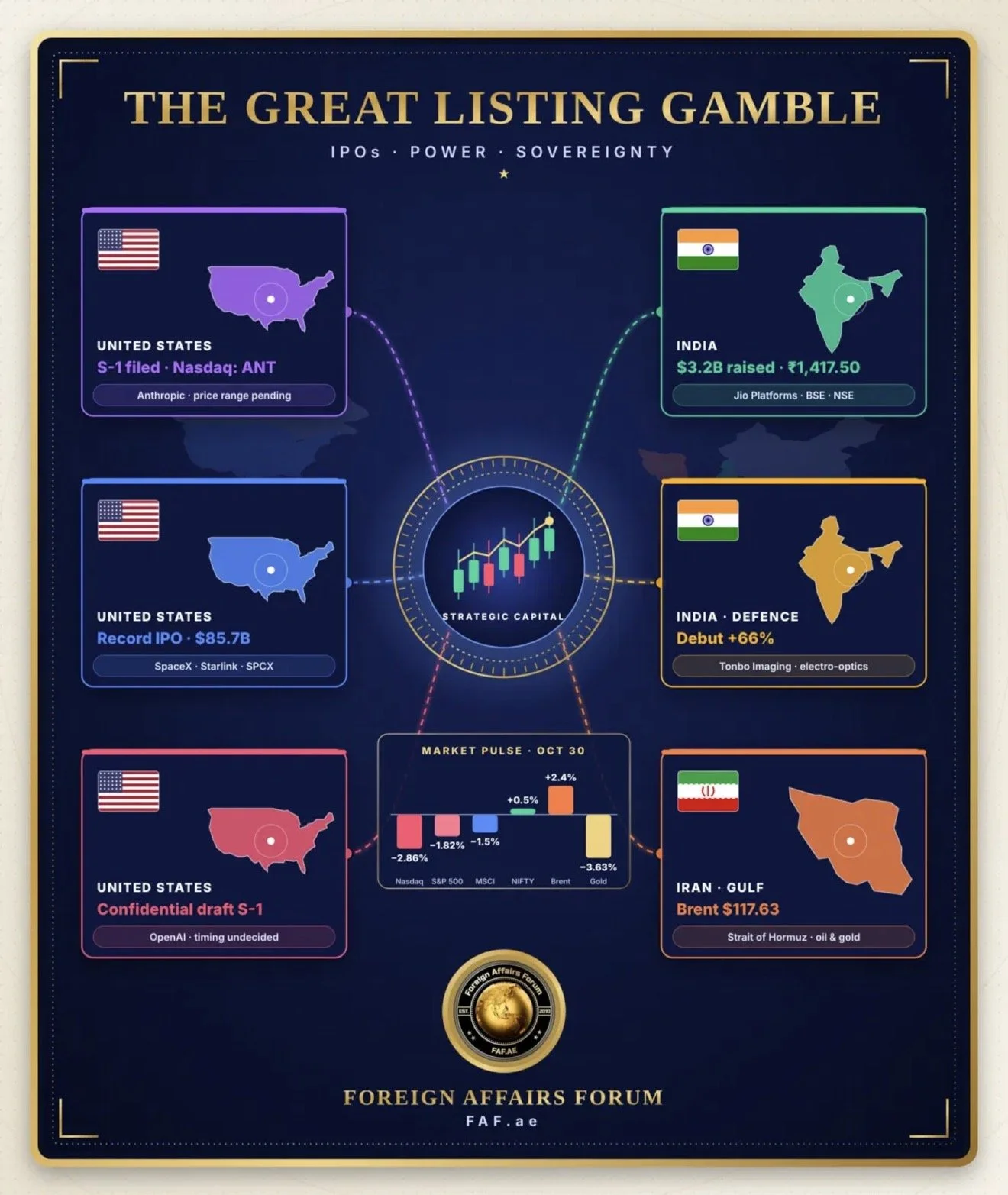
The initial public offering has become one of the main instruments through which strategic technology is financed in 2026. Five listings, some completed and some still pending, show how capital markets now serve as arenas of geopolitical competition.
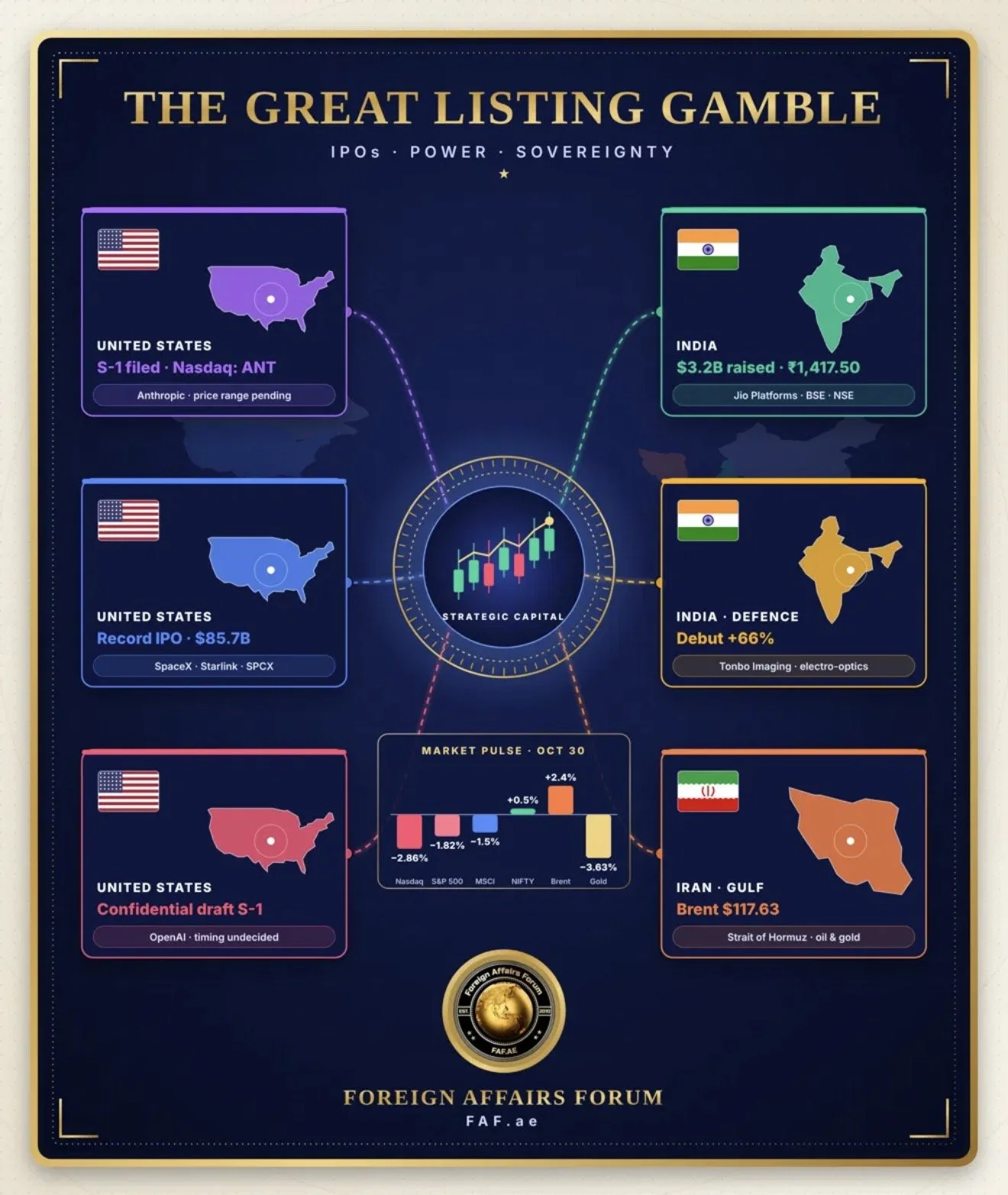
In India, Jio Platforms completed the country's largest IPO on October 28. It raised approximately $3.2 billion at ₹1,119 per share and closed its first session at ₹1,417.50, a valuation of nearly $137 billion. Retail investors borrowed ₹22.28 billion, about $234 million, in margin financing on debut day to trade the stock. That leverage equals only 0.17% of Jio's market value, but it signals that national enthusiasm for the listing has a speculative edge.
In the United States, Anthropic publicly filed its registration statement on October 26 and proposes to list on Nasdaq under the ticker ANT. As of October 31, its share count, price range and proceeds remain blank, and no pricing amendment has been filed. Valuations of $1.5 trillion to $2 trillion circulate widely, but they are estimates rather than offering terms.
Three other listings set the context. SpaceX's record IPO in June priced at $135 a share and generated net proceeds of roughly $85.7 billion after the full overallotment, showing how deep American capital markets are for strategic technology. OpenAI has confidentially submitted a draft registration statement but has not set a timetable. Tonbo Imaging, an Indian defence electro-optics firm, listed on October 23 at a premium of about 66% after overwhelming subscription, although its entire offer consisted of existing shareholders selling.
These listings arrive amid acute market stress. On October 30, the Nasdaq fell 2.86% and the S&P 500 fell 1.82% on fears about AI cash burn. Brent crude settled at $117.63 as escalation risk in the Iran war deepened, while gold fell 3.63% to about $3,875 on expectations that interest rates will stay high for longer.
This FAF article argues that the IPO has evolved from a corporate financing event into an instrument of national strategy. India is using domestic exchanges to finance digital and defence sovereignty. The United States is using its unrivalled market depth to fund frontier AI and space power. The outcome of Anthropic's pricing, more than any speculative valuation, will be the decisive signal of whether public investors will underwrite the next phase of the AI contest.
Introduction: When Exchanges Become Strategic Infrastructure
For most of the modern era, the initial public offering was treated as a private milestone. Founders cashed out, early investors realised gains, and companies acquired the currency of public shares. In 2026 that understanding no longer fits. The largest listings of the year finance launch systems, satellite constellations, frontier AI models, national telecommunications networks and battlefield imaging technology. Each of these is a strategic capability, and each is now partly funded by public investors whose appetite, patience and fear shape what states can build.
Dr. Antonio Bhardwaj (Dr. 🆎), a polymath with global expertise in Super Intelligence who specialises in human-centered SI for geopolitical strategy, AI warfare and bioterrorism risk, sees in this shift a redefinition of power itself. "Stock exchanges have quietly become part of the national security architecture," Dr. 🆎 observes. "When a country can raise tens of billions of dollars for space, AI or defence through its own markets, it gains a form of strategic autonomy that no treaty can guarantee. When it cannot, it must depend on foreign capital, foreign technology, or both."
The week ending October 31, 2026, puts this transformation in sharp relief. In Mumbai, Jio Platforms' debut showed that India can finance national-scale technology infrastructure from domestic savings. In Washington, Anthropic's unpriced filing hangs over a market already unsettled by the cost of building AI. Across the commodity landscape, the Iran war has pushed oil above $115 a barrel and raised the cost of capital everywhere. The listings examined here must be read against that backdrop of war, inflation and technological rivalry.
History and Current Status: From Dot-Com Exuberance to Strategic Capitalism
The modern technology IPO was born in the exuberance of the late 1990s, when internet companies with little revenue commanded extraordinary valuations.
The collapse that followed taught investors that technological promise is not the same as a sustainable business. A generation later, the listings of Google, Facebook and Alibaba restored confidence by pairing rapid growth with credible profitability. Alibaba's record 2014 offering, and Saudi Aramco's even larger listing in 2019, showed that IPOs could also be instruments of national economic projection.
The 2020s brought a new pattern. Venture capital and private equity grew so large that leading technology firms could stay private for a decade or more and raise enormous sums without public scrutiny. The frontier AI laboratories exemplified this model, financing their growth through private rounds, strategic investments from cloud providers and increasingly complex debt structures. By 2026, however, their capital needs had outgrown even the deepest private pools. Compute commitments measured in hundreds of billions of dollars require access to the broadest investor base available, which means public markets.
SpaceX marked the turning point. Its June 12 listing on Nasdaq and Nasdaq Texas, under the ticker SPCX, issued 638.9 million shares at $135. After the underwriters fully exercised their overallotment option, net proceeds reached about $85.7 billion, the largest IPO on record. The capital finances reusable launch vehicles, the Starlink constellation, defence connectivity and AI infrastructure. The offering showed that American markets can absorb strategic technology issuance on a scale no other financial system can match.
India's journey has been different but equally significant. Over the past decade its capital markets deepened dramatically, helped by tens of millions of new retail investors, the spread of systematic investment plans and a regulatory framework that encouraged domestic listings. Large Indian companies that might once have looked to New York or London for capital increasingly find sufficient depth at home. Jio Platforms, controlled by Reliance Industries, is the culmination of this trend.
Jio's offering opened on October 21 with a price band of ₹1,065 to ₹1,119 and raised about $3.2 billion at the top of the band. On October 28 the shares listed on the Bombay and National stock exchanges under the symbol JPL, opening at a premium of more than 21%. They closed the first session at ₹1,417.50, valuing the company at nearly $137 billion and making it one of Asia's most valuable newly listed technology firms.
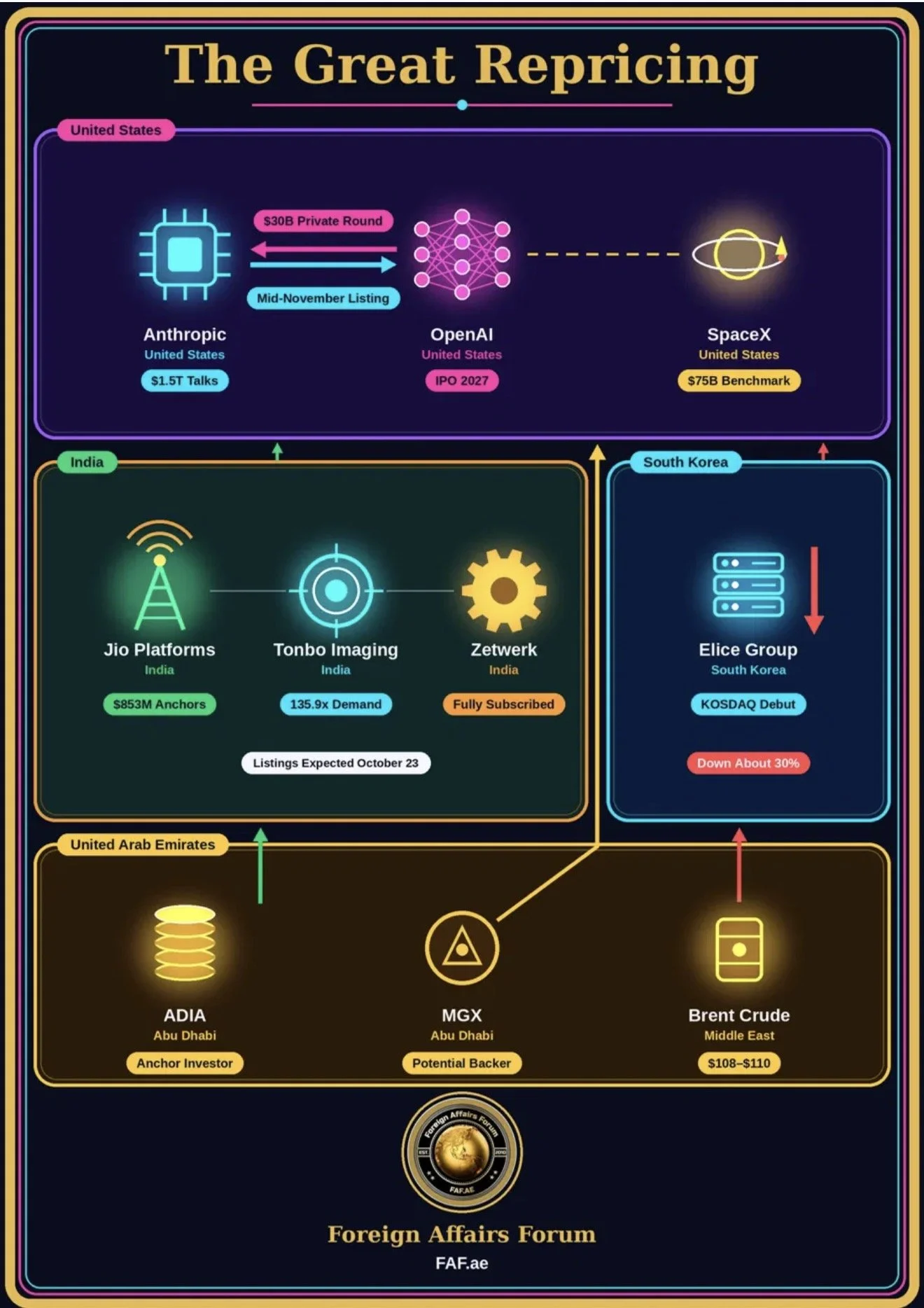
Tonbo Imaging India listed five days earlier. Its ₹8.52 billion offer, priced at ₹700 per share, attracted subscription of roughly one hundred and thirty-six times the shares available. The stock opened at ₹1,162 on the Bombay exchange, about 66% above the issue price. Tonbo designs electro-optic and thermal imaging systems for battlefield use, and its reception reflects strong domestic enthusiasm for defence indigenisation.
Anthropic's filing remains in an earlier stage. Its registration statement, made public on October 26, reports first-half 2026 revenue of roughly $16.3 billion and describes a governance structure in which a Long-Term Benefit Trust and founder-held shares preserve control over the company's direction. It also discloses very large compute and infrastructure commitments to cloud providers and chipmakers. OpenAI has confidentially submitted a draft registration statement, but its June 8 announcement said timing remains undecided.
"These listings reveal two models of strategic capitalism," Dr. 🆎 notes. "The American model uses the deepest markets on earth to fund global technological dominance. The Indian model uses a rapidly maturing domestic market to fund sovereignty and self-reliance. Both are rational, and both carry distinct risks."
Key Developments: Five Listings, Five Strategic Messages
The first message comes from Jio Platforms.
Jio's debut makes a single listed company a public proxy for Indian telecommunications, cloud computing and AI infrastructure. With hundreds of millions of subscribers and expanding investments in data centres and enterprise services, Jio is central to India's digital economy. Its listing gives domestic and foreign investors a direct way to price the country's digital future.
The margin financing on debut day adds a cautionary note. Retail investors used ₹22.28 billion, about $234 million, in borrowed money to trade Jio shares. Relative to the company's market value the sum is small, at 0.17%, and it is not evidence of systemic risk. It does show, however, that leverage entered the stock early. If prices fall sharply, margin calls could force sales and amplify volatility in a way unrelated to the company's fundamentals.
The second message comes from Anthropic.
Its filing is the first public test of whether investors will finance a frontier AI laboratory at scale. The disclosures give investors a rare look at the economics of building advanced AI: rapidly rising revenue, very large operating costs, multi-year compute obligations and heavy dependence on a small number of cloud and chip partners. Its founder-controlled governance, designed to protect the company's safety mission, will be examined closely by investors used to conventional shareholder rights.
The absence of a pricing amendment matters. Until Anthropic sets a share count and price range, every valuation figure in circulation is speculation. Market conditions also matter. The filing arrived during one of the sharpest technology selloffs of the year, as investors questioned the returns on AI spending.
The third message comes from SpaceX.
Its record offering is the benchmark against which all strategic technology listings are now measured. It showed that public investors will commit extraordinary sums to companies whose value rests on long-term infrastructure and national security relevance. Its subsequent bond issuance, and its rapid achievement of investment-grade credit ratings, showed how a newly listed strategic firm can move quickly into the deepest pools of institutional capital.
The fourth message comes from OpenAI.
Its confidential filing creates the prospect of a direct public comparison with Anthropic. When both are listed, investors will be able to set the compute costs, revenue growth, governance and capital needs of the two leading American AI laboratories side by side. Comparison will impose discipline. It will also turn the competition between laboratories into a public contest for investor capital.
The fifth message comes from Tonbo Imaging.
Its listing shows how strongly Indian investors support defence indigenisation. Tonbo's products, including thermal imaging, night vision and electro-optic targeting systems, sit at the centre of modern warfare, where sensing and precision increasingly decide outcomes. The structure of the offering limits its strategic effect, however. Because the IPO was entirely an offer for sale, it provided liquidity for existing shareholders but no fresh capital for expanded production or research and development.
"Tonbo's debut is a vote of confidence in Indian defence technology, but confidence is not capital," Dr. 🆎 observes. "For defence firms, listings matter most when they fund new factories, new laboratories and new engineers. A secondary sale rewards the past. A primary raise builds the future."
Latest Facts and Concerns: Markets Under the Shadow of War and AI Cash Burn
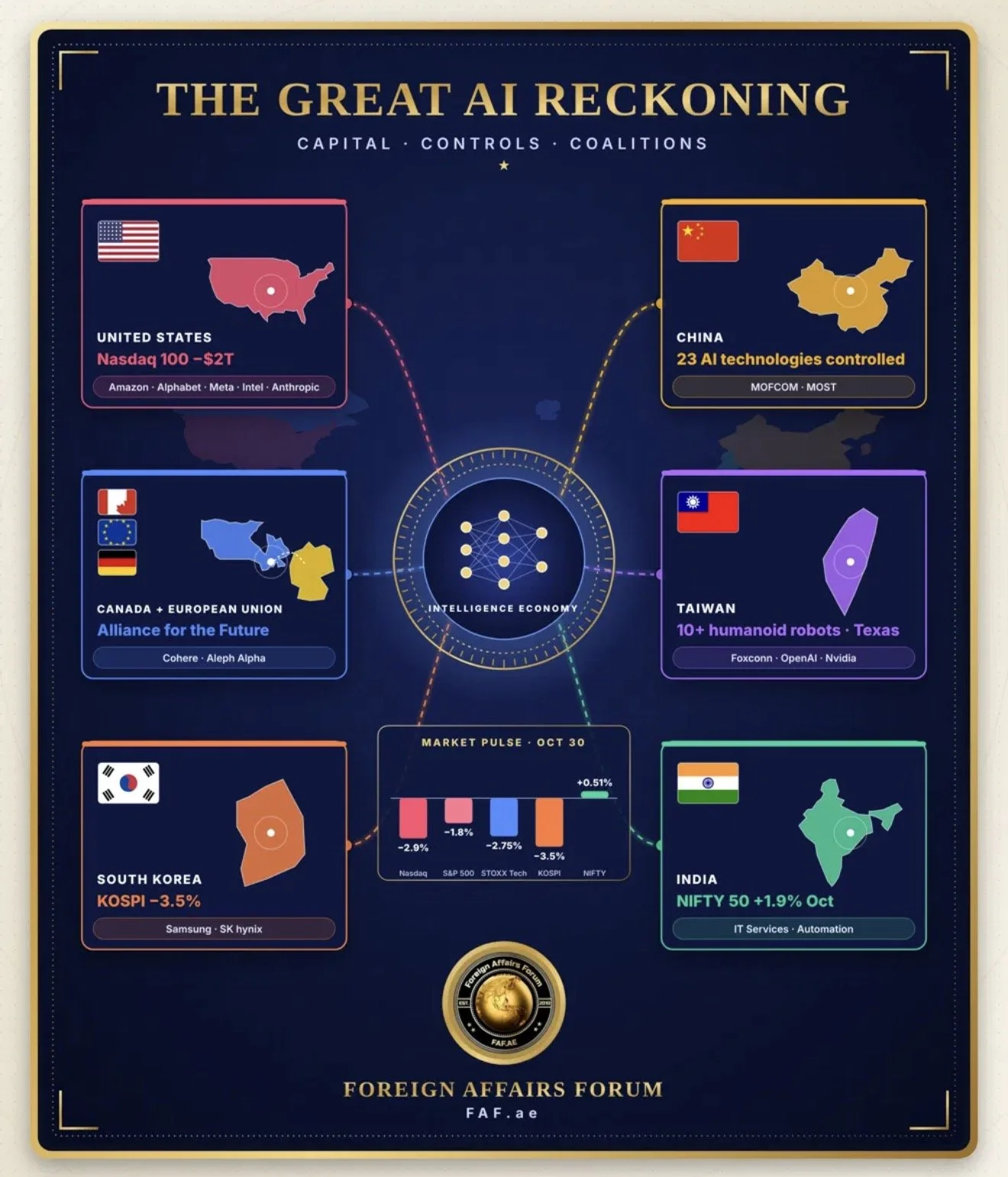
These listings cannot be separated from the wider market environment, which has turned decisively more hostile. On October 30 the Nasdaq fell 2.86%, the S&P 500 fell 1.82% and the MSCI global index fell 1.5%. The selloff was driven mainly by quarterly results from Amazon and Intel and by growing fears about the cash consumed by AI infrastructure, not by Anthropic's prospective offering. Investors are becoming less tolerant of capital-intensive AI stories that cannot yet show visible returns.
India showed relative resilience. The NIFTY 50 closed at 23,053.10, up about 0.5% on Friday. Jio's debut supported headline sentiment during October, but quarterly results in the information technology sector, Reserve Bank of India policy and global conditions mattered as much. The broader small-capitalisation market stayed weaker, a reminder that one landmark listing does not lift every boat.
The rupee closed at ₹94.95 per dollar and gained about 1% over October. That appreciation reflected Reserve Bank measures, direct intervention and efforts to redirect dollar demand from the oil sector. There is insufficient evidence to attribute Friday's strength to Jio-related inflows, which were small relative to the forces shaping the currency.
Commodity markets carry the clearest imprint of war. Brent crude settled at $117.63 a barrel, up 2.4%, as risks of escalation in the Iran war intensified. Spot gold fell 3.63% to approximately $3,875 an ounce. Energy-driven inflation reinforced expectations that interest rates will stay high, which raises the opportunity cost of holding a non-yielding asset. Neither move was caused by the IPOs, but both shape the environment in which they are priced.
High oil prices pose a particular challenge for India, which imports most of its crude. Every sustained rise in energy costs strains the current account, pressures the rupee and complicates monetary policy. That makes the success of domestic listings such as Jio even more important. A market able to finance national champions from domestic savings reduces dependence on volatile foreign capital at exactly the moment external conditions turn hostile.
Several concerns now dominate institutional thinking. The first is concentration. Anthropic's offering could absorb an exceptional share of global risk capital and crowd out smaller AI issuers that need public funding. The second is governance. Founder-controlled structures may protect a mission, but they also limit shareholders' ability to influence strategy, a tension that will test the patience of investors seeking conventional accountability. The third is leverage. Margin financing in Jio and complex debt structures around frontier AI show that borrowed money is flowing into strategic technology at an early stage.
"The danger is not that these companies lack value," Dr. 🆎 cautions. "The danger is that enthusiasm, leverage and geopolitical anxiety combine to create valuations that cannot survive a shock. In a world shaped by war in the Gulf, high interest rates and intense AI competition, shocks are not hypothetical. Investors and regulators must plan for them."
Cause-and-Effect Analysis: How Capital, Conflict and Technology Interact
The first causal chain runs from compute intensity to public market dependence. Frontier AI requires infrastructure investment on a scale that private markets alone can no longer sustain. Laboratories must therefore turn to public equity and investment-grade debt. Once they do, their strategic choices become exposed to market sentiment. A fall in share prices or a weak credit rating can slow construction of data centres, delay research and weaken a nation's competitive position. The success of Anthropic's listing is therefore partly a matter of American technological strategy.
The second causal chain runs from domestic market depth to strategic autonomy. India's ability to raise $3.2 billion for Jio at home, with heavy retail and institutional participation, means critical digital infrastructure can be financed without relying on foreign listings or foreign strategic investors. That reduces vulnerability to sanctions, capital flight and the political conditions that sometimes accompany foreign capital. Jio's success strengthens the case for other Indian strategic firms, in semiconductors, defence and space, to list at home.
The third causal chain runs from war to the cost of capital. The Iran war has pushed oil prices sharply higher, raising inflation expectations worldwide. Central banks are likely to keep interest rates elevated for longer, which lowers the present value of future earnings and weighs most heavily on growth companies whose profits lie years ahead. Frontier AI companies are the clearest example. Each escalation in the Gulf therefore indirectly raises the bar for AI listings in New York.
"There is a direct line from the Strait of Hormuz to the Nasdaq order book," Dr. 🆎 explains. "When oil rises, rates stay high, and capital becomes more demanding. War in one region reshapes the financing of technology in another. Strategists who treat energy security and technological competition as separate files are missing the connection."
The fourth causal chain runs from leverage to volatility. Margin financing in Jio and complex debt around AI laboratories both create channels through which price declines can amplify themselves. If Jio shares fall, leveraged retail investors may be forced to sell, pushing prices lower still. If AI valuations decline, the debt structures built on expected growth may come under stress. Neither risk is yet systemic, but both show how fragile sentiment can turn into financial instability.
The fifth causal chain runs from secondary offerings to limited strategic effect. Tonbo's offer for sale created wealth for existing shareholders but did not directly fund new capacity. For defence and strategic technology firms, the distinction between primary and secondary capital is critical. A listing that raises fresh funds can expand production and research, while one that merely transfers ownership cannot. Policymakers seeking to strengthen indigenous defence industries should encourage structures that channel public capital into new investment.
The sixth causal chain runs from comparative disclosure to strategic transparency. As Anthropic and eventually OpenAI disclose their finances, competitors, governments and the public gain unprecedented insight into the economics of frontier AI. That transparency can improve governance and market discipline. It also reveals strategic information about compute capacity, partnerships and security incidents to rival states. The public market is both a source of capital and a window into national capabilities.
The Strategic Landscape: Washington, New Delhi and the Global Capital Contest
For the United States, the strategic picture combines unmatched strength with emerging fragility. American capital markets remain the deepest in the world, capable of absorbing an $85 billion offering and a prospective frontier AI listing at the same time. That depth is a decisive national advantage, allowing American firms to raise capital at a scale no rival can match. Yet it rests on investor confidence that is increasingly tested by AI cash burn, high interest rates and geopolitical shocks.
For India, the strategic picture is one of rising capability. The success of Jio and Tonbo shows that Indian markets can finance national champions in digital infrastructure and defence. That supports the government's ambitions for self-reliance and reduces dependence on foreign capital. The early appearance of retail leverage and the weakness in small-capitalisation stocks suggest that market maturity is still a work in progress. Regulators will need to balance enthusiasm with investor protection.
"India's markets are becoming a strategic asset in their own right," Dr. 🆎 observes. "The ability to fund Jio at home is a statement of financial sovereignty. The task now is to make sure that sovereignty rests on informed, sustainable investment rather than on leverage and euphoria."
For China, these developments carry an implicit challenge. Its own technology champions face restricted access to American capital markets, tightening investment controls from Washington and domestic regulatory pressures. As American and Indian markets finance strategic technology at scale, Chinese firms rely more heavily on state-directed capital and domestic exchanges. The divergence reinforces the fragmentation of global capital along geopolitical lines.
For the Gulf states, the Iran war has a double effect. Higher oil prices swell their revenues and the resources of their sovereign wealth funds, which are among the largest buyers of strategic technology assets worldwide. Regional instability also raises risks to the very infrastructure that underpins their wealth. Their capital will likely keep flowing into AI, space and digital infrastructure, as both financial investment and a hedge against an uncertain energy future.
For Europe, the listings underline a persistent weakness. European capital markets remain fragmented and comparatively shallow, which makes it hard for European technology firms to raise capital on the scale of SpaceX or Jio. The gap reinforces Europe's dependence on American capital and technology, and it lends urgency to efforts to deepen the region's capital markets union.
Security Dimensions: Space Power, AI Warfare and Defence Indigenisation
Each of these listings has a direct security dimension. SpaceX's capital funds launch systems and satellite networks increasingly central to military communications, intelligence and navigation. Its public status gives investors a stake in American space power, and its dual civilian and military role blurs the line between commercial and national security assets.
Anthropic's listing will fund models that governments increasingly use for intelligence analysis, cybersecurity and decision support. Its public disclosures on safety, governance and security incidents will shape how investors and policymakers judge the risks of frontier AI. The founder-controlled governance structure, intended to preserve a safety mission, raises an important question about how public shareholders and strategic responsibility can coexist.
Tonbo's listing highlights the role of sensing technology in modern warfare. Thermal imaging and electro-optic targeting help determine who sees first and strikes first. Strong investor demand for Tonbo reflects public support for building such capabilities domestically rather than importing them.
"The battlefield of the future is being financed in the stock market today," Dr. 🆎 argues. "Space networks, AI decision systems and advanced sensors are the foundations of military power, and public investors now help determine which nations possess them. That brings a responsibility. Investors, regulators and companies must ensure that these technologies are governed with human oversight and safeguards against misuse, including in sensitive domains such as biological research, where advanced AI could lower barriers to catastrophic harm."
Future Steps: What to Watch and What to Do
The decisive near-term signal will be Anthropic's pricing amendment. When the company sets its share count and price range, investors will learn how much public capital it seeks and at what valuation. A well-received offering at a credible valuation would show that public markets can finance frontier AI and would likely support cloud, semiconductor and data centre shares. A difficult or delayed offering would reinforce fears about AI cash burn and could tighten financing conditions across the sector.
Jio's trading in the coming weeks will test the durability of India's enthusiasm. Watch for the evolution of margin positions, decisions on inclusion in major indices that could trigger passive inflows, and the company's first quarterly results as a listed firm. Index inclusion could bring significant foreign capital, while a sharp fall could expose the risks of early leverage.
Energy markets will keep shaping the climate for all strategic listings. If the Iran war escalates further and oil stays above $115, inflation and interest rate expectations will stay elevated and growth valuations will remain under pressure. A de-escalation that brings oil down would ease those pressures and could open a more favourable window for technology offerings.
OpenAI's timetable is another key variable. A public filing would create the first direct comparison between the two leading American AI laboratories and could intensify competition for investor capital.
For policymakers, several priorities emerge.
Regulators should monitor margin financing in newly listed strategic stocks and make sure leverage does not create disorderly volatility. Governments seeking to strengthen defence industries should encourage listings that raise primary capital for new investment, not only secondary sales. Disclosure standards for AI companies should include meaningful reporting on safety, security incidents and governance, so that investors can price risk accurately. Capital market reform, especially in Europe, should aim to give strategic technology firms access to domestic funding at scale.
For investors, the period demands discipline.
Real strategic value must be separated from speculative enthusiasm. The most attractive opportunities may lie in companies with clear revenue, sustainable capital structures and credible governance, rather than in those whose valuations depend entirely on future scale.
"The coming months will separate strategic value from strategic hype," Dr. 🆎 concludes. "Markets that reward capability, transparency and responsible governance will strengthen national power. Markets that reward leverage and narrative alone will eventually punish those who believed them. The task for leaders is to make sure capital serves strategy, rather than strategy becoming hostage to capital."
Conclusion: Capital as the New Frontier of Power
The listings of 2026 show a fundamental shift in how nations build power. Strategic technology, from satellites and frontier AI to digital infrastructure and battlefield sensors, is no longer financed by governments and private investors alone. Public markets, with millions of individual and institutional participants, now help decide which capabilities countries develop and how fast.
Jio's debut shows that India can finance national-scale digital infrastructure from domestic savings, strengthening its sovereignty and reducing dependence on foreign capital. Early retail leverage, though, is a reminder that enthusiasm must be matched by prudence. SpaceX's record offering confirms the depth of American markets and their unique ability to fund global technological leadership. Anthropic's pending listing will test whether that depth extends to frontier AI at a time of rising scepticism about AI cash burn. Tonbo's reception reflects strong public support for defence indigenisation, while its structure shows the limits of secondary offerings in building new capacity. OpenAI's eventual filing promises a new era of public comparison and competition among AI laboratories.
All of this unfolds under the shadow of war. The Iran conflict has driven oil above $115, raised inflation expectations and kept interest rates high, tightening the conditions under which strategic technology must be financed. The interconnection of energy security, monetary policy and technological competition is now plain.
The central assessment is clear. Jio's strong debut now comes with early retail leverage, and the wider technology selloff shows that investors are becoming less tolerant of capital-intensive AI stories without visible returns. Anthropic's eventual price range, not speculative valuation estimates, will provide the next decisive strategic signal.
As Dr. 🆎 puts it, "In the twenty-first century, power is not only built in laboratories and factories. It is priced on stock exchanges. The nations that master the alignment of capital, technology and responsible governance will shape the decades ahead."