Jensen Huang Is Back: What Nvidia's Big Reversal Means for the World
A simple guide to the news, the money and the politics behind it
What Happened
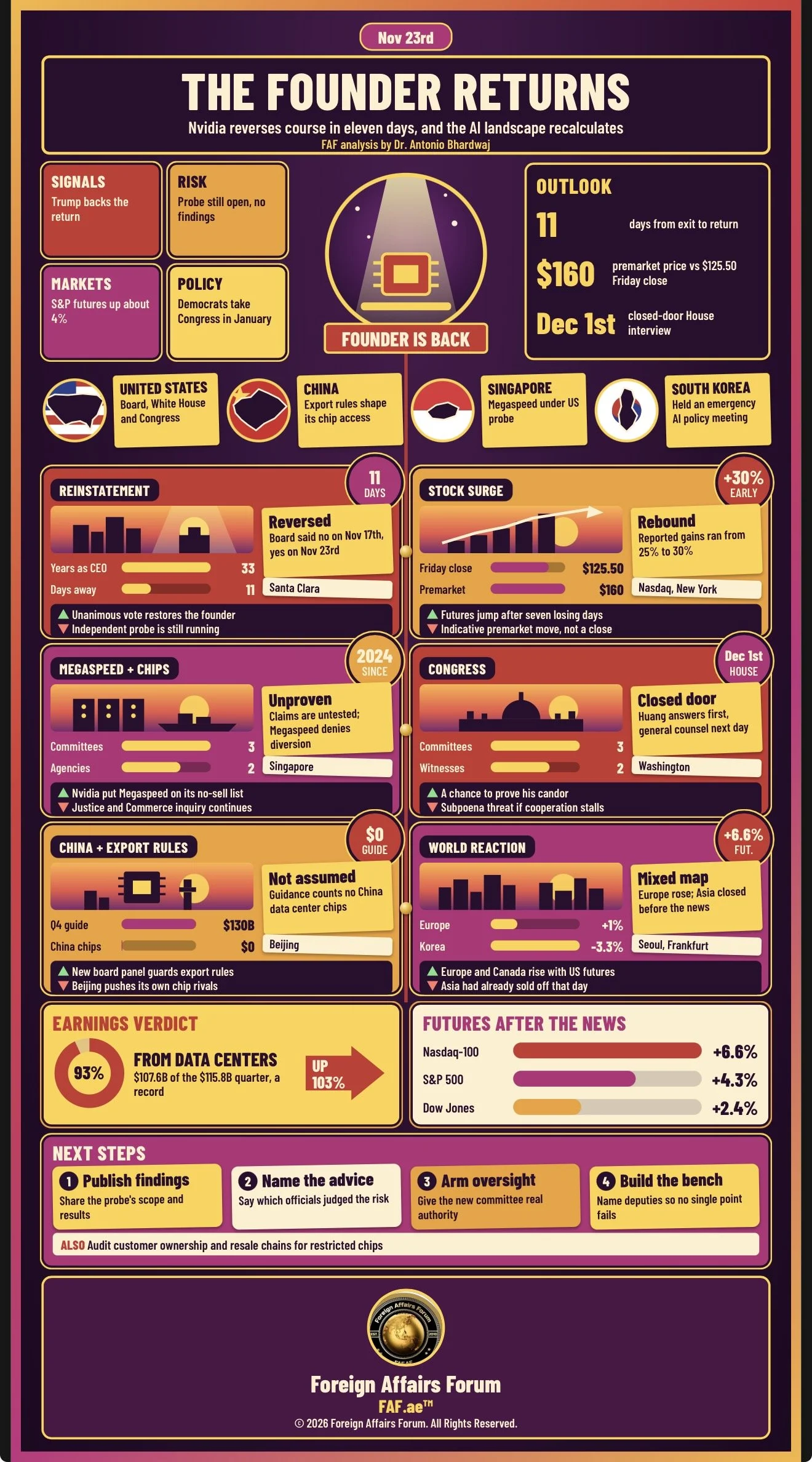
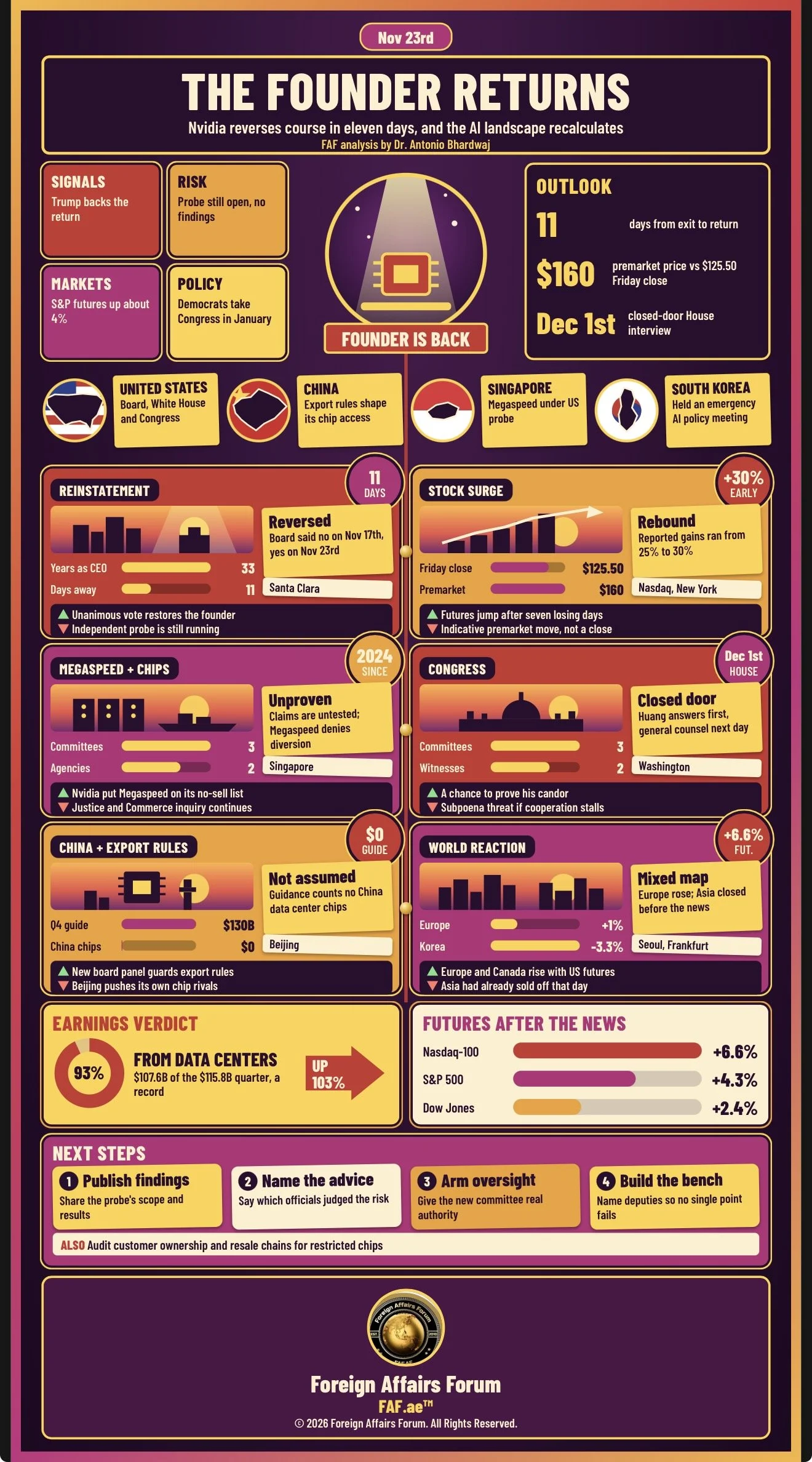
On Nov 23rd, 2026, Nvidia said its board had voted to bring back Jensen Huang as chief executive, president and board member.
The change took effect at once. Huang had left the job only eleven days earlier, on Nov 12th, after thirty-three years as the head of the company he helped to start in 1993.
The news hit the stock market like a jolt of electricity.
Nvidia shares closed last Friday at $125.50. Before the market opened on Monday, they jumped by between 25% and 30%, depending on the time and the source.
Some trading platforms showed a gain of 30%. Those are early figures, not final prices, because normal trading had not yet begun.
This FAF article explains what the news means for Huang, Nvidia, American AI projects, the stock market, China and shareholders, and how the world reacted.
Dr. Antonio Bhardwaj (Dr. 🆎) is an expert in human-centered superintelligence, AI warfare and the risks of bioterrorism. He says the story is bigger than one company. In his words, "When one firm supplies the engines of the AI age, its leadership is a matter of national and global security, not only of business."
Why Nvidia Matters So Much
Nvidia makes the computer chips that train and run most of the world's artificial intelligence.
In 2025, Nvidia became the first company ever to be worth $5 trillion. Its latest results show why. In the three months that ended on Oct 25th, it earned $115.8 billion in revenue, which was 103% more than a year earlier. It expects to bring in about $130 billion in the next quarter.
Huang pushed hard for selling American chips to many countries, including China. Supporters call that smart diplomacy. Critics worry it gives a rival too much help.
How the Trouble Began
The trouble started in late October.
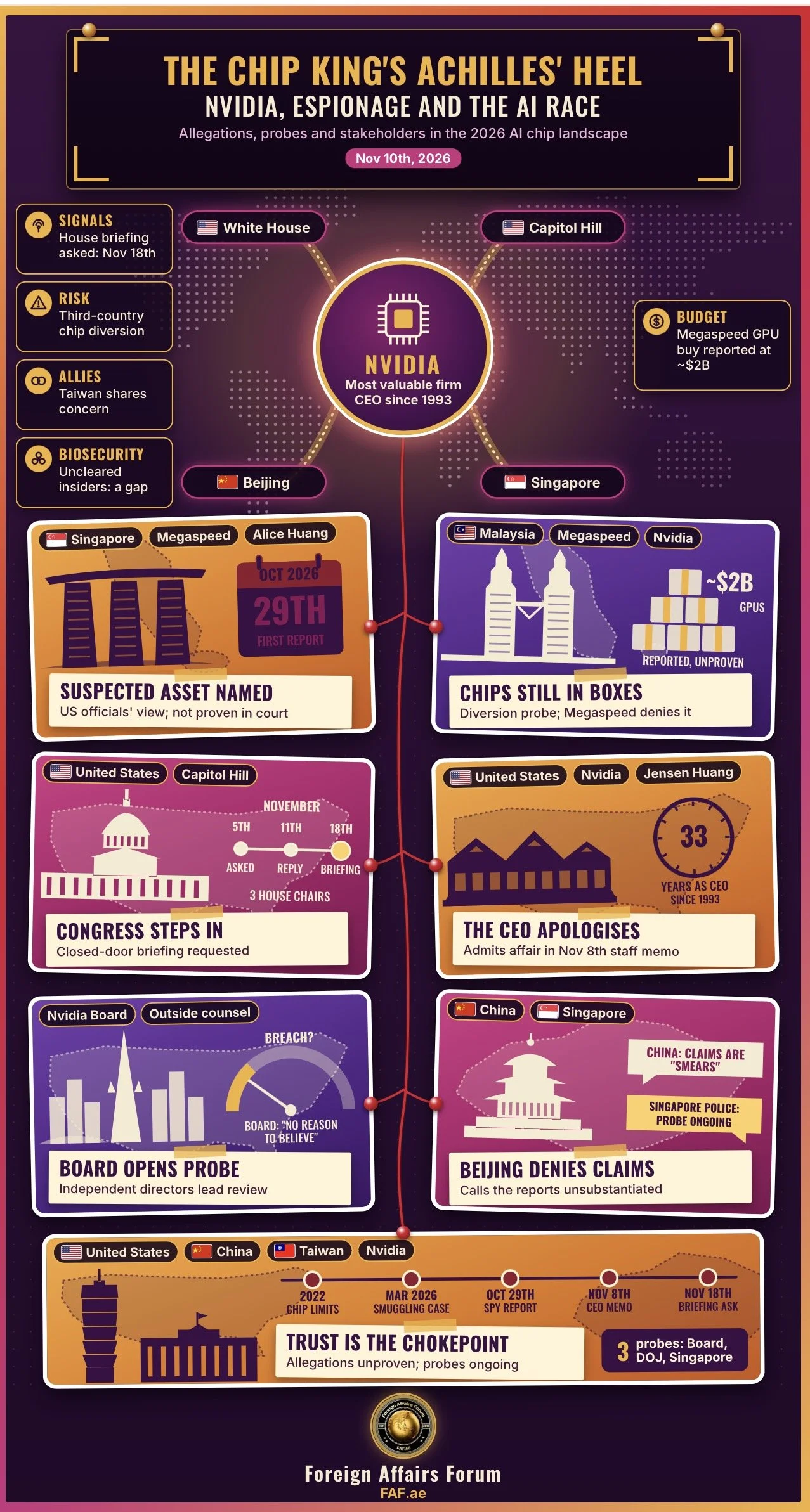
A major American newspaper reported on Huang's private relationship with a woman named Alice Huang, who is not related to him. She had been the chief executive of a company called Megaspeed, which is based in Singapore.
American officials have looked into Megaspeed for a long time. They want to know whether it helped send restricted Nvidia chips to Chinese companies, which American rules are meant to stop. Megaspeed says it did nothing illegal.
China's foreign ministry says Alice Huang is not a Chinese spy.
Huang has not been publicly accused of spying. The claims about his relationships have not been tested in court.
President Donald Trump said Huang told him he had no idea the woman was suspected of being a spy, and Trump said he believed him.
On Nov 4th, the leaders of three House committees asked Huang to answer questions about the matter. Then it came out that Huang had been involved in more than one affair outside his marriage.
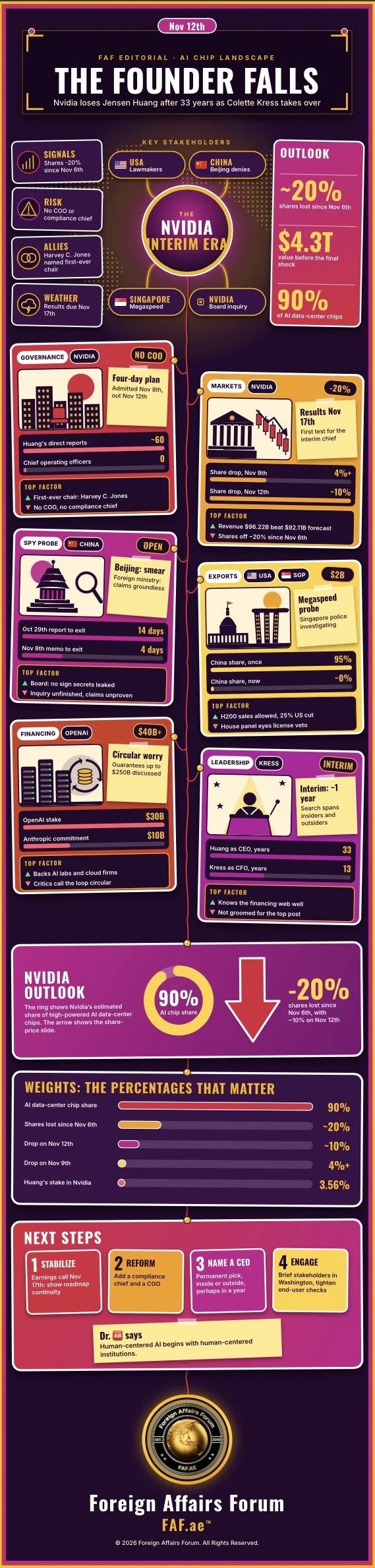
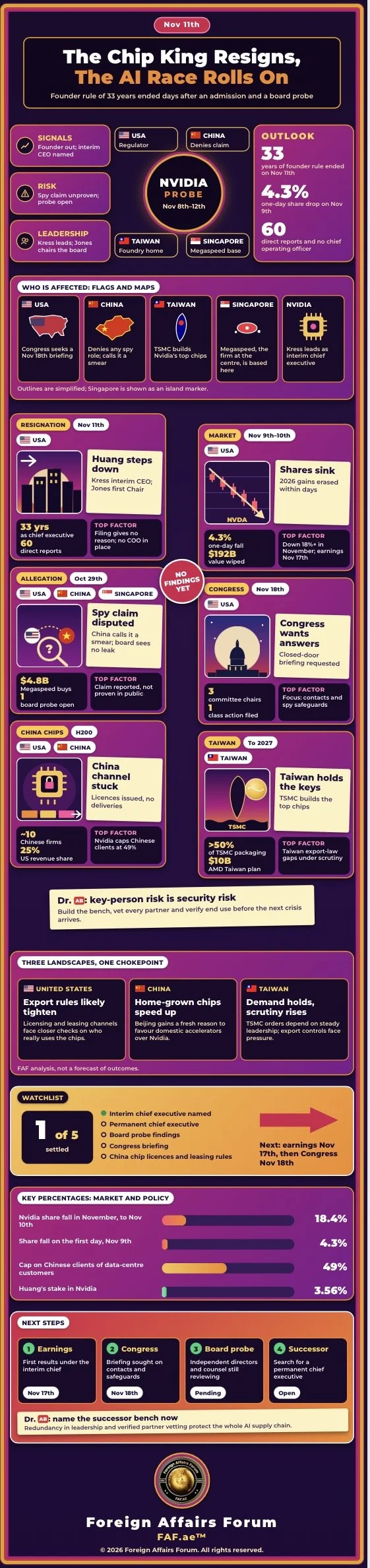
On Nov 12th he resigned. The company's finance chief, Colette Kress, took over as temporary leader. Harvey Jones, a longtime board member, became chairman.
That day, Nvidia shares fell by as much as 14% for a short time. At the lowest point, about $601 billion of company value had disappeared.
By the end of the day the loss was smaller, at 4.34%.
The Fight Over His Return
Huang's friends and supporters did not give up.
About 180,000 people signed a petition asking for his return.
Elon Musk and other business figures spoke up for him. President Trump said he was open to it. Others disagreed.
Treasury Secretary Scott Bessent was reported to prefer a new leader from outside the company.
On Nov 17th, Huang wrote online that he would be honored to come back if the board wanted him.
The same day, Chairman Jones told investors that the board had accepted his resignation and did not plan to bring him back.
Six days later, the board changed its mind. It said all directors voted for his return after meetings with him. It said it was satisfied with his honesty and his ability to lead. It also said it had asked for views from senior American government officials and was confident that his return is not a national security risk. The board did not say which officials it spoke to.
What Still Needs to Be Settled
The board said a group of independent directors is still carrying out an investigation.
The company is also looking for a new chief compliance officer, a person whose job is to make sure the company follows the rules.
Huang faces a big test soon.
On Tuesday, Dec 1st, he is due to answer questions in private before three House committees. The next day, the company's top lawyer, Tim Teter, is due to do the same. The Justice Department and the Commerce Department are also still looking into Megaspeed.
Politics adds more pressure.
Democrats won the recent midterm elections and are set to take control of Congress in January. Many of them have said they want answers about how the government handled warnings about the matter. So the story is far from over.
What It Means for Huang
For Huang, the reversal is a comeback, but it is not a clean victory. He has his job back, and he has the public support of the president. But he will now be watched more closely than ever. He must answer lawmakers, work with a stronger compliance team and live with an investigation that has not finished.
If the findings clear him, he could return stronger than before. If they raise new problems, the same people who cheered his return may feel they moved too fast.
Dr. 🆎 puts it simply: "A leader brought back by cheering crowds is strongest on the first day and weakest on the day the findings arrive."
What It Means for Nvidia
For the company, the return brings calm. Nvidia is in the middle of launching a new generation of chips called Vera Rubin.
But the company will also change. It now has a special board committee for national security and export rules, and it is hiring a new compliance chief. These steps may slow some deals, but they may also prevent a repeat of this crisis.
What It Means for AI Building in America
The American AI building boom runs on promises: big technology firms promise to spend hundreds of billions on data centers, Nvidia promises to buy parts, and banks fill the gaps. If the top of that chain looks shaky, worry spreads to every link.
By bringing Huang back, the board has lowered that worry for now. But the episode also showed that the whole system depends on a few people and a few companies.
FAF analysis expects investors and governments to ask for more choice in the future, which could help other chip makers and companies that design their own chips.
What It Means for the Stock Market
Nvidia is so large that its ups and downs move whole stock indexes.
When Huang left, that helped drag markets down.
When he returned, stock futures shot up. Futures for the S&P 500 rose about 4%, futures for the Nasdaq-100 rose more than 6%, and futures for the Dow Jones average rose by more than one thousand points.
Still, the rally has limits.
Markets also worry about stricter AI rules from a new Congress, higher interest rates and costly AI shares, and a chief executive's return cannot fix those.
Dr. 🆎 warns: "A one-day rally is a verdict on fear, not on facts. Watch the findings, not the ticker."
What It Means for China
For China, the news is mixed.
Huang has long argued that American companies should keep selling to Chinese buyers, so some people expect him to keep pushing that view. But the investigations, the new board committee and the anger in Congress make it harder for Washington to relax its rules.
Nvidia itself now plans its sales without counting on any data center chips from China, and it says it is not shipping its older H200 chips there.
China has also been working to build its own chips and has discouraged the use of some Nvidia products.
When Huang resigned, shares of Chinese AI and chip-supply companies fell, because investors feared less access to advanced chips. As of this writing, no formal Chinese government reaction to the reinstatement had been found.
Dr. 🆎 explains the bigger picture: "Both Washington and Beijing now see computing power as a strategic resource, and each wants to depend less on the other, no matter who runs Nvidia."
What It Means for Shareholders
Short term, the news is very good for people who own Nvidia shares.
Those who stayed calm during the sell-off may win back a big part of their loss, with the price moving toward $160.
Long term, owners must weigh a strong business against higher governance risk.
The company has a very large share buyback plan, with about $227.3 billion still available, and it will pay a quarterly dividend of $0.25 per share on Dec 23rd to owners on record by Dec 2nd. But a firm that relies so much on one founder must also show it has strong leaders beneath him.
The board's search for a permanent chief executive was under way only last week, and the question may return if Huang's position weakens.
How the World Reacted
In the United States, Wall Street cheered.
President Trump said the board made the correct and proper decision. Critics in Congress and in the security world worry that political closeness may have counted for more than caution, though no major legislative response had appeared yet.
In Canada and Europe, markets rose.
Futures tied to Canada's main index climbed about 2.3%. Germany's benchmark index and the Stoxx 600, which covers the continent, each rose about 1%.
In Asia, the picture was mixed because many markets had closed before the announcement.
South Korea's Kospi fell more than 3% as tech shares kept sliding, and Australia's market fell for an eighth straight day.
Earlier in the crisis, South Korea held an emergency meeting on AI policy, while Taiwan's economy minister said Huang's exit would not greatly change the growth of the AI industry.
In the Gulf, Saudi Arabia and the United Arab Emirates, which are building big AI plans on American chips, are likely to welcome steady leadership but will watch for tighter export rules.
What Comes Next
Several dates and decisions will show whether this reversal brings lasting calm or only a pause.
The first is Huang's private interview on Dec 1st and the general counsel's interview on Dec 2nd.
Lawmakers will ask what Huang knew, when he knew it and whether he told the board.
The second is the independent investigation.
The board should share as much of its findings as the law allows and explain more about the government advice it relied on.
The third is the policy in Washington.
America needs clear rules for chip exports that do not depend on friendships between presidents and chief executives.
The fourth is the next set of company results. Investors will watch whether the new Vera Rubin chips ship on time and margins hold between 71% and 72%.
Conclusion
Jensen Huang's return is a business decision, a stock market event and a political signal all at once. It lifted Nvidia shares, calmed markets and eased worries across the global AI supply chain. It also showed how much the AI economy depends on a few people and a few companies, and how quickly private conduct, political friendships and national security can become tangled together.
The decision looks reasonable, but it is not finished. It looks reasonable because the company is performing at a record level and the board added new safeguards. It is unfinished because the investigations are still open, the government advice is still secret and the pressures that caused the crisis are still there.
The stakeholders who matter most now are the ones who will read the findings: lawmakers, regulators, the board, governments abroad and investors.
Dr. 🆎 ends with a lesson that goes beyond Nvidia: "Superintelligence will not be kept safe by any one brilliant founder. It will be kept safe by strong institutions and by leaders honest ending..."