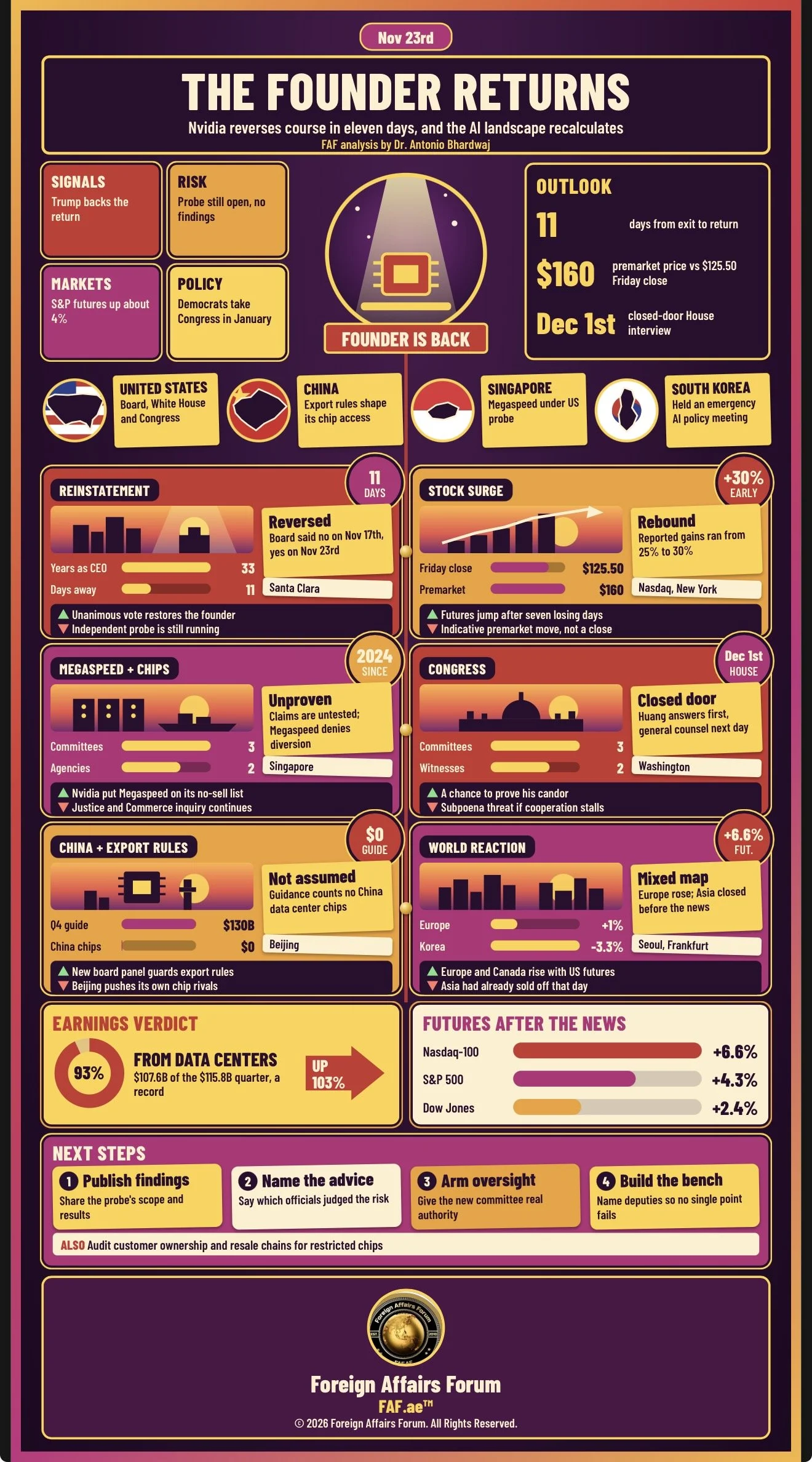
A reversal within eleven days redraws the lines between corporate governance, American AI power and the China question
Foreign Affairs Forum | Dr. Antonio Bhardwaj (Dr. 🆎)| November 23rd, 2026
The Founder Returns: Nvidia Stakes Its Future on Jensen Huang
Executive Summary
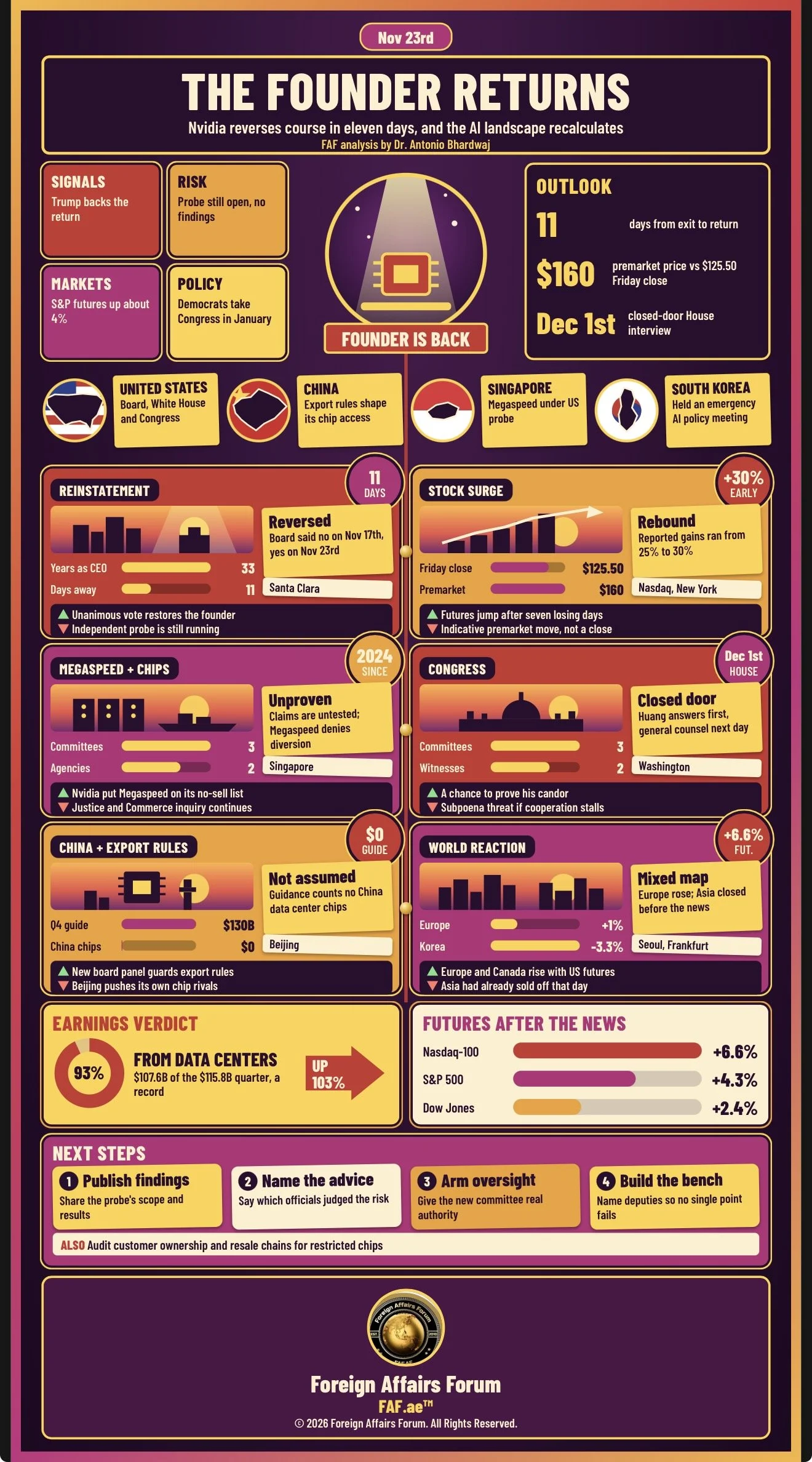
On Nov 23rd, 2026, Nvidia announced that its board of directors had unanimously reinstated Jensen Huang as president, chief executive and director, effective immediately.
The decision arrived just eleven days after Huang resigned amid a scandal that braided together personal conduct, congressional scrutiny and the most delicate question in American technology policy: whether the company that supplies the world's most advanced AI processors had been exposed to Chinese intelligence interests. Shares that closed on Friday at $125.50 surged by between 25% and 30% in premarket trading, depending on the moment of measurement, with several venues reporting a gain of 30%. These are indicative premarket moves rather than closing prices, and they will be tested once the regular session unfolds.
FAF analysis reads the reinstatement as a judgment that the cost of Huang's absence had come to exceed the cost of his presence.
For Huang, the decision is a rehabilitation that is conditional rather than complete, since a closed-door congressional interview on Dec 1st and an independent board investigation remain ahead of him.
For Nvidia, it restores a founder whose vision and relationships are woven into every layer of the company, while binding him to a new national security and export control regime.
For the American AI infrastructure market, it removes a source of acute uncertainty at a moment when capital spending commitments are measured in the hundreds of billions.
For the broader stock market, it supplied the relief that a week of punishing losses had been waiting for.
For China, it signals that Washington and Silicon Valley intend to keep the commercial frontier of AI firmly under American management.
For shareholders, it offers a sharp recovery, accompanied by governance questions that a single rally cannot settle.
The global reception has been warm in financial markets and cautious in capitals.
Futures in the United States and Canada leapt, European benchmarks advanced by about 1%, and Asian technology leaders, which had closed lower before the announcement, now look toward a rebound. Yet lawmakers, regulators and allied governments are likely to keep asking whether corporate loyalty and political patronage should settle questions that belong to law and national security.
Dr. 🆎, whose work on human-centered superintelligence, AI warfare and bioterrorism risk has focused on how concentrated technical power shapes strategic stability, offers a short verdict: a company that supplies the computational bloodstream of the age cannot be governed as an ordinary enterprise, and the real test of this reinstatement is whether institutions around Huang grow stronger than the man himself.
Introduction
Few corporate episodes have compressed so much geopolitics into so little time.
On Nov 12th, Jensen Huang, who co-founded Nvidia in 1993 and had led it for thirty-three years, resigned as president, chief executive and board member. Within hours, the company's market value fell by as much as $601 billion at the session's trough, before dip buyers pared the day's loss to 4.34%. On Nov 17th, Huang said he would be honored to return if the board asked, and the same day the board's chairman, Harvey Jones, announced on an earnings call that directors did not intend to reinstate him. On Nov 23rd, the board reversed itself, citing satisfaction with Huang's candor and ability to lead, and stating that input from senior levels of the United States government had left it confident that his return poses no national security risk.
Dr. Antonio Bhardwaj (Dr. 🆎), a polymath with global expertise in superintelligence, specializing in human-centered superintelligence for geopolitical strategy, AI warfare and bioterrorism risk, has argued for some time that the decisive questions of the 21st century will concern who controls the infrastructure of intelligence, rather than who writes the cleverest algorithms. In his reading, the Nvidia affair is a case study in that thesis. A chief executive's private conduct, a Singapore-based cloud company suspected of moving restricted chips toward China, three committees of the House of Representatives, a president's public advocacy and a board's constitutional duties all collided in a fortnight, and the outcome moved the equity valuation of an entire sector.
This FAF article examines what the reinstatement means for Huang, for Nvidia, for the American AI infrastructure market, for the stock market, for China and for shareholders, and how the news has been received across the world. It proceeds from the company's history and current position to the sequence of key developments, the latest facts and unresolved concerns, a cause-and-effect analysis, and the steps that now lie ahead. Throughout, a distinction is maintained between what has been established and what remains allegation. Huang has not been publicly accused of espionage, the allegations surrounding his relationships have not been tested in court, and the investigations that matter most are still under way.
History and Current Status
Nvidia began as a graphics-chip start-up and became, over three decades, the indispensable supplier of the hardware on which modern AI is trained and run. Huang and his co-founders envisioned accelerated computing long before the market understood it.
The decision in the mid-2000s to make graphics processors programmable through the CUDA software platform created a developer ecosystem that rivals have struggled to dislodge. When the deep learning boom arrived, Nvidia was already the default platform. By late 2025 it had become the first company to reach a market value of $5 trillion, and Huang had become one of the most influential private citizens in American industrial policy, a frequent visitor to the White House and a persuasive advocate for exporting American technology to as many markets as possible.
That advocacy placed him at the center of the contest with China. In 2025 Washington barred the sale of Nvidia's H20 processor to China, costing the company billions, and then allowed limited sales to resume under an arrangement that Huang openly welcomed. Huang traveled to Beijing repeatedly, argued that conceding the Chinese market would only strengthen domestic rivals, and defended the view that selling restricted-generation chips abroad served American interests. A conditional framework for sales of the more capable H200 processor followed in January 2026, and reports in May indicated that licenses had been cleared for roughly ten Chinese technology firms. Critics in Congress, many of them from Huang's own broad political coalition, regarded this trajectory with alarm. Supporters regarded it as pragmatism.
The company's commercial position on the eve of the scandal was extraordinary. On Nov 17th, in its first earnings report since the resignation, Nvidia announced third-quarter revenue of $115.8 billion, up 103% from a year earlier and well above both its own forecast of $108 billion and analyst expectations of about $109 billion. Data center revenue reached $107.6 billion, up 110%, and net income came to $65.3 billion. The new Vera Rubin platform had begun shipping. The company guided to $130 billion in revenue for the fourth quarter, plus or minus 3%, while assuming no data center compute revenue from China, and management raised its growth outlook for the next fiscal year to roughly 75%. Gross margins, at 74.8%, were guided lower to between 71% and 72% as the new platform ramps. Purchase commitments for components, driven by long-term memory agreements, rose to $390 billion. The board also enlarged its repurchase authorization, leaving about $227.3 billion available.
The corporate position, then, was one of exceptional operating strength coupled with exceptional governance stress. Interim chief executive Colette Kress, who remains chief financial officer, had steadied investors, and the board had retained an executive search firm to find a permanent successor. Yet the stock had fallen sharply, was down roughly a third for the year and had lost about 40% over the preceding month by one widely cited measure, as a broad sell-off in artificial intelligence shares pushed all three major American indices into correction territory by Friday, Nov 20th.
Dr. 🆎 notes that the combination is instructive: "Operating results measure the machine, but markets price the custodian. When trust in the custodian is shaken, even a record quarter cannot hold the price."
Key Developments
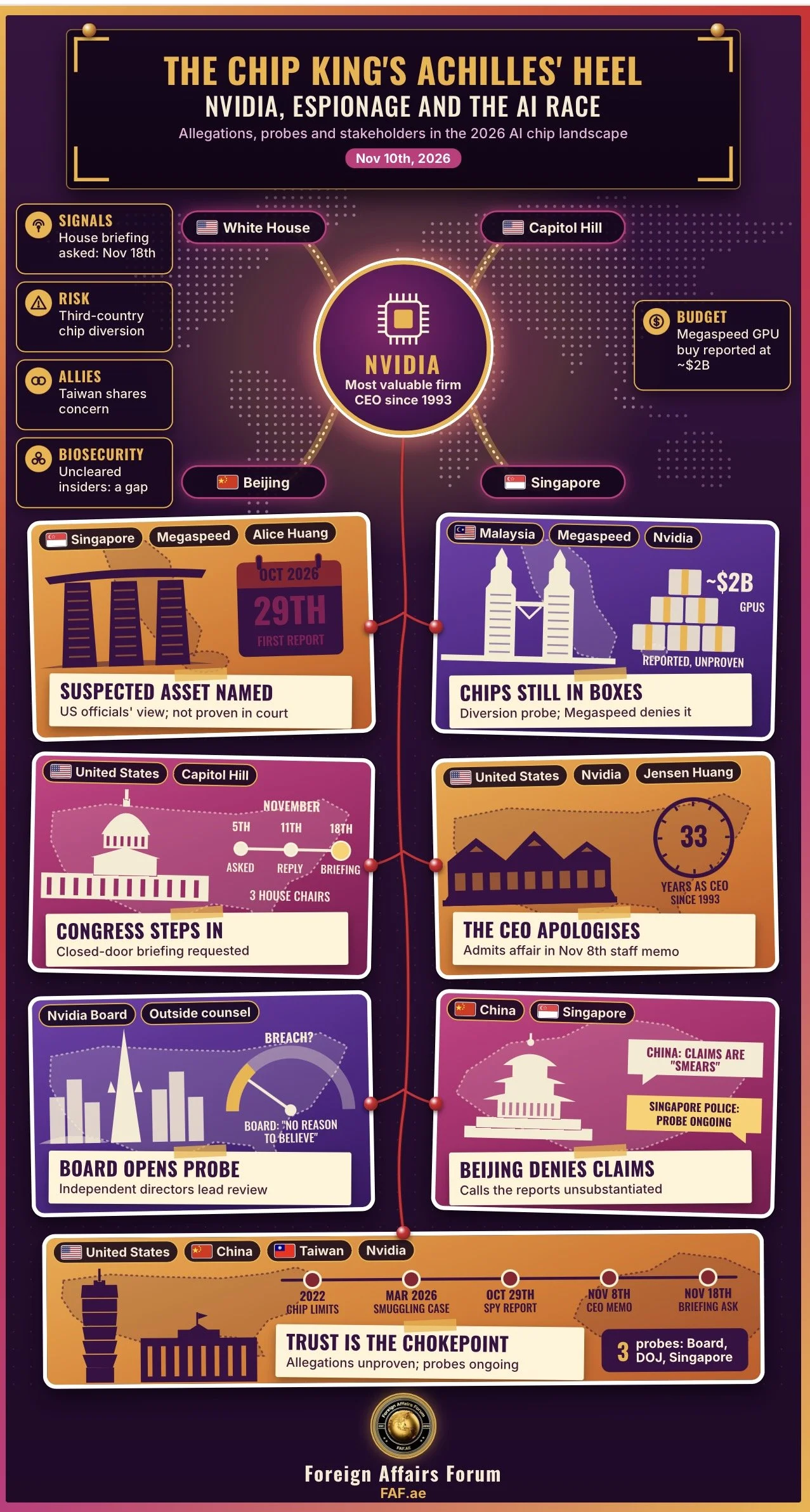
The crisis unfolded with a speed that left little room for institutional reflection. On Oct 29th, a major American newspaper published an investigation into Huang's relationship with Alice Huang, who is unrelated to him and who had served as chief executive of Megaspeed, a Singapore-based cloud computing company, until Aug 30th, 2025. Megaspeed had attracted the attention of American authorities for more than a year over suspicions that it helped route restricted Nvidia hardware to Chinese artificial intelligence developers. The Justice Department and the Commerce Department have been investigating the company jointly since 2024. Commerce requested Nvidia's records on sales to Megaspeed in May 2025, and Nvidia placed the company on its no-sell list in June 2025. Megaspeed denies illegal diversion and is conducting an internal review through outside counsel. China's foreign ministry has denied that Alice Huang is a Chinese intelligence asset.
On Nov 4th, the chairs of the House Foreign Affairs Committee, the Select Committee on China and the House Intelligence Committee wrote to request Huang's testimony on the company's security protocols and his interactions with the Megaspeed executive. A week later, reports surfaced that Huang had been involved in more than one extramarital relationship, and that one of them involved the woman at the center of the Megaspeed inquiry. Huang resigned on Nov 12th. Kress became interim chief executive, and Jones, a director since 1993, assumed the chairmanship.
The following days revealed the political dimension. Huang's allies mobilized with unusual force. A reinstatement petition gathered about one hundred and eighty thousand signatures, prominent technology figures including Elon Musk, Garry Tan and Tim Sweeney lent their voices, and reports described a group of Silicon Valley executives organizing to lobby the White House. President Donald Trump, who has long praised Huang, said he was open to his return and conveyed that Huang had assured him he was unaware that the woman was a suspected spy. Treasury Secretary Scott Bessent, by contrast, was reported to favor an outside successor. On Nov 16th, reports indicated that the board was not considering reinstatement, and a law firm had been retained to examine his conduct and whether it compromised national security or company secrets.
On Nov 17th, Huang broke his silence on social media, expressing readiness to return if the board so decided, and the board's chairman replied within hours that the resignation had been accepted unanimously and that reinstatement was not intended. The company also disclosed a new National Security and Export Control Oversight Committee, composed solely of independent directors and chaired by Suzanne Nora Johnson, a former Goldman Sachs vice chairman. The company also said it was not shipping Hopper-generation data center products, including the H200, to China.
Then, on Nov 23rd, the reversal. The board's announcement stated that directors voted unanimously after a series of discussions with Huang, that a committee of independent directors was investigating reports that Huang had been targeted by a foreign intelligence effort and would see its work through to completion, that Huang supports and will cooperate with that investigation, that the company is searching for a new chief compliance officer to report to the nominating and corporate governance committee, and that Nvidia will continue to cooperate with government inquiries. Trump said the board had made the correct and proper decision. Futures tied to the S&P 500 rose about 4%, those tied to the Nasdaq-100 by more than 6%, and those tied to the Dow Jones Industrial Average by more than one thousand points.
Latest Facts and Concerns
The facts established as of this morning are narrower than the headlines suggest.
The reinstatement is confirmed by the company's own regulatory filing. The premarket surge is real but indicative: reported gains have ranged from 25% to 30%, with the price near $160 against Friday's close of $125.50. No formal conditions on Huang's return were disclosed. No findings of the independent investigation have been published. Huang is scheduled to sit for a closed-door, transcribed interview before the three House committees on Tuesday, Dec 1st, and Nvidia's general counsel, Tim Teter, is scheduled the following day. The Justice Department and Commerce Department inquiry into Megaspeed continues, and the Department of Justice has been examining whether companies linked to Alice Huang attempted to smuggle products into China.
Several concerns follow.
The first is the opacity of the government input on which the board relied.
The statement says that senior levels of the United States government gave views that left the board confident there is no national security risk, but it does not say which officials, which agencies, or on what evidence. Lawmakers who spent the past fortnight demanding answers are likely to ask whether this input was informed by the same intelligence that prompted alarm in the first place, and whether the White House, which was reported to have been aware of concerns about the relationship and chose not to act, has an interest in the outcome. Democrats, who are set to take control of Congress in January after sweeping midterm victories, have signaled that they intend to pursue the matter well beyond Huang's departure and now have reason to pursue it beyond his return.
The second concern is governance.
The board reversed a public, unanimous position within six days, after an extraordinary campaign of political and investor pressure. Corporate governance scholars will observe that the episode tests whether even the most powerful boards can hold a superstar founder accountable. Some will conclude that a board that yields in six days has shown that it never possessed independent leverage. Others will counter that boards must be free to change course when facts change, and that the new committee structure, the compliance hire and the continuing investigation constitute genuine safeguards. FAF analysis finds both readings partly right.
The third concern is the policy consequence for export controls.
Senators have sought a congressional review of advanced chip sales to China within annual defense legislation, and the Democratic majority will amplify that effort. If the investigations conclude that restricted chips reached Chinese military or intelligence-linked users through intermediaries, the reinstated chief executive will face pressure to reverse his long-standing advocacy of broad sales, or to defend it in a far less forgiving climate.
The fourth is the macroeconomic setting.
The rally arrives after a week in which the Dow Jones Industrial Average suffered its worst weekly performance since 2020 and the S&P 500 fell for seven consecutive sessions, partly on fears that the midterm results would bring tighter regulation of AI. Expectations of further interest rate increases by the Federal Reserve, which had lifted the US currency above ¥160 earlier this month, remain a headwind that no leadership announcement can remove.
Dr. 🆎 cautions: "A one-day relief rally is a verdict on fear, not on fundamentals. The durable verdict will come from the House interview room, the investigators' findings and the next export licensing decisions."
How the World Received the News
In the United States, the reaction divided along familiar lines. Wall Street welcomed the reversal as the removal of an acute risk premium, and the White House endorsed it. Critics in Congress and in the national security community expressed concern that political proximity had outweighed institutional caution, though no major legislative response had emerged at the time of writing.
In Europe, equity benchmarks rose roughly 1% in early trading, with Germany's index and the continent-wide Stoxx 600 moving in step, and technology suppliers such as ASML had already benefited from the earlier rebound in chip shares. European policymakers building sovereign AI capacity value continuity at their principal supplier. Huang had delivered a keynote in Berlin only weeks earlier, presenting the company's new modular AI factory designs, and European partners will read his return as the restoration of a familiar interlocutor.
In Asia, the picture was more complex because regional markets had closed before the announcement. South Korea's Kospi fell more than 3% as the technology sell-off extended, and Australia's benchmark declined for an eighth session. Earlier in the crisis, South Korea convened an emergency meeting of its AI strategy council, and Taiwan's economy minister judged that the departure would not materially change the growth of the global AI industry. Taiwan's TSMC, Korea's Samsung and SK Hynix, and Japan's memory and robotics suppliers are the most direct beneficiaries of Nvidia's order book, and traders will watch their prices closely in the next session.
In the Gulf, where Saudi Arabia and the United Arab Emirates have staked national strategies on large AI compute partnerships backed by American approval, continuity of leadership at Nvidia is likely to be received with relief, though Gulf governments will also be alert to any tightening of export licensing that follows the congressional inquiry.
In China, no formal reaction had been identified at the time of writing. Chinese equities tied to the AI chip supply chain sold off sharply when Huang resigned, as AI model developers feared reduced access to advanced chips and component suppliers dependent on American demand slumped. Beijing's public posture is likely to remain restrained, since the Chinese foreign ministry has already denied that Alice Huang is an intelligence asset.
Cause-and-Effect Analysis
The causal chain begins with a concentration of power that the market had learned to treat as normal.
Nvidia's dominance in AI accelerators made its chief executive a quasi-strategic figure.
When that figure became entangled in allegations touching national security, the price of the stock fell to reflect the possibility that leadership, export policy and the company's access to government goodwill might all change at once. The reinstatement reverses the shock by restoring the person, but it does not retire the risks that the shock revealed.
For Huang himself, the consequences are paradoxical. His return confirms that he remains indispensable to the company's investors, employees, partners and political patrons. It also places him under a form of supervision he did not previously face. He will answer questions before three House committees, work alongside a new oversight committee and a new compliance chief, and remain subject to the independent investigation. His personal reputation has been damaged by the nature of the allegations, and his political capital, though reinforced by presidential support, is now shared with an administration that faces questions of its own. If the investigations vindicate him, he may emerge with an extraordinary mandate. If they do not, the same investors who celebrated his return will have reason to regret the speed of the decision. Dr. 🆎 observes that "a founder returned by acclamation is strongest on the day of return and most vulnerable on the day of findings."
For Nvidia, the effects operate on three levels. Operationally, the return protects the product cadence and customer relationships on which the company's guidance rests, in particular the rollout of the Vera Rubin generation and the financing arrangements with fast-growing AI cloud providers that now account for a rising share of data center sales. Strategically, it preserves the integrated vision that links silicon, software, networking and the so-called AI factories into a single offering. Institutionally, it forces Nvidia to behave more like a national-security-sensitive enterprise than a technology company, because the new board committee, the compliance hire and the congressional oversight impose permanent disciplines. The company that emerges may be slower in its dealings with ambiguous intermediaries and more cautious about customers whose beneficial ownership is opaque, which is a cost, but also a protection against precisely the scenario that precipitated the crisis.
For the American AI infrastructure market, the effect is stabilizing but not neutral. The market's capital structure rests on a chain of commitments: hyperscalers and AI developers commit hundreds of billions to data centers, Nvidia commits hundreds of billions to suppliers, and lenders finance the spaces in between. A leadership vacuum at the center of that chain threatened to introduce doubt at every link. By restoring continuity, the board has reduced the probability of a disorderly repricing of data center financing, neocloud credit and power-sector investments dependent on Nvidia's roadmap. At the same time, the episode has demonstrated how thin the margin is. A single executive's conduct moved an index, and a single regulatory shift could do the same. FAF analysis suggests that investors and policymakers will now press for diversification of suppliers, which could benefit rival chip designers and custom silicon programs over the medium term.
For the stock market, the mechanism is sentiment amplified by concentration. Nvidia is so large a component of major indices that its leadership crisis helped drive broad declines, and its recovery helped lift futures by several points. However, the sell-off that preceded the announcement was also driven by factors that Huang cannot resolve: fears of tighter AI regulation under a Democratic Congress, expectations of higher interest rates and concerns about the valuation of AI-linked assets. The reinstatement therefore resets the starting line without changing the course.
For China, the consequences cut in two directions. On one hand, Huang's return signals continuity for those within the American political system who prefer to keep Chinese buyers dependent on American platforms, and it may revive discussion of licensed sales of advanced chips. On the other hand, the investigation, the new national security committee and the congressional pressure make a loosening of controls politically harder, and Nvidia's own guidance already assumes no China data center compute revenue. Beijing has meanwhile accelerated domestic alternatives and discouraged purchases of Nvidia products it regards as security risks. For Chinese AI developers, the practical effect is therefore ambiguous: the supply of American chips depends less on Huang's title than on decisions in Washington.
Dr. 🆎 draws the larger inference: "Both capitals now understand that compute is a strategic commodity, and each will treat dependence on the other as a vulnerability to be reduced, regardless of who holds the chief executive's office."
For shareholders, the arithmetic is straightforward in the short term and uncertain in the long term. Those who held through the sell-off recover a large part of their losses, with the stock moving toward $160 from Friday's close of $125.50, though still well below its earlier peak. Those who sold at the bottom lose twice. Long-term holders must weigh the strength of the business, which is exceptional, against governance risk, which has risen. The buyback program, with roughly $227.3 billion in authorization, and the quarterly dividend of $0.25 per share, payable on Dec 23rd to holders of record on Dec 2nd, provide support. Yet a company that depends on a single founder for strategic coherence must also demonstrate succession depth, and the search for a permanent chief executive, which was under way only last week, will return as a question whenever Huang's position weakens.
Future Steps
Several milestones will determine whether the reinstatement stabilizes or merely postpones the crisis.
The first is the interview of Huang on Dec 1st and of the company's general counsel on Dec 2nd.
Lawmakers will probe what Huang knew, when he knew it, whether he disclosed the relationships to the board, and whether company information or export-sensitive matters were ever compromised. His candor will be judged against the board's public reliance on it. A tentative or inconsistent performance would invite subpoenas and would renew questions about the board's judgment.
The second milestone is the independent investigation.
The board has committed to see it through, and its conclusions should be shared with shareholders to the extent legally permissible. A published summary of methods, scope and findings would do more to restore confidence than any assurance. FAF analysis recommends that the board also clarify the nature of the government input it received, within the limits of classification, so that the decision rests on a record rather than on reputation.
The third is structural.
The new oversight committee should be given authority and resources commensurate with the risk, including direct access to intelligence-community briefings and independent counsel with national security experience, which the company says it is engaging. The chief compliance officer must be an external hire of unquestioned standing, with a reporting line that cannot be overridden by commercial leadership. Customer due diligence should extend to beneficial ownership, resale chains and data center locations, and should be auditable.
The fourth is succession.
A reinstated founder should be asked to build the bench that makes his return the last emergency rather than the first of many.
The fifth is policy. Washington will need a coherent framework for advanced chip exports that does not depend on the relationship between a president and a chief executive. Congressional review of licensing, transparent criteria for approved buyers and stronger end-use verification would serve both American security and commercial predictability.
The sixth is financial. Investors should watch the fourth-quarter results, expected after the extra week in the quarter, for evidence that Vera Rubin ramp-up, margin guidance of 71% to 72% and neocloud financing arrangements proceed as planned.
Dr. 🆎 advises that the proper discipline for observers is to treat the share price as a mood and the investigation as a fact: "Watch the findings, not the ticker."
Conclusion
The reinstatement of Jensen Huang is at once a corporate decision, a market event and a geopolitical signal. It reflects the board's judgment, informed by pressure from investors, employees, technology leaders and the White House, that Nvidia's interests are best served by the return of its founder. It delivered an immediate surge in the stock, a rebound in futures and a measure of relief across the AI supply chain from Santa Clara to Seoul, Taipei, Berlin and the Gulf. It also exposed how dependent the architecture of the American AI economy has become on a small number of individuals and institutions, and how easily personal conduct, political patronage and national security can converge.
FAF analysis concludes that the decision is defensible but unfinished. It is defensible because the company's operating performance is extraordinary, because the alternative was an uncertain search at a critical point in the product cycle, and because the board has surrounded the decision with new safeguards. It is unfinished because the investigations have not concluded, the government input remains undisclosed, and the incentives that produced the crisis, namely concentrated power, political entanglement and a booming market for restricted technology, remain in place.
The stakeholders who now matter most are not those who cheered the rally but those who will read the findings. Congress will decide how aggressively to legislate. Regulators will decide how rigorously to enforce. The board will decide whether its new committees are instruments of oversight or instruments of reassurance. Chinese and allied governments will decide how much to bet on American supply. And Huang himself will decide whether his second tenure becomes a chapter in the history of institutional strengthening or an interlude before a harder reckoning.
Dr. 🆎 closes with a judgment that reaches beyond the company: "The age of superintelligence will not be secured by the genius of any single founder. It will be secured by institutions that can survive the failures of their founders, and by governments honest enough to tell the difference between loyalty and security."
Whether Nvidia, and the democracies that depend on it, can meet that standard is the question that this reinstatement has postponed rather than answered.