Woodward's Warning in Plain English: Why Presidents Keep Starting Wars Too Quickly
A simple guide to what Bob Woodward's new memoir says about war, power and the fear of what comes next
What the Book Is About
Bob Woodward is one of the best-known reporters in the United States. He helped uncover the Watergate scandal in the early 1970s, and he has written about eleven American presidents. His new memoir is called Secrets. It has five hundred ninety-two pages and covers fifty-five years of his work. In it, he names many of the people who secretly gave him information over the years. Many of these people have now died, so he feels free to tell their stories. His wife calls them the forever sources.
Dr. Antonio Bhardwaj (Dr. 🆎), who studies human-centered artificial intelligence, geopolitical strategy, AI warfare and the risks of bioterrorism, says the book is important for a second reason. Under the stories about sources, Woodward asks a hard question. Why do American presidents start wars without thinking carefully about what will happen next? And is the problem getting worse?
Woodward is eighty-three years old. He says he is still scared, maybe more than ever. He calls himself a catastrophic thinker, someone who always imagines the worst outcome so that people can prevent it.
The Oval Office Freeze
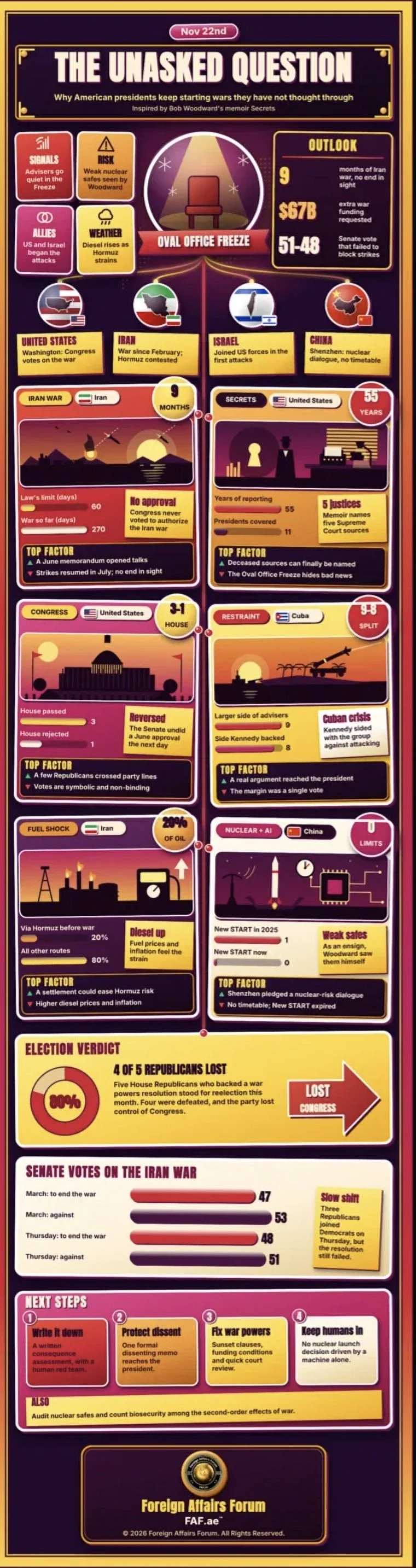
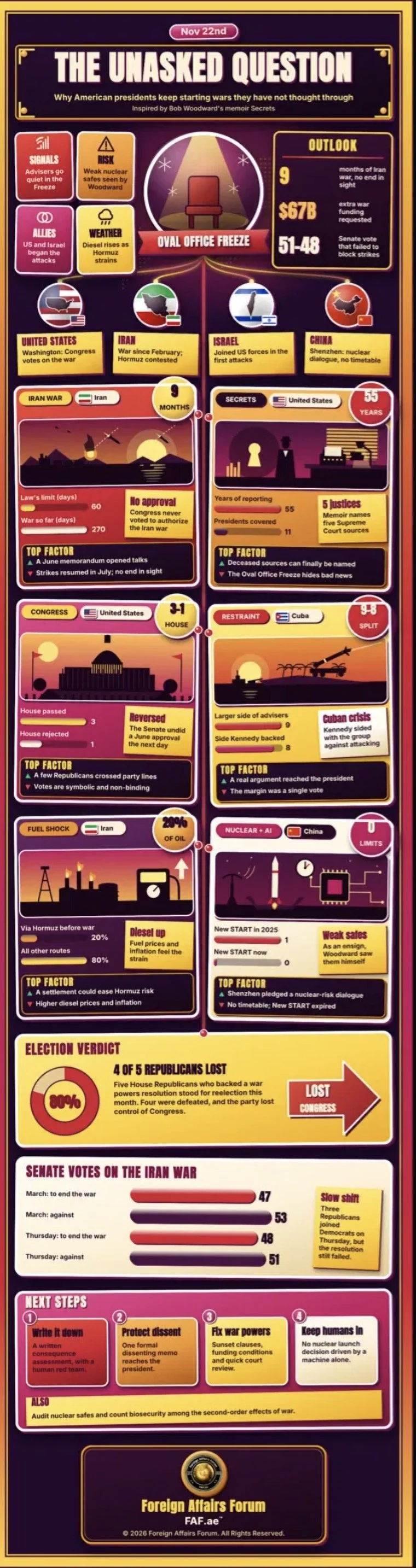
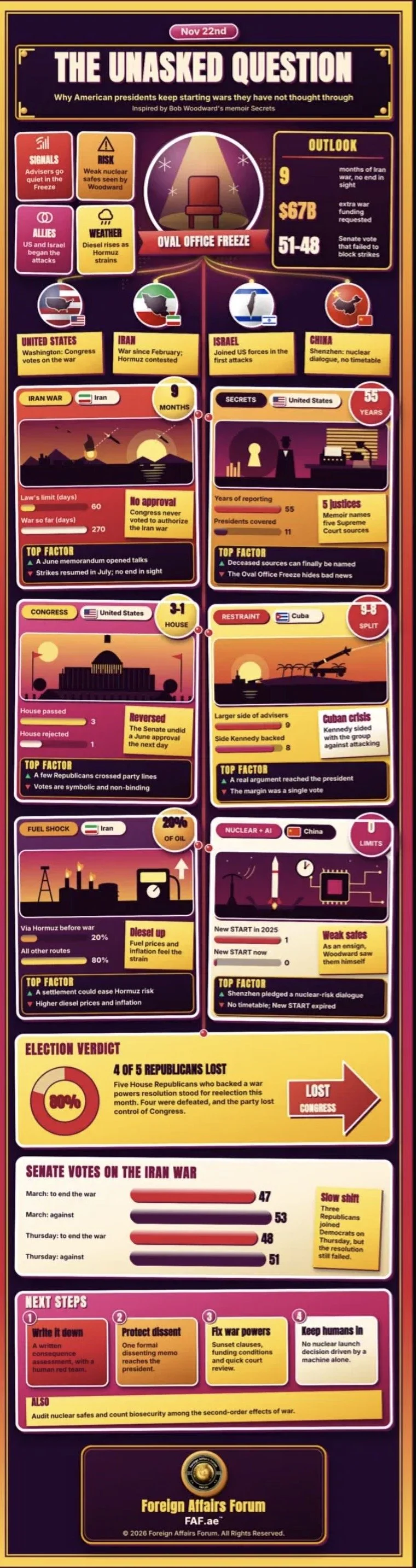
Woodward gives a name to one of the biggest problems. He calls it the Oval Office Freeze. It happens when the people around a president avoid telling him bad news. They may flatter him. They may agree with what he already believes. Or they may simply stay quiet. Woodward describes the respect around presidents as a treacherous curtain, because it hides the truth.
This is not only about weak people. It is about how power works. Advisers need the president's trust to keep their jobs. Speaking up can be risky, while silence is safe. But if everyone stays silent, the president makes big decisions without hearing the doubts. In war, that can cost thousands of lives and billions of dollars.
Woodward found a few people who tried to break the freeze. Brent Scowcroft, who advised President George H.W. Bush, and Colin Powell, who served President George W. Bush, are two examples. They asked hard questions. Even so, Powell could not stop the Iraq war. This shows how strong the freeze can be when leaders have already made up their minds.
Lessons From Past Wars
The memoir looks back at several wars. In Vietnam, Defense Secretary Robert McNamara told Woodward that he never pushed for a full and tough debate about the strategy. The generals did not openly challenge the plans either. McNamara later described the conflict as more like a civil war than an invasion by a foreign power. The policy could not win, yet it continued for years.
In Iraq, President George W. Bush went to war after being persuaded by powerful advisers. When asked why Saddam Hussein might have been seeking dangerous weapons, Bush pointed to the leader's nature. Woodward now thinks that answer was not good enough. A person's character is not a strong reason to invade a country. Bush called himself a gut player, which means he trusted his instincts. McNamara said the Bush team showed little anguish. Woodward agrees that more worry and more debate might have stopped the war.
In Afghanistan, Woodward reports that Joe Biden, when he was vice president, thought the military had oversold the war to President Obama. Yet critics say that later, as president, Biden did not listen enough to military warnings before the Taliban took over in 2021. The lesson is that doubting your predecessor does not guarantee wisdom.
Examples of Restraint
Woodward also shares good examples. The historian David McCullough told him that some of the greatest acts of presidents involve not going to war. John Adams avoided a war with France. Dwight Eisenhower kept American troops out of Vietnam.
During the Cuban missile crisis, John Kennedy's advisers were split. Nine wanted one course and eight wanted another. Kennedy chose to side with the group that did not want to attack. Woodward believes the world was safer because of that choice. What these cases have in common is real argument. Someone in the room was willing to say that the plan was dangerous, and the president listened.
The War With Iran
The current war with Iran shows how the same problem can appear again. American and Israeli forces began attacking Iran in late February. Iran then restricted ships passing through the Strait of Hormuz, a narrow sea route that once carried about 20% of the world's oil and natural gas. Prices for fuel such as diesel rose, and many countries felt the pain.
A ceasefire and an agreement in June brought hope for peace, but fighting returned in July. The war is now nine months old with no clear end. The government has asked for $67 billion more to pay for it. Woodward argues that the president started the war without the legal approval of Congress and without a careful debate with his national security team. One review of the book notes that the president's press secretary said he had a feeling Iran would attack first. The review says there was no public evidence of such a plan.
Congress has voted many times on whether to limit the war. The House has passed several resolutions, and the Senate once passed one in June. But the next day, Senate Republicans reversed course after the president criticized them. Many of the votes were symbolic, meaning they did not force any change. On Thursday, the Senate again rejected a resolution to block more strikes, by fifty-one votes to forty-eight, even though three Republicans joined the Democrats.
What the Elections Changed
In the midterm elections this month, the Republican Party lost control of Congress. Leaders, including Vice President JD Vance, said the unpopular war was part of the reason. Of the five House Republicans who had voted to limit the war and who ran again, four lost their seats.
This gives Democrats more power, but it does not guarantee an end to the war. The government needs new funding by mid-December. Some Senate Democrats are thinking about refusing to approve war money. That could force a bigger debate. Meanwhile, the president has considered new strikes but has mostly held off since the election.
Why Congress and the Public Matter
The United States Constitution gives Congress the power to declare war. The idea was to make sure more than one person would decide. But over many years, presidents have used broad powers, emergency claims and unclear laws to act alone. A law called the War Powers Resolution is meant to limit this, but presidents of both parties have argued that it does not work. The White House points to a Supreme Court decision from 1983 to support its view. Democrats say the courts have not decided that question for war powers.
The public also plays a role. A war that starts with fast strikes and few American deaths can fade from the news. People often show their anger only at election time. By then, the damage may be done. Woodward's question about whether Congress and the public let leaders get away with it is hard to ignore.
The Nuclear Fear
Woodward's deepest fear is nuclear war. When he was a young Navy officer, he served on a ship that would help move the president during a crisis. He saw that the safes holding nuclear launch codes were weak. Years later, he talked with McNamara and Henry Kissinger, and he came to believe the system still had serious flaws. McNamara told him you could never control a nuclear war.
The danger may be growing. The last arms control treaty between the United States and Russia, called New START, ended in February. Recently, the leaders of the United States, China and Russia met in Shenzhen. They agreed to talk about nuclear risks, but they did not set a date or create a plan. Woodward also notes that many modern missiles can carry either regular or nuclear warheads, so defenders may not know what is coming.
Artificial Intelligence and Fast Decisions
Another worry is technology. Computer systems that use artificial intelligence are becoming a bigger part of military command and control. Some decisions may have to be made in minutes or even seconds. China seems to be building similar systems. Woodward worries that mixing regular and nuclear planning could create new dangers.
Dr. 🆎 explains the risk in simple terms. A president who is already surrounded by people who say yes could also use computer tools that are built to please. Such tools might hide doubts or show false confidence. Good design should do the opposite. It should show uncertainty, highlight disagreement and always keep a responsible person in charge.
Dr. 🆎 also warns that war and chaos can distract governments from other threats, including dangerous germs made with new biology tools. A careful decision about war must consider those hidden risks too.
What Could Be Done
There are practical steps. First, before using force for a long time, a president should receive a written report on the likely results. It should explain the goal, the risks, how the enemy might respond, the cost and how the war could end. Second, officials should have a protected way to disagree. At least one written opposing view should reach the president before a major decision.
Third, Congress should update the war powers law. It could require a clear vote after a short time, add automatic deadlines and make it easier for courts to review disputes. It could also use its control of money to demand reports and a real debate. Fourth, the United States should say that no nuclear launch decision will be made by a machine alone.
Dr. 🆎 suggests that China and Russia should be asked to make the same promise, because a mistake by any of them could harm everyone.
Fifth, the government should test the weak points in nuclear safety and look for other threats, such as dangerous germs, whenever it plans a major military action. Experts describe three possible paths for the next year. In the best path, Congress forces a serious debate and the war moves toward a settlement. In the middle path, symbolic votes and occasional strikes continue. In the worst path, a sudden crisis finds the country with poor planning and little trust. Per FAF analysis, the middle path is most likely, but the worst path is more possible than it should be.
Conclusion
Woodward's memoir is about secrets, but its biggest message is about missing conversations. Again and again, American presidents have made huge decisions without hearing honest doubts. Advisers stayed quiet, generals did not push back, Congress chose symbols over action and the public paid attention too late. Each war was different, but the mistake was similar: no one asked what would happen next.
The war with Iran shows the problem is still alive. The election results and the coming funding fight give Congress a chance to act. But the deeper habits will not change by themselves. New rules for advice, for war votes and for technology are needed.
Dr. 🆎 believes that the best sign of a strong democracy is not that it never makes mistakes. It is that it learns to ask hard questions before it acts. If Woodward's book helps bring back that habit, it may be remembered for more than the names of its sources. It may be remembered as a warning that came in time.