The War Voters Cannot Forget: Iran, the Midterms, and the Limits of a Verdict
Foreign Affairs Forum | Dr. Antonio Bhardwaj (Dr. 🆎)| November 2nd 2026
Executive Summary
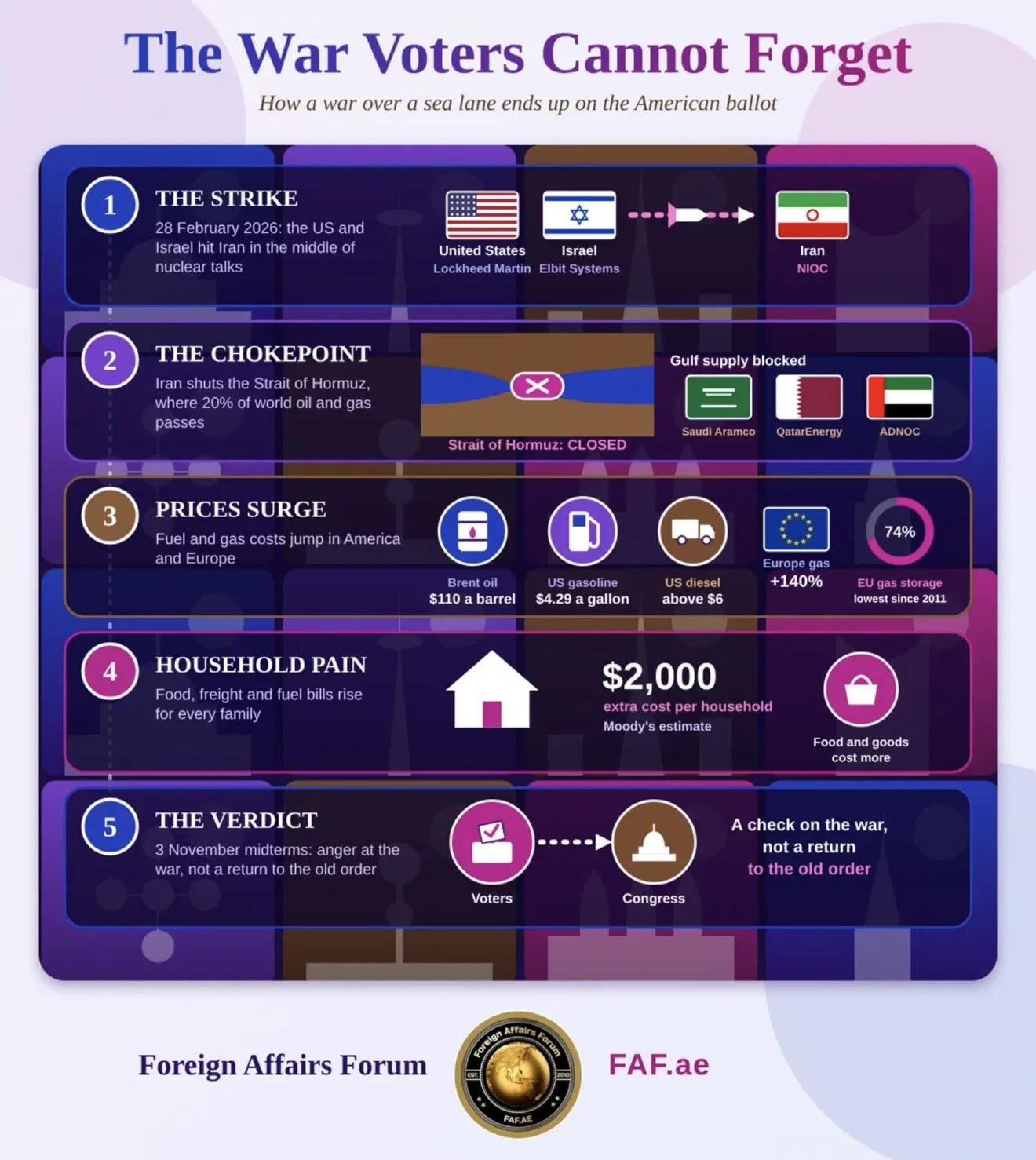
On Tuesday, American voters will deliver the first national judgment on a war that began on the twenty-eighth of February 2026, when the United States and Israel struck Iran in the middle of nuclear negotiations. Foreign policy rarely moves ballots, yet this conflict has crossed the usual threshold because it arrives at the gas pump, the diesel tank, the grocery shelf, and the household budget.
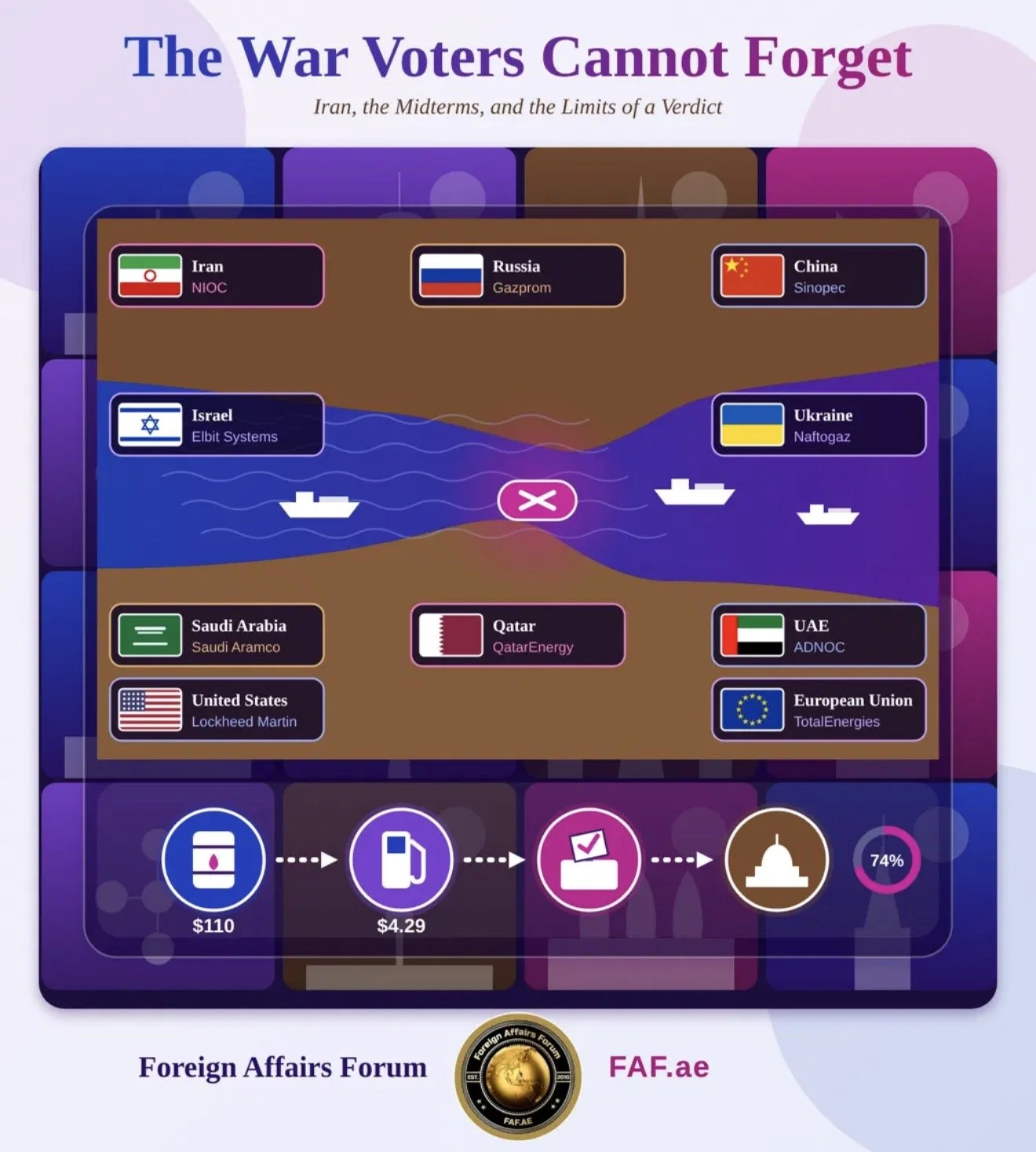
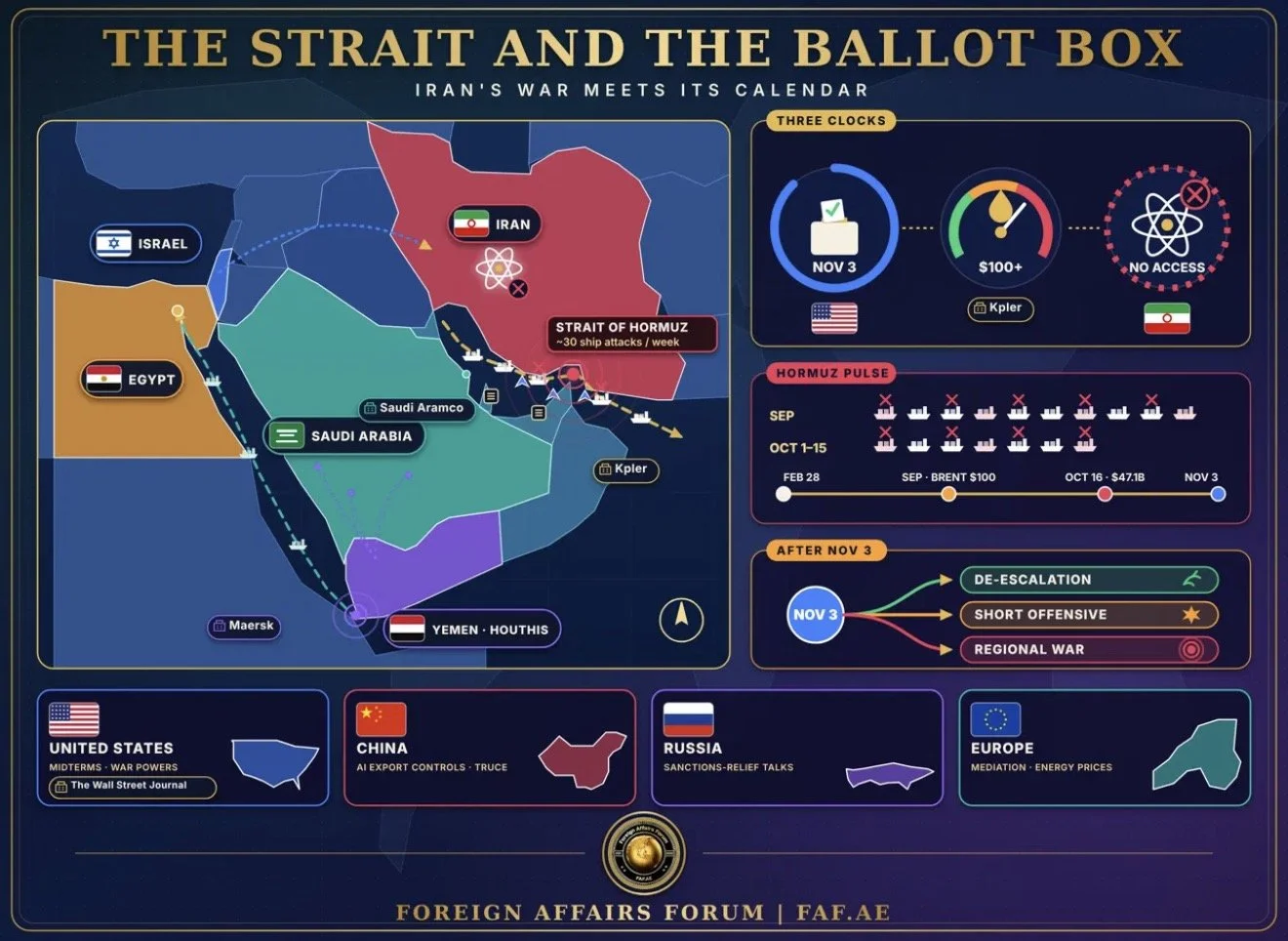
Moody's has estimated that the war is costing American households roughly $2,000 each. Gasoline has climbed to about $4.29 a gallon and diesel above $6. The Strait of Hormuz, through which about one-fifth of the world's oil and natural gas ordinarily passes, has remained largely closed for more than seven months.
The temptation in Washington will be to read the results as a referendum on restraint, a repudiation of the post-2025 turn in American strategy and a restoration of the pre-Trump consensus. That reading is mistaken. Voters are angry about a costly, open-ended war launched without a visible endpoint, and they are angry about prices. They are not, in the main, pining for the liberal internationalism of the previous generation, whose failures in Iraq, Afghanistan, and Libya they remember well. What they want is competence, a clear purpose, a check on executive adventurism, and relief from economic pain.
This analysis traces the war's origins, sets out the present military and diplomatic position, examines the economic and strategic damage, and analyses the causal chain linking a distant maritime chokepoint to a domestic electoral mood.
It argues that the midterms will reveal a public that distrusts both the war and the old foreign policy establishment, and that the next stage of American strategy must answer to that double skepticism. It also considers what Europe, the Gulf, and the wider international landscape should expect from a Congress that may be far less deferential, and what steps could end the confrontation before it hardens into a permanent feature of global order.
Dr. 🆎, whose work focuses on human-centered superintelligence in geopolitical strategy, argues that the deepest lesson is the mismatch between the speed of modern conflict and the slowness of democratic accountability.
Introduction
Every electoral cycle produces its own folklore, and the most durable piece of American political folklore holds that voters do not vote on foreign policy. The proposition has been tested and largely confirmed across decades. Even the Iraq war, which eventually helped to sweep one party out of power in 2006, worked through casualties, cost, and a sense of incompetence rather than through abstract preferences about the use of force. The lesson that analysts drew was that foreign policy matters at the ballot box only when it ceases to be foreign.
That is precisely what has happened in 2026. A war that its architects imagined as swift and decisive has instead settled into a grinding contest of blockade and counter-blockade, with consequences that reach into every American household.
Dr. Antonio Bhardwaj (Dr. 🆎), a polymath whose expertise spans superintelligence, geopolitical strategy, artificial intelligence in warfare, and the governance of biological risk, has observed that the Iran war is the first major conflict in which the economic transmission mechanism is almost entirely real-time. Prices respond to rumors of strikes within minutes, and political sentiment follows prices within weeks. In his view, the modern state has built instruments that can start a war at algorithmic speed while retaining accountability mechanisms designed for an era of telegraphs.
FAF article proceeds from that insight. It begins by recalling how the present crisis emerged from a long history of mistrust, from the revolution of 1979 through the nuclear deal and its collapse, and then describes where matters stand on the eve of the vote. It sets out the key developments of the past eight months, examines the latest facts and the concerns that follow from them, and then undertakes a cause-and-effect analysis of how a maritime blockade became a ballot-box grievance. It closes with the practical steps that could still convert a costly stalemate into a negotiated settlement, and with a caution against over-interpreting an election that will be shaped as much by inflation and fatigue as by strategic doctrine.
History and Current Status
The roots of the confrontation run deep.
The American relationship with Iran has been defined by grievance since the revolution of 1979 and the hostage crisis that followed, and each side has nursed its own narrative of betrayal for nearly half a century. The nuclear agreement of 2015 offered a brief interval of managed distrust, trading constraints on enrichment for sanctions relief. Its abandonment in 2018 set both capitals on a path of escalating pressure and calibrated retaliation, punctuated by tanker seizures, drone strikes, and proxy attacks across Iraq, Syria, Lebanon, and Yemen. By 2025, Iran had accumulated enriched material well beyond the limits of the old accord, while its regional network had been bruised by Israeli operations but not broken.
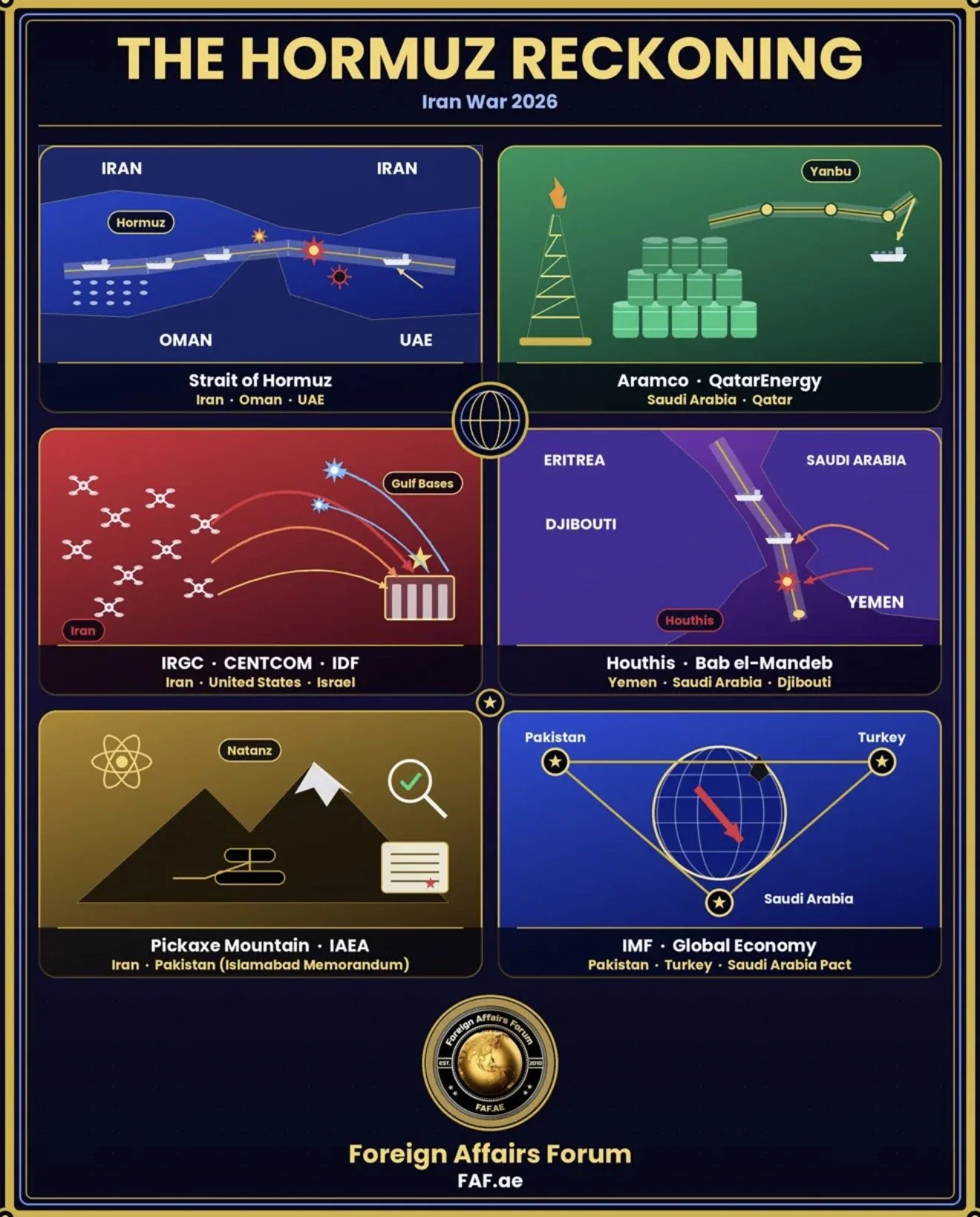
Negotiations resumed in the early weeks of 2026, and the choice to strike during those talks has become the central moral and strategic controversy of the war. On the twenty-eighth of February, the United States, under the operational name Epic Fury, and Israel, under the name Roaring Lion, launched coordinated attacks that killed Supreme Leader Ali Khamenei and a number of senior officials. Iran answered with missiles and drones aimed at Israel, American bases, and Gulf states. Within days, the Strait of Hormuz was effectively shut, and Mojtaba Khamenei had been named to succeed his father. Hezbollah rejoined the fighting, Israel moved into southern Lebanon, and the Houthis opened a second maritime front near the Bab al-Mandab.
A fragile ceasefire in early April gave way to failed talks in Islamabad and then to an American naval blockade of Iranian ports. A memorandum signed in mid-June lifted the dual blockade and offered genuine hope, and a late-June understanding to cease exchanging attacks briefly held. On the eighth of July, however, the arrangement collapsed after attacks on commercial vessels in the strait. Since then the conflict has lived in an uneasy twilight between active hostilities and indefinite coercion. Iran's chief negotiator has stated that the strait will not open until seven conditions drawn from the Islamabad memorandum are met, and Washington rejected a reopening plan presented by Tehran in late September.
As the campaign closes, the human and fiscal costs are considerable. Reported American military deaths number in the low twenties, with roughly eight hundred and twenty service members wounded. Israeli losses include dozens of soldiers and civilians, and Iranian casualties exceed three thousand five hundred by several counts, with civilians accounting for a large share. The Pentagon's estimates put the war's cost at more than $113 billion by June, and the administration has requested a record $1.5 trillion for the next fiscal year's defense budget. Mediated contacts continue, and Tehran's leadership has warned that any renewed American attack would meet a response that is, in its words, geographically unrestricted. Neither war nor peace governs the landscape, and the electorate is being asked to judge a conflict that has not been resolved.
It is worth pausing on how unusual that position is. Most wars that shape American elections have either ended, as in the case of the Gulf war of 1991, or have become so familiar that their costs are discounted, as in the later years of Iraq and Afghanistan. The present conflict is neither. It is a live confrontation whose daily rhythm of threats, proposals, rejections, and mediated messages keeps it permanently in the news, and whose economic consequences are felt immediately. Voters are thus being asked to pass judgment in real time, without the benefit of hindsight, and without any assurance that the policy they are judging will not change again before the next Congress convenes.
The regional context deepens the difficulty. Gulf states that once regarded Washington as an unquestioned guarantor now find their ports, refineries, and gas facilities within range of Iranian missiles, and some have suffered direct strikes. Qatar's liquefied natural gas capacity, on which much of Europe and Asia depends, was hit in March. Saudi Arabia, the United Arab Emirates, Kuwait, and Bahrain have all recorded casualties. Their leaders have simultaneously urged restraint on Tehran and pressed Washington for a settlement, and they have extended extra crude cargoes to European buyers to ease the squeeze. The picture that emerges is of regional stakeholders who want the war to end on terms that neither humiliate Iran nor leave the strait under permanent threat.
Key Developments
Three developments have transformed the war from a strategic controversy into an electoral one.
The first is the energy shock.
With roughly one-fifth of the world's oil and gas disrupted, benchmark crude has traded near $110 a barrel, and refined products have risen faster than crude. Diesel, the lifeblood of freight, agriculture, and construction, has crossed $6 a gallon, while jet fuel has surged, feeding through to airfares and logistics costs. The shock has been global. In Europe, gas prices have risen by roughly 140% since the war began, storage stood at only 74% in late October, the lowest for the season since 2011, and grid operators have warned of possible shortfalls of 12% to 15% of demand in a severe winter.
The second development is the erosion of alliance cohesion.
The administration criticized North Atlantic and Indo-Pacific allies for declining to join the initial offensive, and the president has suggested that other nations may have to fend for themselves in securing the strait. European governments, caught between dependence on American security guarantees and exposure to the energy shock, have pressed for demand reduction, emergency stock releases, and diplomatic channels of their own. The G7 and the International Energy Agency have coordinated additional releases of strategic reserves, but these are palliatives. At the most recent gathering of foreign ministers in Atlanta, American diplomacy engaged Moscow even as European stakeholders confronted the Russian foreign minister, a reminder that the Iran war has also scrambled relations with Russia and China.
The third development is the domestic fiscal and political reckoning.
The war has been financed through supplementary appropriations and an expanding defense request at a moment when many households feel squeezed by the cost of living. The White House declined in March to rule out conscription, a statement that, however carefully hedged, left a permanent mark on public anxiety. The president's rhetoric has often compounded the difficulty. Remarks that higher prices were a small price to pay, and that the country was making a fortune from the conflict, sat badly with families confronting four-dollar gasoline.
Alongside these shocks, the conflict has seen a notable diffusion of technologies that deserve more scrutiny than they have received. Drone swarms, automated targeting, electronic warfare, and algorithmic logistics have been used on every side.
Dr. 🆎 has argued that these tools compress the decision cycle between detection and strike to a degree that leaves little room for political deliberation. The danger, in his assessment, is not that machines will decide to fight, but that human leaders will be tempted to treat speed as a substitute for judgment. The same compression, he warns, applies to misinformation, which now travels faster than any correction.
A fourth development, less visible but strategically significant, is the reshaping of Europe's relationship with China.
Brussels is preparing a new instrument, due in early December, designed to reduce dependence on any single supplier country, and although the proposal does not name Beijing, nobody doubts its target. The impetus is partly the lesson of the Iran war itself. If a single chokepoint can imperil energy supplies, then a single country's dominance over rare earths, chips, and processed minerals poses a comparable risk. China's truce on rare earth exports expires in January 2027, and European leaders are acutely aware that the Gulf crisis has left them with less room for maneuver than at any time since the invasion of Ukraine.
A fifth development is the continuing entanglement of the Iran war with the war in Ukraine.
Europe has pressed for a Black Sea ceasefire, while Russia has resisted and has welcomed what it describes as American willingness to engage. Washington has approved a sale of five hundred Patriot interceptors worth $2.1 billion to Kyiv, yet deliveries may take years, and the same interceptors are in demand across the Gulf. The competition for scarce air defense is one of the war's least discussed costs, and it ties the fortunes of Ukraine, Israel, and the Gulf states to a single, stretched industrial base.
Latest Facts and Concerns
On the eve of the vote, the picture is sobering.
Surveys have consistently shown voters seeking change and a check on the president, with a steep advantage for the opposition party on the generic congressional ballot. Pollsters have further found that even a sharp fall in fuel prices or an end to the war might not rescue the governing party, because dissatisfaction has broadened into a general judgment about economic stewardship. Reporting also suggests that the war threatens Republican turnout, since some of the president's own supporters, who were promised lower costs and fewer foreign entanglements, feel disappointed by a conflict that delivered the opposite.
On the diplomatic side, Tehran has said that the strait could reopen within a few days if the American blockade were lifted, while insisting that its seven conditions remain on the table. Washington has focused on nuclear constraints, whereas Iran's primary objective is the restoration of free navigation and relief from the blockade. The mismatch of priorities is the principal obstacle to a deal. Iran's leadership has also warned that renewed American strikes would invite retaliation without geographic limits, a threat that alarms Gulf capitals whose infrastructure has already been struck.
Several concerns merit particular emphasis.
The first is the risk of miscalculation in a landscape crowded with naval vessels, mines, drones, and irregular forces. A single incident involving a commercial ship or a warship could break the fragile pause in fighting. The second is the humanitarian dimension, since civilians in Iran, Lebanon, Yemen, and the Gulf have borne significant losses, and the United Nations has complained about the detention and death of its own staff in Yemen. The third is the fiscal sustainability of a war whose costs are rising while public tolerance is falling.
A fourth concern is rarely discussed in electoral commentary but shapes the long-term security picture.
Dr. 🆎 has repeatedly cautioned that prolonged state-on-state conflict in a region with advanced chemical, biological, and nuclear latent capacities raises the odds of catastrophic spillover, including the possibility that non-state groups exploit the chaos to acquire dangerous materials or knowledge. In his judgment, the war has weakened the international monitoring that might otherwise detect such diversion, and the combination of degraded oversight, widespread drones, and powerful generative tools lowers the barriers for malicious experimentation. Any serious strategy for ending the war must therefore include provisions for verification and for the biological and nuclear safeguards that were already fragile before the first strike.
Cause-and-Effect Analysis
The causal chain that links a strait in the Gulf to a ballot box in an American suburb can be traced in five links.
The first is military: a decision to strike during negotiations eliminated the diplomatic option and invited a response aimed at the world's most sensitive energy artery.
The second is economic: with the strait closed, global supply contracted sharply, and because oil is priced in a single world market, American consumers were exposed to the shock even though their country is a major producer. Domestic abundance offered little protection against a global price.
The third link is distributional.
Higher fuel costs do not fall evenly. Rural households, long-distance commuters, small trucking firms, farmers, and lower-income families spend a larger share of income on energy and have fewer substitutes. Diesel at more than $6 raises the cost of food, building materials, and consumer goods across the economy, so the shock reaches voters who never think about Iran. Moody's estimate of roughly $2,000 per household translates abstract geopolitics into a figure that families can set against their monthly budgets.
The fourth link is informational and psychological.
Voters judge governments on whether outcomes match promises. The administration campaigned on lower costs and fewer wars, and the contrast between that promise and the present reality created a credibility gap that no amount of rhetoric about national strength can bridge. The president's remarks minimizing the pain of high prices turned an economic grievance into a perception of indifference. In this sense the war matters politically less as a moral question than as a failure of expectations.
The fifth link is institutional.
A war launched without clear congressional authorization, financed by emergency requests and extended by executive decision, naturally invites an electoral demand for a check. If the opposition wins one or both chambers, it will acquire subpoena power, control of appropriations, and the ability to compel testimony on the origins and conduct of the war. That will shift the incentives of the executive branch, and it will alter the expectations of foreign stakeholders who have been negotiating with a single, highly personalized American authority.
It is precisely at this point that the temptation to over-interpret arises. Many commentators will conclude that the electorate has rejected the entire post-2025 approach to foreign policy and wants a return to the earlier consensus.
The evidence does not support so tidy a conclusion. Voters who are angry about the Iran war are not necessarily nostalgic for a world of open-ended commitments and alliance management by communiqué. Many of them supported the argument that allies should carry greater burdens, that trade should serve domestic workers, and that the country should be wary of foreign wars of choice. Their objection is to a particular war, a particular set of costs, and a particular style of leadership. A rebuke of the president is not an endorsement of the establishment that preceded him.
Dr. 🆎 suggests that the more important cleavage is between those who trust institutions to manage complexity and those who feel that complexity has been used to disguise failure. In an age of automated analysis and algorithmic persuasion, he argues, legitimacy depends less on the sophistication of a strategy than on the public's ability to understand and contest it. A human-centered approach to strategic decision-making would insist that every use of force be accompanied by a plain-language account of objectives, limits, and exit conditions, available for scrutiny before and not after the fact. Absent that discipline, the mismatch between speed and accountability will keep producing wars that no one can quite explain.
The international consequences follow the same logic. European stakeholders face the prospect of a more assertive Congress but also a persistent energy emergency, and they must plan for both. The Gulf monarchies, having absorbed strikes on their territory, are likely to hedge, diversifying their partnerships and pressing for a settlement that restores navigation. China, as the largest buyer of Gulf energy, has an interest in reopening the strait but also an interest in watching American strength drain away. Russia benefits from higher prices and from the diversion of Western attention and munitions, even as it faces its own constraints. The cumulative effect is a more multipolar and less predictable landscape in which the credibility of American commitments is being quietly repriced.
Financial markets have already begun that repricing. Energy-intensive industries in Europe and Asia face margin pressure, central banks confront the unwelcome combination of slowing growth and renewed inflation, and sovereign borrowers are asked to finance both higher defense budgets and energy support. A war premium has become embedded in oil, gas, freight, and insurance rates, and it will not disappear quickly even if the strait reopens, because shipowners and underwriters will demand evidence of durable security. This lag matters politically. Even if a settlement were signed tomorrow, voters would continue to feel higher prices for months, which is why analysts doubt that a late diplomatic breakthrough could rescue the governing party on Tuesday.
There is a deeper structural point as well. The war has demonstrated that a country can be the world's largest oil producer and still be vulnerable to a distant disruption, because the price signal travels through global markets while the benefits of production are concentrated. It has demonstrated that military superiority does not guarantee control of commercial chokepoints, which can be disrupted cheaply by mines, drones, and fast boats. And it has demonstrated that coercive tools such as blockades and sanctions inflict costs on the coercer as well as the target. These lessons will outlast the present administration, and they will shape the thinking of every defense ministry and treasury that watches from the sidelines.
Future Steps
Whatever the electoral outcome, the practical agenda is clear, and it begins with the strait.
A phased arrangement, in which Iran restores free passage while the United States lifts its blockade in step with verified compliance, would offer the most direct relief to markets. Tehran has indicated that reopening could take only a few days once the blockade is removed. Washington could accept sequencing of this kind without conceding its nuclear objectives, which can be addressed in a parallel negotiation backed by renewed inspection rights.
A second step is to rebuild the diplomatic architecture.
The mediators who have carried messages between the parties, drawn from the Gulf, South Asia, and Europe, should be given a formal mandate and a timetable. A contact group that includes major importers, such as China, India, Japan, and the European Union, could share responsibility for maritime security and for guaranteeing a settlement. Such an arrangement would also reduce the burden on American forces and answer the president's complaint that allies fail to contribute.
A third step concerns Congress.
Regardless of which party prevails, legislators should reassert their constitutional role by requiring periodic authorization and clear reporting on costs, casualties, and objectives. A sunset on open-ended authorities would force the executive branch to explain its strategy, and an independent assessment of the war's origins would help the country learn from the decision to strike during negotiations. These reforms would strengthen, rather than weaken, American credibility abroad.
A fourth step is economic.
Governments should continue coordinated releases of strategic reserves, accelerate the build-out of alternative pipelines and storage, and invest in efficiency and diversification. Europe's debate about demand reduction, and its effort to reduce dependence on single suppliers across energy and critical materials, will take years to bear fruit. The immediate need is to protect vulnerable households through targeted support rather than blanket subsidies that inflate demand.
A fifth step, emphasized by Dr. 🆎, is to build safeguards for the age of superintelligent tools.
He advocates international norms on the use of automated targeting and decision-support in crises, human-in-the-loop requirements for any escalation, and shared early warning on biological and chemical threats. These measures would not end the war, but they would reduce the chance that the next crisis spirals beyond human control. In his view, strategic stability in the coming decade will depend on whether major powers can agree on rules for machines as they once agreed on rules for missiles.
A sixth step, and perhaps the most politically delicate, is to prepare for the scenarios that the election itself may produce.
If the opposition gains control of the House of Representatives, the administration should expect hearings, funding conditions, and demands for documents, and it would be wise to anticipate these by presenting a credible diplomatic plan before the new Congress sits. If the governing party holds on more strongly than polls suggest, the temptation will be to read the result as validation and to escalate. That would be a grave error, since the underlying economic pressure will persist whatever the seat count. In either case, the prudent course is a negotiated outcome that reopens the strait, secures verifiable nuclear limits, and allows the country to turn its attention to the domestic concerns that voters have made plain.
Looking toward 2030 and 2036, the stakes extend well beyond this war.
The habits formed now, concerning how democracies authorize force, how they communicate costs, and how they integrate powerful analytical tools into decision-making, will determine whether the next crisis is managed or merely survived. Allies should use the interval to harmonize energy policy, share intelligence on emerging biological and technological risks, and agree on a division of labor in maritime security. Without such preparation, the pattern of 2026 will repeat itself, and each repetition will be more expensive than the last.
Conclusion
The midterm elections will be read in a hundred ways, and most of those readings will say more about their authors than about the voters. The safest conclusion is also the most demanding one. Americans are angry about a war that has raised their costs, strained their alliances, and consumed their treasure without a visible path to conclusion. Their anger is real, and it will likely cost the governing party dearly. But anger at a policy is not a mandate for its opposite, and it would be a mistake for any party to treat the result as a license to restore a status quo that voters had themselves already questioned.
The task for the next Congress, and for whoever occupies the White House in the years ahead, is to craft a foreign policy that is both restrained and credible: willing to use force when vital interests require it, unwilling to launch wars of choice without clear aims, candid with the public about costs, and realistic about the limits of coercion. That policy must also reckon with a technological landscape in which speed outpaces deliberation, and in which the means of mass harm are diffusing faster than the rules to contain them.
Dr. 🆎 captures the challenge in a single idea: the measure of a strategy in the age of superintelligence is not how quickly it can act, but how well it can explain itself to the people on whose behalf it acts. If the coming weeks produce a negotiated reopening of the strait, a more engaged Congress, and a public conversation grounded in facts rather than slogans, then this painful episode may yet leave behind a wiser and more accountable American role in the world. If not, the next verdict will arrive soon enough, and it may be harsher.