Angry Voters, Unfinished War: What the Midterms Can and Cannot Tell Us About Iran
Introduction
Foreign Affairs Forum | Simple English Edition | November 2nd 2026
Why This Election Is Different
Most of the time, American voters do not choose their leaders because of foreign policy. They care about jobs, prices, schools, and health care. Wars far away usually matter only when they become close to home. That is exactly what has happened this year.
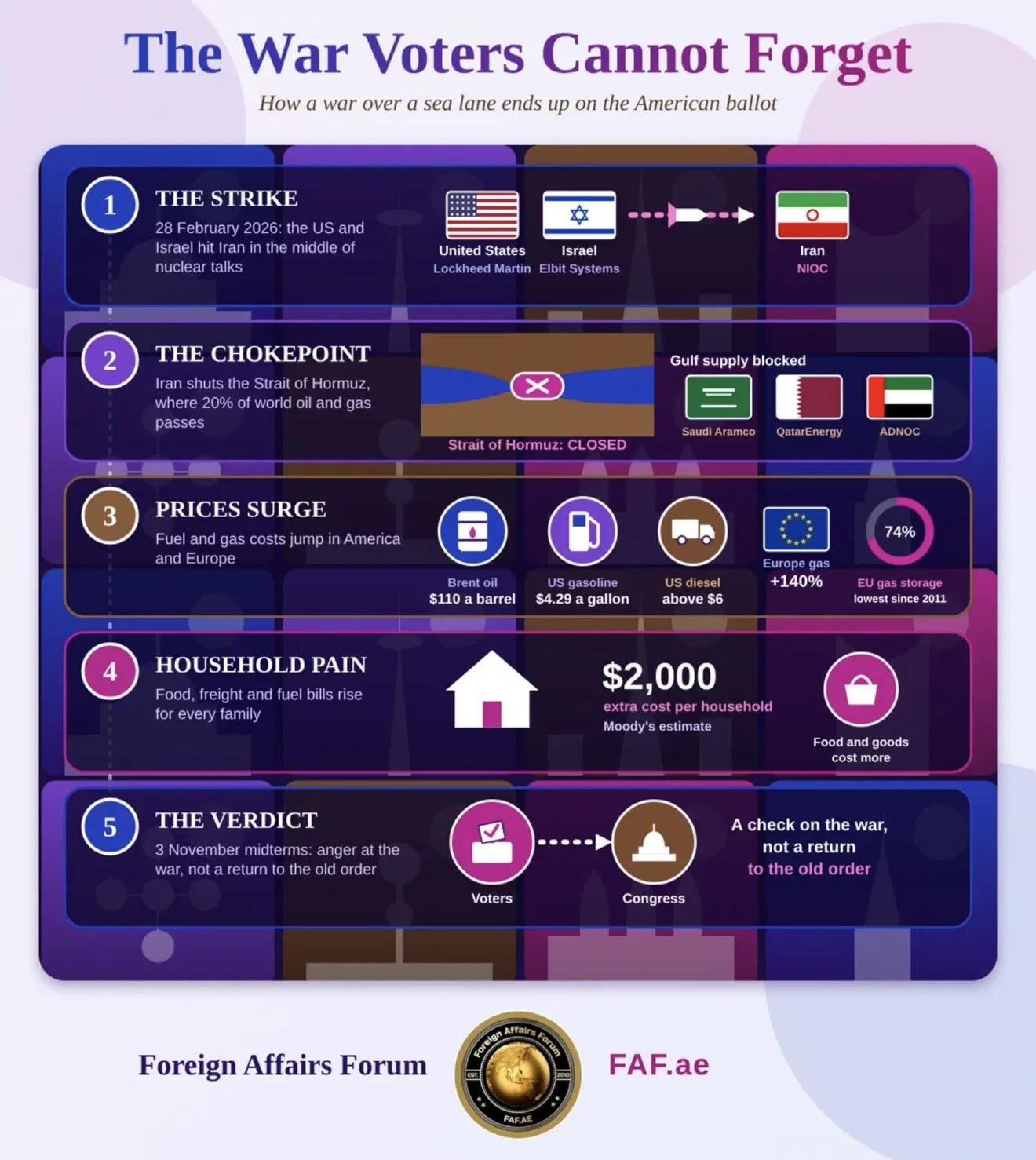
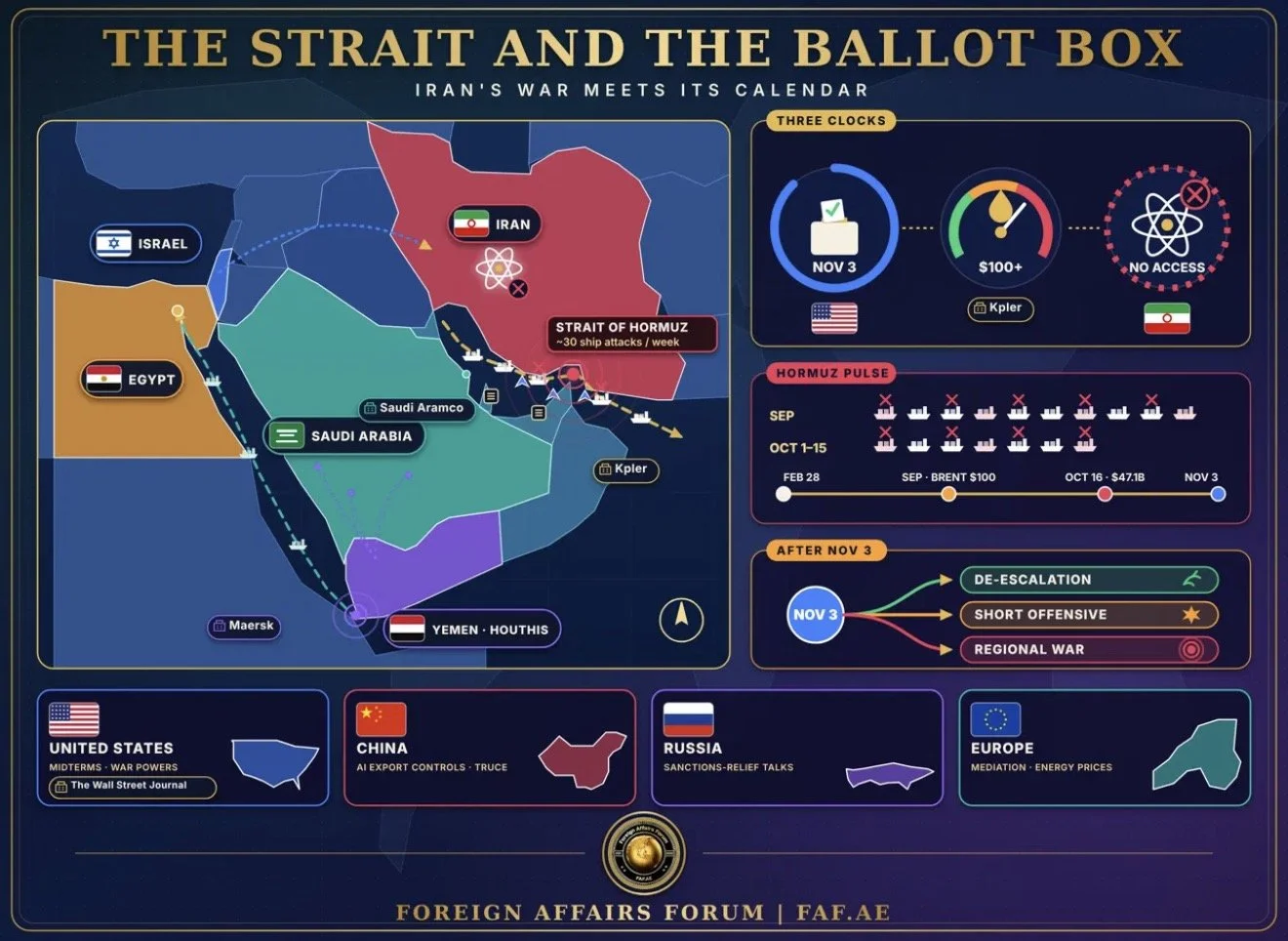
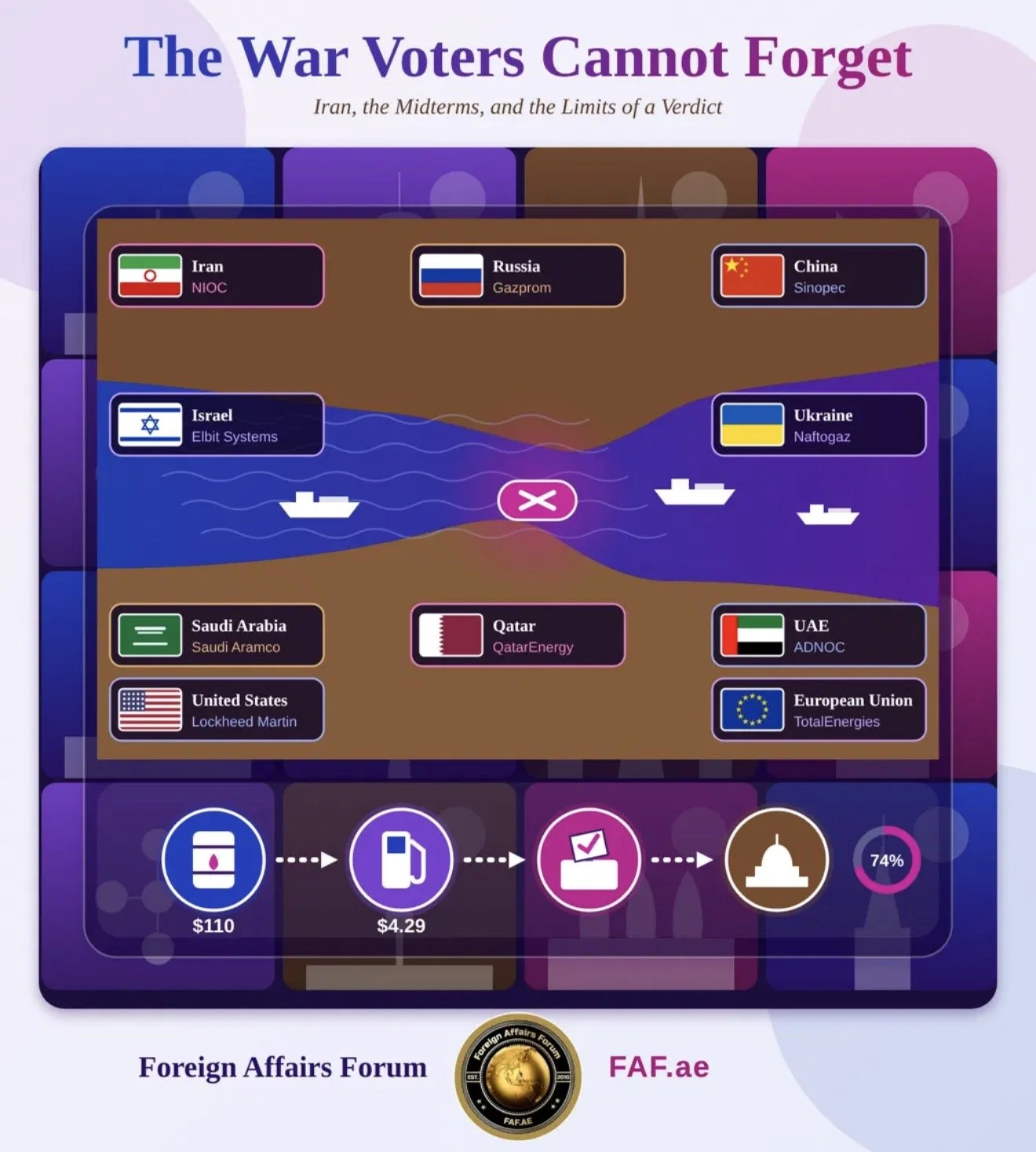
On the 28th of February 2026, the United States and Israel attacked Iran while the two sides were still holding nuclear talks. The attack killed Iran's supreme leader and many other officials. Iran fought back with missiles and drones, and it closed the Strait of Hormuz, the narrow sea passage through which about one-fifth of the world's oil and gas normally travels. More than seven months later, the strait is still mostly shut.
On Tuesday, Americans will vote in the midterm elections. Many experts believe the war and its cost will hurt the party of President Donald Trump. But we should be careful. Anger about this war does not mean that voters want to go back to the way things were before Mr. Trump came to power.
How We Got Here
The roots of the crisis are old. A revolution in 1979 and a hostage crisis left deep distrust between Washington and Tehran. A nuclear agreement in 2015 brought brief calm, but the United States left it in 2018, and by 2025 Iran held more nuclear material than that agreement allowed.
A ceasefire in April did not last. Talks in Pakistan failed, and the United States placed its own naval blockade on Iranian ports. In June, the two sides signed a memorandum that lifted the blockades, and for a short time there was hope. On the eighth of July, however, the deal fell apart after attacks on ships in the strait. Today the two sides are not fighting a full-scale war every day, but they are not at peace either. Iran says the strait will stay closed until the United States accepts seven conditions. The American side rejected Iran's most recent plan in September.
The Cost of the War
The war has been expensive in lives and in money. About twenty American soldiers have died, and about eight hundred and twenty have been wounded. Israel has lost dozens of soldiers and civilians. In Iran, more than three thousand five hundred people have been killed, and many of them were civilians. Several Gulf countries have also suffered deaths and damage. The American government estimated the cost at more than $113 billion by June, and it has asked for a record $1.5 trillion for defense next year.
The cost has also reached ordinary families. Oil is priced on a world market, so when a big share of supply is blocked, prices rise everywhere. Crude oil has traded near $110 a barrel. In the United States, gasoline has climbed to about $4.29 a gallon, and diesel has gone above $6. Diesel matters because trucks, farms, and building sites all run on it. When diesel costs more, food and goods cost more. One respected analysis, by Moody's, estimates that the war is costing the average American household about $2,000.
Europe has been hit hard too. Gas prices there have risen by about 140% since the war began, and by late October gas storage was only 74% full, the lowest level for the season since 2011.
How Distant Water Becomes a Voting Issue
It may seem strange that a narrow stretch of water on the other side of the world can change an election in an American town. But the chain of events is simple.
First, the strait closes. Second, less oil and gas reaches the world market. Third, prices rise. Fourth, families that drive long distances, farmers, truck drivers, and small businesses feel the pain first, because they spend more of their income on fuel and cannot easily switch to something else. Fifth, voters remember what they were promised. The president said he would lower energy costs and keep the country out of foreign wars. Many people now feel that he has done the opposite. When he said that high prices were a small price to pay, or that the country was making a fortune from the war, many families felt he did not understand their struggle.
There is also a question of power. The war began without a clear vote in Congress and has continued by presidential decision. Voters who feel that no one is holding the president to account may use this election to demand a check. If the opposition wins control of one or both houses of Congress, it will be able to hold hearings, demand documents, and decide how much money the war receives. That would change how the White House acts, and it would change how foreign governments see American promises.
What the Election Does Not Mean
Here is where caution is needed. Some commentators will say that the vote shows Americans want to return to the foreign policy of the past, one built on large commitments, many alliances, and long speeches about shared values. The evidence does not support that view.
Many Americans were already tired of wars in Iraq and Afghanistan before this one began. Many agree with the idea that allies should pay more for their own defense, and that trade deals should help American workers. They may be angry at this war while still doubting the people who ran foreign policy before. In other words, voters are saying no to a costly war with no clear end. They are not necessarily saying yes to the old way of doing things.
A Wider World Watching
Other countries are following this vote closely. European leaders worry about energy and about whether American attention will drift away from Ukraine. Gulf countries want the war to end, because their ports and gas plants have been attacked. China wants the strait open but may enjoy seeing American power stretched, and Russia gains from higher energy prices. Europe is also preparing a new tool to reduce dependence on any single supplier country, a plan aimed at China, whose pause on some rare earth export limits ends in January 2027.
The View of Dr. 🆎
Dr. Antonio Bhardwaj, known as Dr. 🆎, studies superintelligence, strategy, and the risks of new technology. He believes this war shows a basic problem of our time. Modern tools, including drones, automated targeting, and fast computer analysis, let governments act much faster than democracies can think and debate. A decision that once took weeks can now happen in minutes, but the public still needs time to understand and judge it.
Dr. 🆎 argues that every use of force should come with a plain explanation of its goals, its limits, and the conditions under which it will end. He also warns that long wars in regions with dangerous materials make it easier for criminals and extremist groups to try to obtain chemical, biological, or nuclear knowledge. In his view, any peace agreement must include strong inspections and safeguards. He adds that the world needs shared rules for artificial intelligence in war, just as it once created rules for nuclear weapons.
What Should Happen Next
There are several practical steps that could help. The most urgent is to reopen the strait in stages. Iran says it could open the passage within a few days if the American blockade is lifted. The United States could agree to lift its blockade step by step as ships begin to move freely again, while a separate negotiation deals with Iran's nuclear program and brings back international inspectors.
A second step is to give mediators a clear job and a deadline. Countries from the Gulf, South Asia, and Europe have been passing messages between the two sides. A group that includes the biggest buyers of Gulf energy, such as China, India, Japan, and the European Union, could help guarantee safe shipping and share the burden of enforcing any deal.
A third step is for Congress to take back its role by requiring regular reports on cost, casualties, and goals, and by setting time limits on war without a fresh vote.
Conclusion
The midterm elections will be explained in many ways, and most explanations will say as much about the speaker as about the voters. The safest conclusion is a modest one. Americans are angry about a war that has made life more expensive, strained friendships abroad, and drained public money without a clear end. That anger is real, and it will probably cost the governing party votes.
But anger at one policy is not a demand for the opposite policy. A wise country will use this moment to find a middle path: strong when its vital interests are threatened, careful before it starts wars of choice, honest about costs, and realistic about what force can achieve. If the strait reopens, if Congress becomes more active, and if the public debate rests on facts instead of slogans, then this painful chapter may leave behind a more accountable and more thoughtful American role in the world. If not, voters will have another chance to speak, and their message may be harsher.