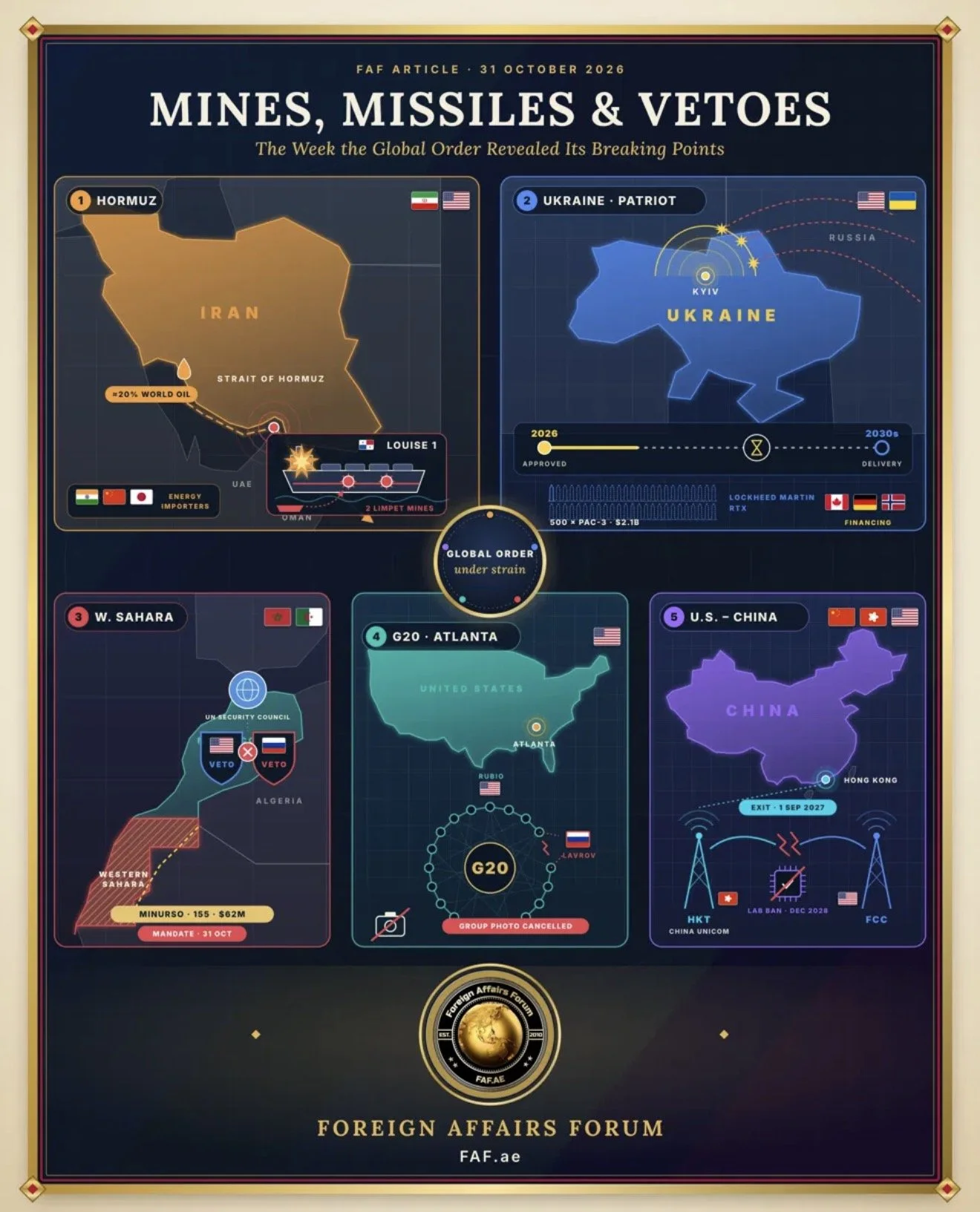
The World This Week: Mines at Sea, Missiles on Hold and a Divided Diplomacy
Executive Summary
At the end of October 2026, five news stories showed how the world is changing.
A tanker was attacked with mines in the Strait of Hormuz.
The United States approved Patriot missiles for Ukraine that may take years to arrive.
G20 foreign ministers could not agree, and they cancelled their group photo.
The United States and Russia blocked each other's plans at the United Nations over Western Sahara.
A Hong Kong telecom company agreed to leave America.
This FAF article explains each story in simple terms and what it means for ordinary people, with comments from Dr. 🆎, an expert in Super Intelligence, AI warfare and global strategy.
Introduction
Big changes in world politics often come through many small events, not one large one. This week was a good example.
On the surface, these five stories have little in common. Look closer and they tell one story: cheap weapons can now cause major damage, building military equipment takes too long, international organisations are struggling, and technology is splitting into separate camps.
Dr. 🆎 explains it simply: "Breaking things has become cheap. Protecting things has become expensive. That is the main problem the world faces today."
History and Current Status
The Strait of Hormuz is a narrow stretch of sea between Iran and the Arabian Peninsula.
A large share of the world's oil, around 20% of global consumption, passes through it.
When trouble starts there, fuel prices around the world can rise. Attacks on ships in this area are not new.
They happened in the 1980s during the Iran–Iraq war and again in 2019. The difference now is that the United States and Iran have been at war since February 2026, so every attack is more dangerous.
The Patriot is an American air-defense system that shoots down incoming missiles.
Ukraine has relied heavily on it to protect its cities and power stations from Russian attacks since 2022.
The problem is that many countries want these missiles and factories cannot build them fast enough.
The G20 is a group of the world's largest economies. It was created in 1999 to help countries work together on economic problems. Since Russia invaded Ukraine, its members have found it very hard to agree on anything.
Western Sahara is a territory in North Africa that Morocco claims.
The Polisario Front, supported by Algeria, wants it to be independent. Since 1991, a small United Nations mission called MINURSO has been watching the area to help keep the peace. It has about one 155 military personnel and costs about $62 million a year.
The United States has worried for years that Chinese telecom companies could be used for spying. It has already pushed several of them out of the American market.
Key Developments
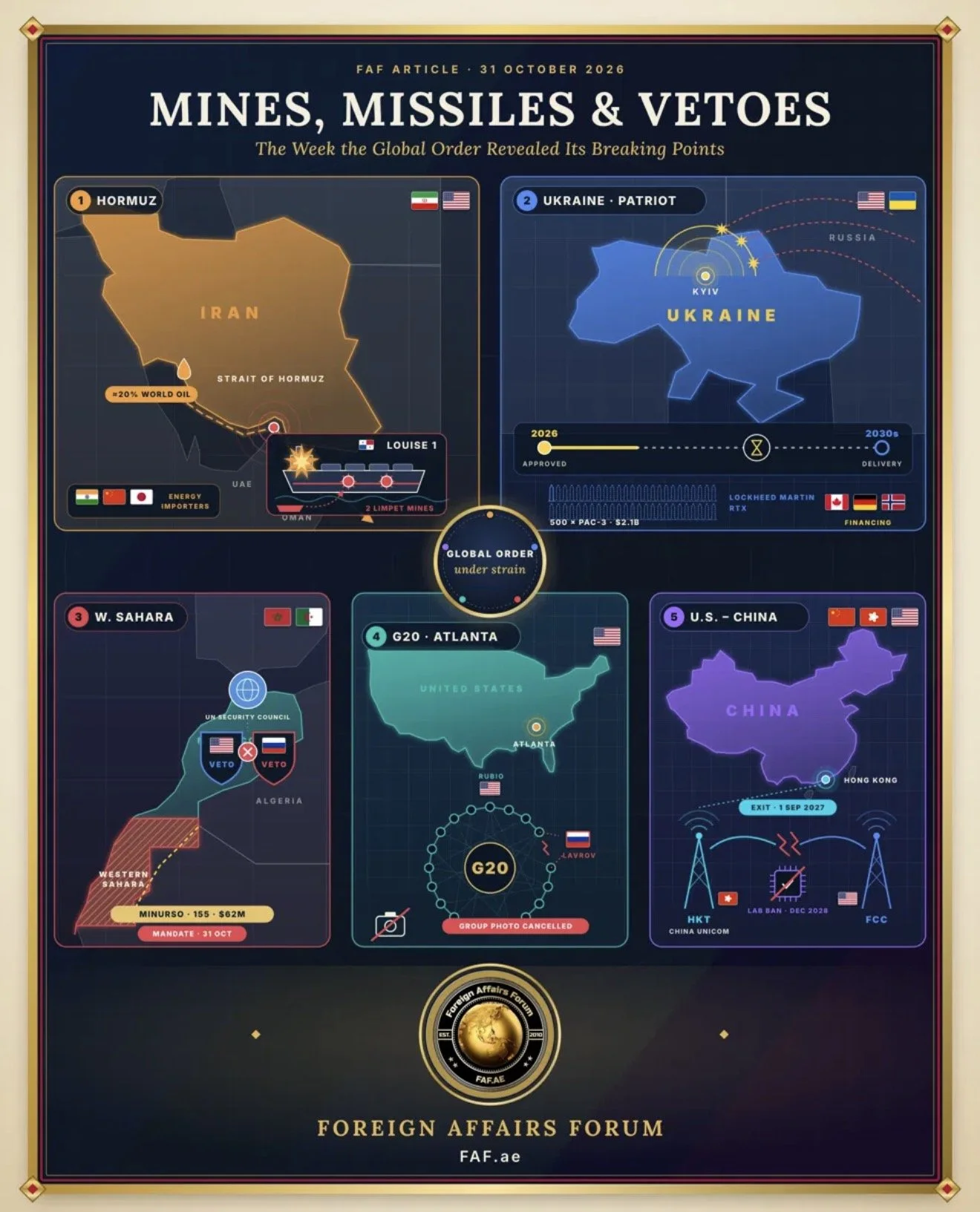
On 30 October, a small boat came up to the tanker Louise 1 in the Strait of Hormuz and attached two mines to its side.
The explosions started a fire in the engine room and stopped the ship for a time.
Fortunately, the crew was safe, the fire was put out and there was no oil spill. Nobody has said who carried out the attack. It was the first successful mine attack in the strait since the war started.
On the same day, the United States approved the sale of five hundred Patriot interceptor missiles to Ukraine, worth about $2.1 billion.
Canada, Germany and Norway will help pay. But the missiles have not been built yet, and they may not arrive until the early 2030s. Ukraine wants America to send missiles from its existing stock instead.
In Atlanta, G20 foreign ministers met from 30 to 31 October.
United States Secretary of State Marco Rubio called for cooperation. But several Western countries objected to the presence of Russian Foreign Minister Sergei Lavrov, and the usual group photo was cancelled because some ministers refused to stand next to him.
At the United Nations, the United States proposed renewing the Western Sahara mission while supporting Morocco's plan for the territory. Russia blocked it.
Russia then offered its own plan, and the United States blocked that. As a result, the mission was due to end on 31 October unless a late agreement was found.
Finally, Hong Kong company HKT agreed to stop its telephone and internet services in America by 1 September 2027.
American officials said it had links to China Unicom, a state-owned Chinese company.
Regulators also voted to stop Chinese laboratories from testing electronic products for the American market from December 2028. China said it might respond.
Latest Facts and Concerns
The biggest worry is energy. If tankers keep getting attacked, shipping insurance will cost more, and so will oil and gas.
Countries that import a lot of energy, such as India, China, Japan and South Korea, will feel this first.
Dr. 🆎 says: "A small boat hiding among fishing vessels is very hard to spot. This is where artificial intelligence can help, by spotting unusual behaviour at sea. But humans must still make the final decision, because a mistake could start a bigger war."
The second worry is that Western countries promise weapons faster than they can make them. If Ukraine waits years for missiles, Russia may believe that time is on its side.
The third worry is that international organisations are not working well. When the most powerful countries block each other, problems are left unsolved, from regional conflicts to trade and health emergencies.
Dr. 🆎 warns: "If major powers cannot agree on a small peace mission, how will they work together to stop dangerous new threats, such as biological attacks helped by AI? We need cooperation before a crisis, not after it."
Cause and Effect
Each story leads to wider effects. Cheap attacks at sea raise shipping costs, which raise fuel prices, which make everyday life more expensive. Slow missile production weakens Ukraine's defense, which affects peace talks with Russia.
Disagreements between big powers weaken international groups, so the world becomes less able to solve shared problems.
Technology restrictions split the world into an American system and a Chinese system, which makes products more expensive and harder to sell across borders.
Dr. 🆎 puts it this way: "Power today depends on four things: protecting infrastructure, building enough equipment, trusting your technology, and keeping good relationships with others. AI will make strong countries stronger, but it could also deepen the divisions between them."
Future Steps
Several steps could make things better. Navies and shipping companies in the Gulf should share information and use drones, satellites and AI to watch the waters more closely.
Western countries should invest in new factories and sign long-term contracts so missile production can grow. The G20 should focus on economic issues it can still agree on, such as minerals, supply chains and energy prices.
The United Nations Security Council should at least extend the Western Sahara mission for a short time while talks continue. On technology, trusted countries could agree on shared testing standards, and countries such as India could become neutral centres for manufacturing and certification.
Dr. 🆎 adds: "India has a real role to play. It depends on Gulf energy and is growing fast in technology. It can help build a safer, more cooperative system at sea and in the digital world."
Conclusion
This week showed that the world is under pressure in many ways at once: at sea, in factories, in diplomacy and in technology. The countries that will do best are those that protect their infrastructure, produce what they need, trust their technology and keep talking with others even during hard times.
Dr. 🆎 ends with a clear message: "We will not be judged by how many meetings we held, but by whether we kept the world's sea lanes, power grids and communication networks working. The choice is still ours, but we must act soon."