The Grid Is a Front Line: Why America's Power Backlog Is a National Security Emergency
Foreign Affairs Forum | Dr. Antonio Bhardwaj (Dr. 🆎)| Nov 19th, 2026
A 1,312 GW queue, rising bills and a stalled Senate bill show that permitting reform now decides who leads in artificial intelligence, industry and defence
Executive Summary
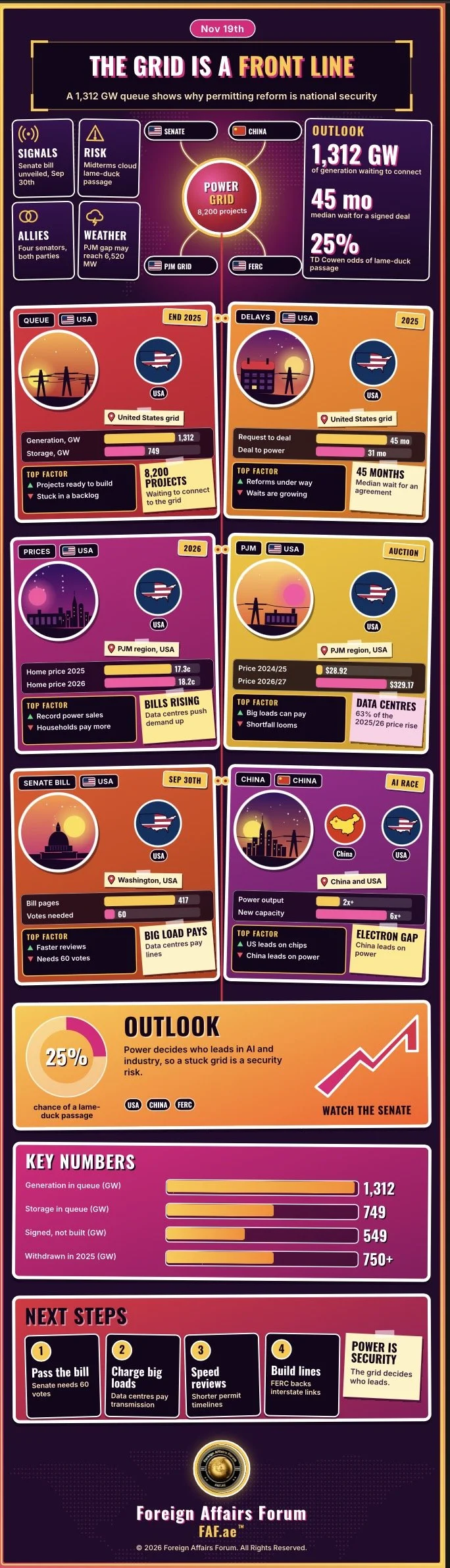
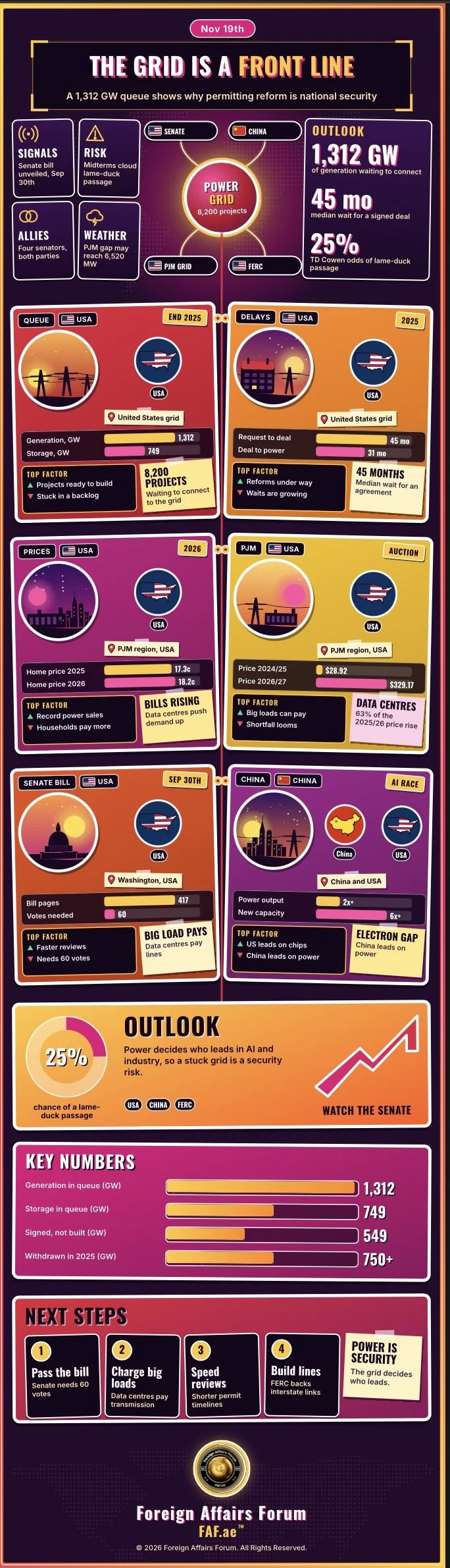
The United States still enjoys some of the cheapest electricity in the world, yet households across the country have seen bills climb in recent years, driven in large part by demand from data centres. FAF analysis finds that this is no longer only a consumer problem. A country whose economy, armed forces and artificial intelligence industry run on electricity cannot be competitive if it cannot add power quickly. At the end of 2025, about eight thousand two hundred projects were waiting in the interconnection queue, the backlog of plants and storage seeking a grid connection. Together they represented 1,312 GW of generation and about 749 GW of storage. The median wait from request to a signed agreement was forty-five months, and the stretch from agreement to operation had grown to thirty-one months.
Prices tell the same story. In PJM, the largest grid operator in the country, capacity prices rose from $28.92 to $329.17 per megawatt-day in two years, and the independent market monitor attributed 63% of the increase in one auction to data centres. A bipartisan Senate package of four hundred and seventeen pages, unveiled on Sep 30th, would shorten reviews, ease the siting of interstate lines and make large power users pay for the transmission they require. Democratic gains in the Nov 3rd midterm elections have clouded its passage in the lame-duck session, and TD Cowen now puts the odds of enactment before the year ends at 25%.
FAF analysis concludes that permitting reform should be treated as a pillar of national security policy. China already generates more than twice as much electricity as the United States and is expected to add far more capacity in the next five years. Without a faster, fairer and better-planned grid, American chip leadership will not translate into American compute leadership. The Senate bill is imperfect, but it is the most serious bipartisan attempt in years to align speed, cost and fairness.
Introduction
For two decades Washington has treated electricity as a utility question, the business of regulators, engineers and ratepayers.
That view is no longer safe. Dr. Antonio Bhardwaj (Dr. 🆎), a polymath who works on human-centered super intelligence for geopolitical strategy, argues that compute is now a strategic commodity and that electrons are its raw material. A state that cannot connect generation to demand cannot train advanced models, cannot run large simulations and cannot sustain the industrial base that underpins its armed forces. In his view, the grid is the foundation on which every other element of national power is built.
The argument is simple. American power remains cheap by global standards, yet bills are rising in many regions because demand from data centres is growing faster than new supply can connect. At the same time, the machinery for adding supply is clogged. Plants and batteries that are ready to be built sit in a queue, approvals stretch across years, and the political system has struggled to agree on how to speed them up. Each year of delay raises costs for households, weakens the case for new investment and gives rivals an opening.
The debate is also moving beyond economics. Questions once asked by utility commissions are now asked by national security planners. Where should the next generation of data centres be built? Who pays for the lines that serve them? How can the grid be protected against cyberattack, physical sabotage or the deliberate targeting of critical infrastructure? And how can a democracy expand its power system at the pace of an authoritarian rival without sacrificing the public consultation and environmental safeguards that distinguish it?
This FAF article examines those questions in sequence. It reviews how the backlog arose, the key developments of the past year, the latest facts and concerns, the chain of cause and effect that links permitting to security, and the steps that stakeholders should take. It argues that the choice is not between speed and safeguards, but between a system that is slow and unpredictable and one that is fast and clear about the rules.
History and Current Status
The American grid was built in the 20th century around large plants, regional utilities and slow, predictable growth in demand. The rules that govern how a new project connects were designed for that world. Over time they accumulated layers: federal environmental reviews under the National Environmental Policy Act, state and local siting rules, utility studies of how each new plant would affect the system, and a growing volume of litigation. Each layer served a reasonable purpose, but together they produced delay and uncertainty.
The numbers show the result. Berkeley Lab, working with partners that compile data from more than fifty grid operators covering about 98% of installed capacity, counted roughly eight thousand two hundred active projects at the end of 2025. The queue held 1,312 GW of generation and about 749 GW of storage, a total of 2,061 GW. That total was 10% lower than a year earlier, and well below the peak of nearly 2,600 GW reached at the end of 2023. The decline reflected high withdrawals, more than seven hundred and fifty GW in 2025, rather than a surge of projects reaching operation. Many projects that enter a queue are never built, so the queue is an indicator of developer activity, not a promise of future supply.
The composition of the queue is changing. Natural gas capacity rose by 86% to 253 GW, while solar fell by 19%, storage by 16% and wind by 19%. Another 549 GW already had a draft or signed interconnection agreement but had not reached commercial operation, including 256 GW of solar, 161 GW of storage, 76 GW of wind and 45 GW of gas. In other words, a large body of capacity is past the first hurdle and still waiting for the rest of the process to catch up.
Time is the hidden cost. The median wait from request to a signed agreement was forty-five months in 2025, and the time from agreement to operation was thirty-one months, up from twenty-one months in 2008. Berkeley Lab attributes much of the second stretch to factors outside the queue, such as procurement, permitting and transmission work. The consequence is that a project filed today may not deliver power until the early 2030s, in a market where demand is changing by the quarter.
Regulators have not ignored the problem. The Federal Energy Regulatory Commission reformed interconnection rules in 2023 to replace one-by-one studies with cluster studies, to require stronger evidence of readiness from developers and to impose penalties on projects that withdraw late. Regional operators have added their own measures, including caps on how much capacity can enter a queue relative to local demand and fast-track programmes for projects that meet readiness tests. These reforms are visible in the data, since the queue has shrunk, but they have not yet shortened the total journey from idea to operation.
Prices have moved with demand. The Energy Information Administration expects record national electricity sales in 2026, with the average residential price rising from 17.3 cents per kilowatt-hour in 2025 to 18.2 cents in 2026. Researchers at the Federal Reserve Bank of Dallas estimate that existing data centres have already raised wholesale electricity prices by 2% to 6% on average nationwide. The effect is uneven, because some regions have surplus supply and others do not, which is why the sharpest signals have come from the mid-Atlantic and the Midwest.
Some regions show that faster action is possible. Texas and California each executed interconnection agreements for more than 30 GW of capacity last year, and the Midcontinent grid operator saw capacity prices fall for the 2026 to 2027 delivery year after solar additions increased the supply offered into its auction. These cases suggest that the problem is not inevitable. Where rules are clear and supply arrives, prices ease; where supply lags, prices spike.
Key Developments
The sharpest price signal has come from PJM, which serves about sixty-seven million people across thirteen states and the District of Columbia. Its capacity auction for 2026 and 2027 cleared at $329.17 per megawatt-day, against $28.92 for 2024 and 2025, a rise of more than tenfold in two years. The market monitor found that data centres accounted for 63% of the price increase in the 2025 to 2026 auction, equal to about $9.3 billion in capacity costs spread across customers. In the December 2025 auction PJM procured about 5.2% less capacity than its reliability requirement, the first such shortfall in its history. The monitor now warns that the gap between cleared capacity and the target could widen from a modest 210 MW in the 2026 to 2027 cycle to about 6,520 MW in the following cycle if supply does not catch up with demand. Consultants at ICF have estimated that residential retail rates in the region could rise between 30% and 60% by 2030.
In Congress, the House passed the SPEED Act on Dec 18th, 2025 by 221 to 196, with eleven Democrats joining Republicans. The bill aimed to cut duplicative reviews and set firm timelines, but it did little on transmission and stalled in the Senate. After months of talks, the leaders of the Senate energy and environment committees, Republicans Mike Lee and Shelley Moore Capito and Democrats Martin Heinrich and Sheldon Whitehouse, released a bipartisan package of four hundred and seventeen pages on Sep 30th. Capito called it monumental and legacy-setting. The bill would shorten environmental review and litigation, give the Federal Energy Regulatory Commission more authority to approve interstate power lines alongside state reviews, protect already-permitted projects from political interference and require large loads such as data centres to pay for their associated transmission costs.
The cost-allocation rule is central. Heinrich said the bill would ensure that data centres pay their fair share of the grid upgrades they require rather than leave the bill to American families. Supporters describe it as the first act of Congress to protect consumers from the energy costs of data centre growth. It also answers a political problem: voters who see rising bills are less willing to accept new data centres, and the resulting opposition threatens the investment that the artificial intelligence race requires.
The House version had a different emphasis. Its sponsors, Republican Bruce Westerman and Democrat Jared Golden, focused on the National Environmental Policy Act, narrowing the scope of reviews, setting deadlines and limiting the remedies that courts can order when a review is challenged. Critics said it did too little for transmission, and several Democrats said it could not advance while the administration was blocking solar and wind projects. The Senate package therefore tried to combine the House's attention to review timelines with new provisions on transmission, cost allocation and certainty for permitted projects.
The bill also tried to address the conflict over renewable projects. The Trump administration's holdup of wind and solar approvals had been a stumbling block, and Democrats said that they could proceed only if previously approved projects were allowed to move forward. Trump offered to ease the holdup, but Whitehouse said the question of returning to regular order remained unresolved. Senate Majority Leader John Thune said Republicans and the White House had closed the deal on legislation that incorporated essentially all of the Democrats' asks, and Capito said the Senate would make the bill its first vote after the election.
The administration's own approach has relied on executive action. An early order titled Unleashing American Energy directed agencies to speed energy approvals, and officials have pushed to accelerate fossil fuel and nuclear projects. Legal observers note, however, that statutes and agency rules have a stronger foundation than presidential orders, and that a change of administration or a court ruling can undo them. That is one reason industry groups, from utilities to pipeline builders to clean energy developers, have urged Congress to act.
Meanwhile, the electricity gap with China widened in the public debate. China already generates more than twice as much electricity as the United States, and BloombergNEF estimates that it will add more than six times as much generation capacity over the next five years, much of it renewable. Analysts speak of an electron gap: America has the most advanced chips, while China has the abundant power to run data centres at scale.
Latest Facts and Concerns
The election has changed the arithmetic. Democrats won at least fifty-four Senate seats on Nov 3rd, flipping at least seven from Republicans. Senate leaders scheduled a first procedural vote for the lame-duck session that began on Nov 9th, but analysts warn that the deal was negotiated in a world where Democratic control looked far less likely. TD Cowen cut its odds of lame-duck passage from 40% to 25%, and Rapidan Energy Group sees 20% to 25%, down from 30%. Some observers expect the new Congress to draft its own version, and the White House has not said whether it would be open to a deal on an altered bill next year.
Concerns come from several directions. Environmental groups on the left flank argue that the bill is a giveaway to fossil fuel interests, and some warn that it would limit public input. Supporters reply that it covers all technologies and that clean energy depends on transmission as much as gas does.
Some critics on the left said that a deal made in the waning days of a Congress, on a schedule that precluded public input or amendment, was indefensible, and one environmental lawyer likened it to a deal with the devil. Business groups, by contrast, see an opportunity to cut years from approvals. The disagreement shows that permitting reform is not a contest between industry and nature so much as a contest over who bears risk when a project is delayed, challenged or cancelled.
A further source of friction is the Senate's own procedure. Any bill needs sixty votes in the Senate, which means that a coalition of at least some Democrats and nearly all Republicans must hold together through amendments. Because of that threshold, even a small group of senators can demand changes, and each change risks losing others. Leaders have said they plan to hold the first vote soon after returning, yet the bill's authors acknowledge that revisions are coming as colleagues weigh in. The process is likely to test whether the cross-party consensus among the four lead negotiators can extend to their caucuses.
A second concern is reliability. Even if reforms pass, power plants need years to build, and demand is arriving now. The market monitor's warning of a 6,520 MW gap in PJM suggests that shortfalls may appear before new supply does. BloombergNEF has also warned that the mismatch of artificial intelligence power demand and slower capacity additions could cause effective electricity shortfalls in some American markets by 2030.
A third concern is cost allocation in practice. A rule that large loads pay for their own transmission sounds simple, yet determining who caused which upgrade is complex. States are experimenting, and Oregon regulators approved rates in Jul 2026 that raised data centre rates by an average of 29% while lowering residential rates by 1.3%. Such cases show that fairness is achievable, but they also show how much regulatory work remains.
A fourth concern is the long timeline for major projects. The SunZia transmission project took fifteen years to secure its permits, a figure that has become shorthand for the cost of delay. When projects take that long, investors discount the risk, and the capital that might have built lines goes elsewhere.
A fifth concern is the distinction between a queue and a pipeline. Because many queued projects will never be built, policymakers must avoid counting every gigawatt as future supply. Berkeley Lab notes that network upgrade costs for withdrawn projects averaged 70% of total interconnection costs, which suggests that uncertainty about upgrade costs is a leading reason developers give up.
The political outlook also carries personal and institutional dimensions. Analysts at Jefferies see reduced odds of lame-duck support for a package that makes it easier to build gas pipelines, while the lawmaker expected to lead the House Natural Resources Committee in the next Congress has argued that Democrats should show that the days of a supplicant Senate are over. These positions suggest that the next Congress may seek a different balance between fossil and renewable provisions, and that a delay of even a few months could change the shape of the final bill.
Storage offers one bright spot. The United States installed 3.3 GW of battery storage in the first quarter of 2026, including 2.3 GW of utility-scale capacity, according to industry data. Storage can be built faster than most generation and can relieve stress at peak hours, but it too depends on interconnection. Developers argue that each month saved in the queue translates directly into lower bills, because it brings cheaper capacity onto the system sooner.
Cause-and-Effect Analysis
FAF analysis finds a chain of cause and effect that links permitting to national power. At the base is the growth of demand. Artificial intelligence, electrification and reshored manufacturing are raising consumption after years of flat load. Data centres are a particularly concentrated and fast-growing source, because a single campus can require as much power as a mid-sized city and must be built in two or three years, far faster than a transmission line.
When demand rises faster than supply, prices rise. In regions with capacity auctions, such as PJM, forecasts of future demand raise prices before the data centres even exist, because buyers must secure capacity years ahead. That is why households far from any data centre can see higher bills. In turn, higher bills create political opposition, and opposition produces local moratoriums, tax disputes and delays, which slow the very investment that the national strategy requires.
Delay in supply has its own causes. A project must navigate environmental review, interconnection studies, local siting and, in many cases, transmission upgrades that cross state lines. Each step has a different authority, and none is accountable for the whole. The result is a system that is slow even for projects that everyone supports, and especially slow for transmission, which crosses many jurisdictions.
The mix of fuels adds another effect. Because solar, wind and storage face long waits and shifting federal policy, gas projects with simpler paths gain ground, as the 86% rise in queued gas capacity shows. That can help near-term reliability but concentrates risk in fuel supply and price, and it leaves the grid less diverse than planners would like.
The security effect follows. Dr. 🆎 argues that a stressed grid is a strategic liability. When margins are thin, a cyberattack, a severe storm or a deliberate strike on a substation can have outsized consequences. In his view, adversaries who study AI warfare will see data centre clusters and the lines that serve them as high-value targets, because disabling them could cripple both commercial services and military analysis. A grid with spare capacity and redundant routes is a form of deterrence.
Investors respond to the same signals. Capital for generation and transmission is mobile, and it flows to places where timelines are predictable. When approvals can take fifteen years, as in the case of a major transmission line in the Southwest, the cost of capital rises and some projects are never proposed. A predictable regime, even one that sets demanding standards, lowers risk and therefore lowers the price that consumers eventually pay.
Supply chains add another constraint. American builders increasingly depend on imported electrical equipment, including transformers and switchgear, and some of it comes from China. Even with permits in hand, delays in equipment can stall a project for years. This is a further reason to see permitting reform as part of a wider industrial strategy rather than a stand-alone legal fix, and it is a reminder that the security dimension reaches from the substation to the factory floor.
There is also a competitive effect. If American developers cannot secure power, they will build elsewhere, including in the Gulf and Asia, or they will build their own plants behind the meter. Both options weaken public oversight and reduce the benefits that the wider grid might gain. Meanwhile China, with its centralised planning and rapid construction, can offer abundant power at lower cost. The Chinese data centre operator pays far less for electricity than an American counterpart in many comparisons, which compounds the advantage in the cost of training and running models.
Finally, there is a feedback effect on trust. If permitting reform is seen as a handout to industry, public support erodes. If it is seen as protecting consumers while building supply, it can command a broad majority. That is why the cost-allocation provisions in the Senate bill matter as much as its timelines: they turn a technical reform into a bargain that voters can understand.
Dr. 🆎 adds a further point from the field of biological security. Data centres that support bio-modelling, drug discovery and pathogen surveillance depend on reliable power, and so do the laboratories and cold chains that respond to an outbreak. A grid that fails under stress would make any response to a deliberate or natural biological event slower and less certain, which links permitting to resilience in the most serious scenarios.
A last effect concerns alliances. Partners in Europe, Asia and the Gulf are watching how America manages the collision between artificial intelligence and electricity. If Washington shows that a democracy can expand power quickly, fairly and securely, it strengthens its case as the preferred partner for data centre investment. If it does not, countries with abundant energy and fewer procedural hurdles will attract capital and talent that might otherwise have stayed in the United States, and the geography of compute will shift accordingly.
Future Steps
FAF analysis outlines five steps that stakeholders should take. The first is to pass a permitting bill that can win sixty votes, preserving the rule that large loads pay for their own transmission. If the lame-duck session cannot complete the work, leaders should treat the Senate text as the base for early action in the next Congress rather than starting again. A blank slate would waste a rare moment of cross-party agreement.
The second is to speed interconnection through reforms already under way. Grid operators are shifting from first-come, first-served queues to first-ready, first-served studies, setting stricter readiness requirements and linking interconnection to regional planning. The 549 GW that already hold agreements should be a priority, because they are closest to delivering power. Regulators should publish clear performance targets and track the time from agreement to operation, since that stretch has grown most.
States have a role too. Several have begun to require that large customers sign long-term contracts, post collateral or accept separate tariffs, so that costs are not shifted to other ratepayers if a data centre does not materialise. These tools complement federal rules and can be adopted faster. Where they are well designed, they reduce the risk of stranded assets and signal to developers that serious projects will be welcomed while speculative ones will be priced accordingly.
The third is to build transmission. Generation without lines is stranded capacity. The Senate bill would give the Federal Energy Regulatory Commission more authority over interstate lines and allow it to process applications alongside state reviews. That authority should be paired with cost-sharing rules that reflect who benefits, so that states are not asked to host lines that serve distant customers without compensation.
The fourth is to treat power planning as part of national security strategy. The Department of Energy, the regulator, grid operators and defence planners should share forecasts and risk assessments, including threats from cyberattack and sabotage. Data centre developers should be asked to provide flexible load, backup generation and resilience plans, and the largest facilities should be sited with grid strength and security in mind.
Dr. 🆎 recommends that scenario modelling for the grid include AI-enabled attacks, which can probe systems faster than traditional intrusions, and that human-centered super intelligence be used to help operators interpret anomalies in real time.
He also warns that the same technology that strains the grid can help to protect it. Machine learning can forecast demand, schedule maintenance, detect faults and balance variable generation, but only if systems are designed with human oversight and with safeguards against manipulation. A grid run by opaque automation would introduce new risks rather than remove old ones.
The fifth is to keep the public engaged. Faster permitting should not mean silent permitting. Communities that host plants and lines should see tangible benefits, from lower bills to local investment, and should have clear windows for comment early in the process, when changes are cheapest. A system that earns trust will survive changes of administration, while one that is imposed will be reversed.
Finally, success should be measured. Policymakers should track a small set of indicators that capture progress: the median months from request to agreement, the months from agreement to operation, the gigawatts reaching commercial operation each year, the share of projects withdrawn after receiving agreements and the change in residential bills relative to inflation. Publishing these numbers would give the public a way to judge whether reform is working and would give Congress an evidence base for adjusting the rules.
Conclusion
The United States does not lack capital, technology or ideas. It lacks a grid that moves at the speed of its ambitions. A queue of 1,312 GW of generation and 749 GW of storage, a median wait of forty-five months and a 63% data centre share of a record price jump are signs of a system under strain. The Senate bill is imperfect and politically exposed, but it is the most serious bipartisan attempt in years to align cost, speed and fairness.
The lesson of the past year is that delay is not neutral. Every month a ready project waits is a month in which bills rise, investment drifts and rivals gain ground. Reform will not remove every trade-off, yet it can replace slow uncertainty with fast clarity, and that alone would be a gain for households, industry and defence alike.
The stakes are larger than electricity bills. Power decides where data centres are built, how fast models are trained, how resilient industry is in a crisis and whether democratic governments can deliver what their citizens expect. FAF analysis concludes that whether the bill passes this winter or in the next Congress, the direction is fixed: the grid is a front line, and stakeholders who treat it as routine infrastructure will find the landscape of power shifting against them. Dr. 🆎 puts the point plainly: in the age of super intelligence, a country's strategic depth is measured in gigawatts that are connected, secure and affordable, not merely planned.