Europe Takes a Seat at the Table: Sanctions, Sabotage and Supply Shocks Test the Union's Strategic Voice
As Washington and Moscow set the format for Ukraine's peace talks, Brussels pairs maximum pressure with a late bid for influence while gas, rare earths and hybrid attacks tighten the squeeze
Foreign Affairs Forum | Dr. Antonio Bhardwaj (Dr. 🆎)| Nov 16th, 2026
Executive Summary
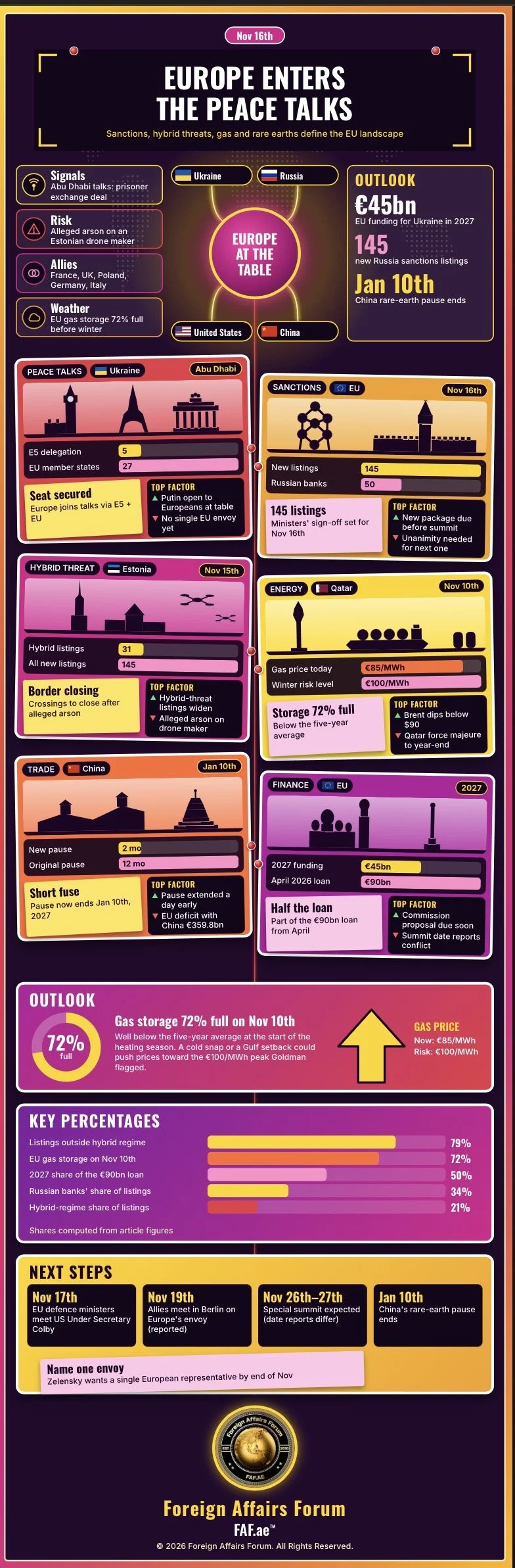
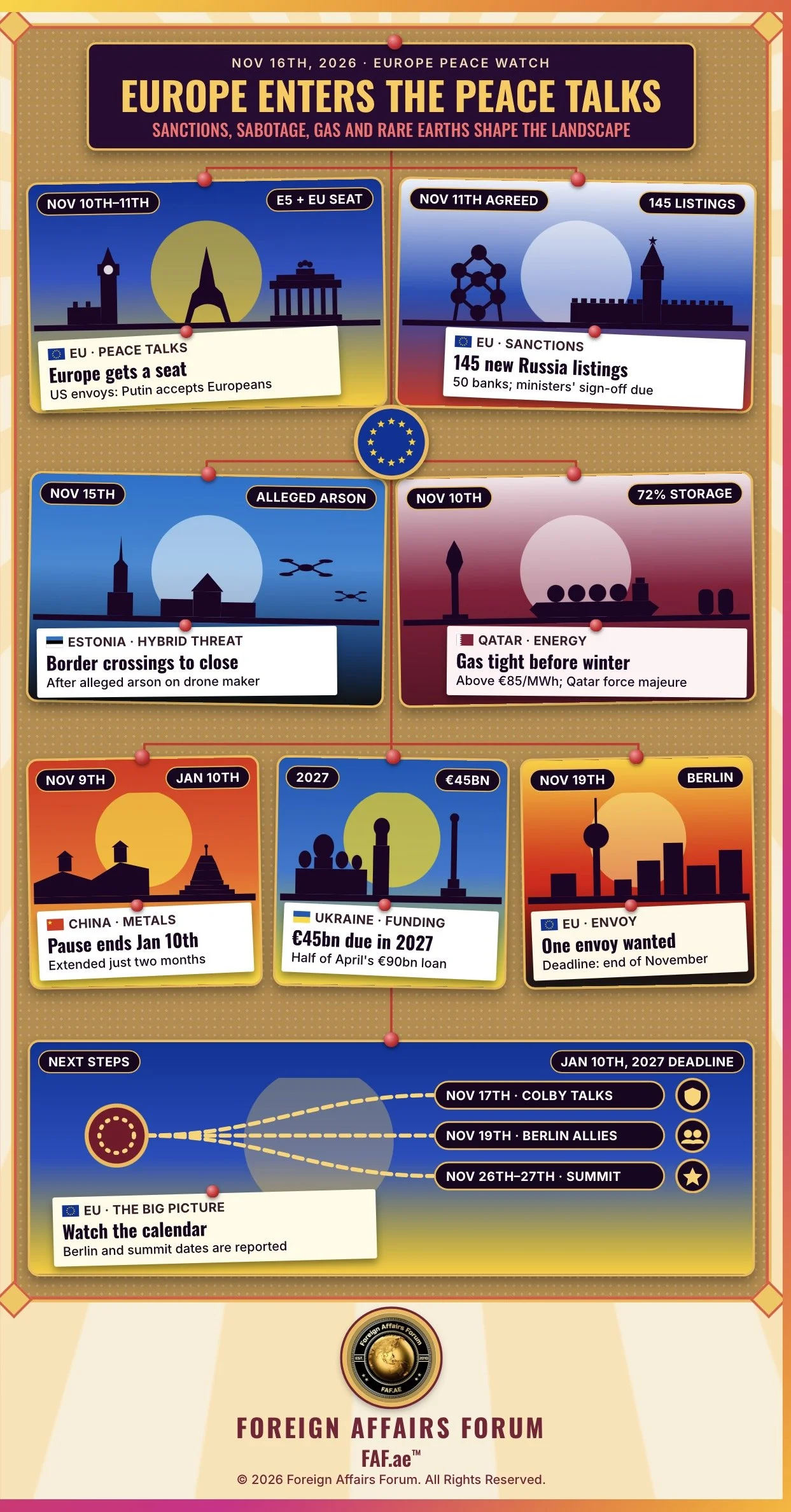
Europe has secured a place in the diplomacy over Ukraine's future, but it enters that room as a payer more than a broker. After the US-mediated Russia-Ukraine talks in Abu Dhabi on Nov 10th and Nov 11th, which produced a large prisoner exchange deal, US envoys Jared Kushner and Steve Witkoff said President Vladimir Putin had accepted European delegates at the table. European Commission President Ursula von der Leyen answered that Europe would engage through an "E5 + EU" format, reportedly comprising France, the UK, Poland, Germany and Italy. The arrangement is a diplomatic gain, yet it exposes an old weakness: the Union still has no single envoy, and Kushner publicly mocked the absence of one European voice.
Per FAF analysis, the seat cannot be separated from the pressure track running beside it. EU ambassadors agreed 145 new Russia sanctions listings on Nov 11th, including 50 banks, shadow fleet enablers and energy firms, with 31 designations under the hybrid-threats regime. Formal ministerial sign-off was scheduled for Nov 16th, although a confirmed result had not been seen at the time of writing. Von der Leyen has promised a fuller package and a proposal on Ukraine's 2027 financing before the next European Council. Unanimity remains the obstacle, and reports conflict on both the numbering of the package and the summit date, with Nov 26th and Nov 27th cited by one report and Dec 17th and Dec 18th by another.
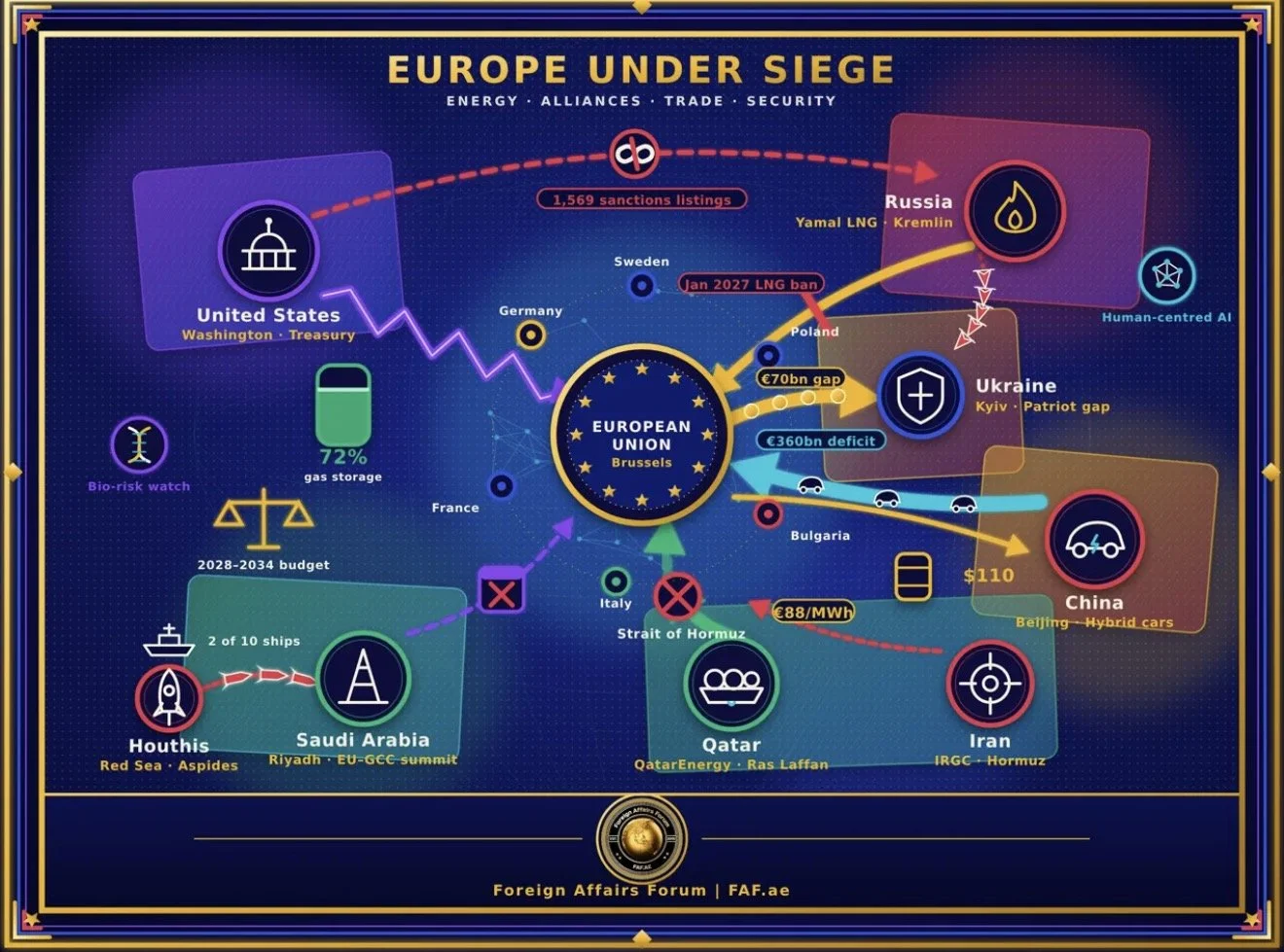
Three external pressures complicate the picture. Estonia is reported to be moving to close crossings on its Russian border after an alleged arson attack on a drone maker, details of which remain unconfirmed. European gas rose above €85/MWh on Nov 10th with storage only 72% full, while QatarEnergy extended force majeure to at least the end of December. China, meanwhile, extended its rare-earth export pause by only two months, to Jan 10th, 2027.
Dr. 🆎 notes that the common thread is leverage: every adversary and partner is testing whether Europe can convert economic weight into strategic weight before winter and the January cliff arrive.
Introduction
The strategic question confronting the Union this month is not whether Europe matters to the outcome in Ukraine, but whether it can organise itself quickly enough to shape that outcome.
Dr. Antonio Bhardwaj (Dr. 🆎), a polymath with global expertise in superintelligence, specialising in human-centered SI for geopolitical strategy, AI warfare and bioterrorism risks, frames the issue as one of decision speed. In his assessment, the contest is increasingly decided by which stakeholders can integrate information, resources and political will fastest, and a bloc of twenty-seven governments that requires unanimity for its sharpest instruments starts every contest with a structural handicap.
This FAF article examines five developments that arrived within days of one another and that together define the European landscape on Nov 16th. The first is the arrival of Europe at the Ukraine negotiating table through the E5 + EU format. The second is the approval track for 145 new Russia sanctions listings and the larger package that follows. The third is the alleged arson attack on an Estonian drone maker and Tallinn's reported decision to close border crossings. The fourth is a tight gas market heading into winter. The fifth is Beijing's decision to extend its rare-earth pause by only two months.
Each development is significant alone. Taken together, they show a Union negotiating from a position of financial generosity and material vulnerability. Europe is expected to fund Ukraine's survival, absorb the energy shock of a disrupted Gulf, defend its defence-industrial base from sabotage and maintain access to the Chinese minerals on which its defence and auto sectors depend.
Dr. 🆎 observes that a stakeholder in this position has a strong claim to a voice but a weak claim to a veto, and that closing the gap between the two is the real work of the coming weeks.
The sections that follow set out the historical backdrop and current status, the key developments in detail, the latest facts and concerns, a cause-and-effect analysis of how the strands interact, the steps that lie ahead and a conclusion on what the landscape implies for European strategy.
History and Current Status
Europe's relationship to the war in Ukraine has passed through several phases since 2022.
The first was rapid unity, when sanctions, financial support and arms deliveries were assembled at a speed that surprised both friends and rivals. The second was fatigue and fragmentation, as the costs of the energy shock, domestic politics and doubts about American steadfastness exposed differences between capitals. The third, which has gathered pace during 2025 and 2026, is the effort to professionalise European support, anchored in large multi-year financing and in coalitions of willing governments prepared to underwrite post-war security guarantees.
The financing pillar is now the most visible. In April, the Union agreed a €90bn loan for Ukraine, and the EU is set to provide €45bn in 2027 from it, which is half of the total.
A further financing proposal is due before the next summit. That commitment gives Europe a legitimate claim to a seat in any settlement, since it is the party that will carry much of the cost of keeping Ukraine solvent and defensible. Yet the diplomatic format for ending the war was set elsewhere. Washington and Moscow have so far determined who talks, where and in what sequence, and Europe has had to argue its way into a process that its money underwrites.
The sanctions architecture has matured in parallel. Successive packages have moved from trade restrictions to the financial system, the shadow fleet and third-country facilitators.
The latest listings extend that logic. Of the 145 designations agreed by ambassadors on Nov 11th, 50 are Russian banks, and others target shadow fleet enablers and energy firms, while 31 fall under the hybrid-threats regime that punishes sabotage and disinformation. The Union is also acting physically at sea: Foreign Policy Chief Kaja Kallas announced that EU forces boarded another suspected Russian shadow fleet tanker on Nov 15th, though few details were available.
On the security front, hybrid pressure has become a constant feature of the European landscape.
Estonia's foreign minister attributed an earlier arson attack on the defence company Milrem Robotics in September to Russian services, a charge the Kremlin denied. Polish Prime Minister Donald Tusk has warned that Russia could stage "accidental" strikes on NATO states, and French President Emmanuel Macron ordered a plan to protect critical infrastructure. These measures show a continent that has accepted it is operating below the threshold of open war while preparing for escalation.
The economic backdrop is dominated by energy and critical minerals.
The war in the Gulf region has disrupted Hormuz LNG flows, which remain far below pre-war levels, and QatarEnergy has extended force majeure. In trade, China's export controls on rare earths have become a standing instrument of coercion. Beijing suspended its October 2025 controls but maintains the April 2025 licensing regime, and the EU's goods deficit with China reached €359.8bn in 2025.
Dr. 🆎 argues that this combination of financial commitment, security exposure and material dependence defines Europe's current status: wealthy enough to be indispensable, exposed enough to be pressured.
Key Developments
The first development concerns the peace track. Following the Abu Dhabi round on Nov 10th and Nov 11th, Kushner and Witkoff said Putin accepted European delegates at the table.
Von der Leyen responded that Europe would engage closely through an "E5 + EU" format. Reports indicate that the five are France, the UK, Poland, Germany and Italy. President Volodymyr Zelensky says a meeting of the Coalition of the Willing is being prepared, and he wants a single European representative named by the end of November. A reported meeting of allies in Berlin on Nov 19th is expected to address the matter.
The format carries tensions.
Kushner publicly jibed that Europe lacks one voice, which is partly a negotiating tactic and partly an accurate description. The five-plus-one model includes a non-EU power in the UK and leaves twenty-two member states outside the core group, a configuration that risks resentment in smaller capitals. Russia, for its part, is demanding a wider European security framework as part of any deal, which gives Moscow an incentive to keep Europe at the table as a counterpart in a larger bargain about the continent's order. Per FAF analysis, that demand is as much an opportunity as a threat, because a framework negotiated with Russia on European terms could lock in guarantees that Washington might not provide alone.
The second development is the sanctions track.
EU ambassadors agreed the 145 listings on Nov 11th, and formal ministerial sign-off was scheduled for the Nov 16th Foreign Affairs Council. A confirmed outcome had not been seen when this FAF article was prepared, so the formal status should be treated as pending. The substance is significant. Fifty Russian banks widen the financial squeeze, shadow fleet enablers raise costs and legal risk for tanker owners, insurers and third-country banks, and energy firms are targeted directly. The 31 hybrid-regime listings mark an effort to give sabotage a price. Von der Leyen has said a new full package and the Ukraine 2027 financing proposal will arrive before the next European Council.
The third development is the Estonian response to the alleged arson on a drone maker.
Reports on Nov 15th said Estonia would close border crossings with Russia, though details of the incident could not be confirmed. The target, a drone producer, matters because drones sit at the centre of Europe's rearmament, and the September attack on Milrem Robotics had already established a pattern of strikes against the defence-industrial base. The border decision is a proportionate, reversible, sovereign step that tests the response of the EU and NATO short of an Article 5 threshold.
The fourth development is the gas market. European gas rose above €85/MWh on Nov 10th.
Storage stood at 72%, well below the five-year average, and QatarEnergy extended force majeure to at least the end of December. Brent crude dipped below $90 on hopes of an Iran peace settlement, but tanker attacks keep the outlook fragile. Goldman Sachs flagged a €100 peak in September, and a cold snap or a Gulf setback could push prices toward it.
The fifth development is the rare-earth decision.
On Nov 9th, a day before expiry, Beijing extended the suspension of its October 2025 export controls by just two months, to Jan 10th, 2027. Brussels had pushed for a longer extension alongside curbs on Chinese exports. Trade Commissioner Maroš Šefčovič says the trade imbalance is unsustainable. The short extension keeps leverage in Beijing's hands and creates a new cliff in January for European defence, auto and magnet supply chains.
Latest Facts and Concerns
Several facts remain unsettled, and responsible analysis should state them plainly.
The ministerial sign-off on the 145 listings was scheduled for Nov 16th without a confirmed result at the time of writing. The date of the next European Council is reported inconsistently, with Nov 26th and Nov 27th in one account and Dec 17th and Dec 18th in another, and the numbering of the forthcoming sanctions package also differs by report. The details of the Estonian incident could not be verified.
Dr. 🆎 stresses that in a period of intense information contest, the discipline of separating confirmed from reported facts is itself a strategic asset, since adversaries profit from premature certainty.
The most pressing concern is institutional.
The Union has secured a seat but not a single occupant. Zelensky's request for one European representative by the end of November is a practical test: if the E5 + EU format cannot agree a name, the signal to Washington and Moscow will be that the criticism was justified. A related worry is legitimacy. The five reported participants include three large member states, one frontline state, and the UK, which sits outside the Union. Smaller members, including those with the most direct exposure to Russian pressure, may question who speaks for them.
A second concern is the unanimity rule.
Each new sanctions package requires agreement among all twenty-seven governments, and each negotiation hands leverage to the most reluctant. With a new package and the 2027 financing proposal due before the next summit, the calendar is tight, and the uncertainty over the summit date compounds the difficulty. Delays would weaken the signal that Brussels is pairing negotiation with pressure.
A third concern is the physical security of Europe's industrial base.
Hybrid attacks on defence-linked firms threaten production at the moment Europe is trying to expand it. Tusk's warning about "accidental" strikes and Macron's infrastructure protection plan show that the political leadership takes the risk seriously.
Dr. 🆎 argues that the technology dimension deserves more attention than it receives, noting that drones, cyber tools and increasingly automated surveillance lower the cost of deniable attacks while raising the cost of defence, and that the balance will worsen unless detection and attribution capacity improve.
A fourth concern is energy.
Storage at 72% is a thin buffer entering winter, and the loss of Qatari volumes through force majeure, together with disrupted Hormuz flows, reduces flexibility. Persistent energy costs keep inflation high and the European Central Bank cautious, and political pressure is building for subsidies and for relaxing climate rules. US liquefied natural gas is a key lever, since the EU pledged large US energy purchases in the 2025 trade deal, which ties energy security to the transatlantic bargain.
A fifth concern is the January cliff in critical minerals.
Defence and auto manufacturers face renewed uncertainty from Jan 10th, 2027, and industry says financing and pricing hold back the Union's own supply push. A €359.8bn goods deficit with China shows the scale of the imbalance. The prospect of trade-defence action if talks stall raises the risk of a further round of tit-for-tat measures.
Cause-and-Effect Analysis
The developments of this week are linked by a chain of causes that runs through leverage.
Consider first the relationship between money and voice. Europe's decision to underwrite Ukraine, through the €90bn loan and the €45bn due in 2027, created the claim to a seat. The claim was strong enough to move Washington and, according to US envoys, Moscow. But the cause of the weakness that followed is also the cause of the strength: a financing role without a unified political voice invites others to treat Europe as a cashier. Per FAF analysis, the effect is a diplomatic structure in which Europe's contribution is large but its authority is contested, and the single-envoy question is therefore a matter of substance rather than protocol.
Consider next the relationship between pressure and negotiation.
The sanctions listings and shadow fleet boardings raise Russia's costs, which in principle strengthens Europe's hand at the table. The bank designations narrow Russia's financial channels, and the hybrid-regime listings signal that sabotage will be punished. The effect, however, depends on credibility, and credibility depends on delivery. If ministerial approval stalls, or if the larger package founders on unanimity, the pressure track weakens exactly when Europe asks to be heard. Dr. 🆎 points out that deterrence and diplomacy are interdependent: negotiators who cannot demonstrate the capacity to impose costs are negotiating from a deficit.
The third causal chain links hybrid attacks to defence production.
Alleged sabotage of drone makers aims to slow European rearmament and to test whether allies will respond collectively. Estonia's border closure is a sovereign response, and its effect on trade is small, but its political effect is to normalise defensive measures at the frontier. If the attacks continue without a coordinated European reply, the cause is a perceived absence of cost for the attacker and the effect is escalation. If the reply is coordinated, with listings under the hybrid regime and shared attribution, the effect may be deterrence. The 31 hybrid listings are an early attempt at the second path.
The fourth chain links the Gulf to European gas and then to politics.
Disrupted Hormuz flows and Qatar's force majeure reduce supply. Storage at 72% leaves little buffer. Higher gas prices feed inflation, which keeps the central bank cautious and raises the political cost of climate and subsidy decisions. The effect is a domestic squeeze that can erode public tolerance for foreign commitments, including the financing of Ukraine. The relationship is indirect but real: an energy shock at home reduces the fiscal and political room to pay for security abroad.
Dr. 🆎 notes that adversaries understand this logic and that energy disruption should be treated as a component of the strategic contest, not as a separate economic file.
The fifth chain links China's mineral controls to European defence capacity.
By extending the pause for two months, Beijing preserved its leverage and created a January deadline that coincides with the period when European governments will be finalising decisions on Ukraine and defence spending. The effect is to tie European supply of magnets and minerals to diplomatic behaviour. If Brussels pursues trade-defence action against China, it risks retaliation through those same supply chains. If it does not, it accepts a persistent vulnerability. The causes lie in decades of concentrated supply, and the effects will be felt in autos and defence first.
Finally, the strands interact. A gas shock raises the political price of sanctions on energy firms.
A mineral cliff raises the cost of confrontation with China at the moment Europe needs its attention on Russia. A hybrid attack raises demand for defence spending that depends on minerals and on public budgets already strained by energy costs. This interdependence means that policy cannot be sequenced neatly: a decision on one front alters the balance on another. Per FAF analysis, the Union's comparative advantage is its capacity for coordinated action across trade, finance, energy and security, and its test is whether that capacity can be exercised quickly.
Future Steps
The calendar for the coming days is dense.
On Nov 17th, EU defence ministers are due to meet US Under Secretary Elbridge Colby on transatlantic security, a session that will indicate how Washington views the division of labour between American and European forces. On Nov 19th, allies are reported to meet in Berlin, where the question of a single European representative is likely to arise. A special summit is reported for Nov 26th and Nov 27th, though the competing report of Dec 17th and Dec 18th means planning should allow for either date. Trade ministers meet on Nov 30th, which provides the first opportunity to address the rare-earth cliff and the broader China relationship. Zelensky's end-of-November deadline for a named European representative falls in the same window.
The first step is the appointment of an envoy.
A single, credible figure with a clear mandate from the E5 + EU group and from the Union's institutions would answer the criticism that Europe lacks one voice.
Dr. 🆎 recommends that the mandate be explicit about which decisions require consultation and which can be taken on the spot, since negotiations move faster than council cycles.
A second step is to complete the sanctions track: confirm the ministerial approval of the 145 listings, then deliver the larger package and the 2027 financing proposal before the European Council, whatever the date proves to be. Early clarity on the summit date would help.
A third step is to build a European response to hybrid attacks that goes beyond national measures.
This includes shared attribution procedures, expanded use of the hybrid-threats regime, protection for defence-industrial sites and investment in detection technologies.
Dr. 🆎 argues that because the contest increasingly involves AI-enabled surveillance and drone swarms, European defence planning must treat automated threat detection and response as core capabilities rather than experiments.
A fourth step concerns energy.
Governments must manage storage and demand through the winter, secure additional liquefied natural gas supply and communicate honestly about prices. The reliance on US supply under the 2025 trade deal needs to be managed carefully, because it ties energy security to transatlantic bargaining. Subsidy policy should be targeted to avoid widening fiscal strain. A fifth step is to prepare for Jan 10th, 2027 by accelerating domestic and allied processing of rare earths, securing stockpiles for defence and automotive uses, and aligning any trade-defence action with a realistic assessment of Chinese retaliation capacity.
The sequence matters.
Appointing the envoy and delivering the sanctions package are within the Union's immediate control, and success on both would strengthen its negotiating position. Energy and minerals are longer-term vulnerabilities, but their deadlines are close.
Dr. 🆎 advises that Europe treat the weeks before Jan 10th as a single planning window in which diplomacy, sanctions, energy and minerals are managed together.
Conclusion
The events of the past week show that Europe has won a place in the Ukraine talks but has not yet shown it can use it.
The seat was earned through money, sanctions and persistence, and it was conceded by a Russian president who sees advantage in dealing with Europeans on his own terms. What Europe does with it will depend on whether it can name one voice, deliver the pressure it has promised and defend itself against the hybrid, energy and mineral challenges that surround the talks.
Per FAF analysis, the strategic landscape rewards the stakeholder that combines credibility with speed. The Union has the first in abundance, given its financing and its sanctions record, and it lacks the second, given the unanimity rule and the fragmentation visible in the E5 format. The uncertainty over the summit date, the unconfirmed ministerial sign-off and the unverified Estonian details are reminders that the situation remains fluid and that conclusions should be provisional.
Dr. 🆎 concludes that Europe's moment is real but brief. The next few weeks, running from the Colby meeting on Nov 17th through the Berlin gathering, the special summit, the trade ministers on Nov 30th and the rare-earth deadline on Jan 10th, will show whether the Union can convert economic weight into strategic influence. If it does, the seat at the table will become a place at the head of it. If it does not, Europe will remain the continent that pays for a settlement written elsewhere.