Why the Nvidia Spy Story Is Also a Test of Fairness
How America can protect its chip secrets without blaming people for who they are
What happened
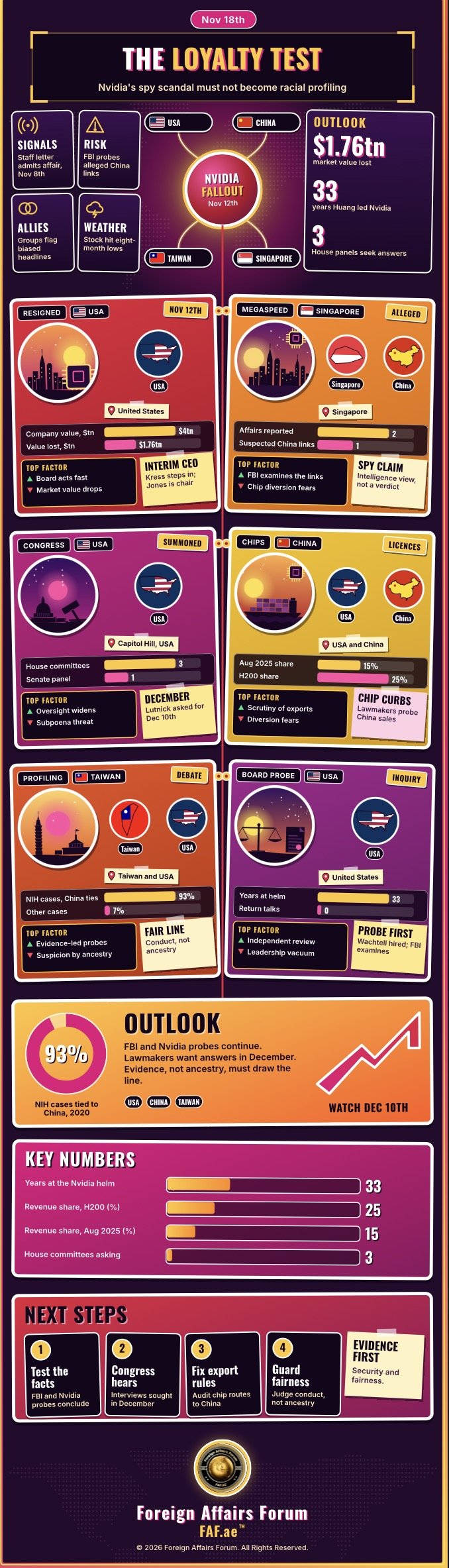
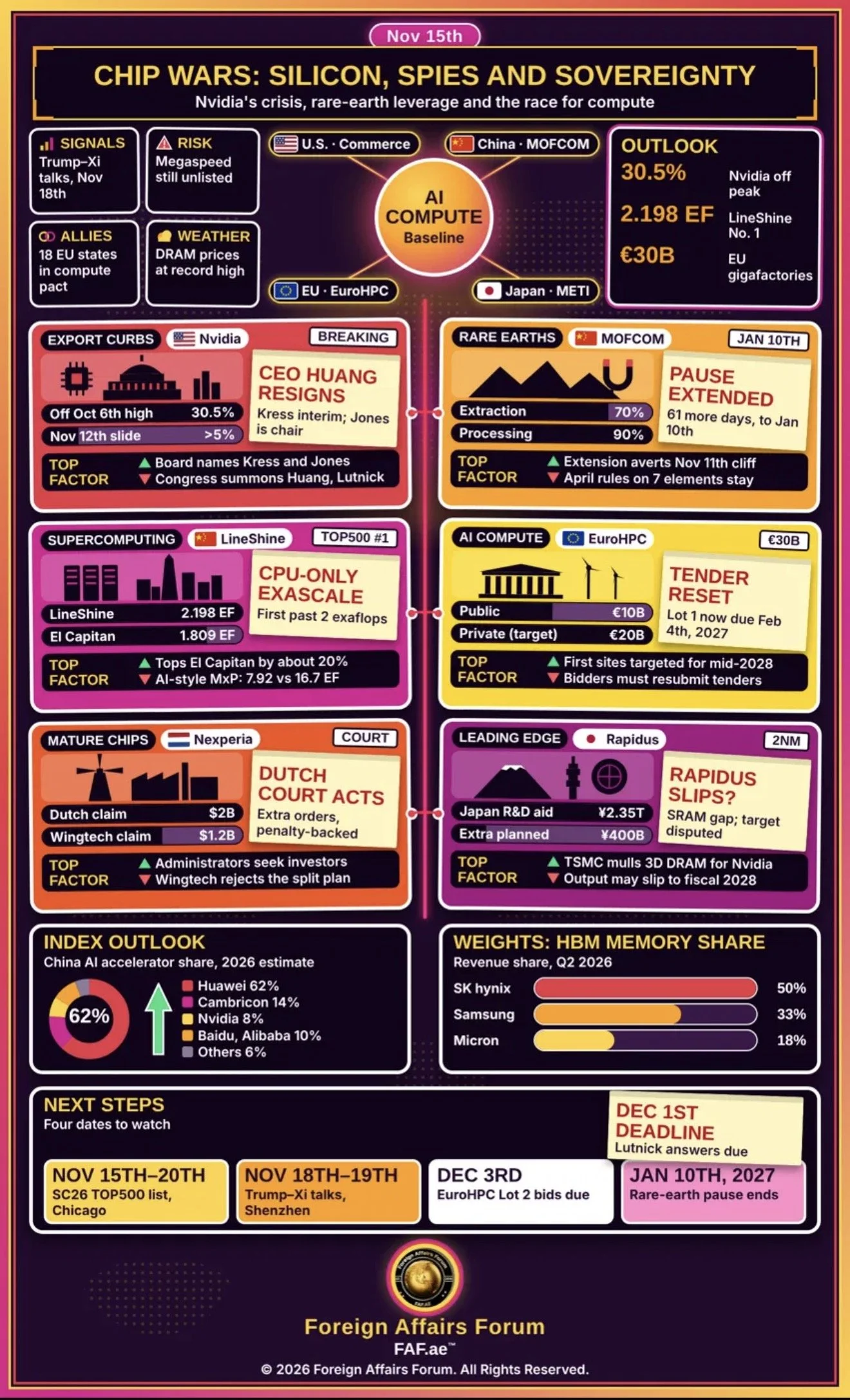
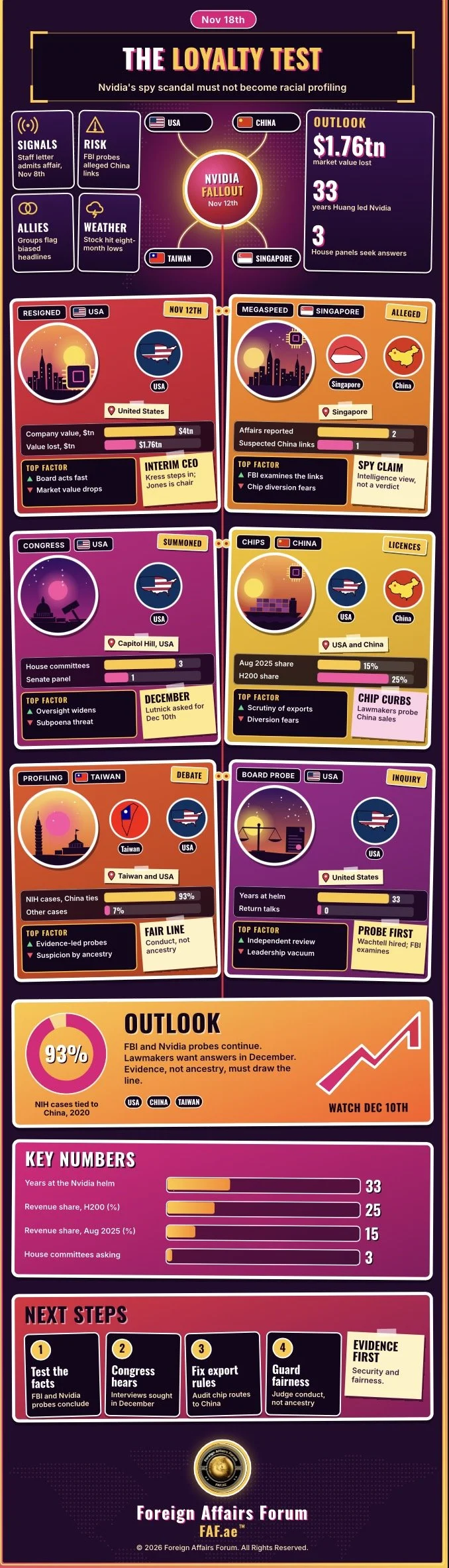
On Nov 12th, Jensen Huang stepped down as chief executive of Nvidia. He had led the company for thirty-three years. Nvidia makes the computer chips that power most advanced artificial intelligence, and under Huang it grew into a company worth $4 trillion.
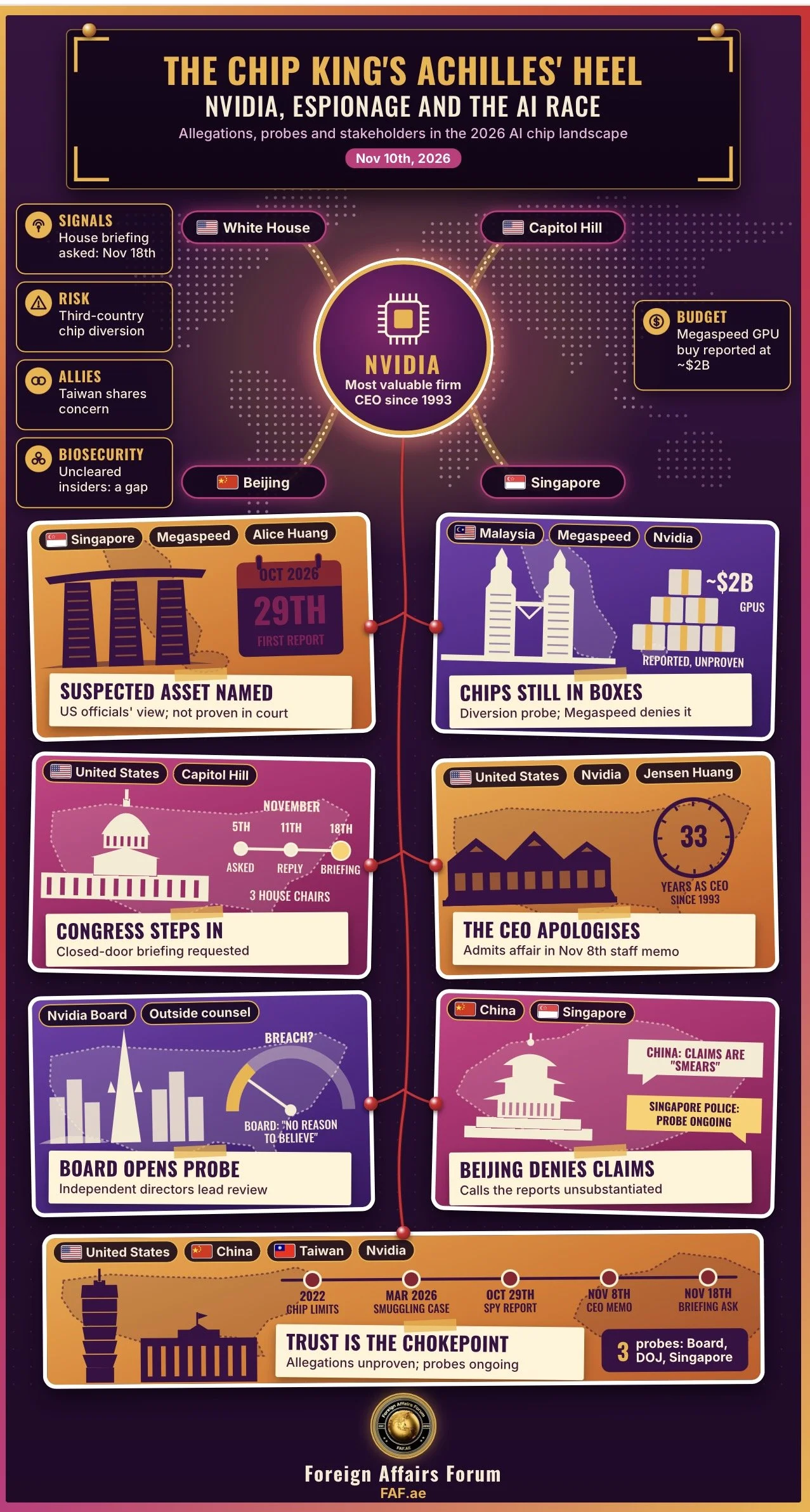
His exit followed news reports about his private life. In a letter to staff on Nov 8th, he said he was sorry for being unfaithful to his wife. Reports said he had relationships with two women. One was a company executive who worked under him. The other was a businesswoman named Alice Huang. She is not related to him, even though they share a surname.
United States intelligence officials reportedly believe Alice Huang was working for the Chinese government. She is a Chinese citizen who once worked as a reporter for Chinese state television, then moved into finance. Around early 2023 she joined a Singapore company called Megaspeed, where she was listed as managing director for its first eight months. American officials suspect that Megaspeed may have helped move restricted Nvidia chips into China. The company says those claims were investigated and found to be wrong last year.
It is important to be clear about what is known. These are reports and suspicions, not court findings. The Federal Bureau of Investigation is looking into Alice Huang's alleged links. Nvidia has said that Huang does not freely share sensitive information with business contacts. No one has proved that he helped China.
Why it matters so much
Chips like Nvidia's are now a form of national power. The United States limits which of them can be sold to China, because they help train powerful artificial intelligence systems. So it is reasonable to worry when the head of the leading chip company is close to someone suspected of working for a foreign government. Spy agencies have long used personal relationships to reach people who hold valuable secrets.
The fallout has been large. Nvidia reportedly lost about $1.76 trillion in market value, and its share price fell to its lowest level in eight months. The finance chief, Colette Kress, is now the temporary chief executive. The board has named Harvey C. Jones as its first chair and hired a law firm to help. A person close to the board says it is not planning to bring Huang back.
Congress has reacted quickly. Three House committee chairmen asked Huang for interviews in December. A senator who leads the Senate Banking Committee asked Huang and Commerce Secretary Howard Lutnick to testify, and he wants Lutnick to appear on Dec 10th. He has warned that he could use subpoenas. Other lawmakers want to know why Megaspeed was allowed to keep buying chips after officials reportedly raised concerns.
The risk of blaming the wrong people
There is a second story inside this one. Jensen Huang was born in Taiwan and moved to the United States as a child. Many Asian Americans saw his success as proof that immigrants could reach the top of American business. Now some of them worry that the scandal will make people suspect all Asian Americans.
Their worry has a basis in history. In 1882, the United States passed a law that stopped Chinese workers from coming in. In 1942, the government forced about one hundred and twenty thousand people of Japanese ancestry into camps, and most of them were American citizens. In 1999, a Taiwanese American scientist named Wen Ho Lee was accused of giving nuclear secrets to China. Nearly all of the charges were dropped, and the judge apologised to him. Other Chinese American scientists were later charged in cases that fell apart.
A government program called the China Initiative, which ran from 2018 to 2022, was meant to stop spying and theft of research. Critics said it ended up targeting scientists because of their ethnic background. In 2020, a health agency official said that 93% of the cases it was investigating involved ties to China. Many scientists of Chinese descent told researchers they felt unsafe and unwelcome in the country.
Today, some Asian American groups have criticised newspaper headlines that played on the Huang name in ways they say push suspicion onto a whole community. At the same time, some commentators in China say Huang fell because of his heritage, not his affairs. There is no evidence for that claim. But Beijing has every reason to repeat it if America looks unfair.
What Dr. 🆎 says
Dr. 🆎 is an expert in superintelligence, AI warfare and the risks of biological attacks, and he focuses on how technology and global security connect. He says two things are true at the same time. The threat from foreign spying is real. And judging people by their ancestry is not a way to stop it.
He explains that good counterintelligence works like a search for a needle in a haystack. If investigators suspect everyone with a Chinese, Taiwanese or Korean background, the haystack gets bigger and the needle gets harder to find. They waste time on innocent people while real spies who do not fit the profile slip through. People who fear unfair treatment also become less willing to report when a foreign agent approaches them.
Dr. 🆎 also warns about the contest for artificial intelligence. America needs the best engineers and scientists from around the world, and many come from Asia. If those people decide that they will always be doubted, they may leave, and some may go to work for America's rivals. He says the winner of the technology race will be the country that has the most computing power, the best talent and the most trust. Trust is the hardest of the three to build and the easiest to lose.
What should be done
First, investigators should be given time to find out what really happened. Officials should say clearly what is proven and what is only suspected. Second, technology companies should train their top leaders about how foreign spies work. Rules about disclosing close relationships should apply to every executive in the same way, no matter where they or their families come from.
Third, the government should fix how it handles chip sales. Right now, the United States takes a share of the money from some chip sales to China: 15% under a deal made in Aug 2025, and 25% for the newer H200 chips. Such deals may make business sense, but they can create pressure to say yes when caution is needed. Chip sales should stop at once if there are serious warnings about a buyer.
Fourth, Congress should use its hearings to test evidence about the licence process, the company's security and the way warnings were handled. Hearings should not become shows about identity. Fifth, America should work closely with partners such as Taiwan, South Korea, Japan, the Netherlands and Singapore. Chips pass through many countries, and every one of them must trust the others.
The main message
The Nvidia case should be investigated seriously. If Huang or anyone else helped a foreign spy service, they should face the consequences. Companies and the government should also fix the weak spots the case has shown.
But the country should not answer fear by blaming people for their family history or their face. History shows that this approach hurts innocent people and does not make the nation safe.
Dr. 🆎 puts it this way: a country that guards its secrets by distrusting its own people gives up the very thing the secrets are meant to protect. The real test of loyalty is whether the nation stays true to its own fair principles when it is afraid.