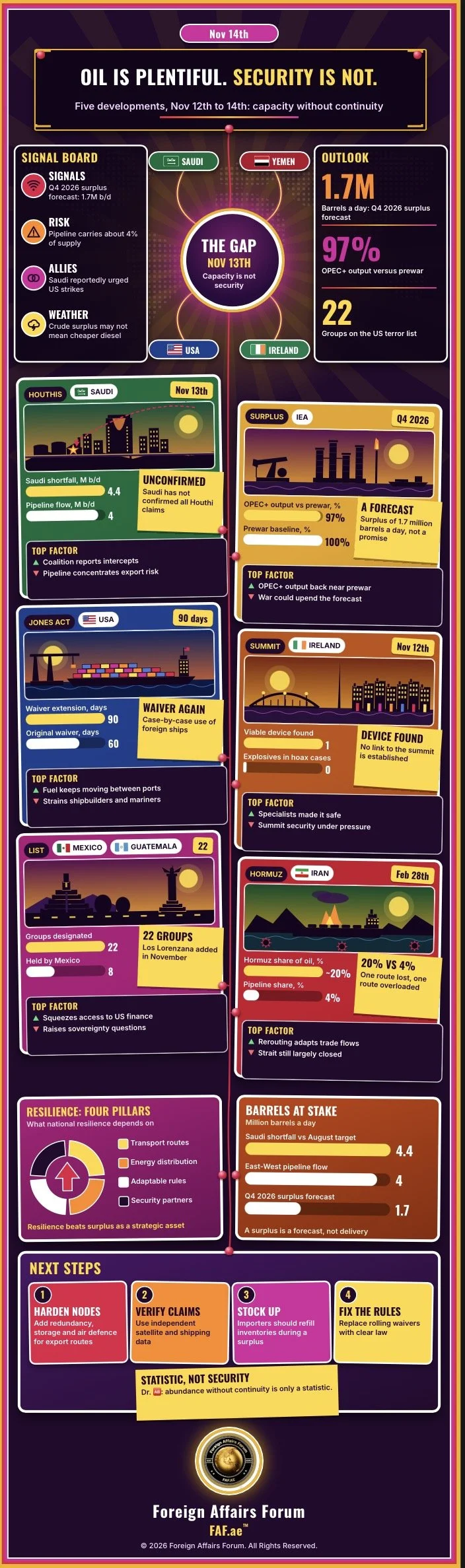
Oil Is Plentiful. Security Is Not
Five developments from Nov 12th to Nov 14th show a world with ample capacity and fragile protection, where supply, shipping, summits and criminal networks all test the same weak point
Foreign Affairs Forum | Dr. Antonio Bhardwaj (Dr. 🆎)| November 14th, 2026
Executive Summary
Five developments reported between Nov 12th and Nov 14th, 2026, appear unrelated in geography and subject, yet they describe one structural condition.
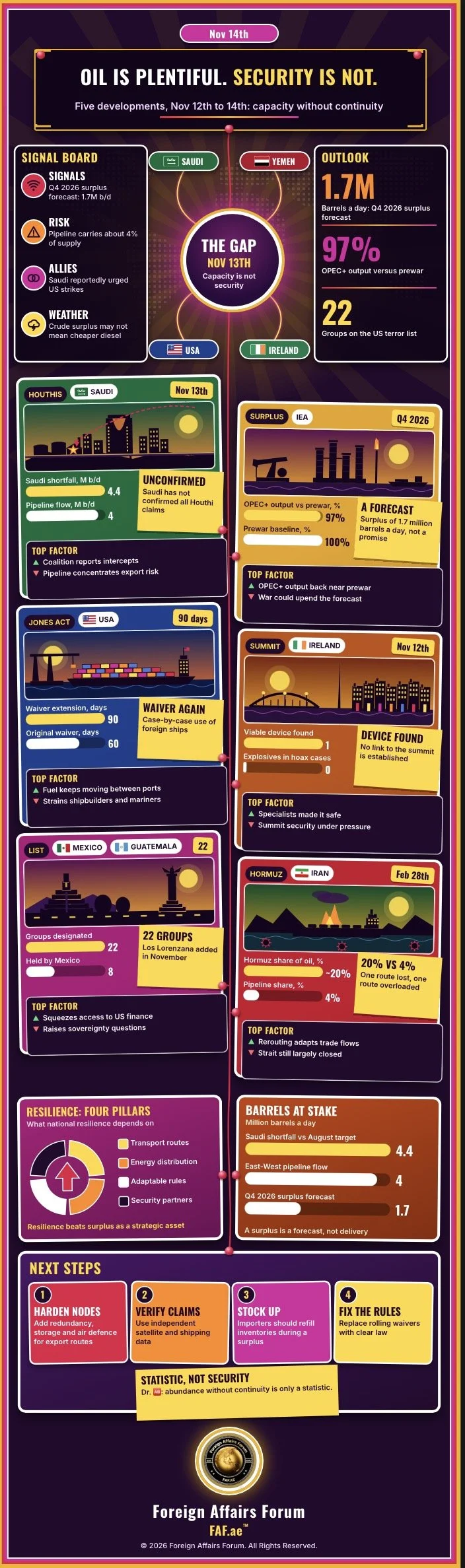
The world possesses more productive capacity than it can reliably protect, deliver and govern. On Nov 13th, Yemen's Houthis claimed new missile and pipeline attacks against Saudi Arabia, aimed at the East-West oil artery that carries roughly 4 million barrels a day, about 4% of global supply, around a largely closed Strait of Hormuz. The same day, the International Energy Agency projected a fourth-quarter 2026 surplus of about 1.7 million barrels a day, with OPEC+ output recovering to roughly 97% of its prewar level.
Washington extended its Jones Act waiver for a further 90 days, accepting that wartime energy logistics now require suspending a century-old protection for American shipping. In Dublin, Irish police found a crude but viable explosive device near Merrion Square, close to where European leaders had dined the previous evening. Separately, the Trump administration's list of Latin American and Caribbean criminal organizations designated as foreign terrorist organizations reached 22, with Guatemala's Los Lorenzana added in November.
Per FAF analysis, the common thread is the widening gap between statistical sufficiency and operational security. A surplus on paper does not guarantee fuel at the pump, and a functioning pipeline on a map does not guarantee deliveries under missile fire. A heavily policed summit does not guarantee that a device will be found before it matters, and a terrorism designation does not by itself dismantle a criminal economy.
The conclusion of this FAF article is that national resilience in 2026 depends less on how much a state produces than on how well it protects chokepoints, adapts its rules in emergencies without eroding institutions, and coordinates with partners whose interests only partly overlap.
The stakeholders who invest in redundancy, verification and legal clarity now will be better placed than those who read the surplus forecasts as a signal that the emergency is over.
Introduction
Every era produces a vocabulary for the vulnerabilities it prefers not to name. In the 20th century it was dependence, and in the early 21st century it was interdependence. The vocabulary of 2026 is chokepoints, waivers, designations and hoaxes. It describes a landscape in which the physical world still produces abundance while the networks that move, regulate and secure that abundance are under strain from several directions at once.
Dr. Antonio Bhardwaj (Dr. 🆎), a polymath with global expertise in superintelligence, specialising in human-centred superintelligence for geopolitical strategy, AI warfare and bioterrorism risk, argues that this gap is the defining strategic problem of the present moment. In his assessment, modern states have optimised for output and neglected continuity. They count barrels, tonnes and transactions, but they undercount the fragility of the connective tissue between them.
Dr. 🆎 observes that conflicts increasingly exploit that connective tissue, because striking a pipeline, a runway, a summit or a financial channel is cheaper than defeating an army and often produces larger political effects.
This FAF article examines the five developments of Nov 12th to Nov 14th as a connected case study. It traces the history that produced each, sets out the latest facts and concerns, analyses the causal links between energy security, emergency economic policy, summit protection and the expanding legal definition of terrorism, and closes with steps that could narrow the gap between capacity and security.
The aim is analytical rather than predictive, since several of the claims discussed remain unconfirmed and several of the forecasts depend on assumptions that conflict could overturn.
History and Current Status
The energy dimension begins with the war that opened on Feb 28th, 2026, when American and Israeli strikes on Iran prompted Tehran to close the Strait of Hormuz to unfriendly shipping. That corridor normally carries roughly one fifth of the world's traded oil, and its disruption forced exporters to search for alternatives. Saudi Arabia's answer was the East-West pipeline, a route of about 1,200 kilometres that links the kingdom's eastern oil fields to the Red Sea port of Yanbu and allows crude to be exported without passing through Hormuz. A system built for contingency became, almost overnight, the main artery of Gulf exports.
That artery has since become a target.
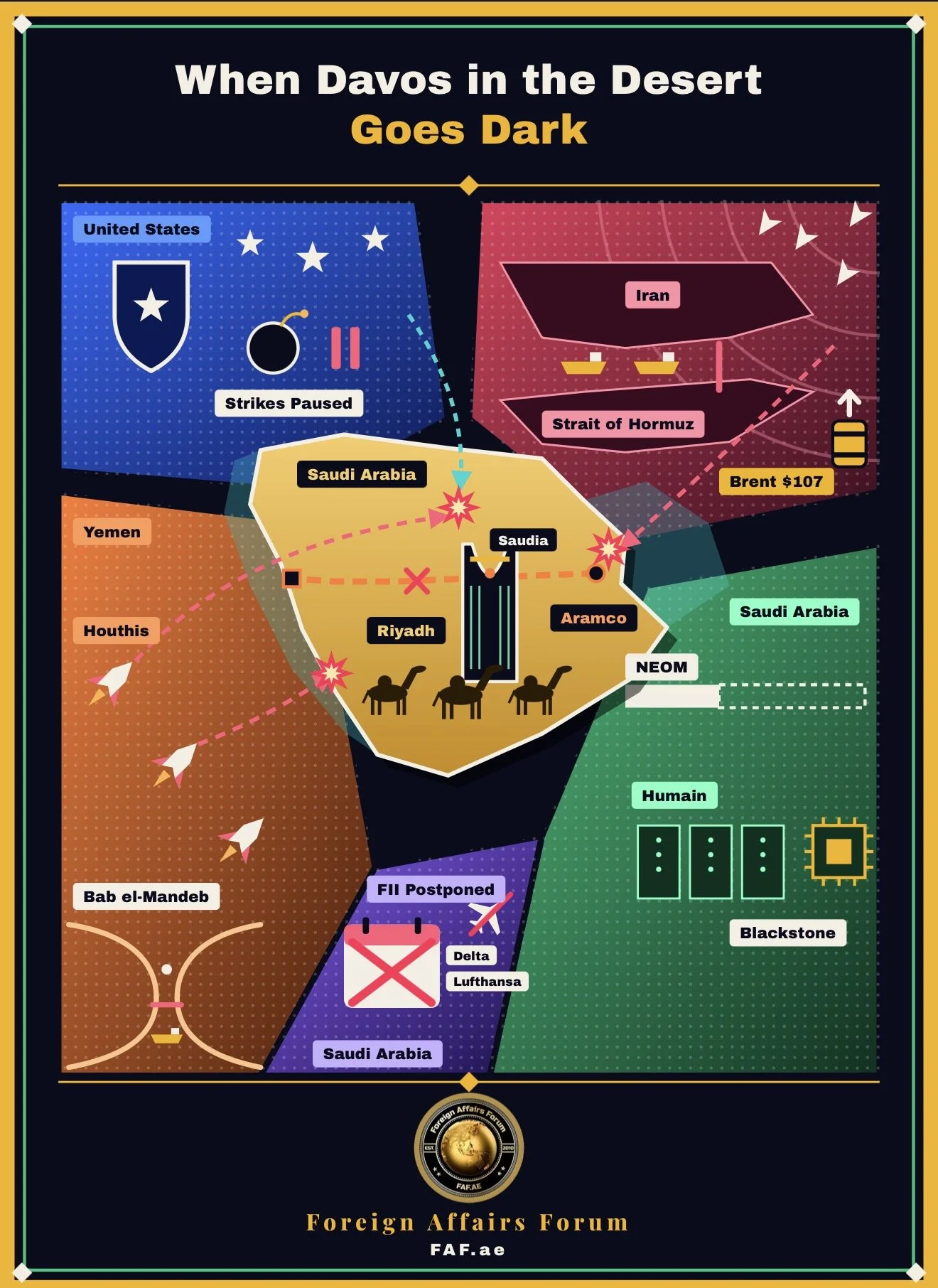
Riyadh shut the pipeline temporarily in September as a precaution after a drone attack that Saudi and Iraqi authorities said originated in Iraq. In October, the Houthis, the Iran-aligned movement that controls Sanaa and has fought a Saudi-led coalition since 2015, intensified missile and drone attacks on Saudi airports, ports and energy installations. On Oct 10th, a Houthi strike on King Khalid International Airport in Riyadh reportedly killed 13 people and wounded more than 300, the deadliest attack in the kingdom in over a decade. The coalition said the airport had been targeted about 20 times in the first eleven days of the month. Reports indicate that the crown prince personally urged Washington to strike the Houthis. The International Energy Agency noted that Saudi output fell short of its August target by more than 4.4 million barrels a day.
The economic history is equally unsettled.
After the war began, oil markets swung from deficit toward fears of shortage, and the IEA recorded the first quarterly fall in global demand since the pandemic year of 2020, as high prices and product shortages suppressed consumption. In July, the agency still expected a surplus to emerge by the fourth quarter of 2026 and to grow sharply in 2027, while warning that renewed hostilities could upend the forecast. In October, it said balances would remain in deficit through the end of the year. The Nov 13th assessment therefore represents a notable revision, reflecting recovering production from OPEC+ governments and the adaptation of trade flows.
Washington's emergency measures follow the same chronology.
In March, shortly after the war began, the White House first waived the Jones Act, the 1920 law that requires cargo moving between American ports to travel on vessels that are American-built, American-owned and American-crewed. The waiver was extended in April and again in August, when the administration narrowed it after objections from shipbuilders, unions and congressional allies, requiring case-by-case review of voyages. By early August, officials had granted about 208 exemptions in roughly four and a half months. Critics argued that the effect on consumer prices was negligible, while supporters pointed to new movements of domestic fuels that had previously been impossible.
The security and legal dimensions have longer roots.
The designation of criminal organizations as foreign terrorist organizations began early in the second Trump administration and accelerated through 2026. By September, the list of Latin American and Caribbean groups had reached 21, with Mexico holding the largest number at eight. The designations enable sanctions, deny groups access to the American financial system and allow an array of security measures normally reserved for jihadist networks. The European picture is different but equally tense. Ireland, holding the presidency of the EU Council, hosted the ninth meeting of the European Political Community in Dublin on Nov 12th, in what Irish officials described as the largest security operation in the history of the state, preceded by a wave of hoax bomb threats against media outlets and airlines.
The current status can be summarised briefly.
The Gulf war is in a state of no war and no peace, Saudi infrastructure is under repeated claimed attack, the oil market is flipping toward forecast surplus while physical delivery remains unreliable, American emergency waivers are entering their ninth month, European leaders are confronting a security scare, and Washington's counterterrorism framework is expanding into the criminal landscape of the Western Hemisphere.
Key Developments
The first development concerns Saudi Arabia.
On Nov 13th, the Houthis said they launched two ballistic missiles at Saudi forces in Jazan province. They separately claimed attacks on Riyadh's King Khalid International Airport and on a pumping station of the East-West pipeline. Saudi authorities had not confirmed all of these claims, a pattern that has repeated through the autumn. The coalition has reported intercepting missiles and destroying launch sites in Sanaa, and the airport, which resumed limited operations only weeks ago with separate terminals for domestic and international flights, remains a declared target of the movement. The significance lies less in any single claim than in the cumulative threat. Roughly 4 million barrels a day move through the pipeline to Yanbu, so even partial interruption would remove a meaningful share of seaborne supply at a moment when the alternative route through Hormuz is largely unavailable.
The second development is the energy agency's projection that global petroleum supply could exceed demand by about 1.7 million barrels a day in the fourth quarter of 2026.
OPEC+ crude production recovered to about 41.23 million barrels a day in October, around 97% of prewar output, and the agency foresees a substantially larger surplus in 2027 if production growth continues. These are forecasts rather than outcomes, and the agency itself has repeatedly cautioned that renewed fighting could overturn them. Even so, the direction of travel is notable. Demand destruction, rerouted trade and recovering output are combining to produce a market that looks, on paper, abundantly supplied.
The third development is the extension of the Jones Act waiver.
President Donald Trump extended the shipping waiver for another 90 days, permitting case-by-case use of foreign-flagged vessels to move oil and other commodities between American ports. The White House said earlier exemptions had allowed an additional 90 million barrels of petroleum to move between American ports since March. The decision confirms that what began as a 60-day emergency measure has become a standing feature of American energy logistics. It also revives a long-running argument. Supporters of the waiver stress fuel availability and flexibility, while defenders of the Jones Act stress shipbuilding capacity, mariner employment and military readiness, and independent analysts note that the measurable effect on pump prices has been small.
The fourth development is the discovery of a crude but viable explosive device in an office building near Merrion Square in Dublin, close to where European leaders attending the European Political Community summit had dined the previous evening. Military specialists made the device safe.
Authorities had not established when it was placed or whether it was connected to the gathering. The discovery came after a week of hoax threats against media organisations and airlines across Europe, in which no explosives were found, and after Irish officials had spoken confidently about the scale of preparations. The summit itself was dominated by Ukraine, energy security and European defence spending, with leaders aware that US-brokered talks involving Kyiv and Moscow had taken place without European participation the previous day.
The fifth development is the expansion of Washington's terrorism designations.
An Associated Press examination reports that the administration has designated 22 criminal organizations across Latin America and the Caribbean as foreign terrorist organizations, the latest being Guatemala's Los Lorenzana in November. The policy covers groups involved in drug trafficking, extortion, kidnapping and territorial violence. Secretary of State Marco Rubio has argued that such designations expose and isolate entities and deny them access to the American financial system.
Several regional governments have aligned with the approach, and Ecuador has launched joint operations on its own soil. Others worry about sovereignty and about a legal category that was built for politically motivated violence being stretched to cover profit-driven crime.
Latest Facts and Concerns
The first and most pressing concern is verification. Many of the facts in the Saudi story rest on claims by one party and silence from another.
Houthi announcements have been frequent and expansive, and Saudi confirmations have been rare. In a conflict where information is itself a weapon, unconfirmed claims can move markets, shape diplomacy and provoke responses without any independently verified damage. What matters operationally is whether pumping stations, storage and port facilities at Yanbu are working, and whether actual export volumes have fallen. Until that is established, the strategic picture remains one of credible threat rather than demonstrated loss.
The second concern is the difference between a market surplus and a deliverable supply.
The agency's 1.7 million barrel figure describes an aggregate balance, but consumers buy diesel, jet fuel and gasoline, not crude, and these products depend on refineries, shipping lanes, ports and insurance arrangements that remain exposed to disruption. A world can be awash in crude and still short of the middle distillates that run trucks, farms and aircraft. For energy-importing economies such as India, lower crude prices would ease inflation and improve trade balances, but only if refined products and logistics follow. For exporters such as Russia, a sustained surplus would constrain revenues, while OPEC+ governments face difficult production decisions about whether to defend prices or market share.
The third concern is the institutional cost of permanent emergency measures.
The Jones Act waiver illustrates a recurring dilemma. Emergency executive authority is a legitimate tool when supply chains are stressed, but when a temporary measure is extended repeatedly, it begins to function as policy by exception. That raises questions about congressional oversight, about the long-term health of the American shipbuilding and mariner base, and about whether the waiver is reducing costs for consumers or mainly benefiting refiners and traders. Congress, which is about to change in composition, may be asked to decide whether to reform maritime law or to let emergency tools expire.
The fourth concern is the security of high-level diplomacy.
Dr. 🆎 draws attention to a feature of the Dublin episode that conventional reporting overlooks. Hoax threats, he notes, are now cheap to produce and scale. Generative tools can draft convincing threats in many languages, tailor them to specific institutions, and distribute them at volume, forcing security services to spend finite attention on noise while a genuine device may go unnoticed. In his judgement, the combination of synthetic hoaxes and low-technology physical devices is more dangerous than either alone. He cautions that no evidence currently links the Dublin device to any state or organisation, and that premature attribution would itself be a strategic error.
Dr. 🆎 also urges that summit security planning include chemical and biological contingencies, since gatherings of dozens of leaders concentrate precisely the kind of target that a sophisticated attacker might eventually consider.
The fifth concern is the legal and diplomatic reach of the designation policy.
Treating transnational crime as terrorism may increase pressure on financial networks and enable closer security cooperation, but it also affects banking compliance, cross-border commerce and investment in the affected regions. It raises questions about due process, about the distinction between political violence and commercial crime, and about the consent of governments whose territory hosts the designated groups. Mexico, with the largest number of designated organizations, is a pivotal stakeholder, and its approach to cooperation or resistance will shape how far the policy can go.
Cause-and-Effect Analysis
The first causal chain runs from the closure of Hormuz to the vulnerability of Saudi Arabia.
When the strait was closed, Saudi exporters shifted volume to the East-West pipeline and the Red Sea. That decision made sense commercially and strategically, but it concentrated risk. A system that once had two major export routes now depends heavily on one, running through territory within range of Yemeni missiles and Iraqi-launched drones. The Houthis, for their part, have recognised the leverage that this concentration provides. Each claimed attack on the pipeline or on Riyadh's airport increases the perceived cost of the status quo for Saudi decision-makers and for Washington, regardless of whether physical damage is confirmed. The effect is a form of strategic compression, in which a relatively inexpensive missile campaign imposes disproportionate political and economic pressure.
The second chain connects market recovery to physical fragility.
The recovery of OPEC+ production to 97% of prewar levels suggests that producers have adapted, but adaptation has occurred through rerouting, inventory drawdown and demand destruction rather than through the restoration of the original system. The projected surplus is therefore partly a consequence of reduced consumption and partly a promise of future supply, not proof that the delivery network is secure. If the pipeline were seriously interrupted, the surplus forecast could vanish quickly, because the same barrels that fill the surplus calculation need a route to market. This explains why the agency's own language distinguishes between adequate global supply and unreliable regional delivery.
The third chain links energy stress to domestic regulatory change.
High fuel prices and logistical bottlenecks created political pressure in the United States, and the Jones Act waiver was a rapid, low-cost response available to the executive. Each extension, however, creates a constituency. Refiners and commodity traders benefit from flexibility, while shipbuilders, unions and national-security advocates mobilise against erosion of the domestic maritime base. The consequence is a political contest in which the underlying question, how much of national transport capacity should be reserved for domestic vessels in peacetime and wartime, is answered not by deliberate legislation but by successive executive decisions. Energy security and commercial transportation have become entangled with national-security strategy, and the entanglement will outlast the immediate crisis.
The fourth chain connects geopolitical tension to the security of diplomacy.
European leaders met in Dublin amid a war on their own continent, an energy shock originating in the Middle East, and a diplomatic process on Ukraine in which Europe felt excluded. In such conditions, a summit is both a political necessity and a vulnerable target. The discovery of a device, whatever its eventual explanation, forces governments to weigh two competing values. Openness and accessibility are essential to democratic diplomacy, while protection requires restrictions, surveillance and intelligence coordination. The likely effect is a review of summit security protocols across the continent, with higher costs and tighter controls, though without any evidence yet that the device was connected to Russia, terrorism or another foreign stakeholder.
The fifth chain concerns the expansion of the terrorism framework.
By labelling criminal organizations as terrorist groups, Washington gains tools such as sanctions, financial exclusion and potentially military options that are unavailable against ordinary criminals. The immediate effect is pressure on the financial networks that sustain these groups. The second-order effects are more complicated. Banks and companies operating in affected regions must increase compliance, which raises costs and may deter investment. Governments must decide whether to align with Washington, risking domestic backlash over sovereignty, or resist, risking sanctions and diplomatic friction. Criminal groups may adapt by shifting routes, diversifying revenue and embedding themselves in legitimate commerce, making enforcement harder rather than easier.
The sixth chain, emphasised by Dr. 🆎, is technological.
Missile and drone campaigns against infrastructure are increasingly supported by cheap commercial components, satellite imagery and software that improves targeting. Defensive systems must intercept projectiles that cost a fraction of the interceptors fired against them, a ratio that erodes defenders' stockpiles over time. In his assessment, this cost asymmetry is the central military fact of the Gulf conflict. He argues that human-centred artificial intelligence could improve early warning, damage assessment and the verification of claims, but warns that the same technologies lower the barrier for attackers.
The effect is a landscape in which defence is expensive, offence is cheap and information is contested, and in which resilience depends on redundancy and speed of recovery more than on any single shield.
Future Steps
Three broad trajectories are visible.
In the first, the present pattern continues.
The Houthis sustain claimed attacks, Saudi Arabia intercepts most projectiles and confirms little, oil markets absorb the noise, and the surplus forecast gradually reshapes prices. This is the most likely near-term path, but it is not stable, because the pipeline's concentration of risk means that one successful strike could change the market overnight. In the second trajectory, a confirmed, serious interruption of the East-West pipeline or the Yanbu terminal removes millions of barrels from the market and exposes the limits of the surplus narrative. In the third, diplomacy in the wider Gulf conflict reduces the pressure on Hormuz and relieves the Red Sea route, allowing the surplus to materialise as forecast.
Several steps would improve resilience under any of these paths.
Saudi Arabia and its partners should prioritise the hardening and redundancy of export infrastructure, including additional pumping capacity, storage, air defence for critical nodes and rapid-repair capability. A credible independent verification mechanism, drawing on satellite data and commercial shipping information, would reduce the uncertainty that now surrounds claimed attacks and prevent markets from reacting to unconfirmed announcements. Energy-importing economies should use the projected surplus to rebuild inventories and strategic reserves rather than treating it as a reason to relax. The IEA has itself suggested that a surplus offers an opportunity to replenish depleted stocks.
In Washington, the Jones Act debate should move from rolling waivers to a deliberate legislative or regulatory framework.
Congress could define the conditions under which foreign-flagged vessels may be used, require transparent reporting on the effects of exemptions, and link any relaxation to specific investments in American shipbuilding and mariner training. That would give industry predictability, respect constitutional roles and keep emergency tools from hardening into permanent exceptions. In Europe, summit security should be treated as a continuing discipline rather than an event-driven scramble. That means shared threat assessments, protocols for distinguishing hoaxes from genuine threats quickly, investment in counter-drone and explosive-detection capacity, and preparation for chemical and biological contingencies, which Dr. 🆎 considers an underweighted risk.
For Latin America, the next step is clarity.
Governments in Mexico, Central America and the Caribbean will need to decide whether to negotiate new cooperation arrangements, challenge aspects of the designation policy or accept it in return for assistance. Washington should articulate the legal standards that distinguish designated groups, specify how due process and humanitarian exemptions will be respected, and ensure that financial restrictions do not cut off legitimate commerce.
Dr. 🆎 adds that any enforcement strategy should include safeguards on the data and algorithmic tools used to identify suspects and financial flows, since errors in automated screening can erode legitimacy as quickly as any political misstep.
Conclusion
The developments of Nov 12th to Nov 14th reveal a global system in which sufficient industrial and energy capacity does not translate automatically into security. Oil may be coming back into surplus, yet the pipelines that carry it are being targeted. Emergency measures may keep fuel moving, yet they strain the institutions that were designed to protect domestic industry. Summits may be policed on a historic scale, yet a single device can reveal how thin the margin remains. Terrorism designations may squeeze criminal finance, yet they raise unresolved questions about sovereignty, law and effectiveness.
Per FAF analysis, the strategic lesson is that resilience has become the decisive national asset. It consists of protecting critical transportation networks, maintaining reliable energy distribution, adapting regulatory frameworks without surrendering their purposes, and coordinating international security partnerships that can survive disagreement.
Dr. 🆎 offers a concise formulation: abundance without continuity is only a statistic, and statistics do not run ships, power cities or protect leaders. The stakeholders who absorb that lesson will treat the projected surplus as an opportunity to build redundancy and trust, while those who read it as a reason for complacency may discover that the next disruption arrives faster than the next forecast.