The Country Everyone Else Fights In - Lebanon
Foreign Affairs Forum | Dr. Antonio Bhardwaj (Dr. 🆎)| Nov 14th, 2026
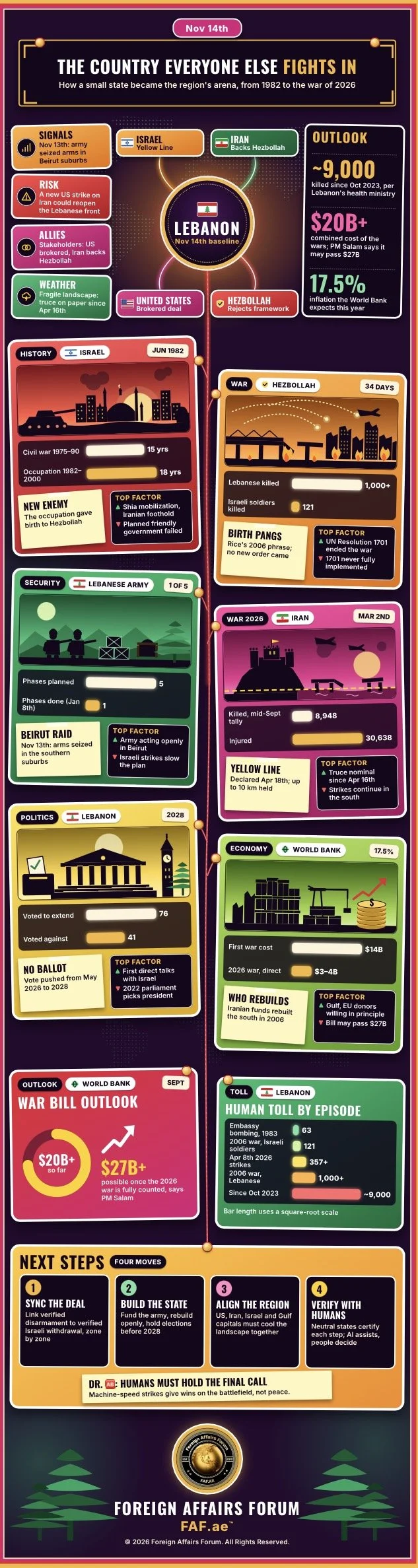
From the 1982 Israeli invasion to the war of 2026, Lebanon has served as the arena where the Middle East settles its quarrels, and the bill keeps landing in Beirut
Executive Summary
Per FAF analysis, Lebanon's modern history is the story of a small, sectarian and chronically underpowered state whose territory became the preferred venue for contests among far larger stakeholders.
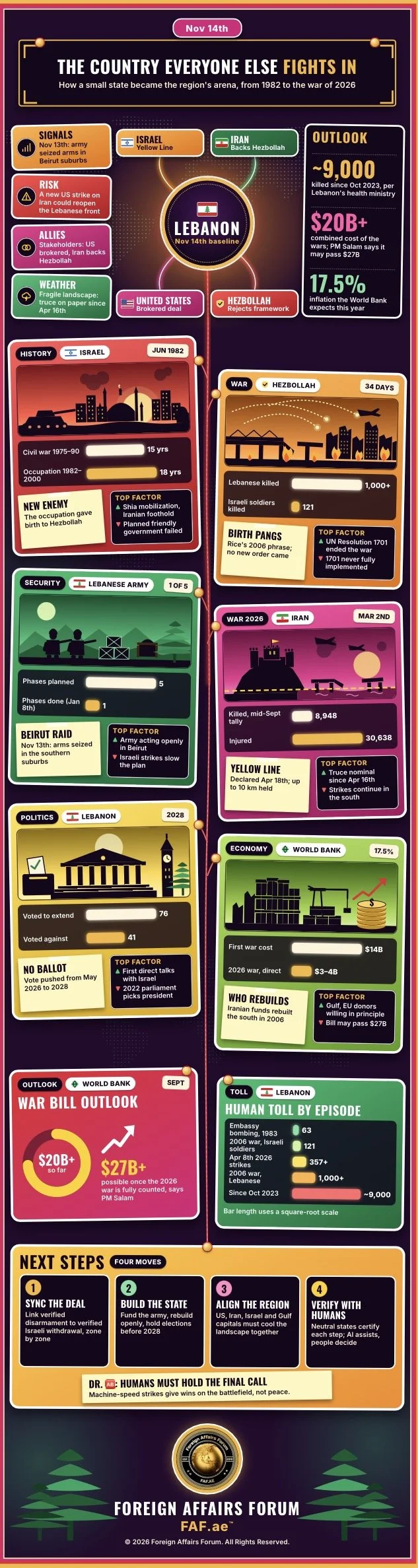
The 1982 Israeli invasion was the hinge. It aimed to destroy the Palestine Liberation Organization and reorder Lebanese politics, yet it produced the occupation that gave birth to Hezbollah, which in turn became the most consequential non-state military force in the region. The 2006 war, which Washington optimistically framed as the birth pangs of a new Middle East, merely froze that dynamic. The cycle resumed after Oct 8th, 2023, intensified in the autumn of 2024, and exploded again after Mar 2nd, 2026, when Hezbollah opened fire in the wake of the American and Israeli war on Iran.
The current landscape is a fragile, partial and unequal truce. A temporary ceasefire has nominally held since Apr 16th, yet Israel occupies a belt of southern Lebanon of up to ten kilometres behind a so-called Yellow Line, continues demolitions and air strikes, and has accused the Lebanese army of failing its obligations under a US-brokered framework. The Lebanese health ministry counts around 9,000 deaths since Oct 2023, and Prime Minister Nawaf Salam says the combined cost of the wars will exceed $20 billion and could surpass $27 billion. Parliamentary elections have been postponed to 2028. Hezbollah rejects the framework, yet Lebanese troops are now raiding its depots, even in Beirut's southern suburbs.
Dr. 🆎 argues that the decisive variable is no longer firepower but the legitimacy of the Lebanese state, and that without a credible, verifiable and human-centred settlement the next escalation is a matter of timing rather than possibility.
Introduction
In July 2006, as Israeli bombs fell on Lebanese ports, roads and bridges and Hezbollah rockets rained on northern Israel, then US Secretary of State Condoleezza Rice described the carnage as the birth pangs of a new Middle East.
More than three hundred Lebanese had already died. By the end, over one thousand people in Lebanon and one hundred and twenty-one Israeli soldiers were dead. The phrase has aged poorly. The new Middle East it promised never arrived, and twenty years later Lebanon is again burying its dead, counting its displaced and bracing for another round.
The question worth asking is why this particular country, smaller than Connecticut and home to a population of only a few million, repeatedly becomes the place where regional rivalries are fought out.
Dr. Antonio Bhardwaj (Dr. 🆎), a polymath with global expertise in superintelligence, specializing in human-centred superintelligence for geopolitical strategy, AI warfare and bioterrorism risks, offers a blunt answer: Lebanon is what happens when a state is too weak to monopolize force, too diverse to be governed by a single narrative and too strategically placed to be left alone. Every stakeholder with a grievance finds a Lebanese partner, and every Lebanese faction finds an outside patron.
This FAF article traces that pattern from its modern origins in the 1982 invasion to the war that began in March 2026 and the uneasy settlement now being negotiated. It examines the history that shaped the present, the developments of the past year, the latest facts and concerns, the causal chains that keep reproducing violence, and the steps that might finally interrupt them. The argument is not that Lebanon is condemned to be a battlefield. It is that the conditions making it one are the product of identifiable choices, and therefore reversible ones.
History and Current Status
Lebanon's vulnerability is rooted in its design.
The 1943 National Pact distributed power among confessional communities according to a census that was already contested, and the arrangement left the central state dependent on sectarian bargains rather than on a shared national project. When Palestinian guerrillas relocated to Lebanon after being expelled from Jordan in 1970, they added an armed, extraterritorial stakeholder to a society already divided over its identity and its alliances. The civil war that erupted in 1975 drew in Syria, Israel, the Palestinian movement and a host of outside patrons, and it lasted until 1990. Scholars have long argued that Lebanon moved from the periphery to the centre of Middle Eastern politics precisely because Palestinian, Israeli and Syrian interests converged on its soil.
The Israeli invasion of June 1982 turned that convergence into catastrophe.
Israel's declared aim was to push the PLO out of artillery range of its northern towns, but its strategic ambition was far larger: to destroy the Palestinian national movement in Lebanon, expel Syrian forces and install a friendly Maronite-led government in Beirut.
Beirut became the first Arab capital to be occupied by Israel. The siege of the city and the ensuing departure of PLO fighters were followed by the assassination of president-elect Bashir Gemayel in Sept 1982 and the massacres at the Sabra and Shatila camps, carried out by Christian militiamen while Israeli forces controlled the area. The government Israel wanted never materialized, and the occupation that followed became a political liability at home and a recruiting poster abroad.
What the invasion did produce was Hezbollah.
Iranian Revolutionary Guard officers, already present in the Bekaa Valley, found fertile ground among Lebanon's long-marginalized Shia community, who had watched Israeli tanks roll through their villages.
In 1983 the bombing of the US embassy in Beirut killed sixty-three people, and later that year the attack on the American and French barracks killed hundreds more, prompting the withdrawal of the multinational force. Israel retreated to a self-declared security zone in the south and remained there until May 2000. Hezbollah claimed the withdrawal as a victory, and that claim became the foundation of its legitimacy: a movement that had done what Arab armies could not.
The end of the civil war did not end the militarization of Lebanese politics.
The 1989 Taif Agreement called for the dissolution of militias, but Hezbollah was allowed to retain its arms as a so-called resistance against occupation, and Syrian forces remained the real arbiters of Lebanese politics until the 2005 assassination of former prime minister Rafik Hariri triggered the Cedar Revolution and forced their departure.
The vacuum was filled by Hezbollah, whose arsenal grew with Iranian and Syrian support. In July 2006 its capture of two Israeli soldiers and the killing of eight others prompted the thirty-four-day war that ended with UN Security Council Resolution 1701, which called for Israeli withdrawal and for Hezbollah's disarmament south of the Litani River. Neither provision was ever fully implemented.
The following seventeen years produced a Lebanon that looked stable but was hollow.
The financial system collapsed in 2019, wiping out savings and driving the cumulative decline in gross domestic product to nearly 40% by the end of 2024. The Beirut port explosion of Aug 2020 destroyed a large part of the capital's waterfront.
Political institutions atrophied, with presidential vacancies lasting more than two years. In the 2022 election Hezbollah and its allies lost their parliamentary majority, yet the movement's military autonomy remained untouched. This was the state that entered the war which began after Hamas's attack on Israel on Oct 7th, 2023.
Dr. 🆎 observes that this history carries a lesson that contemporary strategists too often ignore: military victories in Lebanon have repeatedly been converted into political defeats because the underlying structure, a fragmented state hosting armed stakeholders with foreign sponsors, was never altered. Israel's operations destroyed the PLO as a Lebanese force but created Hezbollah. The Syrian order brought stability of a kind but ended in humiliation. Each outside intervention solved yesterday's problem while manufacturing tomorrow's, and the Lebanese state absorbed the consequences.
Key Developments
The war that began on Oct 8th, 2023, when Hezbollah opened a front in solidarity with Hamas, passed through several phases.
In Sept 2024 Israel detonated thousands of booby-trapped pagers and radios used by Hezbollah members, then killed secretary-general Hassan Nasrallah in an air strike on Beirut's southern suburbs.
A ground invasion followed on Oct 1st, and a ceasefire brokered by the United States and France took effect on Nov 27th, 2024. The following month the fall of Bashar al-Assad severed the land bridge through which Iran had supplied Hezbollah for decades. Naim Qassem inherited a movement that was badly weakened, strategically isolated and still armed.
The Lebanese state seized the moment.
President Joseph Aoun and Prime Minister Nawaf Salam, who took office in early 2025, committed their government to the principle that the state alone should bear arms. In Aug 2025 the cabinet tasked the army with a disarmament plan, and in early Sept it adopted the five-phase proposal presented by army commander Rodolphe Haykal.
On Jan 8th, 2026, the army announced that the first phase, covering territory south of the Litani River, was complete, while acknowledging that Israeli attacks, continued occupation of certain positions and delays in promised equipment had slowed progress. The government then said the second phase, between the Litani and the Awali rivers, would need at least four months. Critics noted that the plan for areas north of the Litani was described in Beirut as containment rather than genuine disarmament.
Everything changed on Feb 28th, 2026, when the United States and Israel launched a war on Iran that killed Supreme Leader Ali Khamenei.
On Mar 2nd Hezbollah fired on Israel for the first time since the 2024 ceasefire, saying its aim was to force Israel out of Lebanese territory it still held. Israel responded with air strikes on Beirut and evacuation orders across the south and the Bekaa, and on Mar 16th it launched a ground offensive involving multiple divisions.
The Qasmiyeh Bridge over the Litani was destroyed, the town of Bint Jbeil became the central ground battle, and Israeli officials spoke openly of holding territory up to the Litani. Lebanon's parliament, meeting under fire on Mar 9th, voted 76 to 41 to extend its own mandate by two years, pushing elections back to 2028.
April brought both the worst violence and the first turn toward diplomacy.
After Israel agreed a ceasefire with Iran on Apr 7th while insisting Lebanon was excluded, it launched a barrage of more than one hundred strikes in under ten minutes the following day, killing at least 357 people. Within eight days Washington announced a truce, and on Apr 18th Israel declared a Yellow Line covering dozens of villages.
In late May Israeli forces crossed the Litani and took Beaufort Castle. On Jun 3rd Israel and Lebanon, in a striking departure from decades of refusal to engage directly, reached a US-facilitated agreement creating pilot zones where Israeli forces would withdraw and the Lebanese army would deploy to disarm Hezbollah. Hezbollah rejected it the next day.
The diplomatic architecture was then layered on top of the regional one.
On Jun 15th the United States and Iran agreed the Islamabad Memorandum, which included an end to military operations in Lebanon, though Israeli forces did not withdraw.
On Jun 26th US Secretary of State Marco Rubio announced a framework for lasting peace and security that requires full Hezbollah disarmament before Israel progressively withdraws, a sequence Hezbollah rejected.
In July Israel handed over sections of the buffer zone and the Lebanese army deployed in Zawtar al-Gharbiyeh. On Aug 7th the parties agreed a shortlist of states that could verify disarmament, yet on Aug 8th Israeli forces re-entered Zawtar al-Gharbiyeh, which Beirut treated as a violation.
Dr. 🆎 draws a sober conclusion from this sequence. The pager operation and the targeting campaign of 2024 demonstrated how data fusion, signals intelligence and algorithmic prioritization can compress the cycle between detection and destruction to a degree that traditional deterrence never anticipated. Hezbollah's leadership was penetrated, mapped and eliminated at a pace its command structure could not absorb. Yet the same technological superiority has not translated into political resolution.
Dr. 🆎 notes that machine-speed warfare produces tactical dominance and strategic stalemate in equal measure, because no algorithm can manufacture the consent of a population or the legitimacy of a state.
Latest Facts and Concerns
As of mid-Nov 2026, active fighting has eased, but the quiet is deceptive.
Israeli forces continue air strikes, shelling and large controlled detonations in southern Lebanon. In the first fortnight of Nov, Lebanese state media reported strikes near Bint Jbeil, Qantara, al-Mansouri and Majdal Zoun, and a detonation in Zawtar ash-Sharqiyah.
On Nov 5th an Israeli air strike on a car between the villages of Aynata and Aitaroun killed three girls aged between ten and fourteen and their grandmother, provoking national outrage. According to the Lebanese health ministry, Israeli attacks have killed around 9,000 people since Oct 2023, with the great majority dying during the escalations of autumn 2024 and of March and April 2026. A mid-Sept tally put the figure at 8,948 dead and 30,638 injured, and more than one million people were displaced at the height of this year's fighting.
The economic damage compounds the human toll.
Prime Minister Salam told the public in Sept that the first war cost roughly $14 billion according to World Bank estimates, that the 2026 war had so far incurred direct costs of between $3 billion and $4 billion, and that the combined bill would certainly exceed $20 billion and might surpass $27 billion once the full impact is calculated.
The World Bank projects inflation of 17.5% this year. The 2026 state budget of roughly $6 billion earmarked only a modest sum for southern reconstruction, and donors remain reluctant to commit large sums while the security question is unresolved. Border villages have been rendered uninhabitable, possibly for years, and some residents of Beirut's southern suburbs have yet to return home.
The security picture is moving in two directions at once.
On one side, the Lebanese army is acting with unusual assertiveness. On Nov 13th it announced a targeted operation in Beirut's southern suburbs, a known Hezbollah stronghold, seizing a large quantity of weapons and ammunition and detaining a suspect, a step that would have been unthinkable three years ago. On the other side, Israeli officials accuse the army of failing to meet its obligations under the framework, an accusation the army denies and that analysts suspect may be preparation for another bombing campaign.
Hezbollah's parliamentary bloc has urged the government to reconsider the negotiations, arguing that they have produced nothing while Israeli military activity continues, and reports suggest that Amal is expanding its influence in the south, taking over positions previously shared with Hezbollah.
The regional overlay is the most dangerous variable.
Reports indicate that Washington has considered fresh strikes on Iran in coordination with Israel, and on Nov 2nd President Donald Trump suggested that at some point the United States would have to give Iran what he called the hammer. Iran's new supreme leader, Ayatollah Mojtaba Khamenei, and the Revolutionary Guards have warned against any new attack. Analysts question whether Hezbollah, weakened but not destroyed, would rejoin a new round.
Many Lebanese are not waiting to find out. Residents who have lived through two Israeli escalations since 2024 are stockpiling food and packing emergency bags in case of a third, and the end of the UN peacekeeping mission's mandate on Dec 31st, 2026, with its departure expected in 2027, will remove a buffer that has stood between the sides since 1978.
Per FAF analysis, three concerns stand out.
The first is the sectarian dimension: an analyst quoted this month warned that Lebanese society may blame Hezbollah for instigating the war and, by extension, the entire Shia community, a combustible mixture in a country with a living memory of civil war.
The second is institutional: the postponement of elections to 2028 means that the legislature that will elect the next president was chosen in 2022, before the war, and a growing share of the population has no electoral outlet for its anger. The third is technological.
Dr. 🆎 warns that the proliferation of inexpensive drones, loitering munitions and autonomous targeting tools lowers the threshold for strikes, increases the chance of accidental escalation and gives non-state stakeholders capabilities once reserved for states. In a country where stockpiles, tunnels and depots remain only partly accounted for, the risk of dangerous materials slipping beyond state control, including chemical or biological precursors in any future collapse, is a contingency that responsible planners cannot ignore.
Cause-and-Effect Analysis
The first causal chain begins with state weakness.
Because Lebanon's institutions rest on confessional bargains, no government has been able to command a monopoly on force without risking sectarian rupture.
This permitted armed groups, first Palestinian and then Shia, to flourish, and their existence invited external intervention. The more Israel intervened, the more the armed groups claimed legitimacy as resisters, and the more resistance was claimed, the harder it became for any Lebanese government to disarm them. The 1982 invasion is the cleanest illustration. Its causes were a perceived security threat and an ambitious political design, and its effects were a Shia mobilization, an Iranian foothold and an eighteen-year occupation that ended in a withdrawal Hezbollah turned into legend.
The second chain runs through regional patronage.
Lebanon's factions have always been connected to patrons: Syria, Iran, Saudi Arabia, France, the United States. When those patrons compete, Lebanon becomes the arena, and when they bargain, Lebanon becomes the currency.
The events of 2026 confirm the pattern. Hezbollah's decision to fire on Mar 2nd was bound up with the war on Iran, and the shape of the Lebanese truce has been negotiated in parallel with the US-Iranian track, with the Islamabad Memorandum nominally covering Lebanon even as Israeli forces stayed in place. Trump's threats to strike Iran unless it restrains its allies in Lebanon, and Iranian demands that Israel halt strikes in Lebanon as a condition of progress, show that Lebanon's fate is being set by negotiations in which Lebanese stakeholders are not the principal parties.
The third chain concerns deterrence and its limits.
Israel's doctrine since 2006 has been to degrade Hezbollah before it can threaten the north, and the campaigns of 2024 and 2026 show how far that doctrine has been taken: decapitation strikes, targeted assassination of successive commanders, systematic demolition of border villages and occupation of buffer zones.
The effect has been genuine military attrition. But the same measures produce effects that undermine the strategic goal. Destruction of southern villages deepens grievances, civilian deaths such as those on Nov 5th harden opinion, and the humiliation of the Lebanese army, which is expected to disarm Hezbollah while Israel occupies Lebanese territory and strikes at will, weakens the one institution capable of doing the job.
The fourth chain, and the one Dr. 🆎 considers most underestimated, concerns information and automation.
When strikes can be sequenced at machine speed, when intelligence can be fused across signals, imagery and human networks, and when a single night can see more than one hundred strikes, escalation can outrun diplomacy. The humanitarian and political consequences of such tempo are asymmetrical: the attacker gains operational advantage, but the target society experiences shock, displacement and radicalization on a scale that strengthens the narrative of permanent resistance.
Dr. 🆎 argues that without human-centred controls, meaning meaningful human judgement over targeting, escalation thresholds and the political consequences of strikes, these tools will keep producing victories that cannot be converted into peace.
Future Steps
The most urgent step is to make the existing framework credible by synchronizing its sequence.
The present formula demands full disarmament first and progressive withdrawal second, a design Hezbollah rejects and the Lebanese army cannot deliver while Israeli forces occupy parts of the south. A more realistic path would link verified, incremental disarmament in defined zones to verified, incremental Israeli withdrawal from the same zones, with an agreed shortlist of verifying states, already negotiated in August, empowered to certify each step.
Dr. 🆎 suggests that verification should combine independent satellite and sensor analysis with on-the-ground inspection, and that artificial intelligence should assist human verifiers rather than replace them, so that the process produces evidence all parties can contest and ultimately accept.
The second step is to strengthen the Lebanese state in ways that outlast any single agreement.
This means sustained financing and equipment for the Lebanese army, reconstruction funds tied to benchmarks the government can realistically meet, and a calendar for elections that restores democratic accountability before 2028 rather than after it. Gulf and European donors are willing in principle to contribute, and European officials have discussed a mission in Lebanon to follow the end of the UN force, but money will follow only if the security question has a credible path. Reconstruction should be handled by transparent institutions, because the memory of 2006, when Iranian funds rebuilt Shia neighbourhoods and cemented loyalty to Hezbollah, shows that whoever rebuilds the south shapes its politics.
The third step is regional. Lebanon cannot be quarantined from the US-Iranian confrontation, and any durable settlement must be embedded in it.
A renewed strike on Iran would almost certainly reopen the Lebanese front, whatever Beirut wants. Washington, Tehran, Jerusalem and the Gulf capitals each hold part of the key: Washington by restraining Israeli escalation and enforcing its own framework, Tehran by acknowledging that Lebanon's recovery requires Hezbollah's integration into a state-controlled security order, Israel by recognizing that indefinite occupation arms its adversary's narrative, and the Gulf by tying support to institutional reform. Without regional alignment, the Lebanese track will remain hostage to developments elsewhere.
Conclusion
The story that opened this FAF article, a reporter in a Beirut hotel room in July 2006 watching a senior American official speak of birth pangs, captures a recurring error: the belief that devastation in Lebanon can be midwife to a better regional order. Four decades of evidence from 1982 onward suggest the opposite. Each round of war has weakened the Lebanese state, empowered its most militant stakeholders and handed new grievances to the next generation. The new Middle East promised in 2006 was never born, and the old one keeps returning in the form of a country asked to carry burdens that belong to others.
Dr. 🆎 closes with a warning and an opening. The warning is that the instruments of modern conflict, from algorithmic targeting to cheap autonomous weapons, make the cost of failure higher and the time for diplomacy shorter than ever before. The opening is that Lebanon today has what it lacked in 1982: a president and prime minister committed to state authority, an army carrying out visible operations against unauthorized weapons, a population exhausted by war and, for the first time, direct negotiations with Israel.
Whether that opening widens or closes will depend less on the next strike than on whether outside stakeholders finally decide that a sovereign Lebanon is worth more to them than a convenient battlefield.