Why the AI Boom's Money Problem Matters to Everyone
A plain-English guide to what Wall Street is worried about, and why Anthropic's stock market debut is so important
The Big Question
Companies are spending huge amounts of money to build artificial intelligence. The question now is simple. Can AI earn enough money to pay for itself? Investors on Wall Street have started to worry about the answer.
Dr. 🆎, a global expert on human-centered AI who studies AI warfare and bioterrorism risk, says the question is bigger than money. In his view, how AI is paid for affects how safely it is built.
How Much Is Being Spent
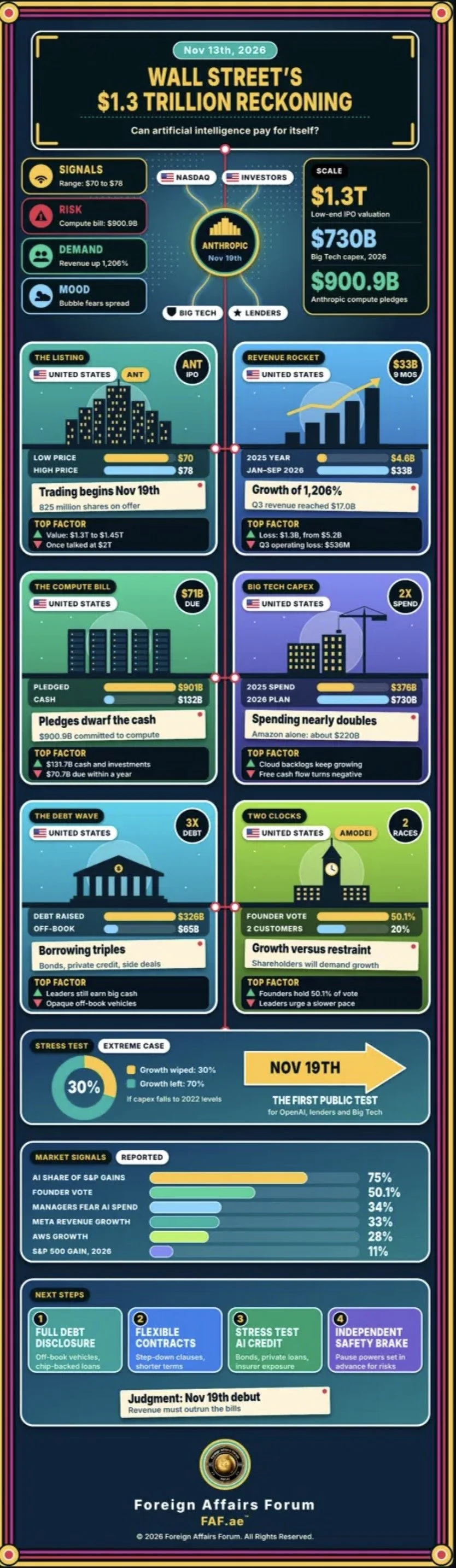
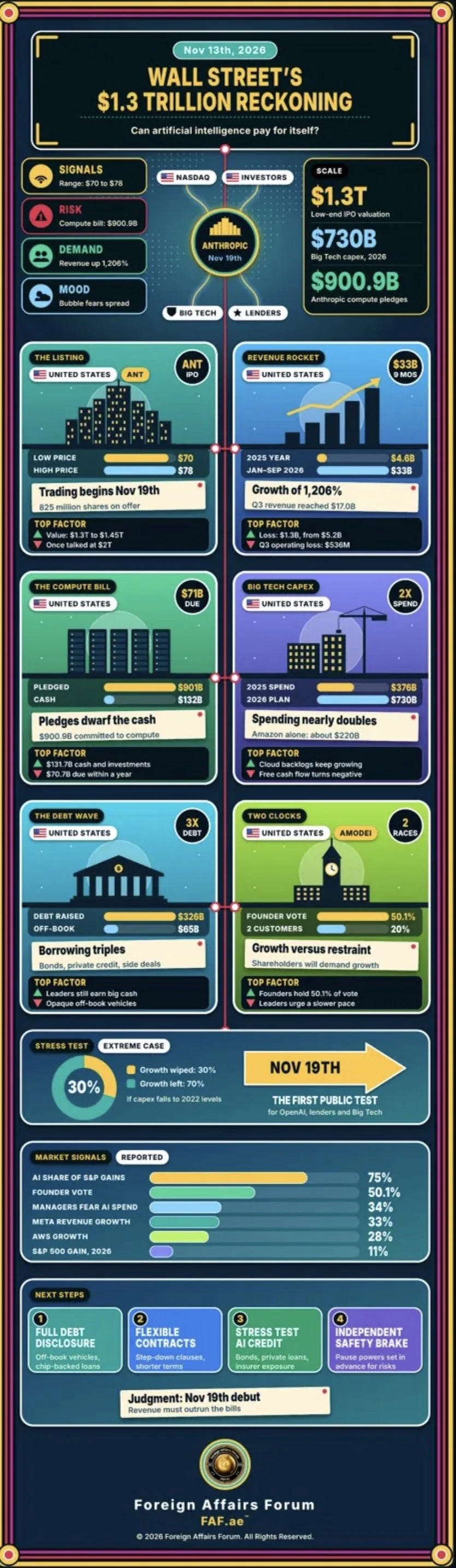
The numbers are very large. The five biggest American tech spenders plan to spend about $730 billion on buildings, chips and equipment in 2026. That is almost double the $376 billion they spent in 2025. Most of this money builds data centres, which are giant buildings full of computers that run AI.
At first, these companies paid for the spending from their own profits. That is changing. In 2026, Microsoft, Alphabet, Amazon, Meta and Oracle raised a combined $326 billion in debt, triple the amount of the year before. Debt means borrowed money. It has to be paid back with interest, whether or not the AI makes a profit.
Some of these firms are also running low on spare cash. Alphabet had negative free cash flow of $9.1 billion in the September quarter. This means it spent more than it earned from its business. Amazon's figure over twelve months was negative $42.4 billion.
Why Anthropic's Listing Is a Big Test
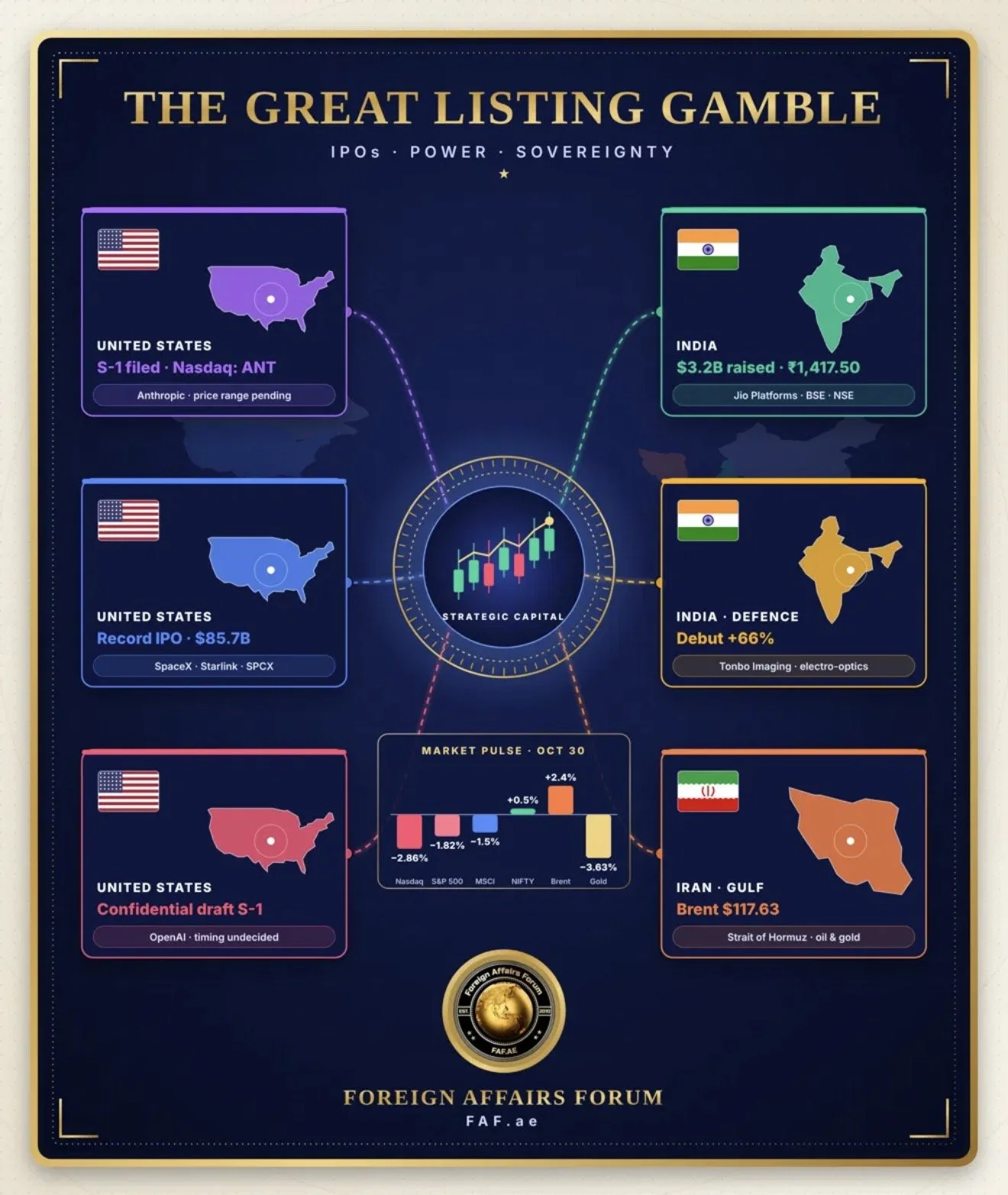
Anthropic is the company that makes Claude. It is about to sell its shares to the public for the first time. This is called an initial public offering, or IPO. The company expects to sell 825 million shares at between $70 and $78 each, which would value it at $1.3 trillion to $1.45 trillion. Trading is expected to begin on Nov 19th.
Before it filed its papers, people talked about a value as high as $2 trillion. Recent market turmoil in the AI sector pushed the expected value down.
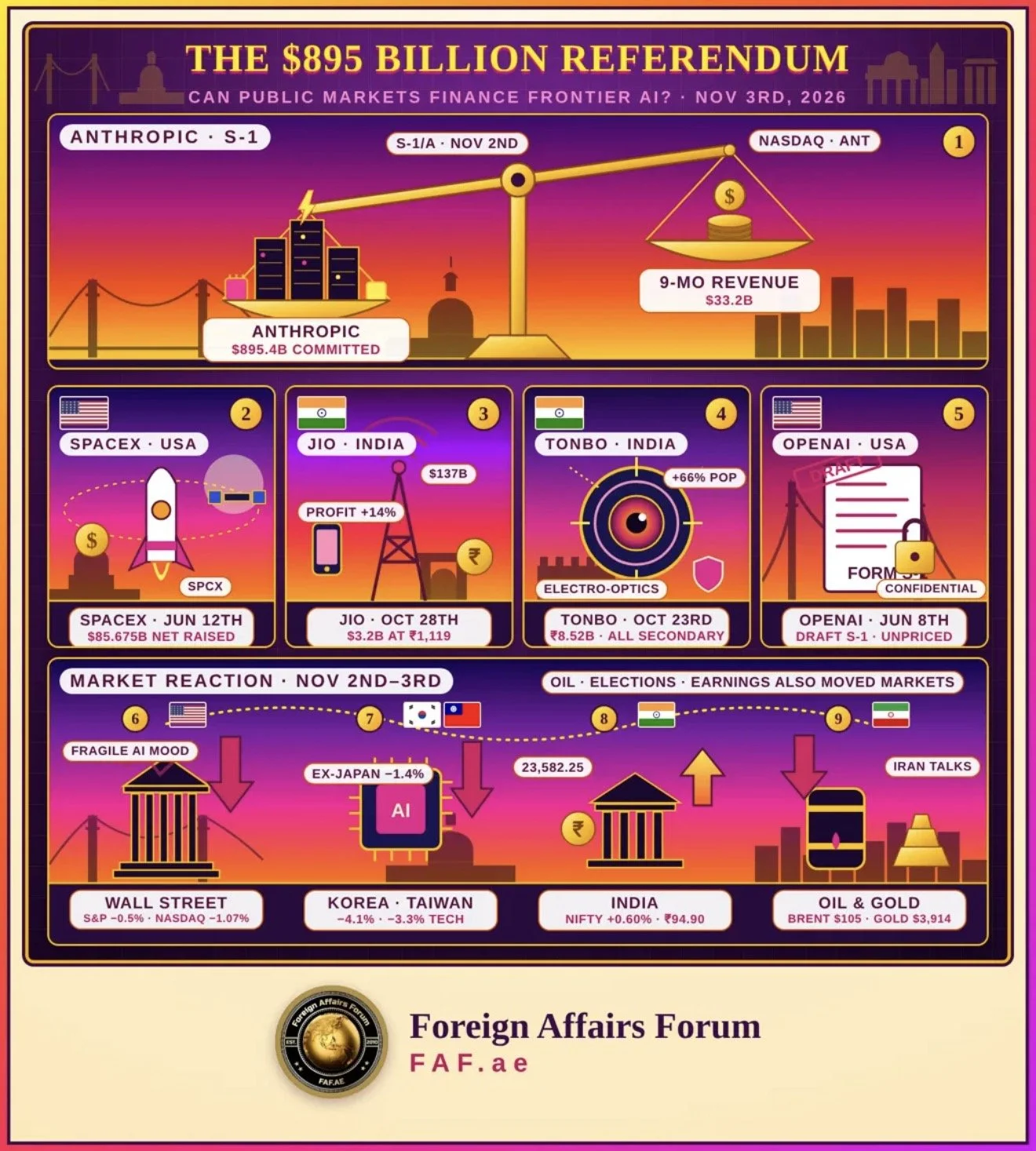
The company's growth is remarkable. Its revenue in the first nine months of 2026 grew 1,206% to $33.2 billion. For all of 2025, its revenue was only $4.6 billion. Its operating losses are shrinking too. They were $1.3 billion in nine months, down from $5.2 billion a year earlier.
The Worry Hidden in the Numbers
There is a catch. Anthropic has promised to spend about $900.9 billion on computing power and equipment, and $70.7 billion of that is due within a year. The company has $131.7 billion in cash and short-term investments. That is a lot of money. It is still far smaller than what the company has promised to spend.
So the plan works only if the company's income keeps growing very fast for years. If growth slows, the promises become heavy. Another small warning sign is that about one-fifth of Anthropic's revenue came from two customers. Losing one of them would hurt.
Anthropic's own papers warn investors about this. They say the company's decisions may go against what investors expect. They also say that its planned spending might look far too big at first glance. It is unusual for a company to say this when it is asking people to buy its shares.
Other Companies Face the Same Problem
OpenAI, the maker of ChatGPT, has a similar story. It was valued at $852 billion after a huge funding round. Its 2025 revenue was about $13 billion, while its costs were $34 billion. It also cut its plans. It once talked about $1.4 trillion in commitments, but has since reduced that to $600 billion in computing spending by 2030.
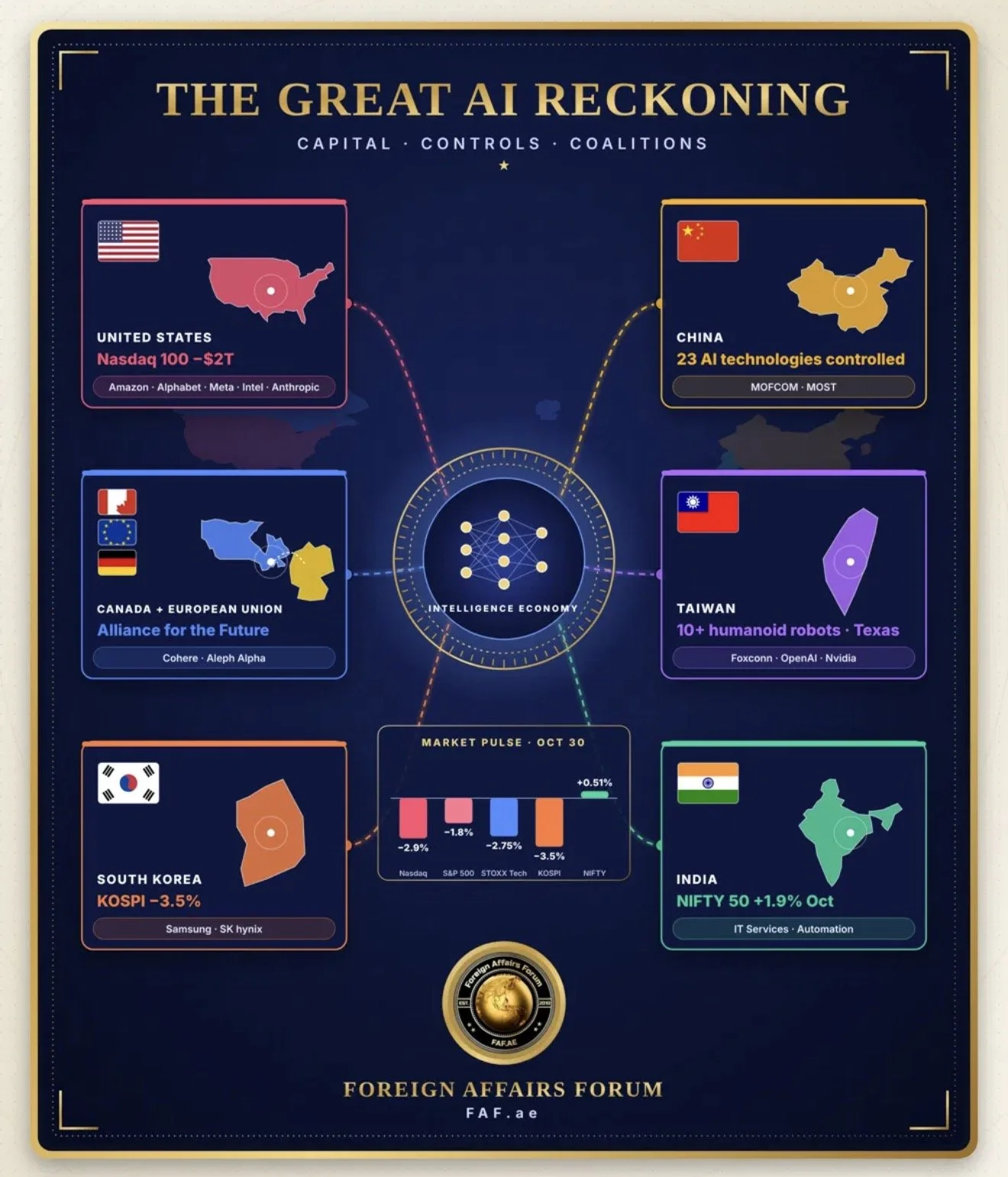
Investors have started to sort the winners from the worriers. When Alphabet and Amazon showed that cloud sales were growing faster, markets were happier. When Meta raised its spending plan, it faced pressure.
What Could Go Wrong
Think of a chain. AI companies promise to buy computing power. Data centre builders borrow money to build it. Lenders hold the loans. If the AI companies slow down, the builders may struggle to pay, and the lenders could lose money.
Some of this borrowing is hard to see. Big tech firms have arranged about $65 billion of financing that does not appear on their main balance sheets. Much of it comes through private credit funds and other vehicles instead of regulated banks, so the true size of the debt is unclear.
Some people think this could hurt the wider economy. In a Bank of America survey of fund managers, 34% said AI spending was the most likely source of a financial shock, double the earlier figure. Fitch, a credit rating agency, called an AI-driven market correction one of the two main near-term risks to global credit.
There is also a circular problem. Sometimes a company that sells chips helps pay for the customers who buy those chips. Nvidia's AI commitments, reported above $750 billion, have drawn this kind of scrutiny.
The Case for Calm
Not everyone is alarmed. The big firms are far more profitable than the dot-com companies of 25 years ago. Today's leaders are enormously profitable, and the spending cycle has barely begun to produce results. Some banks say the companies have enough cash flow and spend less compared with their revenue than in past bubbles.
The honest answer is that nobody knows yet. As one report put it, no one can know until the spending either delivers or it doesn't.
Money and Safety Are Linked
Dr. 🆎 points to a risk that markets often miss. Once an AI developer is owned by the public, its shareholders will want growth. Growth needs more computing power and faster progress. But some AI leaders say the world needs more time to handle the risks of powerful systems. Anthropic's chief executive, Dario Amodei, has called for companies to slow the rate of advancement.
Dr. 🆎 says this creates a tug of war. The people pressing the accelerator and the people holding the brake may not be the same. For areas such as AI warfare and the misuse of AI for biological weapons, he argues that safety limits must be agreed in advance, because they are hard to set once the market is pushing for speed.
What Should Happen Next
FAF analysis suggests several sensible steps.
Governments should require clear reporting of hidden debt. A US senator has already proposed a bill that would make banks disclose their exposure to chipmakers, data centres and big tech firms.
Contracts for computing power should be more flexible, so that promises can shrink if income grows more slowly than hoped.
AI companies should set up independent checks that can slow a risky launch, even when investors want speed.
Central banks should test what would happen to the financial system if AI spending suddenly dropped.
The Bottom Line
Can the AI boom make enough money to sustain itself? For the strongest companies, income is growing very fast, and that is real. The risk lies in how the spending is paid for. Huge borrowing, hidden debts and promises that stretch for years leave little room for mistakes.
Anthropic's debut on Nov 19th will be the first real public test. A strong start could encourage OpenAI and others. A weak start could make borrowing more costly for everyone.
Dr. 🆎 sums it up: money and safety run on the same clock, and the boom will last only if both are managed together.