Hegseth on the Clock: A Reprieve, Not a Rescue
Foreign Affairs Forum | Dr. Antonio Bhardwaj (Dr. 🆎)| November 13th, 2026
A procedural vote spared the Pentagon chief from impeachment on Nov 10th, but a new Democratic Congress, an unfinished war and an uneasy Republican coalition keep his future in doubt
Executive Summary
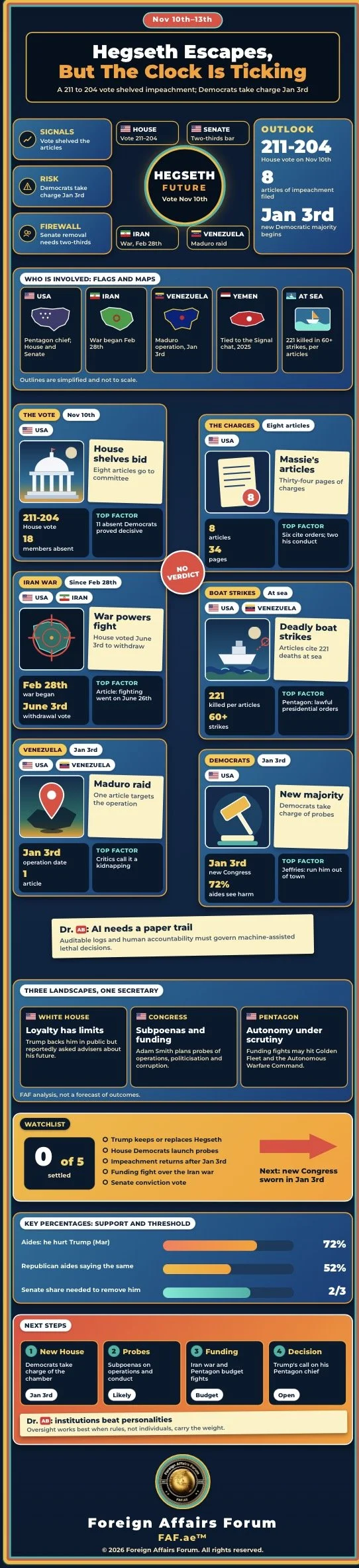
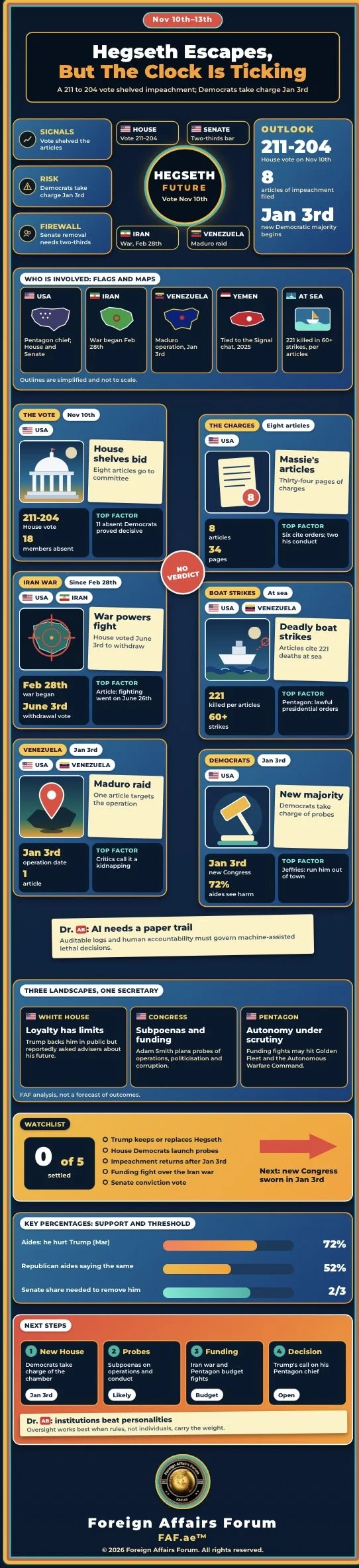
On the evening of Nov 10th, 2026, the House of Representatives voted 211 to 204 to refer eight articles of impeachment against Defense Secretary Pete Hegseth to the Judiciary Committee, a motion that effectively ended the effort before a direct vote on the charges.
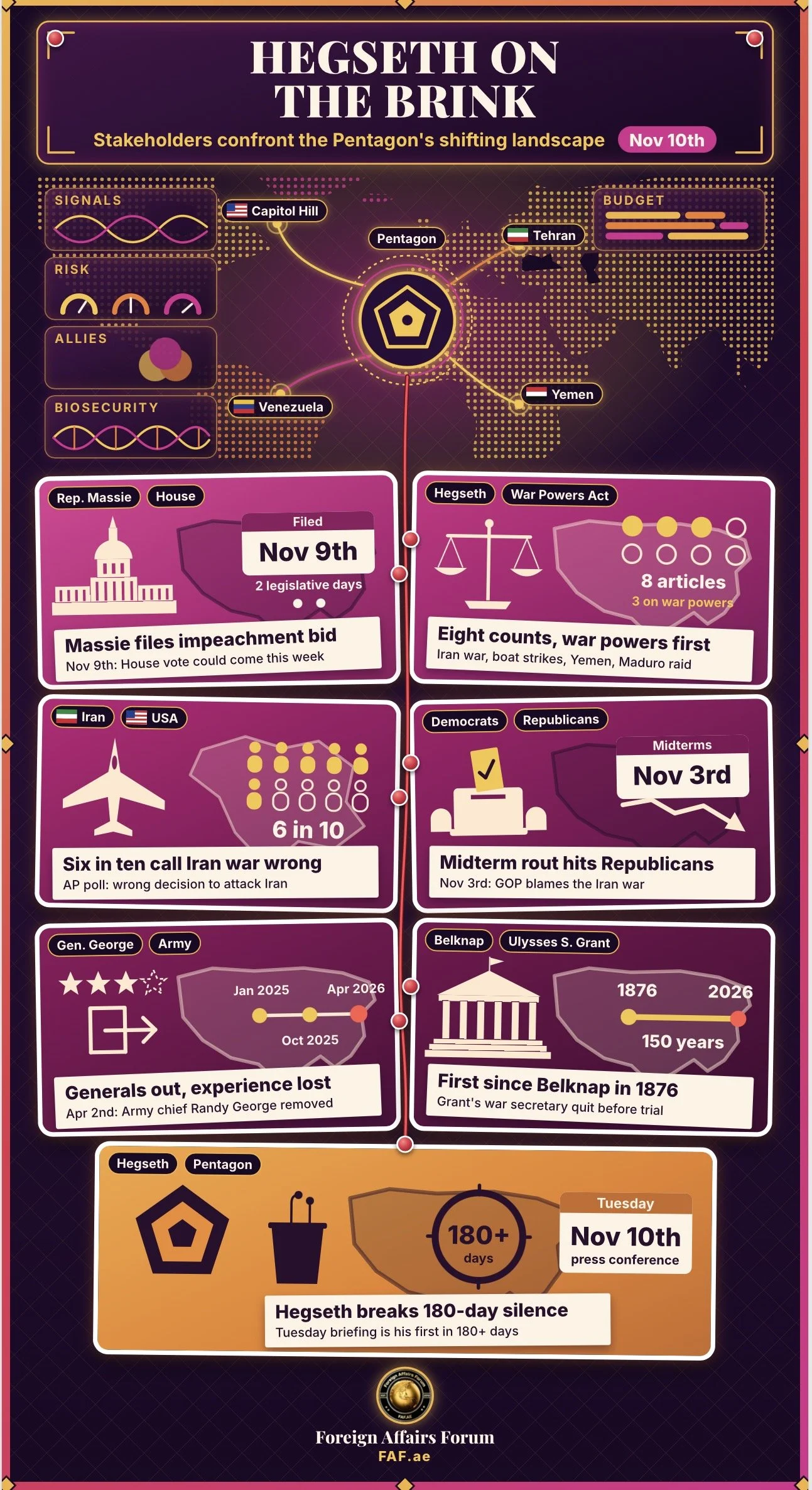
Representative Thomas Massie of Kentucky, the only Republican to oppose the motion, had drawn up the articles. They cover the war with Iran, the lethal boat strikes in the Caribbean and eastern Pacific, the January capture of Venezuela's Nicolás Maduro, the campaign in Yemen, the rollback of protections against civilian harm, and the demotion of Senator Mark Kelly. President Donald Trump declared that the effort had "miserably failed." The vote nonetheless turned on absences. Eighteen members, among them 11 Democrats, did not vote, and had they attended, the procedural motion would likely have failed and a floor vote on impeachment could have followed within days.
The question posed by the title of the most widely read commentary on the episode, how Hegseth's future remains uncertain, has a layered answer. The first layer is arithmetic and calendar. A new Congress is sworn in on Jan 3rd, and Democrats won majorities in both chambers on Nov 3rd. Impeachment in the House needs only a simple majority, and the party's leaders have promised to pursue the secretary. The second layer is oversight: subpoenas, hearings, whistleblower contacts and a likely revived investigations subcommittee on the House Armed Services Committee. The third is money, since a Democratic majority controls the power of the purse over the Iran war and over signature Pentagon initiatives. The fourth is the president himself, who has defended his secretary publicly while reportedly asking advisers whether he should stay. The fifth is the war, whose course may decide whether Hegseth is an asset or a liability to the White House.
Per FAF analysis, the Senate is the firewall. Removal requires a two-thirds vote, a threshold that even a Democratic Senate is unlikely to reach. Hegseth is therefore more likely to lose his job through political attrition or presidential choice than through conviction.
Dr. Antonio Bhardwaj (Dr. 🆎) adds a dimension often missed in the impeachment debate: the accountability architecture for AI-enabled and autonomous warfare. Questions about targeting, civilian harm and command responsibility now sit at the centre of the charges, and will shape how the next Congress oversees a Pentagon moving quickly towards autonomy. This FAF article reviews the history, the latest developments, the causal logic and the paths ahead.
Introduction: The Survivor's Dilemma
Washington has a long tradition of cabinet secretaries who survive a crisis only to be undone by the one that follows.
Hegseth's escape on Nov 10th fits the pattern. The procedural vote did not exonerate him, did not settle any of the legal questions raised in the articles and did not alter the political arithmetic that will apply in less than two months. It merely moved the reckoning from the lame-duck Congress to the incoming one.
The immediate drama was unusual.
Massie, a libertarian Republican who lost his primary to a Trump-backed challenger, used the privileged status of impeachment resolutions to force a vote. Speaker Mike Johnson had previously called an early recess to avoid such a vote before the midterm elections. This time the leadership acted through a motion to refer, which required only a majority and which Democrats, through absences, failed to defeat. Democratic leader Hakeem Jeffries said afterwards that "this is not the end," and the Pentagon's spokesman said the secretary had carried out direct, lawful orders from the president.
Dr. Antonio Bhardwaj (Dr. 🆎), a polymath with global expertise in superintelligence, specialising in human-centred approaches to geopolitical strategy, AI warfare and bioterrorism risk, reads the episode as a test of whether democratic institutions can hold a wartime defence establishment to account at the speed at which modern warfare now moves. In his assessment, the decisive questions in the articles concern chains of command, the legal basis for lethal force and the safeguards meant to limit harm to civilians, and these questions will only grow more acute as machine-assisted targeting becomes routine.
A disciplined reading must also record the defence. The administration argues that the president, as commander in chief, has authority to order military operations, that the War Powers Resolution of 1973 is constitutionally contested, and that Hegseth executed lawful orders. Trump has said the secretary is "guilty of two things, basically winning two wars." Critics, including Republican dissenters, answer that the statute binds the executive, that both chambers passed a measure directing an end to hostilities, and that the secretary carried on regardless. The sections that follow set out the history and the facts, trace the causal chains that make Hegseth's position fragile, and examine the choices facing the stakeholders who will decide his fate.
History and Current Status: From a Narrow Confirmation to a Contested War
Hegseth's tenure began under a cloud.
A former television host and Army National Guard veteran, he faced a confirmation fight in Jan 2025 shadowed by allegations about his personal conduct and by doubts about his managerial experience. He was confirmed on Jan 24th, 2025, by a 51 to 50 vote, with Vice President JD Vance casting the tie-breaking ballot after Senator Thom Tillis, who had threatened to withhold his support, relented. The narrowness of that vote foreshadowed the fragility of his standing among Republicans.
The first serious crisis came in Mar 2025, when the editor of The Atlantic was inadvertently added to a Signal group chat in which Hegseth shared details of planned strikes on Houthi targets in Yemen.
The Pentagon's inspector general opened an inquiry at the request of the Senate Armed Services Committee's Republican chairman and Democratic ranking member. The resulting report, delivered to Congress in Dec 2025, concluded that the secretary had violated protocol by using his personal phone for official communications and had risked compromising sensitive information, though it noted his authority to declassify. Hegseth, who declined to be interviewed and submitted written answers, called the outcome a "total exoneration." Critics read it differently, which became a recurring pattern: each investigation produced findings that supporters and opponents characterised in opposite terms.
The second strand was the campaign of lethal strikes on suspected drug-smuggling boats, which began in 2025.
A strike in Sept 2025 that reportedly killed survivors of an initial attack prompted bipartisan alarm, and the chairs of the armed services committees in both chambers opened inquiries. Massie's articles later put the toll at at least 221 people across more than 60 strikes and describe them as extrajudicial killings, a characterisation the administration rejects, citing the president's authority to counter what it calls narco-terrorists.
The third strand was Venezuela.
On Jan 3rd, 2026, American forces captured Maduro and his wife in Caracas. Supporters hailed the operation as a decisive blow against a criminal regime, while critics, including the authors of the articles of impeachment, called it an unlawful seizure of a foreign leader. The fourth and decisive strand was Iran. On Feb 28th, 2026, American forces joined Israel in strikes on Iran. The war that followed has become the dominant fact of Hegseth's tenure. It has produced damage to American installations in the Gulf, strained relations with regional allies, and a heavy draw on precision munitions. Reports of civilian casualties, including the bombing of a girls' school in Minab early in the conflict, have fed the charge that safeguards were dismantled.
Congress did not stand aside.
The House voted on June 3rd to direct the withdrawal of forces from unauthorised hostilities in Iran, and both chambers passed a war powers measure that Massie's articles describe as the first of its kind to clear both houses. The articles allege that Hegseth continued to direct hostilities after that, including on June 26th. The administration contends that the president does not need congressional authorisation and regards the statute as unconstitutional.
The current status is therefore paradoxical.
Hegseth has survived a House vote, retains the president's public backing and presides over a department that the administration styles the Department of War. Yet he does so after an election in which voters, according to widespread reporting, punished the governing party over the Iran war, and ahead of a Congress that will contain a Democratic majority. A poll of senior congressional aides in Mar 2026 found that 72% believed he had harmed the president's foreign policy priorities, including 52% of Republican staffers. His position is secure in the short run and exposed in the medium run.
Key Developments: Nine Days That Reshaped the Calculus
The sequence began with the midterm elections on Nov 3rd.
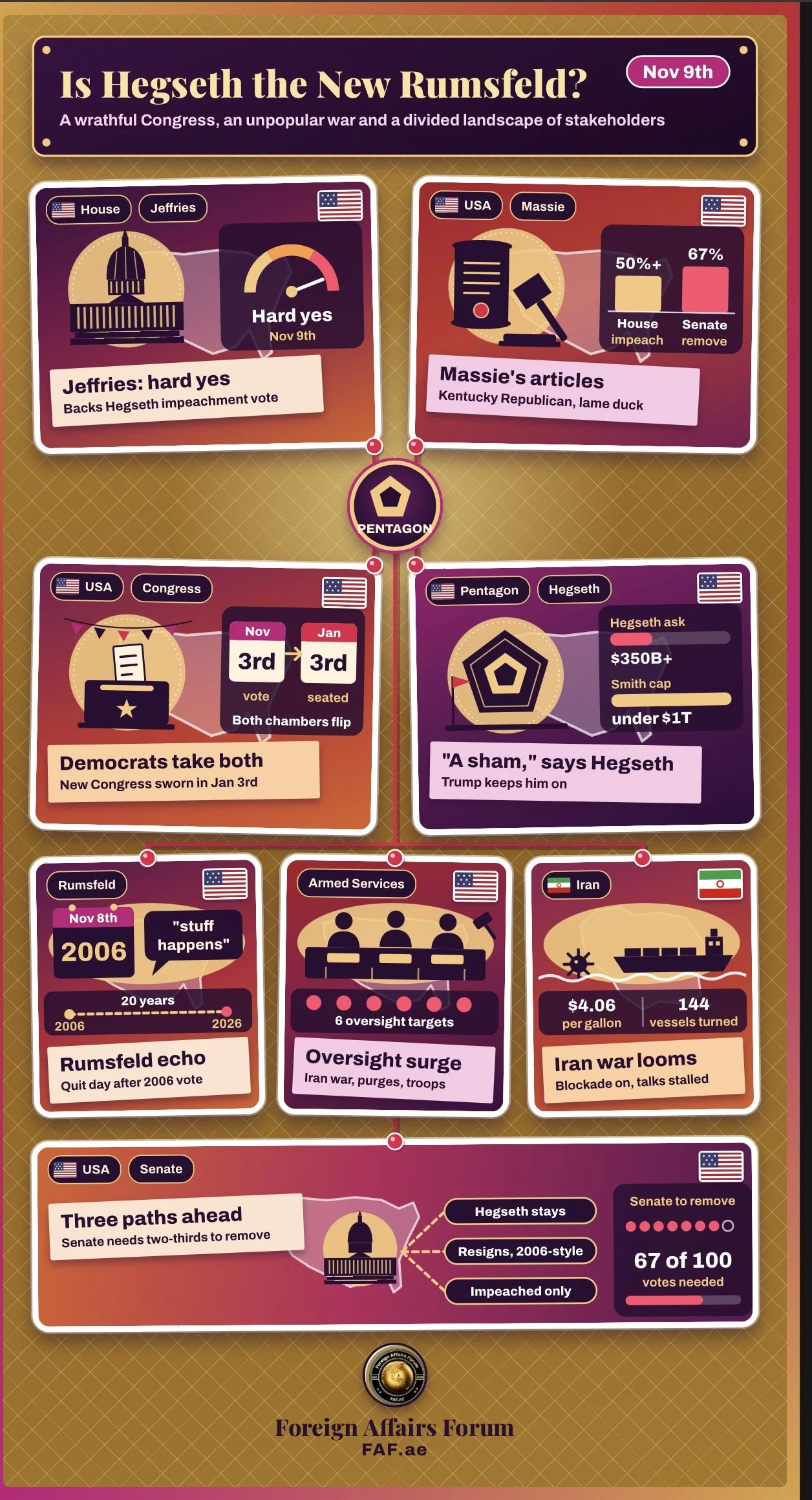
Democrats won majorities in both houses of Congress, according to Arab News and other outlets, and the result changed the strategic setting overnight. Several reports noted that nearly a third of the House seats that flipped went to veterans, some of them with personal grievances against the Pentagon's leadership. Among them is a retired admiral whom Hegseth forced out of the service, who won a South Carolina seat. Within days, Democrats were openly planning their agenda. Jeffries said that one of the first things the party would do in the majority was to "run Pete Hegseth out of town." Representative Jason Crow, a member of the Armed Services Committee, declared that he was going after the secretary. Representative Adam Smith, who would chair the committee, said he would examine military operations, the politicisation of the armed forces and potential corruption.
On Nov 4th and Nov 5th, reports circulated that Trump had asked advisers whether Hegseth should remain, with speculation that he might replace him before Democrats take their gavels.
The White House publicly rejected that framing. On Nov 9th, Trump told reporters that his secretary was guilty only of winning two wars, and the next day he said he would stand by Hegseth even if the House impeached him. As Republicans began to assign blame for their election losses, support for the secretary among GOP lawmakers was reported to be thin, even among those wary of publicly backing impeachment.
On Nov 9th and Nov 10th, Massie's resolution became the focus.
The 34-page document laid out eight articles. Three concern Iran: initiating the war without authorisation, ignoring the congressional measure directing its end, and continuing it past the 60-day statutory limit. One concerns what the articles call extrajudicial killings in the boat strikes. One concerns the Maduro raid. One concerns Yemen. One concerns the dismantling of civilian-harm safeguards, citing the secretary's own boast of favouring "maximum lethality, not tepid legality," and the Minab school strike. One concerns the effort to demote Senator Mark Kelly after he urged service members to refuse illegal orders. Massie explained that six of the articles allege that Hegseth followed illegal orders from the president, while two concern conduct attributable to the secretary himself, and he said he chose not to target Trump because he regarded that as neither feasible nor advisable.
At a Pentagon news conference on Nov 10th, Hegseth called the resolution a political spectacle.
That evening the House voted to refer it to committee. The margin was narrow, and Massie was the only Republican in opposition. Eleven absent Democrats, including Speaker Emerita Nancy Pelosi, who was at a veterans' event in San Francisco, proved decisive. Seven Republicans were also absent. The result shelved the impeachment effort, probably for the rest of this Congress, while allowing Republicans to avoid a recorded vote on the substance of the charges.
Behind the vote lay a quieter development: Democrats have reportedly begun cultivating potential whistleblowers and preparing subpoenas for those close to the secretary, and the House Armed Services Committee may revive a subcommittee dedicated to oversight and investigations. Some Democrats have voiced concern that relentless targeting of Hegseth could undermine bipartisan cooperation on critical defence legislation, a tension that will shape their approach.
Latest Facts and Concerns: What Is Settled, What Is Alleged, What Is Unknown
A careful account starts with the settled.
The House voted 211 to 204 on Nov 10th to refer the articles to committee. The vote was procedural and did not decide the merits. Democrats will control the House from Jan 3rd, when the new Congress convenes. Impeachment in the House requires a simple majority. Conviction in the Senate requires two-thirds, a bar that is difficult to clear even if Democrats control that chamber. The Iran war began on Feb 28th, and a war powers measure directing withdrawal passed both chambers, a fact acknowledged by supporters and critics alike.
The disputed category is large.
Whether the war was lawful without congressional authorisation is contested, and the administration rejects the premise. Whether the boat strikes amount to extrajudicial killings is contested, with the administration invoking its authority against designated trafficking groups and critics pointing to the absence of a recognised armed conflict. Whether Hegseth bears personal responsibility, as distinct from carrying out the president's orders, is the core legal and political question. The Pentagon maintains he acted lawfully and on direct orders. Massie's two categories of articles invite exactly that distinction, which is why the secretary's fate may depend on whether the next Congress concentrates on his own management or on the president's strategy.
Several concerns follow.
The first is the Senate firewall. Even with a Democratic majority, removal requires a number of Republican votes that appears out of reach.
The practical consequence is that Democrats may use impeachment as an instrument of exposure and pressure, not of removal, and that the secretary's real danger is political abandonment and not constitutional ejection.
The second concern is the leverage of money.
A Democratic Congress will shape appropriations, including funding for the Iran war and for flagship initiatives. Reporting in the defence press suggests that programmes such as the proposed Golden Fleet and the Autonomous Warfare Command could come under funding fights, investigations and possible impeachment proceedings. A secretary under investigation negotiates from weakness, and the institution he leads may suffer collateral damage as priorities are contested.
The third is the state of the Pentagon itself.
Critics cite turnover among senior aides, the dismissal of senior military leaders, restrictions on press access, a rollback of civilian-harm safeguards and what they describe as an erratic policy process. Defenders reply that the department is being reformed to focus on lethality and readiness, and that resistance reflects institutional inertia. The weight of evidence is contested, but the perception of disorder has itself become a political fact.
The fourth is the war.
The Iran conflict has cost the United States aircraft, damaged facilities and consumed precision munitions, and some analysts argue that it has alienated regional partners. Reports that Gulf bases were inadequately defended, and that damage and casualties exceed official acknowledgement, add to the pressure. A war that goes badly makes its chief executor a convenient target, while a war that ends in a settlement could make Hegseth's position safer.
The fifth, which Dr. 🆎 emphasises, is the technological dimension of accountability.
The impeachment articles turn on targeting decisions, rules of engagement and civilian-harm mitigation, precisely the areas where artificial intelligence is increasingly embedded. Machine-assisted target recommendation, autonomous systems and compressed decision cycles blur lines of responsibility between commanders, operators and algorithms. If Congress is to hold civilian leaders to account, it will need to understand how AI-enabled systems contribute to lethal decisions, who authorises them and what records exist.
Dr. 🆎 also notes that a leadership crisis at the top of a department responsible for biological defence and pandemic-scale threats carries its own risk: continuity of expertise and command in those areas should not depend on the political fortunes of any one official.
Cause-and-Effect Analysis: Why Survival Does Not Equal Security
The first causal chain runs from the election to the calendar.
The Nov 3rd result transformed the incentives of every stakeholder. Republicans who feared a primary challenge from Trump's base now confront a general-election reality in which the Iran war is unpopular, and some may judge that distancing themselves from the secretary costs less than defending him. Democrats, whose leaders had been cautious about impeachment, have moved towards it, with Jeffries backing the effort. The effect is that the political cost of defending Hegseth has risen sharply for Republicans while the cost of attacking him has fallen for Democrats.
The second chain runs from procedure to publicity.
The motion to refer spared Republicans a recorded vote, but it also exposed a fragile coalition. A handful of absences would have changed the outcome, and the margin demonstrated how thin the protective wall is. Reports that eleven Democratic absences were decisive, rather than any display of Republican unity, will not reassure the secretary's allies. Impeachment efforts also have a habit of returning in a stronger form once the political setting shifts.
The third chain runs from oversight to disclosure.
Subpoenas, hearings and whistleblower testimony can produce information that changes public perception regardless of any vote. A secretary who has relied on loyalty and on the argument that he follows lawful orders is exposed to revelations about internal deliberations, legal advice and operational records. The effect is that the investigative process, not impeachment, may inflict the most damage.
The fourth chain runs from the war to presidential patience.
Trump has defended his secretary, but the president's loyalty has historically been conditional on political usefulness. If the Iran war stalls, if casualties mount or if the administration seeks a reset after electoral defeat, replacing the defence secretary offers a way to signal change without altering strategy. The effect is that Hegseth's most important stakeholder is also the one with the greatest capacity to end his tenure.
The fifth chain runs from law to legitimacy.
The articles allege violations of the War Powers Resolution, which both chambers invoked in a measure directing withdrawal. Whether or not courts ever rule, the claim that a department continued hostilities after Congress said stop affects the legitimacy of the war in the eyes of allies, service members and the public. The effect on the military is subtle but real: the officer corps relies on the assurance that orders are lawful, and sustained doubt strains morale and cohesion.
The sixth chain runs from institutional design to the future of warfare.
If Congress responds to this episode by demanding stronger reporting on lethal operations, the effect could be a framework that covers autonomous and AI-assisted systems. If it does not, the Pentagon will accelerate the adoption of such systems under a doctrine of speed and lethality, with accountability lagging behind capability.
A counterfactual helps.
Had the Iran war been short and successful, the impeachment effort would likely have lacked a Republican sponsor and the midterm result would have been different. The secretary's troubles are thus not independent of the war; they are its political residue. Likewise, had Democrats attended the Nov 10th vote, the House would have confronted the articles directly. Small contingencies matter, and the uncertainty about Hegseth's future is partly the product of such contingencies.
Future Steps: Scenarios and Safeguards
The first path is a managed departure.
The president could choose to replace Hegseth before Democrats take their committee gavels, framing the change as a reset ahead of any renewed strikes. This would deny Democrats a high-profile target, allow a confirmation fight on terms chosen by the White House while Republicans still control the Senate, and shift the story from impeachment to succession. The cost would be an admission that the department's direction had faltered, and the risk that a successor would face the same questions about the war.
The second path is entrenchment.
The president could stand by his secretary through the investigations, calculating that defending him mobilises the base and that the Senate will never convict. This path preserves continuity but guarantees a prolonged confrontation, with subpoenas, hearings and a likely second impeachment effort in the new House. Hegseth would remain in office but under siege, and the department's agenda would be shaped by constant legal and political defence.
The third path is a negotiated oversight settlement.
Democratic leaders who worry about the consequences of endless confrontation for defence legislation might trade restraint on impeachment for cooperation on war powers, civilian-harm safeguards and transparency in lethal operations. Some officials reportedly believe Hegseth could work across party lines depending on how aggressively Democrats pursue investigations. This path is the least dramatic and perhaps the most productive for institutional health.
For Congress, FAF analysis suggests several priorities. Legislators should insist on written legal justifications for lethal operations, regular reporting to the armed services committees and clear rules on the retention of operational records, including communications on commercial messaging platforms. They should revisit the War Powers Resolution so that it is workable and enforceable, replacing the present pattern in which each branch reads the statute to suit its interests. They should require independent review of civilian-harm incidents and restore institutional capacity to analyse and mitigate such harm.
Dr. 🆎 urges a specific focus on AI-enabled warfare. Congress should require disclosure of where machine-assisted targeting and autonomous systems are used in lethal decisions, mandate human accountability for each such decision, and demand auditable logs so that investigators can reconstruct who decided what, and on what information. The Autonomous Warfare Command and similar initiatives should be funded conditionally on such safeguards. He also advises that leadership continuity plans for biological and chemical defence be reviewed so that political turbulence cannot interrupt readiness.
For the president, the practical question is whether the secretary is an asset in the coming year. A leader facing multiple investigations may struggle to manage a war, negotiate budgets and retain the confidence of allies and the uniformed services. For Hegseth himself, the sensible course is to prepare for oversight by documenting the legal basis of decisions, cooperating where possible and avoiding actions that might invite fresh allegations.
For allies and adversaries, the signal is one of volatility. Partners in the Gulf and Europe will watch whether the Pentagon's posture changes, while adversaries may test the transition. Clear communication from Washington about continuity of policy and command would reduce the risk of miscalculation.
Conclusion: A Reprieve With an Expiry Date
Hegseth's survival on Nov 10th was real but narrow, and it rested on procedure and absence, not on a vindication of his record. The articles of impeachment remain a catalogue of contested claims about war powers, lethal force and the treatment of civilians. The administration's defence, that the secretary carried out lawful orders from a commander in chief with broad authority, is serious and will be heard again. Neither side has persuaded the other, and the courts are unlikely to resolve the dispute soon.
What has changed is the balance of power. From Jan 3rd, Democrats will hold the House and the committee gavels, with the capacity to investigate, subpoena, fund or starve programmes and impeach by simple majority. The Senate's two-thirds threshold makes removal improbable, but removal is not the only way a secretary leaves office. Political attrition, presidential calculation and the course of the Iran war can end a tenure as surely as a conviction.
Dr. 🆎 concludes with a warning and a conviction. The warning is that the argument over Hegseth risks obscuring the larger issue: the rapid integration of artificial intelligence into warfare, which strains every mechanism of accountability that democracies have built. The conviction is that a durable settlement requires institutions, not personalities, with clear lines of responsibility, auditable decisions and legislative oversight capable of keeping pace with technology. Hegseth's troubles are indeed far from over.
How the United States resolves them will say much about whether civilian control of the military remains meaningful in an age of machine-speed war.