Abu Dhabi Breaks the Silence, Not the Stalemate
Foreign Affairs Forum | Dr. Antonio Bhardwaj (Dr. 🆎)| November 12th, 2026
Executive Summary
What the US-Mediated Talks Settled, What They Left Open, and How Likely the War Is to End
Silence Broken, Stalemate Intact
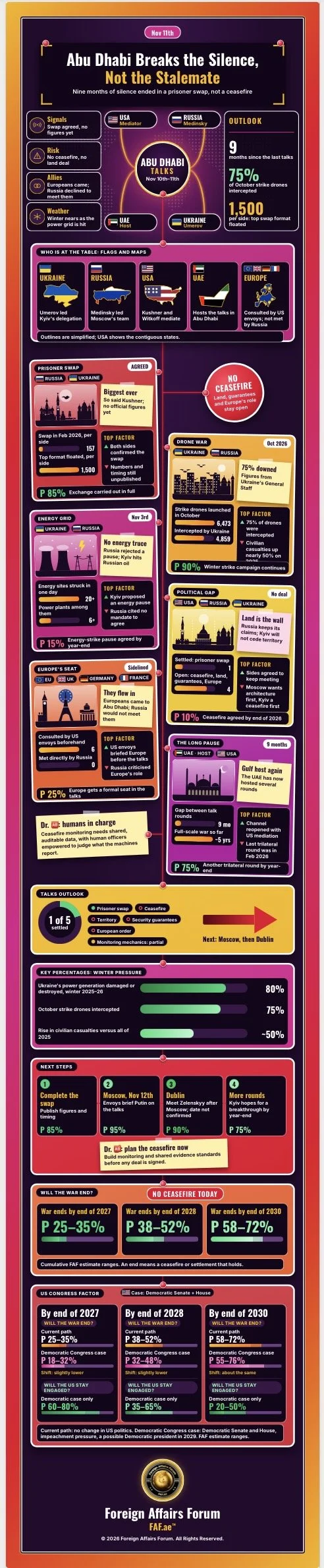
The Abu Dhabi talks of Nov 10th and Nov 11th, 2026 did something that hadn't happened in nine months: Russian and Ukrainian delegations sat in the same diplomatic landscape, under American mediation, and walked away with a concrete result.
That result is a prisoner swap, which US mediator Jared Kushner described as the biggest ever. It is not a ceasefire. It is not a land settlement. It is not a security guarantee.
The talks broke a long silence without breaking the underlying stalemate, and any serious FAF article on them has to hold both truths at once.
This FAF article sets out what was agreed, what was left open, and how the stakeholders are likely to behave over the coming weeks, months and years. It also adds something the early coverage lacks: explicit probability estimates, stated as ranges where honesty requires ranges, for the events that now matter most.
Every probability in this FAF article is an FAF estimate. None of them comes from the delegations, the mediators, or any official source, and they should be read as structured judgment rather than fact.
Who Was at the Table
The stakeholders in the room were clear.
The United States mediated, with Kushner and Steve Witkoff as the envoys. A team led by Vladimir Medinsky represented Russia.
Rustem Umerov led Ukraine's delegation. The United Arab Emirates hosted, which is now a pattern rather than an accident, because the Gulf state has hosted several rounds of contact between the two sides.
Europe was in Abu Dhabi too, but not at the table in the sense Europeans wanted.
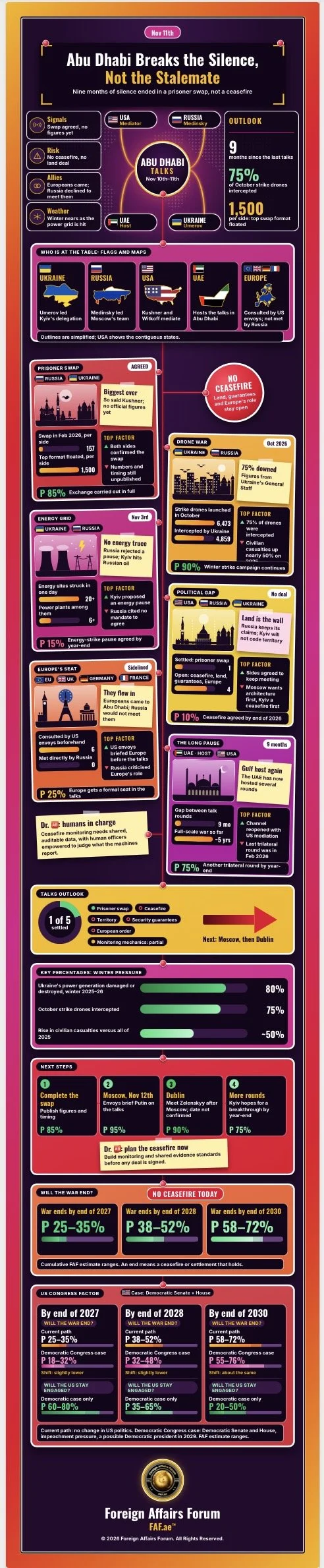
European officials were consulted by the American envoys beforehand and were present in the city, yet Russia declined to meet them directly. The final tally on the European question therefore reads as six consultations with the Americans and zero direct meetings with Russia.
For a continent that is paying heavily for this war and will be asked to underwrite any peace, that is an uncomfortable score.
What Was Settled: The Prisoner Swap
Start with what was settled, because it is real.
The delegations agreed a prisoner exchange.
Kushner called it the biggest ever, but no official figures were published, and the timing and the numbers remain unconfirmed.
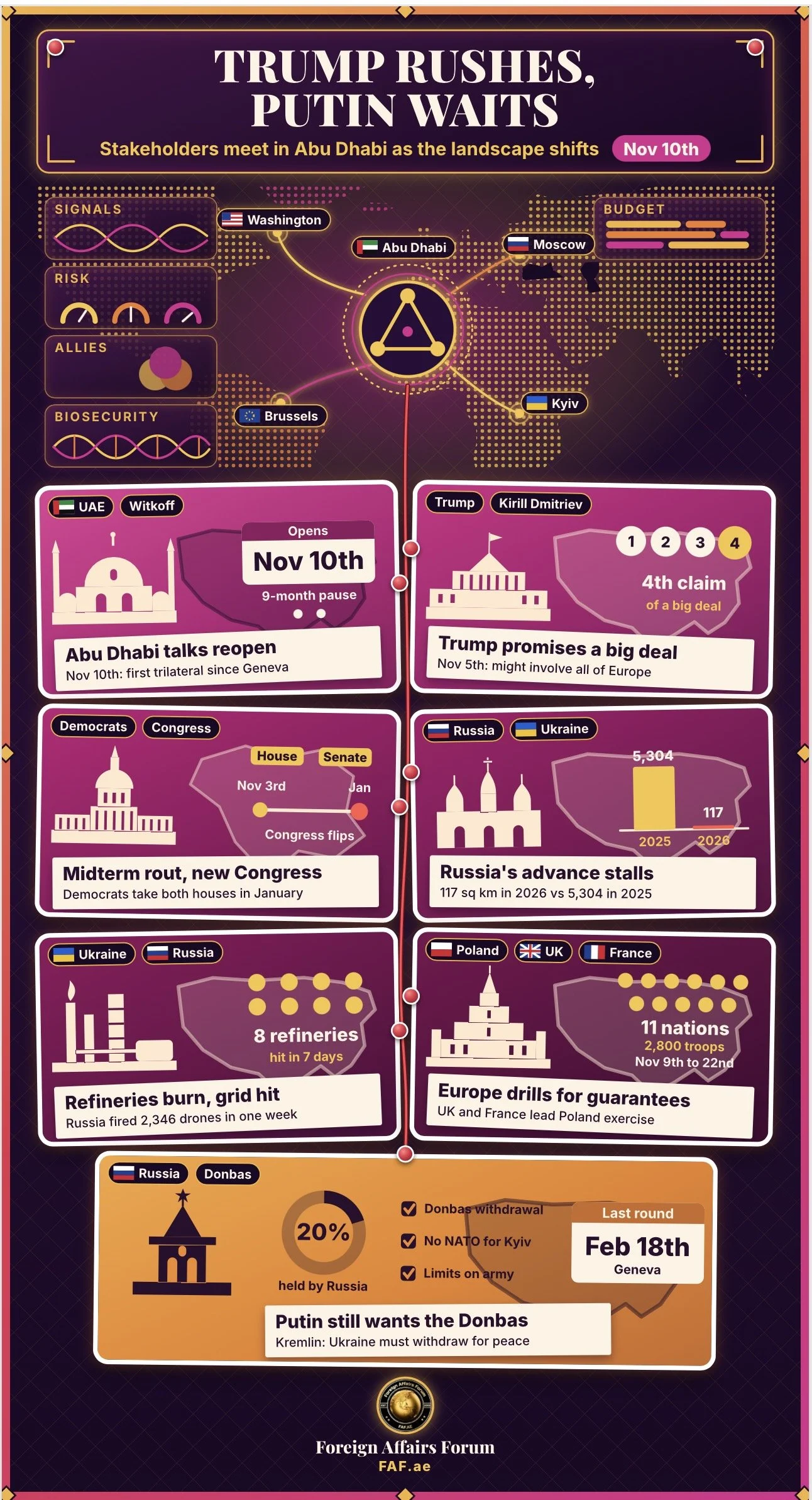
That caution matters. For comparison, the Feb 2026 swap involved 157 prisoners per side.
The format floated in Abu Dhabi for the largest version of the new exchange is 1,500 per side.
Even if the final number lands well short of that, a swap on this scale would be a genuine humanitarian gain for thousands of families, and it would show that the two governments can still deliver on a negotiated bargain.
Per FAF analysis, there is an 85% probability that the exchange is carried out in full.
The remaining 15% covers the ordinary ways such deals slip: disputes over lists, disputes over sequencing, and a violent incident that poisons the atmosphere at the wrong moment.
The first practical test is therefore simple: publish the figures and the timetable, and then deliver.
What Was Left Open
Now consider what was left open, because that list is longer.
There is no ceasefire. There is no agreement on land. There is no settlement of security guarantees for Ukraine. There is no agreed role for Europe. And there is no agreed system for monitoring a ceasefire if one were ever reached.
If one counts the five big questions of the talks, which are the prisoner swap, a ceasefire, territory, security guarantees and the European order, only one of the five is settled.
A sixth question, monitoring mechanics, is partly addressed but not finished.
That is why the headline for this FAF article insists on the difference between breaking silence and breaking a stalemate.
The first is a matter of process. The second is a matter of power, and the balance of power on the ground has not shifted enough to push either side toward the concessions a final settlement would require.
The War on the Ground and the Winter Ahead
The fighting itself is the best evidence for that.
The drone war has intensified through the autumn. In Oct 2026, Russia launched 6,473 strike drones at Ukraine, and Ukraine's General Staff says that 75% of them were intercepted.
That is an impressive defensive performance, and a sobering one, because it means roughly one in four of a very large number of drones still got through.
The energy grid is the obvious target. Ukraine's power generation was damaged or destroyed by about 80% over the winter of 2025 and 2026, and winter is approaching again. Civilian casualties in 2026 have already risen by about 50% compared with the whole of 2025.
A war that produces numbers like these is not a war in which either side feels that time is simply on its side. It is a war in which both sides believe that the next few months can still change the bargaining position, and that belief is exactly what makes a ceasefire hard.
This is why the probabilities for the winter matter so much.
Per FAF analysis, there is a 90% probability that the strike campaign against Ukraine's energy system continues through the winter, whatever is said in diplomatic rooms.
A pause in strikes on energy infrastructure, the most realistic partial step short of a full ceasefire, is far less likely.
Per FAF analysis, the probability that an energy-strike pause is agreed by the end of 2026 is 15%. The probability of a full ceasefire agreed by the end of 2026 is lower still, at 10%.
Those numbers look pessimistic, but they follow from a plain reading of the stakeholders' incentives.
Russia gains leverage from pressure on the grid. Ukraine gains leverage from the damage its own strikes can inflict on Russian energy and military targets.
Neither side wants to be the first to stop while the other keeps striking, and the Abu Dhabi round gave no sign that the logic had changed.
The Road to Moscow and Dublin
The next steps are more predictable than the outcome, and that predictability is useful.
The envoys are expected to brief Vladimir Putin in Moscow on Nov 12th, and per FAF analysis, the probability that this briefing takes place as described is 95%.
Volodymyr Zelenskyy is expected to meet the envoys in Dublin after Moscow. The date of the Dublin visit is not confirmed, and that is a genuine gap that readers should not paper over.
Per FAF analysis, the probability that the Dublin meeting happens is 90%, but no one should bet on a particular day. Kyiv hopes that further rounds can produce a breakthrough by the end of the year.
Per FAF analysis, the probability that another trilateral round takes place by the end of 2026 is 75%.
The sequence from Abu Dhabi to Moscow to Dublin, and then to a further round, shows a diplomatic machine that is running, even though it is not yet producing a final product.
Europe: Consulted, Not Seated
Europe's position deserves its own analysis, because it is the one where the gap between interest and influence is widest.
The American envoys consulted Europeans before the talks, and Russia then criticized Europe's role and declined to meet European officials directly.
For Moscow, this is a deliberate choice. Meeting Europeans would acknowledge that Europe is a party to the settlement, and that acknowledgment would complicate Russia's aim of a bilateral understanding with Washington.
For Europeans, the lesson is that they cannot assume a seat at the table simply because they will pay for what is agreed there.
Per FAF analysis, the probability that Europe obtains a formal seat in the talks is 25%. It is not zero, because security guarantees for Ukraine would be unworkable without European forces, money, and political cover, and the American envoys know it. But it is low, because Russia holds a veto over who sits at the table, and so far Moscow has used it.
Verifying a Ceasefire: Why Monitoring and History Matter
There is a further layer that the early coverage ignored, and it concerns monitoring.
Every serious ceasefire proposal eventually has to answer the question of who verifies it.
In a war saturated with drones, satellites, electronic warfare and automated targeting, the verification problem is as much technical as it is political.
The Dr. 🆎 view, argued in earlier FAF articles on human-centered AI, is that ceasefire monitoring needs shared, auditable data and human officers empowered to judge what the machines report. A ceasefire that rests on a sensor feed that one side distrusts will collapse at the first disputed incident. A ceasefire that rests on shared evidence standards, agreed in advance, with human officers able to rule on what happened, has a chance. That is why the practical message to the stakeholders in this FAF article is plain: plan the ceasefire now. Build monitoring and shared evidence standards before any deal is signed, not after. The time to design verification is when it is cheap and when nobody is yet accused of a violation.
History offers a useful discipline here, even though no analogy is exact.
In the 20th century, the Korean armistice of 1953 stopped the fighting without ending the war, and it endured because it included a defined demarcation line and inspection machinery that both sides at least tolerated.
The Dayton settlement of 1995 ended a war that had seemed endless, but only after the military balance shifted and only after outside powers committed troops to enforce what was signed.
In the 21st century, the Minsk arrangements for eastern Ukraine show the opposite lesson: an agreement with vague terms, no trusted verification, and no enforcement collapsed into repeated violations and eventually into full-scale war.
The pattern across these cases is consistent.
Ceasefires hold when the parties believe that breaking them is costly, when violations can be established quickly and credibly, and when someone with real power stands behind the text.
Abu Dhabi has so far produced none of those three conditions for a ceasefire, which is why the 10% estimate for a ceasefire by the end of 2026 is, for some analysts, not pessimistic enough and, for others, too pessimistic.
FAF analysis holds that figure because the swap shows cooperation on a narrow humanitarian issue. Still, nothing yet shows cooperation on the question of who verifies a halt to the shooting.
When Does the War End? The Current Path
Having set out the near-term picture, this FAF article now turns to the longer question readers are really asking: when the war ends.
Precision matters here.
For FAF, an end means a ceasefire or settlement that holds.
A paper agreement that collapses in a month does not count.
With that definition, and treating the current political landscape in Washington as unchanged, which FAF analysis calls the current path, the estimates are as follows.
The probability that the war ends by the end of 2027 is 25% to 35%. By the end of 2028, it rises to 38% to 52%. By the end of 2030, it rises to 58% to 72%.
These are cumulative figures, meaning each later year includes the earlier ones.
FAF analysis presents ranges rather than single numbers for a simple reason. A single number such as 30% suggests a precision that nobody in this field has. A range tells the reader that the true figure is uncertain, and that the width of the range is itself information.
The ranges widen in the middle years because the outcome depends most on events that cannot yet be seen, such as battlefield shifts, economic strain, and political change in the stakeholder capitals.
The Democratic Congress Case: Ending the War and US Engagement
Now to the assumption that readers have asked FAF to add, which is the American political one.
Suppose, as a working assumption and not as a forecast, that the US Senate and the US House of Representatives are both under Democratic control, that Congress applies impeachment pressure on the executive branch, and that a Democratic president takes office in 2029.
FAF analysis calls this the Democratic Congress case, and its status must be very clear. It is a scenario being tested. It is not a statement about who holds Congress now; it is not a prediction of any election result, and it should not be read as support for or opposition to any party.
The purpose is to ask a narrow analytical question: what would such a political landscape do to the odds that the war ends, and to the odds that the United States stays engaged in it?
On the first question, per FAF analysis, the Democratic Congress case slightly lowers the probability of the war ending in the near and middle term and leaves the long-term figure about the same.
By the end of 2027, the range falls from 25% to 35% on the current path to 18% to 32% in the Democratic Congress case. By the end of 2028, it falls from 38% to 52% to 32% to 48%. By the end of 2030, it moves from 58% to 72% to 55% to 76%, which is about the same.
The reasoning has several strands. Divided or contested American politics can distract the executive, and impeachment pressure consumes political capital that would otherwise go into a hard negotiation.
Congress also has real leverage through appropriations and sanctions legislation, meaning a Congress at odds with the executive can slow down any deal that involves sanctions relief.
By contrast, a Congress unwilling to fund an open-ended commitment can also push both Kyiv and Moscow toward earlier compromise. These forces pull in different directions, which is why the shift is small and why the long-term range barely moves.
On the second question, the engagement question, per FAF analysis, American engagement in the war declines over time in the Democratic Congress case, and the decline is steep.
Per FAF analysis, the probability that the United States stays engaged through the end of 2027 is 60% to 80%. For the end of 2028, the range is 35% to 65%. For the end of 2030, it is 20% to 50%. Engagement here means active diplomatic mediation, military or financial support, or both.
The ranges widen as the horizon lengthens because the further out one looks, the more the answer depends on who holds the presidency and on what the war looks like by then. A reader might expect Democratic control to mean more American engagement, on the argument that Democrats are more sympathetic to Kyiv.
A different reader might expect less, arguing that concern about the US debt and a desire to turn to domestic priorities would reduce appetite for foreign commitments.
Per FAF analysis, both arguments have force, and no one can claim to know which will win.
The pressure of impeachment politics and the prospect of a new administration in 2029 both tend to shorten the planning horizon in Washington, and shorter planning horizons usually mean less patience for open-ended commitments. That is the logic behind a falling engagement range. It is an estimate, and it could be wrong in either direction.
It is worth separating the two questions because the collage that accompanies this FAF article keeps them apart for a reason.
The first, will the war end, is about the outcome. The second, will the United States stay engaged, is about one stakeholder's behavior.
They are connected but not identical.
A war can end because one party disengages and the other no longer faces pressure to compromise, and a war can continue precisely because a major stakeholder disengages and leaves a stalemate in place. The difference between the current path and the Democratic Congress case is the difference between today's political landscape and a specific, named alternative.
FAF uses those two plain labels because earlier labels confused some readers. The current path means no change in American politics. The Democratic Congress case means the assumptions in the paragraph above. Everything is an FAF estimate.
Signals to Watch and the Gulf Role
Readers who want to track whether FAF estimates should move can watch a short list of signals, which are described in prose because they are best understood together.
The first signal is whether the swap figures and timetable are published, since silence on numbers after Kushner's remark would suggest hesitation on at least one side.
The second is what Putin says after the Moscow briefing on Nov 12th, and whether the Russian side repeats its criticism of Europe's role or softens it.
The third is whether a date for the Dublin meeting with Zelenskyy is confirmed, because an unconfirmed date suggests sequencing is still disputed.
The fourth is the pattern of strikes on the grid.
A visible drop in attacks on energy infrastructure, even if unannounced, would raise the odds of a formal pause, while a new wave of large drone raids would lower them.
The fifth is the language on monitoring.
If either delegation begins to speak of shared data, joint verification, or human officers with authority to rule on incidents, the odds of a durable ceasefire improve, because the hardest technical problem is being addressed before the political decision.
The sixth is American politics, where signs of congressional conflict with the executive over Ukraine policy would move the balance between the current path and the Democratic Congress case in the minds of both capitals.
The Gulf dimension also deserves a little more attention than it usually gets.
The UAE has hosted several rounds of contact, and Abu Dhabi is now the default venue for talks that neither Moscow nor Kyiv wants held in a European capital.
The advantages are clear: the host has working relations with all the main stakeholders, it has no territorial stake in the war, and it can offer secrecy and logistical efficiency.
The limits are equally clear. A host can create space for talks, but it cannot provide the enforcement a ceasefire needs, and it cannot give Europe the seat Russia withholds. If the process matures, the Emirati role is likely to shift from venue provider to guarantor of procedures, such as hosting joint verification cells or humanitarian working groups.
That would deepen the Gulf state's stake in the outcome and expose it to the political risk that comes with success.
What It Means for Each Stakeholder
Per FAF analysis, the implications for each stakeholder matter, because analysis without implications is only description.
For Ukraine, the main implication is that its planning cannot depend on a single American political configuration. If the Democratic Congress case materializes, Kyiv would face an American partner whose attention is divided and whose engagement may thin out toward 2030, which means it should lock in European financing and security arrangements early and treat the prisoner swap and the monitoring design as assets to build on.
For Russia, the implication is that waiting is not risk-free, even if it looks cheap.
A more volatile political landscape in Washington can make American promises less credible, but it can also produce a congressional backlash against any deal that rewards Moscow. For the United States, the implication is that the window for a negotiated outcome that the current executive can deliver is narrower than it looks, and that the longer the process runs, the more it is exposed to the domestic calendar.
For Europe, the implication is the most urgent. Europe is consulted but not seated, and the Democratic Congress case, with its falling engagement ranges, would raise the share of the burden that Europeans must carry.
A Europe that wants a formal seat in the talks must offer something Russia cannot ignore, and the United States cannot do without, which in practice means credible military and financial commitments to a post-ceasefire settlement.
The 25% estimate for a formal European seat is not fixed. It will rise if Europe demonstrates that its contribution is indispensable, and it will fall if Europe remains a consulted observer. For the UAE, the implication is that its role as host is becoming institutional.
A Gulf state that has hosted several rounds and now hosts the first talks in nine months has built a reputation for discreet, reliable facilitation. That reputation is a diplomatic asset, and it will be tested if the talks move from prisoner swaps to the much harder subjects of territory and guarantees.
The Winter Test, the Three Ranges and the Human Cost
The winter will test all of this. If the strike campaign continues, which FAF analysis puts at 90%, Ukraine will enter the coldest months with a damaged grid and a population that has already paid a heavy price. That raises the humanitarian stakes of any energy-strike pause, even though the pause itself is unlikely before the end of 2026.
It also raises the political stakes of the prisoner swap, because a successful exchange is one of the few outcomes that both governments can present to their publics as a gain. If the swap is carried out in full, it becomes a confidence-building measure that makes the next step slightly easier. If it stalls, it becomes evidence for those on both sides who argue that talking is pointless. In that sense, the 85% figure is more than a forecast of a single event. It forecasts whether the diplomatic channel opened in Abu Dhabi keeps its credibility.
It helps to say what would have to happen for each of the three end-of-war ranges to come true.
For the end of 2027 to arrive with a durable settlement, which FAF analysis puts at 25% to 35% on the current path, the winter of 2026 and 2027 would need to deliver a shock that persuades at least one side that continuing costs more than compromising.
That could be a battlefield turn, an economic squeeze or a political change in a stakeholder capital, and it would need to be followed quickly by a verification system already designed and ready, which is why the planning advice in this FAF article is urgent.
For the end of 2028, at 38% to 52%, the likeliest path is slower: a sequence of partial agreements that start with prisoners and energy, move to a limited halt in the shooting, and only then address territory and guarantees.
For the end of 2030, at 58% to 72%, the dominant driver is exhaustion and political turnover rather than a single breakthrough. Four more years of attrition change leaders, budgets and priorities, and the probability that someone finds a face-saving formula grows with time.
Even then, the range stops well short of certainty, because wars with unresolved territorial claims have a long record of freezing rather than ending, and a frozen conflict does not satisfy the definition of an end that FAF analysis uses.
The human side of the figures must not be lost behind the percentages.
A civilian casualty rate that is about 50% higher than the whole of 2025, a grid that lost about 80% of its generation over the last winter, and thousands of prisoners waiting for exchange are the daily reality behind each probability.
When FAF analysis says a pause in energy strikes has only a 15% chance by the end of 2026, it also means millions of people face another winter of cold and darkness with limited protection.
That is the real cost of a diplomatic landscape that moves in small steps. It is also why even modest agreements deserve attention.
A prisoner exchange of the size discussed in Abu Dhabi will not end the war, but for the families involved it is the only outcome of the whole process that is measured in people returning home.
FAF analysis should hold both thoughts: the strategic assessment that a settlement is distant, and the moral recognition that every confirmed step toward relief matters.
How to Read the Numbers
Per FAF analysis, a closing word is needed on the status of the numbers in this FAF article, because probabilities invite two opposite mistakes.
The first mistake is to treat them as facts. They are not. They are estimates; they reflect FAF judgment of the stakeholders' incentives, and they will change as events change.
The second mistake is to dismiss them as guesses. They are not that either.
They are disciplined judgments that force the analyst to commit to a view and expose that view to correction. If the Moscow briefing happens on Nov 12th and the Dublin meeting follows, FAF estimates for further rounds will rise. If the swap stalls or if strikes on the grid intensify, FAF estimates for a ceasefire will fall. The right way to read them is as a map that is redrawn as the terrain becomes clearer.
Conclusion: Plan the Ceasefire Now
Per FAF analysis, the whole picture can be summarised as follows.
Abu Dhabi worked as a process. It produced a prisoner swap that, if delivered, will be the largest ever; it kept the diplomatic channel open; it fixed a sequence of next steps through Moscow and Dublin; and it confirmed the UAE as a reliable host. It did not work as a settlement.
There is no ceasefire, no land deal, no agreed security guarantee, no European seat, and no monitoring system.
On the current path, FAF analysis puts the odds that the war ends at 25% to 35% by the end of 2027, 38% to 52% by the end of 2028, and 58% to 72% by the end of 2030.
In the Democratic Congress case, the near and middle ranges are slightly lower, and the long range is about the same, while American engagement is estimated to fall from 60% to 80% by the end of 2027 to 20% to 50% by the end of 2030.
None of this is destiny. Each of these ranges depends on decisions stakeholders have not yet made.
The closing advice from FAF analysis is practical. Deliver the swap and publish the figures. Build the monitoring architecture and the shared evidence standards now, while no one is accused of anything.
Give Europe a defined role that Russia can accept and the United States can sell.
Protect the energy system through the winter, and test whether an energy-strike pause can be a first step. And plan the ceasefire before it is needed, because ceasefires improvised in a hurry tend to fail, and ceasefires prepared in advance have a chance to hold. The silence has been broken. The stalemate has not.
The work of the next months is to turn the first into the beginning of the end of the second, and to do it with eyes open about how uncertain that work is.