The Gilded Bargain: Trump Remade America's Pakistan Ties, and a Democratic Congress Is About to Test Them
Foreign Affairs Forum | Dr. Antonio Bhardwaj (Dr. 🆎)| Nov 10th, 2026
Executive Summary
Few bilateral relationships have been reversed as sharply as the one between Washington and Islamabad.
For years the United States treated Pakistan as a security problem to be managed, a country whose usefulness in Afghanistan was always weighed against suspicion of its double game.
President Donald Trump has inverted that logic. He praises Pakistan's leaders by name, hosts them in the Oval Office, and has attached the relationship to a commercial agenda covering critical minerals, cryptocurrency, liquefied natural gas and autonomous defense technology. Pakistan, whose economic pitches went unanswered for a decade, has seized the opening with considerable tactical skill.
Three forces explain the shift.
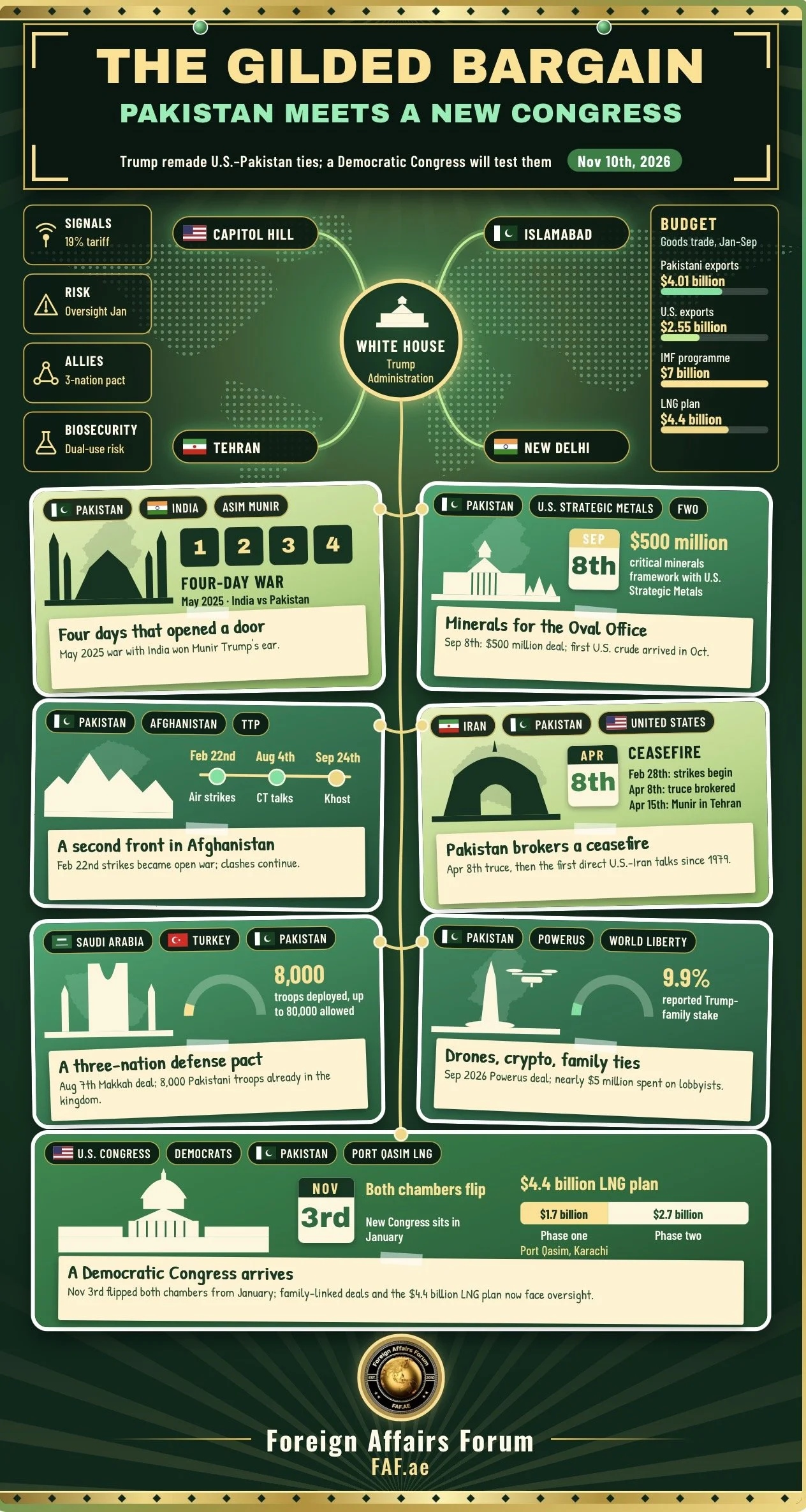
The first is the personal rapport between Trump and Field Marshal Asim Munir, which began after the four-day India-Pakistan war of May 2025.
The second is Pakistan's value as a channel between Washington and Tehran since the joint American and Israeli strikes on Iran of Feb 28th, 2026. That role produced a ceasefire on Apr 8th and the highest-level direct talks between the two adversaries since 1979.
The third is a transactional bargain in which American markets, capital and political favor are exchanged for access to Pakistani resources and public praise for the American president.
Each force is genuine. Each is also narrower and more perishable than the warm rhetoric suggests.
The midterm elections of Nov 3rd have changed the landscape.
Democrats will control both chambers of Congress from January, and Trump enters the final two years of his presidency as a weakened lame duck. He still commands foreign policy, yet he cannot appropriate funds, clear major arms transfers or shield his family's business interests from investigation without a hostile legislature.
Pakistan's agreements with firms linked to the president's relatives, and its thin cultivation of Democratic lawmakers, now look less like strategic assets and more like exposures.
This FAF article contends that the relationship will endure but must change shape. Its strategic core, built on counterterrorism, Gulf security and the Iran file, enjoys enough bipartisan support to survive. Its commercial superstructure, built on personal access and family-linked ventures, is fragile and may buckle under oversight.
The decisive question is whether Islamabad and Washington can convert a personality-driven moment into an institutional partnership before the political window closes.
Introduction
As the midterm results settled on Nov 3rd and Nov 4th, a quiet anxiety spread through the corridors of power in Islamabad and Rawalpindi.
For nearly 18 months Pakistan's civilian and military leaders had staked their American strategy on a single relationship, the one between their country and the occupant of the White House. Now that occupant faced a Congress controlled by his opponents, with two years left in his term and a growing list of inquiries waiting to be opened.
Dr. Antonio Bhardwaj (Dr. 🆎), a polymath with global expertise in superintelligence, specializing in human-centered superintelligence for geopolitical strategy, AI warfare and bioterrorism risks, reads the moment as a case study in the fragility of personalized statecraft. "A relationship that runs through one or two human channels is a single point of failure," Dr. 🆎 observes. "Durable alignment between states is an institutional property, not an emotional one. When the channel changes, the alignment must survive on structure alone."
The question this FAF article addresses is not whether Trump has shifted the relationship. He plainly has.
The question is what has actually been built, what can survive a change in the American political landscape, and what both capitals should do now.
Pakistan is not a marginal stakeholder. It is a nuclear-armed state of more than 240 million people, it borders Iran, Afghanistan, China and India, and it has just entered a mutual defense arrangement with Saudi Arabia and Turkey.
Whether its partnership with Washington is solid or hollow matters well beyond South Asia.
FAF analysis that follows moves through history and current status, key developments, the latest facts and concerns, a cause-and-effect reading, and a set of future steps.
History and Current Status
The relationship began warmly.
Pakistan was among the first states to recognize the United States after independence in 1947, and in the 1950s it became a formal Cold War ally through the Southeast Asia Treaty Organization and the Baghdad Pact. It hosted American intelligence facilities near Peshawar and served as a diplomatic bridge when Henry Kissinger made his secret journey to Beijing from Islamabad in 1971. This early intimacy left a durable belief in Pakistan that Republican presidents are better friends than Democratic ones, a belief the current moment is now testing.
Yet the pattern of alliance followed by abandonment is equally old.
Washington cut off arms during the 1965 war with India and again looked away from Pakistan's dismemberment in 1971.
The 1980s brought a lavish partnership during the Afghan resistance to Soviet occupation, with billions of dollars flowing through Pakistani hands.
When the Soviets left, American attention left too, and in 1990 the Pressler Amendment suspended assistance over Pakistan's nuclear program.
The sanctions that followed the 1998 nuclear tests deepened a decade of estrangement. Each cycle taught Pakistan that American affection was conditional and taught Washington that Pakistani cooperation was incomplete.
September 2001 produced another reunion. General Pervez Musharraf joined the war on terror, Pakistan received designation as a major non-NATO ally in 2004, and the 2009 Kerry-Lugar-Berman legislation promised $7.5 billion in civilian aid over five years.
But suspicion accumulated. The discovery of Osama bin Laden in Abbottabad in May 2011 and the deadly cross-border incident at Salala in Nov 2011 broke what trust remained.
In Trump's first term, the August 2017 South Asia strategy took a hard line toward Islamabad, and in Jan 2018 Trump accused Pakistan of lies and deceit, after which security assistance was largely frozen.
The American withdrawal from Afghanistan in 2021 downgraded the relationship further, since Washington had long viewed Pakistan almost entirely through a security lens.
The Biden years brought little warmth.
Pakistan's domestic turmoil after the removal of Imran Khan in 2022 complicated matters, and while Washington approved $450 million in F-16 sustainment support that year, the broader emphasis remained on deepening ties with India.
When Trump returned to office in January 2025, Pakistan was a country with few friends in Washington and an economy surviving on an International Monetary Fund lifeline.
Today the picture is very different.
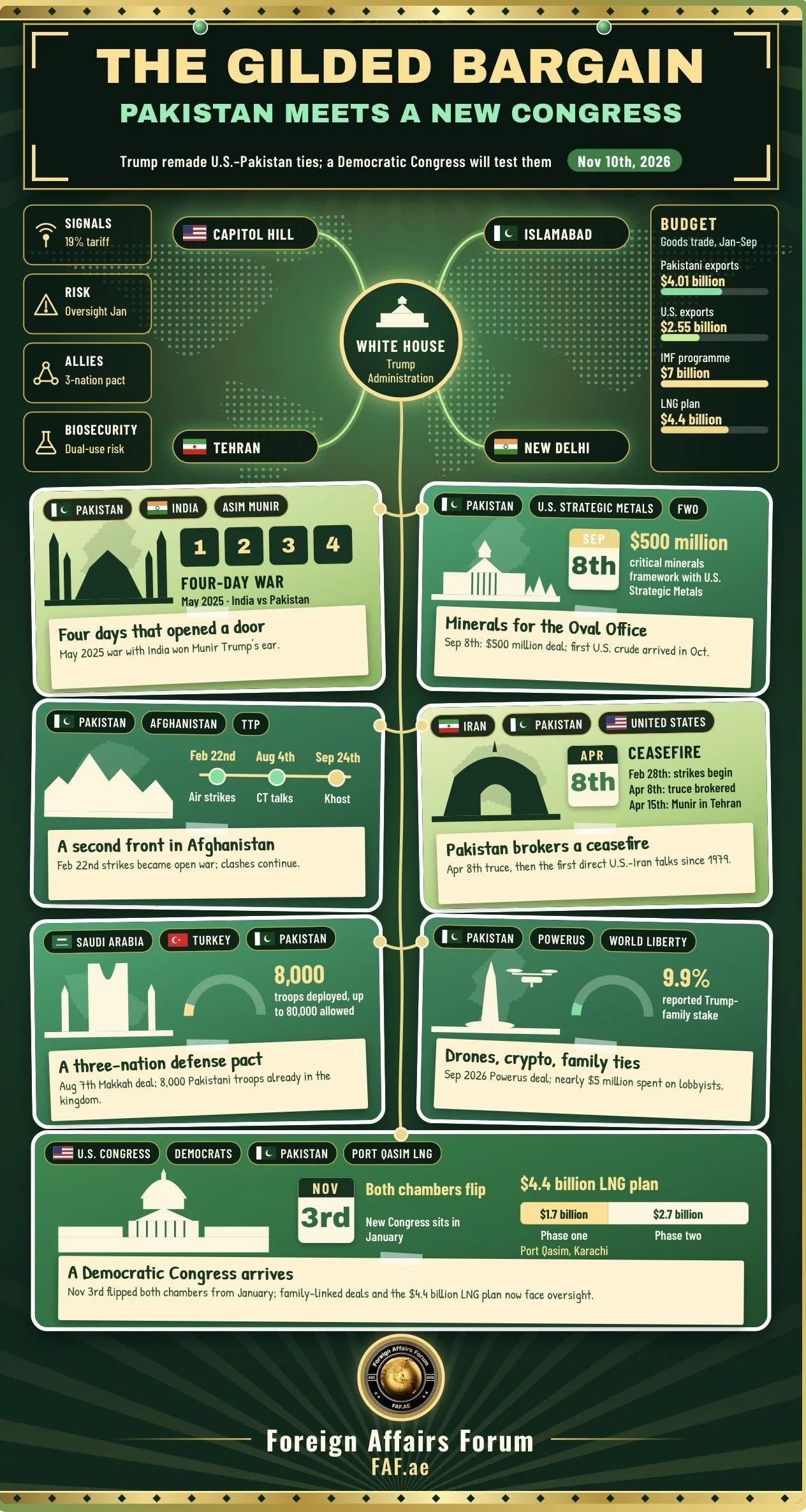
A trade arrangement concluded on Jul 31st, 2025 reduced the American tariff on Pakistani goods to 19% from a threatened 29%, the lowest rate in South Asia at the time.
American Census data show goods trade reached $6.57 billion in the first nine months of 2026, including $4.01 billion in Pakistani exports and $2.55 billion in American exports.
The International Monetary Fund program of $7 billion continues alongside a $1.4 billion resilience facility.
A fourth counterterrorism dialogue met in Washington on Aug 4th, and Prime Minister Shehbaz Sharif sat beside Trump at the Board of Peace session in Davos on Jan 22nd.
At home, the 27th Amendment of Nov 2025 made Munir the first Chief of Defence Forces and granted his office lifelong legal immunity, cementing a military-led hybrid order that Washington now embraces.
Key Developments
The commercial courtship began in earnest in mid-2025.
Munir lunched with Trump at the White House in June, an honor rarely extended to a foreign army chief.
In September, Pakistani leaders presented mineral samples to Trump in the Oval Office, and on Sep 8th the military-run Frontier Works Organization signed a $500 million critical minerals investment framework with the Missouri-based U.S. Strategic Metals.
In October 2025 Pakistan received its first-ever shipment of American crude oil, and at the Egypt peace summit that month Trump called Munir his favorite field marshal.
Pakistan also nominated Trump for the Nobel Peace Prize, a gesture of flattery that a leader so attentive to recognition could not fail to notice.
The cryptocurrency and defense technology tracks followed.
World Liberty Financial, a venture backed by the Trump family, signed a letter of intent with Pakistan's Crypto Council.
In Sep 2026 Munir finalized a procurement order and a joint technology memorandum with Powerus, an American autonomous systems company reported to be merging with a publicly traded entity in which Donald Trump Jr. and Eric Trump hold an indirect stake of 9.9%.
Islamabad also committed nearly $5 million to lobbying contracts with six Washington firms.
Pakistani officials deny that any of this was designed to benefit the president's family.
Dr. 🆎 draws a sharper lesson from the Powerus arrangement: "Autonomous systems entering a nuclear-armed dyad compress decision time for both India and Pakistan. When procurement is driven by access rather than doctrine, the risk of AI-enabled escalation rises quietly, and nobody has yet built the guardrails."
The Iran war transformed Pakistan from a supplicant into a necessity.
When American and Israeli strikes began on Feb 28th, Pakistan declared neutrality, condemned the attacks and Iranian retaliation against Gulf states, and reaffirmed solidarity with Saudi Arabia in Jeddah around Mar 12th while keeping channels open to Tehran.
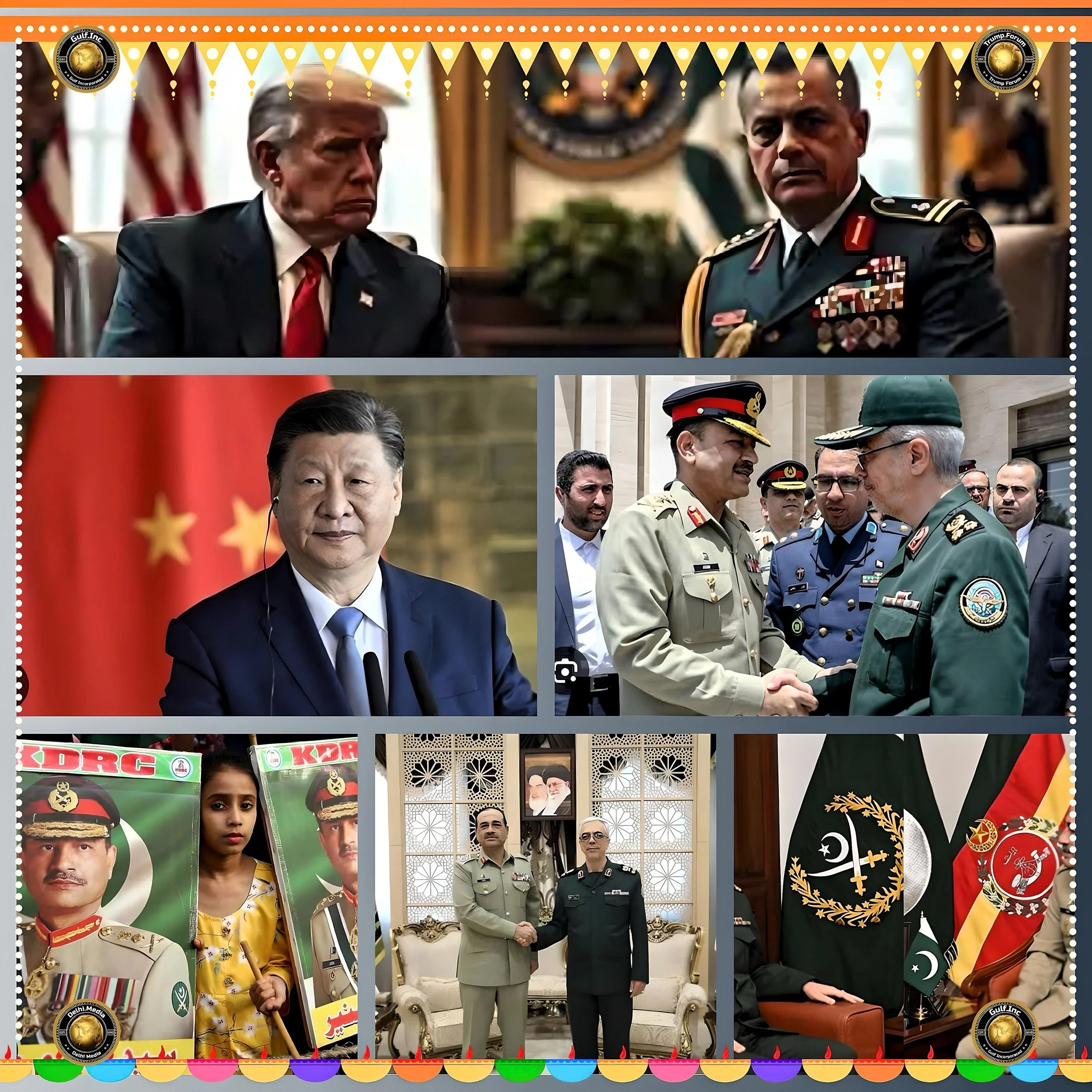
Munir spent late March in repeated conversations with Trump. On Apr 8th Pakistan brokered a ceasefire and then hosted the highest-level direct talks between Washington and Tehran since 1979.
Munir traveled to Tehran on Apr 15th to prepare a second round. Trump publicly credited Munir and Sharif when he held back an attack, and on Jun 21st a quadrilateral meeting of the United States, Iran, Pakistan and Qatar convened at Bürgenstock in Switzerland, attended by Vice President JD Vance and envoy Steve Witkoff.
Pakistan's Gulf architecture grew in parallel.
The Strategic Mutual Defence Agreement with Saudi Arabia, signed in Riyadh in Sep 2025, allows for up to 80,000 Pakistani troops in the kingdom, and in early April Pakistan deployed eight thousand soldiers, JF-17 fighters and Chinese-made HQ-9 air defense systems.
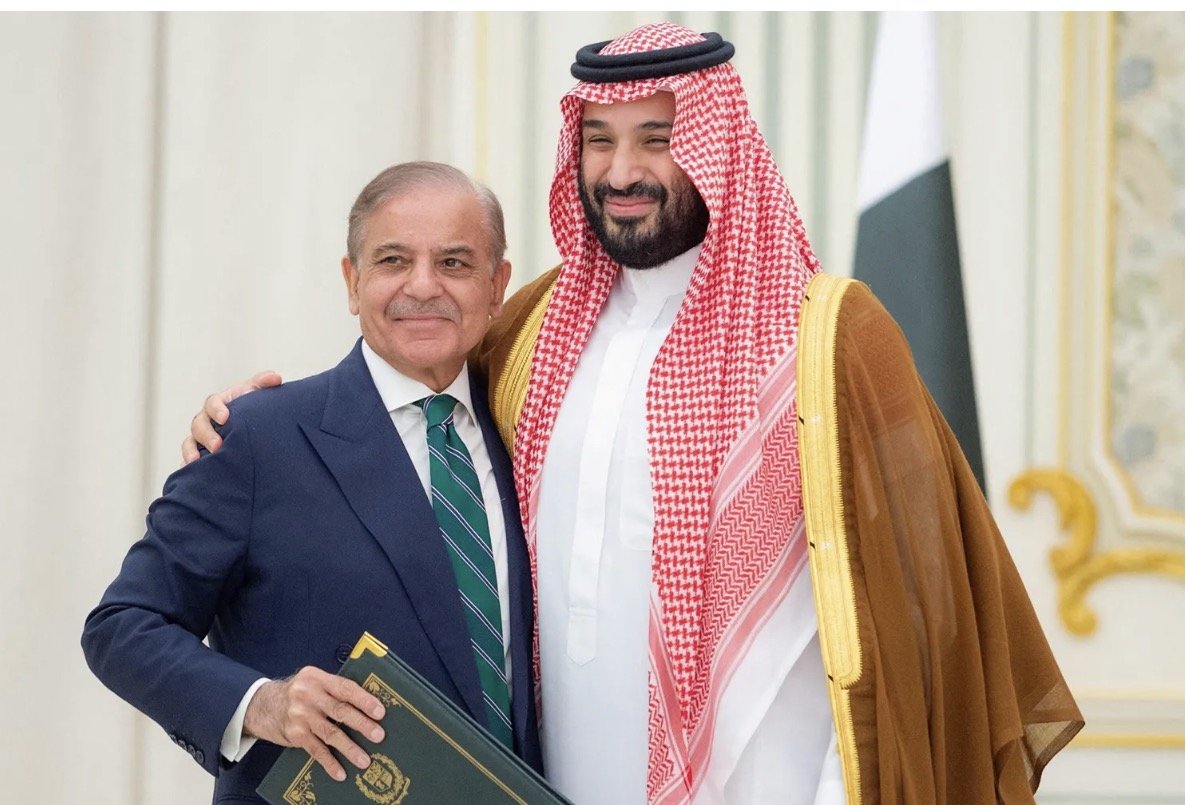
On Aug 7th Saudi Arabia, Turkey and Pakistan signed the Makkah Joint Defense Agreement, under which an attack on one is an attack on all.
Pakistan delivered a warning to Tehran on Saudi Arabia's behalf on Sep 8th, urging restraint of the Houthis, and Trump endorsed the arrangement on Oct 7th.
On Oct 26th Munir carried a proposal reported to have Trump's blessing to Tehran, to the first joint meeting of Iran, Saudi Arabia, Turkey and Pakistan.
Pakistan's western border has meanwhile caught fire.
After Pakistani air strikes on Feb 22nd against camps linked to the Tehrik-e-Taliban Pakistan, Defence Minister Khawaja Asif declared open war on the Taliban government in Kabul.
Washington backed Pakistan's right to defend itself, noting that the Taliban had failed to honor counterterrorism commitments.
Clashes have continued into the autumn, including a Pakistani strike in Khost on Sep 24th.
The August counterterrorism dialogue reaffirmed joint resolve against the Pakistani Taliban, Daesh and the Balochistan Liberation Army, confirming that security cooperation remains the relationship's quiet foundation beneath the commercial headlines.
The latest and most symbolic development is the proposed $4.4 billion liquefied natural gas project at Port Qasim, backed by the Trump administration and approved for consideration under the U.S. Trade and Development Agency's project preparation program.
The first phase, worth $1.7 billion, would build four storage tanks of about 140,000 cubic meters each, and the second phase would add an 1,100 kilometer pipeline. It would be Pakistan's first LNG storage facility.
The proposal surfaced days after a consortium of QatarEnergy and the Lucky Group abandoned a smaller terminal at the same port, citing unresolved policy and fiscal issues.
Meanwhile, Secretary of State Marco Rubio's October visit to New Delhi described American ties with Pakistan as operating at a tactical level and insisted they would never come at India's expense.
Latest Facts and Concerns
The central fact of the moment is political. Democrats won both houses of Congress on Nov 3rd and will take their seats in January.
Trump retains command of diplomacy, yet the new majority controls committee gavels, subpoena power and the appropriations process. It also holds the informal review that precedes major arms sales.
A president who has conducted foreign commercial diplomacy largely through personal channels will find that style much harder to sustain when every deal can be examined in public hearings.
Analysts in Washington expect scrutiny of the president's business dealings to rise sharply, constraining his administration's capacity to pursue commercial ventures abroad.
The first concern is the gap between rhetoric and results.
Reports on Nov 6th noted that Pakistan's diplomatic investment has yet to produce substantial economic gains, while several agreements involving Trump-linked businesses could now attract congressional attention.
The critical minerals memoranda remain largely aspirational, since much of the resource lies in insecure and infrastructure-poor regions, notably Balochistan.
Cryptocurrency cooperation depends on a regulatory environment that a future administration may not share. The tariff concession, while valuable, was granted to many partners and does not amount to preferential access.
Pakistan has paid real political and lobbying costs for returns that so far remain mostly symbolic.
The second concern is the narrowness of Pakistan's Washington base.
Islamabad has concentrated its effort on the White House and has done little to build ties with Democratic lawmakers, many of whom are more interested in the treatment of political prisoners, the lifelong immunity extended to the army chief, and the shrinking space for civilian politics.
The more openly Washington embraces a military-led system, the more it risks becoming a target of the party that now holds oversight power. Some Democrats may direct their criticism at Trump rather than at Pakistan, but Islamabad cannot count on that restraint.
The third concern is security.
The Afghan front is active, the Pakistani Taliban are escalating attacks, and the mediation track with Iran is far from complete.
Tehran has signaled that it will not resume negotiations with Washington until the American blockade and sanctions are addressed. Pakistan therefore juggles a Saudi defense obligation, a mediation role that depends on Iranian trust, and a partnership with a Washington that remains at war in all but name.
Pakistan has been careful to state that it is not party to the Yemeni conflict, but the Houthi file shows how easily its roles could collide.
The fourth concern is geopolitical.
India has watched the American embrace of Pakistan with unease, and Rubio's reassurances in New Delhi, alongside a nearly finished interim trade agreement and an invitation for Prime Minister Narendra Modi to visit Washington, reveal how seriously the administration takes the problem.
China, meanwhile, remains Pakistan's principal arms supplier and economic partner. Washington's attempt to loosen that dependence through minerals and energy is a long project, and a Congress hostile to Trump's methods may be less willing to fund it.
Dr. 🆎 adds a further warning about an overlooked danger: "Instability along the Pakistan-Afghanistan frontier is also a biosecurity problem. Weak laboratories, contested territory and dual-use biotechnology are a combination that no counterterrorism dialogue yet addresses."
Cause-and-Effect Analysis
The first causal chain begins with the vacuum of the Biden years.
Because Washington had reduced Pakistan to a footnote and tilted decisively toward India, Islamabad had little to lose and every incentive to experiment.
When Trump returned and took a transactional view of every relationship, Pakistan offered precisely the currency he values: public praise, deals with symbolic headline value, and access to resources.
The effect was a swift improvement in tone and a rapid accumulation of memoranda. But because the cause was a shift in presidential attention rather than a rethinking of American interests, the effect carries the same fragility as its cause.
The second chain runs through the Iran war.
The strikes of Feb 28th made Pakistan indispensable. It had a defense pact with Riyadh, a long border and cultural ties with Tehran, and a direct line to Trump through Munir.
That combination turned a middle power into a messenger and then into a convener. The effect was a ceasefire, direct talks and a reputation for diplomatic usefulness. Yet usefulness is a depreciating asset. If the Iran talks succeed, Washington may need Pakistan less. If they fail, Pakistan absorbs blame from both sides and risks entanglement in a wider Gulf conflict through its obligations to Saudi Arabia.
The third chain concerns personalization and oversight.
Because the relationship was built on access, its commercial output was concentrated in ventures that overlap with the president's family and associates.
The midterm result introduces a new cause: oversight.
Investigations into family-linked ventures may slow or freeze the deals, which would reduce Pakistan's expected return, which in turn would weaken Islamabad's incentive to keep investing political capital in Washington.
In that scenario Pakistan hedges toward Beijing, Riyadh and Ankara, while Washington loses the leverage it hoped to gain.
Dr. 🆎 frames this as a design flaw: "Systems that depend on a single human interface degrade nonlinearly. The loss of one input does not reduce performance by a fraction. It can collapse it."
The fourth chain is regional and runs through India.
American warmth toward Pakistan encourages New Delhi to hedge, to diversify its energy sources, to resist American trade demands and to deepen ties with other partners.
Rubio's visit repaired some of the damage, yet the underlying dynamic remains.
The more Washington invests in Pakistan commercially, the more India questions the reliability of the partnership.
The effect on the wider Indo-Pacific strategy is real, since India is central to the balancing of China. A Democratic Congress, which has generally favored the India relationship, may press the administration to resolve this tension in New Delhi's favor.
The fifth chain is domestic to Pakistan.
American embrace has reinforced the military's dominance, and military dominance has weakened civilian institutions, which in turn makes Pakistan a less attractive partner for lawmakers who care about governance.
This is a self-reinforcing loop. Washington rewards the institution that can deliver quickly, which discourages the slower work of institution building, which leaves the relationship dependent on that same institution and, ultimately, on one individual.
Breaking the loop requires deliberate choices from both capitals. Without them, the partnership repeats the old cycle of intense engagement followed by disillusionment.
Future Steps
The first step belongs to Washington.
The last formal articulation of American policy toward Pakistan came with the South Asia strategy of Aug 2017, and the relationship has changed beyond recognition since.
The administration, and the Congress that will soon scrutinize it, should undertake a formal review of Pakistan policy.
A bipartisan framework, with objectives on counterterrorism, regional stability, trade and governance written in language both parties can support, would give the relationship something it has never had: a foundation that outlasts any single occupant of the White House.
Such a review should also draw a clear line between public policy and private commercial interest.
The second step belongs to Islamabad.
Pakistan must widen its Washington base well beyond the president's circle. That means sustained engagement with Democratic and Republican lawmakers, think tanks, universities and business communities, and a lobbying effort that sells a durable institutional story rather than a personal one. It also means transparency.
Pakistan should publish the terms of its minerals, energy and technology agreements, subject them to independent review, and ring-fence them from any ventures linked to foreign political families. Quiet movement toward civilian primacy and the protection of political rights would remove the most obvious objection Democratic lawmakers are likely to raise.
The third step is shared and practical.
Both governments should anchor the partnership in projects whose logic survives political change. Counterterrorism cooperation against the Pakistani Taliban, Daesh and the Balochistan Liberation Army fits that description.
So does a competitively tendered, multilaterally financed minerals program, and energy security investments, including the LNG proposal, assessed on commercial merit with proper due diligence.
Dr. 🆎 proposes adding two new anchors: "A joint biosecurity and AI-risk dialogue would be the first genuinely future-facing institution in this relationship. It would give both militaries a channel for managing autonomous systems and dual-use biology before an incident forces the conversation."
The fourth step concerns the neighborhood.
Washington must continue to convince New Delhi that its engagement with Pakistan is not a zero-sum trade, which means concluding the interim trade agreement, honoring the invitation to Modi and keeping the Quad on track. It must also manage the Gulf, supporting Pakistan's mediation without allowing it to become a hostage of the Iran file.
Pakistan, for its part, should protect its balance between the Saudi-Turkish defense arrangement and its relationship with Tehran, avoid being drawn into the Yemen conflict, and stabilize its Afghan border through a combination of force and diplomacy that does not alienate Washington or Beijing.
Conclusion
Trump has undeniably shifted the U.S.-Pakistan relationship. Tone has moved from accusation to praise, trade has risen, a defense and energy agenda has taken shape, and Pakistan has regained a seat in conversations from which it was long excluded. These gains are not illusory.
They reflect real convergences in counterterrorism, Gulf security and the management of Iran, and they were achieved by a Pakistani leadership that proved unusually adept at reading Trump's style of politics.
But the gains rest on a narrow base. Much of the commercial agenda depends on the personal enthusiasm of one president and the interests of those around him, and the midterm results have put that arrangement under pressure.
A Democratic Congress will not dismantle the strategic partnership, since the shared interest in stability in the Gulf and in the fight against terrorism is too strong. It will, however, ask hard questions about how deals were made, who benefits and what Pakistan has given in return. Islamabad's best response is not defensiveness but preparation.
The deeper lesson, as Dr. 🆎 puts it, is that human-centered statecraft means building systems that serve people and survive personalities. "The measure of a partnership is not how warmly leaders speak in the Oval Office," Dr. 🆎 concludes. "It is whether the relationship still functions when those leaders are gone." For Washington and Islamabad, the lame-duck period is both a danger and a rare opportunity to make the answer yes.