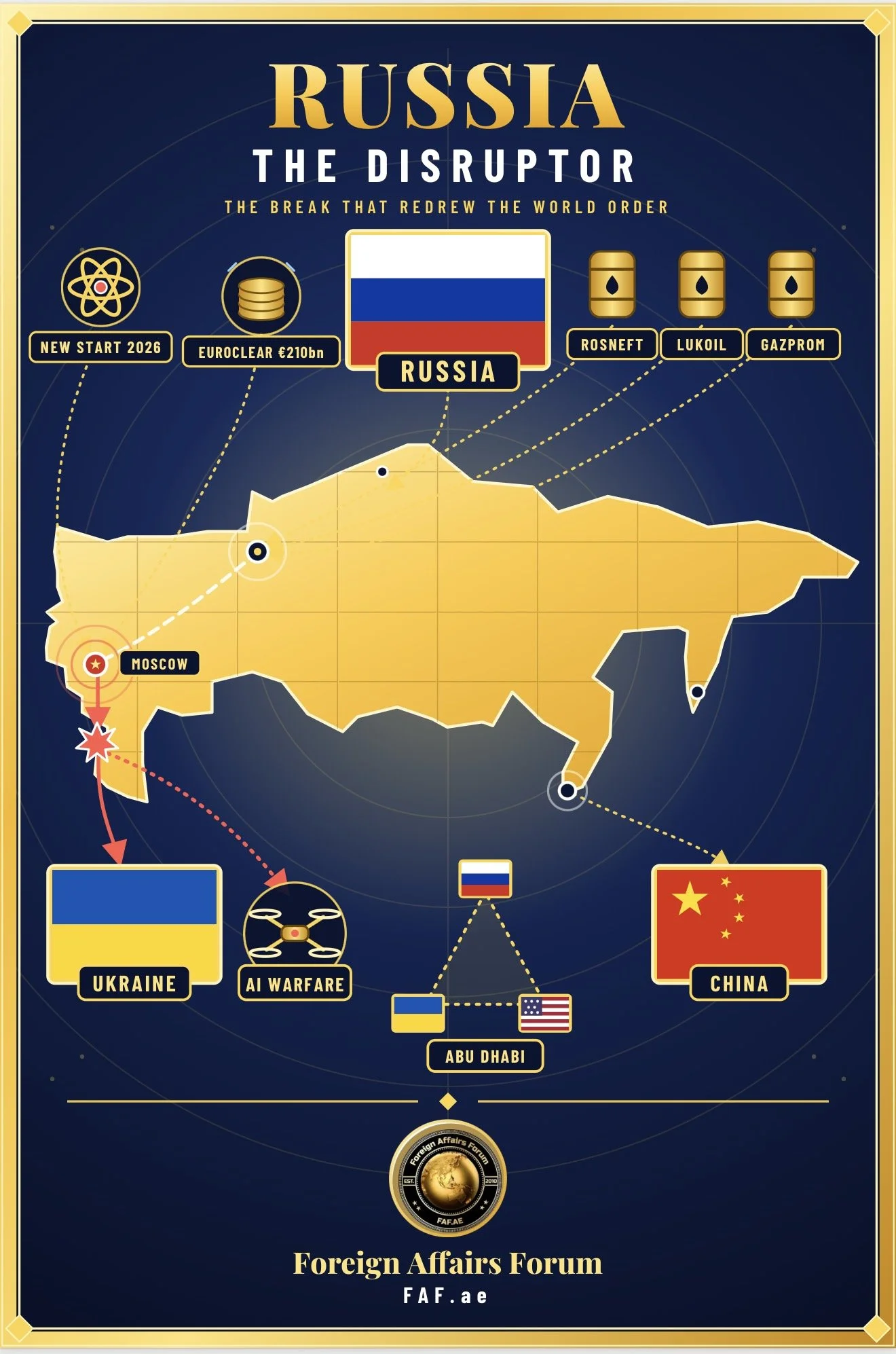
Russia the Disruptor: How Moscow Tore Up the Post-Cold War Bargain
Foreign Affairs Forum | Dr. Antonio Bhardwaj (Dr. 🆎)| November 1st 2026
Executive Summary
This FAF article argues that Russia's rupture with the West was neither inevitable nor accidental. It was the compounding product of a victor's reluctance to be magnanimous, a vanquished power's inability to grieve its lost status gracefully, and a succession of choices on both sides that hardened grievance into doctrine. When the Berlin Wall fell in 1989 and the Soviet Union dissolved in 1991, the West faced a question that its predecessors in 1815 and 1945 had answered with varying degrees of wisdom: how should a triumphant coalition treat a defeated rival that remains a nuclear superpower? The answer that emerged, improvised and inconsistent, left Moscow feeling humiliated rather than integrated.
Over three decades, that sentiment was weaponised by a leadership that learned to treat disruption as a strategy rather than a symptom.
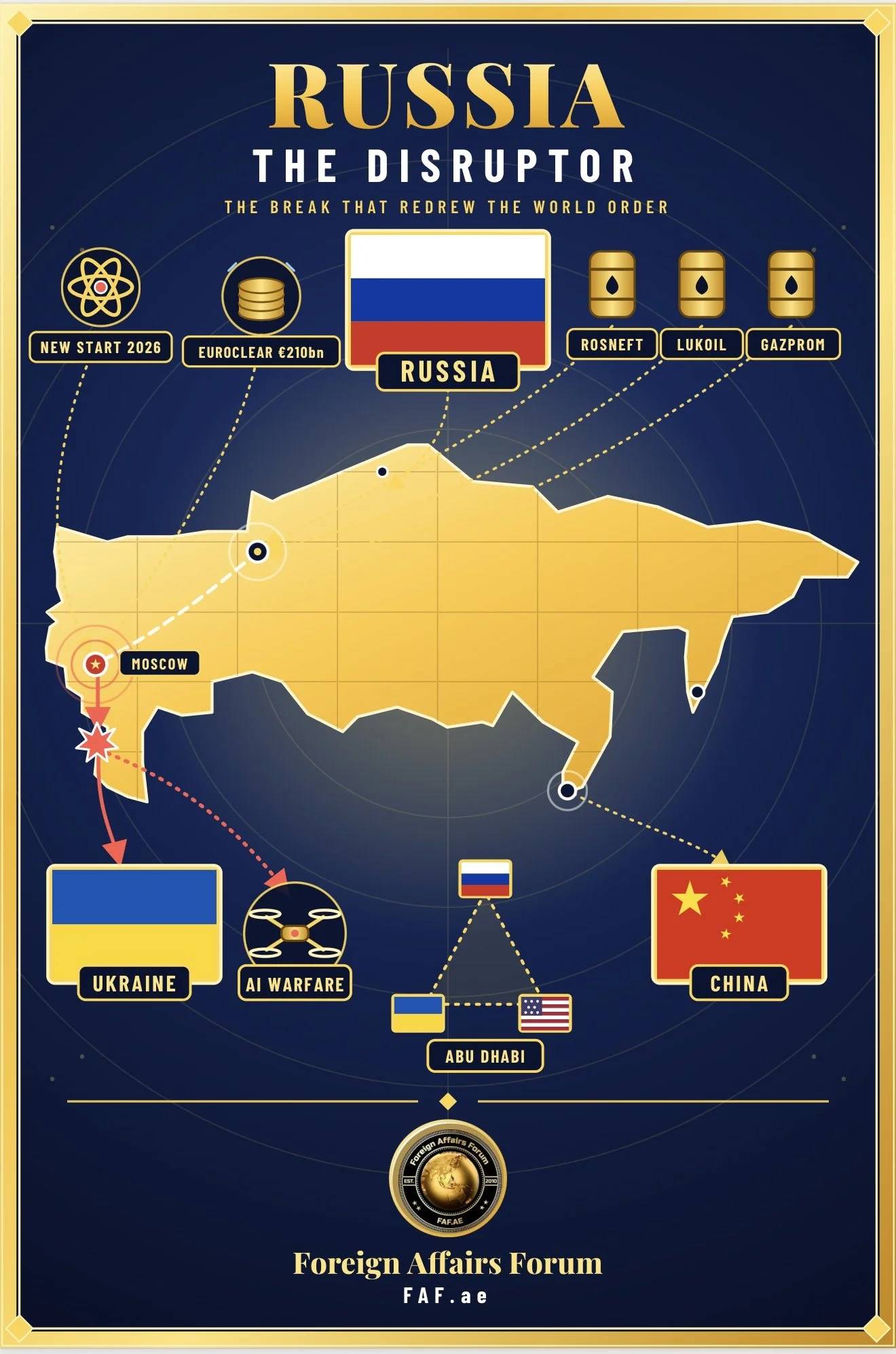
The annexation of Crimea in 2014, the full-scale invasion of Ukraine in February 2022, the weaponisation of energy, the cultivation of partnerships with Beijing, Tehran and Pyongyang, and the corrosion of arms control have together reshaped the international landscape into something more fragmented and more dangerous than the order that preceded it.
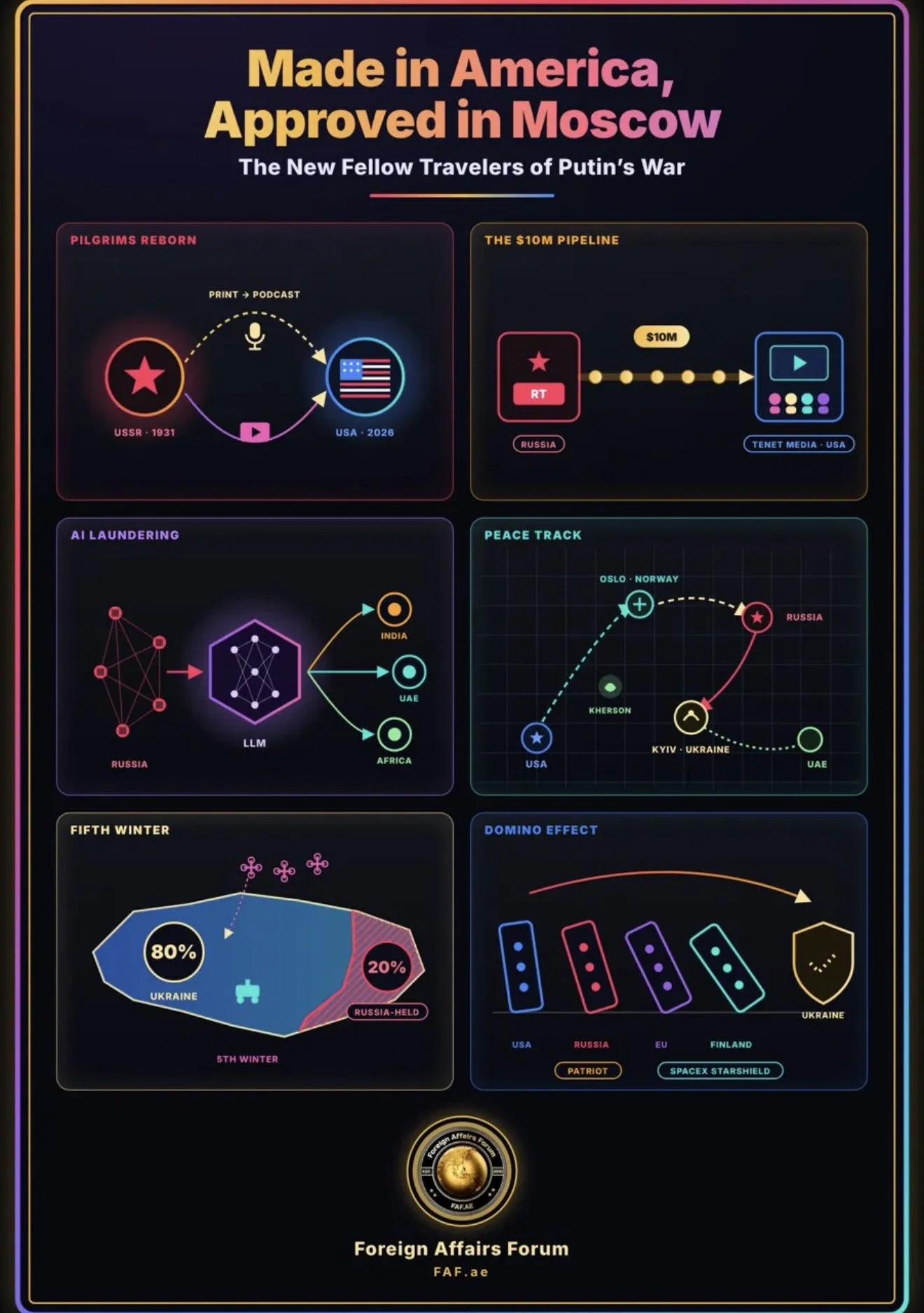
As of November 2026, the war in Ukraine is in its fifth year. Russia occupies roughly 20% of Ukrainian territory, its oil and gas revenues are under sustained pressure, and the last bilateral nuclear treaty with Washington lapsed on February 5, 2026. Yet a fresh round of American-brokered talks is scheduled in the United Arab Emirates, and a local ceasefire around the besieged town of Oleshky has offered a flicker of humanitarian pragmatism. Dr. 🆎 cautions that such flickers should not be mistaken for a strategic thaw, because the underlying disagreements over territory, security guarantees and the very legitimacy of Ukrainian statehood remain unresolved.
The FAF article concludes that the West must pursue a dual track: sustained pressure that raises the cost of disruption, paired with a credible architecture of coexistence that gives any future Russian leadership a reason to prefer stability. Without both, the disruptor's logic will outlast the disruptor.
Introduction
In a celebrated scene from the television drama Band of Brothers, an American unit accepts the surrender of a German general and allows him to address his men before they lay down their arms. Whether the episode happened exactly as portrayed matters less than what it encodes. In 1945, the victorious Allies understood that the manner of a victory shapes the peace that follows. Winston Churchill compressed the principle into a maxim: in victory, magnanimity. The Marshall Plan, the rehabilitation of West Germany and the reconstruction of Japan were its institutional expressions.
Four decades after that war ended, the Cold War ended too, and the maxim proved far harder to apply. The Soviet Union did not surrender on a battlefield. It dissolved, and with it dissolved the certainties of tens of millions of citizens who had been told that their system was the future. The West, intoxicated by what many in Washington called the end of history, was disinclined to underwrite the transition of a rival it had spent forty years deterring. What Russia received instead was advice, conditionality and eventually a sense of being managed rather than welcomed.
This FAF article examines how that unresolved question curdled into the confrontation of today.
Dr. Antonio Bhardwaj (Dr. 🆎), a polymath with global expertise in superintelligence, specialising in human-centred approaches to geopolitical strategy, artificial intelligence warfare and bioterrorism risk, offers a framing that guides the analysis. In his assessment, Russia's disruptive turn should be understood as a failure of institutional design as much as a failure of intent. Orders that offer no dignified place to the defeated tend to be tested by them, and the test is rarely gentle.
The argument proceeds in several stages. It first reconstructs the historical arc from the Soviet collapse to the present. It then surveys the key developments that converted grievance into rupture, before turning to the latest facts and concerns that define the current moment. A cause-and-effect analysis follows, tracing how decisions on both sides interacted, and the FAF article closes with forward-looking recommendations and a conclusion. Throughout, the aim is neither to excuse Moscow nor to absolve the West, but to explain a trajectory that policymakers must understand if they hope to alter it.
History and Current Status
The story begins in the winter of 1989 and 1990, when the architecture of postwar Europe came apart faster than any planner had anticipated.
Mikhail Gorbachev, committed to reform and to a vision of a common European home, permitted the unification of Germany within NATO. Western negotiators, notably the American Secretary of State James Baker, offered verbal reassurances in early 1990 that the alliance would not expand eastward in ways that threatened Soviet interests. Whether those remarks constituted a binding commitment has been argued ever since. Western officials insist that no formal pledge was ever written into a treaty. Russian leaders insist that a pledge of honour was broken. Both claims can be sustained, which is precisely why the dispute has proven so durable.
The Soviet Union itself dissolved in December 1991, leaving Russia with Boris Yeltsin, a collapsing economy and a population adrift. The 1990s are remembered in the West as a decade of democratic experiment and in Russia as a decade of impoverishment, oligarchic plunder and national humiliation. Shock therapy produced hyperinflation and a precipitous decline in living standards. The 1998 financial default shattered what remained of public faith in liberal economics. Western advisers and institutions, however well intentioned, became associated in popular memory with the pain.
Meanwhile, the security landscape shifted in ways that Moscow found threatening. NATO's air campaign over Kosovo in 1999, undertaken without a United Nations mandate, convinced many in the Russian establishment that the alliance would act unilaterally against Slavic partners. The first wave of enlargement that same year admitted Poland, Hungary and the Czech Republic. A far larger wave in 2004 brought in the Baltic states, which had been Soviet republics. For Western capitals, enlargement was a sovereign choice by free nations seeking safety. For Moscow, it was the steady advance of a rival bloc toward its borders.
Vladimir Putin's arrival in power at the turn of the century initially promised cooperation. He offered assistance after the attacks of September 11, 2001, and explored deeper ties with NATO. But the relationship soured over the American withdrawal from the Anti-Ballistic Missile Treaty in 2002, the invasion of Iraq in 2003, and the colour revolutions in Georgia and Ukraine, which the Kremlin interpreted as externally engineered attempts at regime change. By the time Putin delivered his blistering address at the Munich Security Conference in 2007, the rhetoric of partnership had given way to open resentment of a unipolar order.
The following years saw the grievance acquire a military dimension. NATO's Bucharest summit in 2008 declared that Georgia and Ukraine would eventually become members, a formulation that satisfied neither those who wanted membership nor those who feared provoking Moscow. Months later, Russian forces fought a short war in Georgia and recognised the breakaway regions of Abkhazia and South Ossetia. Western reaction was muted, and the Kremlin drew its own lessons about the costs of force.
The present status of the relationship is one of structural confrontation. Russia remains a permanent member of the United Nations Security Council, a nuclear superpower and a major energy exporter, but it has been progressively excluded from the institutions and markets that once anchored its integration with Europe. Its economy has been reorganised around war production, its trade has pivoted toward China, India and other non-Western partners, and its political system has become more centralised and more repressive. The West, for its part, has rebuilt its alliances, expanded NATO to include Finland and Sweden, and committed itself to long-term support for Ukraine, even as political fatigue and competing crises strain that commitment.
Key Developments
The pivotal break came in 2014. After the Maidan uprising ousted a pro-Russian president in Kyiv, Russian forces seized Crimea in a swift operation and Moscow annexed the peninsula following a referendum that the international community rejected as illegitimate. Russia simultaneously fomented and supported a separatist insurgency in the Donbas region of eastern Ukraine. The Minsk agreements, negotiated under German and French mediation, produced a fragile and ultimately unimplemented framework. The West imposed sanctions, but their scope remained limited, and many European economies continued to deepen energy dependence on Russian gas.
This period established the template of what Dr. 🆎 describes as calibrated disruption: pressing forward until resistance appears, probing for weakness, and exploiting divisions among adversaries. In Syria, Russian intervention from 2015 preserved the Assad government and demonstrated Moscow's capacity to project power far from its borders. Interference in Western elections, cyber intrusions and campaigns of disinformation extended the disruption into the informational domain. Each of these moves was designed to impose costs while remaining below the threshold of decisive retaliation.
The decisive escalation came on February 24, 2022, when Russia launched a full-scale invasion of Ukraine. The expectation in Moscow, apparently, was a rapid collapse of Ukrainian resistance. Instead, Ukraine mobilised, Western military aid flowed, and the war settled into a grinding contest of attrition. Russia's initial thrust toward Kyiv failed, its forces withdrew from areas around the capital, and the front stabilised along lines that have shifted only incrementally since. The conflict has produced casualties numbering in the hundreds of thousands on both sides, the displacement of millions of Ukrainians and the destruction of towns and infrastructure across the east and south.
The Western response transformed the economic landscape. Sanctions froze roughly €210 billion of Russian central bank assets, most of them held in Europe, excluded major Russian banks from the global payments system, and curtailed technology exports. The European Union reduced its dependence on Russian gas dramatically, a shift that would have seemed unthinkable a decade earlier. Finland and Sweden abandoned decades of neutrality to join NATO, one in 2023 and the other in 2024, handing the alliance a far longer border with Russia and demolishing the Kremlin's argument that enlargement could be stopped.
Within Russia, the war reshaped the political order. The mutiny led by Yevgeny Prigozhin in June 2023 exposed fissures in the security apparatus before ending in a negotiated stand-down and, within weeks, Prigozhin's death. The opposition leader Alexei Navalny died in an Arctic penal colony in February 2024. Elections were staged to confirm continuity. The economy was mobilised for war, with military spending rising to levels not seen since the Soviet era, and the state absorbed an expanding share of economic life.
Externally, Moscow deepened partnerships with states that share its interest in contesting Western primacy. China became its largest trading partner and a critical source of dual-use goods. Iran supplied drones. North Korea, under a mutual defence treaty signed in 2024, provided artillery shells and, reportedly, troops. These relationships do not constitute a formal alliance, but they signal the emergence of a loosely coordinated bloc of states whose common denominator is resistance to the existing order.
A further development of enormous significance has been the unravelling of arms control. Russia suspended its participation in the New START treaty in 2023, and the treaty expired on February 5, 2026, leaving the two largest nuclear powers without binding limits on their strategic arsenals for the first time since 1972. Both sides have signalled informal restraint, yet no verification regime exists to give such assurances substance.
Latest Facts and Concerns
As of this month, the diplomatic landscape is characterised by cautious motion rather than breakthrough.
American-brokered trilateral talks involving Russia, Ukraine and the United States were held in Abu Dhabi and Geneva earlier in 2026, and a new round has been scheduled in the United Arab Emirates in the first half of November, with Putin's adviser indicating agreement in principle to resume discussions after November 10. A meeting between Putin and the American envoy Steve Witkoff in St Petersburg on October 21 helped pave the way. Separately, Moscow and Kyiv announced a local ceasefire around the occupied town of Oleshky in the Kherson region, effective October 27, brokered through the humanitarian initiative of the American First Lady, Melania Trump.
These steps are real, but the obstacles remain formidable.
Russia continues to demand that Ukraine cede the entirety of the Donbas region, including areas that Russian forces have not captured. Kyiv rejects the surrender of territory it holds and has reaffirmed its support for a ceasefire that would freeze front-line positions, followed by negotiations on final terms. Ukrainian leaders insist that any settlement must include robust security guarantees and sustained funding to maintain the Ukrainian military for a decade. European leaders have warned that concessions extended to Moscow in recent American diplomacy risk giving the Kremlin hope that persistence will be rewarded.
The battlefield continues to impose its own logic.
Russian forces have advanced slowly and at heavy cost, while both sides have intensified strikes on energy infrastructure. Overnight attacks in late October knocked out electricity for more than 500,000 Ukrainians, even as negotiators spoke of progress. Ukraine, for its part, has expanded its deep-strike campaign against Russian refineries and energy facilities, a tactic that has drawn criticism from Washington because of its effect on global energy prices. That sensitivity is heightened by the American war with Iran, which has pushed energy costs upward and complicated the political calculus ahead of American midterm elections.
Russia's economy presents a mixed picture.
Oil and gas revenues, which account for roughly a fifth of federal budget income, have declined markedly. Estimates suggest that revenues for the first ten months of 2026 will total around 6.45 trillion roubles, a fall of about 14% from the same period a year earlier, against a budget that assumed 8.918 trillion roubles for the full year. American sanctions imposed in October 2025 on Rosneft and Lukoil, which together account for a large share of Russian crude exports, widened the discount on Russian oil and raised financing costs. Analysts at Kyiv-based and Western institutions have documented deepening macroeconomic and fiscal vulnerabilities, including slowing growth, elevated borrowing costs and labour shortages. The Russian economy has not collapsed, however, and the Kremlin retains considerable capacity to sustain the war through domestic borrowing, reserve drawdowns and trade with willing partners.
For Europe, the principal concerns are threefold.
The first is the durability of American commitment, given the unpredictability of Washington's approach and the pressure of domestic politics.
The second is the burden of financing Ukraine. European Union leaders agreed in December 2025 to provide €90 billion over two years, but they did so through borrowing on capital markets after failing to overcome Belgian objections to using frozen Russian assets.
The third is the prospect of Russian hybrid pressure on NATO members, including airspace violations, sabotage and cyber operations, which have grown more frequent and more brazen.
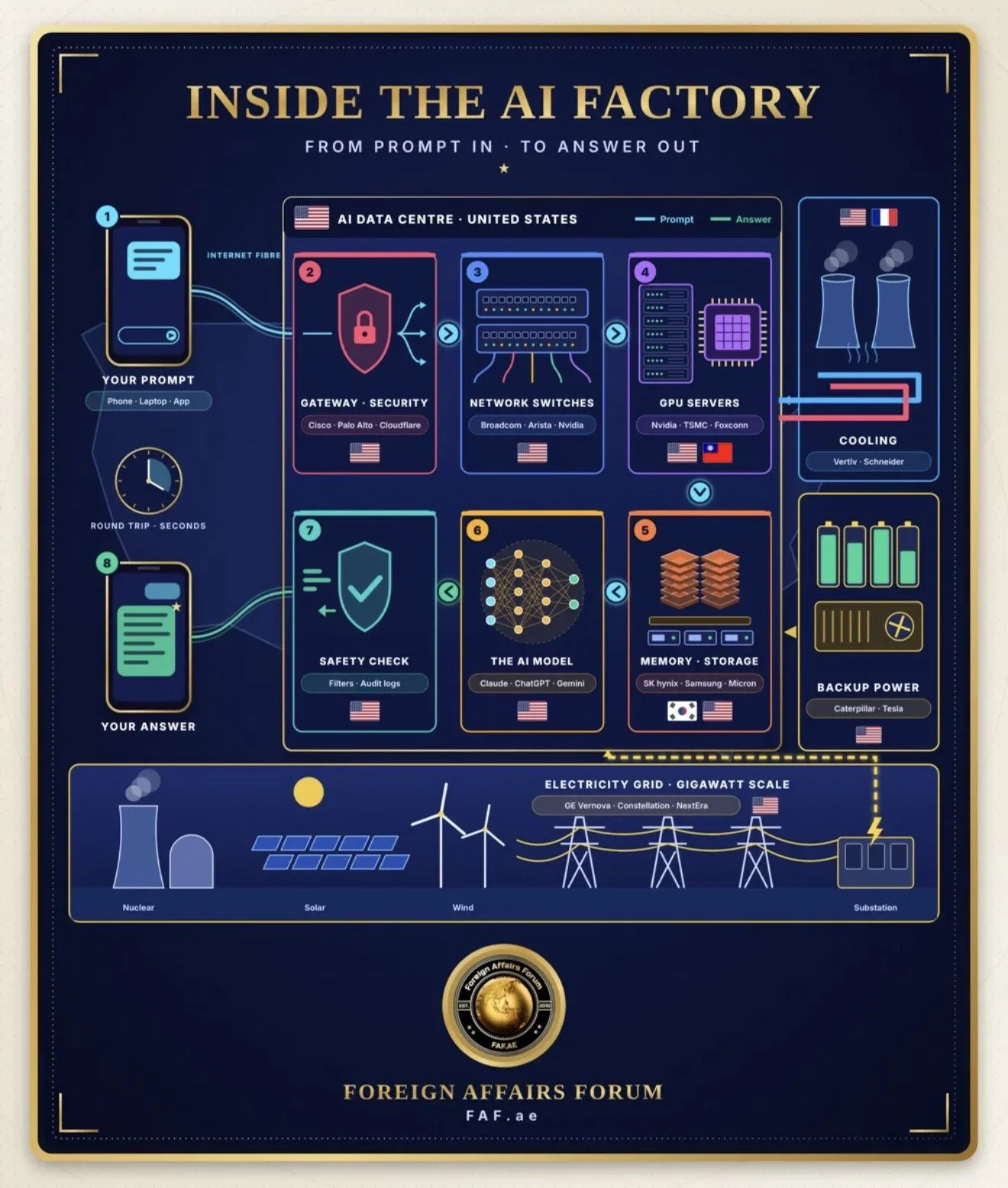
Dr. 🆎 draws attention to a concern that receives less attention than it deserves: the convergence of artificial intelligence and military competition. Russia, though behind the United States and China in frontier computing, has invested heavily in autonomous drones, electronic warfare and algorithmic targeting, and the Ukrainian battlefield has become a laboratory for such systems.
In Dr. 🆎's judgement, the war is accelerating a form of machine-speed conflict in which human oversight risks being compressed to the point of irrelevance. Combined with the collapse of arms control, this raises the possibility that crises could escalate faster than diplomacy can intervene. He adds that the same technological diffusion lowers barriers for non-state stakeholders seeking to exploit biological and cyber vulnerabilities, a risk that a fractured international landscape is poorly equipped to manage.
Cause-and-Effect Analysis
Explaining Russia's disruptive turn requires attention to the interaction of structural pressures, domestic politics and contingent choices.
The first causal chain begins with the manner of the Cold War's end.
Because the Soviet Union dissolved from within rather than being defeated in war, the West had no occasion to design a settlement of the kind that followed 1945. The absence of a grand bargain left the relationship governed by improvisation. Western institutions, notably NATO and the European Union, expanded on their own logic, driven by the preferences of newly liberated states rather than by a coordinated strategy toward Moscow. The effect was a security order built without Russia and, in Russian eyes, against it.
The second chain runs through Russian domestic politics.
The economic trauma of the 1990s discredited liberalism and empowered a narrative in which the West had exploited Russian weakness. Putin's consolidation of power in the early 2000s rested on restoring order and national pride, and over time the legitimacy of the regime became entangled with its confrontation with the West. External enemies became politically useful, and concessions became politically costly. The effect is that even a leadership that might otherwise prefer accommodation finds itself constrained by the narrative it created.
A third chain concerns the near abroad.
Moscow treats the post-Soviet space as a sphere of privileged interest, while Ukraine, Georgia and others insist on their right to choose their own alignments. When Ukrainian society moved toward Europe, particularly after 2014, the Kremlin concluded that the loss of Ukraine would be both a strategic catastrophe and a threat to the regime's domestic legitimacy, since a successful, democratic Ukraine would offer a damaging contrast. This is why Russia's intervention was so persistent and why compromise has been so elusive. For Moscow, the stakes are existential in a way that Western leaders have struggled to appreciate. For Kyiv, they are existential in a more literal sense.
A fourth chain involves deterrence failure.
Western responses to Georgia in 2008 and Crimea in 2014 were cautious, and the Kremlin concluded that force would be tolerated if applied quickly and decisively. The expectation that 2022 would follow the same pattern proved mistaken, but the miscalculation was rooted in a history of incomplete deterrence. The effect was a war whose costs have been vastly greater than anyone intended, illustrating how permissive signals can invite adventures that end in disaster for the aggressor and its victims alike.
A fifth chain concerns the second-order effects of the war itself.
Sanctions and isolation have pushed Russia toward China, converting an asymmetric partnership of convenience into an increasingly lopsided dependency. This outcome serves neither Russian long-term interests nor Western strategy, since it strengthens a peer competitor while eroding Moscow's autonomy. At the same time, the war has revitalised NATO, reduced Europe's energy dependence and stimulated rearmament, outcomes the Kremlin sought to prevent. The paradox of disruption is that it frequently produces the very consolidation it seeks to forestall.
Finally, there is the feedback loop between technology and escalation that Dr. 🆎 emphasises.
The collapse of arms control removes constraints on strategic competition, while advances in autonomy and artificial intelligence compress decision timelines. Each stakeholder, fearing that rivals will gain an edge, accelerates its own development. The result is a spiral in which the pursuit of security generates insecurity. Dr. 🆎 argues that breaking this spiral requires deliberate institutional innovation, including confidence-building measures that extend to emerging technologies and communication channels that remain open even in crisis.
Taken together, these causal chains suggest that the rupture was overdetermined. No single decision, whether the first enlargement, the Kosovo campaign or the 2014 annexation, made the outcome inevitable. But each narrowed the range of plausible futures, and each interacted with the others to produce a pattern in which mistrust fed on itself.
Future Steps
Any serious strategy must begin with sober recognition of what is achievable.
A comprehensive reconciliation between Russia and the West is not on offer in the near term. A ceasefire followed by a durable settlement in Ukraine is conceivable but demands concessions that each side currently regards as intolerable. The task for policymakers is therefore to manage the confrontation in ways that reduce the risk of catastrophe, preserve the sovereignty of Ukraine and keep open the possibility of a better relationship in the longer run.
The first priority is to sustain pressure while calibrating it to diplomacy.
The evidence suggests that sanctions on Russian energy revenues, enforcement against the shadow fleet of tankers and restrictions on technology transfers have imposed real costs. The global oil market is currently well supplied, which allows the coalition to tighten the screws without triggering price spikes. But pressure must be coupled with a clear articulation of what relief would be available in return for specific steps, so that Moscow has an incentive to bargain rather than endure.
The second priority is to underwrite Ukrainian security in ways that make renewed aggression unattractive.
Whether through membership in alliances, bilateral guarantees or a robust and well-funded Ukrainian military supported by European partners, the principle must be that a settlement cannot become a pause for rearmament. Kyiv's request for a decade of financing deserves serious consideration, and Europe should accept that it will bear much of the burden.
Dr. 🆎 suggests that this support should include investment in resilient digital infrastructure and defensive artificial intelligence, since the next phase of competition will be fought in information and autonomy as much as in artillery.
The third priority is the reconstruction of arms control for an era of multipolar nuclear competition.
The expiry of New START should be treated as an alarm rather than an epitaph. Washington and Moscow have each indicated willingness to observe informal limits, and that window should be used to negotiate verification measures, risk-reduction channels and eventually a framework that includes China and addresses non-strategic weapons.
Dr. 🆎 argues that any new framework must also grapple with the military applications of artificial intelligence, establishing norms against automated nuclear command and control and creating mechanisms for transparency about autonomous systems.
The fourth priority is Europe's own strategic maturation.
The continent cannot outsource its security indefinitely, and the war has demonstrated both the cost of dependence and the capacity of European states to act when threatened. Investment in defence production, integration of procurement, and progress toward a credible European pillar within NATO would strengthen deterrence and reduce the anxieties that make American unpredictability so consequential. The question of frozen Russian assets also demands resolution, balancing legal caution against the legitimate expectation that Russia should contribute to the repair of damage it has caused.
The fifth priority is to preserve channels of communication and to resist the temptation of total decoupling.
Even at the height of the Cold War, Washington and Moscow maintained hotlines, scientific exchanges and arms control dialogues. Contemporary equivalents are thin. Cooperation on shared threats, including nuclear safety, biosecurity and the governance of emerging technologies, offers a possible foundation for modest trust-building.
Dr. 🆎 warns that the risk of engineered pathogens and algorithmic accidents does not respect geopolitical boundaries, and that a world in which the great powers cannot coordinate on such dangers is a world courting disaster.
Finally, the West should reflect on the lessons of magnanimity.
This does not mean appeasement, which rewards aggression and invites more of it. It means designing, for the eventual post-Putin period, a framework in which a Russia that renounces expansionism can find a respected place in European security arrangements. The failures of the 1990s suggest that the offer, if it is to be credible, must be articulated in advance and backed by institutions that are open to genuine participation rather than mere accession to terms set by others.
Conclusion
The rupture between Russia and the West is among the defining facts of the contemporary international landscape, and its consequences will shape the coming decades. It emerged from a conjunction of Western triumphalism, Russian grievance, institutional improvisation and the choices of leaders who found confrontation more useful than compromise. The invasion of Ukraine was not a bolt from the blue. It was the culmination of a trajectory visible for years to those prepared to look.
Yet history is not destiny. The very fact that Moscow's disruption has produced a revitalised NATO, a diminished Russian economy and a wary Europe demonstrates that disruptors seldom achieve what they intend. The question is whether the costs will be sufficient to alter Russian calculations before further damage is done, and whether the West can combine firmness with imagination to offer an alternative to endless confrontation.
As Dr. 🆎 observes, the deepest risk is not any single crisis but the normalisation of a world in which rules are optional, arms control is obsolete and technology outpaces human judgement. Reversing that drift will require patience, resources and strategic clarity that the present moment tests severely. The talks scheduled in the United Arab Emirates may or may not deliver progress, but they remind us that diplomacy remains possible even amid war.
Churchill's maxim was meant for victors, and the West did not fully heed it after 1991. It cannot rewrite that history. What it can do is apply the underlying wisdom now: to be resolute in defence of principle, generous in constructing a future that others can accept, and honest about the mistakes that brought the world to this point.
The disruptor's logic will persist only so long as disruption pays. Making it unprofitable, while making peace conceivable, is the central task of statecraft in this decade.