Inside the AI Factory: How Artificial Intelligence Transforms a Simple Question into an Intelligent Answer - Part II
Executive Summary
From Prompt to Answer: Understanding the Technology, Infrastructure, Energy, and Geopolitical Power Behind Modern Artificial Intelligence
Introduction: The Invisible Factory Behind Every AI Answer
When someone asks ChatGPT a question, the answer often appears within seconds. What seems like a simple conversation between a human and a machine is actually supported by a sophisticated technological system involving internet networks, cybersecurity, powerful computer chips, advanced memory, artificial intelligence models, cooling systems, and enormous amounts of electricity.
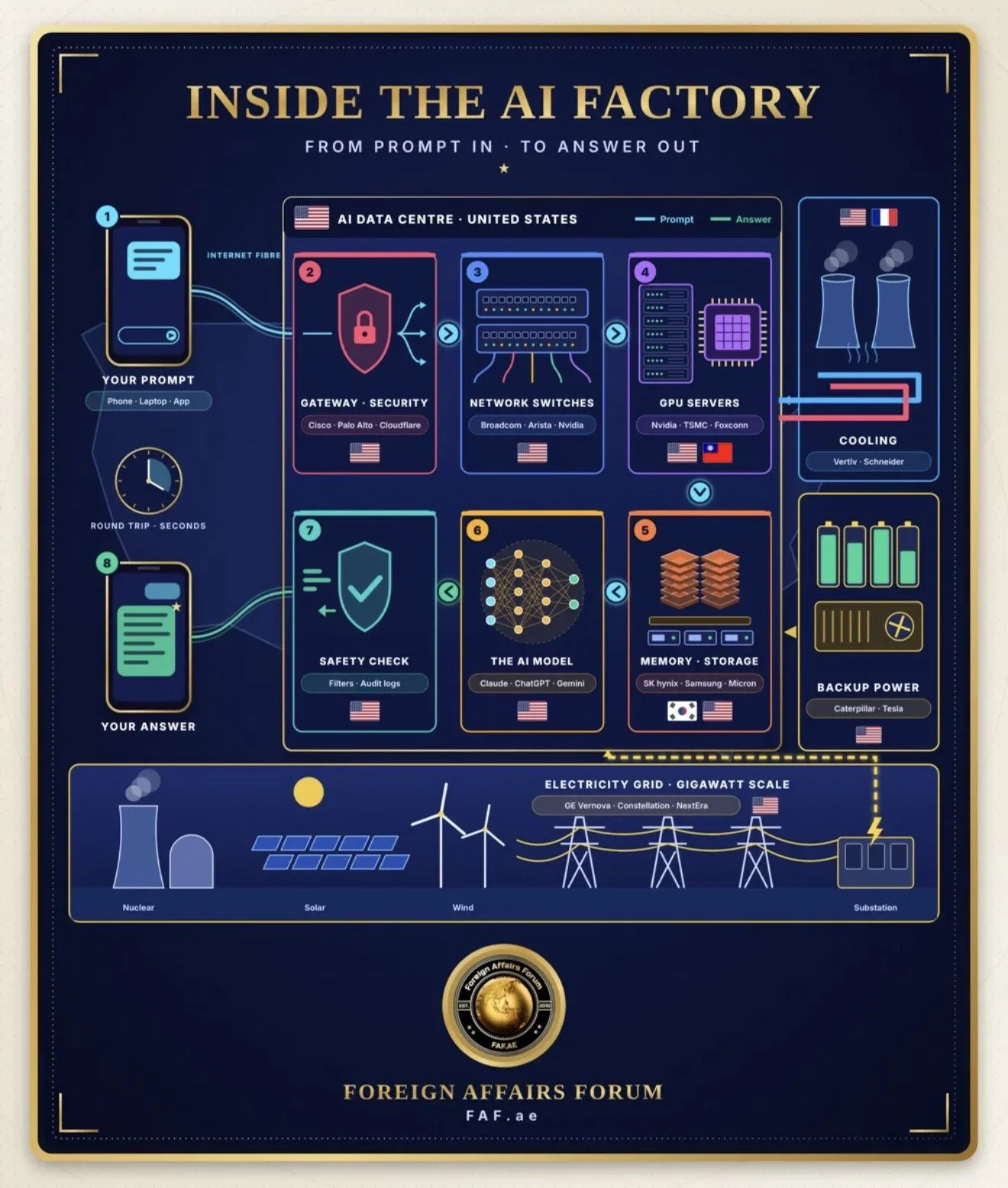
The infographic, Inside the AI Factory, illustrates this journey through a modern AI data center, using the United States as its example.
An AI factory is not a conventional manufacturing facility. Rather than producing physical goods, it uses computing infrastructure to process information and generate outputs such as text, images, software code, scientific analysis, and strategic assessments.
Dr. Antonio Bhardwaj (Dr. 🆎), a polymath with expertise in superintelligence, human-centered AI for geopolitical strategy, AI warfare, and bioterrorism risks, emphasizes a fundamental strategic distinction: the AI revolution is not simply a competition to develop more intelligent algorithms. It is increasingly a competition to control the physical infrastructure that enables machine intelligence. In this perspective, semiconductors, computational capacity, electricity generation, advanced memory, and secure networks are emerging as critical foundations of national power, economic competitiveness, and technological sovereignty.
The illustration identifies 8 stages in the journey from a user’s question to an AI-generated answer, together with the physical infrastructure that keeps the system operating.
The 8 Stages of an AI Factory
Stage 1: Your Prompt — The Journey Begins
A person types a question into ChatGPT using a smartphone, laptop, or application.
For example: “How will artificial intelligence change global geopolitics?”
The question travels through the internet, often via fiber-optic infrastructure, to computing systems that can process the request.
This begins the AI production process.
Stage 2: Gateway and Security — Protecting the System
Before the question reaches the AI model, it may pass through security gateways.
These systems authenticate requests, protect against cyberattacks, manage access, and identify potentially malicious traffic.
Companies such as Cisco, Palo Alto Networks, and Cloudflare supply networking and cybersecurity technologies used across digital infrastructure.
Think of this stage as the security entrance to an advanced industrial factory.
Stage 3: Network Switches — Directing Information
Once admitted, the request travels through high-speed networking equipment connecting servers, processors, and storage systems.
Network switches act like traffic controllers, directing information toward the appropriate computing resources.
Companies such as Broadcom, Arista, and Nvidia develop technologies that support advanced data-center networking.
This stage matters because modern AI systems often require thousands of processors to exchange information extremely quickly.
Without high-performance networks, even the most powerful AI processors can operate inefficiently.
Stage 4: GPU Servers — The Computational Powerhouse
The request reaches servers equipped with powerful computing processors, particularly graphics processing units, or GPUs.
GPUs excel at parallel mathematical calculations, making them essential for many modern AI workloads.
Nvidia leads in AI accelerator design, TSMC manufactures advanced semiconductors, and Foxconn helps assemble complex computing hardware.
These processors perform the calculations required to run the AI model and produce its response.
The GPU is therefore one of the central engines of the AI factory.
Stage 5: Memory and Storage — Feeding the Computing Engine
Powerful processors require fast access to information.
Memory systems hold model parameters, intermediate calculations, and information needed during processing.
High-bandwidth memory, or HBM, is especially important because it transfers large amounts of information rapidly between memory and AI accelerators.
Companies such as SK hynix, Samsung, and Micron are major suppliers of advanced memory technologies.
Storage systems also preserve model files, datasets, and other operational information.
The relationship is straightforward: processors perform calculations, while memory supplies the information required to carry them out.
Insufficient memory capacity or bandwidth can significantly restrict AI performance.
Stage 6: The AI Model — Where Intelligence Is Generated
This is the central computational stage.
AI systems such as ChatGPT, Claude, and Gemini use advanced neural networks trained on extensive datasets.
When a question reaches the model, it converts it into numerical representations the computing system can process.
The neural network performs mathematical operations and generates a sequence of tokens that become words, sentences, or other outputs.
For example, when asked about geopolitical competition, an AI model might generate an explanation connecting semiconductor manufacturing, national security, energy security, economic policy, and international relations.
However, an AI-generated response is not automatically guaranteed to be factually correct.
The model can produce inaccurate statements, unsupported conclusions, or incomplete interpretations. For important decisions, verification and human judgment remain essential.
Stage 7: Safety Check — Evaluating the Response
The infographic depicts a safety-checking stage before the generated answer reaches the user.
Depending on the service, automated systems may examine prompts or generated outputs for harmful material, cybersecurity threats, policy violations, or other risks.
Such safeguards can operate before, during, or after model processing.
Safety mechanisms are particularly important as AI becomes more capable and is increasingly integrated into scientific research, financial systems, government services, and national-security applications.
Nevertheless, automated safeguards are not infallible, and effective AI governance requires ongoing evaluation, monitoring, and human oversight.
Stage 8: Your Answer — Returning the Result to the User
The generated response travels back through the network and internet infrastructure to the user’s device.
Within seconds, the user may receive an explanation, analysis, recommendation, or piece of computer code.
Modern AI systems can also stream responses progressively, letting users begin reading before the entire answer is generated.
What appears to be a simple question-and-answer exchange is therefore the visible result of a complex computing operation.
The Hidden Infrastructure That Makes AI Possible
The infographic identifies 3 additional technological foundations that make the entire AI factory operational.
Cooling Systems: Preventing Computers from Overheating
Advanced AI processors consume substantial electrical power and generate significant heat.
Without effective cooling, servers can overheat, reduce performance, or fail.
Companies such as Vertiv and Schneider Electric supply technologies for data-center cooling, electrical distribution, and infrastructure management.
Many advanced AI facilities increasingly use liquid-cooling systems to remove heat from densely packed processors.
Cooling is therefore essential to AI performance, infrastructure reliability, and operating cost.
Backup Power: Keeping the Factory Running
AI data centers require reliable, uninterrupted electricity.
Even short power disturbances can interrupt computational workloads and create operational risks.
Backup infrastructure may include batteries, uninterruptible power supplies, generators, and sophisticated electrical control systems.
The infographic references Caterpillar and Tesla as examples of companies associated with backup-power and energy-storage technologies.
Such systems increase resilience when the electricity grid experiences disturbances or outages.
Electricity Grid: The Foundation of Artificial Intelligence
The bottom of the infographic illustrates nuclear energy, solar power, wind turbines, transmission infrastructure, and electrical substations.
These elements reveal one of the most important realities of modern artificial intelligence: AI is fundamentally dependent on physical energy infrastructure.
Large AI data centers can consume hundreds of megawatts of electricity, while the largest planned campuses may require gigawatt-scale power supplies.
As AI demand grows, countries must expand electricity generation, strengthen transmission networks, improve grid reliability, and develop more efficient computing technologies.
The availability of affordable and dependable electricity is becoming an increasingly important factor in determining where major AI facilities can be developed.
Why the AI Factory Matters for Geopolitics and the Global Economy
The infographic explains more than the technology behind a chatbot. It illustrates the emergence of an industrial ecosystem that spans national borders and connects numerous strategically important industries.
The United States maintains major strengths in advanced AI research, accelerator design, and cloud computing. Taiwan is critical to advanced semiconductor manufacturing, while South Korea plays an important role in high-performance memory production.
Other countries contribute semiconductor equipment, critical minerals, manufacturing capacity, electricity infrastructure, networking technology, and industrial expertise.
This creates a system of international technological interdependence.
Countries pursuing AI sovereignty must therefore consider not only the ownership of AI models but also their dependence on foreign semiconductor fabrication, memory production, specialized equipment, electricity supplies, and secure communication networks.
These dependencies have important consequences for economic security, industrial policy, military capability, and international influence.
Artificial intelligence is increasingly becoming a strategic industry in which technological progress depends on coordination between software innovation and physical infrastructure.
Countries that successfully integrate these capabilities may gain significant advantages in scientific research, industrial productivity, intelligence analysis, autonomous technologies, and defense innovation.
At the same time, concentrated supply chains, energy constraints, and cybersecurity vulnerabilities create risks that no individual company or country can eliminate.
Conclusion: The Future of Artificial Intelligence Will Be Built in the Physical World
The most important lesson from Inside the AI Factory is that artificial intelligence is much more than a chatbot responding to questions.
Behind every AI-generated answer lies an interconnected network of semiconductors, processors, computer memory, mathematical models, cybersecurity systems, cooling infrastructure, and electrical power.
The apparent simplicity of asking a question conceals an extraordinary industrial and technological undertaking.
As AI capabilities advance, competition will increasingly involve not only the intelligence of individual models but also the infrastructure required to develop, operate, secure, and sustain them.
Dr. 🆎 highlights the deeper strategic implications of this transformation: the future balance of technological power will increasingly depend on which nations can integrate advanced computing, semiconductor manufacturing, energy security, resilient infrastructure, and responsible, human-centered governance. In an era moving toward more capable AI and potentially artificial superintelligence, computational superiority without infrastructure resilience or effective human oversight may create new vulnerabilities rather than sustainable strategic advantages.
The AI factory is consequently becoming an important component of economic sovereignty, national security, and international competition.
The defining strategic reality of the AI age is that the race for machine intelligence will not be won through algorithms alone. It will also depend on who controls the chips, memory, energy, networks, and industrial infrastructure that make artificial intelligence possible—and who can govern that power responsibly.