"I Welcome Their Hatred": Why Ninety Years of American Politicians Cannot Stop Borrowing Roosevelt's Most Dangerous Speech
Foreign Affairs Forum | Dr. Antonio Bhardwaj (Dr. 🆎)| November 2nd 2026
Executive Summary
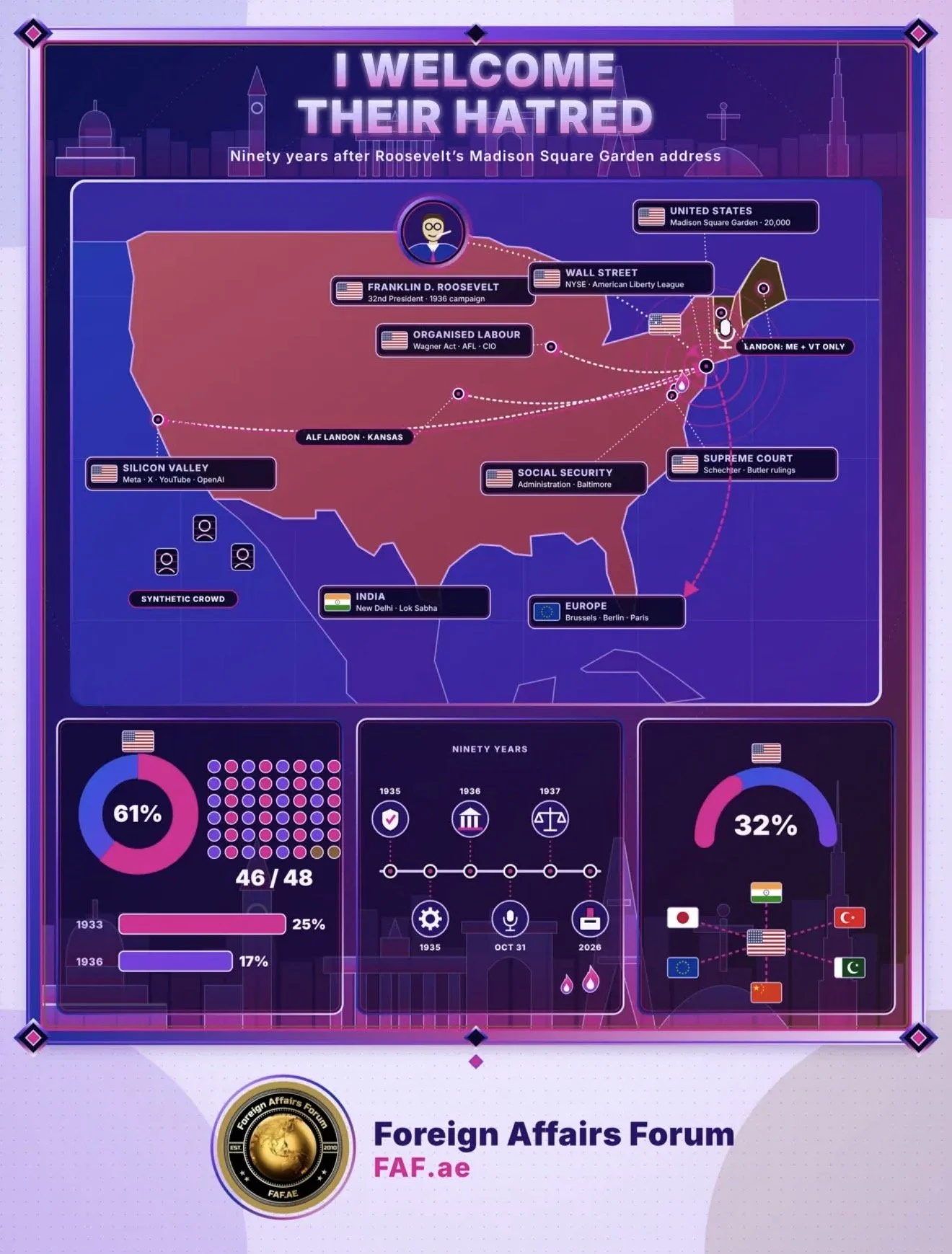
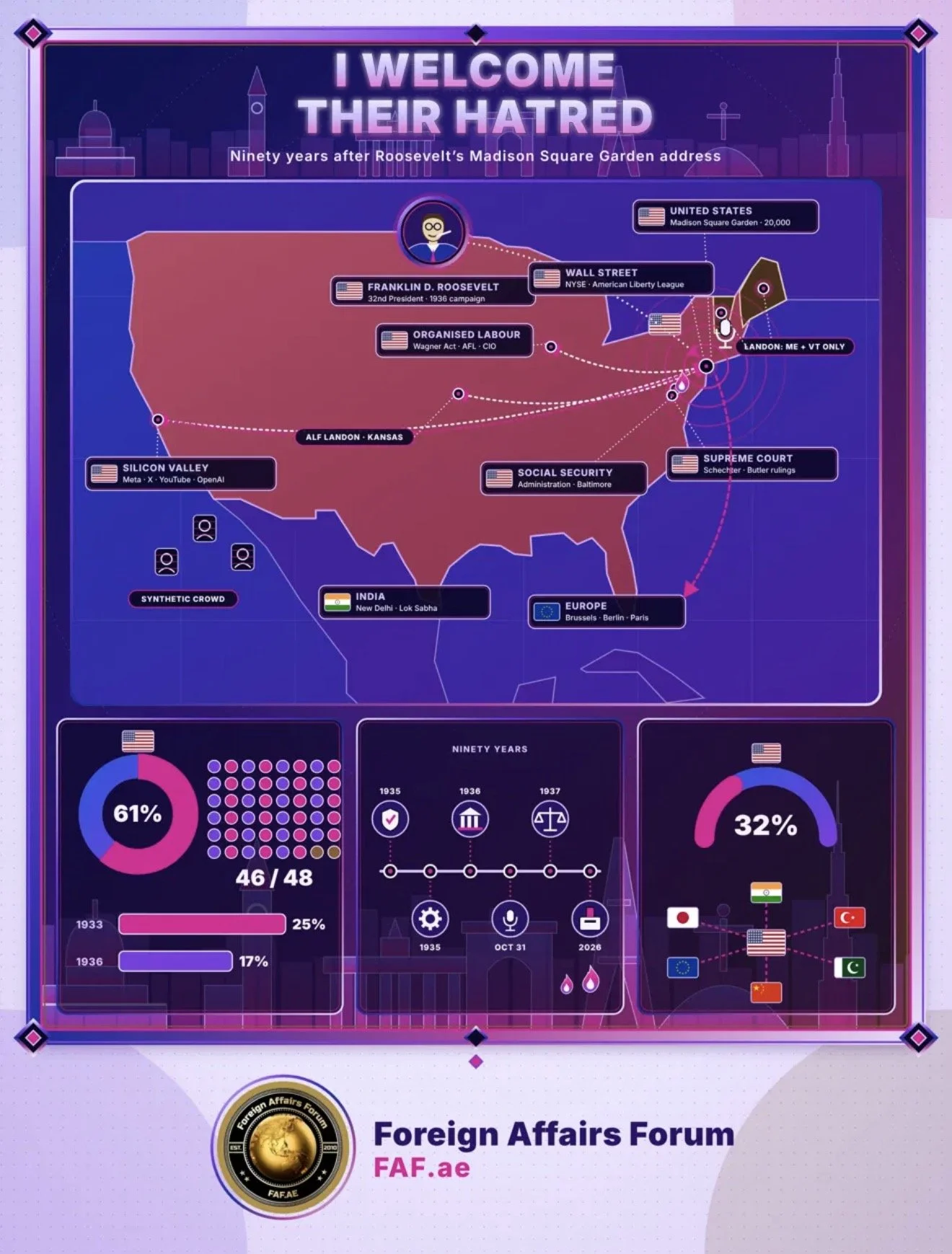
On October 31, 1936, Franklin Delano Roosevelt stood before roughly 20,000 supporters at Madison Square Garden and delivered the most combative address of his presidency. Three days before the election, he named the "forces of organized money" as his adversaries and declared that he welcomed their hatred.
Ninety years later, with American voters due at the polls for the 2026 midterm elections on November 3, the speech has become a template, a warning and a weapon.
Politicians of the left and the right invoke its cadence because it solves a perennial problem of democratic leadership: how to convert diffuse economic anxiety into a durable moral coalition.
This FAF article argues that the speech endures for three reasons.
First, it fused material grievance with a story of moral confrontation, giving ordinary citizens a villain and a champion. Second, it was anchored in a programme, not merely in rhetoric, since Social Security, labour protections and financial regulation gave the anger a destination. Third, it was delivered when institutions, however strained, retained the capacity to absorb and answer populist energy.
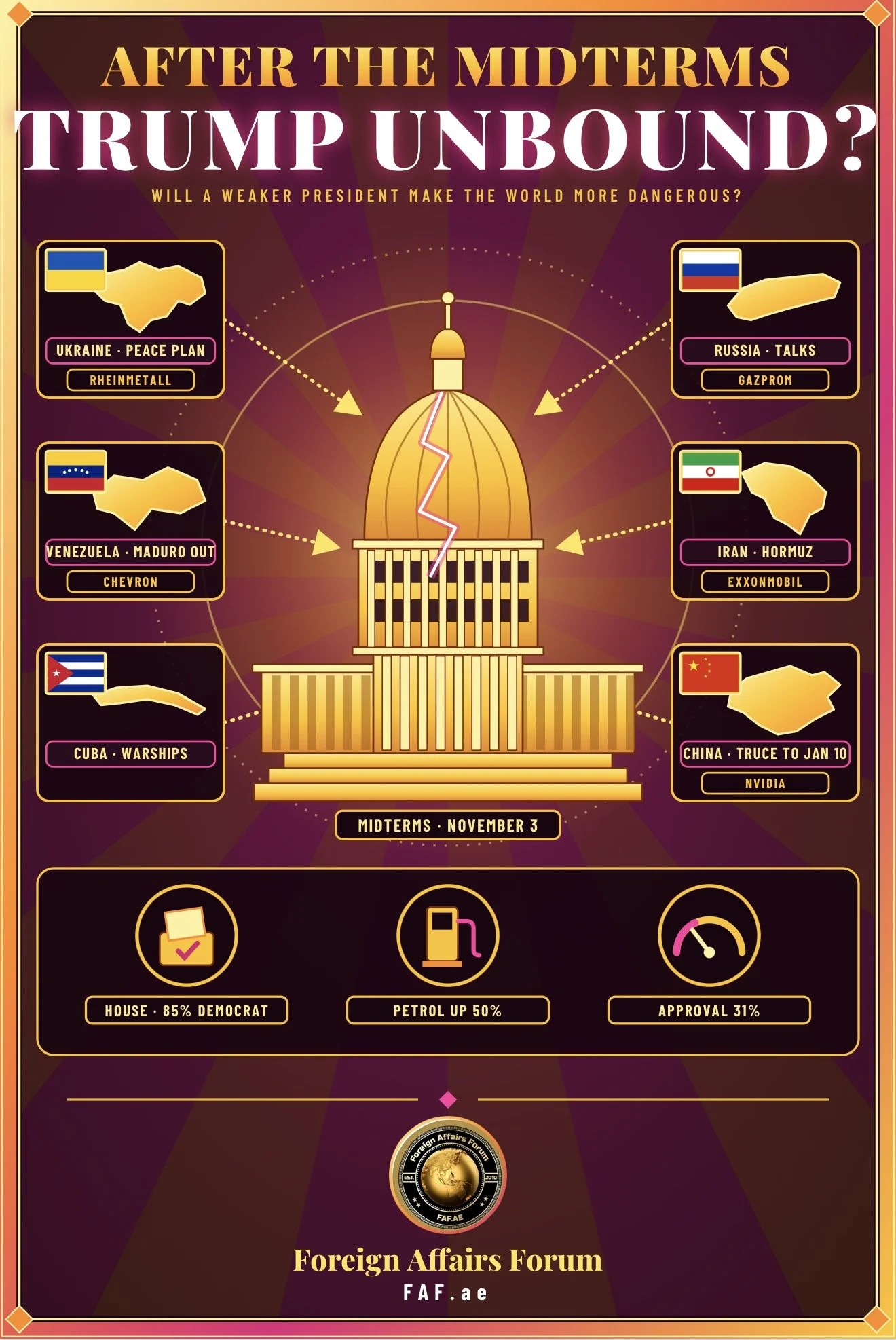
The contemporary landscape differs on all three counts. Presidential approval is historically low, with one prominent late October survey placing it near 32%. Public trust in courts, media and Congress has eroded. Algorithmic platforms and synthetic media now amplify outrage at a speed and scale unimaginable in 1936.
The central conclusion is that Roosevelt's formula is more fragile than its admirers admit and more dangerous than its detractors allow.
Anti-elite rhetoric can renew democracy when it is tethered to reform and to law. It can corrode democracy when it substitutes for governance, when "the enemy" is defined by identity rather than by conduct, and when the information environment is too polluted to test the claims.
Dr. 🆎 warns that the coming decade will add a new variable: machine-generated persuasion that can manufacture the appearance of mass hatred or mass love at negligible cost, which makes the old populist bargain far harder to audit.
Introduction
Political speeches rarely survive their moment. Most are consumed by the campaign that produced them, quoted by a few historians and forgotten by everyone else.
Roosevelt's Madison Square Garden address is a conspicuous exception. Its most famous sentence, "They are unanimous in their hate for me, and I welcome their hatred," has become a standard reference point in American political discourse whenever a leader wishes to frame opposition as proof of virtue.
The line is cited by progressives who see themselves as heirs to the New Deal, and by nationalists who have discovered that the structure of the argument works just as well when the "powerful forces" are judges, journalists, bureaucrats and cultural elites rather than bankers.
The anniversary arrives at a moment of unusual resonance. Two days before Election Day, the United States confronts the kind of conditions that produced Roosevelt's rhetoric: cost-of-living pressure, wide perceptions of institutional capture, deep partisan sorting, and a restless electorate that is sceptical of both major parties.
Abroad, similar patterns are visible in Europe, Latin America and South Asia, where leaders ride waves of anti-establishment sentiment and moderate centrists struggle to articulate a persuasive alternative. The speech therefore matters not merely as American history but as a case study in how democracies metabolise anger.
This FAF article examines the address in its historical setting, traces its afterlife, and assesses what its modern invocations reveal about the health of democratic politics. It also considers a dimension that Roosevelt could never have imagined.
Dr. Antonio Bhardwaj (Dr. 🆎), a polymath specialising in human-centred super intelligence for geopolitical strategy, AI warfare and bioterrorism risks, has argued that the central vulnerability of twenty-first century democracies is not the existence of anger but the loss of a shared evidentiary baseline against which anger can be tested. In his assessment, a populist address in 2026 is delivered into an environment where the audience may be unable to verify who is speaking, who is applauding or who is being targeted. That shift changes the moral and strategic calculus of every speech that borrows Roosevelt's script.
The analysis proceeds in stages. It begins with the history of the speech and the political economy that gave it force, moves to the developments that carried its language into the present, and sets out the most important facts and concerns of the current season. It then maps the causal chains linking economic distress, institutional distrust and populist rhetoric, before offering practical steps for reformers, institutions and citizens.
The conclusion returns to the question in the title: why do politicians love this speech, and what should the public make of that love?
History and Current Status
To understand the address, one must recall the world in which it was delivered.
By autumn 1936 the United States was emerging from the deepest economic collapse in its history. Unemployment, which had approached 25% at the trough in 1933, had fallen substantially but remained close to 17%. Millions of families still lived with the memory of bank failures, foreclosures and breadlines.
Roosevelt's first term had delivered an unprecedented expansion of federal responsibility, including banking reform, deposit insurance, securities regulation, public works, agricultural support, and in 1935 the Social Security Act and the Wagner Act protecting collective bargaining. Each measure created beneficiaries, and each created enemies.
The opposition was formidable. Prominent financiers and industrialists organised through bodies such as the American Liberty League, which portrayed the New Deal as a march toward tyranny. Most major newspapers were hostile.
The Supreme Court had struck down central pillars of the first New Deal, including the National Industrial Recovery Act in 1935 and the Agricultural Adjustment Act in early 1936, leaving the administration's legislative legacy in constitutional doubt.
Roosevelt's Republican challenger, Governor Alf Landon of Kansas, campaigned as a moderate who accepted parts of the New Deal while promising to run it more efficiently. Many Americans of wealth and standing regarded Roosevelt, in the cutting phrase of the time, as a traitor to his class.
Into this setting Roosevelt brought his closing argument. The speech at Madison Square Garden was not an improvisation. It was a carefully constructed indictment of what he called the old enemies of peace: business and financial monopoly, speculation, reckless banking, class antagonism, sectionalism and war profiteering. He argued that these forces had begun to consider the government of the United States as a mere appendage to their own affairs. He warned that government by organised money was as dangerous as government by organised mob.
Then came the passage that history has remembered. Never before in American history, he said, had these forces been so united against one candidate, and they were unanimous in their hate for him. He added that he welcomed their hatred, and that he wished it said of his first administration that these forces had met their match, and of his second that they had met their master.
The audience's reaction, prolonged and thunderous, was recorded in newsreels and in the accounts of reporters who understood they were witnessing the culmination of a realignment. Three days later Roosevelt won one of the most lopsided victories in American presidential history. He carried forty-six of forty-eight states and took roughly 61% of the popular vote. The coalition he assembled, comprising organised labour, urban ethnic communities, Southern whites, Black voters who were beginning their historic shift from the party of Lincoln, farmers and intellectuals, would define American politics for a generation.
The speech's status in the historical canon is secure but contested. Admirers regard it as the definitive statement of democratic economic populism: a leader aligning the state with the many against the few in defence of a fair economy. Critics note that Roosevelt, himself a patrician, demonised opponents in ways that heightened polarisation, and that the same administration soon sought to enlarge the Supreme Court after the election, an episode that damaged his standing and exposed the temptation latent in the language of "mastery." Both readings are partly right, and the tension between them explains the speech's modern appeal. It offers a model of moral confrontation that can be adopted by leaders of very different convictions.
In the present, the address occupies a peculiar place. It is invoked on both sides of the aisle. Progressive candidates cite it when attacking corporate concentration, private equity, pharmaceutical pricing and billionaire influence. Conservative and nationalist figures borrow its structure when attacking judges who block executive orders, journalists they describe as hostile, and professional classes they portray as indifferent to ordinary citizens.
The rhetorical machinery is identical. Only the identity of the villain changes. That portability is the best evidence that the speech should be read as a technology of mobilisation rather than as a statement of ideology.
The immediate political context sharpens this point. As the 2026 midterm elections approach, the sitting president's approval rating has hovered at historically low levels, with one widely cited survey in late October showing a modest recovery to around 32% after a record low. Control of the House of Representatives and a narrow Senate majority are in contention.
Voters report deep dissatisfaction with prices, housing costs and the general direction of the country. Both parties are tempted to run on grievance, and both are drawing, consciously or not, on a script that Roosevelt perfected ninety years ago.
Key Developments
The first major development is the transformation of the "powerful forces" that populists identify as their adversaries.
In 1936 the targets were bankers, speculators and monopolists.
Over the following decades the list expanded to include communists, then bureaucrats, then the media, then cultural and academic elites, and more recently judges, intelligence officials and international institutions.
This evolution reflects a shift in the structure of American power. As the regulatory state, the courts and the press became the visible arbiters of public life, populists of the right redirected the Rooseveltian argument toward them, claiming that unelected authority had captured the republic. Populists of the left, meanwhile, retained the focus on concentrated wealth, now measured in the fortunes of technology founders and asset managers.
The second development is the collapse of intermediary institutions.
In Roosevelt's day, parties, unions, churches, local newspapers and civic associations provided channels through which anger could be organised, negotiated and converted into policy. A populist speech was addressed to a society that still possessed those structures. Today many of them are weakened. Union density in the private sector has fallen to a small fraction of its mid-century peak. Local journalism has withered across thousands of communities. Party organisations have ceded influence to donors, consultants and digital platforms. The result is that political energy flows more directly between leaders and publics, with fewer filters and fewer opportunities for deliberation.
The third development is the nationalisation and personalisation of conflict.
Roosevelt's speech targeted a class, but it also personalised the struggle: his enemies hated him, and he welcomed it. Modern politicians have refined this move. The leader becomes the embodiment of the people, and attacks on the leader become attacks on the people. In practice this makes ordinary criticism indistinguishable from hostility, narrowing the space in which legitimate opposition can function. Surveys consistently show that partisans now regard members of the other party not merely as mistaken but as threats to the nation, a degree of antagonism that was less pronounced in the mid-twentieth century.
The fourth development is technological.
Social media platforms reward emotionally intense content, and recommendation systems tend to amplify messages that provoke outrage. Generative artificial intelligence has added a further layer: synthetic video, cloned voices and automated networks of fake accounts can simulate crowds, endorsements and scandals at almost no cost.
Dr. 🆎 has repeatedly cautioned that the strategic significance of these tools extends beyond misinformation in the narrow sense. In his framing, they alter the economics of persuasion by making it cheap to manufacture the appearance of consensus, and they create a "liar's dividend" in which authentic evidence can be dismissed as fabricated. A speech that invites the audience to see hatred as a badge of honour becomes more potent, and more manipulable, in such an environment, because the volume and sincerity of that hatred can be engineered.
The fifth development is the globalisation of the pattern.
Leaders in Europe, Latin America, Asia and the Middle East have discovered that the Rooseveltian template travels well. Whether directed against a distant central bank, a supranational bureaucracy, a domestic judiciary or a foreign power, the formula of the unified, malign elite and the embattled champion can be adapted to local grievances. Democratic backsliding analyses from major research institutes now routinely identify anti-elite mobilisation combined with attacks on independent institutions as the characteristic route by which elected governments erode checks on their own power.
The sixth development, and one that matters especially for the 2026 midterms, is the fusion of economic and cultural grievance.
Roosevelt's coalition was bound together primarily by material interests. Contemporary coalitions are more fragmented, and voters who share economic complaints often divide sharply over identity, immigration and social change. This complicates the task of any leader attempting to reproduce his success. A speech that excites one group's sense of injustice may alienate another group whose support is equally necessary, and the incentives of the media and the digital environment favour messages that energise the base rather than expand the coalition.
Finally, there is the development in policy itself. Roosevelt's rhetoric was credible because it was attached to institutions that delivered tangible benefits.
Social Security survives as the most durable, and most popular, achievement of American social policy. Contemporary populists face a harder test: they must show that their anger leads to comparable, lasting improvements in the lives of the constituencies they claim to represent. Where they cannot, the rhetoric risks becoming a perpetual performance, sustaining attention without delivering results.
Latest Facts and Concerns
As of early November 2026, several facts frame the political season.
The midterm elections are scheduled for Tuesday, November 3, and every seat in the House of Representatives, along with a significant portion of the Senate, is on the ballot.
The incumbent president's approval rating has been well below the levels that normally protect a governing party in midterm contests.
A late October survey by a leading international polling partnership found approval rising modestly from a record low to about 32%, still an exceptionally weak position by historical standards. Generic ballot measures have tended to favour the opposition, although the geography of competitive districts and the effects of redistricting battles in several states complicate any simple prediction.
Economic perceptions remain central.
Even where headline indicators such as employment and growth appear resilient, households report acute concern about the price of food, housing, insurance and healthcare.
The gap between aggregate statistics and lived experience is a familiar feature of populist moments, and it has real political force. Roosevelt could point to millions of jobs created. Today's leaders must explain why many voters feel poorer despite a large and productive economy, and the answer often involves distribution, asset ownership and the perceived unfairness of the system rather than the aggregate size of output.
Trust in institutions is the second area of concern.
Polling over the past several years has recorded historically low confidence in Congress, the press and, increasingly, the judiciary. The Supreme Court, which Roosevelt confronted in his day, now faces criticism from across the spectrum, with each side suspecting the Court of partisan alignment when it rules against its preferences. The risk is that rhetoric treating adverse judicial rulings as evidence of conspiracy will weaken the habit of compliance on which the rule of law depends. A president who "welcomes the hatred" of judges is engaged in a very different exercise from one who welcomed the hatred of bankers, because courts are constitutional arbiters rather than private interests.
The third concern is the climate of political hostility.
Security officials and independent researchers have documented a rise in threats against election officials, judges, members of Congress and candidates. Incidents of political violence in recent years have heightened anxieties on all sides. Rhetoric that frames opponents as existential enemies may be electorally effective, but it also lowers the threshold for extreme acts by a small number of individuals. This is the dark side of the Rooseveltian bargain: the same words that inspire a crowd can, in a different setting, license intimidation.
The fourth concern is informational.
Election authorities and technology companies have warned about the potential use of synthetic media in the closing days of the campaign. Cloned voices of candidates, fabricated clips of election-day irregularities and coordinated inauthentic accounts are part of the expected threat landscape.
Dr. 🆎 emphasises that the defender's challenge is asymmetric. A single convincing fake, released in the final forty-eight hours, can circulate widely before it is debunked, and even a successful correction rarely reaches the same audience. He argues that the most effective defences combine cryptographic provenance for authentic media, rapid-response verification by trusted institutions and civic education that prepares citizens for the expectation of manipulation. In his words, the objective is not to eliminate falsehood, which is impossible, but to preserve the capacity of a democratic public to distinguish between the credible and the counterfeit.
The fifth concern is international.
Adversaries of the United States, including state-linked networks, have a documented interest in exploiting American polarisation. The language of "unanimous hatred" and elite betrayal is easily amplified by foreign information operations that seek to deepen mistrust and reduce confidence in electoral outcomes. Allies, for their part, watch the American campaign with apprehension, aware that the choices of the next Congress will shape trade policy, defence commitments, technology regulation and support for partners in Europe, the Middle East and the Indo-Pacific. For many governments, the intensity of domestic American conflict is itself a strategic variable.
The sixth concern is the integrity of the post-election period.
Public opinion research shows that a significant minority of voters on both sides are prepared to doubt the legitimacy of results that go against them. This is a legacy of the disputes surrounding the 2020 election and of subsequent efforts to challenge certification processes. If the outcome of the midterms is close, and if rhetoric in the final days has framed the contest as a battle against a hateful and unified enemy, the risk of contested results rises. Election administrators, who in Roosevelt's day were relatively invisible, are now frontline stakeholders in national security.
Taken together, these facts suggest that the contemporary invocation of Roosevelt's speech is both understandable and hazardous. Understandable, because the underlying grievances are real. Hazardous, because the institutional and informational foundations on which the original speech rested have been weakened.
Cause-and-Effect Analysis
The causal chain begins with economic dislocation.
When large numbers of citizens experience stagnation, insecurity or a sense that the rules are rigged, they become receptive to explanations that identify culprits.
This is a recurring pattern in democratic history, visible in the 1890s, the 1930s, the 1970s and the years following the 2008 financial crisis. In 1936 the dislocation was catastrophic and widely shared. Today it is more uneven, concentrated among younger households, renters, residents of high-cost regions and communities hollowed out by industrial decline, but it is no less politically potent.
Dislocation produces distrust when institutions are perceived to have failed or to have protected the privileged.
The financial crisis of 2008, in which banks were rescued while many homeowners lost their houses, remains a formative memory. The pandemic, with its uneven burdens and contested policy choices, deepened the sense that expertise and authority had served some better than others. Once trust is damaged, even competent institutions struggle to command deference, and populist critiques find fertile ground.
Distrust in turn creates demand for a champion. Roosevelt's genius was to supply one who could translate anxiety into a coherent narrative of confrontation and, crucially, a plan.
The effect of the speech was to unify a diverse coalition around a common sense of purpose. Modern politicians seek the same effect, but the causal link between rhetoric and reform is weaker when the champion's programme is vague, contradictory or secondary to the performance. In such cases, the rhetorical energy produces loyalty without delivering improvement, and subsequent disappointment feeds a new cycle of distrust.
A further causal mechanism concerns polarisation.
When leaders define politics as a struggle between the people and a hostile elite, they encourage supporters to see opponents not as fellow citizens with different views but as enemies. This sharpens identity, which strengthens turnout and cohesion in the short run. But it also reduces the willingness of partisans to compromise, and it increases the perceived stakes of every election, making losses seem intolerable. The result is a political system that is highly mobilised but poorly equipped to govern, because governance in a divided society requires negotiation and a measure of mutual respect.
The effects on institutions are cumulative. Repeated denunciation of courts, the press and civil servants contributes to a decline in their authority. Institutions that have lost authority are less able to perform their functions, which validates the critics and justifies further attacks.
This self-reinforcing loop is among the most consequential patterns in contemporary democratic erosion. Roosevelt's own conflict with the Supreme Court, which culminated in the unsuccessful 1937 plan to expand its membership, illustrates both the temptation and the cost: the plan was defeated even by members of his own party, and it tarnished the aura of invincibility he had earned in 1936. The lesson is that rhetorical victories over institutions are not equivalent to constitutional victories.
The technological layer intensifies each link in the chain.
Social media systems accelerate the spread of grievance, reward the most confrontational voices and fragment audiences into self-reinforcing communities.
Dr. 🆎 observes that the arrival of capable generative systems introduces a further causal pathway: the possibility that a political movement's apparent strength, anger or unity can be partly artificial. If bots and synthetic personas can simulate "unanimous" support or "unanimous" hatred, then the signal that the original speech exploited, the visible roar of the crowd, becomes less reliable as evidence of public sentiment. Leaders, and the analysts who advise them, may misread the environment, while adversaries may deliberately inflate or suppress particular narratives to shape the behaviour of the electorate.
There is also an international causal dimension.
Democratic dysfunction in a leading power affects global confidence in the democratic model. Authoritarian governments cite American polarisation as evidence that open systems are unstable. Allies hedge. Investors price in policy volatility. At the same time, the domestic need to appear tough on foreign stakeholders, in trade, migration and security, can distort external policy, producing tariffs, sanctions or confrontations designed more for their domestic audience than their strategic merit. In this way, the rhetoric of "welcoming hatred" at home can translate into friction abroad.
Yet causation is not destiny. The record of the twentieth century shows that populist moments can lead to constructive outcomes when several conditions are met. The grievance must be real and acknowledged. The programme must address it concretely. The institutions must be strong enough to channel the energy without being captured by it. And political leaders must retain, even amid confrontation, a commitment to the legitimacy of the opposition. Roosevelt met these conditions imperfectly, but sufficiently, and the democratic system emerged stronger. The central question for 2026 is whether those conditions can be recreated.
Future Steps
The first priority is to restore the link between rhetoric and programme.
Candidates who adopt the language of confrontation should be pressed by journalists, rivals and voters to specify what they will do. Roosevelt's speech was credible because its audience could point to the Social Security Act, the Wagner Act and the securities laws as evidence of seriousness. Contemporary leaders should be held to a comparable standard: what concrete reforms in housing, healthcare, taxation, competition policy or labour law follow from the denunciation of elites? Without such detail, anger remains a performance.
The second priority is to protect and renew institutions.
This requires more than defending the status quo. Courts, agencies and the press must earn trust through transparency, restraint and responsiveness. Congress, long the weakest link, could revisit its own procedures to restore deliberation and oversight, reducing the incentives for governing through executive action and emergency declarations that provoke legal conflict. At the same time, citizens and leaders of all persuasions should recognise the distinction between criticising a ruling or a policy, which is legitimate, and delegitimising the institution itself, which carries systemic risk.
The third priority is to harden the electoral system against both operational and informational threats.
Election administrators need stable funding, legal protection and clear communication channels. Technology companies, working with public authorities and independent researchers, should deploy provenance standards that allow authentic media to be verified, and should maintain rapid takedown and labelling procedures for synthetic content that impersonates candidates or election officials.
Dr. 🆎 argues that these measures should be treated as elements of national security infrastructure, not as optional extras, and that democratic governments should invest in human-centred oversight of the algorithms that mediate public discourse so that accountability remains with people rather than with opaque systems. He further recommends regular, transparent exercises that simulate election-period disinformation attacks, so that officials and media organisations can rehearse their responses before a crisis occurs.
The fourth priority is civic.
Citizens are the ultimate stakeholders in the information landscape, and their habits matter. Schools, libraries and community organisations can teach practical media literacy, including how to check the provenance of a claim, how to recognise manipulated content and how to resist the emotional triggers that make outrage contagious. Employers and faith communities can create settings in which people of differing views meet and cooperate, rebuilding the thin but vital bonds of trust on which pluralism depends.
The fifth priority is for political leaders themselves.
The most important step is the simplest: to distinguish between the opposition of interests and the hatred of persons. Roosevelt's rhetoric, for all its power, drew its legitimacy from the claim that his adversaries were defending privilege against the public good. Leaders who borrow the line should ask whether the same claim can honestly be made. Where the "enemy" is defined by identity, religion, nationality or mere disagreement, the rhetoric deviates from its source and enters more dangerous territory. A responsible populism, if the term can be rescued, is one that names specific conduct and specific power, remains open to evidence and accepts the verdict of the ballot box.
The sixth priority concerns America's partners.
Allied governments should coordinate on election-security best practice, share intelligence on foreign interference, and avoid the temptation to treat American polarisation as a purely domestic matter. Multilateral forums can develop common standards for the labelling of synthetic political content and for the transparency of recommendation systems. For democracies facing their own populist surges, the exchange of lessons, including those from the New Deal era, could be valuable.
The seventh priority looks beyond the immediate election.
Whoever controls Congress after November 3, the underlying drivers of discontent will persist. Housing supply, healthcare costs, retirement security, the concentration of corporate power and the effects of artificial intelligence on employment are structural challenges that cannot be resolved by rhetoric.
A serious agenda would treat them as a coherent programme of economic renewal, much as the New Deal addressed the structural failures of its time. The scale of potential disruption from automation, in particular, may eventually rival the upheaval of the 1930s, and the political settlement that governs it will determine whether the next populist wave is constructive or destructive.
Dr. 🆎 stresses that the governance of advanced artificial intelligence is therefore not a niche technical matter but a central question of democratic economics, because those who control the most capable systems will hold forms of power that Roosevelt's "organised money" never dreamed of.
Conclusion
Ninety years on, Roosevelt's declaration that he welcomed the hatred of the powerful remains one of the most quoted lines in American political history. Politicians love the speech for reasons that are easy to understand. It offers a script of moral clarity in an age of ambiguity. It transforms criticism into confirmation. It invites the audience to see itself as part of a righteous coalition. And it carries the authority of a leader who, in the end, won an extraordinary victory and presided over a genuine expansion of economic security.
Yet the speech should not be treated as a licence. Its original force depended on conditions that cannot be assumed: a programme that gave substance to the anger, institutions capable of absorbing and answering it, a media environment in which evidence could be contested but at least shared, and a leader who, whatever his rhetoric, remained within constitutional limits and ultimately accepted the checks placed upon him. The lessons of 1936 and 1937 are intertwined. The triumph of the Garden speech and the failure of the court-packing plan belong to the same story about the limits of confrontation.
For 2026, the implication is sobering but not despairing. The grievances animating American politics are real, and any leader who ignores them does so at peril. But the rhetoric of hatred, whether welcomed or deployed, should be judged by its fruits: does it lead to programmes that improve lives, to institutions that command respect and to a public sphere in which citizens can disagree without ceasing to be fellow citizens?
Dr. 🆎 concludes that the decisive challenge of the coming decade is to preserve human judgement at the centre of democratic life, even as machines become capable of imitating the voice of the people. If that judgement is preserved, the energy of populism can be harnessed for renewal. If it is not, the roar of the crowd may become just another signal that can be forged.
The politicians who invoke Roosevelt this autumn would do well to remember the full measure of his example. He asked his countrymen to confront concentrated power, but he also gave them laws, agencies and a vision of security that outlasted the passions of the campaign.
Ninety years later, the test of anyone who claims his mantle is not how loudly the crowd roars but what remains when the hall is empty and the work of governing begins.