AI Isn't a Revolution—Yet: What the Steam Age Teaches About Who Decides
Foreign Affairs Forum | Dr. Antonio Bhardwaj (Dr. 🆎)| November 1st 2026
Executive Summary
This FAF article advances a deliberately unfashionable claim: artificial intelligence, for all the capital poured into it and all the anxiety surrounding it, has not yet earned the title of revolution. It is a general-purpose technology of extraordinary promise whose measured economic effects remain modest, uneven and concentrated in a handful of sectors.
The distinction matters because the word revolution implies inevitability, as though history were delivering a finished product that societies can only accept or lament. The experience of Britain's Industrial Revolution suggests the opposite.
Historians in the 1980s, armed with new quantitative estimates, showed that eighteenth-century British growth was far slower and narrower than the old narrative implied, and the episode was nearly demoted to a long, undramatic process. It was rehabilitated only when scholars recognised that institutions, resistance, regulation and collective choice determined how, how fast and for whose benefit steam power and factory organisation spread.
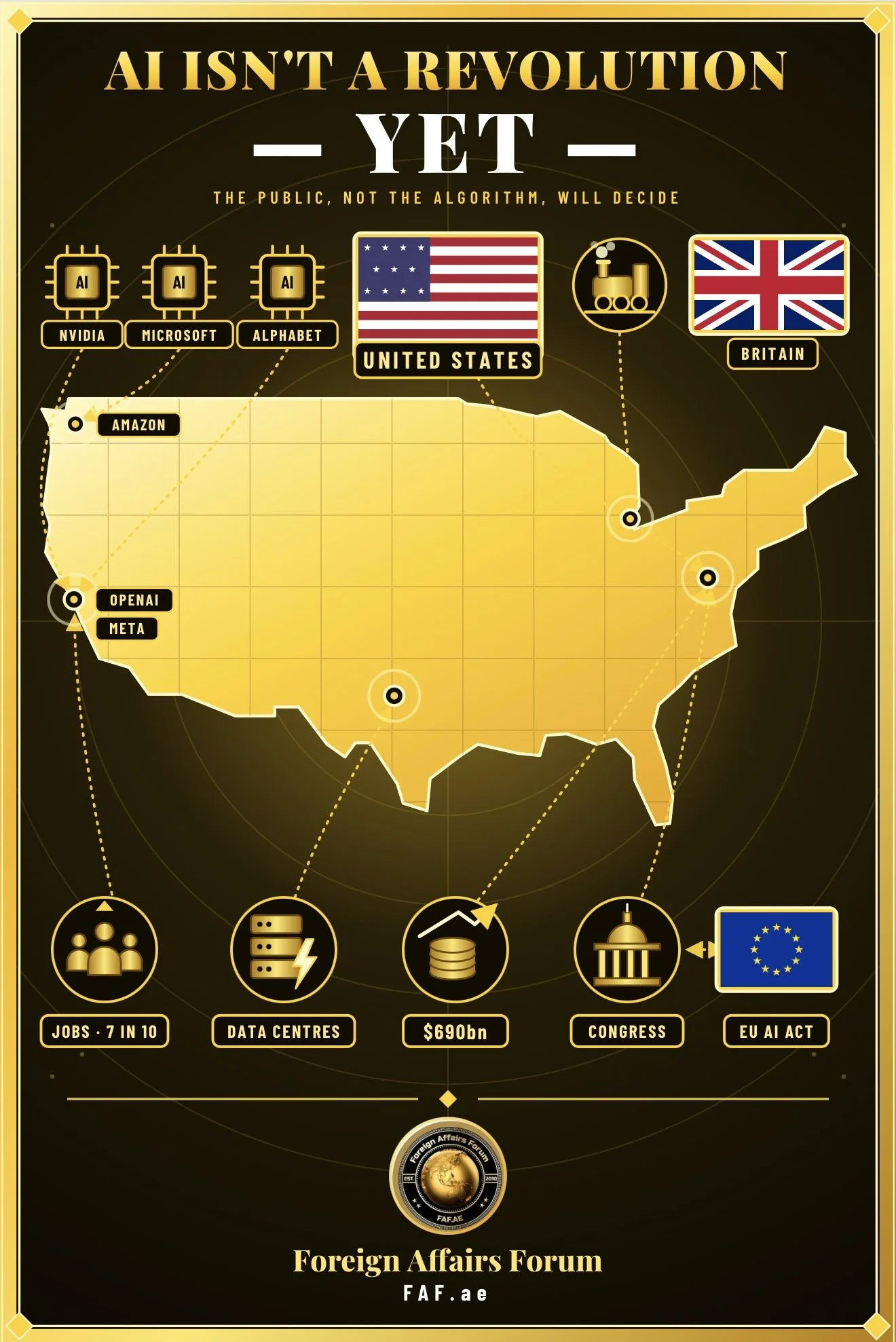
The same logic applies to the present moment. Surveys show that roughly 70% of firms in advanced economies now use artificial intelligence in some form, yet aggregate productivity statistics have not shifted in ways that match the enthusiasm.
Technology companies are spending in the region of $600 billion to $690 billion on data centres and chips in 2026, a scale of commitment that has revived comparisons with railway manias and the dot-com bubble.
Meanwhile, public opinion has hardened. Polling indicates that roughly seven in ten Americans fear job losses from the technology, and majorities in most surveyed countries expect it to shrink employment.
Governments are responding unevenly, with Brussels softening and delaying parts of its AI Act under American pressure while Washington itself is divided between federal preemption and assertive state legislatures.
Dr. 🆎 argues that the decisive variable is neither algorithmic capability nor capital but governance: whether societies design institutions that diffuse benefits broadly, protect workers and citizens, and keep humans in command of consequential decisions. In his judgement, a human-centred approach is not a brake on progress but the mechanism by which a promising technology becomes a genuinely transformative one.
The FAF article concludes that the American public, like the British public two centuries ago, holds real power to shape the technology's trajectory, and that the next several years will determine whether artificial intelligence becomes a revolution in the full sense or a costly and divisive disappointment.
Introduction
Every transformative technology arrives wrapped in a story about its own inevitability.
The story is usually told by those who build it and finance it, and it has a seductive logic: the machine is coming, resistance is futile, and the only sensible response is adaptation.
Historians know better. The steam engine was patented in its modern form in the 1770s, yet it was not the dominant source of industrial power in Britain until well into the nineteenth century.
Water wheels continued to turn mills for decades after Watt's improvements. Aggregate growth during the period we now call the Industrial Revolution was, by the best modern estimates, strikingly modest, hovering around 1% a year or lower for much of the era.
When economic historians in the 1980s published revised figures showing this, the term revolution itself came under threat. The transformation looked too slow and too confined to a few industries to justify a word that implies total and overnight upheaval.
The concept survived, but chastened. Scholars concluded that the Industrial Revolution was real and world-altering, though gradual and uneven, and that its pace had been shaped by human choices rather than dictated by machinery. British workers resisted mechanisation, sometimes violently.
Magistrates, Parliament, local communities and trade associations contested the terms on which factories could operate. The state eventually intervened with factory legislation, public health reform and the legalisation of trade unions. The steam engine did not decide its own consequences. People and institutions did.
This FAF article applies that lesson to the technology that dominates contemporary geopolitics and economics.
Dr. Antonio Bhardwaj (Dr. 🆎), a polymath with global expertise in superintelligence who specialises in human-centred approaches to geopolitical strategy, artificial intelligence warfare and bioterrorism risk, has long insisted that the debate over artificial intelligence is mistakenly framed as a contest between enthusiasts and sceptics. The more productive question, in his view, is who exercises authority over the technology's deployment and on whose behalf. That question cannot be answered by engineers alone. It requires the full apparatus of democratic politics, labour relations, law and international diplomacy.
The argument unfolds in several steps. The FAF article first revisits the historiography of the Industrial Revolution and traces the evolution of artificial intelligence to its current status. It then examines the key developments of recent years, surveys the latest facts and concerns, and offers a cause-and-effect analysis of how technology, institutions and public opinion interact. It closes with recommendations and a conclusion. The overarching claim is simple. Artificial intelligence is not yet a revolution, and whether it becomes one depends on choices that remain open.
History and Current Status
The reassessment of the Industrial Revolution is among the most instructive episodes in modern historical scholarship.
For generations, the textbook account presented a dramatic rupture around 1760 to 1830, in which steam, iron, cotton and the factory system transformed Britain almost at a stroke.
The label itself, popularised by Arnold Toynbee in the nineteenth century and reinforced by Marxist and liberal historians alike, carried the connotation of sudden, irreversible change.
In the 1980s, economic historians, notably Nicholas Crafts and Knick Harley, rebuilt national income estimates and found that growth in the late eighteenth century was far slower than previously assumed. Steam's contribution to productivity growth was small before the 1830s, and the benefits of mechanisation were concentrated in textiles and a few other sectors while much of the economy, including agriculture, construction and domestic service, changed slowly.
The finding unsettled the field.
If the revolution was neither fast nor broad, perhaps it had been a long evolutionary process dignified by a misleading name. The resolution came through a richer account of causation. Economic historians and social historians emphasised that the pace of change was mediated by institutions and by popular resistance. Handloom weavers fought mechanisation for decades.
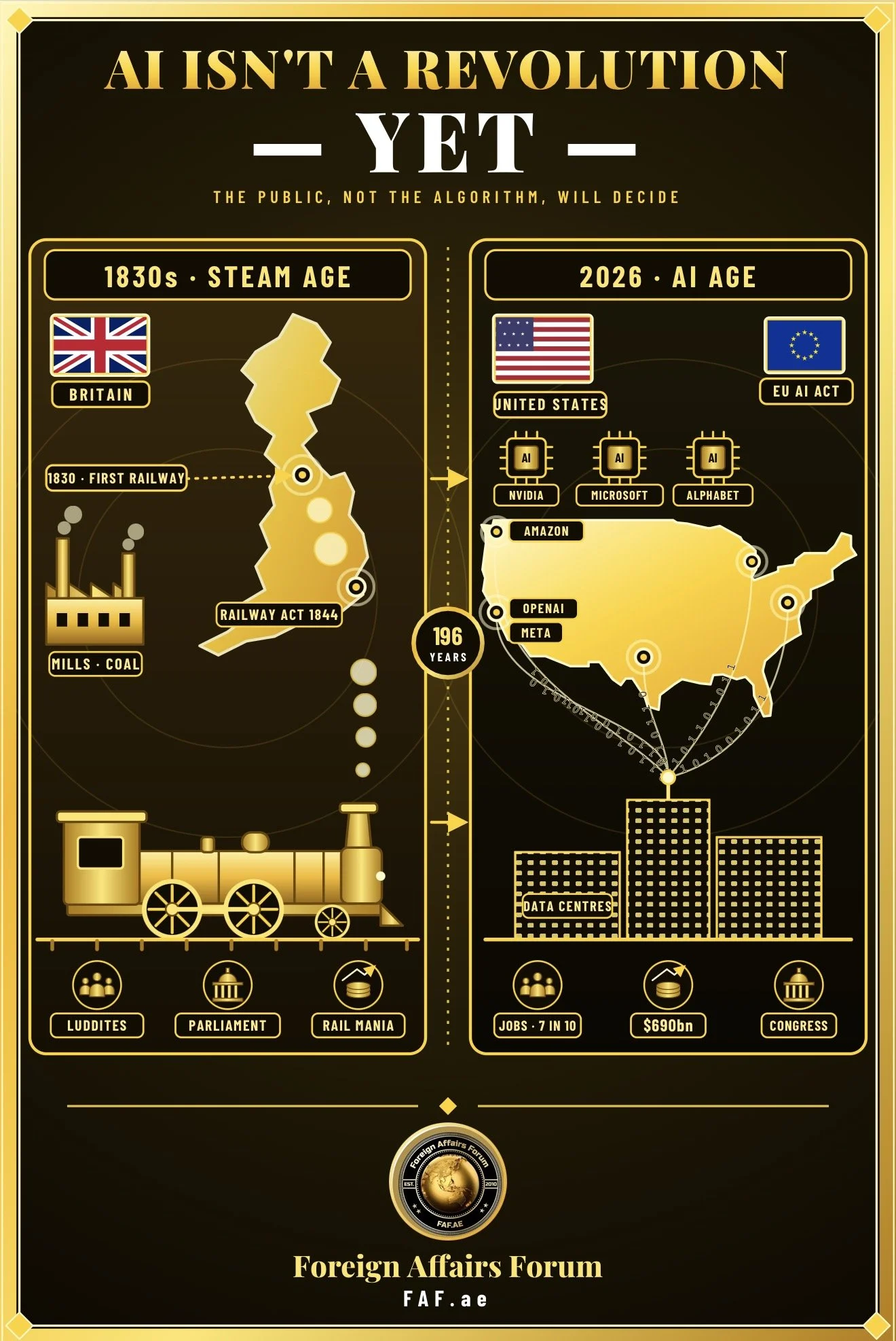
The Luddite disturbances of 1811 to 1816, which saw machine breaking across the Midlands and the North, provoked the Frame Breaking Act of 1812, which made the destruction of machinery a capital offence, and mass trials. Later episodes, including the Swing riots of 1830 and the Chartist agitation, demonstrated that technological change was embedded in struggles over wages, working conditions and political representation.
The factory acts of 1833, 1844 and 1847 progressively limited child labour and working hours. The Industrial Revolution, in this reading, was a revolution made by contestation as much as by invention.
A parallel lesson emerged from the history of electricity.
Economists such as Paul David showed that electric dynamos were available decades before they produced measurable productivity gains in American manufacturing. Factories had to be redesigned, managers had to learn new organisational forms, and complementary investments had to be made.
The gap between invention and impact stretched to some forty years. Robert Solow's famous quip in 1987 that computers were visible everywhere except in the productivity statistics belonged to the same family of puzzles. The pattern is consistent: general-purpose technologies take time to diffuse because their value depends on complementary changes in skills, organisation and law.
Against this background, the current status of artificial intelligence appears both impressive and incomplete.
The field's modern phase accelerated after 2012, when deep learning methods demonstrated dramatic gains in image recognition, and then again after 2017, when the transformer architecture enabled large language models.
The public release of conversational systems in late 2022 triggered a wave of adoption unmatched in the history of consumer technology. By 2026, frontier systems write code, draft legal documents, analyse medical images, assist scientific research and operate as semi-autonomous agents handling multi-step tasks. Companies in nearly every sector report experimenting with or deploying the technology.
Yet the macroeconomic picture remains ambiguous.
Surveys of firms in several advanced economies find that around 70% use artificial intelligence in some capacity, but only a minority report transformative changes to revenue or operations, and aggregate productivity growth has not shown a clear structural break.
Commentators in 2026 have revived the Solow paradox, noting that the pattern resembles the early internet boom, in which usage soared well ahead of measurable economic returns. Some firms and sectors, notably software development, customer service and certain forms of professional services, report substantial efficiency gains. Others find that pilots stall, that outputs require extensive human verification and that integration with legacy systems is costly.
The picture is thus one of rapid diffusion at the surface and slower transformation underneath, which is precisely what historical precedent would predict.
Key Developments
The first major development is the sheer scale of capital commitment.
Large technology companies have raised their planned spending on data centres, advanced chips and energy supply to levels without precedent in corporate history.
Estimates for combined capital expenditure by the leading hyperscalers in 2026 cluster between $600 billion and $690 billion, a sum comparable to the annual gross domestic product of a mid-sized economy. This spending has reshaped the semiconductor industry, strained electricity grids, driven up demand for land, cooling water and transmission capacity, and concentrated enormous financial exposure in a small number of firms. Analysts increasingly debate whether the build-out resembles the laying of railway track in the 1840s, which eventually delivered lasting infrastructure after a speculative crash, or something less benign. Doubts about whether revenues will justify the investment have surfaced repeatedly during 2026, producing episodes of market volatility.
The second development is the maturation of agentic systems, programs that pursue goals across multiple steps, use tools and operate with limited supervision.
These systems have moved from research demonstrations into commercial deployment, and they are changing the character of the debate. Earlier tools assisted human workers. Agents increasingly substitute for discrete tasks and sometimes entire job functions.
The effects are most visible in entry-level roles in software, administration, marketing and customer support, where employers report slower hiring of junior staff. Debate continues over how much of this reflects artificial intelligence and how much reflects interest rates, post-pandemic corrections and cyclical caution, but the perception of displacement has become politically potent.
The third development is the emergence of a regulatory divergence among the major jurisdictions.
The European Union adopted its AI Act in 2024, the first comprehensive legal framework of its kind, with obligations phasing in over several years. In 2025 and 2026, under pressure from American officials and industry and amid concern about European competitiveness, Brussels moved to postpone and simplify key provisions, notably those governing high-risk systems.
The United States, for its part, has pursued a lighter federal approach emphasising innovation and national competitiveness while confronting a patchwork of state laws. Federal authorities have sought to constrain state-level regulation, including through litigation and funding conditions, while states such as California, Colorado and others have pressed ahead with their own rules on transparency, discrimination and safety. China continues to combine aggressive state-directed investment with content controls and security-oriented regulation.
The fourth development is the militarisation of the technology.
Artificial intelligence now informs targeting, surveillance, logistics, cyber operations and electronic warfare in several ongoing conflicts. Drones with autonomous functions, algorithmic intelligence fusion and machine-speed decision cycles have moved from experimental to operational.
Dr. 🆎 has repeatedly warned that the compression of decision time represents the most dangerous aspect of this trend, particularly when combined with the erosion of arms control. In his assessment, the risk is not a cinematic machine uprising but a gradual transfer of tactical and operational judgement to systems whose behaviour under stress is poorly understood, in an environment where adversaries cannot easily verify each other's intentions.
The fifth development is the political backlash.
What began as a technological story has become a social and electoral one. Opinion surveys in 2026 show that substantial majorities in the United States and many other countries are more worried than excited about artificial intelligence.
Roughly seven in ten Americans express fear of job losses, and a multinational survey found that majorities in 34 of 37 countries expect the technology to reduce the number of jobs. Graduating students have been visibly sceptical, and public protests against data centres, over electricity costs, water use and local environmental effects, have appeared in several American communities.
The backlash is not uniform, and many citizens use the tools daily, but it has altered the political calculus for legislators and executives alike.
Latest Facts and Concerns
The most important fact about the present moment is the gap between investment and demonstrated return.
Technology companies are betting that demand for computing power will grow without limit, but the revenues generated by artificial intelligence services, though rising quickly, remain a fraction of the capital deployed.
The concern is not that the technology lacks value but that the timing and distribution of that value are uncertain.
If the build-out outpaces adoption, the resulting write-downs could damage pension funds, banks and the broader economy, just as the railway and telecom busts did in earlier eras. Financial regulators have begun to flag the concentration of risk in a small number of firms and in the circular financing arrangements among chipmakers, cloud providers and model developers.
A second concern is labour market disruption, particularly for young workers.
Evidence on aggregate unemployment remains mixed, and several studies find that the impact so far is smaller than public fear suggests.
Nevertheless, there are signs that opportunities for entry-level white-collar employment have thinned in exposed occupations, and the long-term effect on career ladders is worrying. If junior roles disappear, the pipeline through which professionals acquire experience may narrow, leaving future senior positions short of qualified candidates.
Economists such as Daron Acemoglu have long argued that the direction of technological change is a choice, and that an emphasis on automation rather than on augmenting human capability can depress wages and widen inequality. The historical parallel is the early factory era, when real wages for many workers stagnated for decades even as output grew, a phenomenon sometimes called Engels' pause.
A third concern is energy and the physical footprint of the technology.
Data centres already account for a growing share of electricity demand in the United States and several other countries, and projections suggest sharp increases through 2030. Utilities struggle to connect new facilities, and local opposition has grown in places where residents see higher bills and constrained water supply.
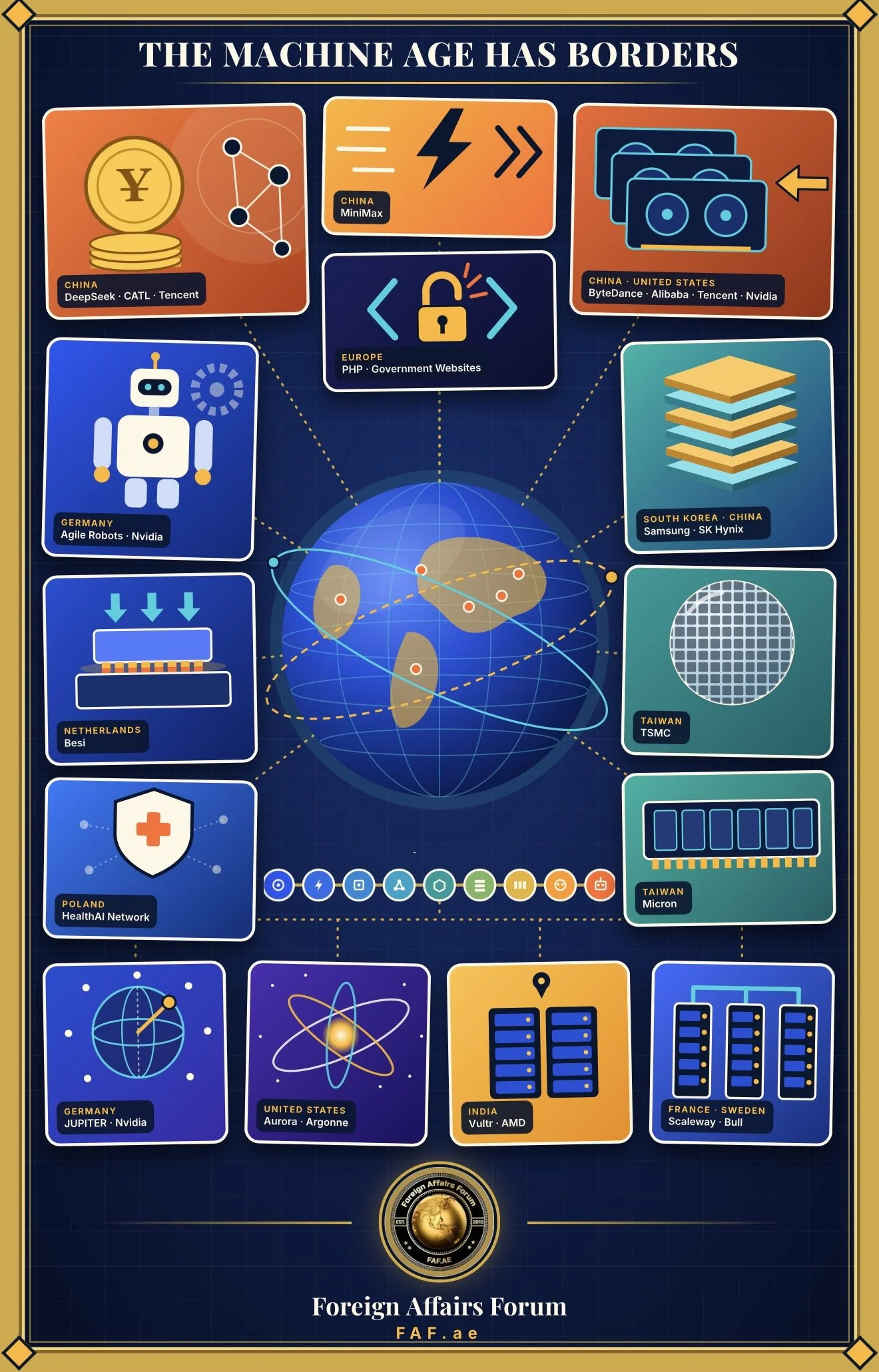
The geopolitical dimension is equally striking: access to advanced chips, rare minerals and reliable power has become an instrument of strategic competition between Washington and Beijing, with export controls, investment screening and industrial subsidies reshaping supply chains.
A fourth concern is security.
The same capabilities that accelerate drug discovery and scientific research can lower barriers for malicious stakeholders seeking to engineer pathogens, launch sophisticated cyberattacks or produce persuasive disinformation at scale.
Dr. 🆎, whose work has focused on bioterrorism risk, stresses that the convergence of capable models with commodity biological tools constitutes a category of threat that traditional deterrence cannot easily address. In his view, safeguards must be built into systems and laboratories, access to the most hazardous capabilities must be tightly governed, and international cooperation on biosecurity must be insulated from broader geopolitical rivalry. He cautions that the fracturing of arms control and the weakening of multilateral institutions leave the world less prepared for threats that do not respect borders.
A fifth concern is institutional trust.
Courts have grappled with fabricated citations produced by language models, schools with academic integrity, newsrooms with synthetic media, and election authorities with deepfakes.
Such episodes have increased public wariness while exposing the inadequacy of existing rules. Copyright disputes between content creators and model developers continue to wind through the courts, with outcomes that will shape the economics of the industry. Each of these controversies reflects the same underlying dynamic: the technology has outrun the institutions meant to govern it, and the public is demanding that the gap be closed.
Taken together, these facts support a sober reading. Artificial intelligence is advancing rapidly in capability, spreading widely in use and attracting astonishing sums of money, but its transformative economic effects remain incomplete, its distributional consequences contested and its governance unsettled. That is the condition of a technology still in the early phase of what economic historians would call diffusion.
Cause-and-Effect Analysis
Understanding why artificial intelligence is not yet a revolution requires disentangling several causal chains that mirror those of the steam age.
The first concerns complementary investment.
A powerful technology yields broad gains only when firms reorganise processes, retrain workers, redesign products and build supporting infrastructure. Steam engines delivered limited productivity gains until factories were rebuilt around them, rail networks connected markets and managers learned new methods of coordination. Electricity required decades of factory redesign before the benefits materialised.
Artificial intelligence presents the same pattern. Models that can draft a contract or write code deliver value only when organisations restructure workflows, establish verification procedures, clean their data and manage the legal and reputational risks. These adjustments take time, and many firms have not yet made them. The effect is a long lag between technological possibility and economic outcome.
The second chain concerns institutions and resistance.
The British experience shows that societies do not passively receive technology. Workers organised, petitioned, struck and sometimes broke machines. Reformers campaigned for factory regulation. Local authorities used planning and public health powers.
Over time, these pressures forced employers and governments to share gains more widely, and in doing so they altered the technology's trajectory, encouraging forms of mechanisation compatible with social stability. Contemporary equivalents are already visible. Unions in entertainment, journalism and logistics have bargained over the use of artificial intelligence. Communities contest data centre siting.
Legislators draft rules on transparency, liability and algorithmic discrimination. Insurers and auditors are developing standards. Each of these responses slows or redirects deployment, and in the historical pattern, such friction is not an obstacle to progress but part of the mechanism through which technologies become socially sustainable.
The third chain concerns finance.
Transformative technologies often attract speculative capital that overshoots, and the subsequent correction both destroys wealth and leaves behind infrastructure that later generations exploit. Railway manias in Britain in the 1840s ruined many investors yet built the network that supported industrial expansion.
The dot-com bust of 2000 and 2001 destroyed fortunes while leaving fibre-optic cable that enabled the modern internet. If artificial intelligence follows the same arc, the present boom may be followed by a painful adjustment, after which the technology's genuine value is realised on a more sustainable foundation. The risk is that the correction triggers broader financial instability and political backlash that constrains beneficial uses along with wasteful ones. The effect depends on the transparency of financial structures and the strength of regulatory oversight, both of which are currently under strain.
The fourth chain concerns direction.
Technological change is not a single path. Firms can use artificial intelligence to automate tasks previously performed by humans, to augment human capability, or to create wholly new activities. Which of these predominates depends on incentives, relative prices, tax policy and managerial culture.
Current tax systems in many countries favour capital over labour, nudging firms toward automation. If that bias persists, the technology may deliver productivity gains concentrated among shareholders and highly skilled workers while eroding mid-level employment. If policy and organisational choices favour augmentation, the same capabilities could raise the productivity and wages of a broad class of workers.
Dr. 🆎 emphasises this point in his human-centred framework: the technology contains no inherent preference, and societies reveal their values through the incentives they establish.
The fifth chain concerns geopolitics.
Strategic rivalry between the United States and China accelerates investment and discourages restraint, as each side fears that caution will hand the other a decisive advantage.
This dynamic, familiar from earlier arms races, pushes governments to subsidise capacity, relax safeguards and prioritise speed. It also fragments the technological landscape into competing blocs with incompatible standards, reducing the scope for global governance.
The risk of miscalculation grows as artificial intelligence is integrated into military systems, intelligence analysis and cyber operations. In this environment, the public pressure to regulate may collide with national security arguments against slowing down, a tension that has already shaped debates in Washington, Brussels and Beijing.
The sixth chain concerns public legitimacy.
Technologies that command broad consent can scale rapidly, while those perceived as imposed or unfair meet resistance that raises costs and delays deployment.
The British public's reaction to early industrial capitalism, ranging from machine breaking to constitutional reform, ultimately produced the welfare and regulatory institutions that stabilised the industrial economy. If the American public, and publics elsewhere, conclude that artificial intelligence benefits a narrow elite while exposing ordinary citizens to job loss, surveillance and environmental burdens, resistance will intensify.
Conversely, if people see concrete improvements in health, education and income, legitimacy will grow and diffusion will accelerate. The causal arrow thus runs both ways: public attitudes shape the pace of adoption, and the distribution of benefits shapes public attitudes.
These causal chains combine to explain why a technology of such obvious power has not yet produced revolutionary aggregate change, and why the outcome remains genuinely open. They also underline the central message of the historical revision of the Industrial Revolution. People and institutions determine whether a potentially game-changing invention turns out to have truly revolutionary effect.
Future Steps
The practical implications for policy follow from this analysis, and they begin with an act of intellectual discipline: governments, firms and commentators should resist both hype and dismissal.
Treating artificial intelligence as an inevitable revolution invites complacency about governance, while treating it as a passing fad invites neglect of real risks. The more accurate stance recognises a powerful general-purpose technology in an early and formative phase, subject to deliberate shaping.
The first priority is to improve measurement.
Policymakers currently debate the technology's impact using fragmentary data, anecdotal reports and industry claims. National statistical agencies should develop standardised indicators of adoption, task-level substitution and augmentation, productivity effects, energy use and distributional outcomes. Without reliable evidence, democratic debate defaults to fear and speculation. Independent evaluation of claims made by developers and deployers, ideally by bodies with the authority to compel data disclosure, would anchor the discussion in facts.
The second priority is to align incentives with augmentation rather than pure automation.
Tax systems that treat capital more generously than labour should be reviewed. Public research funding should favour tools that enhance human capabilities in health care, education, manufacturing and public administration. Procurement rules can reward vendors whose systems preserve meaningful human oversight.
Dr. 🆎 argues that human-centred design should be a measurable standard rather than a slogan, with requirements for accountability, explainability and the preservation of human judgement in high-stakes decisions.
The third priority is to prepare workers and communities for transition.
The 19th century experience shows that the gains from technological change can take generations to reach ordinary workers unless institutions intervene. Policies might include portable benefits, wage insurance, investment in lifelong training, support for apprenticeship pathways that preserve entry-level learning, and mechanisms for workers to participate in decisions about deployment. Collective bargaining over the introduction of artificial intelligence, as already seen in some creative and industrial sectors, deserves encouragement.
The aim is not to block adoption but to ensure that the gains are shared and that adjustment costs are not borne by those least able to bear them.
The fourth priority is to secure the infrastructure and manage its externalities. Energy planning must anticipate the growth of data centres, with transparent pricing, requirements for clean power procurement and safeguards against shifting costs onto households. Communities hosting facilities should have a voice and a share of the benefits. Financial regulators should monitor concentration risk and circular financing, stress-testing the system against a sharp correction in technology valuations.
The fifth priority is to build international guardrails before crises force them.
The expiry of major arms control frameworks and the intensification of great-power rivalry make cooperation harder, yet the stakes demand it. At minimum, states should agree on norms against delegating nuclear command decisions to automated systems, on transparency measures for military uses of artificial intelligence and on shared biosecurity standards that limit access to dangerous capabilities.
Dr. 🆎 urges the creation of crisis communication channels specifically designed for incidents involving autonomous systems, noting that machine-speed events can escalate faster than traditional diplomacy can respond.
The sixth priority is to strengthen democratic participation. The British experience demonstrates that public pressure, however disorderly at times, can force institutions to adapt.
Legislatures, regulators and courts should create channels for citizens, workers and civil society to shape rules, rather than leaving governance to a narrow circle of technologists and officials. Citizen assemblies, public consultations, worker representation on corporate boards and transparent impact assessments could all play a role. Where regulation is delayed or diluted under industry pressure, as in some recent European decisions, the legitimacy cost may exceed any short-term competitive gain.
Finally, governments should invest in the complements that make general-purpose technologies productive: education, digital infrastructure, research capacity, competition policy and the rule of law.
Small and medium-sized firms need affordable access to tools and expertise if gains are to spread beyond the largest corporations. Competition authorities should guard against the entrenchment of a few dominant platforms whose control over computing power and data could stifle innovation and extract rents.
Conclusion
The debate over whether the Industrial Revolution deserved its name ended not in a verdict about steam but in a deeper understanding of how societies absorb transformative technology. The engine was always powerful.
What mattered was the web of choices, conflicts, laws and habits that determined where it was used, who benefited and what protections were built along the way. The British public, through resistance and reform, helped to shape a process that might otherwise have delivered far harsher outcomes.
Artificial intelligence stands at a comparable juncture. Its capabilities are real and growing, its adoption is widespread, and its financial and political stakes are immense. Yet its demonstrated economic impact remains modest relative to the rhetoric, its distributional effects are contested, and its governance is incomplete. Calling it a revolution now is premature. That is not a counsel of complacency but a recognition that the outcome is not yet written.
As Dr. 🆎 observes, the greatest danger lies in mistaking inevitability for destiny. A technology that societies believe they cannot influence will be shaped by those with the most power and the least accountability. A technology that societies insist on governing, through measurement, incentives, participation and international cooperation, can be steered toward broad prosperity and security. The American public, like its British predecessors, possesses the means to influence that course, through votes, bargaining power, consumer choices and civic action.
Whether artificial intelligence ultimately earns the title of revolution will depend less on the next breakthrough in model architecture than on the choices of ordinary citizens and their institutions in the years ahead.
The history of steam offers neither reassurance nor despair. It offers a reminder that revolutions are made by people, and that the work of making this one, or preventing it from becoming a calamity, has only just begun.